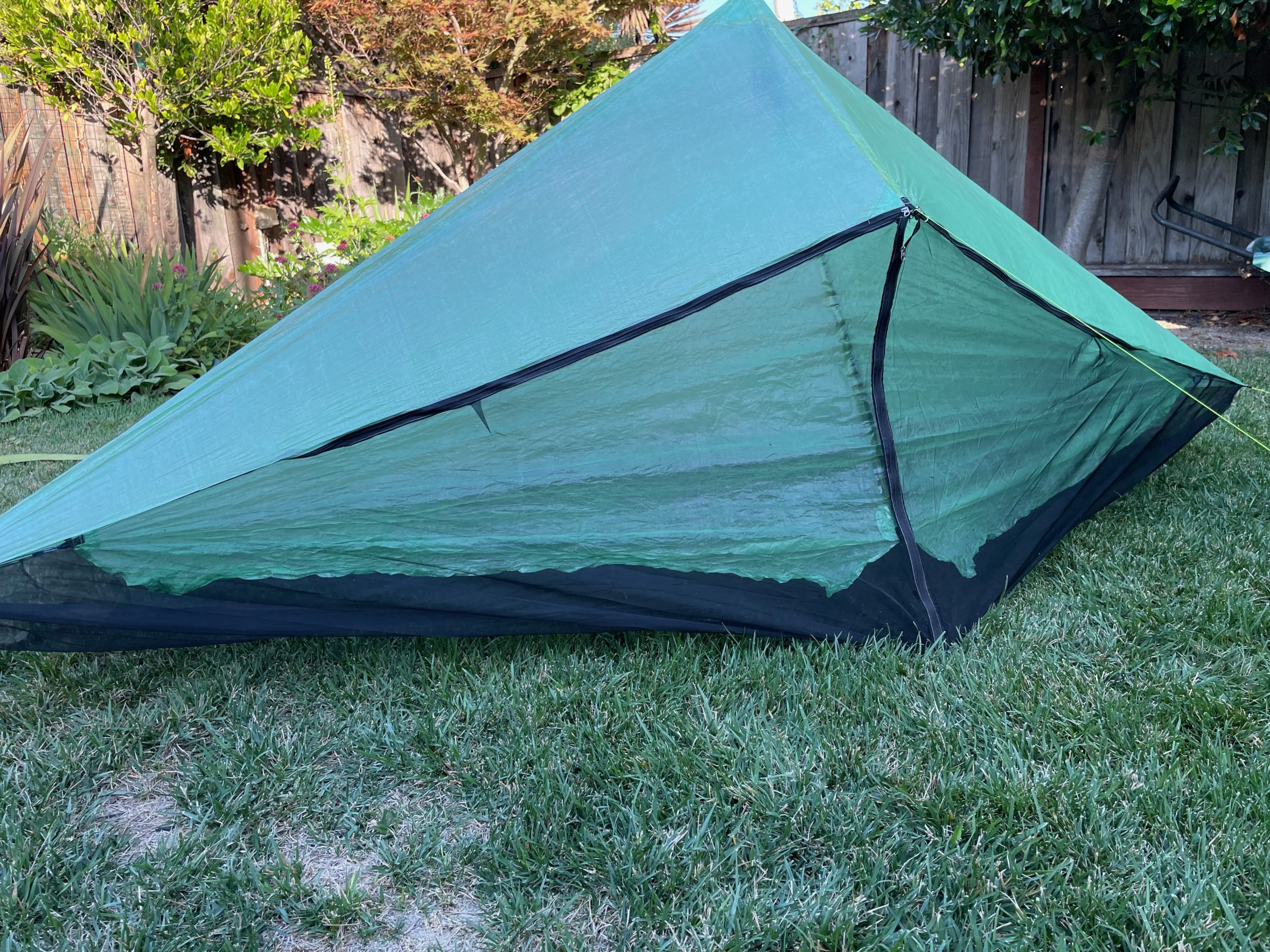
Tag: shelters

  • Tarp-tents and Other Ultralight Shelters

    Today  there is a wide range of ultralight shelters including traditionally designed tents using exotic materials to move them into the ultralight weight classification. Many of the ultralight shelter designs came from people’s experiences on long thru hikes combined with a desire to find the lightest possible shelter while still providing adequate protection. I think the sweet-spot value sweet spot are single wall tarptents made from SilPoly. You can save weight by upgrading to a shelter made from DCF. A big advantage of SilPoly and DCF over the classic SilNylon is the lack of stretch so you don’t have to constantly re-tighten the shelter to maintain a taut pitch. These single wall shelters are extremely light weight, and when well designed can handle severe weather, and provides a bug free space which enables me (and I expect others) to have a more restful night. There are a number of other types of shelters, one of which might be better for you. See fitmytent.com to see how interior space of different shelters compare to each other.

    My Choice

    I use a Durston x-mid pro2 which is light enough for solo use and large enough for trips with my wife or a friend. Stable enough for 3+ seasons, can be opened up for decent ventilation in warmer weather, and easy to pitch if you use a few tricks. I now also have a Gossamer Gear Whisper shelter for solo trips when I want to minimize my load.

    Quick Recommendations

    I can’t recommend one shelter as being the “best”. Giving equal weighting to the weight, usable size (See Andrew’s article about calculation usable space and the related space spreadsheet), small footprint, ease / speed of pitch, bug protection, survive high winds, rain protection, and ventilation, there is no clear winner. Add price and the field flattens even more. Depending on how you weight these issues will result in a different shelter being “the best”. Here are my favorite:

    • Durston X-Mid2 Pro 20oz, $639, A two person, hiking pole shelter. Plenty of room for two. Likely can handle light 4-season weather (not extreme snow), easy to pitch.
    • MLD SoloMid (or DuoMid) XL with inner bug-netting which can be thought of as a “some assembly required” tarp-tent. Doesn’t do anything perfectly, but can handle just about any conditions you might encounter.
    • Six Moon Designs Gatewood Cape $135, 10oz, combined with the Serenity NetTent $125, 12oz provides shelter, rain gear and pack cover in a versatile package. There are better shelters and better rain gear but this is a great system for some people. I find it a tad too small for my taste, but it is workable and beloved by many.
    • Tarptent Notch Li solo 20oz, $599 provides a very usable space which is more storm worthy than ZPacks shelters and feel more roomy that the SoloMid.  Inner tent is small but useable and can be set up after the outer tent is up. A good first look review of the Notch Li. Need room for two? Check out the Stratospire Li.
    • HMG Mid-1 solo 16.8oz, $599. One person pyramid with integrated bug netting and floor. A number of extra tie-outs for want facing more severe weather. Sets up with a single pole.

    Limitations of Tarp-tents

    Tarp-tents are ideal when facing moderate weather conditions combined with a desire for a bug free space. There are shelters that provide more protection, or are lighter weight, but few that will match a tarptent’s overall performance. There are a number of situations that I think there are better shelters:

    • Extreme Conditions.  Most of these shelters don’t handle extreme conditions well.  What’s extreme?  For me, winds consistently above 35 mph, standing water, or real snowfall. A little snow isn’t a problem, but when there is enough to pile up and get blown in to the shelter most ultralight designs just aren’t appropriate with a possible exception of pyramid tarps.
    • People who can’t control their movement and therefore need something to keep them from repeatedly rubbing against the condensations on the shelter walls. This is often a problem with kids.
    • People that can’t be gentle with gear, or who are extremely accident prone… e.g. will fall on top of their shelter several times due to coordination issues or carelessness.

    Managing Condensation

    People are often concerned about condensation in single walled shelters which most ultralight shelters are. My experience is condensation is not a big issue in well designed ultra light shelters which have adequate ventilation and reasonably steep sidewalls. Those made from Dyneema (formally called cuben) seem to have less issues with condensation.

    Pretty much any night that the temperature drops significantly you will get some condensation (in the worse cases a fair bit), but so long as you don’t repeatedly brush against the walls the water won’t be a significant issue. In heavy winds or rains some water will shake off, but most will stay on the walls, or roll down to the edge without falling on you. The worse condensation will be nights were you have cold rain which cools your shelter, but the ground under the shelter is warm so ground moisture condenses on the shelters walls/roof. In the morning you wipe the inside of the shelter down with a bandana or pack towel and you are fine.

    Some people perspire significantly more than others and might find that they will have more condensation that others using the same shelter, in the same conditions. Obviously two people will generate more moisture than one person.

    SMD has a nice article about Getting the Most from your Ultralight tent. BPL’s single wall shelters and condensation has useful information.

    Floors

    Floors in ultra light shelters can be convenient, specially for people new to ultra light shelters or when you really need your shelter to be sealed against bugs or other crawling creatures, but they are rarely adequate if you are facing standing water which can’t be avoid in some locations (like the flat midwest during a thunderstorm). There was a nice posting by Ron Moak about the limitations of ultralight bathtub floors.

    Tarp Systems

    A close relative of the ultralight shelter / tarp tent are flat tarps combined with “netting” tents, and  shaped tarps combined with optional bug netting and/or floors. While these shelters weight more than an similarly size ultralight shelter, they have a couple of advantages. The first is that the bug netting can be pitched separating from the tarp which is great when there are bugs and good weather. Secondly with the floor separate from the canopy it’s easy to replace a damaged floor, you can pack your “dirty floor” separately, and most importantly, it’s easily to manage wet unless there is standing water. When it’s raining hard you can go strait into your shelter and close the door. Sort of like a vestibule, but larger. The excess water can typically be absorbed by the the ground. Finally, most shaped tarps are more storm worthy than most tarp-tents, especially when facing heavy winds.

    Ultralight Solo for the Sierras

    I used the original Zpacks Hexamid for many years. I found it nearly ideal for three season trips in the Sierras. It provide adequate protection from weather, a bug free, for just over 8oz. The only downside for me was the entry was lower than ideal (28″). When I decided to purchase new solo shelter, the Hexamid was no longer made and began to look something like the hexamid. I like the design and taut pitch of the Meadow Physics Abode but the entry was even lower. If I was better at sewing I would made a montmolar shelter. In the end, I purchased a Gossamer Gear Whisper shelter. It’s light, easy access, plenty of room, with protection from flying insects. I like that it has no floor which makes managing in the rain easier than an integrated floor. Other good options are the Zpacks Plex Solo, Durston X-Mid Pro1, and HMG Mid-1. If I didn’t need bug protections I would have go with the OG MLD SoloMid or consider the minimalist Ounce Designs.

    Other Options

    I don’t track the market these days. I would recommend look at BPL Editor’s Recommendations, The Trek’s Best Shelters, or Adventure Allan‘s shelter gear guides.

    Some ultralight shelters I have used, are still made and worth a look:

    • Gossamer Gear The One: 21oz, $299. A single person shelter with plenty of  room for me that’s fairly easy to use. I used the first version for a couple of years. I had troubles getting a really taut pitch. The current model has been updated and I understand pitches better.
    • LightHeart Gear shelters. I wrote up my experiences with a Solo+Awning.   A diamond shaped floor that makes use of two hiking poles. This shelter provides a double walled solo shelter with a lot of room, good views when the fly is pulled back, good insect protection, and decent weather protection.There are some good discussions at lightheart@whiteblaze and lightheart@bpl.  I wouldn’t trust this shelter in high winds, but in places that have some wind protection it would be very nice. This shelter is very similar to the Wanderlust Nomad.
    • Tarptent Double Rainbow (DR): ~32sq ft + 20 sq ft vestibules, 40oz, $299. Very usable shelter for two that weighs less than 2.5lbs. The design keeps netting between you and the sil-nylon which might accumulate condensation virtually eliminated the danger of getting condensation on your sleeping bag. Adequate living space for two 6ft people, though the top is narrower than the floor so you have to be a bit careful not to bump the sides near the top of the shelter. Typically purchased with a bathtub style floor which can be relaxed for better ventilation. There are a pair of high vents which are slightly helpful with the vestibules are closed. The DR can be pitched free starting if you have a pair of long hiking poles or it can be staked down (what I did most of the time). Double vestibules have a fabric extender which lets you turn them into rain porches. If you expect to face strong winds get wind stabilizer anchors added. Can be pitched in under 4 minutes.  The DR, especially if you add extra guy points can survive surprised harsh conditions as described in this thread about Tarptent Double Rainbow in strong winds. I am comfortable using the DR in anything but a real snowfall.
    • Tarptents has a number of other shelters which are attractive and well designed shelters.
    • Six Moon Designs makes a number of ultralight tarp-tents. My favorite is the Skyscape which stands up to wind better than the Lightheart Solo. I found it fairly easy to set up and provides a comfortable living space. On paper Six Moon Designs shelters are nice, but for whatever reason I never used one of their shelters for more than a few trips.  If they bring back the 16oz Dyneema version of the Skyscape, I would be very tempted.
    • Warmlite was the first tunnel tent (1958? – history link) made of light weight Sil-Nylon. IMHO it was decades before there were commercial tents that matched the weight / performance. I haven’t used one of these tents since then early 2000s. They are pricy compared to the above shelters, but some people might fine them useful.

    Historical

    BPL’s Single Wall Tents: State of the Market gives a nice summary of the options in 2008. They also did a Floorless Shelter Review and  Single Wall Tents & Shelters Review in 2004. There are some shelters I thought worth noting which are no longer made.

    • Tarptent Squall: One of the lightest 2-person shelter of it’s day: 23oz for a floorless shelter with flying bug protection, 30oz with a sewn in floor. I found the Squall Classic to be one of the fastest shelters to set up. It had simple but elegant design with beautiful lines. Plenty of room for two people sleeping, but only one can sit up at a time. Later, Gossamer Gear Squall Classic made a spinnaker cloth version. This saved weight, but didn’t pitch as well due to the lack of stretch of the spinnaker material.
    • MSR Missing Link : lots of room for two people in this 37sq ft shelter + a huge overhang. But this weights more than 3lbs (1lb more than most of the other ultra-light shelters). There are some people who have a fondness for this shelter, but I was disappointed in it’s performance in any sort of storm. I never owned this shelter, but have been on several outings where the people with me were using a Missing Link and had problems.
    • Six Moon Designs Europa: A light weight, single walled tent for two people (36oz). This hybrid shelter has most of the advantages of a double walled shelter at the weight of a single walled tent. It is natural for me to compare this shelter to my favorite, the Squall2. Advantages for the Europa are slightly better ventilation, it’s a bit easier to keep dry during a rain storm and it is less likely for you to brush against condensation on the body of the shelter. I found that the Europa is a bit harder to get a good pitch, doesn’t pitch as taut, and therefore isn’t as good in high winds. The Europa has more square footage, but doesn’t have sidewalls that are as steep or as much headroom of the Squall2. There was a nice review comparing the squall2 and six moon designs europa.
    • Wanderlust made a number of light weight shelters that were loved by their owners. Alas, this cottage business got overwhelmed seemed to stop doing business in 2003. If you want a Wanderlust shelter, check out Lightheart Gear which has a very similar design.

    Budget Options

    There are several Chinese companies which makes clones of US based cottage designs such as 3fulgear which are often very affordable through aliexpress. I have no personal experience but see them referenced on /r/ultralight with generally favorable comments.
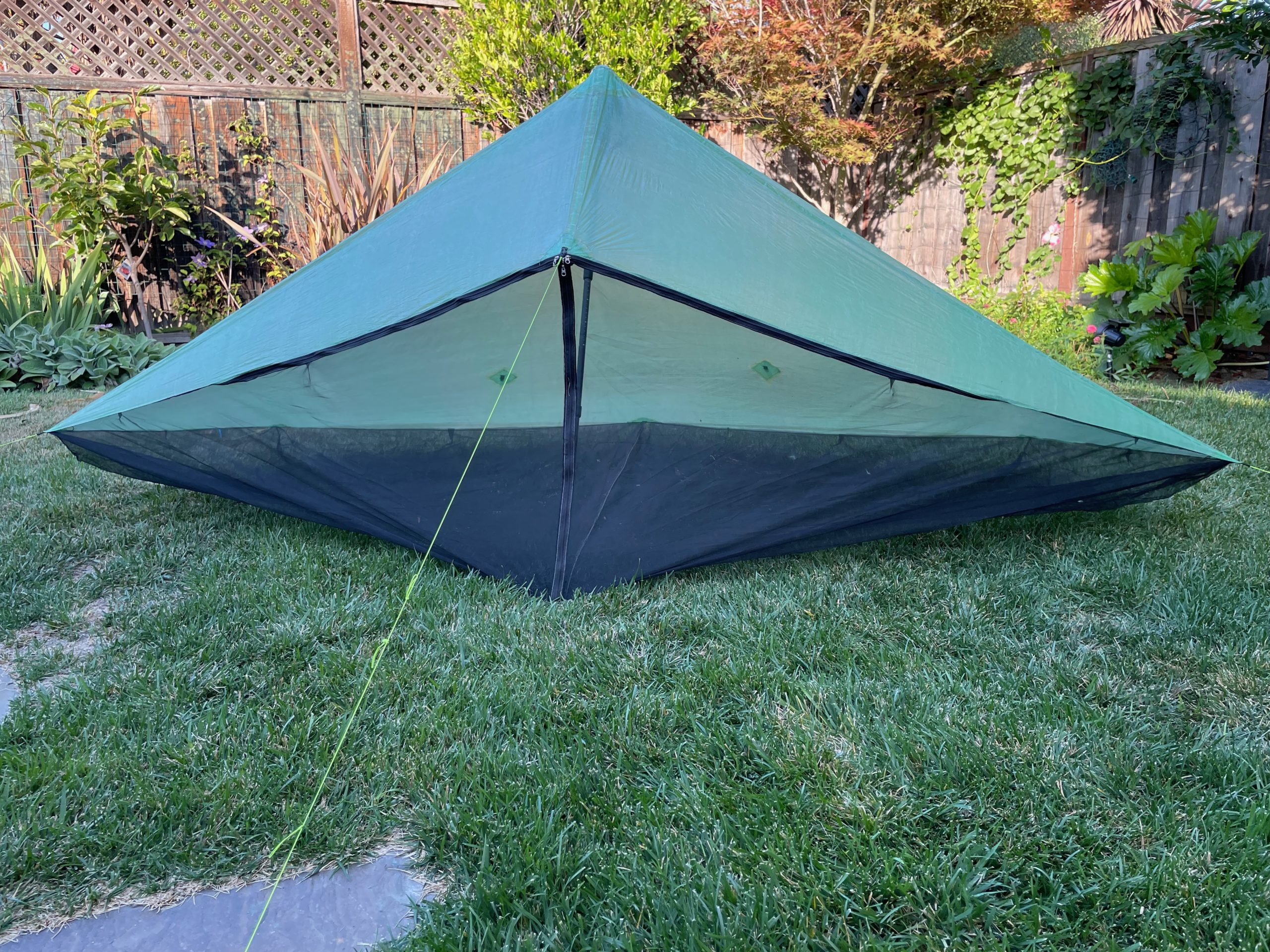
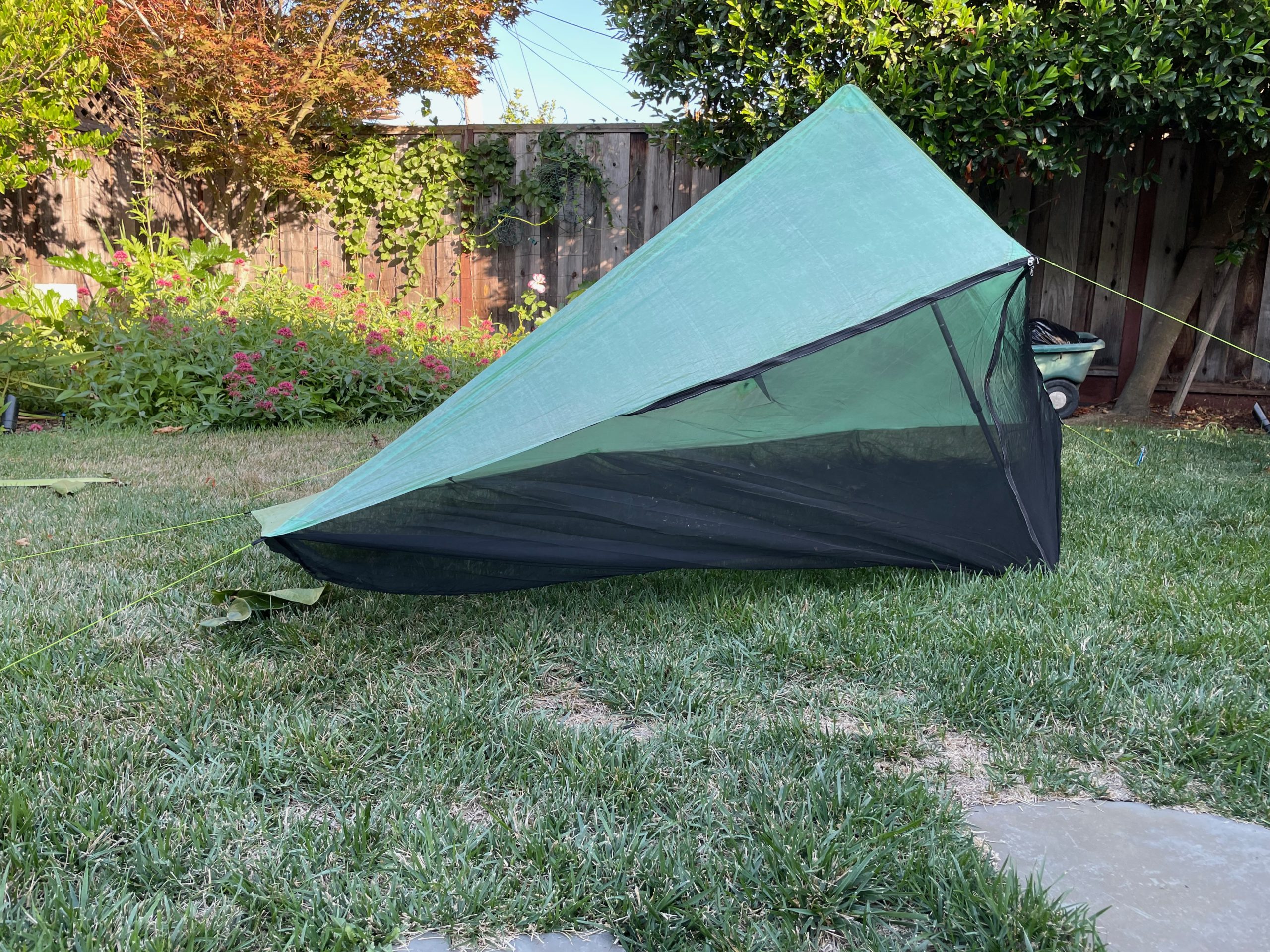
  • ZPacks Hexamid

    Review ItemZPacks Hexamid
    Options: Cuben with Netting
    Manufacture Year: 2010
    Listed weight
    : Cuben shelter, guylines, and bag 8.9oz
    Weight as delivered: tarp+attached guylines 8.3oz
    MSRP: US$259, no longer made

    I have a first generation which uses three zippers that meet at the top peak. Joe has now switched to a single zipper to save weight and reduce the risk of zipper failure. The other major change is that the seams in the current generation Hexamid are primary joined by sewing rather than by taping.

    Summary

    The Hexamid, especially the Cuben + netting model, is an amazing light solo shelter which is fast and easy to set up with a taut pitch. There is adequate of space for one person and gear. While sharing a Hexamid would be possible, I would  only do so under exceptional circumstances because I think the roof slope doesn’t leave adequate space for the person furthest away from the door. Obviously, Joe found that it could work for couple on the second half of his five month CDT hike.

    Things that I liked:

    • Super-light weight
    • Fast, easy setup which results in a taut pitch which has been stable for me in >=35mph winds
    • Good ventilation
    • Plenty of bug free space

    Things I don’t like:

    • Entry is too low (28”) to enter without brushed against the top or crawling on the ground
    • In more extreme conditions not enough protection from side blown rain, though optional doors helps a lot.
    • No line locks.. but this is easily added by user
    • If you experience heavy mud or freezing temperatures the netting can get “stuck” in the ground.

    My total shelter weight is 17.8oz which includes the Hexamid 8.3oz, optional door 1.5oz, 8 stakes, 2oz, MLD SuperLite Bivy 6oz.  This weight doesn’t include 1 GG Lightrek 4 pole 3.9oz. In good weather and low bugs I cowboy camp using the bivy with the Hexamid staying in my pack.

    Description

    The combination of the ZPacks Hexamid product page, and Tony’s pictures from BPL Pt Reyes Trip (starts at picture #17) gives a pretty good feel for the shelter.

    I have a Cuben Hexamid with netting. Since I purchase my Hexamid, Joe has  added an extended beak which would be a good alternative to the door, and is now also selling a separate bug tenting with the tarp. While I might have preferred the extended beak, I still prefer the netting being fully integrated with the tarp rather than separate because it provide more bug free space.

    There is also an optional 1.5oz “door”. In mild conditions I started using the Hexamid with a Gossamer Gear Polycro groundsheet (1.3oz) which I  place inside the shelter on top of the netting. I eventually switched to using a MLD Superlite Bivy with eVENT foot which weights 6oz. I am using the bivy to help keep the foot of my quilt dry (more on this later), to control drafts in colder conditions, and generally keep my quilt contained.

    Field Conditions

    In the first three  years I used the Hexamid in a variety of conditions. From near sea level on the California coast, to 12k ft in the Sierras. I got caught by in a couple of unexpected snow storms. Temperatures have ranged from 15-85F, with a significant number of the nights above dew point which is pretty unusual in my experience. There were a number of nights below dew point so I can talk about condensation. Wind conditions have varied from between completely calm, to clocked at 35mph as the wind was slowing down… I am sure it was quite a bit higher that that at it’s peak. The shelter saw number rain storms, included a three day storm which dropped more than an inch of water in an hour, and a few moderate hail storms.

    Performance

    Overall performance is quite good considering this is a extremely light weight three season shelter. The netting floor is a surprising idea. Placing a ground cloth over the netting does indeed seem to work if you keep the ground cloth away from the edges. The water runs down the netting on the outside of the ground cloth providing good protection. The one issue that needs to be managed is that wind blown rain that can come through the netting and pool on the top of the ground cloth. I would not want to use this shelter in a real rain storm without some sort of supplemental protection, especially if the wind shifted so it was blowing toward the door rather than the back of the Hexamid.  I think could stay dry without supplemental protection when awake, but experience has shown me that I move too much while asleep. I am sure I would wake up with the foot and maybe the head of my quilt soaked if I faced a heavy rain while I slept. Using either a  bivy, the optional door, the optional extended beak, or maybe ground cloth with bathtub side and an elastic strap to keep a bag/quilt inside the ground sheet would have worked.

    Ease of Setup

    This is an easy shelter to pitch. Just follow Joe’s video of setting up the Hexamid. I found that after three attempts I could set up the Hexamid more quickly that Joe does on the video. The only slightly tricky part was getting the pole properly adjusted. The first two times I went to set up the Hexamid I didn’t pull the pole quite forward enough. It’s important for the bottom of the pole to be directly under the front corner of the beak.

    There are three supplements I would recommend. First, as Joe recommends, you need to leave approximately 8 inches of slack between the front two guylines. Rather that having to approximate this each time, tied a knot at that exact point.  This way I pull the shelter tight, and then drive the stake in at the knot location. Second, I often camp places that are extremely rocky which makes placing stakes challenging.  Fixed guylines aren’t ideal. You can retying the staking loop on each trip that needs a varied lengthy, pre-tie a few loops at different lengths, or purchase a set of  mini line locks.  Finally, I would recommend doing a small shock cord loop for the two pullout for the middle of the shelters walls to insure you don’t over tension them.

    Condensation

    For whatever reason, many of my trips stayed above dew point, so most night I didn’t have condensation. I did see a number of nights below dew point, but even then, the condensations seemed lighter that I am used to. It seems like Hexamid is a bit less prone to condensation that other shelters I have used. Is because Cuben is less prone to condensation that Sil Nylon or Spinaker?

    Rain Protection

    A storm was rolling in just as the Hexamid arrived at my home. I set it up with the door facing the direction the wind would be blowing on the theory that this would provide me information about performance in the worst case which can happen if the wind shifts once the shelter is set up. I found the rain protection surprisingly good the first two nights. The first night got some rain, the second night got several hours of hard rain with winds averaging 10mph. While the rain did come through the netting, I found the space from the ridgeline back stay dry. The first night I placed the leading edge of a polycro ground cloth a few inches closer to the door than the top ridge. There was no noticeable moisture accumulation on the ground cloth. The second night the ground cloth was still dry, but the the foot of my quilt did get slightly damp when the wind picked up a bit. The surface dried completely in an hour or so in 50F, 80% humidity so it didn’t get that wet. I expect that if I had deployed the optional door, that the foot of my quilt would have been dry.  The third day we have some wind gusts than were around 15 mph which drove rain through the netting on to the top of the ground cloth near my head which accumulated a small puddle. Neither  me nor my quilt got wet because we were on top of my pad. I believe if the ground cloth’s leading edge was was under the ridge line rather than pushing under the beak that I wouldn’t have had any accumulation on top of the ground cloth.

    I moved the ground cloth so it’s leading edge was at the ridgeline.  The netting that was formerly under the ground cloth as well as the ground underneath was almost completely dry  in a couple of hours. It seems to me that having a netting floor to help manage moisture might work well.  The third night we had some good  gusts. I don’t know wind speed  but I am sure it was more than 20mph and some very hard rain for around 20 minutes. The rain reached slightly beyond the ridge line and got the edge of my quilt wet. I wish I would have deployed the door. The fourth day and night I deployed the door. We have some very hard rain with wind gusts over 30mphs. I had no problem staying dry though I had to be careful with me feet because the Hexamid narrows at the ends. Based on this experience, I would highly recommend the optional door for more severe weather conditions. Note: One of the biggest challenges I had was because I used a quilt which drapes over the side of the pad.

    After 4 days in the rain I shook the Hexamid out and weighed in. It weighted 15.5oz… nearly doubling it’s weight from accumulated water. After hanging two hours in a 55F garage at a 60% humidity the Hexamid was still slightly damp to the touch, weighting 10oz.

    On the next several rainy trips I had issues using a flat ground cloth. I couldn’t seem to find the right placement. Either the ground cloth extended too far so water pooled on top of it, or the ground cloth didn’t extend far enough, and my quilt would end up getting wet because there was no ground cloth between it an the wet ground. This included one of the trips where I did use the door to get more space toward the front of the Hexamid. I think a big part of this is that I use a quilt which I leave spread out in warmer weather to ventilate. If I had consistently used the straps on the quilt or being using a traditional sleeping bag, I think I could have found a placement of the ground cloth which would have worked in all by the worst storms.

    One thing that helped was  making a very shallow “foot pocket” by forming “corners” and slightly raising the side of the polycro with tape. This was helpful because the shape of the Hexamid has the edge of the tarp coming in significantly near the front and back corners. I might be a bit more sensitive to this than some people because my quilt has a very light shell that doesn’t have the best DWR finish. After two years with a number of rainy trips I decided that I was not having fun with my improvised bathtub floor ground sheet. I stayed dry, but keeping my quilt dry was hit or miss. It never got so bad that I was concerned for my safety, but it was troubling.  I considered switching shelters or getting one of the custom ground sheet. In the end I decided to get a DWR bivy because there have been a number of trips using the Hexamid, and using other shelters that a bivy would have been helpful, especially on colder trips when the wind got under my quilt. I now have a MLD Superlite bivy with an eVENT foot and don’t bother with a groundcloth. The bivy also makes it really easy to cowboy camp in good conditions.

    Wind Performance

    There were several trips where the Hexamid faced 15-20mph continuous wind, and >35mph peaks. Hexamid did fine.  When staked firmly, the shelter stayed in place with very modest flapping. In the strong winds there was some flattening of the back wall, but not so much that it caused any problems. There was one trip where winds exceeded 40mph for more than an hour. I only have a few inches of deflection. Several of the light weight tents looked like they lost 1/3 of their volume.

    Bug Protection

    Provided a roomy, bug free space with great ventilation.

    Construction & Durability

    The Hexamid is well construction. All the seams were taped, the sewing was even, I didn’t find any frayed edges. While well constructed, the Hexamid was not up to the class leading constructions of the Cuben shelters from Mountain Laurel Designs. Ron Bell of MLD has noted that he switched to a special tape that was significantly better than the traditional sealing tape. Besides being more UV resistant, the MLD tape doesn’t seem to stick out as much. When the Hexamid arrived, a piece of the tape for the peak had partially separated from the shelter. A bit of pressure and the tape was re-affixes, apparently no worse for the wear. In 2022 this shelter had around ~80 nights of use, many more nights in the pack because I cowboy camp whenever it’s possible. The shelter still looks to be in fine shape.

    I have some concerns about the fabric swatch that you set the tip of the pole into. Joe reports that it did not wear out or get a hole after 5.5 months of use. I am very surprised.  Being a cautious person, I put a rubber cap on my pole tip to protect the fabric. This might not be needed. Joe also pointed out that putting a small hole wouldn’t be a big deal because your ground cloth provides protection from moisture, not the netting floor.

    I do have a small tear in the floor mesh.  The tear wasn’t from the typical source. It’s torn because I grabbed the floor with a gloved hand and thought it was a piece of clothing which was partially stuck under my pad. I jerked hard, heard a rip, and realized that it was the floor, not my shirt.

    Joe has switched from taping the seams to doing a double stitch and letting owner seam seal. Time will tell how this effects durability.

    Sold in 2022 when I thought I was done with solo trips because I am mostly doing trips with my wife, and when it was just me I wouldn’t mind the extra weight / volume of our Durston x-Mid Pro2. Hmm… the might have been a mistake. The Hexamid was still usable but there were some places where the cuben was showing signs of wear I missed suggesting a limited lifetime left.

    Customer Service

    My order was processed quickly, and Joe was able to accommodate a “ship by” date so I could take it on my next scheduled outing.

    Compared To / Other Options

    There are a number of ultralight shelters which might be interesting to someone considering the Hexamid. Additionally, some people will find the combination of a tarp and either a bivy or nest (net tent) effective. The shelters I think are more closely related to the Hexamid with bug netting are listed below.

    Gossamer Gear Whisper: Whisper is a palace with super easy entry and exit compared to the Hexamid. Whisper has perimeter bug netting which you combine with a ground cloth. I like being able to pack the groundcloth separately and to be able to replace it when it wears out. Requires two poles. This is the shelter I am now using on solo trips. So far all the trips have had gentle weather so can’t report of it’s performance in storms.

    HMG Mid-1. One person pyramid with integrated bug netting and floor. A number of extra tie-outs for want facing more severe weather. 16.8oz. If I didn’t have the Whisper, this is the most likely shelter I would purchase for my use cases. I found entry / exit easy, not phased by some minor storms (haven’t see in serious storm), strait forward pitch.

    ZPacks Plex Solo Lite. I think of this as a refined version of the hexamid. Slightly taller (36″ entry), floor, integrated bug netting. Similar pitch characteristics.

    MLD SoloMid or MLD DuoMid + MLD Mid Inner Tent. More versatile and much better in harsh weather with more room inside the tarp at nearly twice the weight and expense. The solo innernet provides a smaller space than the inside of the Hexamid. I don’t have experience with the duo innernet, but expect that it would feel more roomy than the Hexamid sleeping on the diagonal. If I still did winter trips this would be on my short list of shelters to replace my Hexamid.

    Tarptent Aeon-Li provides a more livable and storm worthy shelter than my original Hexamid with a smaller pitching footprint and a bathtub floor which removes the need for using a bivy… but means cowboy camping is out. Downside is that the stays would require me to pack it vertically in my pack.

    Meadow Physics Abode is a streamlined Hexamid with perimeter netting (you do your own floor). It pitches a bit tauted than the Hexamid so should be good in the same conditions I used the Hexamid. Love the simplicity and the lack of a zipper means that it’s lighter with nothing to fail… but it also means the entry is just 18″… too low for my taste.

    SMD Deschutes Plus: Updated Wild Oasis. Slightly cheaper than the sil-nylon, netting version ofthe Hexamid. Not as bugproof as the Hexamid since a groundcloth is laid over the netting without being fully sealed. I borrowed the Wild Oasis from a friend and only used it two nights. The Wild Oasis is a bit more temperamental to set up than the Hexamid, and I found it felt a bit cramped. No personal experience with the Deschutes.

    SMD Gatewood Cape + Serenity NetTent. Provides rain gear/pack cover in addition to shelter. The NetTent has less space than the Hexamid. The Gatewood Cape/NetTent has an advantage that you can use the items separately. The combination of Gatewood Cape and NetTent was more expensive and heavier than the Hexamid when I purchased it, but I believe is a reasonably good deal now. I tried using the Gatewood Cape. I found it a bit unwieldy as rain gear and a bit small for my taste as a shelter.

    LightHeart Shelter (my review of a prototype): Twice the weight and more expensive buys you a larger living area in a true double walled shelter which can give you almost 360 visibility on the nights you don’t need the fly extended. There is also an option with an awning which would be a real plus when facing extended rain.  I had some issues with this shelter being blown down in heavy winds. Attaching the spreader bar to the tent fabric should prevent some of the issues I saw.

    Other Reviews

    Bushwalker Hexamid Review which goes into even more depth than my review about manage in wet conditions

    My recommended shelters for general information and other options.

  • Shelters

    Shelter selection should be based on how much room you need and the conditions you expect to encounter (rain, snow, wind, bugs, blistering heat, etc). For example, if you only camp in mild weather it would be silly to buy a mountaineering tent designed for expeditions since it will be more expensive, heavier, and not be as well ventilated as a shelter designed for three-season use. If you are camping in the Canadian lake district in June, taking a tarp without any bug protection would be stupid. If you are above tree line in the winter, it would be suicidal not to take a four season shelter designed to handle high winds and snow load. A corollary is that there isn’t one shelter which is perfect for all conditions… so if you adventure out in all seasons you might want to think about owning at least two different shelters.  The issues I consider when looking at a shelter are:

    • appropriate protection in view of the conditions expected
      • ability to handle snow loads (sidewall angle / material)
      • blocking spin-drift (solid walls, if not snow skirt)
      • ventilation (summer want a lot, winter I don’t want ventilation other than high vent)
      • if double walled can outer wall be set up first
      • bug protection
    • user friendly / low hassle
      • ease of a basic pitch
      • ease of a storm worthy pitch
      • ease of entry (I like side rather than front entry)
      • need to tighten at night? (DCF, spinnaker set and done, SilNylon stretches)
      • how careful do you need to be when moving (e.g. single or double walled)
    • how much visibility of your environment
    • usable space (sloping sidewalls can limit this) given number of people. See Andrew’s article about calculation usable space and the related space spreadsheet and the nice visualization at fitmytent.com
    • footprint size (smaller for more usable space good)
    • weight
    • how it looks (I like clean lines)
    • lifetime (a discussion about the lifespan of DCF)
    • cost

    The weighting of these factors varies person to person. In fact, my weighting of these factors depends on where I am going to use the shelter. I have noticed that some people tend to gravitate to shelters that are as open as possible. They want to be as fully connected to their environment as possible. I often see these people using flat tarps. Other people want their shelter to be enclosing and protective. Walls and floors are important. While I have used a flat tarp and cowboy camped, I find that I often like some sense of boundaries, especially on solo trips. I know that I could easily live without my “walls”, they can give me a psychological comfort that makes the trip more enjoyable.

    Quick Recommendations

    I am often asked to recommend a free-standing, two man, three season shelter with two doors.  The Durston Design X-Dome 2 is I think best option today. Just 2.7lbs, the space is very usable, easy to pitch, and remarkably weather resistant (especially if you use trekking poles for extra support). The Slingfin Portal-2 is another excellent 2 person which can easily handle 3+ season conditions. For light weight, free standard, 4 seasons, the Slingfin Crossbow 2. Big Agnes Copper Spur 2 Platinum and MSR Hubba Hubba are a bit heavier, not as protective in storms, but can be found in bring-and-mortar stores. A good “budget” tent is the $199 REI Trailmade-2. If the free-standing requirement is removed I strongly recommend selecting one of the better ultralight tarp-tent shelters. My first recommendation would be the Dan Durston’s X-Mid 2P is a versatile shelter is valued priced at $289. Want a do everything shelter that can be used in all four seasons, can be used by two but light enough for solo use? Check  out the MLD DuoMid XL plus their inner-net.

    My Choice of Shelters

    I have used tarps and tarptents on the majority of my trips for the last 20 years. Since 2022 I have used a Durston x-mid pro2 for most of my trips: it is light enough for solo use and large enough for trips with my wife or a friend. Stable enough for 3+ seasons, can be opened up for decent ventilation in warmer weather, and easy to pitch if you use a few tricks. Very livable space. For many years I used the predecessor of ZPacks Plex Solo which was called the Hexamid (my review) for 3-season solo trips in California. I recently started using a Gossamer Gear Whisper for solo trips in similar conditions.

    Options

    Cheap

    Nothing can beat the price / performance of a sil-poly flat tarp. For completely cheap use a 3 mil plastic sheet. Set a line up which will be the ridgeline. Tie some guylines to the four corners using a sheet bend knot, and stake the corners out. If you want a double wall tent, look for a closeout of a better brand such as Sierra Designs, MSR, or REI at places like Sierra Trading Post. I generally don’t recommend buying used tents unless you know it was well cared for and it is in good shape. Waterproof coating can degraded, fabric can weaken due to extended exposure to UV, and improper care can result in mildew and the PU coating disintegrated due to hydrolyzing.

    Classic Scouting / Club Tents

    There are a few manufacturers who seem to have captured a significant portion of the “club” market. By this I mean organizations which have a stock of gear which is loaned, or rented at low cost by their members. Clubs typically look for low cost options which can stand up to people who don’t treat the gear carefully. The two largest supplier to clubs seem to be:

    • Alps: I have no personal experience with Alps, but have a number friends who have used them.  Alps seems to be commonly used by the boy scouts and budget conscience folks. They seem to be better made than wal*mart / target / etc specials. They are not as light or as well made as many higher end tends made by companies like Sierra Designs. You should never pay suggested retail price for Alps tents. A bit of careful looking should lead you to prices around 60% of MSRP which makes it a good price / quality ratio.  Full price is cheap, but not a good value.
    • Eureka!: In the 70s, 80s, and maybe later, the Timberline was “the” standard tent used by many boy scouts troops, YMCA outdoor programs, etc for backpacking. They weren’t the lightest free standing tents, but they were value priced and fairly durable. I still have fond memories of timberline tents even though there were better shelters, even then. I have been much less impressed with Eureka’s dome tents, having seen a number fail in strong winds.

    Other Information

  • Hammocks

    I have tried using hammocks several times and never enjoyed the experience. Furthermore, I am near or above tree line which makes hammocks useless.  I would suggest you check out people who love hammocks such as Sgt Rock’s Hammocks 101.

    In warm weather nothing will keep you as cool as a nice hammock. In moderate weather many people find quilt over them. and a aluminized windshield shades under them work well.  In cooler weather you will need more insulation.  My limited experience is that insulation which is adequate for when I was on the ground down to around 30F kept me almost warm enough at 48F in a hammock. The Gossamer Gear Thinlight Pad (1/4 or 3/8″) looks like a good under insulation layer for cool-moderate weather. I won’t recommend the 1/8″ Thinlight because it’s too easy to hole and isn’t stiff enough to stay in place. In colder weather I would encourage considering using an under quilt. There are a variety of companies that make under-quilts.

  • Bivy

    Bivy’s are minimalist shelters which have a footprint no larger than the person they are protecting. They have the advantage of being very quick to set up and have a very low wind profile.

    Full Protection / Waterproof

    In most cases I would not use a waterproof bivy sack. In mild to hot weather they don’t provide enough ventilation for my taste. In winter, moderate to heavy snow fall will compress any insulation inside the bivy and is likely to produce condensation on the inside of the bivy sack.

    In most situations it’s tricky to get in and out of a bivy without letting rain and snow into them.  Of course, there isn’t room inside a bivy to cook, arrange your gear, or do much of anything expect lay there more maybe read. Stand alone bivys tend to weight around 2 lbs. In really harsh weather I would rather carry an extra pound and get a shelter that gives me room to move and a covered access/exit. In more moderate conditions there might be options that are lighter than a bivy, while providing significantly more room and better air flow.

    Personally, I want to be able to sit up fully, lie down fully extended, prop myself up on my elbows and read, and be able set up a bug free space quickly, throw gear in, dive in, and then deploy my pad, unpack my quilt, maybe change clothing and not have to be a contortionist. Bivies just don’t have this sort of room.

    The only situation I think stand-alone bivy sacks shine is in the high alpine (typically climbing) where you need a very small footprint and something that is as low to the ground to minimize the impact of high winds. Maybe I am missing something, since there are people who use bivy as their primary shelter.  You might want to check out The Book of Bivy by Ronald Turnbull for reasons why to use a bivy and the way to make them effective. There is an interesting article about dealing with dealing with condensation in a bivy. Black Diamond, Rab (owns what was Integral Designs), and Outdoor Research seem to make the best regarded bivys. The minimalist MLD FTK Soul Bivy weighting in at 10oz is the lightest fully waterproof bivy I know.

    DWR Bivy

    The classic DWR bivy is often used in conjunction with a down quilt for protection against side winds, spray, and bugs when using a small tarp. . These are often made with a waterproof sil-nylon bottom, and a DWR top such as the Mountain Laurel Design superlight bivy, and Oware Bivy Bag. The down side is that in warm weather they block cooling breezes and don’t provide a lot of room if you want a space protected from flying insects. I use a MLD Superlight Bivy.

    I have really come to like using a DWR bivy combined with a quilt. I am protected from side drafts like a sleep bag and am able to shift the quilt around to let me vent heat. It makes cowboy camping quit easy. I allows me to be in a small footprint space and keeps my quilt from ending up on the ground. When it gets above 60F I prefer some other system because I want more ventilation / air movement so I don’t over heat.

    Bug Shelters

    There are a wide variety of shelters designed to protect against bugs. The lightest weight options are half length, relying on a sleeping bag to protect the lower legs and having something to hang them from. These typically weight around 3-4 ounces such as the simblissity inner peace bug tent. Next up are small, free standing which typically use fiberglass ribs such as the montbell bug sleeping net, the now discontinued A16 bug bivy, and the full size OR Bug Bivy. The freestanding nature makes it easy to use under a tarp, when sleeping under the stars, or in a shelter. I used 1/2 size bivy for a number of years. Generally they worked well. I found three downsides. The first was when it was hot (>70F) my quilt was too warm, but was required to keep the mosquitos off me. I didn’t like to choose between being eaten alive or overheating. I have numerous nights of poor sleep. Second, a few times I picked a slot which was next to an ant hill… and found way too many of the ant marching across my body. One night I ignored them but the other time they drove me crazy and I moved my camp. Finally, when the mosquitos are really out in force I often want to sit down in a bug free space with room to move and maybe feel a breeze.

    Finally there are larger bug shelters, typically designed to fit under a tarp, but can be used stand alone. Most of these shelters are made by the same companies that set flat tarps and shaped tarps. A slight variety of these are tarps which have netting sewn onto the perimeter. This is what I have tended to use.

  • Tents

    Tents are structures made from fabric that provide an enclosed space which protects the occupants from environment conditions. Historically tents were made from canvas, but now are typically made from nylon or polyester with some some of waterproof treatment. Most tents are double walled, though single walled tents are still in use. There are a number of other types of portable shelters.

    In 2025 my recommendation (mostly from other people whom I trust experiences) for 2 person, free standing backpacking tents would be the The Durston Design X-Dome 2. Just 2.7lbs, the space is very usable, easy to pitch, and remarkably weather resistant (especially if you use trekking poles for extra support). The Slingfin Portal-2 is another excellent 2 person which can easily handle 3+ season conditions. For light weight, free standard, 4 seasons, the Slingfin Crossbow 2. Big Agnes Copper Spur 2 Platinum and MSR Hubba Hubba are a bit heavier, not as protective in storms, but can be found in bring-and-mortar stores. A good “budget” tent is the $199 REI Trailmade-2. Generally I recommend tarp-tent shelters. I don’t recommend the Big Agnes Tiger Wall: Yes, it’s just 2 lbs, but it not up to serious weather, and the space is not that usable.

    The rest of this post is fairly out of date, and I have no plans to update it. You would be better to look at other pages.

    Single-wall Tents

    There are two types of single wall tents. The first is made using waterproof (or water resistant) breathable materials. These are typically free standing shelters designed for mountaineering, and have very similar designs such as those from Bibler, Rab, or Black Diamond. I like these sorts of shelters a lot cold, winter conditions, with low humidity. The second type uses waterproof (non-breathable fabrics) and relies on ventilation to keep condensations down. I have yet to find a shelter like this that I like, I think people would often be better served using an ultralight shelter.

    • Integral Designs MK1lite eVENT: 27 sq ft, 3 lb 6oz, $530. A bombproof single-wall mountaineering tent for one (two in an emergency or if you are friendly). Could be event lighter if you use replacement carbon fiber poles (though there have been questions about whether these will stand up to severe wind… I would recommend sticking with the provided poles). I think this is the best solo winter tent ever made. Alas, it was been discontinued (except for industrial purchase) due to concerns of lawsuits since eVENT isn’t fire resistant. Other good alternatives are the slightly less breathable and heavier Integral Designs Mk1 which uses Tegraltex, the Bibler i-tent made with ToddTex, or the BD Firstlight made from EPIC.
    • Black Diamond Superlight Series including a number of models including the nice two person Lighthouse: EPIC canopy/sil nylon floor adaptation of Bibler designs. A bit more breathable than ToddTex and field reports suggest that it is surprisingly water resistant, but it will wet through in an extended storm. I won’t want to use a EPIC tent in a multi-day rain storm.

    MSR and Nemo are making a number of single walled mountaineering tents I have no personal experience with.

    Conventional Double-Walled Tents

    Most people seem to use double-walled tents. Tents give many people a sense of security by providing privacy and a barrier against wind, rain, insects and other small creatures. Having a double wall means that there is a barrier to protect you from brushing against the condensation which will often form on the fly. Double-walled tents that use fabric for the inner body (rather than mesh) are warmer that other shelters because they air between the inner tent and the fly can act as an insulation layer. The downside is most double-walled tents are heavier, can have ventilation problems when the fly is fully shut, and you lose a visual connection to your environment. Most US designed double wall shelters require the inner tent to be set up, and then the fly to be deployed. In a strong rain, this means you can soak your inner tent. Many of the tents from Europe and Australia have a more sensible design that lets you pitch the full structure at once, or pitch the fly and then sent up the inner tent from the inside. See Roger Caffin’s rather harsh, but generally appropriate, Shelter FAQ. While a true tent taxonomy such as found in The Complete Walker IV divides tents into a large number of categories, I will talk about two, very broad categories.

    Free Standing Tents

    The most common double walled tents are free standing wedge and domes. People like these because they tend to be easy to set up, can be moved around, and work well in locations where getting stakes to hold is difficult. The downsides are that they tend to be heavier, don’t ventilate as well, that most of the time you really need to stake down one of these shelter for strength and to prevent the tent from blowing away even if you have gear in them (e.g. freestanding isn’t really true).  There are a lot of other good quality 2 – 4 man free standing tents. I used to consistently prefer Sierra Designs double wall tents to their competitors. For many years, SD really seems to be one of the most innovative main stream companies, makes good trade-offs, and has nice design features. My family has owned several SD tents since the 1970s. We have love each of these tents. These days I think SD still makes good tents, but I don’t immediately assume they will have the best of class. These days Slingfin seems to be making some interesting tents. Popular light weight free standing shelter that I would suggest looking at include:

    • Big Agnes Fly Creek: Would recommend avoiding unless you like cramped space and only encounter moderate weather.
    • Big Agnes  Copper Spur available at a variety of weights / price points. Usable in moderate three season conditions. Light but somewhat fragile.
    • Slingfin Portal: has gotten some excellent reviews as a light weight 2 person, free-standing shelter which can stand up to 3+ season weather.
    • Big Sky Tents: makes some of the lightest, free standing shelters on the market. I would recommend carefully checking what their backlog is before giving these folks business. In the past people have waited months to get their orders delivered.
    • The MSR Hubba (1 person), HubbaHubba (2 person) One of the most popular light weight free standing shelters. More roomy that the Seedhouse, better vestibules than the SD Lightning. Not quite as stable in the wind as the Lightning. I have only check this tent out in stores, I have no field experience. Friends have reported that extra space costs strength in a storm, especially when facing high winds, but they have been happy with this tent. 
    • REI Quarter Dome (T1T2T3) seem to be good, light weight, 3 season, free standard shelters. My friends original 2 person quarter dome wasn’t as stable or well made as my Lightning, it was cheaper and had two vestibules.

    Tunnel / Arch Tents

    Tunnel shelters typically have 2 or 3 arches that provide support. These tents need to be staked to the ground, but often you can get away with 4 stakes except in harsh conditions.  Tunnel tents tend to be longer than an equivalent dome, and require a fairly flat space to get adequately taut pitch.  A well pitched tunnel tent can survive very harsh conditions. If similar materials are used, a tunnel tent tends to be light weight than a dome. Tunnel tents tend to be designed with good ventilation options. Higher quality tunnels designed to handle nasty conditions tend to use equally sized arches. I would recommend staying away from any tunnel tent which uses fiberglass poles since both the poles and the tent are most likely not built to handle harsh conditions.

    • Hilleberg – Make a variety of tunnel tents. Most are designed to stand up to Northern Europe’s winters. Very well made.
    • Stephenson’s Warmlite 2RSW (2 man 42sq ft, 3lb 4oz, <$500) has been one of the lightest tents on the market for years. Warm, very stable in high winds, and handles snow well provided pitched tautly. The vestibules having a floor was a bit annoying because when you enter and exit in the rain/snow because some gets in and doesn’t have anywhere to go. Should note that while it has two walls, the inner wall is not breathable which makes it different from nearly everyone else’s double wall. My experience is that condensation on the inner wall was less than other non breathable single wall shelters.

    Other Tent Designs

    There are a number of light weight shelters that use a single hoop, or trekking poles to form a ridge line, much like some of the ultra light shelters listed above. In general these shelters are not up to facing extreme weather conditions, but they can provide light weight shelter for 3 season conditions many places (4 in places where winters aren’t too harsh).

    • Hilleberg Akto is quite light for a solo four season tent, and is designed to put the fly up first followed by the tent body which is really nice if you are setting up in the rain. Huge amount of space under the vestibule. The tent is a little short for my taste because I can’t sit up without bumping by head and doesn’t handle heavy snow loads well. On the other hand, everyone I have talked to who owns this tent loves it.
    • Terra Nova.Laserlite is a 1+ person tent similar in design to the Akto but weights a mere 34oz including poles while providing more headroom.
    • Tarptent Scarp1 1 person, 2.75lb and Scarp2 1 person, 3.25lb double walled, winter shelters which is somewhat similar to the Hilleberg Akto. An extra 12oz for a pair of poles makes it free-standing.
    • Montbell single pole tents… pole runs across the long axis rather than the short favored by most of the other monopoles.
  • Winter Shelters

    Actually, this should really be called shelters for extreme conditions with snow since there are many places where “winter” could be handled with a traditional “three season” tent.  When I think “winter shelters” I am thinking something that can survive 50+mph winds, and a foot of snow or more falling overnight.  Things that help make shelter survive in the winter:

    • Strong materials.  Often times mountaineering shelters are made from fabric which is 1.5-2x the thickness and strength of similar shelters designed for three season use. Poles are typically thicker and larger diameter.
    • Supported surface area. Ideally support of the shelters walls is evenly spread, across multiple points so that when the wind is blowing or snow is sticking the room, the pressure is distributed through out the shelter. The larger the area without support, the more likely that the shelter will bow in, and that the pressure will be concentrated on a small area which is more likely to fail. For domes you typically want three poles which cross each other.
    • Steep walls so snow slides off rather than accumulating and weighting down the shelter.
    • Aerodynamic shape so winds don’t knock you down
    • Snow skirt which help keep the shelter stable in wind, and also provide continuous support rather than having the support points being the few places that stakes or snow anchors are attached to a shelter.

    I don’t do a lot of winter / snow trips these days. When I was doing more winter trips I used a MLD Duomid for solo trips, and a GoLite pyramid as my multi-person winter shelter. If I was purchasing a hard-core shelter I would likely look at Hilleberg or Macpac tunnel tent or a large pyramid with a titanium wood stove. There was a good thread on BPL about shelters for winter/snow.

    In the winter / snow I have used  a number of shelters over the years.  In reverse chronological order:

    • MLD Duomid (cuben): 1-2 person pyramid design. Good solo shelter with reinforced pullouts.  Ideal for 1.  Usable but tight for 2.
    • GoLite Hex: Very light for space, especially if you dig out snow. Nice flexibility. Light and cheap compared to most 4-season tents. You can dig out a platform which gives you a huge space. Staking can be a bit temperamental to get set up right. I have used it with a sleeping bag cover and just a ground cloth. In more severe conditions really wished it had snow skirt. Some similar tarps are designed to take a small wood stove like Titanium Goat and Kifaru.  In ancient past shared a large pyramid tarp that did have a snow skirt with a pile of other boys.
    • Integral Designs Mk1 (now made by Rab): Loved it as a solo tent. Reasonable weight. Not cheap. Bombproof. More or less same tent is the Bibler i-tent and the BD Firstlight made using EPIC.
    • Hilleberg Nallo2GT – This tent is not the lightest tent, but has a large vestibule which is handy in nasty weather. Very well made. Popular in Europe.
    • Warmlite 2R – Shed snow well when pitched tight. Good in wind. Middle will sag if not pitched tightly. The 2R is not as tall as I would like if I was going to be spending a lot of time in the tent. The vestibule having a floor was annoying but manageable. They also make tents larger than the 2R. Get a third pole if using size 3.
    • Sierra Designs Stretch Dome… I had the first version. Roomy for 2, usable with three. Mine stood the test of time but was stolen from my car. Not the lightest solution. I continue to be impressed with SD’s commitment to quality and innovation though I haven’t used a modern SD 4-season tent.
    • North Face V24 – Hasn’t been sold for years. Was bombproof and heavy.
    • Sierra Designs 3-Man Tent from the early 1970s… Double walled three person tent which used three strait poles in a tipi like design with a hex floor.  Great size for two in winter, worked for three. Half moon zipper in the floor formed a cookhole for using a stove inside.  Some of my fondest memories are nights I spent in this tent with my dad as storms raged outside.

    I have also used some 3 season tents / tarptents in the winter which worked ok if there was no or small amounts of snow.  When the was enough snow to blow into the shelter through the netting I was unhappy. Anything not protected gets damp.  Those with perimeter netting were a disaster because the netting often frozen into the snow. Not recommended. 

    Whatever you are using a tarp or tent, you need to keep your shelter in place. Typically snow anchors are more effective than stakes for this task. See a nice Snow Anchor Analysis

  • Shelter Fabrics

    Shelters are made from a variety of materials which have a variety of strengths and weaknesses.  One of the important properties of a shelter is being able to keep you dry. Many fabrics, even those that aren’t “waterproof” can keep you drive in moderate conditions. Just think about the materials used in many umbrellas. Storms though can be another story. According to Richard’s post, extreme thunderstorms can generate hydrostatic heads of 12k mm?!, and typhoons can generate 20k mm. Also note that placing weight in a concentrated place (like kneeling) can generate quite a lot of pressure. This is why conventional shelters often had a more waterproof floor than roof.In increasing weight:

    • Dyneema (Cuben): spectra threads embedded between Mylar. Available in 0.36-1.6oz weights. Quite waterproof. Tear strength good (.6) to Excellent (1.6).  Roughly 4x the cost of sil-nylon. Does not stretch when wet.  Not the most abrasive resistant material. Sewing weakens material so best to be taped or glued.
    • Spinnaker: tightly woven polyester which is silicone impregnated. Typically .8-1.1oz weights. Hydrostatic head typically 1400mm (same as sil-nylon). My field experience with spinnaker is that it is better than sil-nylon, and the the spinnaker used by MLD is indeed at least 30% better than any other spinnaker I have encountered.  I have experienced misting through sil-nylon and other companies spinnaker shelters, but I have yet to encourage conditions in the field where rain hits hard enough to mist through MLD spinnaker. In fact, hose with a high speed nozzle didn’t cause misting. Does not stretch when wet.  No abrasive resistant, be careful. Many people find this material noisy when it flaps in the breeze, but I have found that if tautly pitched the noise isn’t an issue.
    • Sil-Nylon: tightly woven nylon which is silicone impregnated. Available in 1.1-2oz weights. High variability is waterproof. Richard suggests that it’s typically 1400mm but heavier weight such as used by GoLite can be close to 3500mm. Will stretch when wet or when the humidity increases so expect to need to retention. Silcone treatment makes the material strong than the nylon left by itself.
    • Sil-Poly: tightly woven polyester which is silicone impregnated. These materials came on the market after a stopped following fabrics closely. Dan Durston explains why he believes Sil-Poly is significantly better than sil-nylon.
    • EPIC: The Black Diamond  Epic tents used the Alpine Summit process fabric. It averages a hydrostatic head of 1,300 mm.
    • Nylon eVENT fabric averages 28,000 mm.
    • Conventional double wall tents typically use 70 denier urethane coated nylon with a 1 oz coating as the fly fabric. It averages a hydrostatic head of 56,275 mm.
  • Selecting Campsites

    PLACEHOLDER

    • Look for someplace with soft ground. Not only is this more comfortable to sleep on, but if it rains, the water will more quickly soak in.
    • Look for someplace that has good drainage: slightly higher than the near by ground, avoid sleeping in depressions.  
    • Make sure you aren’t in the path of runoff if there was a severe storm.
    • By lakes will have more humidity which is normally not a good thing.
    • Under a tree or  on a hill side will typically be warmer than in a valley or the middle of a meadow.
    • Ridge lines are not a good location because of wind and lightning danger.

    Some brief notes by other sectionhikers campsite selection and a thread about selecting sites in the high sierras.

  • Stakes

    Most shelters need something to keep them from blowing away. Most people carry metal or plastic stakes, though it is often possible to improvise using local material. A decent video of the big/little rock anchor is what I often do above treeline. Ultralight backpackers often use titanium stakes because they are strong and reasonably light.

    There is no one best stake.  There are a number of environmental issues which will suggest what might be the most effective stakes. Things I typical consider is the “holding power” of the stake, how easy the stakes will go into the ground, the weight of the stake, and what sort of environmental impact the stake holes might make.

    Holding Power: The looser the ground, the more surface area you need for an equiv hold. If you use two stakes of identical design, the larger on (more surface area) will hold better if you can get it into the ground.  Wide diameter round stakes can work in many conditions, but if you need a lot of holding power, especially in soft ground (sandy, waterlogged, etc), use Y stakes like MSR groundhogs. Some people use V stakes, but I have found that they have a tendency to bent more than most stakes I have tried. In extremely lose soil some people will double stake. At the extreme (sand / snow) you want to use anchors rather than stakes. 

    Easy to Drive: The harder the ground the more you want a strong, thin stake. Many people use titanium sheppard hooks stakes. The one down side of these stakes is that if the ground is very hard, you can’t pound these stakes in, you can only push with your hands. Some people carry one “nail stake” which can be used to get a hole started for a hook stake. Note: Pushing V and Y stakes in can be hard on the hands, so I carry a small plastic PVC tee joint which weights less than .5oz.and saves my palms.

    Durability: The thinner the stake, the more likely it is to bend. Some stakes have been known to break when put under stress, such as the MSR Needle Stakes. The tops of the Easton stakes sometimes comes off. You can epoxy them back on when you get home.

    Weight: If you are shooting for the absolute lightest, titanium stakes might be right for you, but it really depends on the other factors listed above.

    These days I mostly use 6″ easton stakes on 3 season trip because they have pretty good holding power in soft ground because they are wider than my titanium Sheppard’s hooks, and the have a flat head so I can pound them into harder ground with a rock, and they are reasonably light. The only down side is that the epoxy that glues to top to be body can come undone and in extreme cases, they can be broken.  If I am really concerned about holding power (expecting lose soil) I will switch to 9″ easton stakes, or switch to a Y stake.

    Jerry Goller wrote up a more analytical comparision of stakes which I have stashed on my web page and there is a nice article at BPL about tent stake holding power.

    Snow anchors are a good alternative to stakes in the winter or in deep sand.