Tag: gear

objects used for various activities

  • What is Percent of Naked?: Patagonia on Technologies and Testing

    The following was Patagonia’s response to some questions about materials and testing which was posted in 2005 to a public forum.  Most of this article matches my personal experience and still seems valid today.

    Mark Verber

    Innovation, that steamroller of change, has, over the past five years completely redefined the way people dress for the mountains – to the benefit of alpinists, anglers, snowsliders and endurance athletes who can stay out more comfortably and for longer stretches.

    But innovation has also brought confusion to the retail floor: claims and counterclaims abound. How does one make sense of the multitude of marketing messages? 

    The goal of this document is to help clear the fog, to go back to first and basic principles, to concentrate on the customer’s essential question: For the activities I pursue in the conditions I encounter, how do I stay warm and dry?

    That’s Patagonia’s focus when we design. What’s the need? Then, how do we create a product that will meet it?

    Technology and Change: What’s It Good For?

    At Patagonia, technology is secondary: it’s backstory. A means to an end. Only when we come to a full understanding of the performance requirements for a garment do we dive into the details: choosing the elements of the fabric package, but also – and this can get lost in the current discussion – construction, features, fit.

    When technology comes second and performance goals first, “off-the-shelf” fabrics rarely fit the bill. An existing fabric more often than not has some of the performance characteristics we require but lacks others. So we’ll work with the supplier to tweak it: change some element of the construction, or use a different lining or finish. 

    Our more successful concoctions get adopted by the industry as a whole. The shelves and racks of outdoor stores bulge with non-Patagonia products made of fabrics we helped develop over the years: among others, Malden’s Polartec 100, 200, 300, Power Stretch, Thermal Pro, and Recycled Polartec fleece; Dyersburg’s Eco Fleece; Gore’s Activent and Windstopper fabrics; Nextec’s Epic water-repellent finish.

    In any given year, we work as closely as we can with over 80 mills and suppliers. These relationships, built up over 30 years, are important to us. But the customer’s need comes first: Patagonia will always employ the best, most appropriate fabrics (and construction, features, fit) for an intended use. When a better technology comes along, or when we can help create something better, we do.

    Sometimes – as is the case now with shells – the rate of change is dizzying. Our Dimension Jacket, for instance, at the time of its 2001 introduction, was more breathable, more wind- and water-resistant and quicker drying than any competing soft shell on the market. It won industry and customer accolades and sold well. Only two years later, we changed both the fabric and surface treatment – to achieve an 80% increase in breathability and a 20% reduction in weight.

    On the other hand: Capilene®. For the past 18 years we have worked with one supplier to continually improve the performance of our Midweight base layer. And although the 2004 Midweight Crew is in every way better than its 1986 original, the DNA match still looks pretty close. 

    Have we looked at alternatives? Of course. Have we tested all the new underwear fabrics from all suppliers as they’ve come on the market? Yes. Some have great stories behind them, but none pan out to our satisfaction. After 18 years, the only garment that outperforms Midweight Capilene, for some conditions and some uses, is an appropriate Regulator® base layer.

    Capilene technology is not complex, which brings us to a related point. Although we work hard to develop the best possible fabric package for each product, why overbuild? The ice climber, for instance, needs the stretch, high compressibility, low weight, extended DWR performance and breathability that H2No® Stretch HB fabric lends the Stretch Element Jacket. But many of those characteristics are overkill for even the most committed alpine skier or patroller, for whom the Primo Jacket offers more sport-specific features and an excellent, more downhill-appropriate fabric: in this case, Gore® XCR®.

    The Patagonia Lab: What Goes On Behind the Swinging Doors?

    We test ALL emerging fabrics and technologies, whether we’re involved in their development or not. Last year, we conducted 3,796 tests on 836 fabrics in development. Of those, only 56 performed well enough to be adopted. The lab also conducted nearly 15,000 tests on production lots to ensure that adopted fabrics perform to expectations.

    The qualities we test for include breaking strength, abrasion and tear resistance, bonding strength, breathability, zipper strength, compressibility, water repellency, wind resistance, wicking speed, colorfastness and garment durability in wet conditions. 

    Chart 1 lists the tests Patagonia performs on every product designed for mountain layering.
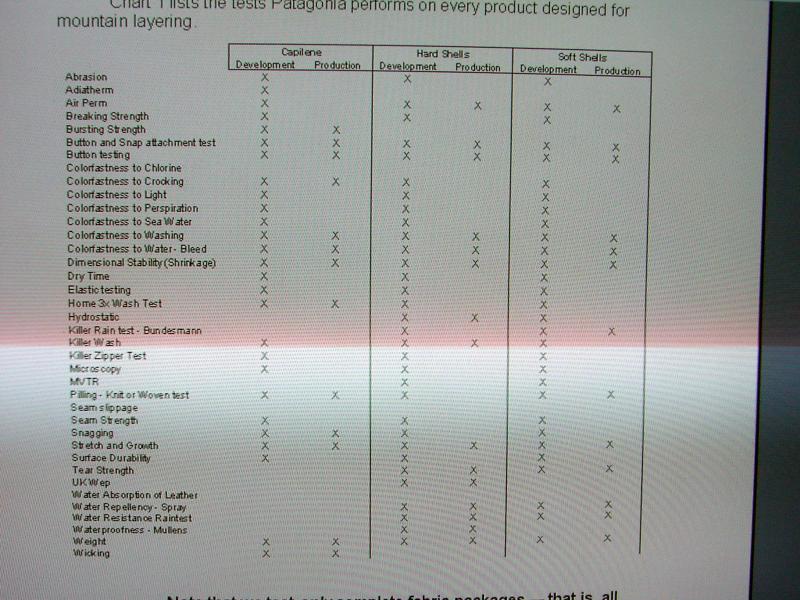
    Note that we test only complete fabric packages – that is, all the fabric components used together in a final garment. It’s useless to test, for instance, a waterproof/breathable barrier without its substrate. The barrier will never be used alone.

    And we test to predict performance in the field, not to generate winning numbers. The tests derive initial, preliminary answers to the important questions: How does one component of a fabric package affect the garment’s overall performance? How will this overall package perform in a range of conditions, and after a full season of use?

    Testing for long-term performance is especially important because many fabrics that ace their exams when new, and would perform beautifully on the sales floor should the roof leak, but deteriorate rapidly in mountain conditions. 
    What are some of the most important tests? What do they signify for end use? We’ll take you through a few of them and, along the way, point out what they can’t tell you.

    What is the PSI Test for waterproofness?

    PSI (pressure expressed in pounds per square inch) is a measure of the strength of a waterproof barrier before water penetrates. A person weighing 165 pounds, for instance, exerts about 16 PSI on the knees, when kneeling. The military standard for waterproofness is 25-PSI, the industry standard – and practice – much higher.

    Patagonia actually performs two tests to check a barrier’s waterproofness: the traditional Mullens Test and, more importantly, the Hydro Test that yields PSI after extended performance. All barrier technologies used by the outdoor industry are better than waterproof when new. And they all degrade with time, and at greatly variable rates. We want long-term performance, not a superhigh off-the-shelf rating that plunges under a bit of rain.

    We have rejected, for precisely this reason, the newer lower-priced 2.5-layer hard shell packages, including those adopted by other manufacturers, in favor of an H2No package that maintains its waterproofness long after others have noticeably deteriorated.

    The H2No 2.5 layer package has a superior surface water repellent; a barrier less prone to contamination from dirt and oil, which can “draw” moisture through a fabric or membrane via capillary action (as well as reduce breathability). In place of standard coating or dots, a slightly raised, internal 3-D matrix provides durable service (as well as better wicking and compressibility).

    How does MVTR indicate breathability?

    Moisture Vapor Transport Rate (MVTR) measures the ability of a fabric to pass moisture from the inside to the outside of breathability in grams per square meter per day. Unfortunately, dozens of test methods are used to measure this: beware of direct comparisons of fabrics tested by different methods.

    Patagonia uses an ASTM protocol known as E96 that allows us to create a pressure differential between the inside and outside of the fabric, one that is reasonably identical to conditions you encounter in the real world (i.e., E96 test results correlate consistently with those of our field testers). It’s the only test that does not introduce artificial factors like excess heat and pressure. E96 also allows us to measure MVTR without regard to air permeability (which we measure separately): this gives us a true measure of a fabric’s inherent ability to move moisture. And we can test two levels of exertion, low and high.

    We’ve developed our own MVTR chamber, one recognized by independent research facilities for its excellence. Our tests are highly repeatable and produce consistent results. 

    How does CFM measure wind resistance?

    Cubic feet per minute per square meter (CFM) is a measure of the wind resistance or air permeability of a fabric. The higher the CFM, the greater the volume of air passing through.

    When hard shells dominated the landscape, discussions about CFM didn’t come up. Traditional barriers like H2NO, Gore, Triple Point, Entrant, and other respectable waterproof breathable technologies all have a 0 CFM rating. They are absolutely windproof.

    With the advent of soft shells and more breathable fabrics, the air permeability argument becomes complicated, sometimes heated. 

    Traditional layering has always taught the “vapor barrier warmth” concept. That is, maintain a (windproof) stable dead air space next to skin and you will stay warmer. That’s true, if you’re watching football game from the stands in November.

    But what happens when you’re pounding uphill to the ridge before someone else sneaks into that untracked line of new powder? You can use a bit of convective heat loss; and you need more breathability to move the extra moisture you create through exertion.

    And a fabric with 0 CFM doesn’t provide it. We’ve found that fabrics that measure as much as 5 CFM are still functionally windproof: that is, you don’t feel the breeze come through. And they afford much greater comfort on the uphill. So we use 1-5 CFM as our standard for weather-protective soft shells (Mixmaster, Dimension, Dragonfly, etc.)

    Shells for higher exertion activities (e.g. Slingshot, Super Guide Pants, Talus Pants) must be even more breathable. For these products we hold to a comfortably wind-resistant, but not windproof, standard of 10-15 CFM.

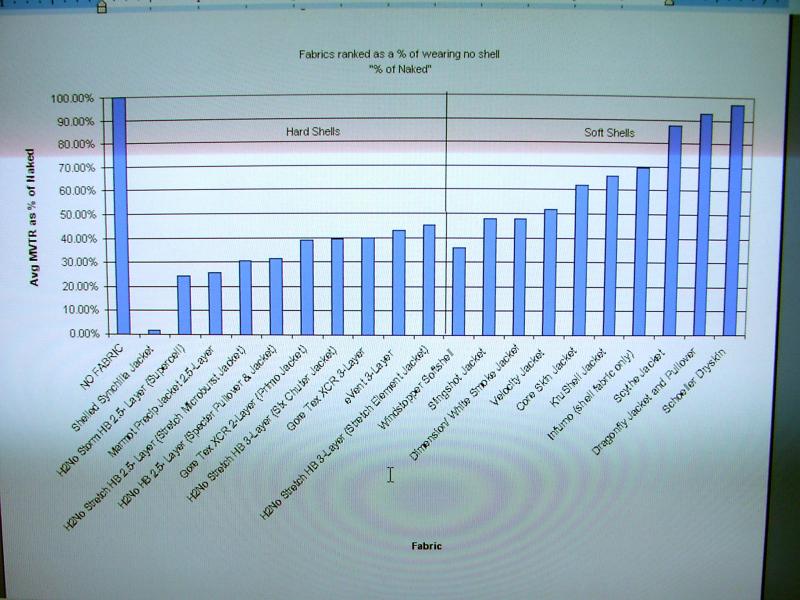
    Beyond this, we don’t go. We don’t produce shell fabrics with a higher CFM (say, 15-20) because our field test shows that further gains in breathability don’t offset the heat loss from wind penetration. (See Schoeller Dryskin on the chart on the next page- offering high breathability, but not enough wind protection) The goal is: both warm and dry.

    At the other end of the scale, as mentioned, we don’t make 0 CFM soft shells. What’s the point of a soft shell that doesn’t breathe better than a hard shell?

    What is Percent of Naked?

    Patagonia has developed an intuitive way of evaluating overall breathability called “Percent of Naked,” in which we directly compare the combined MVTR and CFM data of a fabric to data produced by the same equipment, but without fabric. [Love of the idea of this, but just how do we use equipment with no fabric: sounds more than naked, positively immaterial] This gives us a base line to compare individual fabric performance to the holy grail, the 100% of comfort and breathability: how you feel naked in your living room with the thermostat at 72 degrees.
    How does the Bundesmann Test measure water absorption?

    We use the Bundesmann principally to test the performance of DWR finishes. It’s a more demanding, and accurately predictive, test of water absorption than simple spray tests that uses a shower head to wet a rotating piece of fabric for ten minutes or more. Samples are then tested for dry times (and results compared to those we get from the field.)

    What does the Killer Wash really do?

    A low-tech wonder, our Killer Wash is simply a Maytag modified to churn, churn, churn until we kill the switch. Twenty-four hours is our usual minimum, the equivalent of 160 wash cycles in a home machine. The Killer Wash is more than an excellent test of the durability of laminates and DWR finishes; it gives good clues to a fabric’s overall ability to stand up to punishment in alpine conditions. It also tells us what components of a garment are prone to wear out before others (and thus need beefing up).

    Does Patagonia measure dry times?

    Absolutely. Wet and cold outdoors spells misery. Fast dry times are critical. Patagonia rejects many otherwise promising undershell fabrics for their slow dry time. Our test apparatus: a fairly sophisticated moisture analyzer that measures how many minutes a fabric takes to dry over 90-degree (body) heat.

    What is a “Soft Shell”?

    Simply put, Soft Shell is a concept, not a category. A soft shell, constructed of either a static or stretch fabric, will contain no waterproof barrier – breathable or otherwise. If internal moisture must turn to vapor to exit the shell, it is not soft. A soft shell is, by construction, highly water and wind-resistant and extremely breathable. Secondly, stretch woven garments that afford no effective wind resistance in mountain weather may be soft, but they ain’t shells: they’re gym clothes. Or we can think of it this way, choose your soft shell based on the level of exertion you will output for your intended activity. Consider the spectrum of highly aerobic (skate skiing, trail running) to stop and go (Alpine routes, fly fishing) and then make your purchase choice.

    If you remember nothing more of this document, remember this one statement: A soft shell will, more often than not, allow you to stay drier longer, in a wider range of conditions, than its conventional hardshell counterparts. If you are still thinking, “ok, but for how many minutes will my softshell keep me dry?” then the point has been missed. So, before continuing, go back to the top of this paragraph and read it again. 

    As we said at the outset, technology is only a means.

    Performance comes first.

    That’s why we don’t use slow-drying elastic fibers in soft shell jackets (though we do in pants, which lie closer to the body as a heat source). That’s why our shell tops employ mechanical stretch weaves to achieve freedom of movement without slowing dry time – and thus diminishing breathability. Why we use directional linings to speed moisture transfer. Why we use exceptional – and long lasting – finishes to keep the surface dry in our proprietary Deluge™ DWR. And why we always use the best of the technologies available (and often have a hand developing them).

    Patagonia & Gore-Tex- Where’s the love?

    There is no question that Gore-Tex monolithic fabrics, especially XCR, are strong waterproof/breathables. In the history of waterproof/breathables they certainly set the standard for years – and that is precisely why we used them when they were at the top of the food chain. That said, from a development and testing perspective, today Gore-Tex fabrics are dated in terms of performance and price. To put this in perspective, consider our current H2No HB Stretch Element jacket and pants for comparison. The Stretch Element is not only noticeably more breathable than XCR in field trials, it is also very soft and has remarkable, stretch as compared to stretch fabrics which have what boils down to ‘cosmetic’ or ‘marketing’ stretch. Gore’s current technology, PTFE doesn’t stretch so we don’t expect to see dynamic stretch fabrics in Gore’s near future. Additionally we have found our own Deluge DWR to offer significant performance benefits over the DWR offered (and required by license to be used) by Gore. 

    Additionally, consider the changes that brought about XCR’s level of breathability: a serious reduction in the urethane topcoat applied to Gore-Tex. In fact, this is what changed early Gore from a highly breathable first generation to a not so breathable second generation. So can you guess what the remedy was? Correct, introducing XCR.

    Add to this the wide variety of face fabrics and interior treatments (think 2.5 layer patterns and scrims, etc) that we have at our disposal with non-Gore product, coupled with the higher price on Gore, especially XCR and it starts to make sense.

    So what it boils down to is better performance and value in our own technologies. We have no doubt that Gore will respond to the softening of their market with research and development which is why we keep ourselves open and not tied to single technologies. We insist on state of the art product – period. Things change too quickly to ride only one horse. 

    Why don’t we use Gore Windstopper?

    Pretty much the same story here…we did use Gore Windstopper when windproof fleece was first developed in the late 80’s, early 90’s. In fact, in field trials it was noticeably better in terms of breathability. Today however, in our R4 jackets and vests, we have windproof fleece that is not only more breathable, but has remarkable stretch and softness. Remember, Windstopper is not Soft Shell and cannot be, given its current PTFE barrier technology. We have the capacity to control our barrier technology for different applications whether it be monolithic Hard Shell or Soft Shell – this is really important to us as this allows us to address the limitation that windproof fleeces manifest.

    And Gore “Soft Shell”?

    This is really simple…. it is not Soft Shell, its simply Gore-Tex with a brushed scrim that makes it softer on the inside. It’s just marketing. So Gore Soft Shell has little to offer the Soft Shell market. Gore can only throw marketing dollars at a game of semantics and hope to confuse the issue enough to become a viable player in Soft Shell. Again, hopefully they will throw their energies into some true Soft Shell product.

    The limitations of the Lab

    There are two inherent problems with all lab testing. First, good numbers can become ends in themselves (0 this, 100 that) and deflect from the central goal of making a great product, period. Lab data can become numerologically based mysticism.

    Second, numbers can be manipulated, easily. Not only do specific numeric performance standards vary from fabric supplier-to-supplier and manufacturer-to-manufacturer, companies use a variety of equipment – and protocols – to test fabric attributes. In fact, most outdoor manufacturers don’t have their own serious testing facilities and have to rely on the word of others. “Spinning” the data, in a self-interested way, is not an unknown phenomenon. Other companies practice earnest science but go clueless when they try to correlate lab and field data. The upshot: you simply can’t usefully compare data from different companies. Always beware of numbers used for marketing, how they were derived – and what they mean. 

    Field Testing: What Happens When We Take the Product Outside

    Many of our lab tests turn out to be keen predictors of performance. Comparing the specific criteria of one fabric against another in a controlled environment is a critical first step. But the true test – of how all these individual characteristics work in one garment – must follow in the natural world, and from a human being pursuing a real experience in actual conditions.

    In-the-field testing of prototypes is critically important. You just can’t know how a fabric or garment performs until you try it out as it is intended to be used. Last year, we had 30 field testers put 203 prototypes and samples through the paces, all over the globe. Our testers are paid, trained and extremely skilled.

    In the words of Duncan Ferguson, our long-time field-testing chief: “Our job is to endure some misery in the field so our customers don’t have to.”

    On a bivouac in below-0 weather and howling wind, no one cares any longer about acronyms or numbers or charts or graphs, but whether a zipper works, a collar protects the chin, the body stays warm, the skin stays dry.

    Only a handful of the prototypes we test make it into the line. Technology’s fine. But nature bats last. And she only reveals her power in the wild.

    Endgame

    And so we’ve come full circle. Technology and testing, the lab and field, checks and balances, yin and yang. We’ve left the marketing, the spin and the spray out. Instead you hopefully understand by now that we are absolutely committed to the pursuit of better and better products, achieving optimal benefits for their intended uses.

    Yet, by this point, you may envision us as lab technicians in white coats. You may imagine mustached scientists in pleated trousers clutching electronic daytimers. Perhaps you are thinking of Church Ladies in long dresses and soft shoes. Well, truth be told, we’re still just phunhogs – climbers, anglers, paddlers and surfers, activists and athletes who through serendipity or otherwise, became fabric connoisseurs obsessed with building the best product and doing the least harm.

    So, we’ll leave you with this: Patagonia is a product driven company, run by folks who, you may be surprised to find are just like you. We are never market driven. We are not corporate giants, owned by other corporate giants who have only initials for names. And, while we have no place on Wall Street, we do have shareholders: our resource base. Our shareholders have been celebrated by John Muir, photographed by Ansel Adams and described in the prose of Edward Abbey. Our shareholders have roots, rock and rhythms. Without them, we have no business, no future. And, here at Patagonia, we’re do business like we plan to be here for the next 100 years. Thanks for reading.

    Addendum:

    Test & Protocol descriptions:

    Mullens Test- Mullens is a high-pressure test used to measure waterproofness up to 200 lbs. Per square inch

    Hydrostatic Test- This is widely used worldwide for seam tape testing and low-level waterproofness. It applies 3 lbs. of pressure for two minutes.

    Bundesmann Test- This is a very rough spray test. The normal spray test sprays a gentle stream of water from 4 inches above the fabric that has been angled at 45 degrees for approximately 10 seconds. The Bundesmann drops a heavy shower of large water droplets on a flat surface of fabric from 60 inches for a period of 10 minutes. We’ve adopted this test because our DWR’s passed the normal spray test too easily and we needed a tougher test that correlated better to actual field use. Our standard for Deluge DWR is a 90% rating (10% wetting) after 24 hours killer wash- a very, very tough test.

    What is ASTM protocol? ASTM is the “American Society for Testing and Materials.” Almost every test method out there is written into an ASTM standard, most but not all have comparable EU and JIS (Japan) standards.

  • Bear Bags

    Backpackers have to protect their food against animals while they sleep.  In most parts of the country correctly hanging food in a bear bags can be effective. Unfortunately bags won’t protect your food in locations with habituated bears whose response to backpackers is “Great, I get another treat filled piñata tonight”. In Yosemite I have watched bear tracking backpackers while they were hiking resulting in an after dark visit. I hate the weight of a bear can, but always use one in locations that have a high frequency of human / bear interaction. Please do the same. Below was a great post by Don, the creator of the Photon Alcohol Stove:

    From: Don Johnston [djohnstonREPLACEWITHATSIGNcomcast.net]
    Sent: Thursday, July 04, 2002 4:48 PM
    To: BackpackingLight@yahoogroups.com
    Subject: Bear bagging thoughts

    Anyone who hasn’t been to Yosemite really should visit just for the eye opening education (and the scenery). Go to Yosemite. Camp in little Yosemite valley where there are lots of trees that meet the Ideal hanging criteria. Place most of your food in a Garcia Bear can. Hang the rest of your food by what ever method satisfies you. If a bear visits the area my money says you will be be eating breakfast out of the Garcia bear can while you clean up the mess around your formerly hung food bag. Pay your ticket and go home. The Yosemite bears know tricks that would amaze and astound folks attending the Greatest show on earth. Just to mention a few of the most well known techniques: Kamikaze bear (various variations on branch breaking or leap from another branch), Totem pole bear (The tower of bear cub on bear gymnastics would make a Cheerleader or Pom Pom squad proud), Chain saw bear (sharp teeth, strong jaws, soft wood, lots of time). Send up the bear cub to walk out branch. (Many results possible including the branch breaks and both cub and food come to moma below) There isn’t a more motivated and patient bear in the US.

    They don’t give up and will frequently work the problem all night and sometimes keep working the problem in daylight. They have learned that they are more motivated to get your food than you are to defend it. You  sleep they don’t. They are often seen hovering around horse pack camps just out of stone toss range for days at a time. If one doesn’t loose food that is properly counter balanced in Yosemite the bear didn’t visit or the bear was not motivated to work the problem due to known easier pickings.

    Outside certain areas of the Sierra, counter balance hanging when done right works over most of the rest of the USA but not everywhere. Even in the Sierra your food is safe if it is in an area bears have not learned provide good piqata hunting. If there is no bear visit to your site your food is safe sitting on the ground. I have kept my food in the Sierra by a  combination of stealth camping where no one else camps and luck. On my first Muir trail hike I stayed at Hamilton lakes in Sequoia. The other folks camped in the area hung their food well but theirs fed the bear so my hang wasn’t challenged. I was lucky. Perhaps the softball size stone I had caused to descend crashing down through the branches of a small tree next to the bear in the early evening had caused him to look at the other folks site first. Just because I didn’t loose my food doesn’t mean the bear could not have gotten it.

    Bear cans are required in some areas because they work at any campsite and more people can operate them properly than are will to put forth the time and effort to hang their food properly. Bear cans are usually required because of a history of bears wrecking trips by regularly getting backpacker food. The bear also becomes more dangerous to human life and property and eventually has to be destroyed. Posts on this list show that there are varying levels of willingness to meet height over the ground criteria. People think if they can’t reach it the bear can’t either. That depends on the bear. Many can reach much higher than we can and two bears can reach higher still. All the bear needs to do is touch it in a swipe with extended claws to rip most bags. Few people will spend the time searching for a branch that meets the size, length, drop, and distance from other branch requirements that make it difficult for a bear get your food down by working the problem from up in the the tree.

    Campsites often don’t have trees that have much chance of giving a bear a hard time. Bears have defeated both hang from cable systems and pole systems. It doesn’t help when Backpacker Magazine publishes methods that are nifty and stupid. They may work in non problem areas but not in popular areas like Sierra, smokies and Adirondaks.

    When we visit each new campsite it is new to us. We may think the site has a very good hanging tree but the bear lives there and knows his way around the pantry of his house. Food hung from trees the bear is already well practiced at defeating may look good to us but if the bear has already learned the combination he is going to defeat what we view as a well locked pantry because he already knows the combination.

    Bottom line is the Garcia Bear can is proven to work better than anything else. Especially with inexperienced people and that is where we all start. Proper hanging of food takes experience, time and willingness to learn. Properly done counter balance hanging works very well in areas where the bears do not have a history of defeating it. Especially if they are not motivated to try due to plentiful food sources.

    This is not a Garcia can advertisement. I have no connection with the company and don’t own one. Personally I would look for lighter alternatives that are accepted in the area I would travel in.

    Photon

  • Cable Nonsense

    How much difference do cables make? My experience is “not a lot”. I participated in a blind A-B test which compared a $1.50/meter 12 gauge speaker cable from a hardware store and a number high end audiophile cables that cost an average of  $2000/meter.  I didn’t notice a difference.

    There is some research which suggests you might be able to perceive  a drop and audio quality when a cable is >18 gauge. I believe I could hear slight differences between some 24 gauge wire and my 12 gauge cables, but it wasn’t a blind test.

    Update 2024: These days I don’t have any cables other to optical TOSlink. The last cables I used were interconnects from monoprice and the typical 12 gauge speaker cable which I purchased at a hardware store.

    Roger Russell, who was the Director of Acoustic Research at McIntosh Laboratory notes in his  History of Speaker Wire that the main issue in cable is the resistances, which basically means that heavier gauge is better. For a bit more explanation, see the Cables & Sound Quality column.

    John Dunlavy, a highly regarded speaker designer, made a series of posts on Usenet called Cable Nonsense. Below is a stashed copy of his posts. I would suggest you check out audio postings by dunlavy for even more information.

    Date: Tue, 5 Nov 1996 13:08:50 -0500
    From: 102365.2026@compuserve.com (Dunlavy Audio Labs)
    To: bass@mcfeeley.cc.utexas.edu (bass group)
    Subject: Cable Nonsense (Long)

    Having read some of the recent comments on several of the Internet audio groups, concerning audible differences between interconnect and loudspeaker cables, I could not resist adding some thoughts about the subject as a concerned engineer possessing credible credentials.

    To begin, several companies design and manufacture loudspeaker and interconnect cables which they proudly claim possess optimized electrical properties for the audiophileapplications intended. However, accurate measurements of several popularly selling cables reveal significant differences that call into question the technical goals of their designer. These differences also question the capability of the companies to perform accurate measurements of important cable performance properties. For example, any company not possessing a precision C-L-R bridge, a Vector Impedance Meter, a Network Analyzer, a precision waveform and impulse generator, wideband precision oscilloscopes, etc., probably needs to purchase them if they are truly serious about designing audio cables that provide premium performance.

    The measurable properties of loudspeaker cables that are important to their performance include characteristic impedance (series inductance and parallel capacitance per unit length), loss resistance (including additional resistance due to skin-effect losses versus frequency), dielectric losses versus frequency (loss tangent, etc.), velocity-of-propagation factor, overall loss versus frequency into different impedance loads, etc.

    Measurable properties of interconnect cables include all of the above, with the addition of those properties of the dielectric material that contribute to microphonic noise in the presence of ambient vibration, noise, etc. (in combination with a D.C. off-set created by a pre-amp output circuit, etc.).

    While competent cable manufacturers should be aware of these measurements and the need to make them during the design of their cables, the raw truth is that most do not! Proof of this can be found in the absurd buzzard-salve, snake-oil and meaningless advertising claims found in almost all magazine ads and product literature for audiophile cables. Perhaps worse, very few of the expensive, high-tech appearing cables we have measured appear to have been designed in accordance with the well-known laws and principles taught by proper physics and engineering disciplines. (Where are the costly Government Consumer Protection people who are supposed to protect innocent members of the public by identifying and policing questionable performance claims, misleading specifications, etc.?) — Caveat Emptor!

    For example, claiming that copper wire is directional, that slow-moving electrons create distortion as they haphazardly carry the signal along a wire, that cables store and release energy as signals propagate along them, that a final energy component (improperly labeled as Joules) is the measure of the tonality of cables, ad nauseum, are but a few of the non-entities used in advertisements to describe cable performance.

    Another pet peeve of mine is the concept of a special configuration included with a loudspeaker cable which is advertised as being able to terminate the cable in a matter intended to deliver more accurate tonality, better imaging, lower noise, etc. The real truth is that this special configuration contains nothing more than a simple, inexpensive network intended to prevent poorly-designed amplifiers, with a too-high slew-rate (obtained at the expense of instability caused by too much inverse-feedback) from oscillating when connected to a loudspeaker through a low-loss, low-impedance cable. When this box appears at the loudspeaker-end of a cable, it seldom contains nothing more than a Zobel network, which is usually a series resistor-capacitor network, connector in parallel with the wires of the cable. If it is at the amplifier-end of the cable, it is probably either a parallel resistor-inductor network, connected in series with the cable conductors (or a simple cylindrical ferrite sleeve covering both conductors). But the proper place for such a network, if it is needed to insure amplifier stability and prevent high-frequency oscillations, is within the amplifier – not along the loudspeaker cable. Hmmm!

    Having said all this, are there really any significant audible differences between most cables that can be consistently identified by experienced listeners? The answer is simple: very seldom! Those who claim otherwise do not fully grasp the power of the old Placebo-Effect – which is very alive and well among even the most well-intentioned listeners. The placebo-effect renders audible signatures easy to detect and describe – if the listener knows which cable is being heard. But, take away this knowledge during blind or double-blind listening comparisons and the differences either disappear completely or hover close to the level of random guessing. Speaking as a competent professional engineer, designer and manufacturer, nothing would please me and my company’s staff more than being able to design a cable which consistently yielded a positive score during blind listening comparisons against other cables. But it only rarely happens – if we wish to be honest!

    Oh yes, we have heard of golden-eared audiophiles who claim to be able to consistently identify huge, audible differences between cables. But when these experts have visited our facility and were put to the test under carefully-controlled conditions, they invariably failed to yield a score any better than chance. For example, when led to believe that three popular cables were being compared, varying in size from a high-quality 12 AWG ZIP-CORD to a high-tech looking cable with a diameter exceeding an inch, the largest and sexiest looking cable always scored best – even though the CABLES WERE NEVER CHANGED and they listened to the ZIP Cord the entire time.

    Sorry, but I do not buy the claims of those who say they can always audibly identify differences between cables, even when the comparisons are properly controlled to ensure that the identity of the cable being heard is not known by the listener. We have accomplished too many true blind comparisons with listeners possessing the right credentials, including impeccable hearing attributes, to know that real, audible differences seldom exist – if the comparisons are properly implemented to eliminate other causes such as system interactions with cables, etc.

    Indeed, during these comparisons (without changing cables), some listeners were able to describe in great detail the big differences they thought they heard in bass, high-end detail, etc. (Of course, the participants were never told the NAUGHTY TRUTH, lest they become an enemy for life!)

    So why does a reputable company like DAL engage in the design and manufacture of audiophile cables? The answer is simple: since significant measurable differences do exist and because well-known and understood transmission line theory defines optimum relationships between such parameters as cable impedance and the impedance of the load (loudspeaker), the capacitance of an interconnect and the input impedance of the following stage, why not design cables that at least satisfy what theory has to teach? And, since transmission line theory is universally applied, quite successfully, in the design of cables intended for TV, microwave, telephone, and other critical applications requiring peak performance, etc., why not use it in designing cables intended for critical audiophile applications? Hmmm! To say, as some do, that there are factors involved that competent engineers and scientists have yet to identify is utter nonsense and a cover-up for what should be called pure snake oil and buzzard salve – in short, pure fraud. If any cable manufacturer, writer, technician, etc. can identify such an audible design parameter that cannot be measured using available lab equipment or be described by known theory, I can guarantee a nomination for a Nobel Prize.

    Anyway, I just had to share some of my favorite Hmmm’s, regarding cable myths and seemingly fraudulent claims, with audiophiles on the net who may lack the technical expertise to separate fact from fiction with regard to cable performance. I also welcome comments from those who may have other opinions or who may know of something I might have missed or misunderstood regarding cable design, theory or secret criteria used by competitors to achieve performance that cannot be measured or identified by conventional means. Lets all try to get to the bottom of this mess by open, informed and objective inquiry.

    I sincerely believe the time has come for concerned audiophiles, true engineers, competent physicists, academics, mag editors, etc. to take a firm stand regarding much of this disturbing new trend in the blatantly false claims frequently found in cable advertising. If we fail to do so, reputable designers, engineers, manufacturers, magazine editors and product reviewers may find their reputation tarnished beyond repair among those of the audiophile community we are supposed to serve. 

    Best regards,
    John Dunlavy

    Notes #2

    The many well-written responses to my recent “cable postings” have convinced me that a significant number of readers have awakened to the mess that exists with respect to questionable advertising claims being made for the properties and performance of audiophile cables.

    It has become increasingly obvious that many audiophiles are well aware that most cable advertising is based upon gibberish intended to sell expensive, “high-tech looking” cables that seldom perform as claimed. Indeed, it is a provable fact that most cables, regardless of cost or appearance, are not designed according to the teachings of credible engineering criteria, confirmed by meaningful measurements and properly conducted listening evaluations.

    Intrigued by the questionable technology underpinning the advertised claims for patented cable designs, I contacted a friend who is both a patent attorney and a competent E.E. As a result of our discussion, he secured copies of several patents relevant to some of the most expensive, well-advertised and best-selling cables presently available. Perusing these patents, I was shocked by much of what I read. I was also dismayed that the U.S. Patent Office issued them, in view of the flooby-dust and gobbledygook explanations given for how they were supposed to work and perform.

    Over the past 33 years, I have participated in numerous listening comparisons, often in the presence of knowledgeable, well-intentioned audiophiles claiming the ability to “always hear a difference between cables”. These listening sessions frequently took place within listening rooms that most audiophiles would probably “kill for”! Initially, before appropriate controls were introduced, results always favored the most expensive cable with a high-tech appearance and the greatest “sex appeal”!

    However, when “blind”, but non-intimidating, controls were instituted, the differences originally identified could no longer be recognized – and tabulated results revealed scores very close to those expected for random-guessing. Yet, many self-proclaimed golden-ear audiophiles continue to insist that they can always identify audible differences between cables and abhor “blind evaluations” on the basis of perceived intimidation.

    Reliable studies have conclusively proven that “audible differences” perceived during poorly-controlled subjective listening comparisons almost invariably vanish when proper “listening controls” are instituted. Without proper “blind” controls, listening evaluations almost never yield any relevant or reliable information regarding possible differences between cables. (However, such controls must be designed to effectively eliminate “listener stress” – claimed by some who do not believe in the relevance of blind comparisons.)

    In attempting to eliminate (or reduce) the effect of such perceived intimidation, we have devised an interesting “deception technique”, wherein we pretend to change cables, letting listeners believe they know which cable they are hearing, when in reality they are hearing the same cable throughout the entire session. Interestingly, all participating listeners invariably continue to identify differences they believe exist, even though they have listened to the same cable throughout the evaluation.

    An alternate version consists of actually changing cables but mixing up the order, permitting listeners to believe they are listening to a particular cable they have earlier identified as possessing certain audible differences – when they are actually listening to a different cable. Again, their choice of descriptive adjectives always tracks the identity of the cable they thought they were listening to, but were not!

    Of course, as I have reiterated many times, it is indeed possible to sometimes identify barely perceptible differences between cables. These are almost always traceable to cable/equipment interface problems, etc., and have always proven to be measurable, quantifiable and explainable, using well-understood theory and technical knowledge, along with adequate measurement tools.

    Lets now consider the relevance of the many impressive-looking, high-tech appearing specs and graphs that regularly appear in expensive magazine advertisements, used to compare presumably important “measurable” differences between cables. These include graphs supposedly comparing a zip-cord and one being promoted on the basis of its superior curve of Joules versus frequency. But a Joule is defined as a unit of energy or work in the MKS system. In electrical terms, a Joule is simply a “watt-second”. With respect to energy, it is the work done when “a force of one Newton produces a displacement of one meter in the direction of the force”. However, neither definition seems very relevant for describing an audible or measurable property of an audiophile cable.

    A similarly impressive-looking graph, advertised as comparing the “efficiency” of different cables, also begs examination. Here, the advertisement defined efficiency as being related to “the phase between voltages and currents along the cable”. In the graph, zip-cord is depicted as exhibiting an efficiency very close to zero at frequencies below 100 Hertz, including the mains frequency of 60 Hz. But if zip-cord exhibited such a low “efficiency” (according to normal use of the term), it certainly would not be usable for supplying A.C. current from an outlet to lights, toasters, fans, etc. (Indeed, in most household applications, zip-cord would likely overheat and probably catch fire!) Hmmm!

    A further, frequently encountered advertising claim for cables is the use of “six nines” or 99.9999 percent pure copper (usually designated 6N copper). Such ads usually imply that 6N copper is unique and is used only in the world’s finest and most expensive audio cables. Further references are often made to an audible correlation between the use of 6N copper and sonic purity. But, according to the Directors of the Engineering Departments of several of the largest wire and cable manufacturers in the United States, virtually all of today’s copper wire is made of “six nines” copper. Every one of them claimed it would be hard to find any cable, whether zip-cord, house wiring, etc., that did not use it.

    Some cable manufacturers even refer to their products as being made of special “grain-oriented” copper or copper with “directional properties”, with respect to current/signal flow (gulp)! All large, reputable wire and cable manufactures, with whom we have spoken, laugh (or cry) at such assertions and claims. Indeed, if a wire exhibited directional properties with respect to current flow, the directionality would “rectify” audio signals (like a diode in series with a wire carrying an A.C. current), creating unlistenable levels of second-order harmonic distortion components (wow!).

    Another means for selling more loudspeaker cables is that referred to as “bi-wiring”, requiring the use of two cables. However, bi-wiring does not work in the simplistic fashion imagined by audiophiles lacking the engineering credentials to analyze the potential system degradation in accuracy that can result from using separate cables to connect the output of the power-amp to the separate high and low-frequency input connectors at the loudspeaker. In fact, such usage can induce many expensive high-slew rate amplifiers to oscillate at frequencies above the limit of audibility. This condition can arise because of the added (effectively doubled) capacitance introduced by the “bass cable” not being “resistively- terminated” above the bass crossover frequency and the “mid-tweeter” cable not being resistively-terminated above the tweeter range, where a typical tweeter’s impedance nearly doubles within each octave above the audio range.

    As well, the issue of bi-amping should be addressed with regards to using this application in an attempt to better the quality of sonic reproduction. A straight-forward analysis reveals that this process may actually adversly affect sound reproduction. This is especially true when the amps have different properties, such as a tube-amp for the treble and a solid-state amp for the bass, each possessing different gains, output impedances, etc. Amplifiers with different gains, unless compensated to be equal, can audibly affect the frequency-response, etc. of the loudspeaker.

    I could go on and on, ad nauseum, reciting more nonsense, but it seems prudent to preserve readers from further pain and anguish!

    To see what a sampling of competent engineers had to say about typical cable advertisements, I had three E.E. types (all holding Ph.D’s from different major U.S. universities) read several examples and provide me with their opinions. Their comments and explanations matched my own, with all three being in full agreement with the comments I expressed above. Some of their comments incorporated expletives I prefer to not to repeat!

    Many readers may question my motives for making the above comments and observations. Well, I originally undertook the task of studying the properties and design criteria for audio cables for three reasons: (1) I am the curious type that cannot rest until I have studied the relevant facts concerning controversial subjects, (2) Measurements of the electrical properties of a large sampling of commercially available cables revealed relatively poor performance properties, that did not correlate with their cost, advertised attributes and or high-tech appearance, (3) I needed loudspeaker cables and interconnects with performance as close to “perfect” as possible, so that I could rule out any contributions from the loudspeaker cables and interconnects when making measurements of our loudspeakers or performing critical evaluations with them within our listening room.

    But other reasons cut deeper: when advertised performance claims for products are structured to convey integrity and a sense of being true in every respect, yet in reality are either misleading or outright false, the basic covenant of trust that should exist between manufacturers and consumers is breached. If permitted to continue unabated and without appropriate redress, increasing consumer distrust will eventually destroy the integrity of the audiophile industry as a whole. Ultimately, I believe this has the potential to erode the rewards available from a very neat hobby, especially for those in pursuit of “true, documentable perfection” in the reproduction of music.

    When profits and desired market share are given priority by any manufacturer over their obligation to provide products with performance and features that conform to advertised claims, I believe that consumers have a right to know and be concerned. Too many innocent and uninformed consumers wrongly assume that Government “protection agencies” are vigilantly pursuing false/misleading advertising claims and products that do not perform as claimed. Not so! Today, most government regulatory agencies effectively have their hands tied behind their backs by bureaucrats representing “special interest groups” whose only gauge of success is profit – and profit, alone! As such, they are frequently impotent to take any meaningful action against companies engaged in advertising, marketing and selling products whose performance does not meet the rightful expectations of the purchaser.

    Note #3

    Thanks to all who responded to my original posting concerning audiophile cables and their audible/measurable properties.

    Since some of the responses seemed to convey a discordant position, perhaps a more detailed exploration of the issues is justified. A good beginning might be to examine the issues that separate those whose opinions are based mainly (or entirely) on subjective grounds (perhaps from poorly controlled listening evaluations) from those who favor an objective approach based upon correlating relevant measurements with the findings of “blind”, “double-blind” or other types of properly-controlled listening comparisons.

    To begin, I would like to make clear that I do not believe that a set of cable measurements, taken alone, can consistently and reliably predict how one cable will sound when compared to another cable, without considering relevant “system interface parameters”. This is because the interaction between the electrical properties of a cable and the input/output impedances (and other properties) of typical audio equipment/components being connected by the cables are an integral part of the overall performance equation. Thus, a full and accurate set of measurements is only relevant if interpreted in the context of such system interactions.

    Given such interpretation, measurements can provide an important, if not indispensable, guide as to the potential performance of a given cable within a given system. To say otherwise is to acknowledge an incomplete grasp of present-day measurement technology and the ability of credible engineering knowledge/expertise to fully define and accurately assess all of the relevant properties that affect the performance of cables within an audio system. Despite the pontificating of some individuals to the contrary, well-known laws of physics and principles of engineering are fully adequate to meet the challenge. (A Nobel nomination awaits anyone who discovers and adequately identifies a property that proves otherwise!) The notion that “physics lies”, expressed in a recent magazine editorial, is absolute hogwash!

    Most “seemingly” unexplainable, yet truly audible differences between cables, can be explained if critically examined with respect to equipment interface considerations. For example, a well-designed, low-loss loudspeaker cable (with a relatively-low characteristic-impedance of perhaps 6 to 8 Ohms) can cause many expensive, well-regarded power-amps (with a slew-rate exceeding stability limits created by an improperly designed inverse-feedback loop) to oscillate at frequencies well above the audio range. This is sometimes audible as a low-level, high-frequency “crackling noise” (usually emitted by the tweeter as it’s voice-coil is being cooked). Such amplifier instabilities may also alter the “sound” of the amplifier by creating an “edgy” quality on musical transients or an exaggeration of high-frequency notes, etc.. But the amplifier, in this case, is at fault – not the loudspeaker cable.

    Unfortunately, this is the reason many audiophiles avoid using high-performance cables. Yet, a simple “Zobel” network (typically a 6.8 Ohm resistor in series with a 4.7 uF capacitor) in parallel with the loudspeaker end of the cable can almost always cure the problem. (A multi-turn coil of 20 AWG wire wound around a 6.8 Ohm, 1 watt resistor, connected in series with the amplifier output terminals, will usually accomplish the same thing!)

    However, while low-loss, low-impedance loudspeaker cables are technically the ideal choice, from a purely academic point-of view, most loudspeaker cables are quite short with respect to a wavelength within the audio spectrum, diminishing the effects of “standing-waves” and “reflections” that would normally be of concern at frequencies well above the audio spectrum. But low-impedance low-loss loudspeaker cables, represent the technical and deserve serious consideration where “ultimate accuracy” is the goal!

    With respect to identifying the cause of audible differences between some interconnect cables, excessive capacitance is usually the villain. This is true because transistor output stages of pre-amps, CD players, etc. are frequently “load-sensitive”, especially with respect to excessive capacitance. This is also true of some single-ended tube types. Thus, an interconnect cable with a relatively high capacitance (exceeding 20-30 pF per foot) can often cause some equipment to exhibit non-linear properties at higher frequencies and/or higher output levels, resulting in audible levels of distortion. But again, the cable is not always to blame, although no good engineering reasons exist for not designing an interconnect cable with a suitably low capacitance, e.g., below 10-15 pF/ft. However, some of the most expensive interconnect cables, with a high-tech appearance, exhibit measured capacitance exceeding 75 pF/ft. while some of the least expensive ones clock-in at only 12-15 pF/ft. (We believed the problem sufficiently important to justify the development of an interconnect cable with a capacitance of only about 8-10 pF/ft.)

    Thus, I sincerely hope that the above explanations help to explain why measurements alone may not always fully explain the differences heard between cables – without taking into consideration the interactions between cables and the proclivities exhibited by the output stages of some amplifiers, etc.. However, accurate measurements, properly made and interpreted, can almost always predict how a given cable will react within a given system, taking into account all of the “interface” considerations that must be evaluated. Therefore, measurements can be an invaluable design tool when properly interpreted by a competent engineer seeking optimum performance from a cable or a system.

    So what about subjective listening comparisons for evaluating “audible” differences between cables? Well, I will once again state my belief that the “placebo effect is alive and well” and that listening comparisons are virtually useless unless significant differences exist and/or proper controls are employed! I base this belief on a considerable number of carefully conducted and critically analyzed comparisons between different cables over the past 20-plus years. Initially, I and my staff fully expected to observe audible differences – which we did, in the absence of proper and sensible controls. But in virtually every instance, when controls were instituted, the differences thought to be easily heard and identified, either totally disappeared or closely approached the level predicted by “chance”. Yes, we have frequently consulted psychologists and other experts familiar with “audibility testing” in devising procedures and controls for our comparison evaluations, etc. But the results we have obtained have always been consistent: we have simply not been able to identify any audible artifacts that could not be explained by a critical examination of the equipment, components, etc., coupled with an analysis of their interactions — period!

    Note #4

    The large number of recent postings regarding audiophile cables and loudspeaker design is encouraging. Perhaps, it is indicative of a newfound level of interest in the way cables work and perform. Several posts raised questions and or proffered information that deserve comment. Unfortunately, my cramped work schedule leaves little time for writing individual replies to everyone. Therefore, I will try and lump related answers together and attempt to cover as much important territory as time allows.

    For those who asked how impulse response, step response, amplitude Vs. frequency response and phase Vs. frequency response are related to one another, lets consider the following. The impulse-response of any linear analog network, including amps, loudspeakers, cables, etc., is important because it contains information about virtually all other measurable and audible performance properties. Beginning with a measurement of impulse-response, the frequency-response, phase-response, cumulative-decay-spectra, step-response, energy-time response, etc., may be rapidly and accurately determined by FFT analysis, such as that provided by the now well-known, computer-based, MLSSA measurement system. (We have three MLSSA systems running full-time for R&D and production QC applications, in addition to spectrum analyzers, distortion analyzers, vector-impedance analyzers, complex waveform generators, etc.)

    Further, in answer to another question posed on the NET, variations in phase Vs. frequency within a linear system are the “first derivative” of variations in amplitude Vs. frequency. And, variations of amplitude in the “time domain” produce variations of both amplitude and phase in the “frequency domain”. Indeed, virtually all measurable performance attributes of any linear system, whether it be an amplifier, a loudspeaker, a cable, etc., are related to each other in relatively simple ways that are easily treatable by mathematics – an extremely powerful tool for those who understand and know how to use and apply it.

    Several posts seem intent on taking issue with what I said about low-loss, low-impedance loudspeaker cables causing some poorly-designed power-amps (with a slew-rate exceeding stability limits created by an improperly designed inverse-feedback loop) to oscillate. One recent post said: “This is the third time you have ascribed high slew-rate amplifiers to the problem of cable interface. This is misleading. It’s also the third time I have contradicted you on this point, which is why I’m sending this reply directly via email this time (as well as to the ng)”.

    But in my post on the subject, I never directly related “slew-rate” to oscillation without the caveat: “… created by an improperly designed inverse-feedback loop”. Indeed, the following text (exactly as I posted it on the NET) is the relevant paragraph that seems to bother this particular contributor:

    “Most “seemingly” unexplainable, yet truly audible differences between cables, can be explained if critically examined with respect to equipment interface considerations. For example, a well-designed, low-loss loudspeaker cable (with a relatively-low characteristic-impedance of perhaps 6 to 8 Ohms) can cause many expensive, well-regarded power-amps (with a slew-rate exceeding stability limits created by an improperly designed inverse-feedback loop) to oscillate at frequencies well above the audio range. This is sometimes audible as a low-level, high-frequency “crackling noise” (usually emitted by the tweeter as it’s voice-coil is being cooked). Such amplifier instabilities may also alter the “sound” of the amplifier by creating an “edgy” quality on musical transients or an exaggeration of high-frequency notes, etc.. But the amplifier, in this case, is at fault – not the loudspeaker cable.”

    From the above, I fail to grasp how this person interpreted my comments as inferring that I believe amplifier stability is directly related to slew-rate – alone! Far from it, for some of the best power-amps I have heard and/or tested exhibited very high slew-rate performance – obtained by using proper high-frequency transistors in a “minimalist circuit configuration with relatively little inverse-feedback”. I sincerely hope that the above comments set the record straight and that I do, indeed, understand network/circuit theory, transmission-line theory, amp design, slew-rate, stability margin, inverse-feedback problems, etc.

    One post on rahe recently noted that, “I’ve been following Stereophile’s analysis of time-coherence for a while now, and have noticed that almost none of the speakers reviewed are time-coherent, including those which received excellent ratings.” Without attempting to justify “excellent ratings” sometimes given by Stereophile for loudspeakers that do not exhibit “time-coherent” performance (good impulse, step, waterfall and energy-time responses), their reviews are most often an amalgam of two different approaches for judging “accuracy”: 1) subjectively perceived accuracy (based upon listening) and, 2) objective accuracy (determined by assessing a full-set of accurate measurements). The best reviews, in my opinion, are those that compare the results of both and attempt to resolve and explain any lack of correlation that might exist. Subjectively determined accuracy, taken alone, is an unreliable means for establishing the acoustical merits of audiophile components. This is because even the most honest attempt at determining accuracy by listening, is subject to personal experience, preferences, whims, long and short-term memory, program material, equipment interface problems, listening room modes, etc. Also, one reviewer might consider a “warm, mellow sound” to be most accurate while another might be attracted by a “more detailed, analytical sound” and so forth. If a multi-member group listens to a system and attempts to arrive at a consensus regarding its accuracy relative to some “standard”, the danger exists that the strongest-willed member may, without consciously intending to do so, inadvertently impose his or her choice on the other listeners.

    Several individuals have inquired as to why we designed and sell our own loudspeaker cables and interconnects. The answer is simple: we believe that most audiophile cables are very over-priced, do not perform as advertised and do not provide the technical properties required to insure the best possible system performance (taking into consideration system interface problems). For example, most interconnect cables exhibit a sufficiently high capacitance (typically in excess of 30 pF/ft.) to cause non-linear distortion at high-frequencies when used with some pre-amps and power-amps. The relatively inexpensive top-of-the-line Radio Shack interconnects are a shinning example of an excellent performing, low-capacitance cable (typically about 15 pF/ft.) that is very, very affordable. Our own interconnect cable exhibits nearly half the capacitance but is a bit more expensive – though very affordable for most audiophiles.

    With respect to loudspeaker cables, we measured most of the best known and most expensive audiophile brands and were shocked to find that little correlation existed between selling price and measured/audible performance. If you read back to some of my earlier postings on the subject, you will discover that I covered the matter in a reasonably thorough manner. We will continue to design and market our own cables to meet a consumer and professional demand for cables offering credible performance, based upon solid engineering criteria and accurate measurements of all relevant performance parameters – at very affordable prices. While we do so, we also tell audiophiles and professional users that, especially for relatively short lengths of cable, there appears to be no consistently audible difference between most loudspeaker cables (including high-quality #20 AWG Zip-cord). The same applies to most interconnect cables, regardless of their cost. But, in my opinion, it costs no more to design and manufacture cables that conform to the dictates of good engineering practice than those cables whose properties and performance are very questionable. So, why not do so – and give customers a break from all the flooby-dust, buzzard-salve, snake-oil and hokum that surrounds the advertising of too many of today’s cables?