Tag: gear

objects used for various activities

  • Gear 2019

    In have an updated list which captures what I am using now.

    In 2019 am using pretty much the same gear in 2018. This shouldn’t be a surprised. Several years ago Minimalism led me to simplify my stuff, keeping just the items that are regularly used and give me joy. This year I moved a number of items from “my” list, to a not fully complete list of items which are shared family gear.

    Items in bold are exceptionally great… I regularly finding myself telling people about them. I am happily use items marked with “*”, but they won’t be replaced if lost. Making this list was originally inspired by one bag lifestyle and Tynan’s Gear posts. I hope this list might encourage others to surround themselves with items that truly bring them joy and remove items that are a burden… and not to encourage people to just consume more. My traveling list is a subset of the items in this post.

    Everyday Carry Items

    Flexon eyeglass frames with high index progressive lens (not shown). Seeing clearly is such a blessing. I break most frames within a year of getting them. Flexon last me several years. My current pair was purchased in 2010, though the lens have been replaced a few times when my prescription was updated.

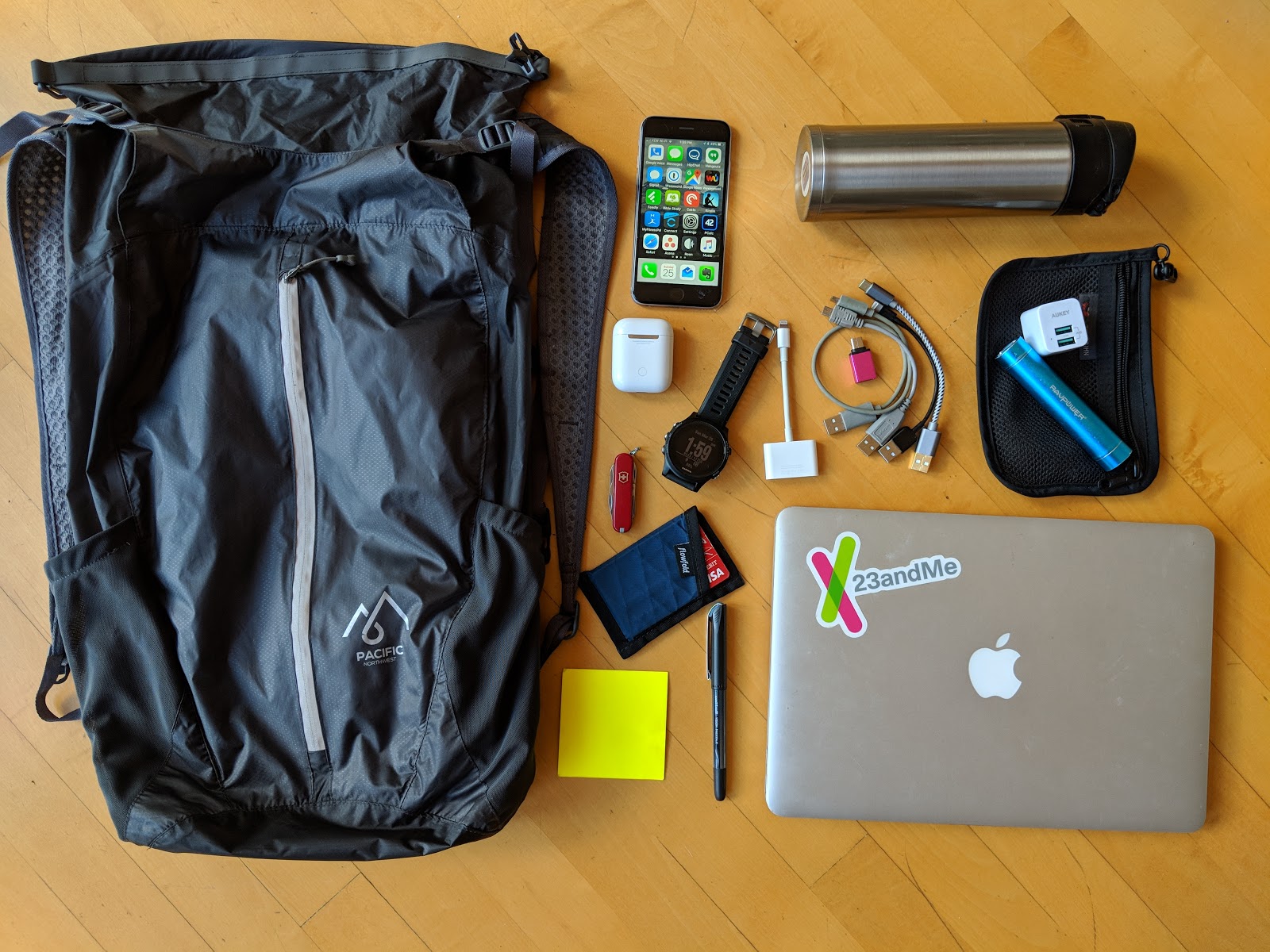
    Garmin 935 Watch: is a do everything watch which is light enough that I don’t mind wearing it everyday.  It has adequate integration with my phone and provides every fitness and activity tracking feature I want with better accuracy than most other smart watches. I appreciate the alert on the watch when it loses bluetooth connection with it’s paired phone that reduces the likelihood of leaving the phone behind. There are a number of other sport watches I would recommend if you wanted to spend less money.

    Flowfold Minimalist Wallet which holds my IDs, 2 credit cards, and a few bills taking up minimal space. The Nomatic Wallet is another good minimalist wallet.

    Uni-ball Vision Micro-Point Rollerball Pen and Post-It Notes for jotted down ideas until I can get them into an electronic system. I like Pilot Precise V5 Extra Fine pens, but the can leak.

    Victorinox Rambler Pocket Knife is the smallest, most usable tool I have found with a phillips head & flat screwdriver, scissors, knife, bottle opener, and nail file. Even though the blade is tiny, TSA will confiscate this knife. When flying I switch to a Swiss+Tech Utili-Key which is not as usable as the Rambler, but for years has made it through TSA checkpoints without being confiscated. I have notes on other knife options.

    Apple iPhone Xs on Verizon. I “upgraded” from a iPhone 6. The camera is much better and I can make it through a normal day of use without needing to recharge. I miss my earphone jack, and the phone is too big to use with one hand, and I find the face unlock inconsistent. I wish Apple would release a smaller (SE sized) phone with a good display,  modern CPU, and fingerprint reader. I am not “happy” with my iPhone Xs, but it’s the best options I have found for me.

    Apple AirPods  have decent sound quality while letting in ambiance noise providing situational awareness, stays in place during the most vigorous exercise, no wires to get tangled, has good user interface with Apple products (would be perfect if I could change volume) and ok with others, acceptable sound quality, the ear buds run 5 hour, fully recharges in 20 minutes, with a carry case which can recharge them 4-5 times. With Apple products they just work! They aren’t rated for water resistance, but after more than a year of using them while sweating heavily, rides and runs in the rain they continue to function flawlessly.

    Zojirushi Double Walled Mug (1 + 1*) can easily be used one handed, locks so it doesn’t open accidentally, pours at the perfect speed, the mouth is wide enough for ice cubes, and best of all does a better job insulating than any other double walled mug I have used. Liquids stay fairly warm or cold for up to 24 hours.  I have a silver colored mug. I often misplaced it at work. When it was misplaced for more than a week, I purchased a replacement thinking it was lost for good. Realizing findability was important, I purchased a Deep Cherry color mug which is much easier to spot across the room. After several weeks I found my original Silver mug. Now I have the Red mug which lives at work, and the silver which I use when not at work. Zojirushi makes a number of other excellent styles of mug and Snowpeak makes a beautiful Titanium double walled mug.

    Tech “Survival Kit” which is stored in a small  pouch. RAVpower Portable Charger/Flashlight is small enough to fit in my pocket while proving power to recharge my phone. Aukey Ultra Compact USB Charger is one of the smallest chargers with two slots and up to 2.4A amps. 6” USB Lightning, USB micro, and USB-C cables with some adaptor tips which let me connect pretty much any two USB devices.  A USB thumb drive because sometimes I need to transfer / store files. An Olight Universal Magnetic Battery Charger powered by USB, and can be used with pretty much any size battery. and charges both 1.5V NiHM and 3.7V LI batteries. 

    Macbook 13″ Pro Laptop (for work). I have tried using tablets but still find myself prefering a real laptop. I would love to find a lighter and more compact laptop, but I like 13” screens, and am still pretty much committed to OSX because it has the applications I use and the good integration with iOS devices. When not doing work (vacations) I am trying to only bring my iPhone and leave laptop behind.

    AWS AC-650 Digital Pocket Scale (not shown) is a small scale which makes it easy to weight food on the go.

    Matador Freerain24 is a nicely designed daypack which: carries well even when running, weights only 5.5oz, easily folds into it’s own pocket, and keeps contents dry even in the worst rain.  I actually own a PNW Sea to Sky Waterproof Backpack which is a ripoff of the Freerain24. Used every day for more than a year. Generally good shape, but the coating on zipper slowly breaking down and leaking a bit in heavy rain.

    ZebraLight H51 (not shown) with an AA eneloop battery, and headband weight 3.5oz. It has 6 regulation output levels which include lumens/runtime : 0.2/19 days, 8/39h,  30/10h, 200/55min. I use the lowest setting for basic proximity lighting I bump up to 8 lumens for tasks when I need to see accurate colors or when I am walking on establish paths, 30 lumens when running on streets. I use higher settles for night hiking or bouncing off ceiling to light up a room. I have the standard (non floody) reflector: the beam has a hot spot with enough throw for wayfinding and enough spill to be useful for close up tasks. The headband is comfortable,  removable, with a glow in the dark holder which makes it easy to find at night. The only thing this light is missing is a battery life indicator which exists in the later version. When stored,  I unscrew the tail-cap 1/3 a twist to prevent accidentally it turning on. I have a post about flashlights.

    Home Electronics

    Apple Mac mini. Needed more storage, memory, and CPU than my 2013 MacBook Pro. The Mini is compact, low noise, with a good collection of ports, and plays well in the Apple eco-system which I am committed to until my next refresh in a few years. It is overpriced compared to non-Apple hardware. This is an experiment to see if when I am away from work and home I can “live” just using an iPhone.

    KEF LS50 wireless monitor speakers with a built in DAC and amplifier designed for the speakers. Good quality sound that fills a room, excellent for near field use in a nicely designed, compact package. Can take TOSlink, USB, Bluetooth, analog, and several IP based streaming protocols inputs over ethernet or WiFi. Roon can stream directly to it over the network, but it’s not Roon-Ready so can’t be synchronized with other Roon-Ready systems.  The iOS remote application is poor.  I drive the LS50 via USB on a Mac Mini running Roon which remove the need for the KEF remote and the speakers can be synchronized with other Roon Ready end-points giving me whole house music. I still prefer the sound quality of electrostatic speakers with audiophile grade full electronics, but I am happy that I downsized my stereo so I could focus on other things.

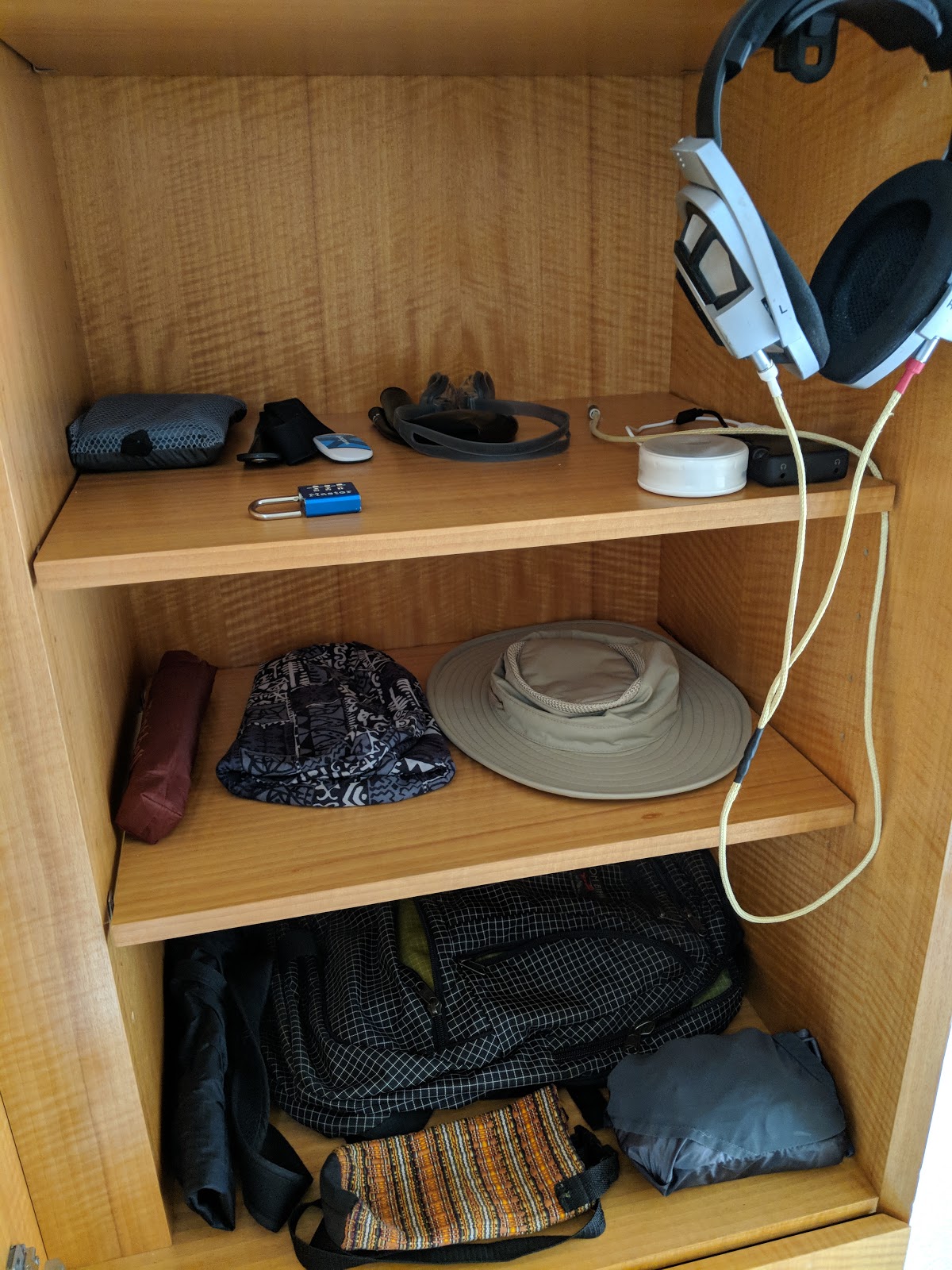
    Sennheiser HD800 Headphones* for when I want very high quality sound and don’t want to bother others too much (sound does leak).  These are the second best sounding pair of headphones I have ever used, at 1/3 the cost of the best (Stax SR-009). I have a headphones post with additional information.

    Nekteck 4-port 72W USB C Charger with 1 USB-C and 3 traditional USB ports which allows me to charge every device I use on a daily basis from a power brick, including the 13” MacBook Pro from work. When the MacBook Pro isn’t being charged can rapidly charge all my devices. Replaced an Anker 60W PowerPort+ 5  which didn’t support PD 12V@3A. 

    Google WiFi Mesh network access points easily install and just work when you have an area than a single WiFi router isn’t sufficient. There may be faster / more featureful options out there, but the Google devices work flawlessly and are visually appealing.

    Bathroom
    Withering Body WiFi Scale (Not shown) makes it easy to track weight which is well integrated to Garmin, Fitbit, MyFitnessPal, LoseIt, and numerous other health tracking eco-systems.

    Oral-B/Braun 4000 Electric toothbrush (Not shown). Oral-B and Sonicare both make excellent toothbrushes which are significantly more effective than using a manual toothbrush.

    Listerine Floss (not shown) is the most effective dental floss I have used. Gentle to the gums while still getting plague and food wedged between teeth out.

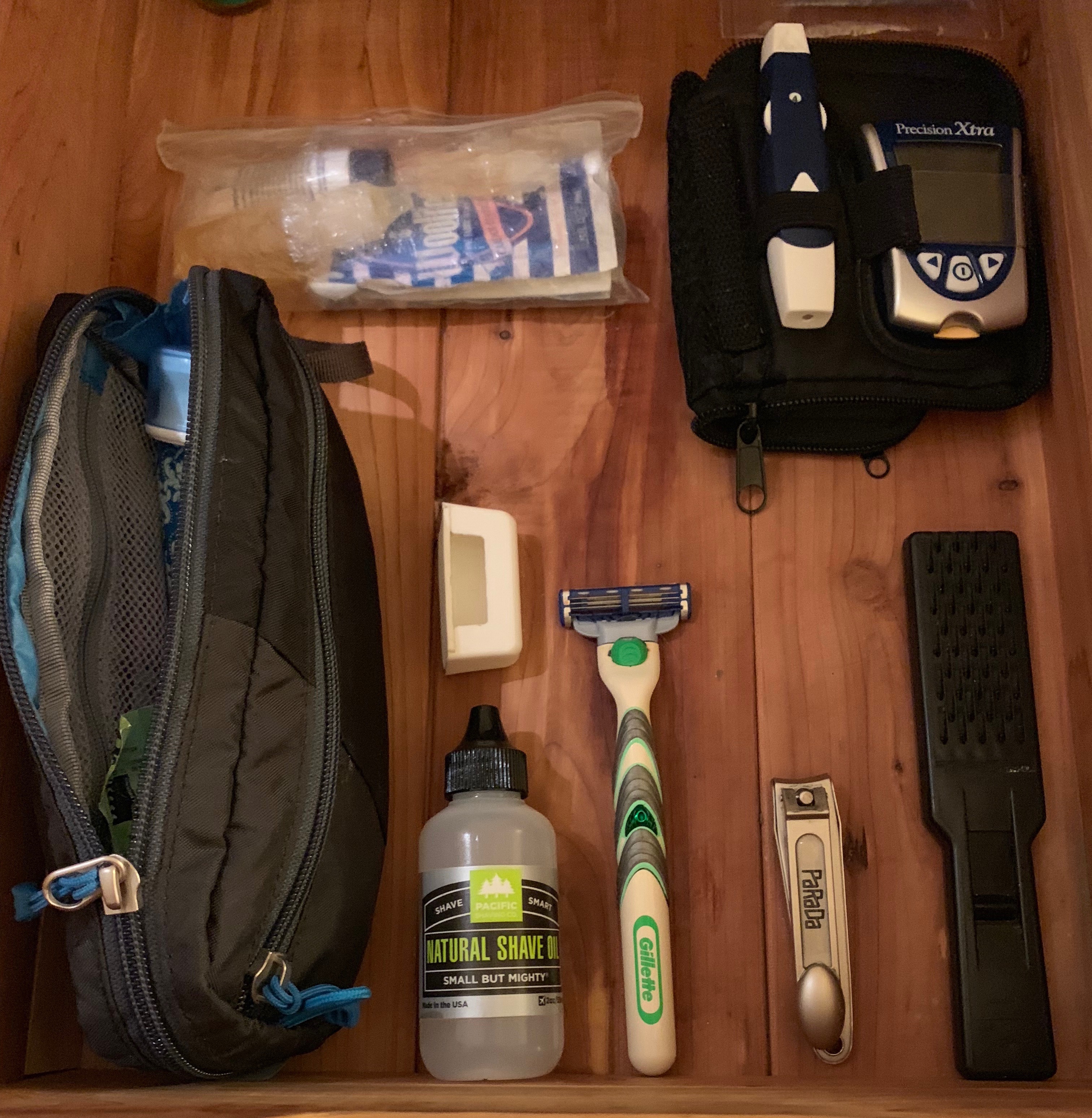
    REI Micro Shower Bag is the perfect size for my toiletry kit while providing just enough organizational features to make it easy for me to find everything quickly. Holds all bathroom items when traveling. Inside has first aid kit which includes waterproof Band-Aids, antiseptic wipes, anti biotic cream, superglue, a couple of safety pins.  Small size HumanGear GoTubb to store aleve and a few nyquil caplets and a Violife Slim Sonic toothbrush.

    Gillette Mach-3 Razor + Pacific Natural Shaving Oil.  I am sure there are better razors and many people would suggest that shaving oil is a prep step which should be followed by shaving cream… but I have found this combination effective, reasonable cost effective, and compact when traveling.

    PaRaDa Nail clipper with a trimmings catcher to make cleanup easy.

    Retractable Bristle Hairbrush (2) which is compact but effective. One in travel bag, one at work

    Ziplock bag with two weeks work of supplies: dropper bottles filled with Dr Bronner Soap, Shaving Oil, shampoo, skin lotion, and a few single use woolite packets

    Precision Xtra Ketone and Blood Glucose Meter* for times I am fasting or engaged in a new diet and want some objective data.

    Travel, Exercise, Hats
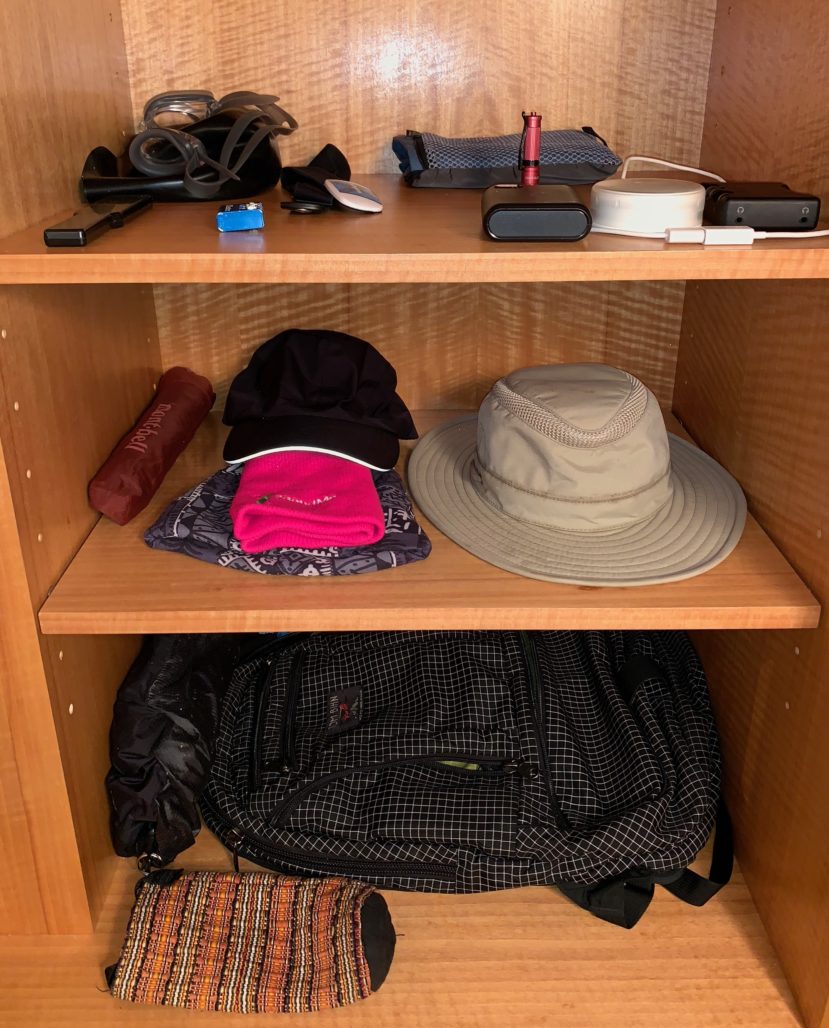
    Tom Bihn Synapse-25 Backpack is my travel luggage. Wonderfully designed with just the right amount of organizational features. Large enough for nearly every trip I have taken, while small enough that it fits under every seat I have used and has never been viewed as “luggage” by transportation operators. The laptop cache works brillantly. Have notes about other travel packs.

    Patagonia Ultralight Courier Bag* is perfect size for day use and compact enough that I can pack it away in my backpack when moving between towns. Easy access without taking it off, in hot weather maximized ventilation, and can be used at the same time that I am carrying a backpack. 

    Water Bottle Sling Nancy brought back from South America. Great for days I just need water and nothing else. Sometimes borrow my wife’s Chico Water Bottle Sling because it can hold my water bottle + my umbrella or windbreaker.

    Montbell Trekking Umbrella* has the best balance I have found between small/light and canopy size. It has survived 40mph wind/rain storms. In warm to hot weather much more comfortable than wearing a rain jacket but doesn’t adequately protect my legs in a hard rain.

    PolarBuff is a versatile item which can be used as a neck cozy, balaclava, beanie, hair band, and in a number of other configurations. I typically use it as a beanie.

    23and Stocking Hat* lives in my daypack for days when it is particularly cold and I want a bit of extra warmth. Not technically needed, but a way to show my company spirit.

    Tilley LTM6 Hat provides good sun protection while offering decent ventilation. I think it’s one of the more stylish hats which provides good sun protection. My wife says I am wrong… that my SunRunner is better looking, but is willing to put up with me wearing this hat when the sun is big. I have a list of other hats that you might prefer.

    REI eVENT Rain Hat: a discontinued ball cap made from waterproof / breathable eVENT. Used when hiking or running when I know it’s going to be raining.

    Mountain Hardware Grub Gloves (not shown)  medium weight PowerStretch gloves with a quilted mitten cover which folds away into the back of the glove making it comfortable to wear in a wide variety of conditions.

    Sleep Mask by Bedtime Bliss (not shown) which lets me get an extra hour of sleep in the morning because the sun coming up doesn’t immediately wake me and helps if I take a nap during the day.

    PackTowel Ultralight (Bodysize/XL) dries amazingly quickly, is compact, and is very effective. The XL is large enough that I can wrap it around my waist like a small sarong.  For awhile I used a medium/face size which packs in a tiny space. I found the face size sufficient for me to dry myself after a swim or shower, but I am willing to carry a larger towel for the added versatility and ease of use.

    TYR Corrective Optical Performance Goggles so that I can actually see when I am swimming. I keep the goggles with a  generic swimming cap because some pools require them, and small combination lock.

    Stryd Footpad (not shown) captures run’s intensity better than using pace or heart rate. The Garmin Running Dynamics Pod might be a cheaper way to get the same sort of data. The RunScribe Plus now syncs to Garmin and other eco-systems and might provide more actionable insights about running form that other running power meters.

    Wahoo Tickr X Heart Rate Strap because optical heart rate monitors aren’t sufficiently accurate for HRV measurements and aren’t responsive enough to track interval training. I mostly use it as a basic HRM, but if you use the Wahoo fitness app there are a number of other metrics that it can record. There are plenty of good HRM including Garmin’s Tri HRM which can be worn swimming and the Viiiva HRM which can be used to bridge other sensors between BlueTooth and ANT+. These days I mostly use Power rather than heart rate to track intensity, and the optical HRM on my Garmin 935 is almost good enough to replace the strap.

    Westone 5ES custom In-ear-monitors (IEM) with excellent sound quality and comfortable enough to wear on 14 hour flights. They reduce noise by 35db which makes travel much less fatiguing for me while being much smaller and having better sound quality than active noise canceling headphones. Stored in a medium size HumanGear GoTubb with adapters.

    Radsome EarStudio ES100 bluetooth/DAC/headphone amplifier allows me to use Westone IEM (or other wired headphones) with my iPhone Xs. The ES100 is tiny, with good sound quality (though Chord Mojo is noticeably better) and able drive Sennheiser HD800 to reasonable sound levels.

    Chord Mojo DAC* offers a nice design, good quality sound, good price / performance ratio, portability, has enough power to happily drive Sennheiser HD 800, and has an internal battery which enables it be driven via USB from phones and portable DAPs. I have written about other DACs.

    Ainope 10K mAh Portable charger for when I need to power devices for several days without access to a power outlet or for long flights without USB power in the seat.

    Olight I3S EOS Flashlight* is slightly larger than the single AAA battery which powers it. Selectable output of 8,50,80 lumens permits the user to make a trade-off of runtime vs brightness. I have other lights which should rendered this flashlight unnecessary, but when I take walks around the neighborhood at night I find myself reaching for this tiny light.  I have notes about other flashlight and headlamps.

    Kindle PaperWhite* (not shown) lets me carry the majority of my library with me and every book can be displayed with large print for my aging eyes. Love being able to quickly search for notes / hi-lighted passages. I miss physical books and knowledge retention with paper books is still better than when using an e-reader, but the connivence of the Kindle outweighs this for me. I often use the Kindle reader on my phone, but the larger display surface of the Paperwhite, much longer battery life, and usability in sunlight means the PaperWhite goes on most trips I take.

    Clothing

    I have notes about selecting clothing for an active life which goes in detail  about how to select clothing for a wide range of activities and conditions.
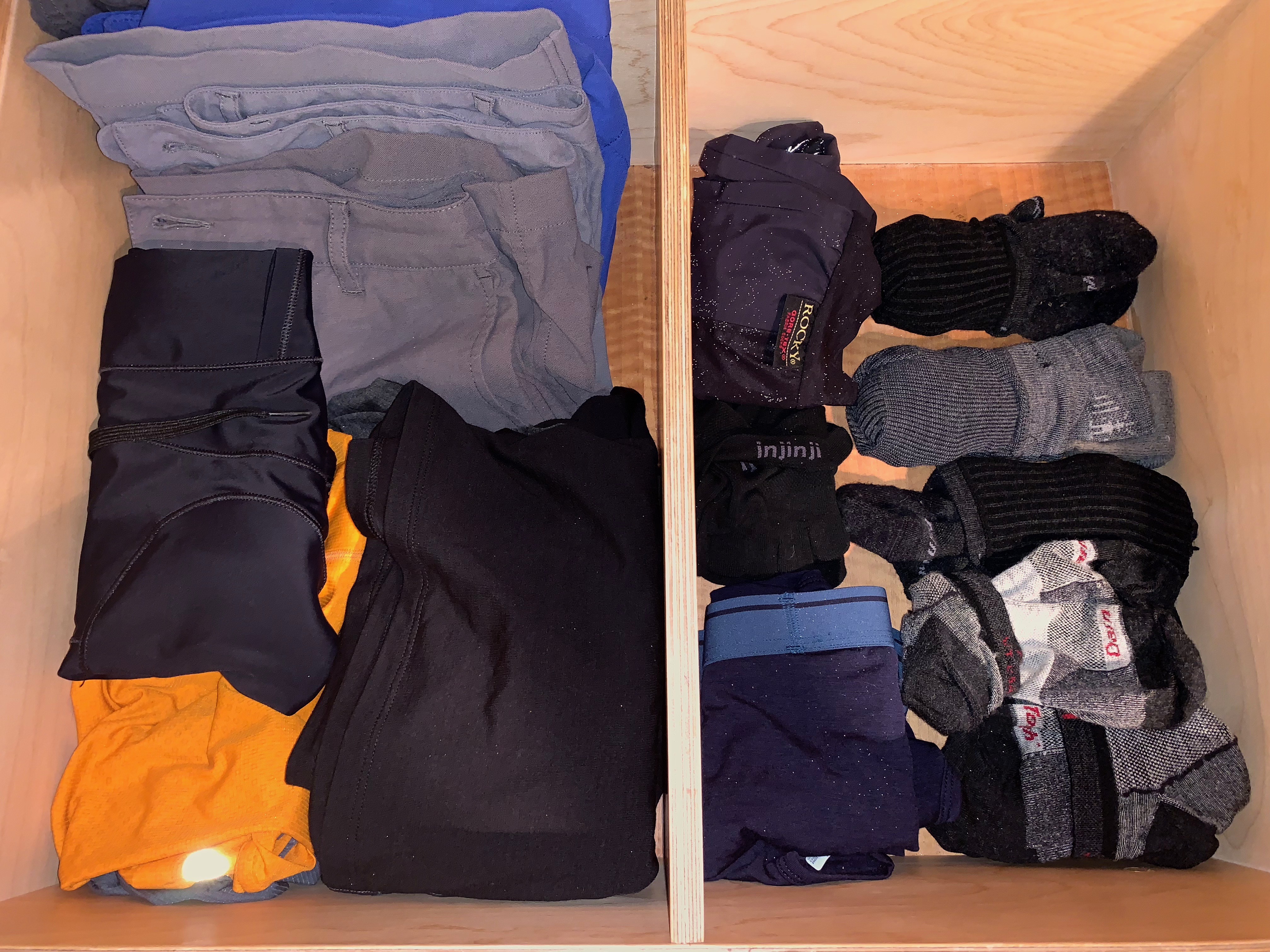
    Outlier New Way Shorts (3) are nice looking shorts which fit me perfectly, don’t have cargo pockets, are durable and dry reasonably quickly. They are pricy but I haven’t found any shorts I like as much.

    North Face Paramount Shorts* (not shown) were the best shorts I could find on a trip where I needed a part of shorts. I appreciate the zipper stash pocket, and they were better than all there other shorts I tried on, but they just don’t fit as nicely as my new way shorts.

    Zootsports Performance Tri Shorts works well cycling, running and swimming. They are comfortable for all the activities I engage in, in a wide range of conditions. They have reduces issues with chaffing,  dry fairly quickly, and are reasonably comfortable  when wet. They have side pockets large enough to hold some nutrition and my phone so I don’t need to use a special cycling jersey. I never need to think about what shorts to wear when I am going to engage in vigorous physical activities…. I just grab my pair of zoot.

    Columbia/Montrail Titan Trailrunning Shirt: Omni-Freeze fabric that helps cool when working out in moderate to hot conditions. Super light weight and breathable. Anti-stink is reasonable.

    Icebreaker Anatomica Tee-shirt (4) merino wool with just a bit of lycra for a body hugging fit. This tee-shirt fits me perfectly, looks good, is super comfortable, doesn’t smell after several days of wear on the road, and dries fairly quickly.  There are two downside.  First, they are pricy especially in view that they wear out more quickly that a cheap cotton tee.  Second, they don’t work as well as synthetics when engaged in  high energy activities where you are sweating a lot. There are a number of other good merino wool shirts from Smartwool, Outlier, and Wool&Price.

    Icebreaker Anatomica Briefs (4) the most comfortable underwear I have worn. Downsides are that they start  getting holes after a year and they are expensive. Some people prefer boxer style but I see no reason to have extra fabric on my thighs. Good alternatives are the synthetic travel oriented briefs from Ex Offico and the comfortable but expensive underwear from Saxx.

    Darn Tough Socks (8) are unsurprisingly durable since they come with a lifetime warranty. I found they fit and perform very well and come in a wide variety of thicknesses, lengths, and colors. I like the endurance light socks. Icebreaker and the Smartwool PhD line are good alternatives.

    Injinji Ultralight Toe Socks (2) for long distance runs / hikes. Generally I prefer wool, but I found light weight wool toe socks get holes very quickly so I use the CoolMax, original weight version.

    Rocky Gore-Tex Socks are the best way I have found to keep my feet reasonably clean, dry and warm in messy back country conditions. Often worn with Keen sandals to maximum breathability and speed drying once they are out of the water.

    Keen Clearwater CNX are the lightest sandals Keen makes. I liked the minimalist sandals made by luna and Xero Shoes but the toe protection of the Keens makes them a clear winner for me. If worn with gray socks they can pass for shoes. Comfortable in a wide range of conditions. I can run in them when I don’t have my Alta running shoes with me.

    Alta Running Shoes are the best running shoes (trail and road) that I have used. Wearing these shoes with toe-socks has allow me to do marathon length runs and 20+ mile days backpacking with no blisters or foot pain.  Just one week after purchasing my first pair of One V2.5 I completed the Big Sur Marathon without issue.  I like the models with minimal cushion.  I currently use One V3 for road running and the Superior V3 for trails.

    Vivobarefoot Gobi II are extremely light weight, zero-drop, minimalist ankle boots which can be worn with casual clothing and my wife tells me they are acceptable to wear with a suit. Love them because they are light weight and comfortable. Two downside are that they take longer to put on and take off than low rise shoes and my feet can feel tired if I have been walking 14+ miles each day, for several days.

    Carots Shoes* are formal looking zero drop shoes. These are the only minimalist shoes I have found that looks like traditional dress shoes (heels and and tapered toe) that are sufficiently comfortable for day long wear. These were purchased before I discovered that the Gobi II were acceptable footwear with my suit.

    Skinners* (Not Shown) Socks with durable flexible coating on bottom so they can be used like shoes. Small and compact. Use as slippers, when I biking somewhere and then want to walk around without cleats, or when I am in the mood for barefoot running.

    Topo Running Shoes (Not Shown) are zero drop minimalist running shoes. My model is a bit lighter than their current zero drop road running shoe. These shoes live at work for the days I ride my bike and don’t want to clomp around with cleats all day or carry shoes back and forth to work.
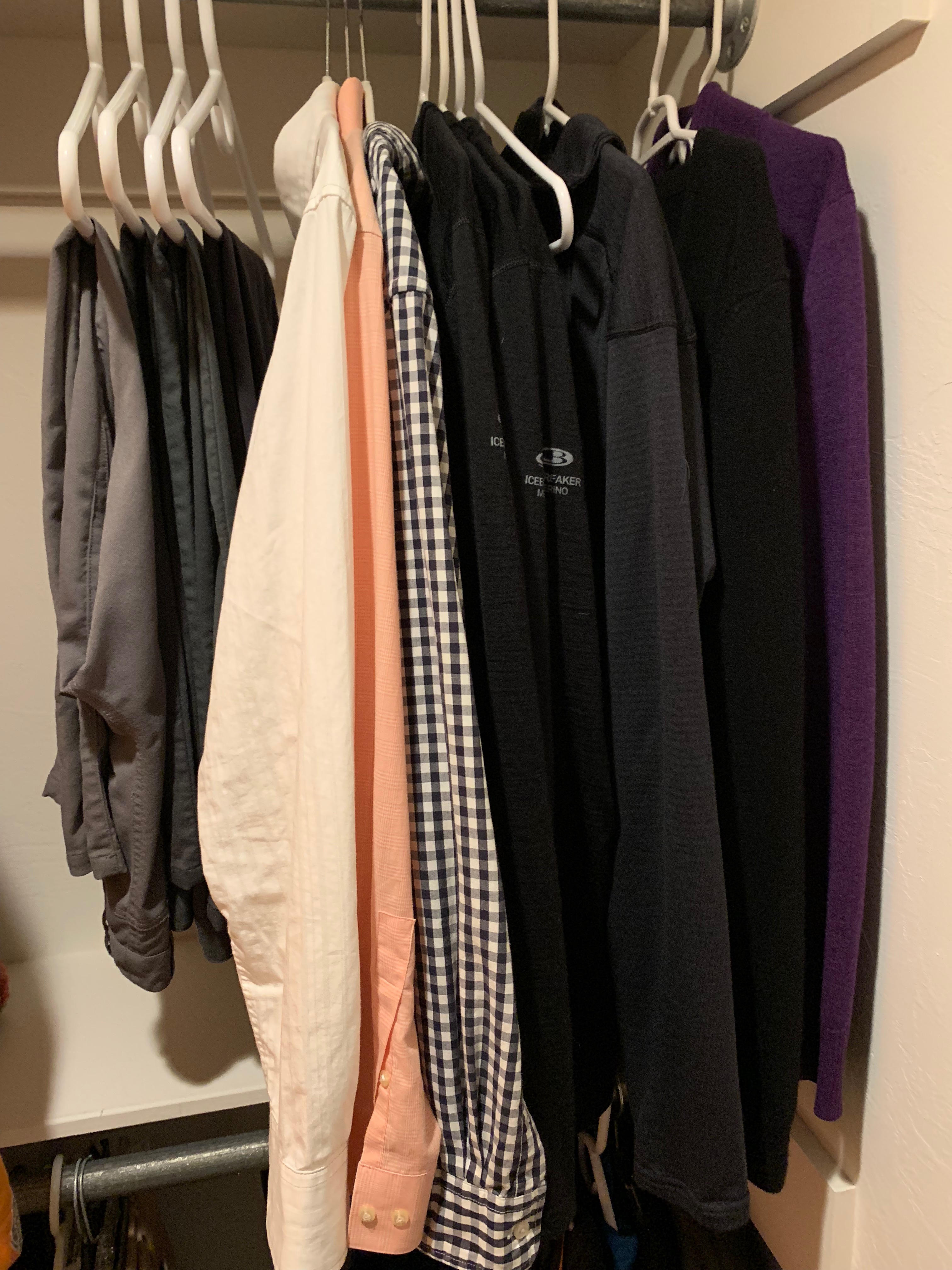
    Outlier Slim Dungarees (4) Soft shell pants in the style of jeans. Wonderful fit, looks good, excellent mobility. Thanks to the NanoSphere treatment very stain and water resistant. They are perfect except when it’s >80F and I am active. They seem pricy, but the per day cost of wearing is about the same as denim jeans. Maker & Rider makes a nice alternative.

    White Dress Shirt for when I need to be dressed up.

    Peach Button Down Shirt* for when my wife wants me to wear something at is a bit different than normal (for me).

    Black/Grey/White Checked Button Down Shirt* for when my wife wants me to wear something nicer than a tee-shirt but less than a suit, white shirt, and tie.

    Icebreaker Wool Hoodie: (4) Oasis 200wt merio wool hoodie with 1/4 length zipper. Worn when it gets too cool to wear just a tee-shirt. Icebreaker has discontinued this model. Also have 3 in storage which will come out when these wear out.

    Patagonia Capilene Thermal Weight Hoody for cool/cold weather outdoor activities. Without wind protection the grid weave lets air flow through letting heat vent out. With a shell it insulates well. Comfort down to 30F when running without a shell, below that with a shell. When walking keeps me comfortable down to 40F when combined with a wind shirt.  I am reasonably comfortable engage in high energy activities when it’s 65F by fully opening the zipper and pushing the sleeves up to my elbows. Dries amazingly quickly and feels more comfortable than any other shirt I have used when it’s wet.

    Grey Cashmere V-neck Sweater for fall and winter evenings that when I should wear something a bit more dressed up than my wool hoody and/or want more insulation.

    Mid-Weight, Purple Merino Wool Sweater* for cool days or when I want to wear something that isn’t black.
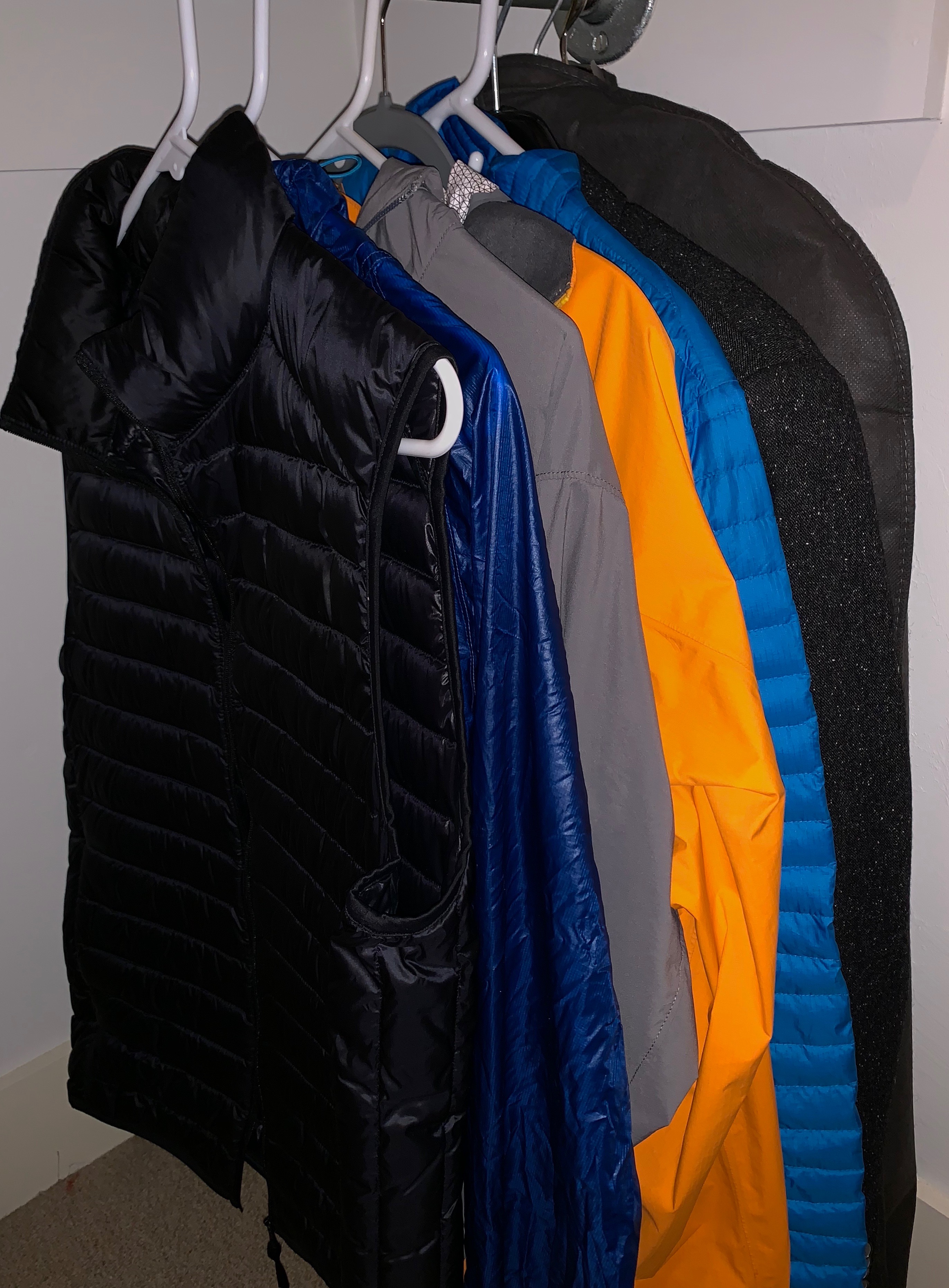
    Uniqlo Ultralight Down Vest is decent quality, low price, with just the right amount of insulation for me. Combined with my sweater and a shell keeps me warm enough in the coldest weather I encounter in the SF Bay area.

    Montbell Tachyon Windshirt a 1.8 ounce wind shirt that can be compressed into something slightly larger than a cliff bar. Windshirts, especially when combined with a air permeable middle layer provide comfort over a huge range of conditions. This lives in my daypack.

    Westcomb’s Focus LT Rain Jacket has been pulled out of storage because in the last few rain storms the zipper on the ArcTeryx Norvan SL has leaked so much that I don’t use it when I expect to be out in the rain for an extended period of time. While not as breathable as the Norvan SL, the Focus doesn’t leak. Other options are discussed in my post about  rain gear.

    Zpacks Vertice Rain Pants (not shown) are simple, light, breathable, waterproof rain pants. Used when commuting by bike, hiking, or backpacking in the rain.

    Patagonia Down Shirt* with 23andMe logo.  A jacket which provides adequate insulation for around the town use in the SF Bay Area. Allows me to show my company spirit and my wife thinks it looks better than the combination of the above items. The Patagonia Micro Puff Hoody using PlumaFill insulation would be better for back country use thanks to it’s superior water resistance. The Montbell inner down jacket continues to be the price performance champ, and Uniqlo’s down jacket is a good alternative for someone on a tight budget.

    Boss Blazer Jacket used when going out and it’s appropriate to be wearing something more dressy than a hoodie, but a full suit is too formal. On cool evenings I sometimes wear the blazer over my shirt rather than taking a more traditional “outdoor” jacket.

    Boss Wool Suit slim/european cut in suit cover bag. Fits me perfectly though not bespoken. First suit that I wear rather than the suit wearing me. Light enough that it’s usable in the summer. I use it anytime I need to be very dressed up: weddings, funerals, special nights out on the town.  Have two ties… one that is “serious” and one that is “fun”

    Backpacking / Winter Clothing

    I have a 3-season packing list which makes use of a number of the items on this list and has several items which are specific for backpacking. In addition to the items on my backpacking list, I have several items which come out when I am heading to the mountains and expect snow.

    Patagonia Cap 3 Tights: which go under normal pants and/or rain pants when facing below freezing conditions.

    GoLite Snow Cap: polarguard insulated bomber style hat which can be layered over other hats. Fairly windproof, warm, and light weight.

    Outdoor Research Meteor Mitts: which have a removable 300wt fleece inner mitt which folds back to let you use your fingers and a durable, waterproof shell.

    Mountain Hardware Tempest Gloves: ultralight light weight water resistant shell with modest liner. Great dexterity.

    Gaiters: for keeping snow out of shoes/boots and the lower legs dry.

    Bicycling Stuff

    Cervelo R3: pricy but amazing road bicycle. Comfortable enough for an endurance ride, but responsive like a race bike. Fitted with an Infinity Seat, and a small seat bag which holds a pump, inter-tube, bike tool, and 2 tire levers. Moots makes some great Titanium bikes but you have to special order them.

    Giro Air Attack Shield Helmet provides protection, good ventilation while having a very streamlined aerodynamic profile. Has snap on optical shield which is great because with my eye prescription, it’s hard to find sports oriented sunglasses. If you ride a bicycle, wear a helmet!! I am alive today because I was wearing a helmet when I was in an accident. Giro has newer models which have better ventilation and aerodynamic profile and also cheaper models that will protect your head just as well for less money.

    Felix BC21R Bike Headlamp  which was purchase when my Expilion 850 was stolen. The BC21R uses a removable 18650 rechargeable battery. I think I slightly preferred the quality of light from the Expilion, but the BC21R works well enough to stick with it, and I do appreciate that the battery can be charged outside light housing.

    Power Tap P1 Pedals because I like objective measures about how my physically conditioning is changing. The Garmin Vector 2 pedals integrate better into the Garmin eco-system, use standard Keto cleats, and are lighter / more streamlined at about the same price point.

    Bicycling Shoes with Cleat for PowerTap peddles.

    Wahoo Fitness Kickr* is a great trainer for when you can’t get outside. Integrated power meter and variable resistance which can be controls via ANT+ or BlueTooth. Wahoo build the Kickr with an open API so there are numerous companies which have applications which can control the Kickr.

    Sentimental

    There are a several items I have kept as a specific way to honor people I have lost.

    Libby’s pins of a nativity scene and of a mother and child. Originally worn by Libby on special occasions they became daily decorations for the hats she wore during chemotherapy. They remind me of Libby’s courage and the two things most important to Libby, family and Jesus.

    Carl’s Rolex Oyster Watch to remember his craftsmanship, love of teaching, and ironically his frugality.

    Jules’ sculptures of musicians made from nails because he passed on a love for music and art.

    WWII Era Wool Blanket (not shown) Originally owned by Carl or maybe even my grandfather. It has been on countless fishing and camping trips and to virtually every picnic and outdoor concert I have ever attended. Everything I see the blanket I think of my dad and many wonderful moments.

    Potentially Retired

    The following items weren’t used last year. I have put them aside for the next year to see if they get pulled back out.

    Wool and Prince Blue Oxford Shirt a blue dress shirt my wife loves. Crisp look and a slim fit while still having all the advantages of 100% wool, but haven’t really needed a light blue color shirt.

    Outlier Air Forged Oxford Shirt Fits me well, made from durable nylon weave so it dries quickly and doesn’t wrinkle when traveling while looking nicer than many “travel” shirts. Hasn’t been used because I live in wool tees or hoody when traveling.

    Icebreaker Long Sleeve Oasis Crew orange & grey color which was a Christmas gift to add some color to my wardrobe but I tend to use my hoody.

    Retired in 2019

    North Face TKA80: Fleece which is lighter weight and less bulky than most. Fleece starting to pill. Might eventually replace it with Montbell’s Chameece Inner Jacket, but for now wool sweaters are working fine.

    Black Diamond Alpine Start Jacket is one of the lightest weight soft shells made today. Moderately air permeable, schoeller nansphere treatment for excellent DWR, fair bit of stretch for ease of movement. Purchased as an experiment for high aerobic activities in cold weather. While the tight weave and Nanosphere treatment is amazing, wets through in heavy rain after 30 minutes. Either I need wind protection which is provided by the Tachyon, or I need read rain protections in which case I use the Focus LT in cool conditions or I just get wet and keep activity level high to stay warm.

    ArcTeryx Norvan SL Rain Jacket is one of the lightest, most breathable rain jacket currently available. I can actually wear it comfortably jogging in cool, rainy weather.  Alas… the zipper leaks too much in heavy rain.

    OR SunRunner Cap ball cap with a removal veil that is very packable. Downside is that it looks a bit silly when used with the veil and air flow when using the veil is less than when I wear the Tilley.

    Petzl Bindi is a very light weight, but pricy rechargeable headlamp which works well for urban running. Retired because it was lost after a run. When I need a headlamp for running make use of the Zebralight H51 from my backpacking gear which is a bit heavier but has a better beam.

    Cygolight Expilion Bike Headlamp are bright enough to illuminate when I am riding fast and has a swappable rechargeable battery. “Retired” because it was stolen.

    Anker 60W PowerPort+ 5 with 1 USB-C and 4 traditional USB ports has enough ports to charge every device I use on a daily basis including my 13” MacBook Pro. Replace to get 12V@3amp PD charging mode on USB-C port and a smaller unit. The need for 12V went away when gave up on the One Netbook, so replacing this wasn’t actually needed 🙁

    One Netbook One Mix 2 Yoga Pocket Notebook is a 19 ounce full PC running Windows 10 with 8GB RAM, a 256GB SSD, and a 1920 x 1200 touch screen. Screen was too small for my aging eyes, and I feel unsafe running Windows 10 due to how much malware is targeted at it. Owned briefly.

    Punkt MP02 Minimalist Phone. Owned briefly. Was considering switching from a iPhone to a MP02 + iPod Touch, but the MP02 is missing bands which would make it usable on Verizon and it was a bit larger than I expect.
  • Gear in 2018

    I have an updated list which captures what I am using now.

    Minimalism led me to simplify my stuff, keeping just the items that are regularly used and give me joy. I considered taking the 100 Items Challenge, but decided I would be too focused on curating stuff rather living a meaningful life. I am following an organic process… holding on to things that are adding value to my life and remove those that are a distraction. Here is a list of all my possessions excluding our family’s furniture and kitchen. Items in bold are exceptionally great… I regularly finding myself telling people about them. I am happily use items marked with “*”, but they won’t be replaced if lost. Making this list was originally inspired by one bag lifestyle and Tynan’s Gear posts. I hope this list might encourage others to surround themselves with items that truly bring them joy and remove items that are a burden… and not to encourage people to just consume more. My traveling list is a subset of the items in this post.

    Everyday Carry Items

    Flexon eyeglass frames with high index progressive lens. Seeing clearly is such a blessing. I break most frames within a year of getting them. Flexon last me several years. My current pair was purchased in 2010, though the lens have been replaced a few times when my prescription was updated.

    Garmin 935 Watch: is a do everything watch which is light enough that I don’t mind wearing it everyday.  It has decent integration with my phone and provides every fitness and activity tracking feature I want. I appreciate the alert on the watch when it loses bluetooth connection with it’s paired phone that reduces the likelihood of leaving the phone behind. There are a number of other sport watches I would recommend if you wanted to spend less money.

    Flowfold Minimalist Wallet which holds my IDs, credit cards, and a few bills taking up minimal space. The Nomatic Wallet is another good minimalist wallet.

    Uni-ball Vision Micro-Point Rollerball Pen and Post-It Notes for jotted down ideas until I can get them into an electronic system. 

    Victorinox Rambler Pocket Knife is the smallest, most usable tool I have found with a phillips head & flat screwdriver, scissors, knife, bottle opener, and nail file. Even though the blade is tiny, TSA will confiscate this knife. When flying I switch to a Swiss+Tech Utili-Key which is not as usable as the Rambler, but for years has made it through TSA checkpoints without being confiscated. I have notes on other knife options.

    Apple iPhone 6 on Verizon. At some point I will switch to a new iPhone for a significantly improved camera. Apple’s iOS usability used to be superior to Android, but Android has mostly caught up except for management of audio I noted with the Pixel 2 below. I continue to use an iPhone because the rest of my family is in the Apple eco-system (iMessage, Photo sharing, iTunes, etc) and I like it’s more security oriented stance. I continue to use Verizon because I find their coverage best in the places I spend my time. Verizon is “overpriced”, but I value working coverage over saving money.

    Apple AirPods  have decent sound quality while letting in ambiance noise providing situational awareness, stays in place during the most vigorous exercise, no wires to get tangled, has good user interface with Apple products (would be perfect if I could change volume) and ok with others, acceptable sound quality, the ear buds run 5 hour, fully recharges in 20 minutes, with a carry case which can recharge them 4-5 times. With Apple products they just work! They aren’t rated for water resistance, but after more than a year of using them while sweating heavily, rides and runs in the rain they continue to function flawlessly.

    Zojirushi Double Walled Mug (1 + 1*) can easily be used one handed, locks so it doesn’t open accidentally, pours at the perfect speed, the mouth is wide enough for ice cubes, and best of all does a better job insulating than any other double walled mug I have used. Liquids stay fairly warm or cold for up to 24 hours.  I have a silver colored mug. I often misplaced it at work. When it was misplaced for more than a week, I purchased a replacement thinking it was lost for good. Realizing findability was important, I purchased a Deep Cherry color mug which is much easier to spot across the room. After several weeks I found my original Silver mug. Now I have the Red mug which lives at work, and the silver which I use when not at work. Zojirushi makes a number of other excellent styles of mug and Snowpeak makes a beautiful Titanium double walled mug.

    Tech “Survival Kit” which is stored in a small mesh pouchRAVpower Portable Charger/Flashlight is small enough to fit in my pocket while proving power to recharge my phone. Aukey Ultra Compact USB Charger is one of the smallest chargers with two slots and up to 2.4A amps. 6” USB Lightning, USB micro, USB mini, and USB-C cables with some adaptor tips which let me connect pretty much any two USB devices.  A Lightning to HDMI converter. A USB thumb drive because sometimes I need to transfer / store files.

    Macbook 13″ Pro Laptop.  I have tried using tablets but still find myself prefering a real laptop. I would love to find a lighter and more compact laptop, but I like 13” screens, and am still pretty much committed to OSX because it has the applications I use and the good integration with iOS devices.

    Matador Freerain24 is a nicely designed daypack which: carries well even when running, weights only 5.5oz, easily folds into it’s own pocket, and keeps contents dry even in the worst rain.  I actually own a PNW Sea to Sky Waterproof Backpack which is a ripoff of the Freerain24.

    Home Electronics

    Roon software isn’t really an item, but it effected many of my decisions related to audio playback. Roon integrates my iTunes library which is made up of CDs ripped using ALAC codex with the TIDAL streaming service to provide loseless audio to multiple speakers around the house. Roon would be perfect if the remote clients supported off-line caching of music so playlists and favorite music was accessible when out of the house, and was a bit less buggy (it sometimes stops playing which requires me to restart the app on my Macintosh). I carry music on my phone by exporting play lists from Roon to TIDAL, and then use the Tidal client on my iPhone to do offline playback. If I didn’t care so much about sound quality I would be using Spotify which would make everything simpler.

    KEF LS50 wireless monitor speakers with a built in DAC and amplifier designed for the speakers. Good quality sound that fills a room, excellent for near field use in a nicely designed, compact package. Can take TOSlink, USB, Bluetooth, analog, and several IP based streaming protocols inputs over ethernet or WiFi. Roon can stream directly to it over the network, but it’s not Roon-Ready so can’t be synchronized with other Roon-Ready systems.  The iOS remote application is poor.  I drive the LS50 via USB on a computer running Roon which remove the need for the KEF remote and the speakers can be synchronized with other Roon Ready end-points giving me whole house music. I still prefer the sound quality of electrostatic speakers with audiophile grade full electronics, but I am happy that I downsized my stereo so I could focus on other things.

    Pulse Flex Wireless Speaker allows me to have syncronized whole house music since it’s Roon Ready. It also supports inputs via USB, Bluetooth, AUX, a number of streaming services like Spotify, and many free sites via URIs.  Has a decent iOS and Android remote control app. Controls on the top let you select one of 5 user-defined “channels” without using the remote. I have the optional battery pack so it can be used in our backyard. It can be used away from it’s home, but you have to reconfigure it’s WiFi settlings which is a pain. Sound quality is significantly less than KEF LS50. For people who aren’t using Roon, I would recommend Sonos: for it’s lower price point, better streaming options, and slightly more processed sound quality which everyone but audio purists like me typically prefer.

    Anker 60W PowerPort+ 5 with 1 USB-C and 4 traditional USB ports has enough ports to charge every device I use on a daily basis including my 13” MacBook Pro. When MacBook isn’t being charged can rapidly charge all my devices.

    La Crosse Battery Charger which does a great job charging any combination of 1-4 AA or AAA batteries for Eneloop Pro Batteries are the best rechargeable batteries I have found. Near maximum capacity for the form factor while retaining most of their charge for months.

    Olight I3S EOS Flashlight is slightly larger than the single AAA battery which powers it. Selectable output of 8,50,80 lumens permits the user to make a trade-off of runtime vs brightness. The combination of the flash on my Phone and the RAVpower Portable Charger/Flashlight should have rendered this flashlight unnecessary, but when I take walks around the neighborhood at night I find myself reaching for this tiny light.  I have notes about other flashlight and headlamps.

    Brother MFC-J880W Multifunction Printer, Scanner, Fax, Copier has been a reliable device for me unlike several other multi-function devices which failed within a year. WiFi enabled, supports AirPrint, Google Print, and several other standards.  

    Google WiFi Mesh network access points easily install and just work when you have an area than a single WiFi router isn’t sufficient. There may be faster / more featureful options out there, but the Google devices work flawlessly and are visually appealing.

    Kindle PaperWhite* lets me carry the majority of my library with me and every book can be displayed with large print for my aging eyes. Love being able to quickly search for notes / hi-lighted passages. I miss physical books and knowledge retention with paper books is still better than when using an e-reader, but the connivence of the Kindle outweighs this for me. I often use the Kindle reader on my phone, but the larger display surface of the Paperwhite, much longer battery life, and usability in sunlight means the PaperWhite goes on most trips I take.

    LG OLED55B6P SmartTV* purchased for the family movie night and other group activities that use a screen. I would be content using the screen on my laptop or even iPhone for the occational video streaming I watch. That said, the picture quality is amazing and the webOS based controls work well.

    Westone 5ES custom In-ear-monitors (IEM) with excellent sound quality and comfortable enough to wear on 14 hour flights. They reduce noise by 35db which makes travel much less fatiguing for me while being much smaller and having better sound quality than active noise canceling headphones. Stored in a medium size HumanGear GoTubb with adapters.

    Sennheiser HD800 Headphones* for when I want very high quality sound and don’t want to bother others too much (sound does leak).  These are the second best sounding pair of headphones I have ever used, at 1/3 the cost of the best (Stax SR-009). I have a headphones post with additional information.

    Chord Mojo DAC* offers a nice design, good quality sound, good price / performance ratio, portability, has enough power to happily drive Sennheiser HD 800, and has an internal battery which enables it be driven via USB from phones and portable DAPs. I have written about other DACs.

    Travel and Activities

    Tom Bihn Synapse-25 Backpack is my travel luggage. Wonderfully designed with just the right amount of organizational features. Large enough for nearly every trip I have taken, while small enough that it fits under every seat I have used and has never been viewed as “luggage” by transportation operators. The laptop cache works brillantly. Have notes about other travel packs.

    Patagonia Ultralight Courier Bag* is perfect size for day use and compact enough that I can pack it away in my backpack when moving between towns. Easy access without taking it off, in hot weather maximized ventilation, and can be used at the same time that I am carrying a backpack.

    Water Bottle Sling Nancy brought back from South America. Great for days I just need water and nothing else. Sometimes borrow my wife’s Chico Water Bottle Sling because it can hold my water bottle + my umbrella or windbreaker.

    Montbell Trekking Umbrella has the best balance I have found between small/light and canopy size. It has survived fairly strong wind/rain storms. In warm to hot weather much more comfortable than wearing a rain jacket.

    PackTowel Ultralight (Bodysize/XL) dries amazingly quickly, is compact, and is very effective. The XL is large enough that I can wrap it around my waist like a small sarong.  For awhile I used a medium/face size which packs in a tiny space. I found the face size sufficient for me to dry myself after a swim or shower, but I am willing to carry a larger towel for the added versatility and ease of use.

    TYR Corrective Optical Performance Goggles so that I can actually see when I am swimming. I keep the goggles with a  generic swimming cap because some pools require them, and small combination lock.

    Stryd Footpad captures workout intensive better than using pace or heart rate. The Garmin Running Dynamics Pod might be a cheaper way to get the same sort of data. The RunScribe Plus now syncs to Garmin and other eco-systems and might  provide more actionable insights about running form that other running power meters.

    Wahoo Tickr X Heart Rate Strap because optical heart rate monitors aren’t sufficiently accurate for HRV measurements and aren’t responsive enough to track interval training. I mostly use it as a basic HRM, but if you use the Wahoo fitness app there are a number of other metrics that it can record. There are plenty of good HRM including Garmin’s Tri HRM which can be worn swimming and the Viiiva HRM which can be used to bridge other sensors between BlueTooth and ANT+. These days I mostly use Power rather than heart rate to track intensity, and the optical HRM on my Garmin 935 is almost good enough to replace the strap.

    Clothing

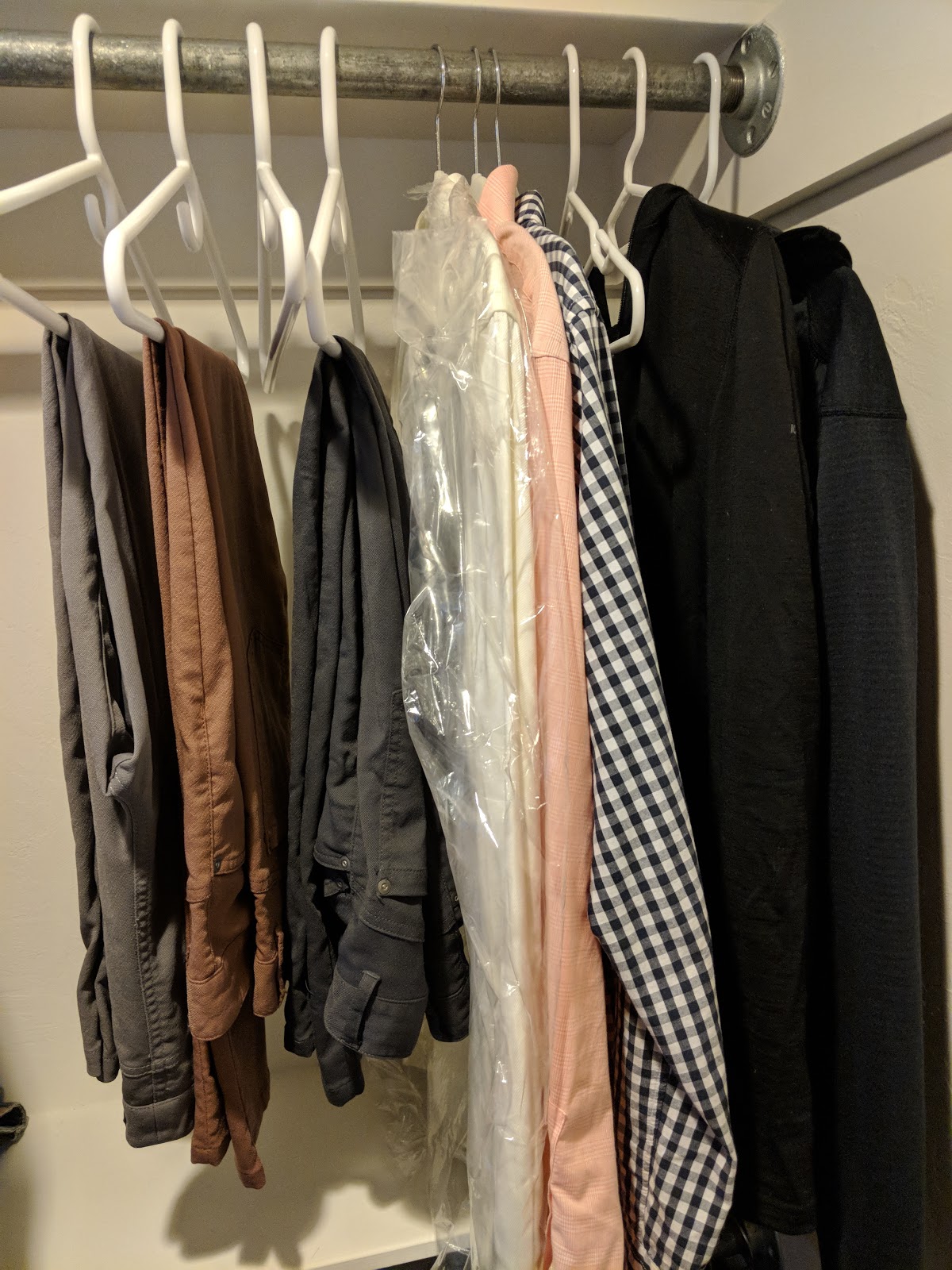
    Pictured Above

    I have notes about selecting clothing for an active life which goes in detail  about how to select clothing for a wide range of activities and conditions.

    PolarBuff is a versatile item which can be used as a neck cozy, balaclava, beanie, hair band, and in a number of other configurations. I typically use it as a beanie.

    Tilley LTM6 Hat provides good sun protection while offering decent ventilation. I think it’s one of the more stylish hats which provides good sun protection. My wife says I am wrong… that my SunRunner is better looking, but is willing to put up with me wearing this hat when the sun is big. I have a list of other hats that you might prefer.

    REI eVENT Rain Hat (not shown): a discontinued ball cap made from waterproof/breathable eVENT. Used when hiking or running when I know it’s going to be raining.

    OR SunRunner Cap* (not shown) ball cap with a removal veil that is very packable. Downside is that it looks a bit silly when used with the veil and air flow when using the veil is less than when I wear the Tilley. I use this hat when I want some shade for my eye but don’t need a full brim,  when I need a hat that’s more compact than a Tilley, or when I forgot to grab the Tiley hat (the SunRunner lives in the trunk of my wife’s car).

    Mountain Hardware Grub Gloves (not shown)  medium weight PowerStretch gloves with a quilted mitten cover which folds away into the back of the glove making it comfortable to wear in a wide variety of conditions.


    Outlier Slim Dungarees (5) softshell pants in the style of jeans. Wonderful fit, looks good, excellent mobility. Thanks to the NanoSphere treatment very stain and water resistant. They are perfect except when it’s >80F and I am active. They seem pricy, but the per day cost of wearing is about the same as denim jeans. Maker & Rider makes a nice alternative.

    BPL Thorofare Trekking Pants (not shown and no longer made which is a shame) are ultralight, ultra-compact pants which are surprisingly weather resistant, quick drying, and feel comfortable against the skin. They aren’t used in day-to-day life. I used them for cool weather backpacking and on trips where the weather is perfect for shorts (e.g. too hot for the Outliers) and I will need to wear long pants to be culturally appropriate. When the Thorofare pants wear out I will replace them something like Royal Robin Global Traveler, Patagonia Quandary, or ArcTeryx Rampart pants.

    White Dress Shirt purchased to be worn with suit or blazer when more formal clothing is required.

    Peach Button Down Shirt* for when my wife wants me to wear something at is a bit different than normal (for me).

    Black Checked Button Down Shirt* for when my wife wants me to wear something nicer than a tee-shirt but less than a suit, white shirt, and tie.

    Wool and Prince Blue Oxford Shirt* (not shown) is a blue dress shirt my wife loves. Crisp look and a slim fit while still having all the advantages of 100% wool.

    Outlier Air Forged Oxford Shirt* Fits me well, made from durable nylon weave so it dries quickly and doesn’t wrinkle when traveling while looking nicer than many “travel” shirts. 

    Icebreaker Wool Hoodie: (4) Oasis 200wt merio wool hoodie with 1/4 length zipper. Worn when it gets too cool to wear just a tee-shirt. Icebreaker seems to have discontinued this model.

    Patagonia Capilene Thermal Weight Hoody for cool/cold weather outdoor activities. Without wind protection the grid weave lets air flow through letting heat vent out. With a shell it insulates well. Comfort down to 30F when running without a shell, below that with a shell. When walking keeps me comfortable down to 40F when combined with a wind shirt.  I am reasonably comfortable engage in high energy activities when it’s 65F by fully opening the zipper and pushing the sleeves up to my elbows. Dries amazingly quickly and feels more comfortable than any other shirt I have used when it’s wet.

    Montbell Tachyon Windshirt  (not shown) a 1.8 ounce wind shirt that can be compressed into something slightly larger than a cliff bar. Windshirts, especially when combined with a air permeable middle layer provide comfort over a huge range of conditions. I could use my Norvan SL as a wind jacket, but given the durability/expense of the Norvan it makes sense to use a cheaper jacket when I don’t need rain protection plus the Tachyon is lighter, more breathable and packs more compactly.

    ArcTeryx Norvan SL Rain Jacket is one of the lightest, most breathable rain jacket currently available. I can actually wear it comfortably jogging in cool, rainy weather.  Other options are discussed in my post about  rain gear.

    Zpacks Vertice Rain Pants are simple, light, breathable, waterproof rain pants. Used when commuting by bike, hiking, or backpacking in the rain.

    North Face TKA80 (not shown): Fleece which is lighter weight and less bulky than most. I love the convenience of a full zipper. Unfortunately this has been discontinued. Montbell’s Chameece Inner Jacket would be a good alternative. My wool sweater can be worn in a wider number of situations, but isn’t as convenient or durable.

    Mid-Weight Merino Wool Sweater is a bit less convenient to take off/put on compared to a full zipper fleece, but provides similar insulation and is much more appropriate to wear to a business event or when going to a nice restaurant.

    Uniqlo Ultralight Down Vest is decent quality, low price, with just the right amount of insulation for me. Combined with my sweater and a shell keeps me warm enough in the coldest weather I normally encounter.

    Patagonia Down Shirt with 23andMe logo.  Even though it’s bit more insulating that I need around town, I want to show my company spirit and my wife thinks it looks better than the combination of the above items. The Patagonia Micro Puff Hoody using PlumaFill insulation would be better for back country use thanks to it’s superior water resistance. The Montbell inner down jacket continues to be the price performance champ, and Uniqlo’s down jacket is a good alternative for someone on a tight budget.

    Boss Blazer Jacket. Used when going out and it’s appropriate to be wearing something more dressy than a hoodie, but a full suit is too formal. I often wear the blazer over my tee-shirt rather than taking a more traditional “outdoor” jacket.

    Boss Wool Suit slim/european cut in suit cover bag. Fits me perfectly though not bespoken. First suit that I wear rather than the suit wearing me. Light enough that it’s usable in the summer. I use it anytime I need to be very dressed up: weddings, funerals, special nights out on the town.  Have two ties… one that is “serious” and one that is “fun”

    Outlier New Way Shorts (4) are nice looking shorts which fit me perfectly, don’t have cargo pockets, are durable and dry reasonably quickly. I am sure there are less expensive shorts that I would like, but I don’t need more shorts so haven’t bother to look.

    Zootsports Performance Tri Shorts works well cycling, running and swimming. They are comfortable for all the activities I engage in, in a wide range of conditions. They have reduces issues with chaffing,  dry fairly quickly, and are reasonably comfortable  when wet. They have side pockets large enough to hold some nutrition and my phone so I don’t need to use a special cycling jersey. I never need to think about what shorts to wear when I am going to engage in vigorous physical activities…. I just grab my pair of zoot.

    Icebreaker Anatomica Tee-shirt (5) merino wool with just a bit of lycra for a body hugging fit. This tee-shirt fits me perfectly, looks good, is super comfortable, doesn’t smell after several days of wear on the road, and dries fairly quickly.  There are two downside.  First, they are pricy especially in view that they wear out more quickly that a cheap cotton tee.  Second, they don’t work as well as synthetics when engaged in  high energy activities where you are sweating a lot. There are a number of other good merino wool shirts from Smartwool, Outlier, and Wool&Price.

    Icebreaker Long Sleeve Oasis Crew (not shown) orange & grey color which was a Christmas gift from my wife to add some color to my wardrobe.

    Columbia Omni-Freeze Zero Shirt: Picture shows a blue shirt which has been discontinued,  but there are other models which use Omni-Freeze fabric that helps cool when working out in moderate to hot conditions. Pretty much any “runner” weight shirt would work well.

    Icebreaker Anatomica Briefs (7) the most comfortable underwear I have worn. Downsides are that they start  getting holes after a year and they are expensive. Some people prefer boxer style but I see no reason to have extra fabric on my thighs. Good alternatives are the synthetic travel oriented briefs from Ex Offico and the comfortable but expensive underwear from Saxx.

    Darn Tough Socks (8) are unsurprisingly durable since they come with a lifetime warranty. I found they fit and perform very well and come in a wide variety of thicknesses, lengths, and colors. I like the endurance light socks. Icebreaker and the Smartwool PhD line are good alternatives.

    Injinji Ultralight Toe Socks (2) for long distance runs / hikes. Generally I prefer wool, but I found light weight wool toe socks get holes very quickly.

    Rocky Gore-Tex Socks are the best way I have found to keep my feet reasonably clean, dry and warm in messy back country conditions. Often worn with Keen sandals to maximum breathability and speed drying once they are out of the water.

    Keen Clearwater CNX are the lightest sandals Keen makes. I liked the minimalist sandals made by luna and Xero Shoes but the toe protection of the Keens makes them a clear winner for me. If worn with gray socks they can pass for shoes. Comfortable in a wide range of conditions. I can run in them when I don’t have my Alta running shoes with me.

    Alta Running Shoes are the best running shoes (trail and road) that I have used. Wearing these shoes with toe-socks has allow me to do marathon length runs and 20+ mile days backpacking with no blisters or foot pain.  Just one week after purchasing my first pair of One V2.5 I completed the Big Sur Marathon without issue.  I like the models with minimal cushion.  I currently use One V3 for road running and the Superior V3 for trails.

    Vivobarefoot Gobi II are extremely light weight, zero-drop, minimalist ankle boots which can be worn with casual clothing and my wife tells me they are acceptable to wear with a suit. Love them because they are light weight and comfortable. Two downside are that they take longer to put on and take off than low rise shoes and my feet can feel tired if I have been walking 14+ miles each day, for several days.

    Carots Shoes* are formal looking zero drop shoes. These are the only minimalist shoes I have found that looks like traditional dress shoes (heels and and tapered toe) that are sufficiently comfortable for day long wear. These were purchased before I discovered that the Gobi II were acceptable footwear with my suit.

    Skinners* (Not Shown) Socks with durable flexible coating on bottom so they can be used like shoes. Small and compact. Use as slippers, when I biking somewhere and then want to walk around without cleats, or when I am in the mood for barefoot running.

    Topo Running Shoes* (Not Shown) are zero drop minimalist running shoes. My model is a bit lighter than their current zero drop road running shoe. These shoes live at work for the days I ride my bike and don’t want to clomp around with cleats all day.

    Bathroom

    Withering Body WiFi Scale (Not shown) makes it easy to track weight which is well integrated to Garmin, Fitbit, MyFitnessPal, LoseIt, and numerous other health tracking eco-systems.

    Oral-B/Braun 4000 Electric toothbrush (Not shown). Oral-B and Sonicare both make excellent toothbrushes which are significantly more effective than using a manual toothbrush.

    REI Micro Shower Bag is the perfect size for my toiletry kit while providing just enough organizational features to make it easy for me to find everything quickly. Holds a number of the items listed above in the “bathroom” section.

    Gillette Mach-3 Razor + Pacific Natural Shaving Oil.  I am sure there are better razors and many people would suggest that shaving oil is a prep step which should be followed by shaving cream… but I have found this combination effective, reasonable cost effective, and compact when traveling.

    Listerine Floss (use to be Reach) is the most effective dental floss I have used. Gentle to the gums while still getting plague and food wedged between teeth out.

    PaRaDa Nail clipper with a trimmings catcher to make cleanup easy.

    Retractable Bristle Hairbrush (2) which is compact but effective. One in travel bag, one at work

    Small first aid kit which includes waterproof Band-Aids, antiseptic wipes, anti biotic cream, superglue, a couple of safety pins.  Small size HumanGear GoTubb to store aleve and a few nyquil caplets.

    Ziplock bag with two weeks work of supplies: dropper bottles filled with Dr Bronner Soap, Shaving Oil, shampoo, skin lotion, and a few single use woolite packets

    Precision Xtra Ketone and Blood Glucose Meter* (not shown) for times I am fasting or engaged in a new diet and want some objective data.

    Bicycling Stuff

    Cervelo R3: pricy but amazing road bicycle. Comfortable enough for an endurance ride, but responsive like a race bike. Fitted with an Infinity Seat, and a small seat bag which holds a pump, inter-tube, bike tool, and 2 tire levers. Moots makes some great Titanium bikes but you have to special order them.

    Power Tap P1 Pedals because I like objective measures about how my physically conditioning is changing. The Garmin Vector 2 pedals integrate better into the Garmin eco-system, use standard Keto cleats, and are lighter / more streamlined at about the same price point.

    Cygolight Expilion Bike Headlamp are bright enough to illuminate when I am riding fast and has a swappable rechargeable battery. Have a Cygolight HotShot rechargeable taillight.

    Giro Air Attack Shield Helmet provides protection, good ventilation while having a very streamlined aerodynamic profile. Has snap on optical shield which is great because with my eye prescription, it’s hard to find sports oriented sunglasses. If you ride a bicycle, wear a helmet!! I am alive today because I was wearing a helmet when I was in an accident. Giro has newer models which have better ventilation and aerodynamic profile and also cheaper models that will protect your head.

    Bicycling Shoes with Cleat for PowerTap peddles.

    Wahoo Fitness Kickr* is a great trainer for when you can’t get outside. Integrated power meter and variable resistance which can be controls via ANT+ or BlueTooth. Wahoo build the Kickr with an open API so there are numerous companies which have applications which can control the Kickr.

    Backpacking

    I have a separate 3-season packing list which makes use of a number of the items on this list and has several items which are specific for backpacking.  

    Sentimental

    There are a few items I have kept as a specific way to honor people I have lost.

    Libby’s pins of a nativity scene and of a mother and child. Originally worn by Libby on special occasions they became daily decorations for the hats she wore during chemotherapy. They remind me of Libby’s courage and the two things most important to Libby, family and Jesus.

    Carl’s Rolex Oyster Watch to remember his craftsmanship, love of teaching, and ironically his frugality.   Jules’ sculptures of musicians made from nails because he passed on a love for music and art.

    WWII Era Wool Blanket (not shown) Originally owned by Carl or maybe even my grandfather. It has been on countless fishing and camping trips and to virtually every picnic and outdoor concert I have ever attended. Everything I see the blanket I think of my dad and many wonderful moments.

    Recently Retired

    Google Pixel 2 on Google Fi has great integration with Google Apps, a best of class phone camera, and I find Google Assistant much more useful that Siri. In the locations I frequent in the USA, Google Fi has coverage that is competitive with Verizon and better than any of the lower cost carriers, while still being one of the cheapest plans. The plan really shines when traveling internationally, providing good coverage which is hassle free at very reasonable prices. I hoped the Pixel 2 on Fi would become my primary phone, but I found it’s management of audio (switching between built in speaker/mic, bluetooth ear buds, car bluetooth, and a USB DAC) to be buggy / inconvenient compared to the iPhone. In situations where the iPhone would automatically switch just as I would desire, Android would stay stuck on a particular audio output channel. I would have to go into the control panel and manually disconnect and maybe unpair/pair a device to get the phone to select the correct audio out I wanted to use. For me, this was a deal breaker. My son is now enjoying this phone.

    Timbuk2 Classic Messenger Bag (Small, Coated Nylon) is just the right size for my day to day needs with just the right amount of organizational pockets. I prefer courier style bags over backpacks because they are easier to access on the go and leave my back with more ventilation. This has been the bag that has carried my daily items to work 2001-2018. I appreciate that it is waterproof, and the fabric is heavy enough to retain it’s shape, but light enough not to be a burden. Retired because I am running rather than biking to work, and the bag is looking scruffy.

    Pilot Precise V5 Extra Fine Pens are the nicest flowing pens I have ever used but often leak after air flights due to pressure changes.

    Arc’Teryx Atom LT Jacket is a lightly insulated jacket with side panels which are very breathable. A useful mid-layer insulation layer which looks good around town,  and performs well in the back country. Was retired when I started to use my 23andme down sweater.

    Salewa Ramble GTX Shoes are attractive leather shoes which are breathable, waterproof and provide all day comfort. Generally I prefer more minimalist shoes, but wife really likes the way these shoes look, and apparently a lot of other people do too because I regularly get asked where to buy a pair.  Replace by Gobi II which are more comfortable.

    Vibram Five fingers shoes for running about backpacking. Loved the lightness, ground feel, and lack of blisters, but I kept stubbed my toes when on trails. Retired when I found Alta shoes which give me the blister free experience I first had with the five fingers while providing more protections to my toes.

  • Mark’s Audiophile Journey

    I am not a sound engineer or music producer. I do consider myself am an audiophile because I really care about the sound qualty of the music I listen to. Unlike some audiophiles, the audio equipment is only a means to an end and not part of my audio hobby. As a result, I tend to hunt for audio equipped that delivers the sound quality I desire, and then don’t think about audio equipment for years. Eventually an external event triggers a re-evaluation my equipment such as a move into a new space, a fundamental shift in technology, or equipment dying. For me this meant I spent time evaluating equipment in 1978 (first real system), 1993 (move, switch to CD), 2006 (computer audio and kids), 2012 (lost wife), 2017 (remarried and moved). I am willing to spend hours evaluating equipment blind A-B testing, etc to find equipment which made a significant improvement in sound at what I considered a reasonable price.

    Reasonable Investment?

    In this age of lossy streaming audio, smartphones, earbuds and bluetooth speakers spending thousands of dollars on audio equipment would not be considered “reasonable” by many. On the other hand, I invested around $6000 + $6000 worth of music in an audio system I used for 19 years which gave me significant joy. That works out to around $1.72 / day, and less than $0.40 / hour. That is less than many people spend each day on coffee. I think it’s been a good investment.

    I often tell people that they should only spend money if they hear a difference. I am sure there are experts who can tell the difference between excellent speakers which cost $10K and the ultra high-end $100K speakers, but if you don’t heard a significant different compared to a $300 speaker, there is no reason to spend the extra money.

    Audio products suffer from diminishing returns. Improving sound quality of higher end products requires significantly more money. For me, “reasonable” has been components which I though delivered an excellent return on investment (e.g. before the quality to price graph is growing exponential). I generally end up with components which are classified by Stereophile as class B (or restricted class A) whose price was at the lower end of what was typically classified class-C. For most components careful selection keeps the cost under $1k, though speakers are likely to be in the $2-4k range.

    Current Listening

    Source Material:

    I like a variety of music.

    • I can hear the difference between good quality lossy (AAC 320kbps, VBR LAME) and CD quality lossless.
    • I have not been able to hear a difference between 44/16 encoding and 96/24, SACD, Pogo, and other high resolution encodings, nor analog (eg vinyl).
    • My media is mostly CD ripped into Apple Loseless, or loseless streams
    • I do use Spotify when building/listening to playlists with/for friends and family because that is the eco system they live and that Bluesound supports.

    Equipment

    • KEF LS50 wireless speakers primarily driven by Bluesound Node via USB cable
    • Bluesound Node streaming device. Playing lossless RIPPed CD from an SD card, driven via AirPlay via Apple Music (Lossless), or via built in streaming service end-point (Paradise Radio, Spotify, etc). Used to use Roon, but bugs led me to give up on it and using the native BlueOS system.
    • Bluesound Flex 2 Wireless Speakers + Battery Pack which provides ambient / a part of a whole house music and can be used in the backyard. When traveling 2 are configured as a pair to provide stereo sound.
    • Apple AirPods Pros driven by an iPhone for around town when convenience trumps sound quality

    History

    Starting Out (1978)

    I started on my audiophile journey in the late 1970s. I wanted a good sounding stereo but I didn’t have a lot of money. There was no way I could afford a system like my dad’s: Thorens turntable with a Dynavector Rudy cartridge, a Apt Holman preamp, driving a Mcintosh amplifier into Dahlquist DQ10 speakers which later got upgraded to Conrad-Johnson preamp&amp driving Sonus Faber speakers.

    I realized that a using headphones rather than speakers would be significantly less expensive. A friend’s Advent receiver driving Stax earspeakers seems equal in sound quality to my dad’s system at a much lower price point. Alas, this was still too expensive.

    My starting system was Technics turntable, Orofon cartidge, NAD 3020 integrated amplifier driving a first generation AKG 240 headphone. Later I added a pair of Boston Acoustic speakers, a Marantz PMD 221 portable cassette deck and a portable CD player and finally got a pair of Stax.

    Upgrade After Move (1993)

    In 1992 I moved to the San Francisco bay area. I had a bit more money, and the cones on the BA speakers needed to be replaced. After much consideration I settled on a pair of Martin-Logan Aeius hybrid electro-static speakers which lead to a Classe 70 power amplifiers paired with a Classe 4 pre-amp. During the move I decided to switch exclusively to using CDs. My cassette deck and turntable were dropped and my CD player was upgraded to a Marantz 63SE CD player.  I finally picked up a pair of Stax Lambda Signatures and a amplifier for them.

    Computer Audio & Second System (2006)

    I purchased an iPod to replace my portable CD player. I was enjoying play lists and not having to swap CDs. It was sometimes plugged into my stereo, I used a pair of Etymotic EP4 on the train, and a Stax SR-001 in the office. I decided it was time to fully embrace computer based audio. I picked up a Squeezebox and starting RIPPING my CDs to FLAC which I later converted to Apple Lossless. Later I added a Lavry DA10 DAC.

    I was motivated to build a second audio systems so when the kids were listening to music in the family room, the adults could enjoy our music in the living room, The family room system was also integrated with a TV and a Mac Mini.  During this time I tried a wide variety of component including some DIY designs. I was pretty active on gear trader and was able to borrow friend’s gear for extended trials.  Eventually we settled on a Bryston BP-60 integrated amplifier, NHT speakers, a DVD/CD player, and a DAC driven by a Macintosh Mini.

    Death and Solitude (2011)

    In 2011 my wife died, and the same day my Classe 70 started to malfunction. In a time of sorrow, music was critical to me. In the past I had liked Chord’s power amplifier. I stumbled on a good deal on a used amplifier, so I replaced the failing Classe without a lot of testing.

    Over the following months I found that I was listening to music late at night. I didn’t want to bother the kid so I was using headphones. Alas, I had sold my Stax years earlier and I didn’t like using my in-the-ear monitoring for extended periods of time. I stopped by an audio store planning to purchase a pair of Stax, only to walk out with a pair of Sennheiser HD800 which sounded better to my ears than the mid-range Stax.

    Over the next couple of years I tried a variety of headphone, headphone amplifiers, and DACs which I was able to borrow from friends, purchase, or trade. Most of the equipment I had for more than a few months is listed on my head-fi profile.

    Ultimately I found three headphone systems I considered keeping. I couldn’t justify the cost of the Stax SR-009 + BH amplifier. I found that while different, I liked  the Stax SR-007mk1 driven by a KGSSHV amplifier and a Sennheiser HD800 driven by a Headamp GS-X mk2 equality. I decided to keep the Sennheiser HD800 system and sold the Stax for two reasons. First, I could get more money for the Stax. Second, I could drive the Sennheiser HD800 using portable electronic while the Stax required me to be tethered to a wall outlet and large amplifier (e.g. more versatile).

    Marriage and Simplicity (2017)

    In 2015 I remarried and started using speakers for most of my listening so my wife and I could share the listening experience. I wasn’t using my headphones that much. I decided that sound quality from the Chord Mojo feeding the HD800 was sufficiently good on the rare occasions I used headphones, so I sold the rest of my headphone gear, a head-fi heresy no doubt. Later I sold the Mojo and HD800 because they weren’t getting used.

    After a move, the Aerius no longer really fit in our living room. After a fair bit of soul searching I decided that I was willing to compromise a bit of sound quality for marriage harmony. I also was actively looking to simplify life.

    The KEF LS50 wireless was exactly what I was looking for. The size and look appealed to my wife. The sound quality for general use was good, and excellent if I used them in a near field configuration. Since the speakers had a built in amplifier and DAC which was designed to pair with the speakers we didn’t need a lot of equipment in the living room, just a device to stream lossless audio (originally directly connected via USB to a Macintosh, later connected to a Bluesound Node). My trusty Aerius and assorted other gear was sold to a co-worker who appreciated it’s sound quality.

    Hall of Fame

    The following are products which I thought delivered particularly good performance given their cost at the time the product was released (great ROI). Some of them I owned, some I merely listen to in friend’s homes.

    • Quad ESL-57 Electrostatic Loudspeaker
    • Magnepan (pretty much any model) Speakers
    • Rogers LS-3/5a speakers
    • Etymotic ER-4 In the Ear Monitors
    • Martin Logan Aerius
    • KEF LS50 wireless Speakers
    • Advent 300 Receiver
    • NAD 3020 Integrated Amplifier
    • GAS Ampzilla II
    • Forte 4 Amplifier
    • Rotel RB-980 amplifier
    • Dynaco ST-70 Amplifier
    • Headphone amplifiers designed by Ken Gilmore
    • Dual 501 Turntable
    • Marantz CD63 Mk II CD Player
    • Audioquest Dragonfly DAC
    • Chord Mojo DAC

    Products which I found class leading (though they weren’t cheap)

    • Amplifiers designed by Nelson Pass
    • Apogee Stage Speakers
    • Aerial 10T Speakers
    • Stax SR-009 Ear speakers

    Classics Desired by Me and My Friends But We Never Purchased

    • KLH Model Eight FM table radio
    • Thorens TD-124 Turntable

    Other Peoples Lists

  • Sport Watches

    Minor Update: 2022

    I define sports watches and wrist worn instruments which collect and display information that grants insight about health, fitness, and/or physical activities. My experience is that in most cases Garmin make the category leading watches. There are also “smart watches” which can be used as sport watches, but they focused on integration with smart phones, and are typically sub-standard for serious use with sports.

    I would recommend checking out Ray Maker’s Buyer’s Guide if you are looking to purchase a sports watch. Ray publishes amazingly in-depth reviews. I have found Ray’s reviews are spot on for all the gear I have used and he has experience with many more products that me and tracks the industry much more closely that I do. The Quantified Scientist Youtube channel does reviews from a health accuracy perspective,

    I have been impressed with the accuracy of Garmin metrics. I have compared it’s numbers (like calories burned) to the same data collected while I was at a performance measurement lab… the results were within 2% which is much better than the 20% or worse I saw from other systems.

    I generally don’t recommend Fitbit unless people want basic activity tracking and have friends already in the Fitbit eco-systems. I started with Fitbit, but found them inaccurate except for basic step counting. Polar was a leader years ago, but gave up their lead. Suunto tends to lag Garmin in overall features, but can be good for endurance sports / activities. Apple iWatch is more featureful, but the battery life is too short for my taste, lack buttons which are important when your fingers are sweaty and you don’t want yo be distracted having to look at the screen. I don’t find it’s sports metrics are as good as Garmin… thought they have the potential to be as good or better.

    As mentioned in my Gear post, I love my Garmin 955: a do everything watch which is light enough to wear everyday.  It has decent integration with phones and provides every fitness and activity tracking feature you could want including SpO2. Fenix is a more expensive, metal case (more durable but all heavier) variant, which might have additional features such as downloadable maps.

    Garmin 255 Watch: Superior to to the older 935 in every way: more advanced features, cheaper, lighter. It has most of the features of the 955. Ironically has a better feature set than some of the current Fenix models.

    Garmin Vivoactive3 are cheaper, smaller, and I think more attractive. I would recommend this watch to anyone who doesn’t want to  track multi stage events such as triathlons, are willing do without some of the more advanced fitness metrics, and don’t need route following navigation. You can download IQ apps that supports navigation, but it’s not integrated into the core of the watch. The Vivoactive4 and Venu are a step up, but I don’t think worth the extra cost.

    Apple iWatch is now the most popular smart watch. It has great integration between the iPhone and the the iWatch, but the combination of it’s poor battery life (2 days best case, much less running GPS), touchscreen interface that doesn’t respond to sweaty fingers, and the so/so accuracy recording high excursion exercise stopped me from using an iWatch 1 I won in a raffle. Later models have better accuracy, and the Ultra model has a larger battery and added a button but still no support for power meters. For many people the iWatch is a great option.

    Garmin Instinct is a watch designed for people who are more interested in trips into the back country than doing a triathlon. It looks like a Casio G-Watch. Has most of map/routing features of the Fenix 5 but lacks many of the more advanced sports metrics and no smart phone integration.

    Suunto Ambit3 Peak was released in 2014 but is still champ when it comes to battery life with 1 min sampling of GPS: 200 hours run time, and almost a month run time with GPS turned off. Nice long-term review for hikers.

    COROS Pace 2 is a lowest cost triathlon watch. Lots of good features in the watch itself including running power, but the app and external integrations are still weak.

    Amazfit Bip (and other models) amazing prices. Decent phone integration / notifications, warns you when you loose connection with your phone (why doesn’t the  iWatch do this yet?!!), always on display, great battery life: 4 days if using all the feature and some runs using GPS to >30 days if you don’t use GPS and display updates 1/minute.  Big downside is the heart rate sensor is extremely poor, often off by +/-25%  making it completely useless. There are some open source downloads which provide additional features.

  • ArcTeryx Norvan SL Rain Jacket Review

    ArcTeryx Norvan SL Rain Jacket is one of the lightest, most breathable rain jacket currently available. I originally purchased the jacket in 2016. I have made some updates my original post based on longer term use. The Norvan SL works brilliantly when biking or hiking when it’s cool (say 55F). When running I can go for 15 minutes before I notice any moisture accumulation. As a reference, this is about the same amount of time before I start sweating when it’s slightly warmer without any shell and the same amount of time as when I am wearing a ArcTeryx Squamish Windshirt. More impressive is that when I stop jogging the moisture / humidity seems to clear out after 10-15 minutes.

    The Jacket has been tailored to be close fitting, over a base layer. There is not a lot of room for insulation unless you size up. This makes sense since it was designed for trail running.

    I used mine for four year biking, running, hiking, and on-trail backpacking with an ultralight pack. That includes around 200 hours under an backpack with 18-28lbs, and many more with a light daypack or no pack. I had no issues with durability, but people who aren’t extremely careful might have issues.

    The one defect of this jacket is the zipper which is water resistant, not waterproof. My first jacket’s zipper leaked very badly. ArcTeryx offered me an exchange or an upgrade to the Norvan Shell which is more expensive. I took the exchange and found the zipper on the replacement jacket was better, but still leaked in heavy rains. In both cases you could easily see light between the zipper teeth.

    In late 2018 a new version of the jacket was released with a better zipper and an internal storm flap. ArcTeryx kindly swapped my jacket for a second time. I have found the new zipper is much better, but still not truly waterproof. It has been fine when facing multiple days of stop and start rain, but I found in a continuous rain storm that after 2 hours enough water came in that my Patagonia Thermal weight base under the zipper had accumulated enough water I could start to feel it. The wet strip was 1/4 of my chest wide centered roughly over my sternum continuing down to my waist. It was sufficiently wet that it took almost 2 hours to fully dry once I was in a dry place without the jacket on. This water was from the zipper, not accumulated perspiration. The first time I experienced this it was cool and I was moving at a casual walking pace of level ground.

    I love the lightness and breathability of this jacket. This was the first jacket I could be highly active in and not feel like I am swimming in my own sweat. Unfortunately several hours of a hard rain soaks me due to the leaking zipper as much as if I was wearing a non-breathable shell. For people doing shorter runs, the Norvan SL is an excellent, but expensive jacket.

    I called ArcTeryx again to discuss the zipper. They told me that the zipper was water resistance, but not waterproof. They wouldn’t take it back as a defect. In 2020 I sold the Norvan SL on ebay and replaced it with a GoreWear H7 Trail Running Jacket. While I don’t like the cut or obnoxious Gore logos, the H7 is as breathable as the Norvan SL and the zipper is truly waterproof so I can stay dry while being reasonably active in multi-hour rain storms.

    I have a post about rain gear with other thoughts. If the Norvan SL doesn’t sound right for you, I would recommend looking at:

    • GoreWear H5 which is made with ShakeDry, but on a slightly heavier fabric so they should be OK for on trail backpacking.
    • GoreWear H7 Trail Running Jacket which as light, not tailored fit but the zipper is waterproof.
    • Zpacks Vertice have good specs, and I have been happy with the Vertice rain pants. My subjective experience it’s about the same as eVENT, and not up to the Norvan SL and is still subject to wet out.
    • Columbia Outdry Extreme Featherweight Shell is less breathable than the Westcomb Focus LT but resists wet out like the Norvan SL, is more durable than the Norvan SL, and can sometimes be found on sale for around $120.
    • Montbell Versalite Jacket is a light weight, full feature jacket at a reasonable price point.
    • O2 Rain Jacket is one of the cheapest rain jackets around, doesn’t wet out, and is surprisingly breathable. Years ago I had my first experience of clothing drying under a zipped up rain jacket. This is form people who don’t care about fit, looks or durability (but it is easy to repair with duct tape).

    .

  • Travel Packs

    I think most people are best served packing light, and using a carry-on size “travel pack” which is a cross between a backpack and soft-side luggage.  Most travel packs are designed for urban use with an emphasis on ease of use, convenient access when at your lodging, fitting efficiently into carry on luggage compartments, and clean lines which are visually attractive in urban environments. They are designed to get you through an airport, to ground transportation, and then a short distant to your lodging. I have found most travel packs holding more than 10lb are not comfortable on multi-hour walks.

    If you are planning to be walking long distances with your pack, you would be better served by using a trekking pack, or wilderness backpack if you able to keep your load weight & volume done. If you have no plans to use your back as a carry-on, a classic daypack which isn’t too deep can function beautifully as a “travel” pack.

    It’s likely that you won’t find “the perfect pack“ and need to make some compromises. Every week someone will post on /r/onebag looking for what I call the unicorn bag. A pack which is comfort to carry for multiple hours when fully loaded, large enough to carry all gear for an extended trip in the back country, compact enough for every day carry (EDC) in urban setting, and sleek enough for business meetings. The ULA Dragonfly is the closest in my mind for people with small volume gear. People will sometimes call out features like load lifters, load transferring suspension, a ventilated back, and fits under the seat (can slip in as a personal item), while asking for low weight and not look too outdoorsy. I think it’s impossible for any bag to fit all those criteria.

    Make sure the travel pack you are considering is still under the limit for carry-ons! Feature and size creep has resulting in many travel packs which are heavy and are too big to be used for carry-on. At the same time the airlines have been reducing the size/weight limits of carry on bags.

    Below are a list of travel packs which I think are worth a closer look. This list is in roughly in my preferred order when considering function and price. Note: this list is dated. I have been pretty happy with my current bag so I haven’t been looking seriously / trying bags since Jan 2023. I will occasionally make a change if I stubble across something that seems noteworthy.

    My Choice

    I typically use a 23L Gossamer Gear Vagabond Jet. When I need to carry a larger or heavier load than is comfortable in the Vagabond I typically use Zpacks Arc Hauler 50l pack. Finally I own a ULA DragonFly 30l which I sometimes use. It’s not as comfortable to carry as my other packs, but the size, organizational features, ease of packing, and styling are perfect for urban trips where I needed to bring dressy clothing (suit, leather shoes, etc) to “upscale” destinations.

    Don’t Over Pack

    A generalization of Parkinson’s law is that the demand on a resource expands to match the supply of the resource if the price is zero. When it comes to luggage it means that you will have a tendency to fill your bag. I mention this because when people start onebagging they often look for a bag that is a “max size” carry-on. This will often lead them to over pack.

    Even experienced travelers are susceptible to over packing. Over the last fifty years I have taken trips to the same destination which were of identical duration with the same expected conditions. I generally used whatever was my “standard” bag of the time which has ranged ~15L-46L. Each trip generally filled the bag with things that I asserted were “needed”. What was the difference? Some of it was experience and more compressible items, but mostly it was the smaller bags forced the question “Is this necessary?” The smaller the bag, the more frequently my answer was “no”.

    If you are new to onebagging, I often recommend getting a bag that’s a bit smaller than you think you “need”, because you will discover there are several items which aren’t actually needed. I can’t remember ever regretted carrying a smaller bag, never felt like I didn’t bring something that would have enhanced the trip. If anything, the trip was more enjoyable. When I carried the larger bags I sometimes did regret bring as much as I did because items ended up not being used and on long walks the bag felt like a burden.

    There are exceptions to this recommendation. The first are people who are big. For example the clothing of someone who is 7ft tall with size 47 feet will have troubles fitting into a bag that works well for my 5ft wife. The second exception are people who are engaged in special activity which required a lot of gear, or gear which can’t be carry-on and they aren’t going to rent at their destination. Special note to photographers. Do you actually need 2 bodies, 6 lens, numerous filters, 6 batteries, and a pocket camera? If you are doing a wedding the answer could be yes, but often a single body and 1 or 2 lens might actually unlock your creativity and improve your eye. Finally, there are people who are going to be in a location for an extended period and the supplies and items they need for day to day life can’t be acquired locally and won’t fit in a bag which is carry on approved. In some cases the supplies won’t fit into a single check-through bag.

    Many airlines used to define carry-on bags as being 45 linear inches which enabled people to bring bags / objects longer than 22″ such as a garment bag or back country backpack. These items often had to go into the overhead bin sidewise which means someone else might not have room for their bag. These days the largest permitted carry on is typically 22x14x9in (55x35x23cm) which perfectly fits most overhead storage areas. It’s possible to overstuff soft side bags to the point that they will not fit, even it the bag is theoretically the “permitted” dimensions. There is a summary of common carry one restrictions, and an exhaustive periodical table of carry on size limitation. When it doubt, check with your carrier. The packhacker site list which airline a bag is guaranteed to qualify as a carry on.

    Organizational Features

    Travel packs vary in the amount of “organizational features” they have. One approach is to divide the bag into sections which are often directly accessible from the outside of the bag. In theory is it’s quick and easy to retrieve a particular item without disturbed most of the pack’s contents. If the way you separate your items matches the size of these compartments this works very well.

    The other extreme is that the bag is just one large space. This has the advantage of being very flexible. The downside is that finding things in the one large section can be challenging. People typically manage this by using packing cubes or stuff sacks to collect smaller items together. When using stuff sacks or packing cubes, I recommend filling them with items you use at the same time / location. For example, if you use a charger next to the bed, group it with other items you use in the bed like sleeping mask rather that with electronic items you use on the go.

    In between are bags that have external access to compartments, but the divider is light and flexible materials that allows the main compartment to “take back” space not used by the small compartments.

    I personally tend toward a large primary compartment, a small internal pocket for documents I don’t want to lose, a modest external pocket on the top of the bag for items I want to reach on the go, and at least one external water bottle pocket. That said, in the past I have used a duffel with shoulder strap that had no pocket and also used (and loved) a Tom Bihn Synapsis 25 that had numerous compartments.

    Personal Size

    Bags which are 16 x 12 x 6 inches (40 x 30 x 15 cm) are considered personal size items on virtually all airlines, including the budget carriers which tend to be extra strict. Many carriers now have have lower cost tickets if you don’t bring a carry-on bag.

    1. Gossamer Gear Vagabond Jet: minimalist 23L pack with a few organizational features, light weight, durable, and carries very well. Flat waterproof bottom lets you put it down on the ground and easily access the main compartment. It’s 18″ tall which is permitted by some airlines but considered too tall on a number of budget carriers. If not overpacked, has been able to squeeze into the personal item sizers box.
    2. Osprey Daylite 26+6: When in compressed configuration meets most airlines “personal size item”, when expanded it qualifies as carry-on on nearly all airlines. Some nice organizational features, an external water bottle pocket, and finally includes a basic laptop sleeve. Has grab handles and a trolley pass through. Often disappears from the market for a few months during its periodic (yearly?) update. The shoulder straps are adequately comfortable.
    3. Tom Bihn Synapse-19 is a beautifully designed pack with many organizational features made from excellent materials and great craftsmanship, and a price to match.
    4. Cabin Zero Military 28L (durable) Classic Tech 28 (lighter few more features) are moderately priced bags designed to maximize carrying capacity while qualifying as a personal item on budget airlines. They don’t have the level of features and finish of some of the above bags, and isn’t particularly comfortable to carry, but they are a good value.
    5. Decathon Quechua Arrpenaz 30L is a $30 day pack which is a bit taller that most personal sizers. If you don’t overpack, it can easily fit into a sizer and under the seat in front of you.
    6. Rangeland New Business Trip Backpack: $45, qualifies as a personal item with most airlines. No personal experience but several people recommended it. 
    7. Decathlon / Quechua 23l NH Escape 500 rolltop: budget bag which qualifies as a personal item.

    Small Carry On

    In my experience, many people will be well served by a bag that is 25-30l with dimensions of 7.8×12.5×20″ or less which will be accepted as a personal size item on more generous airlines, and which virtually every airline permits as carry-on. This size bag often fits under the seat in front of you, though with the smaller seats and intruding infrastructure they sometimes need to go into the overhead storage.

    1. ULA Dragonfly: For minimalist packers who are dialed in. Small bag, beautifully made, great material, good shoulder straps, clean design.
    2. Patagonia Mini MLC 30: A well designed duffel with comfortable backpack shoulder straps and just the right amount of organizational features. Laptop and “office items” near the back, small organizational out the front of the bag, with a fairly large main compartment. Side water bottle stretch pocket. Grab handles including one that can go over trolley handle.
    3. Gossamer Gear Aero Jet: Haven’t seen or used. Looks promising and I have had found most GG packs are very comfortable to carry when appropriately packed.

    Full Size with Load Bearing Hip Belt

    Many people want a maximum size bag. This is often driven by a sense of scarcity: they are being constrained, so they want to take as much as they can get. In most cases, a completely filled, max size carry-on bag will be too heavy to be comfortably carried on the shoulders for and extended period of time. Having a good suspension and load transferring hip belt can make carrying a heavy bag almost comfortable.

    1. ULA Camino: A full feature back country backpack which has been designed to be travel friendly. If you are going back and forth between city and back country with a heavy load and need a carry-on sized bag which can expand when on the trail to hold multiple days of food, this is your pack. If I was to buy a larger bag, this is what I would most likely purchase.
    2. Osprey Farpoint 40: Less functional volume than some of the maxi-volume carry-on size bags which is offset by a real frame that is comfortable for me up to around 22lb, a large pocket on the opening panel, an externally accessible padded slot for laptop, a number of built in straps to keep everything in place. Downside is no side pockets. If the load is less than 10lbs, I would prefer several of the following packs over the Farpoint, but if the load is a bit heavy, the carry comfort of the Farpoint trumps most of the other packs in this list. I would say that the Farpoint (or women’s Fairview) is the “safest” / most likely to be an effective travel pack the most people, especially for someone who is just starting onebag travel. The daypack can attach to the back or hang on the front from the shoulder straps.
    3. Six Moon Designs All Day Pack: Haven’t see it in person but seems promising. 50oz weight, 35 or 45L, SMD “Flight” suspension, suitcase style opening.
    4. Decathlon Forclaz Travel 500 Organizer 40l: No personal experience (other that looking at it in the store) but reported to be quite good, less than $100. Max size carry-on with good organizational features.
    5. Hanchor Breccia Travel Backpack: The suspension is a combination of a folded foam pad (like the Tufa) plus two aluminum stays. 22in tall so long as you don’t fill the brain. It is both top loading and panel access and some organizational features. Max size carry on. A bit more 3lb.
    6. REI 40L Trail and Rucksack 40 are pack which seem well liked by the onebag community and supposedly can transfer significant weight to the hips, is easy to purchase, and reasonably priced. It can stretch to be used in the back country if you are carrying an ultralight load. I have only tried them in the store. I didn’t find them comfortable with >10lb and had trouble getting it into a comfortable position. The zipper configuration that allows it to be partially opened for top loading or fully opened seems nice, but I found the zipper often caught in the transition area.
    7. Tortugaback Packs is a small company that makes packs specifically designed for the light weight traveler. Suitcase like zipper opening, side access laptop sleeve, zip away straps, and other features make this a well designed travel pack. Waist belt actually transfers weight. Heavy.
    8. Matador GlobeRider45: No personal experience. Looks like a very nicely design max size carryon travel pack which should have good load transfer to the hip belt though read several reviews that didn’t find it’s carry comfort particularly good. The one downsize is the pack by itself is more than 4lb.

    The Rest

    The following. Are bags that I have used, seen, or that people I trust have recommended and are worth considering:

    1. Bags from Tom Bihn: All the bags made by Tom Bihn are amazingly well thought out, have great organizational features, and are top quality. Choose the bag that fits your packing need and style, but be prepared to pay for the quality. The downside of Tom Bihn bags is that they don’t have the class leading weight to carry volume nor are they the most comfortable when carrying significant weight for longer durations. If you are carrying a heavy weight, you will likely prefer one of the other travel packs listed that have load transferring hip straps. I wonder how TB fares with Tom and his lead designer retiring and the company purchased by a capital management firm.
    2. ULA 36l Dragonfly. is a larger version of the Dragonfly. Tall enough that the optional hip belt can be load bearing for people with average torso lengths while qualifying as carry-on on all airlines.
    3. Rick Stevens Back Door Bag: A great value. Typically less than $80. Light weight. All the features that are critical. Not as refined as many of the bags on this list, but also significantly cheaper than most.
    4. Cabin Zero Classic Plus: 36l $70, or 42l, $100. Decent quality, basic features, but good price.
    5. Cotopaxi Allpa 35l was a Indiegogo funded project but now easily purchased at stores like REI. Well designed bag that unzips suitcase/clamshell style with zippered mesh compartments. Has a fair number of organizational features and externally accessible laptop compartment. Hip belt does an ok job of transferring weight. Wish it had an external pocket to carrying water. This bag calls attention to itself with the bright, multi-color fabrics pieces. I have noticed a lot of shorter women rave about the packs fit and carry comfort.
    6. Lowe Alpine Escape FlightPro: 40l. No personal experience, but on paper looks good.
    7. Peak Designs Travel Backpack 45L is a kickstarter project from a company that has delivered numerous successful projects designed for photographers. This bag would be ideal for photographers, and would be a good bag for just about anyone. The back has good access and organizational features, and opens likes a suitcase. The hip belt actually takes some weight off the shoulder making it comfortable carrying moderate loads. It can be slimmed down to 35L by closing two side zippers and snaps (which have a tendency to pop open when pressured). It’s very durable. Heavier that I would like.
    8. Opsrey  Porter 46: A durable bag which will protect the contents better than many other bags because there is closed cell foam sewn into the sides which also gives some structure without adding much weight. The “strait-jacket” compression system is very effective but the straps need to be released when you want access to the main body of the pack. There’s a fairly large top pocket which I put everything I might want quick access to while on the move. The lid to the main compartment has an external accessible zippered pocket, and a mesh pocket on the inside. One side of the bag has an internal mesh pocket which runs the length of the bag. This is one of the more comfortable carrying bags I have found though the hip strap is more stability than weight transfer. This pack unfortunately doesn’t have an external water bottle and is a light on organizational features. This was my primary bag for ten years. There is also a 30L version of this pack. Note: Osprey periodically makes minor updates to this bag, at which point you can often find “last year’s model” on sale for less than $100 which is a very good value.
    9. Patagonia MLC: Nothing special but nothing particularly wrong either. Decent travel bag with backpack style straps that hide away. I haven’t see the most recent update so might be better than the first version I tried.
    10. zPacks Bagger: expensive, light, minimalist pack (doesn’t have a laptop/hydration sleeve). Avail in 25 & 40l. No personal experience other that briefly putting it on my back and walking for a couple of minutes.
    11. Patagonia Cragsmith 45l: The foam sewn into the fabric give it a stiffness which provide structure and padding while adding modest weight. Stands up on the bottom with a zip top which provides good access. When laid of it’s front the entire back unzips providing full access to the contents while keep the harness out of the dirt. When empty the foam keeps structure. This bag “natural” size is 23″ x 14″ x 8″ but it will squish into many carry-on sizers provided you don’t overpack. The side pockets are quite tight, your average water bottle will only fit by pressing in against the contents of the pack. The carry comfort is surprisingly good up to around 20lb. They also make a 32l version that has a webbing belt.
    12. MEI: One of (if not the first) travel pack makers. Very durable, carries well. Hard to find in local stores… when doing mail order you might need to wait for your bag to be built.
    13. Marmot Long HaulNorthface Basecamp Duffel (Small), etc: Very durable and highly water resistant. A good option if you expect your bags to be outdoors a lot and you aren’t looking for organizing features (Marmot has a few features, TNF none). I didn’t find either as comfortable to carry as the Osprey Porter, but would choice it if I expected my bag to spend a lot of time exposed to the elements. Duffles are really nice if you are doing a lot of loading / unloading. Many other outdoor companies make similar duffels with straps which are roughly equivalent: Patagonia, REI, etc. Consider how easily the straps come on and off, and what against your back.
    14. Granite Gear Cross Trek2: Moderately priced 36l bag. No personal experience with it, but generally have had good experiences with Granite Gear Packs.
    15. Minaal Carry-on is a pricey bag that was a successful kickstarter project. The bag zips open like a classic suitcase for easy access, has an external water bottle pocket, removable straps, and a well designed padded pocket for a laptop. Clear design, but the webbing waist strap is only for stabilization, not load transfer.
    16. Nomatic Travel Bag is a kickstarter project bag designed for travel. Well designed with a lot of organizing features. Clamshell opening, shoe compartment, side storage pockets, internal waterproof water bottle pocket. I don’t have personal experience using this bag but it seems well regarded.
    17. Decathlon Forclaz Travel 100, 40L Hiking Backpack: Inexpensive travel backpack. No experience but worth a look.
    18. Goruck GRx: I don’t really understand the love as a travel bag, especially given it’s high price. Yes, it’s seriously durable, but short of doing military deployments I don’t believe most people need a pack which is that rugged, and you pay for the weight. The other issue is that I didn’t find the shoulder straps that comfortable when carrying significant weight. I will say that no pack I have tried keeps rucking plates in place as well and Goruck packs. A GoRuck lover told me that they need to break in and I didn’t use it long enough to experience it. I have never heard about a backpack that needs to be broken in before and was unwilling to risk $400 on a pack that was initially uncomfortable, in the hopes than after several weeks of use (which would prevent me from returning it) might still be uncomfortable.

    There are a number of other packs which I don’t have much experience with that seem beloved by their fans including AER, Bellroy, Evergoods, and Topo.

    References

    • spreadsheet of popular onebags
    • bags are being used by the /r/onebag community. Very surprised that the Daylight 26+6 isn’t on the list (should near the top on rankings), and somewhat surprised by the stack ranking, but all the packs I expected to see (other than the 26+6) were on this list.
    • packhacker site has lots of reviews and list which airline a bag is guaranteed to qualify as a carry on. I don’t necessarily agree with how they rank bags but they have an extensive list of bags and details about them.
  • Flashlights & Headlamp

    Updated November 2024

    Flashlights and headlamps let you continue your activities once it is too dark to see. The ability to expend the hours that we can do things is invaluable. Today, virtually all flashlights and headlamps use LEDs to produce light. I strongly encourage people to retired any lights which aren’t using LEDs. LEDs are more durable, have a longer lifetime, and are more energy efficient than other options.

    [toc]

    My Choice

    I use the Nitecore NU20 classic for most of my lighting needs. Until recently I used the original NU20 which weighted 1oz with the headband replaced by shock cords. Light output 1lumens/100hours, 40/7h, 220/60min which falls off, turbo boost 360/few minutes. It can charge and run at the same time so you can use it as a remote battery headlamp with a USB power pack when you want longer runtimes or in extreme cold. Holding the button will indicate >50%, between 10-50%, or less than 10% battery level. Output is well for regulated for low and medium output levels, the high not so much. The downsides are that the throw isn’t really up to challenging cross country way finding and you can’t quick change the battery. If I am going to do a lot of way finding while backpacking, I sometimes switch back to my ZebraLight H51 that has a better beam. When I need a lot of light or all night runtimes I use a ZebraLight H600 headlamp (notes on ultralight headband). My family regularly uses a Black Diamond Apollo lantern both around the house and when camping.

    Issues to Consider

    There are a wide variety of headlamp and flashlights. They come at all sorts of different price points, features, and characteristics. Below are some of the issues I consider when selecting a light.

    Brightness/Throw

    The need for light varies based on how light sensitive a person’s eyes are (often older folk need more light) and the task at hand.  Given time, many people’s eyes can adjust to available light. If you are patient, you might find that the moon and stars provide enough light for a number of activity.

    Petzl has been developing lights which adapt their intensity based on the conditions. While I think this is an interesting idea, everyone I know with one of these headlamps has told me that it’s still a work and progress and more gimmick than function.

    I look for lights which have multiple output levels. My experience is that:

    • 1 lumen is enough light for simple tasks
    • 10 lumens close proximity tasks that require seeing details or color.
    • 30 lumens following established trails
    • 100 lumens with focused beam for easy cross country travel
    • 200 lumens for moderate speed urban cycling, technical navigation requiring short distance visualization of terrain
    • 500 lumens for cycling at speed, cross country navigation requiring long range visualization

    For up close activities, an even floody light is desirable. When moving fast (running, biking, skiing), or trying to see things in the distance, a narrower, focused beam is helpful. The distance that a light is effective is called the “throw”. Often lights will provide a compromise by having a focused center (call the hotspot), with a broader area of light at a lower intensity called the spill. When needing to see far distances (like wayfinding) you want the beam to be focused with little spill due to inverse intensity law: I = 1 / d^2. The spill from nearby features will drown out the the distance.

    Regulation

    I strongly recommend using flashlights and headlamps which have full regulation, sometimes called boast regulation. Full regulation uses circutry to keep a steady amount of power flowing through the LED. As a result, the brightness of the light stays nearly flat until the battery is nearly out of power. An unregulated light just lets the current flow which means the light is quite bright with fresh batteries, but falls off quickly.

    The best way to understand the performance of a light is through a runtime graph.  In the graph below you can see the performance of four different flashlights.  the Fenix has full regulation and keeps nearly 100% of it’s initial output for most of the flashlight’s runtime.  The Sapphire light has no regulation. It’s very bright for the first few minutes and then it’s brightness falls off fairly quickly. The EOS flashlight uses simple resistance regulation which limit the amount of current that is permitted to flow. This prolonging the “high” runtime by limiting the maximum brightness with new batteries.

    candlepower forums,com

    You should know that unregulated lights tend to report how long light is generated rather than light which is at a particular intensity. So in the case of a flashlight like the Sapphire, the runtime might be reported as 9 hours, even though it’s at 50% after just 30 minutes, and a quarter after 2 hours. This issue is explore more in the article why headlamp claims are deceptive. You can use ceilingbounce to do your own tests. BackpackingLight is working on LightBench which is a quantitative method for rating flashlights which uses the area under the curve to characterize the light produced.

    Battery Type & Sizes

    Historically I have selected lights it to use AA because this is what most of my other devices use, they are easy to find in stores, and have a reasonable size/power density trade-off. When I have need a light which is exceptionally bright or has a long run time I will consider 18650, 22700, or internal rechargeable batteries because USB is becoming a ubiquitous power source.

    During summer months I recommend using eneloop (or other low discharge NiMH formulation) batteries which outperform classic alkaline batteries and are more eco-friendly. I recommend avoiding the “Pro” version of the envelop, they tend to die much more quickly than the “normal” version.

    In cold conditions NiHM batteries function better than alkaline, but I would recommend using Lithium batteries because they even less affected by cold, hold more power, and, are 30-40% lighter. You should be aware that lithium batteries can burn out un-regulated LEDs. Verify that your light is rated to be used with lithium batteries.

    I would recommend getting a conditioning charger because you can reduce a battery’s capacity and lifecycle using a poor charger. I would recommend the Xtar VC4SL, Nitecore I4, Vapcell S4, or the pricy Epoch X4. The cheapest, more versatile, and compact options is a “universal magnetic” charger. These chargers plug into a USB outlet with two leads that terminate in magnetic heads. Most support multiple battery chemistries, automatically detect polarity. Only downside is that they are fairly slow charging. The first was made by oLight, which not longer makes them, but there are several clones still in the market. These chargers typically cost less than $15. There are a number of batteries that have integrated charging circuits powered by a built-in USB ports such as the Fenix ARB-L14-1600U. Alas, even though this AA Li-Ion battery limits output to 1.5V, it doesn’t work in most Zebralight brand lights. 

    Other Issues to Consider

    Beside what’s listed above things I look for:

    • reasonable user interface (can be used with gloves and doesn’t have many blinking modes you have to cycle through)
    • weight (lighter generally better)
    • waterproof
    • battery life indicator
    • good price / value
    • for headlamps comfort to wear and stay on the head when active
    • additional features such as being an USB power bank.

    I don’t have a recent of experience with headlamps which are extremely bright (>600 lumens) or are dependent on remote battery packs. Remote battery pack are very important when in extremely cold environments because the battery pack can stay under your coat to keep the batteries warm so their performance doesn’t fall due to the cold environment.

    Headlamps

    I recommend getting a headlamp because the hands free operation is extremely useful and you can always use it like a hand light.  Why would you use a headlamp in your hand?  Having a light source coming from the same location as your eyes creates hard shadows which can make it harder to see things. When night hiking having the light coming from down around your waist makes it much easier to see the terrain. Secondly, when in groups, there is a tendency to turn toward people who are talking which minimally exposes them to the spill of the headlamp if the headlamp is properly adjusted down, or worst case, you hit your friend with full force light. When in a group, a useful trick is to wear the headlamp loosely around your neck with the beam angled down toward your hands.

    Headlamps with swappable batteries I would recommend:

    • Zebralight make numerous excellent headlamps. These are my top recommendation if their price isn’t too high. I suggest the standard (non floody) reflectors for all-around use, powered by whatever batteries has the size / runtime profile you desire. Zebralight maintains a google sheet with the specs of all their lights. I have used a ZebraLight H51 from 2010-2019 for most of my portable lighting needs. The current version of this light is the H53. The H51, an AA eneloop battery, and original headband weight 3.5oz. It has 6 regulation output levels which include lumens/runtime : 0.2/19 days, 8/39h, 30/10h, 200/55min. I have the standard (non floody) reflector: the beam has a hot spot with enough throw for wayfinding and enough spill to be useful for close up tasks. The headband is comfortable, removable, with a glow in the dark holder which makes it easy to find at night. The only thing this light is missing is a battery life indicator which exists in the later version. When stored, I unscrew the tail-cap 1/3 a twist to prevent accidentally it turning on. The Hx2 models had one advantage over the newer ones, they can use 14500 batteries.
    • Thrunite TH20, $30 is one of the best values. Durable case, good quality regulation, nice user interface which ramps up intensity rather than going in 2 or 3 big steps. Can use any formulation of AA battery including Lithiums. Beam patterns is fairly floody.
    • Mankerlight E03H, $35 can be thought of as a budget version of the Zebralight H53.
    • Fenix HM50R. $60 which have a good beam, regulation, swappable battery and weights 2.8oz. Downside is lowest setting is 30 lumens which is overkill for simple tasks.

    If none of the above headlamps appeals to you, I would recommend looking at headlamps made by Fenix and Nitecore since they have good regulatory circuity and durable cases at reasonable prices.

    Many of the better known manufacturers include Petzl, Black Diamond, and Princeton Tec tend to lag when it comes to embracing the more efficient LEDs, regulation and durability. I know people who really like the Petzl e-lite but I don’t recommend it. More details below in the section “Button Lights”

    While I generally prefer replaceable batteries when away from civilization, I have come to appreciate several lights which integrate rechargeable batteries into their headlamps.

    • NU20 classic is an upgrade of the original NU20/NU25, and I think better for many people than the current version of the NU25. NU20 classic model is USB-C, has a red and CRI lamp, with a more efficient and better thrown main LED, and improved battery life indicator. A useful review.
    • Petzl Bindi: is the mainstream version of the NU20. I think the NU20 is superior and cheaper, but you can likely buy a Bindi in a local store.
    • BD LT 1100 no personal experience, but is reported to be good for off trail navigation with a super bright burst model which is helpful when trying to see distant indicators.
    • The Nitecore CU10 was an interesting design which clips to a backpack strap and is powered by an external USB power source. It was discontinued shortly after release 🙁

    Traditional (Hand-held) Flashlights

    There are numerous good options today. I would suggest you start by decided what battery size you want to use. Three factors typically effect battery selection: what batteries are being used by other devices, size/weight, and run time. I generally think flashlights which are powered by AA batteries are in the “sweet spot”, through I will consider 18650 when I want longer runtime / brightness, or AAA when small size matters.

    There are a number of companies which make excellent flashlights. Generally I tend toward the flashlights made by Fenix because I have found them to be well made at a competitive price. There are a number of other companies that make excellent flashlights including NitecoreolightStreamlight, SureFire,  Thrunite, and Zebralight. My short list recommended flashlights based on value and performance:

    • Thrunite Ti3, $16, uses a single AAA battery.  Good regulation with three lighting levels 0.04 lm(115h), 12 lm(6.3h), 120lm(0.5h). I think this is the best flashlight you can stash in your pocket, purse, backpack for emergency lighting. The olight i3s eos is very similar, with the maximum output being 80 lm(50 minutes).
    • Fenix E12, $30, uses a single AA battery. Good regulation with three light levels: 5 lm, 30 lm, 200lm. I think this is good all around flashlights in a compact form.
    • Zebralight SC600w, $100, using a single 18650 battery. Has 12 light levels which include 0.1 Lm (4 months), 150 Lm (12 hours), 1700 Lm (20m). Great if you need a very bright light in a modest size package.
    • Wurkkos HD15, $35 is a decent 18650 powered flashlight which can double as a USB power bank. Note: many devices work with the power bank feature, but iPhones didn’t.

    Button Lights

    Small lights that are powered by coin/watch batteries and typically have a single LED. These lights are very small and light. People often attach them to keychains, zipper pulls, or drop them in their pockets or purses for when there might be an unexpected need for lighting.

    Button lights typically have only a few hours of useful light for close proximity tasks or maybe a hour illuminating an easy to follow path. Most button flashlight permit momentary on/off operation by squeezing the case, and most provide a way to “lock” the light on. Many of the locking mechanisms can accidentally get locked on when carried in a pocket using up the batteries. I think the  Doug Ritter Photon made by Photonlight is the best button light made. It’s user interface is very good (easy to vary intensity and to select push-to-light mode, and the various strobes stay out of the way unless you need them). The primary down side is that the light falls off pretty quickly as indicated by the Photon Freedom’s runtime graph.

    Some ultralight backpackers seem to like the Petzl e-Lite, which is a headlamp powered by two coin batteries. Like the Photon Freedom, the light intensity falls off very quickly. I think a AAA powered flashlight with good regulation or the modern keychain lights are nearly as small, significantly more useful.

    Keychain Lights

    I don’t have a lot of experience with the modern keychain lights. These are high performance replacements of the button lights. Rather than running on a coin battery the have internal batteries which are recharged via a USB port. The typically offer a range of intensities, often including super bright (>400 lumens) for brief periods of time. In the ultralight backpacking community the RovyVon Aurora A8 is popular. Moon and low well regulated. A somewhat narrow beam which is useful for navigation, though medium and high fall off pretty quickly. Useful for around camp, easy trail hiking and very brief wayfinding. The Nitecore Tiki and Tip keychain flashlights seem to be popular in the flashlight geek community.

    Bicycle Lights

    Bicycle headlights are sometime mounted on the handlebars and sometimes mounted on the helmet. I prefer the handlebars because I see shadows being cast by obstacles that I might otherwise miss if the light was coming from the same angle as my eyes. The one advantage of a helmet-lamp is that it can shine in any direction you turn your head, not just in the direction your bicycle is going.

    I believe that headlights under 200 lumens primary use is for other people to see you. I can get by on suburban streets with a 300 lumens light, but I often experienced near misses. At the speeds I ride (>15mph), I want a light with an output of least 500 lumens, with 800-1000 being a sweet spot. I certainly appreciate brighter lights, but it’s not worth the reduction in runtime or increase in size/weight. There are a number of companies that make excellent bicycles lights. I have been very happy with the lights made by Cygolite and Light and Motion. There are a number of other good manufacturers. The website bikelightdatabase.com has pretty good coverage of all the options.

    Two Fish makes several different size LockBlocks which make it easy to attach a flashlight to the handlebars of a bicycle. I have had good luck using a Zebralight SC600 and my daughter used a LockBlock with AA powered Fenix flashlight.

    The Cygolite Expilion 850 is the bike headlight I used for several years. It’s bright enough that I have time to maneuver around obstacles in my path, it’s reasonably compact and the batteries are swappable for longer rides, though you have to buy them from Cygolite due to a special case. This light was recently stolen which is why I replaced it

    Fenix BC21R has a good range of intensities with reasonable run times, powered by a removable 18500 battery so it’s easy to carry extra power when you need longer runtime than a single battery can provide and you can charge the battery outside the light enclosure. The enclosure will also charge the battery when powered via a micro-USB port inconveniently located on the underside of the light. You likely will need unclip the light from your bike when charging unlike some lights which place the charging port on the rear of the light which is easily accessed while sitting on the mounting. I found the “dual lens” a great theory, but found the more even light distribution from other lights such as the Cygolite 850 to be more useful.

    I think it’s very important to use tail lights during the day and at night time. They make bicycles significantly more visible. There are a lot of good tail lights. I don’t have a strong preference between them. I purchased the original Cygolite HotShot several years ago, and have been very pleased with it. Recently my Hotshot was stolen. I ordered a replacement from Amazon which was defective. The forth HotSpot I received finally worked… the rest were returned because they were DOA.

    Lanterns

    I don’t have recommendations  if you want a lot of light (>800 lumens). It used to be that the best option for this sort of light was fuel powered lanterns which ran on iso butane canisters on propane. These days I am sure there are good alternatives which use LED that are significantly more durable, and likely have a better light produced / weight ratio.

    If you want less than 700 lumens, there are a number of excellent LED lanterns. These lanterns are not just more durable with a better amount of light / weight compared to their fossil fuel siblings, but if you have a solar panel, you can “fuel up” during the day. My favorite options are the tiny Nitecore LA10 and the fairly compact Black Diamond Apollo which can put our 230 lumens and is powered by an internal rechargeable battery and can switch to three AA batteries if you need additional power. If you need more light, the UST 30 day lantern puts out 700 lumens, and is powered by three D batteries.

    In the old days, candle lanterns, or small oil lamps were the lightest way to provide long lasting light. There were not bright, but you could get something like 12 hours out of a 2oz candle. The candle holder would be another 4-6oz. The old candle lantern has the one advantage of providing a bit of warmth which is nice on a cold night.

    Other Information

    BPL did a State of the Market Backcountry Lighting (2025) which includes a description of their LightBench testing.

    Candle Power Forums (CPF), is one of oldest online communities devoted to flashlights and Budgetlight Forum is quite active. They have great reviews which typically include runtime graphs and beam shots. FlashlightWiki has links and information for people who are obsessed by all things flashlight like. A nice review of some ultralight lights.

    There used to be a large number of websites which specialize in high quality flashlights, headlights, and batteries. These days it seems like there are only two that are left: brightguy and battery junction.

    An interest podcast about how the cost of lighting dropped through history. Until 300 years ago, a day of labor would pay for around 10 minutes of artificial light. The development of kerosene in the 1800s raised this to 5 hours. Today, a day of labor pays for more than 20,000 hours of artificial light!!

    Low Cost

    For basic task lighting, the photon II knock-offs can be found for between $1-$3 many places.

  • Knives and Other Sharps

    Many activities benefits from having some sort of sharp object to cut things. Examples of this include food preparation, opening packaging, trimming material to cover a blister,  preparing kindling, or hacking branches to build an emergency shelter.

    My Choice

    My every day carry (EDC) knife is a Victorinox Rambler Pocket Knife which is the smallest tool I have found which has all the features I desire: a phillips head & flat screwdriver, scissors, and a sharp blade. I also get a bottle opener and nail file which are periodically useful. When flying I switch to a Swiss+Tech Utili-Key which is not as usable as the Rambler, but for years has made it through TSA checkpoints without being confiscated. When backpacking with others I bring a Benchmade Mini Bugout folding lock blade for food prep. I am no longer fishing or hunting so I don’t need to worry about prepping game/fish. When I expect to do wood craft, building fires for larger groups, or in remote back country when a knife might be required for survival I bring a Fallkniven F1. Our family go/car camping bag has a little Vicky for food prep and an original Leatherman because it has a wide array of tools which are sometimes useful: most often the pliers. In the kitchen we most often use an inexpensive Victorinox paring knife and a New West Knifeworks Santoku.

    Pocket Knife

    A “pocket” knife is one of the most used tools while camping and backpacking, but there are many different styles selected by people. Ultra-light backpackers often make do with a tiny Swiss pocket knife like the Victorinox Classic which have a small blade, scissors, a nail file, tweezers, and a toothpick. These tiny knives are more than adequate for basic “housekeeping” tasks.

    I think the best balance of features and size is the classic Camillus boy scout pocket knife and it’s cousin, the medium size Swiss knife from Victorinox which contain a can opener, bottle opener/screw driver, 1-2 blades, and maybe a few other options such as: an awe, corkscrew, and/or phillips head screwdriver.

    Alas, the tendency of bloated “more is better” led to the creation of large Swiss “pocket” knives with their 10s of tools in a package that really doesn’t fit comfortably in a pocket anymore. In general I don’t like these knives since they are expensive, bulky, and I expect I will use less than 50% of the tools. There are also the super light (and not that durable) derma safe utility razor and backknife.

    Folding Lock Blades

    Folding lock blades are often a good compromise. By locking the blade they are safer to use than typical pocket knives and are more compact than fixed blade knives. The most common locking mechanism is a liner lock. It’s cheap, but not super reliable. In recent years there are a number of locking mechanisms which are significantly stronger and easier to use such as my favorite, the the AXIS lock originally developed by Benchmade and now being used by others since the patent expired in 2016.

    I think that Benchmade is one of the best manufacturers of folding knives. If I had to purchase a general use lock blade now, my first choice would be the Benchmade Bugout. It’s not cheap, but it very well designed, made from excellent materials, with great attention to detail, and substantial enough to depend on in emergency situations. The Asher Nomad3 is reported to be a good quality copy for less money. The first lockblade I owned was an Buck 110 Hunter and later used a Ritter RSK Mk1 Knife for many years. The Chris Reeve Sebenza might be the ultimate folder, but I could never bring myself to pay so much for a pocket knife. My knife loving friends also recommend Spyderco and the higher end knives from Kershaw, SOG and Boker. Decent lock blades at a more reasonable price point are made by Buck, CRKT, Gerber, Kizer, and Kabar / Dozier. Ganzo sells a number of Benchmade clones which are 5-10x cheaper (average price $20) but but are lower quality. I have also heard the KingMax folder is an ok knife and only $12. Opinel makes a number of folding knives which have good quality carbon steel blades, adequate wooden handles, and cost around $10 making them a great value. Just be careful to dry them well or the blade will rust and the handle will swell. I generally prefer the simplicity of a single blade locking knife, but there are some multi-blade pocket knives that lock such as the Victorinox Hunter.

    For people doing a lot of cooking on the go might want to check out A.G. Russell Folding Cook Knife, the pricy Spyderco SpydieChef, or one of the ncampgear folding food prep knives. MagnaCut and LC200N are ideal for food prep because I hold a good edge and resist corrosion, but are more expensive than most other options.

    Fixed Blade

    Finally there are some people who really like fixed blade knives because of their ability to stand up to serious abuse (chopping, digging, etc). You should stick with knives with a full tang for maximum durability. Keep in mind that you don’t need a huge / heavy blade, 3-4″ is actually plenty for tasks as described in the book Bushcraft, and a short article in field&stream about The Wilderness Blade. My favorite fixed blade knife for the back country is the Fallkniven F1. This is a high quality knife that is durable and functional.

    There are a number of other high quality, reasonably light weight fix blades which are up to taking serious abuse. I don’t use them, but I have friends who like fix blades from ESEE, SOG, Survive Knives GSO 4.5, and the Benchmade 162. The classic Kabar and USAF Survival Knife are also popular, but heavier than I would want to carry.  Others have noted the the quality of the Kabar and the USAF Survival knife is much lower than the beloved knives from 1970s and before. The Chris Reeve One Piece knives like the Aviator have been very well regarded, but are now discontinued so will likely be even more expensive as they become collectors items. These knives are very well crafted, but I found that I didn’t like the round textured  metal handles. I much prefer the feel of the Fallkniven knives.  If you are around salt water a lot you might look at the Gerber Silver Trident or the titanium knives made by Mission.

    The most affordable, but decent quality fixed blades I have seen are from the Swedish maker Mora though they typically don’t have a full tang such as the Mora Companion or Bahco 2444.

    There are also a number of minimalist fixed blades which aren’t up to heavy abuse, but are reasonably priced and provide a better blade than they typical pocket knife such as the Ka-Bar BK14 Eskabar,  Ka-Bar Becker Remora, the Buck Hartsook, AG Russell Hunter Scalpel, or even an inexpensive kitchen paring knife such as the Little Vicky.

    Most sheaths provided with knives are pretty heavy. Ultimate Edge Bladesaver can be the basis of an effective and light weight sheath or you can get a nicer but more expensive custom sheath from Cleveland Kydex.

    At the minimalist extreme is the CardShark and the pricy Lynx cardblade. These knives are so light that they are easy to be damaged. While I might uses these around town, I would want something more substantial in the back country where a knife might make be critical to surviving something unexpected.

    Multi-Tools

    Growing in popularity are the multi-tools first introduced by Leatherman. These are typically fold-able piers or scissors with a number of blades hidden away in the two handles. If you expect to be repairing machinery, these are a great option since it is like having a small toolbox in small package. Of course having a single package can be an issue since you can’t hold a bolt with the pliers and use a screw driver at the same time. The Leatherman Squirt seems to be one of the more popular multi-tools among backpackers.

    Scissors

    Some people have found that all their cutting jobs are easily handled with just a small pair of scissors. Super ultralight folks tear apart the Victorinox Classic, use the scissors from the Victorinox Swiss Army Swiss Card, or use the small blunt-end kid scissors.

    Additional Information

    There are a large variety of knives in the marketplace today. Options includes basic type (pocket, fixed blade, etc), type of ground used on the blade, blade material, blade shape and craftsmanship. Doug Ritter’s Sharp Stuff page has a good discussion of knife choices with an eye on survival. You can checkout Knife ForumsBlade Forums and EDC Forum’s knives topic  to see what knife enthusiasts have to say.

    Musing about Knives

    There was a discussion on BPL about “Why bring a knife?” A couple of things I thought were noteworthy. First, that a “serious knife” was rarely needed when people are backpacking, but people typically found uses for their knives… e.g. having a knife produced reasons to use it. The second was whether high end knives where “worth it”. For some people high end knives are worth the money. Others will see them as a wasteful extravagance in the same way that some people love their Toyota Corolla while others love their Porsche. Reasons for high end knives:

    1. ease of use single handed. Knives like the Benchmade Bugout can easily opened using one hand and safely closed (love the AXIS lock).
    2. durability in the face of mistreatment / neglect. Counter-point: you could replace cheaper knives multiple times before a high end knife makes financial sense
    3. performance / characteristics such as it’s ability to hold a good edge in the face of challenging situations
    4. enjoyment of good craftsmanship. several people noted the simple act of opening and closing the knife could be joyful.

    Low Cost

    The very cheapest option is the $2.50 derma safe utility razor. You can get a YAODHAOD Ceramic Pocket knives for $8. They are sharp but ceramic blades are much easier to destroy than steel. The small Victorinox Classic can often be found for $10 and are often given away with someone’s logo on the side. If you want a larger pocket knife, it is possible to find the classic Victorinox Recruit for around $15. If you want a locking blade folder, then you should be able to pick up a Opinel folding knife for less than $15.

  • Water Treatment & Containers

    Next to staying warm, the most important survival and comfort factor is drinking an adequate amount of safe water. This often means you need to carry water and be prepared to treat water. Not all locations have a continuous supply of safe water. Failure to treat the water can result in severe illnesses which would minimally make your trip less enjoyable, and in the worse case be life threatening. Death is likely after three days without water.

    My Choice

    Every water treatment option has compromises in terms of speed, simplicity, reliability, and ease of you. Periodically I change my system because my weighting of the tradeoff changes. In the back country I typically carry a SmartWater bottle for drinking, and use a Platypus to hold dirty water which I filter through a HydraPak 28mm Filter Kit. I have a few doses of Aqua Mira or Micropur tablets as a back-up and to purify my collection water container. On group trips I use the HydraPak in-line filter between a 3L Big Zipper SL and a Platypus Water Tank as a gravity filter.

    Pro tip: many of the modern filters need the fibers to be wet to function. A day before your trip make sure they flow. If not, they will typically be good after soaking in water for an hour.

    In urban areas I tend to carry a Zojirushi Double Walled Mug because it can easily be used one handed, locks so it doesn’t open accidentally, pours at the perfect speed, the mouth is wide enough for ice cubes, and liquids stay fairly warm or cold for 24 hours.

    How Much Water?

    Knowing how much water you need is important so you have enough but don’t carry several extra pounds of unneeded water. There has been a lot of mis-information about how much water people need. Overhydration in endurance sports can result in hyponatremia. The best rules of thumb are to drink when you feel thirsty and to pay attention to when you pee. If you are peeing every hour you are drinking too much. If you can’t remember the last time you had peed, or when color of your pee is dark, you aren’t drinking enough. Also keep in mind that if you are sweating a lot you will be losing electrolytes. If you loose too many electrolytes will you start to cramp. If you are expecting high heat / activity levels bring an electrolyte supplement. I like lemon flavored powders that I can add to my water that have little or no sugar.

    I developed a sense of my water needs by repeatedly running an experiment. I would weighing myself naked, get dressed. engaged in activities at different MET intensities and temperatures (no peeing during the experiment and any consumption was measured, and accounted) for 1-4 hours, removing clothing, drying with a towel, and then weighing myself measure weight loss due to sweating / perspiration / breathing. I lost 1L every three hours when it’s 30-60F and I am moderately active (MET 3-6), around 1L for every 1.5-2 hours 60-80F, and 1L every hour when it’s more than 80F.  When >9 METs water lost was 3x my normal rate. When I gave chat-gpt the prompt “what’s the rate of water loss in humans at different MET and temperatures? How does variance of humidity effect this?” I got results compatible with my self experimentation and some added nuance.

    Water Treatment

    Water can be contaminated by biological, chemical, and radioactive components. Some would add micro plastics to this list. In most of the US and the EU the municipal water is “safe” from all contaminates, e.g. you can drink from the “tap”. There is a risk of chemical (lead) contamination in older buildings if their plumbing used lead. The only treatments which effectively remove lead are charcoal filters or reverse osmosis. The safety of water varies in other countries, often better in cities than rural locations. Chemical contamination is more likely downstream from large scale agriculture and mining which is beyond the scope of this post. In these locations it’s best to use water which is bottled / “imported” from outside the area. The rest of this post focuses on biological contaminates because that is what is the most common issue in the back country.

    In the back country of the US (streams, lakes, rivers) the the most common issues are typically larger organisms: bacteria, cysts, etc. If the water is particularly cloudy, chemical and UV treatments are are less effective with these, especially cysts and bio-films. Outside the US, you might also need to deal with even smaller organisms like viruses. A basic filter is not effective, you need a “purifier” filter. The good news is that chemical and UV are highly effective against these smaller organisms, so often people will filter and then use chemical or UV to be completely sure the water is safe. The best place to take water is from the top 1/2 inch of a lake. Constant exposure to UV light from the sun tends to purify the top layer of a fixed body of water.

    Chemical Treatments

    Chemical treatments are small, light weight, and don’t clog. First, let me suggest that you should skip to common chemical treatments of iodine and bleach. Both chemical are more effective than nothing… but both chemicals are less effective than Chlorine Dioxide water purification. I like Chlorine Dioxide because it is effective and has less of a “taste” than most other chemical water treatment. Just after treatment, the water can taste a bit like pool water just after treatment and becomes less pronounced if given a bit of time to “breath”. In clear water it’s fully effective in 30 minutes, in cloudy water everything but cysts are killed in 15 minutes, with the cysts taking up to 4 hours to neutralize. I often used Kaytadyn Micropur tablets because they are so simple. I have also used  Aqua Mira treatment drops. There are a few other chlorine dioxide based treatments tablets made by Aqua Mira, and the MSR MIOX system. The tablets from Aqua Mira and Kaytadyn have three times the chemical load of the suggested dose using Aqua Mira drops making them more effective but also having a stronger taste.

    Squeeze / “In Line” filters

    Squeeze filters have become quite popular since they filter as fast and pumps with less work. The downside is that you need a large contain to hold “dirty” water. Many companies set filters which attach to soft bladders that you squeeze to push the water through the filter.  HydraPak, Katadyn  BeFree, and Sawyers Squeeze are what I have had some experience with, but there are a number of other options these days. I have also heard some gook things about the Platypus Quick Filter. There was a post on reddit of someone who has been testing 5 different filters. Water can be moved through these filters in a variety of other ways beyond squeezing:

    • Gravity filters: originally either DIY used by backpackers or very heavy systems designed for base camps.  A number of companies now sell purpose designed gravity filters that are appropriate for backpacking including the Platypus Gravity Works,  MSR Autoflow and Katadyn Basecamp.  I like the feeder for the Platypus, but I think the clean reserve is less than ideal. The Platypus Water Tank is much better because it can sit on the ground with the opening toward the top.
    • In-line hydration: You typically had to create suction with your mouth to pull the water through. This is fine around town at lower elevations. If you are slightly out of breath after a long climb, and you are at 14k ft, having to apply sufficient suction can be very difficult. The exception to this was the The Geigerrig hydration system let you use a small hand pump to pressurize watch so it would flow through am filter and literally squirt when the activating a “bite value” allowing the filter to be “in-line” of a hydration system.
    • Straws: Sometimes built into hardside water bottles or look like large straws you stick into a water source such as those made by LifeStraw.

    Pump Filters

    Pump based water filters used to be the go-to water filter system used by backpackers. They are very well suited to situations when water hard to access, like in very shallow pools. They are effective, long lasting, and some have charcoal elements which will remove some chemicals and improve water taste. Filters tend not to catastrophically fail, but as the age they can filter 4x slower than a new filter. If you use a filter when the nights get below freezing, make sure to either fully drain your water filter, or keep it warm so it doesn’t freeze. Filters are particularly useful if you are in locations which are hot and have few sources of water. You can “camel up”, drink as much water as you can at the source so you don’t have to carry it.

    UV / Solar

    Recently, a number of products have come to market that use UV light to purify water. The most popular is the SteriPEN which is now owned by Katadyn.  The nice thing about the using UV light is it will purify reasonable clear water in something like 60 seconds. Just scoop up the water and turn on the UV source. When the water is cool and good tasting, this can be quite the treat. The downside of the UV systems are that they don’t work well with cloudy water, and the systems is prone to fail, particularly in colder conditions. It you decide to use a UV system, bring a a backup system. Most UV systems needs a wide mouth container so the typical Playtpus bladders don’t work with it.

    Solar water disinfection (SoDis) is a highly effective way to treat water in sunny locations if you aren’t on the go. Simply fill up a plastic 2 litter or smaller bottle with water, and put it in the sun. In full sunlight it will be safe to drink in 6 hours.

    Boiling Water

    Three minutes of boiling water is also highly effective went dealing with biological containments. The downside is that you might need to carry extra fuel, and in hot weather, you don’t get safe, cold water to drink.

    No Treatment?

    There is significant evidence that poor personal hygiene (e.g. not washing hands during food prep) is the most significant source of contamination in the back country, so some people don’t purify their water sources. I think this is an unnecessary risk and don’t recommend this approach. One of the early scholarly look at this was performed in 1984 about  Giardia Lamblia and Giardiasis in Sierra Nevada and a more recent study from UC Davis from 2003 seems to indicate that the water in most of the high sierras is still pretty clean.  You can read their technical article An Analysis of Wilderness Water in Kings Canyon, Sequoia, and Yosemite National Parks for Coliform and Pathologic Bacteria. Related articles include Cyst acquisition rate for Giardia lamblia in backcountry travelers to Desolation Wildereness and Evidence based Medicine in the Wilderness: The Safety of backcountry Water.

    Water Containers

    When engaged in activities away from home or the office it is good to have water readily available.

    Nalgene & Plastic Water Bottles

    Nalgene water bottles have been one of the most iconic and commonly used water bottles. This is understandable because they are nearly indestructible, don’t give beverages a “taste” like aluminum can,  and have a wide mouth which makes them easy to fill. Boiling water doesn’t melt them which make them particularly useful in the winter as hot water bottles.

    Also popular are sports bottles that are flexible enough to squeeze with sealing squirt tops which was originally popularized by cyclists. There are several companies which make insulated bottles, but I haven’t found any which can keep my drink cold or hot for more than an hour.

    Empty bottled-water containers are a cheap and lighter alternative to the classic Nalgene water bottle and are surprisingly durable. They are also a good size to hang on your shoulder strap (adventurer racer style) which gives easily access and can provide a bit of weight to counter balance your pack

    In recent years people have become concerned about polycarbonate based plastic which might pose a threat to pregnant women and young children. Nalgene now makes a number of bottles which don’t leach chemicals into water.

    Metal Containers

    Metal canteens were a commonly used water container for outdoor pursuits before plastic water bottle became available. In recent years they have been making a come-back as people are concerned about plastic leaching harmful chemicals into their drinks, a desire for containers which are ultra durable, and with the advent of the double walled vacuum container the ability to insulate.

    For modest amounts of water I think metal containers can work well, but when the amount of water exceeds 1L I believe it’s best to use lighter weight water containers.

    Some of the more popular metal water bottles include those made by  Hydro FlaskKlean Kanteen, Yeti. I am very fond of the double walled insulated water bottles made by Zojirushi. Snowpeak makes some beautiful titanium water bottles.  There was a thread on reddit with a discussion about good titanium water bottles.

    Water Bladders

    Platypus was one of the first companies to make flexible bladders designed to carry water and other beverages. The original models could be folded up into a small space when empty and were hand held with a small opening for filling and drinking.  The narrow mouth could be a problem since it was challenging to clean, dry, and in some situations fill. Since those early days a number of other companies now make flexible water containers including Vapur, Hydrapak, and MSR.

    There have been a number of innovations, largely related to the openings. Several companies have paired the soft side bladders with larger opening to make then easier to fill and clean. There is also significant cross over between  water bladders and hydration systems discussed below.

    Hydrations Systems

    Camlbak might have been the first company to make a hydration system. They combined a flexible water bladder which could be kept inside a backpack with a plastic tube and “bite” valve that allows the user to drink without using their hands.

    Several other companies including Platypus now make hydration systems. For several years I used the Platypus 3L Big Zip SL. It is light, durable, and collapsible, and competively priced.  Today, I use a pressurized system made by Geigerrig.

    Other Information

    BPL’s ultralight water treatment options,  and their older Water Quality Technologies and Trends. The most complete review I have seen, but no longer published was the US Army’s Commercially Available Water Treatment (via archive.org)  That site does have a number of resources about safe water.

    Low Cost

    If you aren’t moving much and it’s sunny, you can put the pop bottle filled with water in the sun.  The sun’s UV will kill off biological threats within 6 hours. Otherwise, Aqua Mira or boiling will be the cheapest in the short term.

  • Hats

    Hats seem to be one of the more personal pieces of gear. People seem to care about the style of their hat than many other clothing items. There are a huge number of options with a wide variety of styles, colors, materials, etc.

    Hats are highly effective at fine tuning thermal comfort because they are easy to put on and take off (provided you aren’t wearing a helmet) which lets you control the venting of a significant amount of heat. Hats have a good warmth / weight ratio so don’t try to save weight by skimping on your headwear. I would also strongly recommend that at least one of your jackets have a hood.

    In hot weather a hat can help you stay cool and protects against sun damage with could be sunburn in the short term, and cancer in the longer term. I strongly encourage people to always wear a sun hat which fully shades head, ears, face, and neck and use sun protective lotion.

    My Choices

    I generally use a Montbell Umbrero Rain Hat (more $$ Via US Site) a 1.8oz folding hat which fully shades my face, ears, and neck. It’s fully waterproof but still provides the best ventilation of any hat I have used. It deforms but usable in 25mph winds. I coated the inside with a paint which fully blocks UV. I think it’s silly looking, and periodically have people (mostly men) point and laugh… and I have also received compliments (mostly from women) and periodically have both genders ask where they could purchase on for themselves. I have a Ultrafino Santa Fe Hat which is attractive looking but the brim isn’t wide enough to give me full sun protection. I sometimes use a PolarBuff: in moderate conditions I double the fleece section over my ears with just the light polyester fabric over the top of my head to avoid overheating. When the temperature is down around freezing I reconfigure the buff so the fleece covers all of my head. When it gets really cold the buff becomes a neck gaiter / face mask inside my hood.   In the past I used Tilley LTM6 Hat, OR SunRunner, or a hat from Sunday Afternoons.

    Ball Caps

    Many people use baseball caps to keep their hair out of the way, things out of their hair, and shading for their eyes.  I don’t wear baseball caps because they don’t provide adequate sun protection for the side of my face and neck.

    There are several companies that add a veil to a baseball cap to protect ears and neck from the sun.  These hats provide very effective sun protections. The downside is that when using the veil, the wind is blocked which allows heat to build up more than if there was completely free air flow. I think the OR SunRunner Cap is one of the best options with a removal veil that is very packable. Sometimes rather than a baseball cap shape, hats have a higher crown like the hats made famous by the french foreign legion.

    Sun Hats

    I have found the “coolest” wearing hats are classic loose weave Panama straw hat, which actual come from Ecuador. These hats provide sun protection while permitting better air flow than nylon or cotton weave hats. The down side is that they are more expensive, less durable, and can be a challenge to pack. There are some which will roll, but if you do that too often the hat will start to wear out. These hats degrade quickly if repeatedly worn in the rain. Note: many straw hats have a weave which is so tight that they don’t permit much airflow.

    I have found the hats from Sunday Afternoons, especially the Adventure and Sports models with a veil in the back permits a reasonable amount of air flow while providing some of the best sun protections I have found. One downside is that the larger models have too much surface area without enough structure to work well in wind. The other problem is that I think they are one of the more silly looking hats on the market.

    There are a host of more conventional brimmed hats on the market. I tend toward hats which have reasonable stiff brims such as the famous Tilley LTM6 Hat, the Shelta Hats Firebird v2 and Sunday Afternoon Charter hats. Dorman-Pacific  makes a number of nice hats from a very light weight supplex weave which breaths somewhat while providing good sun protection. I like hats that have foam brim with a plastic or wire stiffener running around the outside of the brim to keep it from flapping in the wind. Wallaroo makes some nice straw hats. ThePopHat is a packable 6″ brim sunhat.

    The Kavu Chillba is a modern interpretation of the asian conical hat which can provide excellent protection from rain and sun while permitting good ventilation. The Montbell Umbrelo is a packable rain hat in a similar style and they also have a foldable sun hat, but the sun model airflow isn’t as good as the rain variant.

    Another option is rather than using a hat, using a light weight hoody, combines with a long visor to shade eyes and face. The challenge is to find a hoody whose material provides good sun protection, air permeability, and is adequately durable. The best I have found is the Arcteryx Cormac Hoody and the MH Crater Lake.

    In hot weather a cotton bandana, or better yet, a “tie” filled with poly-crystals such as those made Kooltie can help keep you cool.

    Modest Conditions

    In moderate weather having a hat which is wind resistant can be a big aid to regulate your body temperature. In cool or cold weather, hats made from waterproof breathable material can be quite useful. Outdoor Research is well known for making brimmed hats from WP/B materials. These sorts of hats can keep your head dry when you are not wearing a hood which allows more ventilation then wearing a hood which is nice in warmer conditions. There are a number of companies that make baseball style hats out of WP/B materials. Some people use these sorts of hats without a hood, or sometimes as a way to compensate for a hood which lacks an effective brim. Keep in mind that not all WP/B materials are equally breathable. If possible, get a hat made from eVENT. The classic OR Seattle Sombrero is one of the most beloved rain hats. I used one for many years.

    Cold

    In cold weather you will want a hat which keeps you warm. Winter hats can be caps (typically wool, fleece, or soft shell) though there is the blackrockgear downfill beanie, hunter style (typically shelled fleece), or balaclavas (normal fleece, windstopping  fleece, high loft).  I typically find a balaclava overkill until it is below 20F and windy at which point it is indispensable. The Mountain Hardware Flex balaclava is my favorite. Don’t underestimate how much a neck gaiter (or scarf) can help you stay warm. Also don’t forget the the snow is very reflective and can easily damage your skin. You won’t even notice because it’s cold. Alway wear sun lotion when out in the snow, and consider using a balaclava not just for warmth, but sun protection.

    Details and Further Information

    There is a wide range of numbers given for how much heat is lost through the head. My investigate of various scholarly articles brought be to the conclusion that somewhere around 10% of body heat exits through the head & neck given uniform insulation on the body.  This changes significantly when you are shivering / approaching hypothermia where you lose around 45% of your heat through your head.

    Low Cost

    Get a free hat. Lots of companies give hats away with their logo on them for proportional purposes.