I noted in my post about church essentials that God’s love and grace is the heart of a healthy church. Churches centered on God’s love presence invite members to be gracious, humble, welcoming and compassionate. Ironically, as churches get serious about following their Lord, something often goes wrong. While a church continue to talk about “grace” and to teach and proclaim “the gospel”, their conduct and attitudes seem more like the Pharisees than Jesus. The people become “religious” and are often characterized by legalism, pride, exclusion, and judgement. The question I have been wresting with is how does one encourage people to be committed to following the way of Jesus, without becoming religious.
[toc]
On an individual level the secret to being committed and grace filled is keeping in mind what we are committed to, or should I say “who”… Jesus. The “commitment” is to have a vital relationship with our Lord. If we are moment by moment in communion with our Lord, if we are seeing the world through His eyes, we will slowly be more or more like our Lord. We will become more and more like Him, and start to do the things He would do if he was in our context. Of course this is easy to say, and hard to live out.
Man’s original and repeated sin is to be independent, to say “I have got this”. The more mature we think we are, the more practices and systems we devise, the more we are inclined to just go out and “do it” rather than to be in close communion with our Lord. We rely on our experience, knowledge, and wisdom. The people I have met who seem most transformed by Jesus see themselves and beginners, expecting to regularly need correction. A friend wisely told me “The sign of maturity is not the lack of sin because in this life you will never be free of sin, but how quickly you return to the throne of grace”
Christian communities form as people respond to God’s amazing love and join together in celebration and worship. As members mature they look for ways to encourage each other. Having a set of shared vision with common values and practices is immensely powerful. Together these lead to group identity. As is often noted: individual choices < habits < identity
Communities implicitly if not explicitly select a shared set of practices which makes them distinct. Typically these are traits of the most respected members of the community. Sometimes it’s the result of careful examination leading to something the book Practicing the Way describes as a rule of life.
These practices can be good, worthy of engaging in… but they can often turn into a religious activity that produces exactly the opposite of what our Lord would desire. The question is how can we purposely pursue life with our Lord as a community without falling into this trap?
Some ideas that have bouncing around in my head but I haven’t been able to turn them into a clean and concise post:
Everyone is welcome. No conditions or expectations on people. Response to people in curiosity and welcome.
Timing is in God’s hand. People are never rushed or pushed. It’s ok to challenge people but never demand or be conditional.
Commitment is to follow Jesus, not to do what the community wants
Community trusts God to provide… don’t need to pressure people to keep their commitments
God reveals Himself to everyone. Everyone has something to share (Parker Palmer model of knowing)
Goal is God being magnified… people seeing his love and beauty, not our church growing (though it will typically grow when God is at the center).
Seasons… things change, it’s ok if one thing ends because God is starting new things elsewhere
Anytime you have a goal and you are measuring KPI, always ask how can that lean in a wrong direction and measure those unintended consequences to know when you are off track.
I really wanted to post something about this topic. Since my thoughts are still jumbled I decided to cheat. Here are a series of interactions with chat-gpt. In the future I hope my thoughts will become clear and concise enough to remove the chat-gpt text and replace it with what I write. Section headings are my prompts. Subheadings and text from chat-gpt.
How did the early church avoid become religious (like Pharisees) as they instituted a rule of life
You’re touching on something profoundly human and spiritually difficult: how to build something beautiful and focused without becoming proud, insular, or unwelcoming. Here’s a way to think about it, rooted in the wisdom of the Desert Fathers, early church, and practical spiritual leadership:
Hold the Mission with Clarity, and the People with Gentleness
A healthy mission needs people who are all-in. But that clarity of mission must be paired with a generosity of spirit. The tension is real—but it’s also sacred.
“If you want to gather honey, don’t kick over the beehive.” – Dale Carnegie (surprisingly relevant here)
Invite people into belongingbefore demanding full commitment. Let them taste the beauty of the community and the mission before they take on its full weight.
Create “Inner Rings” Without Walls
Instead of “in” vs. “out,” think of layers:
The core: those who are fully committed to the rule, rhythm, and mission.
The engaged: those exploring, showing up, trying to understand.
The curious: drawn but not yet involved.
The early church did this naturally. Catechumens were people on the way to baptism, fully welcomed in love, but not yet in full sacramental communion. They weren’t judged for it. They were treasured.
The goal isn’t to lower the bar for commitment—it’s to extend the invitation without pressure.
Model Vulnerability, Not Superiority
Pride kills community. But humility opens doors.
If leaders and core members regularly speak of their own weakness, struggles, and need for grace, it creates an atmosphere where no one feels like they have to “be ready” to belong.
“Come as you are” only works if those inside admit who they really are too.
This is what the Desert Fathers did—they never pretended to be holy. They called themselves beginners even after decades.
Give Space for Slow Conversion
Jesus didn’t demand everything at once. He walked with people. He let them linger. Even his own disciples took years to understand what he was doing.
In any mission-driven community, some will need time. Invite them to:
Participate in life-giving rhythms (meals, prayer, service)
Be loved before being tasked
Share voice before making vows
Rule without relationship leads to rebellion.
Relationship without rule leads to confusion.
But relationship with time to grow into the rule? That’s formation.
See Readiness as a Mystery, Not a Measurement
Who is “ready” is rarely obvious. Often the loudest, most zealous ones fall away. The quiet, hesitant ones become the faithful core.
So a wise community:
Listens more than it evaluates
Prays more than it pressures
Walks alongside rather than dragging or excluding
Think garden, not factory. Let people grow. Water them with presence, patience, and purpose.
How to Engage in Practices that lead to humble and committed members?
Here’s a framework you can adapt to your mission-driven community—whether it’s spiritual, creative, justice-focused, or otherwise. The goal: form a community with clear commitment, open doors, and gentle pathways in.
The Table: Radical Welcome
Posture:Come and see
Who it’s for: The curious, exploring, unsure
Practices:
Open gatherings, meals, storytelling
No expectations, just invitation
Focus on hospitality, beauty, and non-coercive presence
Message:“You belong here even before you believe or commit.”
Desert wisdom echo: The monks welcomed all visitors as Christ. Even those who were skeptical or sinners.
The Hearth: Shared Life
Posture:Come and be known
Who it’s for: Interested and relationally invested
The book Dominion traces the very mixed history of the Christian church through history. When the church emphasized caring for the marginalized, humble service, and freedom for the individual it has been a force for good. When the Church cared more about its institution than the people, removed people’s freedoms through authoritarian decrees, and worst, when it pursued political power, things went very badly. This is my attempt to identify the most essential factors people should keep in mind when thinking about church. Summarizing what I have learned about “church” over the last forty five years is like trying to tame a hydra… as soon one head (topic) is addressed, two more pop up.
TL;DR
Church is not optional: You aren’t going to find a perfect church, but get involved in a church that allows you to build a community of love and draws you closer to God.
God and his grace is the heart: The start, end, and middle of the church is God’s amazing love, His grace toward us. It’s God who initiates, and we respond. A great tempted of humans is to go our own way, to try and be self sufficient. It’s so tempting to become religious and judgement. We need to resist this.
God is the head, not human leaders: Don’t let human created rules, programs, initiative, etc step on people. Leave room for the Spirit to lead and grant individual freedom to respond to what God is calling them to. When a church becomes authoritarian and/or pursues power: especially political or economic power, things go badly.
Everyone is important: The church is to function like our body, each person has a unique and valuable role to play. All gifting is important. Everyone should have a way to contribute to the church, not just “clergy” / “staff”. No one should be marginalized. People who have been marginalized by society should be embraces and supported by the church.
Love is the measure: Put simply by Jesus: the world will know we are His followers if we are loving each other. The mark of a Christian, and the mark of a healthy church is one that is characterized by love and care.
Church isn’t Optional for Christians
I know many people today who have become disappointed with institutional churches. They see originizations driven by humans who hunger after power, money, sex, and/or fame. A place that uses fear to control people rather than love to empower.
This is tragic… but Jesus doesn’t want us to give up. In John 13 He said the world will know we are His by the love we have for each other. The author of Hebrews urges us not to abandon the gathering together.
Don’t give up. Find a local church you can be part of. The question I would encourage everyone to asks is “What church is God calling me to in this season of life”? Don’t be constrained by things like denominational alignment, narrow theological orthodoxy, or a particular worship style.
God and Grace are the Heart
I am working on a separate post on this so just a quick note for now. God is the one who initiated our relationship with Him. We experience life because of His love and grace. He asks us to extend His grace to others. Since everything we have has been a gift from God, we have no room to be proud or judgmental. Ironically, and people become more serious about grace, they have a tendency to become religious, proud, and judgement. This can only be avoided by continuously engaging with God in our daily life. To seek to see the world through His eyes.
God is the Head
Too often members of a church, especially the leaders, forget that the church is God’s. It doesn’t matter what we want, what we think is best. The questions are:
What is important to God?
What does God want us to do?
I have seen numerous churches lock in on a very particular theology, methodology, or program, and insist that this is “the way” to believe, to act, or orginize. Everyone is expected to “fit in”. While this can produce a very “efficent” and “effective” orginization… this is not God’s recipe. It’s ours.
Likewise, when a church become authoritarian, tries to impose it’s will into the lives of people, things will end badly… not matter how “good” what they are advocating is.
Several things which help us live into the truth that God is the head of the church:
Focus your attention and worship of God. Fall in love with, be amazed by God’s wonderous nature. Look to please Him, no one else.
Major in the Majors. Simply put, recogize what’s important to God and focus on those things, not on human created orthodoxy. Learn the most important lesson from the parable of the prodigal son.
Leave room for the Spirit to work. Grant people freedom to follow after how God is leading them. Don’t use a one size fits all program, system, etc. People who are living this way will exhibit humility. Those to are driven my their self will be arrogant.
Remember that God’s law is written on our hearts. Cultivate a practice of seeking God, not of pleasing others. Be open to God’s leading.
Everyone is Important
I Cor 12, 14, and Ephesians 4 makes it very clear that the church is strongest when every person uses the gifting God has granted them to love and serve others. Leaders’ job is to equip and encourage every person to live into God’s calling, not to do all the “work” themselves, or to tell everyone else what to do. Likewise, we need to value everyone. There are people who are marginalized by society. They should be embraced by the church.
There are several practical applications for this.
There need to be meetings / gatherings that are small enough that everyone can contribute using their gifting. See notes about group size.
People who are marginalized should be embraced, welcomed, given a prominent spot “at the table”.
Significant roles must be availible to people who aren’t “on staff” or “clergy”.
The church leadership needs to value all gifts and roles in the church. Too often I have seen churches that placed excessive emphasis on numerical growth and focus on leadership gifts to the exclussion of the other gifts. Other church emphasis “power” gifts or speaking in tongues, even though Paul pointed out that there is no gift that everyone has.
The church needs to recognize that God gifts people, and calls them to service. There need to be opportunities for “grassroot” initiatives from people who aren’t “leaders”.
The book The Spontaneous Expansion of the Church by Roland Allen looks at the growth of the early church. Roland argues that the church doesn’t need complex structures and systems to be effective. Rather the church needs to free its members to follow after God. Too often, church leadership trying to control what is happening and how it’s happening. This is a mistake. The church is a group of people who are together, trying to follow after God and responding to what they are learning. The work of George Patternson and others has applied this lesson to the mission field. I think the out of print book The Church Unleashed by Frank Tillapaugh did a great job explaining what this might look like in a “modern” church in America.
Love is the Measure
Put simply by Jesus: the world will know we are His followers if we are loving each other. The market of a Christian, and the mark of a healthy church is one that is characterized by love and care. This means loving each other and finding true unity through that love. This is a theme well explored in Francis Schaeffer’s short book The Mark of the Christian and is discussed in the book A Church Called TOV.
If we care more about a narrow doctrine, a particular political or social issue to the point that we are hurting people, we are lost.
I think one of the most telling things about a church is who feels comfortable attending. Is the church attracting people who are similar to the people who gathered around Jesus, or is the church gathering people who opposed Jesus such as the Pharisees.
so that through the church the manifold wisdom of God might now be made known to the rulers and authorities in the heavenly places. This was according to the eternal purpose that he has realized in Christ Jesus our Lord. – Ephesians 3:10-11 (ESV)
The following is my highly opinionated list of churches that I would recommend (or than are on my list to check out at some point). I have a separate post above how to find the right church for you.
Silicon Valley
Abundant Life Christian Fellowship~ In the 1990s was an amazing dynamic, multi-cultural church that was located in East Palo Alto bring together people from many cultures, backgrounds, and economic situations. They were rocked by several scandals (resulting in leaders departing). They engaged a number of experienced pastors to get their footing back but have not returned to their “glory days”.
Menlo – Multi-site mega presbyterian. Lots of resources and programs which can be helpful such as Divorce recovery. They tend to use staff rather than empowering members which can hurt community. Side by Side on the Menlo Campus is a good multi-generational group which encourages everyone to use their gifting.
New Beginnings Community Church – A dynamic, multi-cultural church. Seems to have taken the mantle that Abundant Life used to carry.
New Community Church – Menlo’s first experiment with multi-campus was called Cafe. Originally formed to provide space in the main sanctuary, it became a place that people attended who had trouble connecting at the main Menlo service. Cafe was closed, but many of the people who made it a welcoming community are now at NCC, including the original pastor for Cafe.
Peninsula Covenant – A modern parish church. Takes serving Redwood City seriously. Deep commitment to serve and be involved in the locale.
Spark – Spark is a safe place for people who feel the need to deconstruct their faith. The church was formed by some gifted people who were burned out in local mega churches are were looking to build a safe place for them and others to recover. Encourages people to ask hard questions and is comfortable with no easy answers. Deep appreciation of the Old Testament and has a great relationship with a local Jewish congregation. One down side is that due to people recovering from past wounds people aren’t always good at engaging with new people. You will need to work to get connected.
Wellspring – offers retreats and seminars on topics related to spiritual formation.
Bible Study Fellowship – Often in-depth studies of the Bible. Hosted by several local churches.
Mercy Center – Spiritual formation from a catholic perspective. You don’t need to be catholic. They have trained many of the Protestant spiritual directors in the Bay Area.
Transform the Bay – Connects areas leaders to see the bay areas transformed by Jesus.
Volunteer Info Center – has links to most of the organizations which operate in the bay area.
Portland, OR
Bridgetown: Contemplative meets the charismatic streams with strong community groups. An amazing church for many who are looking for a framework for a life following Jesus. Downside is that if you don’t fit into their framework you are going to feel like you are on the outside. You are “welcomed”, but not really enfolded into the community.
Sonrise: Baptist church which has a long history of sacrificial giving and supporting church planting.
Taipei, TW
English speaking congregations.
Thrive Church Taipei | 台北市 | 台灣, bilingual church plant. I appreciate their conservation theology combined with an openness to the Spirit. My favorite church in Taipei.
Friendship Presbyterian Church, one of the oldest English speaking congregations committed to serving the international community. While there are members who have been involved in the church for 30 years, the turn over is typically quick. Their goal is for people to grow and be prepared for their next steps. Jackie’s favorite church in Taipei.
New Hope Church, bilingual. Australian / Hillsong connection.
Church I have spent time with or churches strongly recommended by good friends who I trust
Dwell Community Church Columbus, OH. The church that I came to faith at. Very strong teaching the scripture, deep community, and encourages all to grow and serve. Downside is some parts of the church can be overly controlling.
Vineyard Columbus Columbus, OH. The largest Vineyard church? Strong biblical teaching combined with leaving room for the Spirit to work and lead. Dwell and Vineyard Columbus have common roots / influences, but Vineyard leaves more room for the Spirit to work.
From people at Bridgetown
Oregon – Saint’s Hill (Newberg), Riverbend (Bend), 26 West (Hillsboro)
Washington – Van City (Vancouver), Rivers Edge (Spokane)
There are numerous reasons why you might be looking for a church. You could be being a journey to explore the Christian faith. You might have recently moved, or maybe you are dissatisfied with the church you previously attended. Whatever the reason you are looking for a church, I would encourage to devote yourself to the search and then commit to the best church you find. God’s wants you to be involved in a local church: to build a community of love where you can be cared for, and where you can be serving others.
Finding a new church can be very challenging. There are no perfect church so there will always be trade-offs. If you feel completely lost and don’t have anyone to help you, drop me mail and I will reach out to my personal network to try and help.
In older times people didn’t choose a church. Geography determined what church you attended. The parish church was responsible for the spiritual needs of an area. The good thing about this was that you saw the people from your church everyday and could do “Life together”. The bad thing was when you didn’t get along / agree with the church you didn’t have an alternative. The lack of choice could be good because growth often comes through conflict.
Today, most people have the freedom to choose what church they will attend. It’s easy to approach selecting a church like a consumer, with a list of attributes that are desires such as worship style, a particular set of doctrines, a particular governance, and/or a specific program.
I would encourage people to think like an investor. Look for the place that God is calling you to serve. I Cor 12 and 14 talk about how we each have something to offer. Our lives, the church, and the world we live in is poorer when everyone doesn’t share what God has given them.
Discovering Churches
The first step in to find your church is to discover what are possible churches. In many locations there are more churches to consider than you would have time to explore. This means you need to find a way to narrow down the choices. In my experience, typical review sites like yelp, google, etc are not useful at all. There are several approaches that will improve the odds that you will find a church that is good for you.
Personal Referals
I have found a good starting point is asking people you know in the area for a recommendation. The person you ask should either know you well, or know the sort of church which has been a positive influence in your life.
If I don’t know someone in the area I am looking for a church, I will ask my trusted friends if there is anyone they know in the location I am looking in who could suggest a good church.
Typically churches which are part of an associate or denomination have agreed to a common set of doctrines and practices. If you have appreciated a church that is part of one of these orginizations, you odds go up in finding a like minding program.
Denominations which have strong cultures will produce churches that share many characteristics.
Church associations which churches join will typically indicates some of the core values of the church.
National or International programs which churches might host / sponsor / participate in that indicate something about a churches values.
Parachurch organizations such as IVCF often produce a curated list of churches that they recommend to their members.
Identify What’s Right for Your Now
There are plenty of good reasons to change the church we attend. It could be that we have moved or have constrains which make our old church unworkable. It could be tha as you have grown and changes the church isn’t able to support you, or that your unique gifting might be most benefital to a different church.
Take some time to consider what you are looking for in a church. Don’t default to whatever is familur or comfortable. The “right” church for each of us will likely change as we growth and experiece different seasons of life. For example, some churches have an immersive community which is great for a college student or young adult, but is unsustainable for working parents of small children.
Churches, like people typically have strengths and weaknesses. If your strength and weaknesses are the same as the church you previously attended, it might be benefical to be at a church were your strengths help fill their weak spots, and where their strengths can help you strengthen where you are weak.
One word of caution. You might be attending a church that you are disatisfied with. It may be that God is calling you somewhere new… but please don’t take changing churches lightly. Be sure you aren’t running away from something God wants you to work through. If you are changing churches every year or so, the problem is likely you, not the church.
Preview Churches
Odds are there are several churches which pop up as “possible” churches for you to attend. One approach is to just start attending, and see where that takes you. This is perfectly reasonable approach. There is a lot you can learm when you attend a church that you can’t pick up on from written material or online resources.
Churches “About Us”
Most churches will have an “About Us” section on their webpage. This will include information about their leadership, beliefs, and whatever else the church wants people to know. Churches should be reasonably trasparent about money, so I would like to see something about what they are doing with the money they collect such as a summary of their budget.
For me, this information will typically not draw me to a church, but might throw a “red flag”, issues that are concerning which I would want to investigate in person.
Church Sermons
Most churches put their sermons online. Sidenote: some of my favorite sermons / podcasts. I find listening to how the church teaches the parable of prodigal gives me more insight into a church than reading it’s statement of faith or “principles”. Here is my rating system:
Only talks about the prodigal son that leaves home for a sinful life who then returns home to his father. They are likely “religious” and judgmental. Completely uninterested in visiting.
Talks about the prodigal sons, pointing out that the older son has as many issues as the younger son. They have likely been exposed to Tim Keller or Henri Nouwen writings. This sermon doesn’t draw me nor repel me.
Talks about how the older son is the primary focus… the parable is asking “Will you celebrate/repent?”. Likely read Ken Bailey’s writings. Suggests that they are aware that church people tend toward being overly religious. Hopefully a place that not just teaches, but practices grace.
The focus is on the Father’s heart. The party is for the Father, not the sons. Ah, they really understand!
Evaluating A Church
This is a huge topic which I will have to write up later. The things that are most important to me are captured in my post about church essentials. To summarize:
God is the head, not human leaders
Everyone is important and has a role
Love, not religious judgement
Take Your Time
I generally recommend not to choose the first church you visit without visiting a few churches. I would encourage spending a few weeks at several different churches. Take to members. Attend a “welcome” or “orientation” meeting. If there isn’t one, request a meeting with someone from the church leadership who will spend time sharing their vision for the church and whom you could discuss the best way to get involved.
There are times when it’s clear to be a church is good, but not what is right for me in this season of life. In those cases I will note things that are great about them and then indicate I am looking for something a bit different. I will share what I am looking for. Mature leaders will respect your candor (and hopefully your encouraging words) and be able to suggest a church that could be a good match.
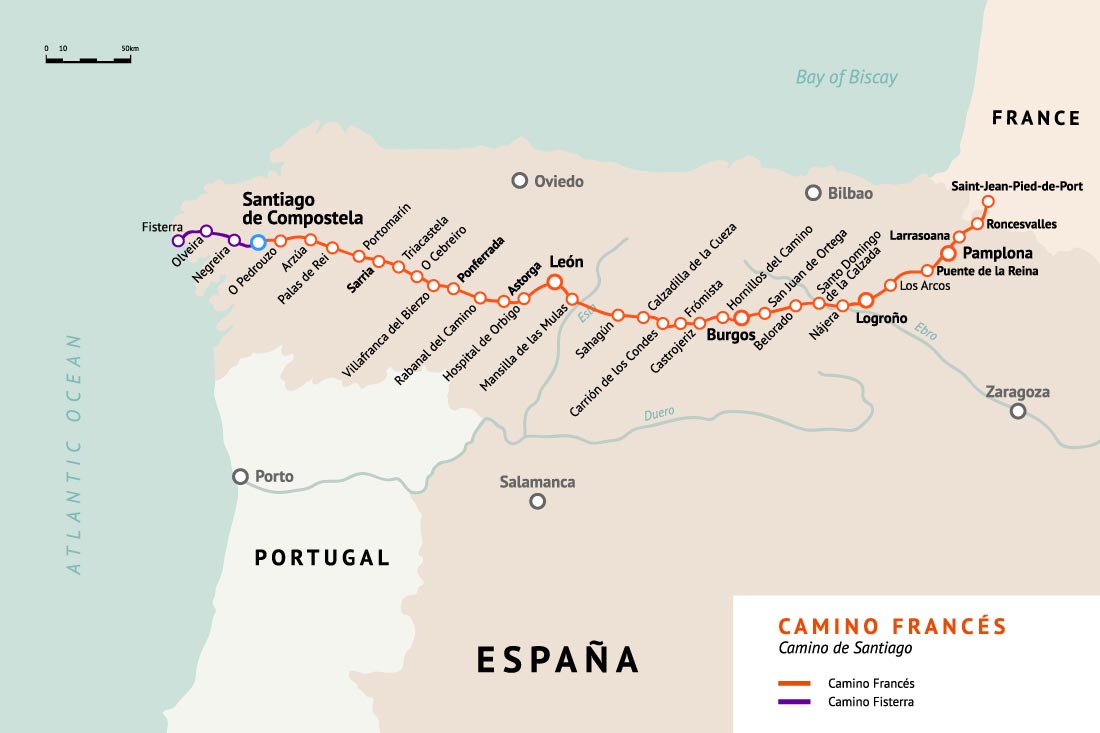
The Camino de Santiago is an amazing experience for nearly everyone. For some, it’s a once in a life time experience. For others, it is repeated regularly, it’s part of their life’s rhythm. Almost all are touched by what is called the Camino spirit. This is the combination of kindness, curiosity, and openness without judgement shared among the pilgrims and the people they encounter. Walking the Camino can be quite inexpensive. If you are prepared to sleep in a bunk bed inside a large dorm space and keep food expenses down, the total cost (other than transportation to get to/from the trail) can be as low as €35/day, €1200 to complete the full Frances route in a bit more than a month. Jackie and I stayed in places that provided a private bedroom (often private bath), and ate typical pilgrim meals with a few Michelin star meals mixed in. The cost for the two of us was $3300 for 32 days. Tour companies are happy to take care of all your arrangements, but this will be significantly more expensive (2-4x). Using a tour company is unnecessary, but for some, the simplicity is worth the expense.
Jackie and I had hoped to walk in 2020 but COVID happened. Shortly after my retirement in 2022 Jackie and I simultaneously realized we could walk the Camino. We completed the 500 miles / 800km from SJPP to Santiago de Compostela along the Frances Camino on June 7, 2023. I posted a follow-up Lessons Learned on the Camino and our polarsteps photo journal.
History
The Camino de Santiago started out as a Christian pilgrimage, but as interest has exploded, devout Christians are small portion of the >400,000 people who travel along “The Way” each year. In May 2023 an average of 500 people were leaving SJPP each day, and even more people were doing the last section starting in Sarria. For people used to the “typical” wilderness thru hikes like Appalachian or Pacific Crest Trail it would be useful to read Ten Reasons not to Hike The Camino de Santiago and a counterpoint What you can expect from the Camino de Santiago. The Camino is much more social and a lot less wilderness.
For some background / history check out 2000 Years of the Pilgrimage which starts with the life of James and ends in the 21st century. In the 9th century pilgrims couldn’t hop on a plane to return home once they reached the “destination”, that was just the half way point for their journey. The goal of the pilgrimage was to visit Santiago de Compostela Cathedral which is reported to hold the remains of the Apostle James. We don’t know for certain it’s James, but it was someone very important in the Christian community from the 1st century. The space was treated as special (no other burials) through the 8th century when it was publicized as the burial spot of James. Over time several common routes to this spot developed and then were forgotten. In the 1950s there was a renewed interest in the pilgrim routes and a program to welcome pilgrims was developed. Through the 1980s there were very few pilgrims. In the early 1990s the president of Galicia started to promote the pilgrimage and arrange for the municipal alberques to be built. Next, numerous associations sprung up such as the American Pilgrims which has local chapters such as Northern California.
Physical Preparation
Walking ~15 miles / day for 30+ days is challenging for most people, even those who are young and fit. On our walk we encounter many people who were struggling with the constant walking. The majority of people didn’t have trouble with the aerobic demands of say going up the steeper hills, but rather the accumulated wear and tear on their lower bodies due to walking miles day after day. Nearly everyone had sore feet and muscles. The most common issue was blisters which will be addressed later. Some developed more serious conditions such as achilles tendonitis, plantar fasciitis, or shin splints. All of these come from people placing a significantly higher load on their feet and legs than normal.
The best way to prepare for the Camino is to slowly increase the amount of walking you do each week. Doing a long walk each weekend is not going to be sufficient. In the running community there is a rule of thumb: your weekly mileage should be 3 times the race distance you are training for. Long distance walking isn’t running a race, but I think it’s a good starting point. In the case of the Camino this would suggest that if you are planning to do 15 mile days, that you should walk >=45 miles in a week, with at least one day that is close to the average day you plan to walk on the Camino. I would recommend work up to doing 3 miles each morning and evening (listen to a podcast or audio book if you need to make the most of your time) 5 days, and a 15 mile walk once a week. You could also look for ways to turn your daily activities into walks. For example, I typically walk to get groceries. Since I have to carry the groceries home this means that the trips are more frequent. A nice side effects is our food is fresher.
When doing your training, it’s important to carry a backpack that has the same weight you would be carrying on the Camino and using the shoes you will wear on the Camino. The slope of the shoe from heel to toe (called the shoe’s drop) changes the demands on your muscles and especially your achilles tendon. Many people wear shoes with moderate to high heels in daily life and use shoes which are near zero drop on the Camino. This can lead to achilles tendinitis.
The book Fix Your Feet is filled with valuable information for people doing long walks.
Mental / Spiritual Preparation
Some people do the Camino as a tourist. That is collecting a set of experiences and crossing the activity off a “bucket list” while staying as comfortable as possible. My perspective is that walking the Camino, especially if you are doing the full Frances Camino, is too much of an investment to approach the journey merely as a tourist. We did the journey as pilgrims. Jackie and I walked with an intention to be open to all we would experience, and to be a blessing to all the people we encountered.
Pilgrimages provide an environment to step outside everyday life and encounter something greater. Pilgrimages typically involve facing challenges. Pilgrimages aren’t meant to be easy or “relaxing”. It is said the Frances way has three distinct sections. The body: which challenges you physically as you adapt to walking 15 miles a day or so. The mind: between Burgos through Astorga where the landscape can be a bit monotonous. The final section is the Soul where you’re finding your true heart.
I was considering doing a 30 day variant of Spiritual Exercises of St Ignatius. I started a thread asking if there was any material / recommendations combining the exercises and the Camino. Based on the feedback, I decided that the Camino de Santiago will be too social to be fully immersed in the Ignatian exercises unless I joined a group lead by an experienced director. Doing the spiritual exercises as a walking retreat might be best done on the quieter Camino Ignaciano some other time. Rather, this might be the opportunity to really listen to my fellow pilgrims.
The best mindset is to lay aside expectations and to embrace the moment by moment experiences. Allow yourself to slow down and notice what you are experiencing on the Camino.
Nancy Frey has documented how Smart phones and WiFi has altered the Camino experience on her site Walking to Presence. For many people this has resulted in a deeper connections with “home” during the Camino, and less of a connection with people on the Camino. I believe everyone should think carefully about how much they will make use of connectivity. Our experience was less is more. To focus on being present with the people and environment you are experiencing on the Camino, and not worry about “back home”.
We removed most apps (especially social media, and filtered email). We used a route guide, map, translation app, bible, audio recorder, and a daily devotional app. We also have WhatsApp installed, not to interact with people back home, but to manage reservations and coordinate get togethers with pilgrims we met. The one exception was we installed Polarsteps which we posted to, but never look at feedback. We decided to using polar steps for two reasons. Most important was to honor a request from Jackie’s father who wanted to follow along because he was unable to join us. Secondly, it forced us to daily record a bit about the day.
Timing and Route
The common view is that the best months are April, May, September, and October. You are missing the worst of the summer heat and the crowds due to school being out. You also miss the harsher weather / closed services during the winter. The temperatures in the fall and spring are cool which is perfect for hiking in, generally (7-18C, 45-65F) though it could be colder or warmer. It is likely there will be several days of rain in the spring. The fall has less risk of rain, but larger crowds. I would note that during holy years there are typically an extra 100k catholics walking the Camino. The next holy year is 2027.
Any of the guides listed below will provide all the information you will need to plan a journey along the Camino de Santiago. An easy starting point would be the online planning resources from the Village to Village guide.
All the guides break the journey into daily stages. Most complete the journey in ~33 stages. Many of the stages are identical across the guides with slight divergence and then resynchronizing in a few days. Jackie would like to do the Camino Frances again at a slower pace. The standard 30-33 stages provide enough time for the walking, house keeping, and experiencing community with fellow pilgrims, but not enough time to fully explore the history, culture, and architecture. The traditional first stage from SJPP is one of the longest and toughest. Discussion of how to handle it / where to stay.
Traditions & Important Sites
Remember loved ones lost with wooden cross along the way
Drink Rioja wine from fountain of Bodegas Irache, just outside Estella (early in the typical stage 6).
Leave a burden behind, symbolized by a rock from home (or maybe the laptop you are carrying) at Cruz de Ferro, the Iron Cross (stage 24)
Wash in the stream at Lavacolla, just outside Santiago. In ancient times there weren’t showers each night. The pilgrims would wash and change into their best clothing to enter the city.
Pilgrim’s Mass (offers in serveral locations)
Zero Days
Some people plan “zero days” to explore a city’s sights and sounds. Other times zero days are to recovery from an injury or illness. The best recommendation is to take a zero day when you body tell you to, and skip zero days you might have planned if your heart wants to continue to walk. Commonly recommended towns for zero days:
stage 3 – Pamplona (lively town, food). I think it’s a bit early, but helpful for people who aren’t experienced walkers who might need to swap some of their gear, get a massage, etc.
stage 7 – Logrono (good size town known for wine and hundreds of tapas places, especially along Laurel street)
stage 13 – Burgos (arch, museum, cathedral)
stage 20 – Leon (arch, food, I think the most beautiful cathedral in the world)
stage 22 – Astorga (arch)
stage 25 – Villafranca
The follows are some towns which the community has indicated are good places to consider if you want a quiet rest:
stage 5 – Estella
stage 10 – Santo Domingo or Grañón
stage 14 – Castrojeriz
stage 17 – Villalcázar de Sirga
stage 18 – Sahagun
stage 19 – Mansilla de las Mulan
stage 26 – O’Cebriero
Interesting Sites (History, etc)
The follows sites / towns might be worth exploring as you pass through:
stage 28 – Arthur Lowe’s art studio on main trail, 1 mile from where the detour to Samos splits off
stage 28 – Samos monastery (if you take the detour)
Festivals Along the Way
An incomplete list which of seasonable festivals. See moon guide for additional festival. Here is a sampling of festivals
Festa do Cocido in Lalin, February
Easter, Sunday, April
Festa do Maio – celebrations in Villafranca, Pontevedra etc, end of April, beginning of May
Ascension, May
Fiestas de San Bernabé in Logroño, June
Saint John and Midsummer celebrations take place in many other seaside towns and also in Santiago de Compostela, June
Sleeping & Housing
There is a huge range of housing. The cheapest is using a tent or staying in one of the free alberques in the dorm. Most alberques will be between €8-15 for a bed in the dorm. Private rooms run between €30-60. There are some very nice inns, hotels, and AirBnB that are €60-100 / night. Finally there a luxury, 5 star hotels such as the Parador properties which are in restored historical buildings and cost hundreds of € / night.
Nearly all the land along the routes are privately owned. Historically it’s been harder to find a camping spot than a bed in a alberque (hostel for pilgrims), hostel, or hotel. Most years I would recommend forgoing camping and leave the typical back country backpacking gear behind (tent, stove, sleeping pad, sleeping bag warm enough for outdoors, etc). The 2023 season seemed to be stressing the system due to a backlog of pilgrims whose trip was delayed by COVID, and a number of alberques that haven’t re-opened since the pandemic. I would still recommend using the alberques, just that you should make reservations.
Alberques (guide to alberques) are the cheapest, most available, and more common option. All alberques have dorm style housing. Many have communal dinners or a common kitchen. Linens and blankets are often not provided in the dorms… so unless you have have made reservations for every night and confirmed they will provide all you need, you should plan to bring a sleeping bag, or a sleep sack + quilt/blanket, a towel and at least a bit of soap. More on this in the gear section. The downside of the dorms is that you don’t have privacy, snoring and others moving around can interrupt sleep. Ear plugs and sleep masks are highly recommended. Many of the alberques have private rooms for extra money which often have ensuite bathrooms and provide linens and towels. Jackie and I think that a private room in an alberque is ideal, allowing a good night of sleep, intimate time as a couple, while experiencing community with other pilgrims.
There are also hotels, guest homes, pensions, and inns which provide housing. If you are traveling during peak season I would encourage pre-booking accommodations a few months before your trip. If you have a reservation and don’t need it, please cancel it.
Many people worry about bedbugs, especially in the alberques. We didn’t encounter any bedbugs nor did anyone we traveled with. From reports I have read online and from friends’ experiences in previous years bedbugs will be found occasionally but are uncommon. If you stay in a location that has bedbugs, there is nothing that can guarantee you won’t be infected. There is some evidence that treating your sleeping gear with Permethrin will provide some protection. If you end up picking up bedbugs, washing your body throughly and then washing all your clothing and gear in 140F water will kill them.
Packing & Gear
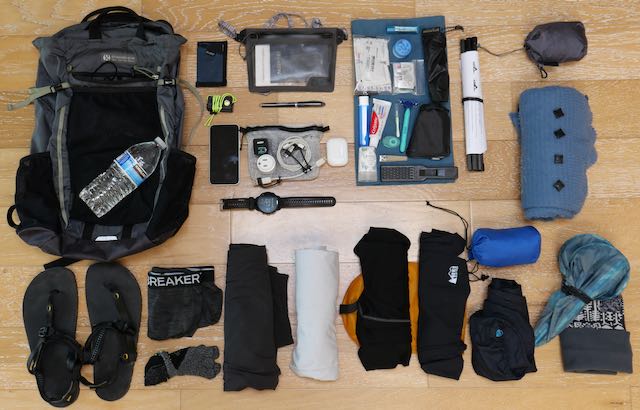
My original packing list had a base weight of 5.5lb and could fit into a 14l bag. At the end of the trip I updated my camino 2023 lighterpack list to include everything I carried on the heaviest day including several items I won’t take in the future. The picture below is nearly everything I carried or wore:
On the walk I picked up some skin lotion and a 15l folding messenger bag to used after this trip (we don’t have Decathlon in US). There are a few items I added at the last minute (packing for fears) that aren’t in the picture and generally weren’t used. When Jackie’s Achilles tendon started to hurt I carried a few of her items. This raised my “base” pack weight to 7lb. The heaviest total weight was 11 pounds when I was carrying extra water and a fair bit of leftover food / snacks.
Everyone I have talked with that wasn’t an experienced light-weight onebag traveler or ultralight backpacker said they brought too much stuff. They often either gave away the unnecessary items, shipped them home or to Santiago. Several people who have done multiple Caminos told us that any item not used by the time you got to Burgos isn’t needed, and you should be dropped. I encourage everyone to treat the Camino like a pilgrimage and leave behind excess baggage and live in the moment. I have some general notes about packing light aka onebag travel which might be helpful to someone packing for the Camino. There are people who go even lighter such as such as Tim Evans’s 7L fanny-packing list for Shawn’s 7-10l fannypack packing
Example Summer Packing List
It’s pretty warm in the summer and you don’t need to bring a lot.
Hiking clothing made from thin nylon, polyester or merino wool which can dry overnight. My recommendation would be:
nylon hiking pants that are quick dry like Outdoor Research Ferrosi, prAna Brion or a hiking dress
fast dry shirt that is high UPF like ArcTeryx Cormac, OR Astroman, Mountain Hardware Crater Lake, or if UPF 15-20 is enough for you, the very comfortable OR Echo
non cotton underwear. Light weight bra or swimsuit top.
insulation: an alpha direct hoody, 100wt fleece, or sweater made of wool, alpaca, or cashmere.
sun hat: something with wide brim or veil such as those made by sunday afternoon
small first aid kit focused on foot care: compeed bandages are great for protecting skin about to blister
toothbrush
water bottle such as reusing a smart water bottle
a 50F rated sleeping bag or sleep sack + a light blanket/quilt if staying in hostels / albergues
Modest size travel towel if staying in hostels, or maybe even if you are staying in full service hotel every night: see towel entry, hitchhiker’s guide to the galaxy.
When needed (which is less frequent than you might expect) you can wash you hiking clothing in a sink, shower, or machine if one is available. That’s all you need.
Hiking poles are not generally necessary, though if you are used to using them, bring them… just remember they have to be checked baggage when flying. If everything else you are bringing is carry-on, you can use a cardboard “poster tube” to ship your poles.
In the spring and fall you would want to add insulation, and extra pair of socks in case they don’t fully dry over night, and maybe rain pants or a rain skirt.
Pro Tip: Don’t bother with “dress up” clothing while walking the Camino. Restaurants are used to pilgrim attire: shorts, tee shirts, slides/sandals. If you need fancy clothing on a trip paired with your “Camino”, ship them to Santiago to be stored until you are done, no reason to carry them while you are walking. There are a number of services such as Casa Ivar which can help. Jackie and my first stop after the Camino was the UK. After after spending a week in Paris, before walking the Camino, we posted our extras including “dress up clothing” to a friend’s home in the UK.
Footwear
The single most important item you bring is footwear. I think minimalist shoes are the best way to go IF you have used them for at least six month. Otherwise I would generally recommend wearing trail runners or hiking oriented sandals. Sandals are often seen as people recover from bad blisters which makes me wonder if they won’t be the best “shoes” to start with. I have written up a brief comparison of boots vs trail runners. It’s important that you use whatever footwear you have selected (or identical models) for an extended time before the Camino to give your muscles a chance to adapt. For example, going from traditional shoes with a heel to zero drop trail running shoes is a good way to end up with achilles tendonitis. For people who are prone to getting blisters I would recommend sizing up your shoes by 1 size and wear 2 pairs of socks: a thin liner made of coolmax or nylon closest to your foot, and a thick wool sock worn “inside out” so the fuzzy part is against the shoe, and the smoother side is facing inward toward the liner and your foot. Another good option are Xoskin toe socks. I have zero blisters after walking thousands of miles in Xoskin toe socks. I had pre-blisters from other socks heal while wearing Xoskin socks while doing 15 mile days.
Backpack
The second most important item is your backpack. People who complete the Camino generally use outdoor oriented pack which are between 20-40L in volume. For people carrying less than 10 lbs, there are many good options. If you are carrying more than 10 lbs you will want a pack that has a hipbelt which is capable of transferring the majority of the weight to your hips rather than just stabilizing the pack. I have a post about selecting a good trekking pack.
Sleeping “Gear”
Most people walking the Camino will spend one or more nights in an albergue dormitories which are often mixed genders in the same room. You should have some clothing to sleep in. Tip: if you are in the bottom bunk near the wall, you can hang your towel to provide a bit more of privacy.
Albergues typically don’t provide linens. Many pilgrims bring a light weight sleeping bag (rated for 40-50F) which removes the need to worry about sheets and blankets. I prefer to use a silk or nylon sleep sack which is paired with a light weight quilt or blanket. When it’s warm you can use just the sleep sack. A good quality down backpacking quilts can cost $300, but if you only need enough insulation for sleeping inside (say rated for 55F), then there are a number of light weight down or synthetic outdoor blanket / quilts which are less than $100, such as hangtight shop blanket. Costco sometimes has a down throw blanket for around $25. A classic poncho liner, aka woobie is another option. Some folks find that just a sleep sack combined with their outwear can work. Clothing which are warm enough for “light work” in 40F (a typical spring morning) should be warm enough for sleeping indoors when the room is >=60F. I used a sleep sack and a piece of Polartec Alpha Direct 90gsm fabric which was used as a blanket at night, and as a scarf, shawl, vest, or poncho liner during the day. I wrote up a description of this in a post about my poncho system.
Keep it Light
For people who are used to luxury & comfort, don’t just prepare yourself to “rough it”, but embrace a simple and more communal experience. It is especially important to minimize what you bring because you will be carrying everything for many miles each day. If your bag feels heavy before you start walking, you are bring too much and it will get worse as the days progress.
Conventional wisdom is that people should carry a backpack that’s <25% of their body weight. This is reasonable for moderate distances but will be fatiguing on a longer hike. There were several experiments evaluating how pack weight impacted soldiers physical performance. A key finding was that on all day exercises, fit/trained soldiers had a measurable increase of fatigue and a drop in agility when they carries more than 10-12% of their lean body weight. This matches my personal experience: I feel no more tired at the end of a 20 miles carrying 17lb as compared to carrying no pack. My one caveat that when over 8 lbs I need to shift some weight to my hips or shoulder pain will be fatiguing through the day. My wife found her sweet spot is <7lb.
Some people ship their bag(s) town to town via a transfer service and carry a small daypack which holds only what they need for the day. This costs 4-6Eu for one time, and around 150Eu for an entire journey. I would recommend not planning to do this as a regular practice, though it can be useful if you are trying to recover from an injury or fatigue. If you going to use a transfer service I would recommend using a duffel which does not need to be expense. We saw a number of people using $4 Ikea frakta duffels. Realize that mistakes can be made, and you might find your transfer bag misplaced for a day or two. For people who are finding lodging as they go, using a transfer service can add stress and complications since you don’t know where to ship your bag on days you don’t have a reservation. Warning: Several traditional alberques have banned “suitcases” or transfer services from delivering because the alberques exist “to serve pilgrims, not tourists.”
It’s better to bring twice the money you think you need, and half the stuff. It fairly easy to pick up items that you forgot, lost, or are damaged along the way. Worse case is a 20 minute taxi ride to a larger town. Several of the town along the Camino have a Decathlon store, which is the Ikea of outdoor equipment and clothing. There are also a number of stores which cater to nearly all the needs of pilgrims (shoes, clothing, backpacks, toiletries, etc) such as Boutique du Pelerin in St Jean Pied de Port, Caminoteca in Pamplona, Pilgrim Oasis in Carrión de los Condes, etc. Most of the towns have a small store near or on the Camino route which sell comfortable shoes (almost all sell Hoka) and some other items that pilgrims might need.
Food and Water
Unlike backcountry backpacking, you rarely need to carry much food or water because you will be in the next town before you need more. Generally .5-1L of water will be enough if you periodically stop at a cafe / food trunk for a drink and make use of the fountains. You will want more water on the hottest days. Before walking, you might figure out how much water you need. I discuss this in my post about water treatment and containers. You might want to carry some food with you when entering a less populated area on Sunday because the groceries / cafes / restaurants might be closed or have hours which are incompatible with your schedule. I liked granola bars and Laughing Cow cheese which doesn’t have to be refrigerated. Of course, if all the food options are closed you can treat it as a day of fasting.
Jackie’s Pack
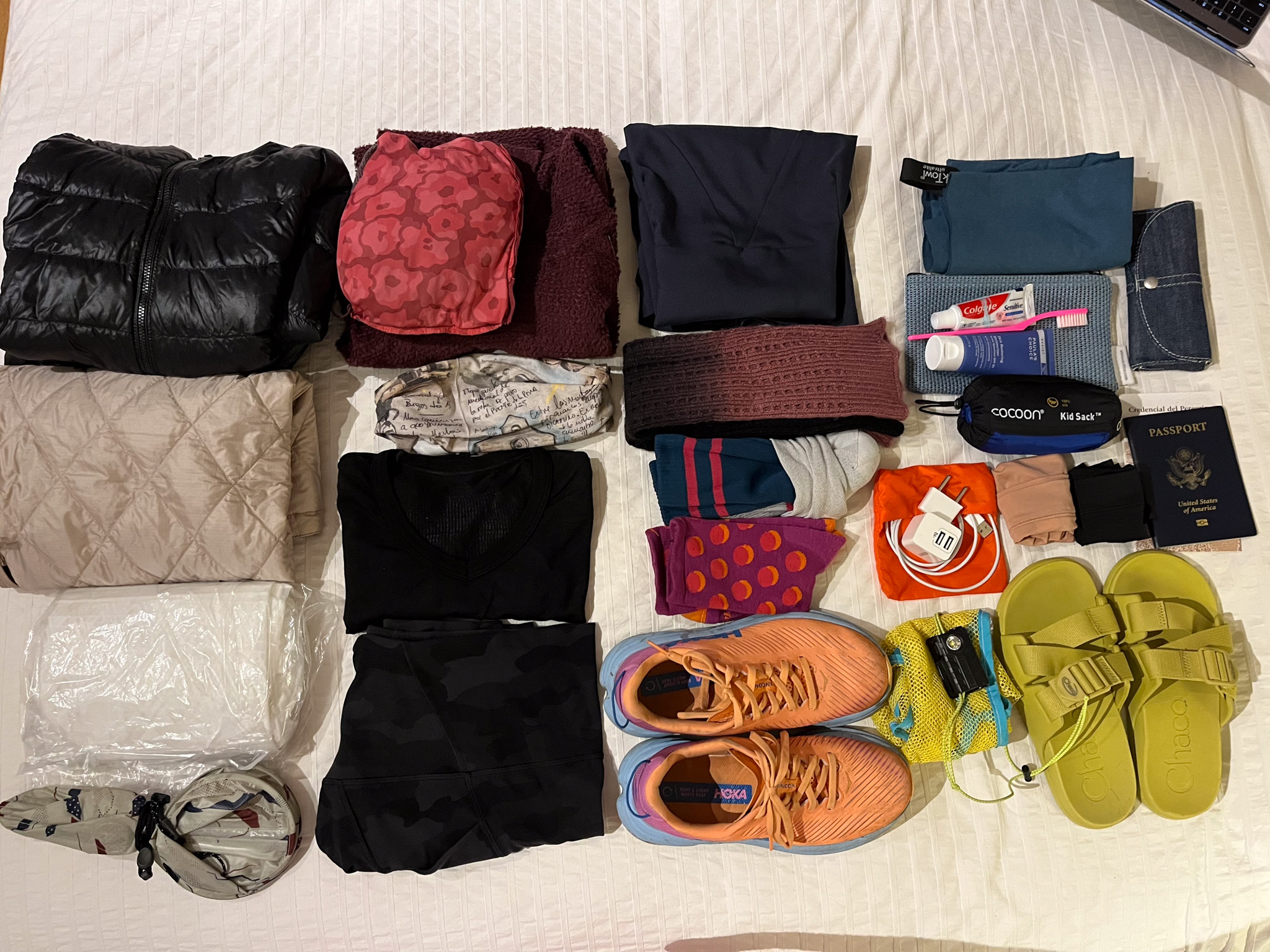
The following is a picture of the contents of Jackie’s backpack for the Camino. She used a 15 year old Camelbak hydration pack which was retired at the end of the Camino. Jackie runs colder than me so she brought more insulation that I did. While my strategy was to use my blanket for warmth during the day, hers was to use insulating clothing + a silk sack for sleep. This works well because night time temperatures inside the albergues required about the same amount of insulation as walking in the coldest mornings.
Outerwear
Clothing
Misc Other
Uniqlo Down Jacket Montbell Insulation Skirt Ikea Rain Poncho Montbell Umbrero Hat Macpac Nitro Alpha Direct Hoody Montbell Windbreaker Buff
Initial Items, Items Offloaded, “+” indicates items added. Buff wasn’t used. Waterproof socks used only a few times. Leg warmer not used after compression socks was purchased. Jackie didn’t bring first aid… she made use of the kit I brought.
Blisters
Jackie and I have been blister free, even for extended journeys like 500 miles of the Camino from SJPP… but we seemed to be exception. Many (most?) people get blisters on extended trips, especially people wearing hiking boats. Most people were able to manage their blisters and continue to walk. A significant number of people we met on journeys like the Camino needed to add a zero day and/or take a taxi or bus to shorten their daily walking to give their feet time to recover.
The first step is to try to prevent blisters. Blisters develop when your skin is exposed to friction, especially when wet or hot. Most important is to remove friction, specially lateral shear forces (good short video). This means that you shoes need to be roomy enough for your toes to splay without being so large that your feet slide around. If you shoes / boots are stiff, you will need something that provides a cushioning. Wearing two socks, a thick wool sock turned inside out, and a thin synthetic liner sock is one of the most effective solutions. More information about this on my recommended socks page. You also want to keep your feet dry when possible. This is typically best achieved by wearing fast drying, well ventilated shoes or sandals. Avoid waterproof shoes and boots. In rain they don’t really keep your feet dry due to feet sweating, and they hold moisture when it’s dry.
Second, as soon as something doesn’t feel right apply treatment, don’t wait for a blister to appear. Sometimes changing your laces or adjusting your socks is all that is needed. Most of the time adding something to protect you skin. My experience is that KT-tape and Compeed blister bandages are the most effective treatments. Duct tape works pretty well. Some people swear by “hiker’s wool” but I have no experience with it. I don’t find Moleskin very effective.
Third, if you develop blisters treat them. Start by draining them and then clean gently. Next you need to make sure they don’t get worse. One option is to leave a small thread in the blister to allow it to drain and then put a breathable protective bandage over them. The method I use is to squirt a bit of superglue (I bring some single use tubes) into the blister. This keeps the loose skin from tearing and makes a durable barrier which protects the tissue under the blister.
For more information about caring for your feet, read the book Fix Your Feet.
Guide Books and Apps
There are a variety of guidebooks and applications designed to help people successfully navigate the Camino de Santiago. All the guidebooks provide information about the route itself and places to stay. Some provide a day by day schedule. Others provide information which allows the pilgrim to decide were they want to stop.
A Pilgrim’s Guide to the Camino de Santiago by John Brierley is the classic english language guidebook (don’t buy it in kindle form, terrible formatting, no hotlinks!). It breaks the route into discrete stages. Many people follow his stages woodenly which typically means that the villages listed at the end of each stage will be more crowded. Brierley includes selection about ‘the mystic path” and “personal reflections” which can be enriching, but annoy speople wanting a purely practical guidebook for a long hike.
Moons Guide is the only guide which highlights food, and focused more on local culture, detailing local festivals and annual events but is somewhat dated. Several of the restaurants mentioned are now closed.
Wise Pilgrim is a very practical guide which is reported to be the best iOS/Android App. The app supports offline maps. The full content is available as a Kindle and Paperback book. Much of the content is also freely available of their website. Has booking.com links for any of the lodging that supports online reservations, and WhatsApp links for any lodging that can contacted that way which is great for non Spanish speakers. The paid version has the best offline map (which includes several of the alternative routes). Downside is that it sometimes crashes but always restarted.
TrekRight Camino Guide is a iOS Guidebook application. UI needs work but is one of the most complete online guides. Trail notes, offline maps, indications of service in town include grocery stores, some good details sbout each of the lodging locations. Missing booking links and WhatsApp contacts found in Wise Pilgram. Has a notes, flags, highlights flags.
Buen Camino De Santiago by Carlos Mencos is available for IOS, Android. What a bit awkward to set up, provides a nice view of your daily stages. Has incorporated a bunch of content from wikipedia and some video clips to provide background to the version towns along the Camino.
Camino Guides by Gerald Kelly is available as an iOS/Android app, Kindle, paperback, and a downloadable PDF. Gerald also makes a free version of the PDF available (which is missing maps and historical background).
FarOut (aka GutHook) is a hiking oriented mapping guide which focuses on the trail, water sources, etc rather than the towns. I don’t see the point with how well the trail is marked.
WhatsApp is used by many businesses along the Camino including a number of the taxi companies and alberquea.
Google Translate lets you communication with people you don’t share a common language with. Our experience was English and Spanish were the most useful / common languages used. We heard a significant amount of Portuguese, Korean, French and German. You can download language modules so the app can work offline.
The camera to help you remember people and places.
Resources
caminodesantiago.me is a very active online community run by Ivar Rekve, a resident of Santiago de Compostela.
santiago.forwalk.org is a very well done website. They have a number of “pre selected” routes / stages with information about what services are available with pictures and links to make reservations.
Route Planner which lets you choice start/end locations, and then select the villages you want to stop in (lists type of accommodations but no description of them). For these selections the website can generate a number of files including a path to be viewed through google earth, gps waypoints, and a schedule in a nice, spreadsheet readable table
gronze.com: in spanish, but google translate can make it quite useful
Metroblue: Best weather app I have found. The weather maps are really useful. iOS
Stories
I Will Push You – Wonderful movie about a great friendship. Patrick joins Justin to complete the walk. The journey would have been impossible for Justin to complete by himself due to a neuromuscular disease.
TrailJournals: Camino de Santiago is a site which originally was used by long distant hikers for the Appalachian and Pacific Crest Trail but now hosts journals for other trails including the Camino de Santiago. I particularly appreciate Slow Walkers (first) 2007 journal… he has more recent entries as well.
The Camino is steeped in history. Having a sense of the history and culture and enrich the journey. While walking the Camino you will pass some classic architecture. Some resources to appreciate this background:
The Pilgrimage Road to Santiago: The Complete Cultural Handbook by David M. Gitlitz won’t tell you anything about the modern cities, hostels, or amenities but will give you an in-depth look into the history of the path you are walking.
Iberia by James Michener isn’t about the Way, but provides a good amount of background about this region of Spain.
Be curious and ask questions of the people you meet. There are many amazing stories you will hear, and many reasons people are walking the Camino. Good questions: “Why are you walking the Camino?” “What have you learned during your walk?” “How has the Camino changed you?” “What are some of the hightlights of your walk so far?”
Make a list of people you meet and take pictures of help your memory. Maybe consider asking how you could pray for them and make prayer cards.
Get used to Spanish schedule. Breakfast is a slightly sweet pastry and a coffee, maybe a spanish tortilla. Lunch is generally 1:30-3:30. Dinner starts at 8 PM. Many stores are closed in the mid afternoon and on Sundays.
As you enter new cities look for a poster with a list of local taxi phone numbers and take a picture in case you are injured and need transportation. Often in the entry of hostels, sometimes there is a poster near the entry / exit to the town. When you take a new picture delete your old picture. For non Spanish speakers, try putting the number in to WhatsApp or iMessage and see if they are on one of those platforms. If so, you can send them messages which includes your location and your request that you translate into Spanish using a translation program.
If you are having trouble finding a place to stay on the Camino look a few km on either side, There are often hotels and guest homes that are pretty close, several will offer free pickup and return to the Camino so you don’t have extra walking.
Walking takes hours to go between towns, but a taxi and bus takes tens of minutes. It’s pretty quick and not that expensive to return to a town to retrieve something you left behind. Realize just because a town has buses doesn’t mean they have buses that go to where you want to go.
Once a week stay someplace with a washing machine. They are way more effective at cleaning clothing than hand washing.
If you are bring a cell phone, have WhatsApp loaded. It seemed to be the universally used communication tool along the Camino for many businesses and most of the pilgrims. Take a screen shot of your QR code (settings, click on the QR code icon next to your name). If you don’t have connectivity and want to exchange contact information with someone just have the scan or take a picture of your QR code which will save the hassle (and eliminate errors) of them getting your contact info.
Each morning I would stop at first church I came to that was open. I would go inside, if there was a nun present thank her and then sit down to reflect of what I had to be grateful for and then to pray for the coming day and the people I had met along the way. Doing the make the rest of the day better.
If you walk from SJPP, prepare for things to change in Sarria. There are many more people and many are more tourist than pilgrim. First, don’t judge them, everyone is walking a different road. It will be much harder for them to experience the Camino spirit, but try to share it with them. To avoid the massive crowds try leaving before 7am or after 9:30. Most of the tours / packaged trips have a breakfast which is between 7-9am.
If you want to get a Compostela, use the pre-register website a couple of days before you finish and get a barcode. You will likely be in and out in 5 minutes rather than waiting in line for hours.
For people biking the Camino… have a bike bell. Its sound is pleasant and universally understood. Saying “coming through” only works if people understand you language and is more jarring that a bell.
Re-Entry from a Pilgrimage
Many people talk about how jarring it is to return to “real life” after a pilgrimage like the Camino. After a month of a slow paced life characterized by simplicity, quiet, and community they found themselves facing a hustle / hurry culture that is filled with noise and often more oriented toward competition than community. It is easy to get overwhelmed and to return to old patterns and habits, leaving the Camino experience something remembered fondly, longed for, but divorced from daily life. As I have talked with people about their post Camino experiences there are several things which seem to have kept the Camino spirit alive for many. The following is a summary of the advice I have heard about how to live into the Camino experience once the walk is complete.
Set aside some quiet time (ideally a week or more) between the end of your Camino and starting back to “normal” life to have time to think, pray, journal, and reflect on your experiences. Identify what you learned, how your perspective has changed, how your values have shifted or strengthened. Ask yourself what is important in light of your Camino experience?
Consider your life before the Camino and ask the question “How did my pre-Camino life align with my post-Camino understanding?”. It is likely that you will find places the two don’t align. Realize that if you don’t make explicit changes, your post-Camino life will likely look exactly like your pre-Camino life.
Identify changes you would like to make as your return to “regular life”. Many try to change everything, fail, and quickly give up. Rather make a list of things you would like to change and then decide on one item you will start with. Break it up into manageable steps and find ways to turn it into a habit and then a lifestyle. The book Atomic Habits is a great resource for this sort of planning. Once something has gotten established, look at your list and make the next change.
The most common change I heard from people was making sure they left slack in their schedule so they weren’t constantly forced to react to life. There were moments to reflect and choose a response. Many found that adding a time each day to just be was key. For some this was time to sit, reflect, and maybe write a few sentences in a journal. For others it was a quiet walk in their neighborhood or a nearby park.
The second most common change I heard was people striving to build a genuine community. Often, they had been part of some sort of a community before the Camino, but the experience fell far short of their Camino experience. In some cases people have found that by intentionally investing and initiating in their community they were able form a genuine community. In other cases people realized that where they were putting their time wasn’t working and that they should try something different.
Set a date for your next Camino 🙂
All of these items suggest that what’s key is to identify what you loved about the Camino and then to identify little things which will remind you and keep your grounded, anchored to those things.
I am not in control. I am not in a hurry. I walk in faith and hope. I greet everyone with peace. I bring back only what God gives me.
I recently talked with a student I mentored years ago about some mid-life course corrections he was considering. This prompted me to think about my mid-life transition in 2011-2012 as I grappled with losing Libby to cancer. The follow is a remembrance of what changed then, and how I think about these issues ten years later.
TL;DR
Live in the now. Leave slack and hold your plans lightly.
Take care of your health. Life is more enjoyable and you are more able to care for others
Prioritize loving people. Initiation and be present
Simplify! Focus on the essential so you don’t waste your time on lessor things
Spend time in nature to have your perspective adjusted and experience awe.
There is also a part II about perspective on money 10 years ago, and part III what I am thinking now.
Live Now, Hold Plans Lightly
In 2009 my wife was diagnosis with breast cancer. We knew she wasn’t going to beat the cancer, but we had hopes (plans) that she would be able to see our junior high aged child graduate high school and successfully launch into life. Unfortunately, Libby’s health declined more quickly than we expected. After a couple of years we knew that Libby wasn’t going to be able to see our child finish high school. In the spring of 2011 we thought we still had a few years. We made a plan to proceed with a “normal life” for our child’s sake, and that when there was around a year left for me to stop work and doing whatever would be most meaningful to Libby. We did decide that all our vacations would be to places on Libby’s “bucket list”. That summer we took the one and only such trip: Alaska. In September Libby’s health took a sudden turn for the worst and we realized we didn’t have a year left, likely just a few months. I took a short term leave of absence from work to care for Libby. It turned out we had just a few weeks before she died. All my plans fell apart.
After a few months my short term leave was ending and returning to work was looming. I wasn’t sure how to hold everything together when I returned to work. I shared my feelings with a friend. He asked “Are you going back to work now because you need the income or just because that was your plan?” I indicated that finances didn’t force me to immediately return to work. He encouraged me to take a year away from work and not worry or plan for the future. I immediately I felt a huge relief. I contacted my boss who graciously accepted my resignation. Over the next year I was free to attend to daily life. I enjoyed the time so much that I extended my break from work into a three year sabbatical.
I decided that during my break I wanted to step away from the “go go” Bay Area culture. When I moved to the Bay Area in 1992 I noticed that that people overfilled their calendars with a heavy bias toward succeeding in their career. A response to “Want to get a beer / ice cream / whatever this evening?” was “My daytimer has a 90 minute slot open 3 Thursdays from now at 7:30, should I pencil you in?”. I tried to resist the drive to be consumed by activity and leave time to care for others. I set aside a couple of evening each week which I won’t pre-schedule, so I could have slack to response to unexpected needs or opportunities. Over the years I had allowed the slack time to be filled up, often by work that wasn’t completed during the day. I also noticed that I was so intent on “making a difference” that I experienced what Watchman Nee called “The Thing in Hand”: being over committed and unable to response to an opportunity which were infinitely better.
I decided that I wanted to be quick to respond to immediate needs and slow to make long term commitments. I was inspired by the story of the “good Samaritan”. I felt challenged to think about how to engage the world around me. In the story a number of people were too busy, or maybe too callus, to care for someone in need, while the hero of the story took the time to care for a stranger. During my sabbatical I committed myself to be open to whatever opportunities that came up.
I was deeply moved by the book A Praying Life by Paul Miller and inspired to cultivating a more contemplative life rooted in prayer. This seemed like a great antidote to the over committed lifestyle. I signed up for a nine month Ignatian Exercises program at the Mercy Center. As a result of these influences I found that I was more grateful and more accepting of others. My perspective had shifted from asking the question “What do I want to happen?” to “What is God doing? How can I participate?”
In the following 10 years I got pulled back into the frenetic bay area lifestyle working for start-ups. I filled my calendar with more activities than was wise and found myself trying to figure out how to have the most impact in the world. Alas, I stopped looking to see what God was doing. I am striving to move back to a more contemplative life that is committed to loving my neighbor without an agenda, being less planned and more open to what God is doing.
Take Care of Your Health
Early in my sabbatical by son was concerned about my health and said he didn’t want to become an orphan. This broke my heart! The issue that concerned him wasn’t major, but I was stressed, overweight and out of shape. I knew this would ultimately shorten my life and reduce what I would be able to do. I decided I needed to take better care of myself.
The video 23.5 Hours produced by Reframe Healthlab motivated me to walk rather than drive whenever possible. I walked for at least an hour each day. My walks often combine a bit of exercise, completing an errand, and maybe talking to a friend, listening to a podcast, praying, or just enjoying being outside. I found that besides improve my fitness, walking encouraged me to slow down and be more connected. I found the time helped me be more mindful.
I joined a gym and started working out, improved my diet, and worked to get more sleep. I found that as my strength increased and my body composition improved that I felt better, had more energy, was sick less, able to take on all sorts of challenges that might have seem “too much” in the past. I also came to recognize that I function very poorly when in pain or sick. When I am healthy it is much easier for me to care for others. I have written up some details about having a healthy and fit life.
Today I am over 60, and am still gaining strength and continue to have small improvements in my body composition. I am a fan of Dr. Peter Attia‘s take on optimizing for healthspan and training for the centenarian olympics. I believe It’s well worth spending 1-2 hours per day in physical activities that promote health. This might seem like a lot of time, but the benefits are well worth the time, even for people who are “very busy”. I have let busyness impact my sleep, not been as careful to avoid foods I am allergic to, and allows stress to build which has resulted in me experiencing migraines. I am developing some new habits that will ensure better sleep and avoiding health issues brought on by my food allergies.
Prioritize Loving People: Initiation and Presence
Jesus said that the greatest commandment was to love God and to love others. If this is the greatest commandment, then we won’t go wrong centering our lives around building loving relationships. Articles about regrets people had at the end of their lives highlighted that most people work too much, and love too little. I have so much I would like to share about the nature of love, but that will have to wait for another day. For now let me provide a basic definition. Love is willing good toward someone else, independent of what you get in return. Love doesn’t have room for “keeping score” or taking revenge. Love is about caring for another person.
Libby’s and my relationship was far from perfect, there was genuine love in both directions. Losing Libby was a huge blow. On top of this, many of Libby and my friends pulled away after Libby died. I guess they weren’t sure how to relate to a young widower. Very few people initiated time with me. I wondered if this was because they saw me as too needy.
I discovered that the lack of initiation had nothing to do with me, it’s a common experience in the Bay area. I asked 47 people how many times someone (besides me or a family member) had initiated personal time with them in the past month outside of a work context. Only 2 people could identify this happening more than once! Several people then said “I haven’t initiate time either. I want to change that.” This led me to conclude that initiating time with others is vital to building loving relationships. I made a goal to initiate time with at least one person each day: share a meal, take a walk, work out at the gym, or just connect over the phone.
I found that presence is the greatest gift we can offer people. When we are with someone they are our focus. We aren’t thinking about what opportunities we are missing. We are attentive to the person we are with without any second thoughts. Recently a friend noted that being present with others in the midst of difficult situations was often the path to finding “Hidden Gold”, where we discover something amazing that we won’t have seen unless we were with people in the midst of difficulties.
Over the last ten years my initiating with others had wained and really dropped during COVID. There are a number people that I call at least once / week to catch up and a few people I regularly get together with in the area. In the last several years my amazing wife Jackie has kept me engaged with other by initiating gatherings, reminding me to initiate with others, and her engaging spirit whenever we are out. Jackie and I try to have others over at least once a week, mixing old friends and new acquaintances. We have found that having 6 people together is a really great dynamic. More than 6 always end up with multiple conversations happening at the same time. During COVID we set up our back patio so it was possible to have people over for a meal, talk, and maybe watch a movie while maintaining physical distance with good air flow. Of course I try to spend time with my family. My favorite time during the week is Saturday morning when Jackie and I hike together for a few hours and have an uninterrupted time to share our hearts with each other. I still recognize the value of being presence and strive to deeply listen. I am working to break my tendency to lookup information on my phone related to the conversation.
Simplify
My dad taught me to appreciate simplicity in all things. During my mid-life reset I decided to simplicity my life. To focus on what was important and strive to remove what wasn’t adding value. I tried to apply this in all areas of life. I started by adopting a minimalist approach to my possessions. Holding on to what added value and getting rid of what wasn’t useful or life giving. I then tried to apply this same approach to many areas of life along the lines discussed in the book Essentialism. I worked to simplify my theology, or more exactly, I focused my thinking on key truths and chose not to be so sensitive to the things of lessor weight. No exactly compromise, but to be less insistent. I have regularly seen the benefits of subtraction and also seen how hard it is.
Today I see many advantages which have come from embracing simplicity as a value. I see the freedom and ease of life that having less stuff has provided. We have watched several friends spending a number of painful months figuring out of what to purge and downside in preparation for moving. We have seen other friends whose weekends are often filled with chores to care for their home, cars, and stuff. Largely due to embracing a more minimalist life, Jackie and I were able to easily move our entire household over a weekend with just one day of preparation, and later to do experiments as a digital nomad with just a couple of days preparation (packing and prepping our home to be used by someone else via AirBnB). A focus on what is most essential and looking for simple answers has brought more peace into my life, and I think has enabled me to work well with a larger group of people.
Spend time in Nature
I have written a page about how it’s extremely beneficial to spend time in “nature”. I have little to add here. My mid-life reset included make time each day to walk, run or ride my bicycle among trees and nature. To be refreshed daily, rather than only making time on the weekends for outdoor activities. I have continued to keep this practice and am incredability thankful that I live in area that natural beauty is so easily accessed. When I feel stuck, frustration, when I am facing what seems to be intractable problems, I found walking among the trees in a local park helps me reset my perspective and gives me hope. When feeling completely overwhelms, seeing the powerful and untamed waves on the coast settles my heart. I often experience a sense of awe and wonder.
These days most western churches record their sermons and put them online. I expect that if a person dedicated all their waking time to listen to all the sermons preached on just one Sunday, they would died long before they listened to even half the recordings. The quality of these sermons is highly variable. Life is too short to waste time listen to poor quality sermons / podcasts. I created (and update) this post so it’s easy for me to share sermons / podcasts that I recommend.
Hebrews 10:25-26 state “And let us consider how to stir up one another to love and good works, not neglecting to meet together, as is the habit of some, but encouraging one another, and all the more as you see the day drawing near.” Listening to good sermons is no substitute to being involved in a good local church.
High Quality Church Podcasts
I regularly list to podcasts from the following churches
The following are church podcasts that have been recommended to me. I haven’t listen to them enough to have a strong opinion on them. Think of this as a list I plan to try at some point. The summary is provided by chat-gpt:
Grace Community Church Pastor: John MacArthur Podcast:Grace to You Known for in-depth, verse-by-verse Bible teaching.
Parkside Church Pastor: Alistair Begg Podcast:Truth For Life Offers clear and relevant biblical teaching.
The Village Church Pastor: Matt Chandler Podcast:The Village Church Sermons Emphasizes gospel-centered teaching.
I recently came across a wonderful interview which featured Eugene Peterson and Bono talking about the Psalms. I was touched by both mens’ humility, their genuine friendship, and their love for the Psalms.
There is also a nice follow-up series of mini interviews between David Taylor and Bono called Beyond the Psalms which are inline later in this post.
Art, U2 and My Life
I purchased U2 first album, Boy, as soon as it was available at my local record store and became a real fan after U2 played the Agora in April 1981. The concert was great: $12 for seats near the front of a hall that held several hundred other fans. At the time I couldn’t have told you why I liked U2… just that their music moved me.
Between first hearing Boy and U2 coming to Columbus I became a Christian. Before the concert one of my new Christian friends told me that a number of the members of U2 were Christians. I thought it was cool that a band I was into shared my new found faith, but I wasn’t going to see them because they were Christians. I was going to see them because I liked their music. My criteria wasn’t “gospel music”… it was that the music that moved my heart and told the truth, often music that was about justice, compassion, beauty, hope, or despair.
I was encouraged to cherish art by the writings of Hans R. Rookmaaker, Francis Schaeffer and the example of a number of Christian men who had been “in the faith” longer than me: Frank, Andy, Joe, Rick, and Doug. I didn’t subject artists or musicians to a narrow theological litmus test to be sure they matched my version of orthodoxy. I looked for truth and beauty and sought art, music, film that inspired or challenged me. I was not interested in passing judgement on the art just because the human creator didn’t conform to my narrow theology.
That’s not to say that I am a relativism, or that I believe each person has their own truth. I believe in absolute truth and am pretty sure I know what is true :). And yet, I am aware that I could be wrong so nearly every encounter could teach me something. Sometimes an encounter might strengthen my existing belief, sometimes it might lead me to refine or even change what I believed. As Salman Rushdie wrote:
ideas stood (or fell) because they were strong enough (or too weak) to withstand criticism, not because they were shielded from it. Strong ideas welcomed dissent. “He that wrestles with us strengthens our nerves and sharpens our skill,” wrote Edmund Burke. “Our antagonist is our helper.” Only the weak and the authoritarian turned away from their opponents and called them names and sometimes wished to do them harm.
This is a long way of saying that I don’t reject or embrace people or their work because the agree or disagree with with me. As a result, I haven’t bother looking for people’s hidden agendas or evaluating their complete theology or trying to gauge if they were a “true Christian”. Rather I ask the question “Is there something here for me to learn or to appreciate?”. In the case of U2, there are numerous songs which have touched me over the years. The day Libby died, U2’s 40 ran through my mind, helping me process my grief and encouraging my heart in a way nothing else did. I didn’t feel the need to ask the question “Are they really Christians?” or “Do they have an orthodox faith?”. I just needed some truth for my heart and they provided it by putting part of Psalm 40 to music.
Bono is a Shill?
I shared the video of Bono and Peterson talking with a number of my friends. I was surprised when one of my friends dismissed the video and indicated that they thought that Bono was a shill, not a real Christian. I was surprised by their viewpoint in light of the conversation between Bono and Peterson. I had a generally favorable view of Bono and U2. My friend was so concerned that I decided to look into their concern. After a bit of time my conclusion was that I saw no evidence that Bono is a “shill”. Rather I saw quite a bit of evidence that Bono has an authentic faith.
An Orthodox Faith
I found an interview with Bono which discussed some of his experiences growing up, his activism, and then explores the core of his faith. The link to the full interview has been removed, but there is still a clip which discusses Bono’s understand of who is Jesus. What I hear is that Bono believes
in a historical Jesus
who is the Messiah
who was raised from the dead
This certain meets the requirements of Romans 10:8-9 for an authentic faith. Bono uses an argument much like C.S. Lewis’ Liar, Lunatic, Lord debunking that Jesus was merely a good teacher. Bono certainly has confessed with his mouth what the Bible says is saving faith.
I also appreciated his understanding of how Christianity is distinct from other religions, namely grace rather than works or karma.
An Authentic Life?
I can’t know for certain that Bono’s words reflect what’s in his heart, and I think it’s very dangerous to judge other people hearts because we can’t see them, heck, we have enough trouble understanding our own hearts (Jer 17:9). We can attempt to discern what is inside a person’s heart by their outward actions, to look to see the fruit of the spirit in their lives, but this is a pretty risky endeavor. In the case of Bono I am inclined to say his external life and his words seem largely consistent with someone who is authentically following Jesus.
He is not shy to talk about his faith and willing associates himself as a christian even though this identification is likely more of a liability that an asset in collecting fans
He has invested his time and energy is advocating for the poor and the powerless, the very thing God asked of his people thousand plus times, Jesus modeled, and the Jerusalem church asked Paul to attended to (and he was delighted to).
He seems to have a humility. He regularly talks about how much he needs grace. He takes interest in other people rather being focused on himself.
He has a generous spirit
He seems to be devoted to his family
He expresses a real love of God’s word, seems to know it pretty well, and says he desires to have a life shaped by God.
Some areas he has been criticized
Advocating for the poor while owning several huge homes, a yacht and private jet
His business moved countries to avoid taxes while advocating the companies pay their share of taxes
Some of his charities seem to spend a significant portion of their money on sponsoring events rather than actually helping people (e.g. overhead ratio).
Some people say wealth and power corrupt, but I say they just remove people’s restrains revealing what’s in the heart. While Bono is quite rich, it has not turned him into a raging ego-maniac. This suggests a gentle heart. Bono is far from perfect as he is quick to point out himself. He, like the rest of us is in the need of grace. Bono seems to have an understanding of how grace is radical and life changing. He is not religious, but does align himself with Jesus, which is as it should be. We need more people who love Jesus while not being religious.
Other Material
A few links I found in the last day or two which I enjoyed:
beyond the psalms: short discussions between David Taylor (who made the Peterson&Bono Video) continuing this discussion. The videos are also embedded in this page below
In the book A Praying Life, Paul Miller asserts that we shouldn’t focus on prayer (the method) but rather God (the object). Miller has a very high view of prayer. He expect prayer to accomplish things. Not because we are somehow manipulating God, but because God cares and prayer is a key way that we communicate with Him. Prayers answered tomorrow? Maybe, or maybe in 20 years, or maybe 2000 years. And your prayers might be answered in a way that you wouldn’t have predicted and might not like, but God will do what’s best. Miller highlights how critical our heart is in prayer, and that prayer will change our hearts. I first read this book in 2011 and I found it disturbing in the best sort of way. This book changed my approach to prayer. I periodically reread it to continue to be reminded of how essential prayer is to life. This post started out as an email with a friend which mixed talking about prayer cards with some situations we both were facing. It took me awhile to turn it into a more generic post.
Besides challenging my view of prayer, I have adopted several of Miller’s practices. One of those practices was switching from a “prayer list” to “prayer cards” which he discusses in chapter 29 entitled “Keeping Track of the Story”.
Miller provided several example prayer cards with the follow general description of what he puts on his cards:
The card functions like a prayer snapshot of a person’s life, so I use short phrases to describe what I want.
When praying, I usually don’t linger over a card for more than a few seconds. I just pick out one or two key areas and pray for them.
I put the Word to work by writing a Scripture verse on the card that expresses my desire for that particular person or situation.
The card doesn’t change much. Maybe once a year I will add another line. These are just the ongoing areas in a person’s life that I am praying for.
I usually don’t write down answers. They are obvious to me since I see the card almost every day.
I will sometimes date a prayer request by putting the month/year, as in 8/07.
One of the things I love about this approach is that by praying the Scripture on the behalf of someone, I can be sure that I am praying for something that is within God’s will. I am in essence, agreeing with what God has already told me would be best. I am just asking for me to see His’ will be done. I find this very encouraging. Wycliffe Bible Translators has a nice articles about How to Pray Scripture Back to God.
In addition to cards for individuals, Miller encourages people to have cards which are more topical. He provides an outline of a sample deck of prayer cards that allows him to pray through his entire life. Some cards he prays through every day; others he rotate through, using one or two cards a day. How many cards to use for a particular area depends on the shape of your life. It is completely up to you. Here is an example of the cards Miller thought you might want to have:
4–10 family cards (one for each person)
1–3 people-in-suffering cards
1 friends card
1 non-Christian card
1 church’s leadership card
1 small-group card
1 missionary, ministries card
1–3 world- or cultural-issues cards
3 work cards
1 co-workers card
3–5 repentance cards (things I need to repent of)
3–5 hope or big-dream cards
I have adopted an electronic version of Miller’s cards which I store in Bear. There are many electronic note taking applications would work just as well. Some might use Evernote, Google Keep, Apple Notes, Microsoft’s OneNote, Anytype or specially designed apps like Inner Room. Contents are often sensitive and need to be protected. Given the sensitivity of some of my prayers, I would only use applications that protects the notes from others reading them. Note keeping apps that can keep the notes encrypted include Bear, Obsidian, Anytype, Joplin, Snote, Standard Notes, turtlapp or Apple Notes.
I have found my electronic “cards” have several advantages over a typical 3×5 card.
It is possible to attach a photo with can bring the person, situation, or group to mind quickly. Many electronic note taking applications have a “card” view which lets you see several cards at once, with the attached photo and the first few words visible. I find the picture often allows me remember my prayer without even looking at the full card. What’s more, the picture often makes me feel a bit more connected.
Since the card is electronic, it can be a bit more dynamic. I feel free to update the card.
I am able to keep track of history on the card. The most current scripture and issues are listed at the top of the card. Older issues are lower on the card. This is a great reminder of how God has been working in the past, which reminds us of His faithfulness.
I always have the cards with me because I always have my phone with me.
There is no danger of losing my cards since they are backed up
A little tip if you use Bear, or other electronic note system that supports tags. Create a Prayer “Tag” to keep all your cards together. Rather than using a single card for your small group, have a card for each person (or maybe each family), and then use tags to make it easy to pull up a set of cards related to a specific context such as small group, work, missions, online community, etc. For example I have tags Prayer, Prayer/Church Prayer/Neighborhood, Prayer/Family, Prayer/SmallGroup1, etc.
Below is an example prayer card with details changed to protect the person’s identity
John Doe
I Cor 15:58 Therefore, my beloved brothers, be steadfast, immovable, always abounding in the work of the Lord, knowing that in the Lord your labor is not in vain.
Sacrificially love even when it seems no hope
Continuing reconciliation with family
Children thrive in the midst of the chaos
Answered
Repentance for adultery and betrayal of wife and others effected
First of all, then, I urge that supplications, prayers, intercessions, and thanksgivings be made for all people, for kings and all who are in high positions, that we may lead a peaceful and quiet life, godly and dignified in every way. This is good, and it is pleasing in the sight of God our Savior, who desires all people to be saved and to come to the knowledge of the truth. For there is one God, and there is one mediator between God and men, the man Christ Jesus, who gave himself as a ransom for all, which is the testimony given at the proper time.
I was born during the transition from modernist era to postmodernism. Like a modernist I believe there is truth in the world which is discoverable and that there are absolutes. Yet, the uncertainty of our postmodern age requires me to acknowledge that knowing what is an absolute rather than situational “truth” can be difficult, if not impossible to determine. I have tried to live an examined life and regularly revisit what I belief in the light of evidence. The last forty years has greatly reduced the number of things I am certain of. I like to say I have many strong beliefs, most of which are loosely held.
Truth is worth pursuing though it can be threatening and uncomfortable. Truth can demonstrate we are wrong or show we are failing. Ignorance doesn’t make us less wrong, nor does it save us pain in the long run. It is far better to know for certain what is true, even when unpleasant, because that gives us an opportunity to go in the right direction. Proverbs 27:6 says “Faithful are the wounds of a friend, but deceitful are the kisses of an enemy.”
[toc]
True Truth
While it is not a popular viewpoint today, I believe in absolute truth, what Francis Schaefer called “true truth”. There is only one reality, one true morality, things are either truth or false. If two people hold conflicting views, they aren’t both right, though both could be wrong. The challenge is discovering what is true. This takes work and humility. Even if someone works to discover what is true, it doesn’t mean they will succeed.
Some things might be so beyond our ability to understand that we will never really know the truth, we will see only a small portion of the truth and come to an incorrect conclusion. This dilemma is captured in the classic parable describing three blind men who encounter an elephant. Each man touches a different section of the elephant (leg, trunk, side of the body) and comes to a different and wrong conclusion about what the whole elephant looks like. This parable is a call for humility, and also for dialog. If each of the blind share their experiences with others, together they might have a more accurate sense of what the elephant is. We should seek to grow our understanding by listening to other faith / traditions and ask ourselves if they have insights into areas that we have a blindspot.
Sometimes I hear people use this parable to suggest that all faiths or religions lead to the same place and are equally valid. While this seems like a position of humility, it’s actually the height of arrogance, because the person is assuming they can see the whole and the communities of faith and religion are the blind who can only see a small part of the truth, not realizing they are no different from each other.
Just as the sighted man is the only person who can tell the story of the elephant, God is the only one who can fully tell the story of our world. That’s not to say that we can’t use our senses and mind figure things out, but what we discover will be an incomplete and often misleading.
This brings up an even more unpopular belief. The Bible is true and trustworthy. I reference some of the evidence for this in my post about faith. The ultimate author of the Bible is God who knows more than us. It’s very common for us to favor our experience and beliefs over the Bible, yet God know more than us and loves us more than we love ourselves. When our experience and beliefs disagree with the Bible it’s appropriate to ask if we were misreading the Bible or if we are misinterpreting our experiences or failing to see long term results.
The Bible is God’s self revelation and is able to give us insight into things that are either so important to Him that He wants to be sure we know them, or things we wouldn’t be able to discover if we reasoned just from our own experience. The Bible is like a letter from a dear friend. It can inform us, but we have to read the letter in the context or our relationship, based on what we know of our friend. The Bible is wholly true, but it is not a comprehensive textbook or an encyclopedia. For example, I like to say that Genesis is about home, not the house. The stories of a house would talk about how the walls are constructed, list materials and a floor plan. When people talk about their home, there may be some allusions to it’s construction, but the focus is typically on how it was a space that felt safe, a place you long for.
Love Truth
I find myself emotionally affected when people purposely attack truth by direct denials, though distortion, or suppression. I am encouraged when I see truth “win out”, especially truth spoken to power. I have come to realize that I view “truth” as being personal, not just objective facts. I believe Parker Palmer has wonderful captured this perspective in the book The Courage to Teach. Rather than seeing truth as a fixed object to be discovered and controlled by a detached observer, Palmer envisions truth as something that emerges within a dynamic relationship—between the knower, the subject, and the surrounding community. In his view, truth is not simply found but is experienced through dialogue, presence, and mutual engagement. Knowing becomes a spiritual and ethical practice, not merely an intellectual one. The subject of study is not a passive object to be dissected but an active participant in a conversation, something that “speaks” when approached with humility and care. Everyone can have something to contribute, not just an isolated expert or the “scientist as high priest” who bestows knowledge to the masses.
Palmer offers a “community of truth” as a rich metaphor—one in which all participants stand in a living triangle of relationships: knower, subject, and community. Each is essential, and none dominates. In this space, learning is not a matter of accumulating facts but of entering a shared search for meaning. It is a space marked by curiosity, openness, and transformation, where knowledge grows not from authority but from attentiveness and presence. This model invites both teachers and learners into a more humane and holistic vision of education, where the pursuit of truth becomes not a solitary endeavor, but a shared journey.
How to Seek Truth
I believe that the Bible is fully true, but just because it’s true doesn’t means that it’s easy for us to understand. The Berean Christian set a good example for all of us:
Now these were more noble-minded than those in Thessalonica, for they received the word with great eagerness, examining the Scriptures daily to see whether these things were so. Therefore many of them believed, along with a number of prominent Greek women and men.
Acts 17:11-12
The Berean Christians were devoted to studying the Bible together because they believed it to be truth from God’s lips. While the Bereans had a belief, a faith, the Bible was God’s true, this wasn’t a blind faith. The things they learned were put to the test and examined to see that it was true. This is different from classic utilitarianism which believes something is true because it works. Rather, things work because they are true. So what did the Bereans do? They did their best to read and understand the Bible. They would then put their understanding into practice and then see if it “worked”, the way a scientist tests a hypothesis. The Bereans not only gained knowledge by faith, but put that knowledge to work which made the truth personal, experiential, the sort of truth that transformed their lives for the better. This sounds like an exciting and wonderful community to have been part of.
The Bible authors make it clear than we should have a strong foundation, an examined faith. Paul wrote that we should be the most pitied of men if our faith isn’t based on truth (I Cor 15). Peter calls all of us to have a ready defense, that is to be able to explain what we believe and why (I Peter 3:15). When I first created my website I posted a description of my faith. Decades later I find that I am every more sure of my core beliefs, but I have become much less certain about many of the beliefs which aren’t at the core of my faith. The next sections explain why that is.
Truth… not lies, half truths or secrets
Truth is the only thing worth standing on. Lies, falsehoods, secrets, excuses, might seem expedient, but they are like quicksand. They will drown your life if you walk in them. Lies can only hurt people and will rot away your heart and conscience. Secrets limit your ability to share fully with others and damages your inner life until exposed by the healing light of truth and honesty. In recent times stories about superheroes often demonstrate how deadly lies and secrets can be. Secrets and lies used to “protect” a loved one end up hurting more than the truth would have.
Ultimately, lies and falsehoods will be revealed and brought to light because the Lord knows all. So live your life as if everything you do and say will be broadcast for everyone to see and hear. Live in the light. In the end you will give an account to the Lord, and you won’t be able to fool him. Indeed, many secrets and cover-ups are exposed in this life. Don’t compromise the truth today because in the face of eternity it is foolish.
Consistency Between Truths and Life
If it is foolish not to live based on the truth, why do people live any other way? Sometimes being committed to the truth seems too hard or too polarizing. It seems like it would be easier to stick with “truth” that doesn’t offend others, that everyone is comfortable with, that seems to remove unwanted conflict. Sometimes we do this by ignoring something that is true. Sometimes we do this by telling lies, often small one, that we don’t think will hurt anyone.
Of course, sometimes we aren’t being purposefully dishonest, we are honestly wrong. We have thought about an issue, maybe studied the particulars and have come to the wrong conclusion. The solution for this is to be willing to honestly look at the facts and be willing to change our position if we find we are wrong. We must not let our pride stop us from admitting when we are wrong. Another common issue is when someone hasn’t thought through a issue, they merely follow “traditions.” This as an unexamined life. The solution is to examine life. Look for facts and data which actually speak into whatever you care about. It is amazing that people who are willing to spend hours researching a purchase or a sports team spend very little time examining their assumptions about life.
Often times people’s day to day conduct seems to contradict their stated views. This is especially common among religious communities. While some of these people are blatant hypocrites, their actions showing their true hearts, often times people like this do “intellectually” believe their high sounding words even though it doesn’t come out in day to day life. Why is that… are they completely irrational? Typically no. What’s going on is that over time their experience has led them to use ineffective method to get some result. This has resulted in deeply held misbelief that contradicts what some philosophical position they express.
It is very easy for us to lie to ourselves, to choose to believe something that we should know is not true. The prophet Jeremiah observed “The heart is more deceitful than all else and is desperately sick; who can understand it?” Jeremiah goes on to observe that only God can cut through the deceit, and know what is true. Thankfully, God’s Spirit has given us a new heart and is happy to help us understand what is going on if we are willing to ask him.
Limits of Examination: Some Mysteries Can’t Be Uncovered
When the Bereans’ experiences differed from their understanding of the Bible they didn’t throw out the Bible, nor did they ignore their experiences. Rather, they used the apparent conflict to examine their understanding of the Bible as well as examining how they were evaluating their experiences. Sometimes this sort of careful examination would allow them to resolve the issue. Sometimes, they would find themselves facing a paradox or a mystery, something that seemed beyond their ability to know. While difficult, these sort of issues did not result in the Berean’s giving up on thinking or trying to understand.
Os Guiness’ excellent book In Two Minds (an abridged and slightly updated version was called Doubt and then released as God in the Dark) examines healthy and unhealthy ways to examine faith and resolve doubts. Guinness point out that rationality is not in conflict with mystery. Mystery is when we encounter things that are beyond human reason, but it is not against reason. It is a mystery to man and not to God. In these places the challenge for us is to suspend judgment and not press human reason to answer questions when it has insufficient information, but to trust God because He has shown Himself trustworthy in the areas we can understand. Guinness observed that rationalist (rather than rational examination of faith) result in one of two errors. Either “knowledge without experience” or “experience without knowledge”. Genuine understanding generates genuine faith, and genuine faith in turn generates genuine experience. without genuine faith, experience can be easily counterfeited by emotionalism. Without genuine understanding, what passes for faith can be a counterfeit confidence of purely human origins
Limits of Knowing: Uncomfortable Truths and Paradoxes
There are a number of things that make me uncomfortable as I read the Scripture. For example, I am uncomfortable with God apparently ordering genocide. My modern sensibility says this is wrong, always. Yet it seems like God told Israel to do just this. It doesn’t seem like most of these genocides occurred. One way to resolve this dilemma is to figure out a way that God wasn’t actually telling the Israelites to do what it seems like He was. There may, or may not be merit in a number of these arguments. I am not a Hebrew scholar, nor have I attempted to study this issue in great detail, so I am not comfortable judging these explanations.
But I think there is an uncomfortable explanation. What is recorded is exactly what it appears to be. That God did order genocide, and the only reason it didn’t happen was Israel was disobedient. Can I explain why God would order something that seems to me so wrong? No. Do I think innocent young children should be killed? No. And yet, who am I to stand up and judge God. Do I know more than Him? Am I more good? Do I truly understand what love is, and the consequences of every act and action? What if a child that God ordered to be killed would have driven a society to depths worse than Hitler, and that killing him would have prevent a greater evil? When God does something or says something that doesn’t make sense to us, we need to remember that we have a limited understanding. Rather than passing judgment, maybe we need to take a step back and let God be God. To let these apparent differences between what we think we understand, and what we see in the Scripture bring us to God in prayer and stretch our hearts. Asking in humility for understanding, but knowing that in this life, there are many things we will not understand. I think the Steve Curtis Chapman song “Questions” does a nice job capturing this stance.
Progressive Revelation
Progressive revelation is when truth is revealed in an incremental way. Rather than getting everything at once, things are learned in steps. Sometimes the steps are too large for anyone to make. In these cases, sometimes God, or our chemistry teacher will tell us something that moves us along the path of understanding but isn’t the full truth. Rather, it’s something that has been simplified for us. Once we master the truth in simplified form we can take the next step. I saw a great example of things with a women who was doing Igantian exercises with me.
Early on in the Ignatian exercises, a dear lady shared something that “God had showed her”. I wanted to jump up and say “No, that’s not possible. Here are five Bible passages that clearly show what you said is wrong.” During these exercises we don’t engage in “cross talk” (e.g. don’t comment on other people’s experiences) but rather stand in witness to what God is doing. Several months later, at the end of the exercises, this women’s life had changed for the better more than any of us. Her sharing at the beginning was what she was able to understand where she was at then. The following months God continued to moved her, showing her more and more truth, growing her understanding. I would bet at the end of the exercises, she would disagree with her earlier statement, yet it was a stage she had to pass through to her greater understanding.
The Two Books
the Bible is filled with passages which talk about examining our world can help us understand what is true. Not just facts about the material world we live in, but also more ethereal truths like the nature of God. Theologians called this general revelation. It’s often said the Bible is one book, and the world we live in is the second book. Both books should be read and understood. If they conflict, we should reread both and figure out what we have mis-understood. Maybe it’s a paradox, but it is just as likely we are reading into one of the books rather than letting it speak for itself.
Unconscious Bias
Daniel Kahneman’s book Thinking Fast and Slow explores how we use two systems when thinking. The “fast” system is much easier for us to use and is faster… but it is driven by broad generalization. As a result, it’s very easy for us to jump to wrong conclusions and to be influenced by others without even knowing it. There is a nice interview with Dan Ariel about Irrationality, Bad Decisions, and the Truth About Lies. At some later time I will do a stand alone post on what I have learned from Kahneman and other researchers working in this area.
Application
Take time and examine what you believe. If something isn’t working take the time to reflect on your life and your beliefs. Be prepared to admit you are wrong and consider a different perspective.
Have the humility to admit you could be wrong. Always consider if your beliefs are falsifiable. Live an experimental life, testing what you think is true.
Be willing to speak the truth, even if it is unpopular, or you will be persecuted for speaking the truth. If you aren’t willing to pay the cost for saying something that needs to be said, who will?
Don’t pretend you have everything together. People often do this because they think people will respect them more. This is not effective because people can sense you are living a lie. Be honest and vulnerable. An authentic life is very attractive.
Never assume you know everything and disregard other people’s perspectives. Take the time to really listen to other people… not just prepare your response. See my post about the 5 minute rule.
Don’t make people second-guess you. Make sure people know where you stand, what are your concerns, etc. We are called to speak truth in love as if seasoned with grace. This means temper what you say based on what the person needs to hear. Don’t use the truth as a weapon.