Trekking packs are similar to travel packs, but put more of an emphasis on carry comfort and typically optimizes the volume to weight ratio. Trekking packs are often a bit narrower than typical carry-on sized travel packs and taller than typical personal sized daypacks. Travel packs typically prioritize organizational features, ease of access, rectangular shape to optimally fit in carry-on spaces, and an “urban vibe”. Classic backcountry backpack tend to be larger than trekking packs. Ultralight backpackers who use low volume gear can use “trekking” packs for fully self supported back country trips / wild camping. Later in the post are some notes about “wild” backpacking in a carry-on bag.
[toc]
My Definition of Trekking
I think of trekking as travel which involves a significant amount of walking while carrying all the gear you will need. Nights are typically spent in huts, hostels, guest houses, inns, or yurts. These trips might be a few days or more than a month if walking longer trails like the Camino De Santiago, Kumano Kodo, or the Alpe Adria Trail. Unlike classic wild / wilderness / backcountry backpacking, you typically don’t need to carry a shelter or cooking gear. Food and water are typically easily acquired. Sometimes you don’t even need to carry your next meal because there will be a cafe or pub between your day’s start and stop points.
Being carry on, or even personal size is highly desirable for a trekking pack to reduce the risk of loss, damage and delay when flying, and to enable using budget airline tickets which only permit a personal size / underseat bag. There is a summary of common carry one restrictions, and an exhaustive periodical table of carry on size limitation.
My Choice
When I can keep the volume of my gear below 20l, and the weight below 12lbs, I use a Gossamer Gear Vagabond (my review). Above 8lbs I attach an ULA Ratpack waist strap to shift some of the weight to my hips. When I need more volume or need to carry more than 12 lbs I switch to a Zpacks Arc Hauler 50l which is carry-on size when the roll-top is rolled down to the frame, and can carry up to 22-25lb comfortably. The Arc Hauler is too big to be used for everyday activities if I am exploring a town without all my gear. I pair it with a very inexpensive Decathalon Packable 15L Courier Bag.
Minimizing Weight
Before talking about packs, a few words about what you put into the pack when trekking. I strongly encourage people to adopt what is often called a minimalist, ultralight, or pilgrim approach. I have some notes about traveling light and some traveling tips which captures lessons I have learned over the years which includes not just what to carry, but also how your attitude makes all the difference. Rather than bringing lots of luxuries, bring only the essentials. Let being unencumbered be your luxury. My Camino packing list is an example of a pilgrim approach.
Conventional wisdom is that people should carry a backpack that’s <25% of their body weight. This is reasonable for moderate distances but will be fatiguing on a longer hike. There were several experiments evaluating how pack weight impacted soldiers physical performance. A key finding was that on all day exercises, fit/trained soldiers had a measurable increase of fatigue and a drop in agility when they carries more than 10-12% of their lean body weight. This matches my personal experience: I feel no more tired at the end of a 20 miles carrying 17lb as compared to carrying no pack. My one caveat that when over 8 lbs I need to shift some weight to my hips or shoulder pain will be fatiguing through the day. My wife found her sweet spot is <7lb.
Roughly Personal Size Packs
Generally when trekking, I recommend people to keep their load as light as possible with a volume <=30L which would allow the pack to qualify as a carry-on, if not personal size item. For people who are able to go very light, I recommend looking at:
Gossamer Gear Vagabond Jet: at 46x27x15cm 18/10.75/5.75 inches carry-on acceptable all airlines and if you don’t overfill it, will fit into the personal items sizer for many airlines and under most seats. One of the most comfortable to carry packs for me… likely thanks to excellent shoulder straps, the torso length not being too short, and the body not being too deep. Reasonably light weight, appropriately durable, with good enough organizational features since it’s a small bag. I like how I can access on the go. Side pockets can be accessed while wearing and the shoulder strap pockets are very useful. The optional GG Fast Belt does a nice job stabilizing, the ULA Ratpack belt can actually provide some weight transfer.
REI Flash 22: a light, minimalist top loading pack with stabilizing hip belt and a small brain on top. Surprisingly comfortable carry given it’s minimal padding.
ULA Dragonfly: 30L, good shoulder straps, durable, pricy. A /r/onebag favorite. Now has optional waist straps which are somewhat load transferring. It’s a bit tall for budget airlines personal items, but if under-filled, it will fit into the airline sizers and under the seat. I find the Gossamer Gear Vagabond more comfortable to carry, but if you want more volume and/or more convenient access, this bag is worth considering.
Decathlon 22l MH500: Reasonably priced, nice features, 10y warranty, a bit heavy, has a frame and hipbelt which can transfer load if your torso isn’t too long.
I used a Matador FreeRain24 for a couple of years, but when it wore out I found v2 wasn’t as comfortable to carry. I used to recommend that Matador Beast 28 but the current version’s narrowing shape and dimensions makes it more of a pure outdoor daypack. I was intrigued by the Zpacks Bagger Ultra 25L but it doesn’t have a hydration / laptop sleeve, nor any waist belt. There are some very inexpensive and light packs sold by companies like 4Monster, 3F UL, Naturehike, and others (see frugalhiker) via Amazon or aliexpress. I haven’t found them particularly comfortable to carry, but other people seem satisfied. There are some other “personal size” travel packs which are compact, but I think they are only marginally comfort.
Lightweight Packs
In my mind what distinguished a light weight pack is that it has a hip belt which can comfortably support >80% of the packs weight, the shoulder straps are only needed for stabilization. There are three key features for this to work
A comfortable hip belt. This typically requires a combination of padding and some sort of rigidity which can not be provided by webbing.
Proper size. The length between the hip belt and shoulder needs to match your torso length. You might be lucky and be a “standard” size. Otherwise you will either need a custom made pack, or one that has adjustable torso length. Hill People has a decent description of fitting a pack and ULA video about fitting a pack.
A “frame”: Typically some combination of framesheet, stays, or hoop which keeps the body of the pack rigid. A well designed frameless pack can provide a virtual frame through tight, careful packing, though it’s rare for this to work for more than 15lbs.
Some packs which have effective suspension systems and should quality as carry-on for most airlines:
ZPacks Arc Hauler: Size small and medium will be carry-on compliant if you roll the top down to the frame (21.5in). It has been suggested that size tall will fit if you unhitch the stays and place them inside the bag on the diagonal but you don’t see how that would work. Comfortable carry up to 25lb, and just 20oz weight. I would recommend the optional lumbar pad.
ULA Camino: Very well made from good quality materials. I found it to be as comfortable carrying 30 lbs as any pack can be 🙂 thanks to a good frame, shoulder straps, and hip belt which are offered in a number of sizes. It is a max size carry-on for major US airlines when the rolltop is rolled all the way down, but can be let out to provide more volume if you aren’t worry about carry on size limits. For example, all your gear fits in the compressed form, but the top can expand so you have room for multiple days of food and water. Pack itself is heavier than a classic ultralight pack, but reasonable given the durability of its materials. Access is from top and front. When made from Ultra fabric there is a bit of stiffness, so even when empty the pack doesn’t flop down making it easier to pack. Not the best pack to compress, so not great when carrying a small volume load.
Osprey Farpoint/Farview: Not as good weight vs volume of other packs, but carries well with more “travel luggage” features, and has an adjustable harness so it can fit a range of torso lengths well. Effective volume seems smaller than the advertised 40l.
Hanchor TUFA: a pack with a clean design and a pad pocket which provides a frame which is effective up to 22lb for me and I have used it up to 30lb. I found its carry comfort slightly better than the HMG SW2400. Size “R” is 22” tall, but if slightly under filled can be pressed into 18” sizer since the foam pad will flex. They also make the Hanchor Marl which has a suspension which is comfortable with heavier weights and the Breccia Travel which is carry-on sized if you don’t fill the brain.
Six Moon Designs All Day Pack: Haven’t seen it in person but seems promising for some people. 50oz weight, 35 or 45L, SMD “Flight” suspension, suitcase style opening.
REI Rucksack 40l: Bag seems to have been made for adventure travel. Has a frame, load transferring hip belt, several torso sizes, top/front zipper opening. I don’t find it a particular comfortable carry, but others seem to like it. Around 3lbs. Size large is listed as 22.5inch, my tape measure reads 23 inch so be sure not to overpack.
Mystery Ranch Coulee 30: 22.5in tall but can typically fit in carry-on if you don’t overpack. A bit heavy, but comfortable carry. Not good if you carry a laptop.
Decathlon 30l MH500 Reasonably priced, nice features, 10y warranty, but is heavy, and not as much usable volume as several of the packs listed here, but does have a back which is somewhat ventilated. Carry on size if you don’t fill the brain.
Gossamer Gear Gorilla: one of the most comfortable packs for me carrying less than 25lb. Light fabric so has less “structure” than some other packs which makes loading / unloading less convenient than a number of the packs listed here. Previous versions of the large with frame is 23”, but so long as it’s slightly underfilled, will fit diagonally in 21” sizers and goes in overhead strait so not taking up extra space if carefully placed. Not sure if this is true the the >=2024 model years.
Durston Kakwa 40: 23″ long and a bit stiff, so will be an issue with airlines that are really strict about carry-on dimensions. Nice design at very good price for the design, quality, and materials. Some people love carry comfort. I found the the shoulder straps good and the hip belt decent but not class leading.
Hyperlite Mountain Gear Southwest 2400: all but the “tall” size are 21″ or less. Very durable and weather resistant. The hip belt produced hotspots for me and I found the shoulder straps so/so… I like the shoulder straps on my Gossamer Gear Vagabond better. Beloved by some who do ultralight wilderness backpacking. The Waypoint looks promising but I have no personal experience with it. Smaller volume than SW2400, lighter, wider shoulder straps with pockets. Removable hip belt.
Dan McHale’s packs are works of art. His “Plug and Go” stays which have an extension on a swivel would enable a pack to quality for personal or carry on dimensions, but support a longer torso when carrying the bag.
Osprey Talon/Tempest 22: A Camino trail favorite of people from North America, though often people use the larger sizes which have to be checked. Comfortable to carry with some nice technical / organizational features. Easy to overpack because it’s too deep for carry-on sizers.
Northern Ultralight & SWD: Cottage gear companies which are reported to make some excellent backcountry packs. No personal experience but several people I trust and correspond with really like their packs. Likely too tall to be carry-on.
Some of the ultralight companies listed below also make packs with optional light frames. I was impressed with a friend’s KS Ultralight pack that has optional external stays. It occurred to me that if the stays could be broken into two pieces, or maybe removed and packed diagonally, the pack could easily compress into a sizer for flights, and then the stays could be re-inserted which would give support for people with a long torso.
There are some travel packs which have frames, load transferring hip belts. I have yet to encounter one (other than the Osprey Fairview/Fairpoint) which was particularity comfortable), and they tend to be heavier that the packs listed above.
Ultralight Packs
Ultralight packs sometimes called frameless packs were first popularized for long distance backpacking on the pacific crest trail and are now used for a variety of activities. These packs typically weight less than 1 lb and have no built in structure other than maybe a thin sheet of foam or a sit-pad which is attached to the back of the pack. Proper packing is critical to carry comfort. Most of these packs support the weight via shoulder straps, though some packs use something more like a vest to spread the weight over the entire torso which also keeps the pack stable when you move rapidly. Some packs offer minimalist waist belts which primarily stabilize the pack, though might be able to transfer some load off the shoulders and onto the hips. Conventional wisdom is that frameless packs are good up to 20 lbs +/- 5lb (I think it’s 15lb +/- 5lb), and beyond that it’s better to use a pack with some sort of frame. I have more about ultralight backpacks on my Wilderness Backpacks page.
I haven’t been following ultralight packs closely but many of my backpacking buddies do use ultralight packs. The following are manufacturers that the highly experienced folks I interact with recommend:
Atom Packs (UK): Built to order (semi-custom), multiple size with light frame and belts which can be optionally added.
Durston Gear Wapta: a very well designed ultralight pack using innovative materials and construction. I have found this pack to be more comfortable to carry than any frameless pack I have tried except the long discontinued StarLite pack made by SMD.
Gossamer Gear: One of the earliest companies making ultralight gear. Good range of products, several of which can be configured with frames. Factory made and easily ordered. Typically very good performance / cost ratio.
Granite Gear: Virga 2 not lightest but durable, reasonably priced and I found it more comfortable than most of the frameless packs I tried in 2010.
KS Ultralight Gear: Built to order (semi-custom) with many options. Have a couple of light frame options and an effective hip belt.
Six Moon Designs: One of the early makers of ultralight packs that can be configured a number of ways. Factory made and easily ordered. Many people love their packs. The discontinued StarLight pack was the most comfortable ultralight packs I used. The last pack I tried didn’t work for me, but I am not sure why.
One of my passions is mixing urban and back country travel. For people who are interested, I have my packing list for these sorts of trips. Jeremy Maluf goes lighter than I do. There are many threads on reddit about this.
The big issue when mixing onebag (urban carry on) travel with multi-day wilderness backpacking in moderate to colder conditions is having enough volume for the food and water when in the back country, but for the bag not to be floppy/empty when in the city. There are four ways to manage this:
Use a bag which compressed and/or “expandable”. A good example of this is the ULA Camino, which you can vary volume by how much the roll-top is let out, or a pack which has well designed compression system.
Leave front country items behind. If there is a place to safely store the items you only use in the city, like a laptop, formal clothing, etc then you can free up space for food.
Move items (ideally high volume but soft) into a stuff sack which you lash onto your pack, leaving room inside for denser items.
Limit wilderness trip duration yo what will fit in your bag. This might require some days to cover more distance than you would normally.
Remember that there are items that you can’t take carry-on. I often modify my normal backcountry packing list to be carry-on friendly.
Hiking Poles. Do without and bring carbon fiber “tent poles” with rounded ends for use with my shelter.
Metal Stakes. I carry-on wooden chopsticks to be used as stakes. Some people have reported that plastic and carbon fiber stakes have made it through security, but I have no personal experience trying these.
Knife. I buy a cheap knife at the destination
Fuel. I buy fuel as the destination.
Sometimes I don’t want to make compromises in which case I will check through my poles, stakes, and knife in a cardboard “poster tube”.
For people who carry larger backpacks which have to be check through, I recommend wrapping it in something. I think a good option is the iconic blue duffel bag from Ikea which zips closed. They are durable enough, large enough to hold a full backpack, cheap ($6), and are light enough and compact enough that you could just carrying it for your return flight. The other option is many airports offer a wrapping service. They will wrap your pack in heavy duty plastic.
the search for an ultimate travel backpack with a focus on carry comfort for moderate load. Missed some packs I would have looked at. Bottom line, Farpoint and Mystery Ranch significantly more comfortable carry than most “travel packs”.
The Camino de Santiago is an amazing experience for nearly everyone. For some, it’s a once in a life time experience. For others, it is repeated regularly, it’s part of their life’s rhythm. Almost all are touched by what is called the Camino spirit. This is the combination of kindness, curiosity, and openness without judgement shared among the pilgrims and the people they encounter. Walking the Camino can be quite inexpensive. If you are prepared to sleep in a bunk bed inside a large dorm space and keep food expenses down, the total cost (other than transportation to get to/from the trail) can be as low as €35/day, €1200 to complete the full Frances route in a bit more than a month. Jackie and I stayed in places that provided a private bedroom (often private bath), and ate typical pilgrim meals with a few Michelin star meals mixed in. The cost for the two of us was $3300 for 32 days. Tour companies are happy to take care of all your arrangements, but this will be significantly more expensive (2-4x). Using a tour company is unnecessary, but for some, the simplicity is worth the expense.
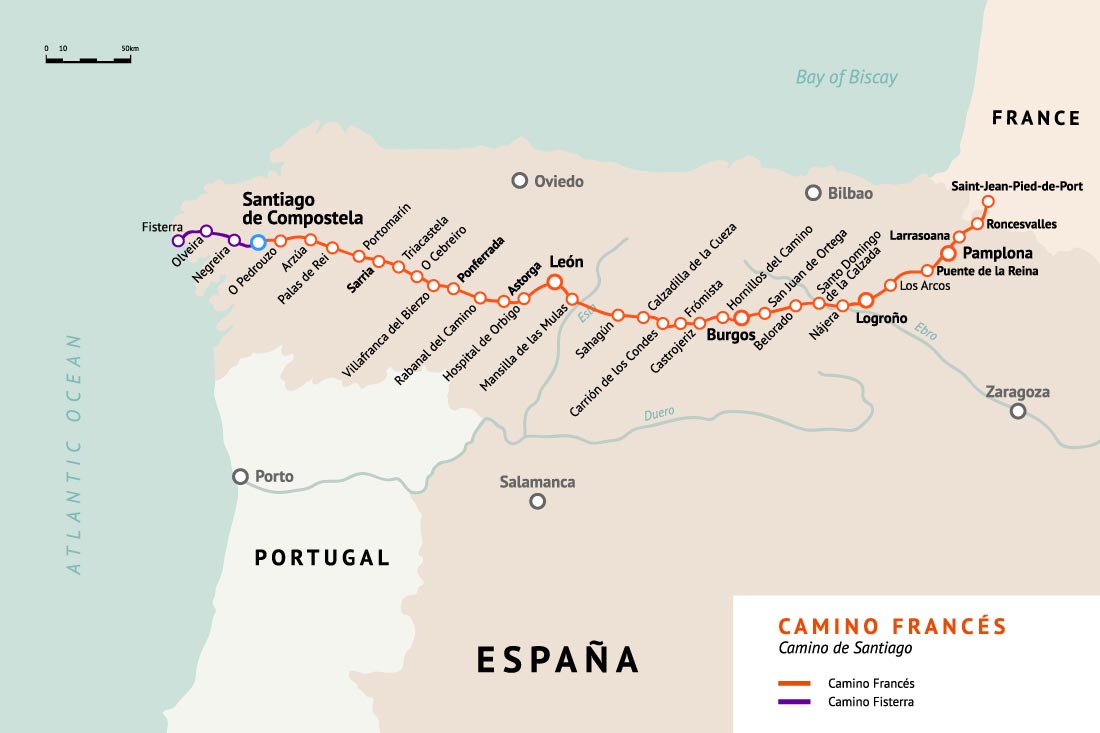
Jackie and I had hoped to walk in 2020 but COVID happened. Shortly after my retirement in 2022 Jackie and I simultaneously realized we could walk the Camino. We completed the 500 miles / 800km from SJPP to Santiago de Compostela along the Frances Camino on June 7, 2023. I posted a follow-up Lessons Learned on the Camino and our polarsteps photo journal.
History
The Camino de Santiago started out as a Christian pilgrimage, but as interest has exploded, devout Christians are small portion of the >400,000 people who travel along “The Way” each year. In May 2023 an average of 500 people were leaving SJPP each day, and even more people were doing the last section starting in Sarria. For people used to the “typical” wilderness thru hikes like Appalachian or Pacific Crest Trail it would be useful to read Ten Reasons not to Hike The Camino de Santiago and a counterpoint What you can expect from the Camino de Santiago. The Camino is much more social and a lot less wilderness.
For some background / history check out 2000 Years of the Pilgrimage which starts with the life of James and ends in the 21st century. In the 9th century pilgrims couldn’t hop on a plane to return home once they reached the “destination”, that was just the half way point for their journey. The goal of the pilgrimage was to visit Santiago de Compostela Cathedral which is reported to hold the remains of the Apostle James. We don’t know for certain it’s James, but it was someone very important in the Christian community from the 1st century. The space was treated as special (no other burials) through the 8th century when it was publicized as the burial spot of James. Over time several common routes to this spot developed and then were forgotten. In the 1950s there was a renewed interest in the pilgrim routes and a program to welcome pilgrims was developed. Through the 1980s there were very few pilgrims. In the early 1990s the president of Galicia started to promote the pilgrimage and arrange for the municipal alberques to be built. Next, numerous associations sprung up such as the American Pilgrims which has local chapters such as Northern California.
Physical Preparation
Walking ~15 miles / day for 30+ days is challenging for most people, even those who are young and fit. On our walk we encounter many people who were struggling with the constant walking. The majority of people didn’t have trouble with the aerobic demands of say going up the steeper hills, but rather the accumulated wear and tear on their lower bodies due to walking miles day after day. Nearly everyone had sore feet and muscles. The most common issue was blisters which will be addressed later. Some developed more serious conditions such as achilles tendonitis, plantar fasciitis, or shin splints. All of these come from people placing a significantly higher load on their feet and legs than normal.
The best way to prepare for the Camino is to slowly increase the amount of walking you do each week. Doing a long walk each weekend is not going to be sufficient. In the running community there is a rule of thumb: your weekly mileage should be 3 times the race distance you are training for. Long distance walking isn’t running a race, but I think it’s a good starting point. In the case of the Camino this would suggest that if you are planning to do 15 mile days, that you should walk >=45 miles in a week, with at least one day that is close to the average day you plan to walk on the Camino. I would recommend work up to doing 3 miles each morning and evening (listen to a podcast or audio book if you need to make the most of your time) 5 days, and a 15 mile walk once a week. You could also look for ways to turn your daily activities into walks. For example, I typically walk to get groceries. Since I have to carry the groceries home this means that the trips are more frequent. A nice side effects is our food is fresher.
When doing your training, it’s important to carry a backpack that has the same weight you would be carrying on the Camino and using the shoes you will wear on the Camino. The slope of the shoe from heel to toe (called the shoe’s drop) changes the demands on your muscles and especially your achilles tendon. Many people wear shoes with moderate to high heels in daily life and use shoes which are near zero drop on the Camino. This can lead to achilles tendinitis.
The book Fix Your Feet is filled with valuable information for people doing long walks.
Mental / Spiritual Preparation
Some people do the Camino as a tourist. That is collecting a set of experiences and crossing the activity off a “bucket list” while staying as comfortable as possible. My perspective is that walking the Camino, especially if you are doing the full Frances Camino, is too much of an investment to approach the journey merely as a tourist. We did the journey as pilgrims. Jackie and I walked with an intention to be open to all we would experience, and to be a blessing to all the people we encountered.
Pilgrimages provide an environment to step outside everyday life and encounter something greater. Pilgrimages typically involve facing challenges. Pilgrimages aren’t meant to be easy or “relaxing”. It is said the Frances way has three distinct sections. The body: which challenges you physically as you adapt to walking 15 miles a day or so. The mind: between Burgos through Astorga where the landscape can be a bit monotonous. The final section is the Soul where you’re finding your true heart.
I was considering doing a 30 day variant of Spiritual Exercises of St Ignatius. I started a thread asking if there was any material / recommendations combining the exercises and the Camino. Based on the feedback, I decided that the Camino de Santiago will be too social to be fully immersed in the Ignatian exercises unless I joined a group lead by an experienced director. Doing the spiritual exercises as a walking retreat might be best done on the quieter Camino Ignaciano some other time. Rather, this might be the opportunity to really listen to my fellow pilgrims.
The best mindset is to lay aside expectations and to embrace the moment by moment experiences. Allow yourself to slow down and notice what you are experiencing on the Camino.
Nancy Frey has documented how Smart phones and WiFi has altered the Camino experience on her site Walking to Presence. For many people this has resulted in a deeper connections with “home” during the Camino, and less of a connection with people on the Camino. I believe everyone should think carefully about how much they will make use of connectivity. Our experience was less is more. To focus on being present with the people and environment you are experiencing on the Camino, and not worry about “back home”.
We removed most apps (especially social media, and filtered email). We used a route guide, map, translation app, bible, audio recorder, and a daily devotional app. We also have WhatsApp installed, not to interact with people back home, but to manage reservations and coordinate get togethers with pilgrims we met. The one exception was we installed Polarsteps which we posted to, but never look at feedback. We decided to using polar steps for two reasons. Most important was to honor a request from Jackie’s father who wanted to follow along because he was unable to join us. Secondly, it forced us to daily record a bit about the day.
Timing and Route
The common view is that the best months are April, May, September, and October. You are missing the worst of the summer heat and the crowds due to school being out. You also miss the harsher weather / closed services during the winter. The temperatures in the fall and spring are cool which is perfect for hiking in, generally (7-18C, 45-65F) though it could be colder or warmer. It is likely there will be several days of rain in the spring. The fall has less risk of rain, but larger crowds. I would note that during holy years there are typically an extra 100k catholics walking the Camino. The next holy year is 2027.
Any of the guides listed below will provide all the information you will need to plan a journey along the Camino de Santiago. An easy starting point would be the online planning resources from the Village to Village guide.
All the guides break the journey into daily stages. Most complete the journey in ~33 stages. Many of the stages are identical across the guides with slight divergence and then resynchronizing in a few days. Jackie would like to do the Camino Frances again at a slower pace. The standard 30-33 stages provide enough time for the walking, house keeping, and experiencing community with fellow pilgrims, but not enough time to fully explore the history, culture, and architecture. The traditional first stage from SJPP is one of the longest and toughest. Discussion of how to handle it / where to stay.
Traditions & Important Sites
Remember loved ones lost with wooden cross along the way
Drink Rioja wine from fountain of Bodegas Irache, just outside Estella (early in the typical stage 6).
Leave a burden behind, symbolized by a rock from home (or maybe the laptop you are carrying) at Cruz de Ferro, the Iron Cross (stage 24)
Wash in the stream at Lavacolla, just outside Santiago. In ancient times there weren’t showers each night. The pilgrims would wash and change into their best clothing to enter the city.
Pilgrim’s Mass (offers in serveral locations)
Zero Days
Some people plan “zero days” to explore a city’s sights and sounds. Other times zero days are to recovery from an injury or illness. The best recommendation is to take a zero day when you body tell you to, and skip zero days you might have planned if your heart wants to continue to walk. Commonly recommended towns for zero days:
stage 3 – Pamplona (lively town, food). I think it’s a bit early, but helpful for people who aren’t experienced walkers who might need to swap some of their gear, get a massage, etc.
stage 7 – Logrono (good size town known for wine and hundreds of tapas places, especially along Laurel street)
stage 13 – Burgos (arch, museum, cathedral)
stage 20 – Leon (arch, food, I think the most beautiful cathedral in the world)
stage 22 – Astorga (arch)
stage 25 – Villafranca
The follows are some towns which the community has indicated are good places to consider if you want a quiet rest:
stage 5 – Estella
stage 10 – Santo Domingo or Grañón
stage 14 – Castrojeriz
stage 17 – Villalcázar de Sirga
stage 18 – Sahagun
stage 19 – Mansilla de las Mulan
stage 26 – O’Cebriero
Interesting Sites (History, etc)
The follows sites / towns might be worth exploring as you pass through:
stage 28 – Arthur Lowe’s art studio on main trail, 1 mile from where the detour to Samos splits off
stage 28 – Samos monastery (if you take the detour)
Festivals Along the Way
An incomplete list which of seasonable festivals. See moon guide for additional festival. Here is a sampling of festivals
Festa do Cocido in Lalin, February
Easter, Sunday, April
Festa do Maio – celebrations in Villafranca, Pontevedra etc, end of April, beginning of May
Ascension, May
Fiestas de San Bernabé in Logroño, June
Saint John and Midsummer celebrations take place in many other seaside towns and also in Santiago de Compostela, June
Sleeping & Housing
There is a huge range of housing. The cheapest is using a tent or staying in one of the free alberques in the dorm. Most alberques will be between €8-15 for a bed in the dorm. Private rooms run between €30-60. There are some very nice inns, hotels, and AirBnB that are €60-100 / night. Finally there a luxury, 5 star hotels such as the Parador properties which are in restored historical buildings and cost hundreds of € / night.
Nearly all the land along the routes are privately owned. Historically it’s been harder to find a camping spot than a bed in a alberque (hostel for pilgrims), hostel, or hotel. Most years I would recommend forgoing camping and leave the typical back country backpacking gear behind (tent, stove, sleeping pad, sleeping bag warm enough for outdoors, etc). The 2023 season seemed to be stressing the system due to a backlog of pilgrims whose trip was delayed by COVID, and a number of alberques that haven’t re-opened since the pandemic. I would still recommend using the alberques, just that you should make reservations.
Alberques (guide to alberques) are the cheapest, most available, and more common option. All alberques have dorm style housing. Many have communal dinners or a common kitchen. Linens and blankets are often not provided in the dorms… so unless you have have made reservations for every night and confirmed they will provide all you need, you should plan to bring a sleeping bag, or a sleep sack + quilt/blanket, a towel and at least a bit of soap. More on this in the gear section. The downside of the dorms is that you don’t have privacy, snoring and others moving around can interrupt sleep. Ear plugs and sleep masks are highly recommended. Many of the alberques have private rooms for extra money which often have ensuite bathrooms and provide linens and towels. Jackie and I think that a private room in an alberque is ideal, allowing a good night of sleep, intimate time as a couple, while experiencing community with other pilgrims.
There are also hotels, guest homes, pensions, and inns which provide housing. If you are traveling during peak season I would encourage pre-booking accommodations a few months before your trip. If you have a reservation and don’t need it, please cancel it.
Many people worry about bedbugs, especially in the alberques. We didn’t encounter any bedbugs nor did anyone we traveled with. From reports I have read online and from friends’ experiences in previous years bedbugs will be found occasionally but are uncommon. If you stay in a location that has bedbugs, there is nothing that can guarantee you won’t be infected. There is some evidence that treating your sleeping gear with Permethrin will provide some protection. If you end up picking up bedbugs, washing your body throughly and then washing all your clothing and gear in 140F water will kill them.
Packing & Gear
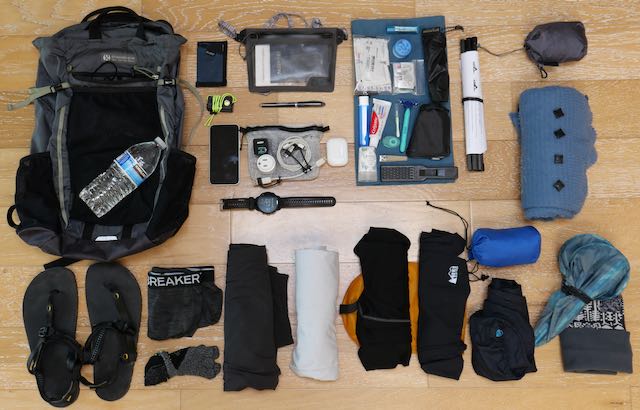
My original packing list had a base weight of 5.5lb and could fit into a 14l bag. At the end of the trip I updated my camino 2023 lighterpack list to include everything I carried on the heaviest day including several items I won’t take in the future. The picture below is nearly everything I carried or wore:
On the walk I picked up some skin lotion and a 15l folding messenger bag to used after this trip (we don’t have Decathlon in US). There are a few items I added at the last minute (packing for fears) that aren’t in the picture and generally weren’t used. When Jackie’s Achilles tendon started to hurt I carried a few of her items. This raised my “base” pack weight to 7lb. The heaviest total weight was 11 pounds when I was carrying extra water and a fair bit of leftover food / snacks.
Everyone I have talked with that wasn’t an experienced light-weight onebag traveler or ultralight backpacker said they brought too much stuff. They often either gave away the unnecessary items, shipped them home or to Santiago. Several people who have done multiple Caminos told us that any item not used by the time you got to Burgos isn’t needed, and you should be dropped. I encourage everyone to treat the Camino like a pilgrimage and leave behind excess baggage and live in the moment. I have some general notes about packing light aka onebag travel which might be helpful to someone packing for the Camino. There are people who go even lighter such as such as Tim Evans’s 7L fanny-packing list for Shawn’s 7-10l fannypack packing
Example Summer Packing List
It’s pretty warm in the summer and you don’t need to bring a lot.
Hiking clothing made from thin nylon, polyester or merino wool which can dry overnight. My recommendation would be:
nylon hiking pants that are quick dry like Outdoor Research Ferrosi, prAna Brion or a hiking dress
fast dry shirt that is high UPF like ArcTeryx Cormac, OR Astroman, Mountain Hardware Crater Lake, or if UPF 15-20 is enough for you, the very comfortable OR Echo
non cotton underwear. Light weight bra or swimsuit top.
insulation: an alpha direct hoody, 100wt fleece, or sweater made of wool, alpaca, or cashmere.
sun hat: something with wide brim or veil such as those made by sunday afternoon
small first aid kit focused on foot care: compeed bandages are great for protecting skin about to blister
toothbrush
water bottle such as reusing a smart water bottle
a 50F rated sleeping bag or sleep sack + a light blanket/quilt if staying in hostels / albergues
Modest size travel towel if staying in hostels, or maybe even if you are staying in full service hotel every night: see towel entry, hitchhiker’s guide to the galaxy.
When needed (which is less frequent than you might expect) you can wash you hiking clothing in a sink, shower, or machine if one is available. That’s all you need.
Hiking poles are not generally necessary, though if you are used to using them, bring them… just remember they have to be checked baggage when flying. If everything else you are bringing is carry-on, you can use a cardboard “poster tube” to ship your poles.
In the spring and fall you would want to add insulation, and extra pair of socks in case they don’t fully dry over night, and maybe rain pants or a rain skirt.
Pro Tip: Don’t bother with “dress up” clothing while walking the Camino. Restaurants are used to pilgrim attire: shorts, tee shirts, slides/sandals. If you need fancy clothing on a trip paired with your “Camino”, ship them to Santiago to be stored until you are done, no reason to carry them while you are walking. There are a number of services such as Casa Ivar which can help. Jackie and my first stop after the Camino was the UK. After after spending a week in Paris, before walking the Camino, we posted our extras including “dress up clothing” to a friend’s home in the UK.
Footwear
The single most important item you bring is footwear. I think minimalist shoes are the best way to go IF you have used them for at least six month. Otherwise I would generally recommend wearing trail runners or hiking oriented sandals. Sandals are often seen as people recover from bad blisters which makes me wonder if they won’t be the best “shoes” to start with. I have written up a brief comparison of boots vs trail runners. It’s important that you use whatever footwear you have selected (or identical models) for an extended time before the Camino to give your muscles a chance to adapt. For example, going from traditional shoes with a heel to zero drop trail running shoes is a good way to end up with achilles tendonitis. For people who are prone to getting blisters I would recommend sizing up your shoes by 1 size and wear 2 pairs of socks: a thin liner made of coolmax or nylon closest to your foot, and a thick wool sock worn “inside out” so the fuzzy part is against the shoe, and the smoother side is facing inward toward the liner and your foot. Another good option are Xoskin toe socks. I have zero blisters after walking thousands of miles in Xoskin toe socks. I had pre-blisters from other socks heal while wearing Xoskin socks while doing 15 mile days.
Backpack
The second most important item is your backpack. People who complete the Camino generally use outdoor oriented pack which are between 20-40L in volume. For people carrying less than 10 lbs, there are many good options. If you are carrying more than 10 lbs you will want a pack that has a hipbelt which is capable of transferring the majority of the weight to your hips rather than just stabilizing the pack. I have a post about selecting a good trekking pack.
Sleeping “Gear”
Most people walking the Camino will spend one or more nights in an albergue dormitories which are often mixed genders in the same room. You should have some clothing to sleep in. Tip: if you are in the bottom bunk near the wall, you can hang your towel to provide a bit more of privacy.
Albergues typically don’t provide linens. Many pilgrims bring a light weight sleeping bag (rated for 40-50F) which removes the need to worry about sheets and blankets. I prefer to use a silk or nylon sleep sack which is paired with a light weight quilt or blanket. When it’s warm you can use just the sleep sack. A good quality down backpacking quilts can cost $300, but if you only need enough insulation for sleeping inside (say rated for 55F), then there are a number of light weight down or synthetic outdoor blanket / quilts which are less than $100, such as hangtight shop blanket. Costco sometimes has a down throw blanket for around $25. A classic poncho liner, aka woobie is another option. Some folks find that just a sleep sack combined with their outwear can work. Clothing which are warm enough for “light work” in 40F (a typical spring morning) should be warm enough for sleeping indoors when the room is >=60F. I used a sleep sack and a piece of Polartec Alpha Direct 90gsm fabric which was used as a blanket at night, and as a scarf, shawl, vest, or poncho liner during the day. I wrote up a description of this in a post about my poncho system.
Keep it Light
For people who are used to luxury & comfort, don’t just prepare yourself to “rough it”, but embrace a simple and more communal experience. It is especially important to minimize what you bring because you will be carrying everything for many miles each day. If your bag feels heavy before you start walking, you are bring too much and it will get worse as the days progress.
Conventional wisdom is that people should carry a backpack that’s <25% of their body weight. This is reasonable for moderate distances but will be fatiguing on a longer hike. There were several experiments evaluating how pack weight impacted soldiers physical performance. A key finding was that on all day exercises, fit/trained soldiers had a measurable increase of fatigue and a drop in agility when they carries more than 10-12% of their lean body weight. This matches my personal experience: I feel no more tired at the end of a 20 miles carrying 17lb as compared to carrying no pack. My one caveat that when over 8 lbs I need to shift some weight to my hips or shoulder pain will be fatiguing through the day. My wife found her sweet spot is <7lb.
Some people ship their bag(s) town to town via a transfer service and carry a small daypack which holds only what they need for the day. This costs 4-6Eu for one time, and around 150Eu for an entire journey. I would recommend not planning to do this as a regular practice, though it can be useful if you are trying to recover from an injury or fatigue. If you going to use a transfer service I would recommend using a duffel which does not need to be expense. We saw a number of people using $4 Ikea frakta duffels. Realize that mistakes can be made, and you might find your transfer bag misplaced for a day or two. For people who are finding lodging as they go, using a transfer service can add stress and complications since you don’t know where to ship your bag on days you don’t have a reservation. Warning: Several traditional alberques have banned “suitcases” or transfer services from delivering because the alberques exist “to serve pilgrims, not tourists.”
It’s better to bring twice the money you think you need, and half the stuff. It fairly easy to pick up items that you forgot, lost, or are damaged along the way. Worse case is a 20 minute taxi ride to a larger town. Several of the town along the Camino have a Decathlon store, which is the Ikea of outdoor equipment and clothing. There are also a number of stores which cater to nearly all the needs of pilgrims (shoes, clothing, backpacks, toiletries, etc) such as Boutique du Pelerin in St Jean Pied de Port, Caminoteca in Pamplona, Pilgrim Oasis in Carrión de los Condes, etc. Most of the towns have a small store near or on the Camino route which sell comfortable shoes (almost all sell Hoka) and some other items that pilgrims might need.
Food and Water
Unlike backcountry backpacking, you rarely need to carry much food or water because you will be in the next town before you need more. Generally .5-1L of water will be enough if you periodically stop at a cafe / food trunk for a drink and make use of the fountains. You will want more water on the hottest days. Before walking, you might figure out how much water you need. I discuss this in my post about water treatment and containers. You might want to carry some food with you when entering a less populated area on Sunday because the groceries / cafes / restaurants might be closed or have hours which are incompatible with your schedule. I liked granola bars and Laughing Cow cheese which doesn’t have to be refrigerated. Of course, if all the food options are closed you can treat it as a day of fasting.
Jackie’s Pack
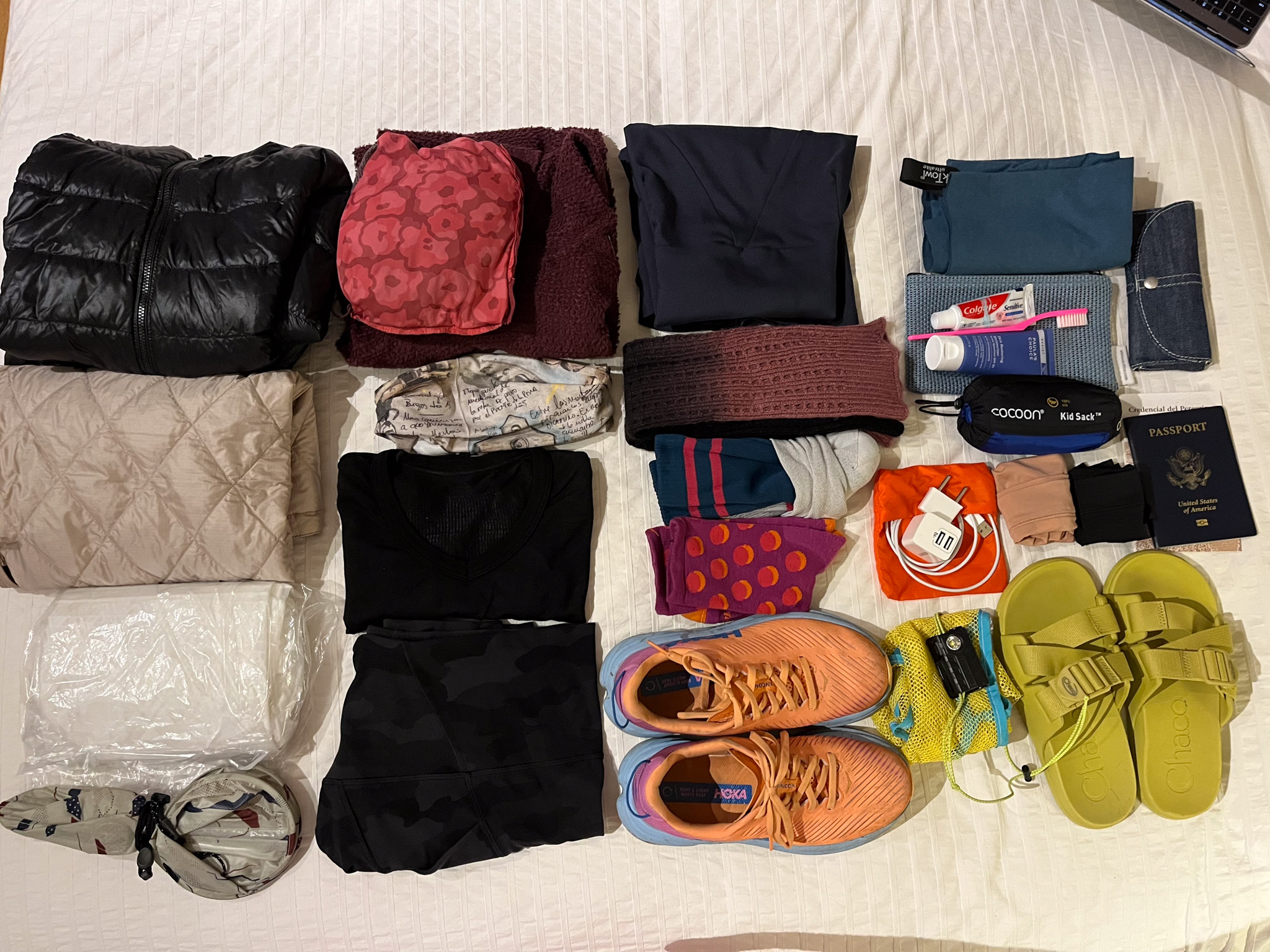
The following is a picture of the contents of Jackie’s backpack for the Camino. She used a 15 year old Camelbak hydration pack which was retired at the end of the Camino. Jackie runs colder than me so she brought more insulation that I did. While my strategy was to use my blanket for warmth during the day, hers was to use insulating clothing + a silk sack for sleep. This works well because night time temperatures inside the albergues required about the same amount of insulation as walking in the coldest mornings.
Outerwear
Clothing
Misc Other
Uniqlo Down Jacket Montbell Insulation Skirt Ikea Rain Poncho Montbell Umbrero Hat Macpac Nitro Alpha Direct Hoody Montbell Windbreaker Buff
Initial Items, Items Offloaded, “+” indicates items added. Buff wasn’t used. Waterproof socks used only a few times. Leg warmer not used after compression socks was purchased. Jackie didn’t bring first aid… she made use of the kit I brought.
Blisters
Jackie and I have been blister free, even for extended journeys like 500 miles of the Camino from SJPP… but we seemed to be exception. Many (most?) people get blisters on extended trips, especially people wearing hiking boats. Most people were able to manage their blisters and continue to walk. A significant number of people we met on journeys like the Camino needed to add a zero day and/or take a taxi or bus to shorten their daily walking to give their feet time to recover.
The first step is to try to prevent blisters. Blisters develop when your skin is exposed to friction, especially when wet or hot. Most important is to remove friction, specially lateral shear forces (good short video). This means that you shoes need to be roomy enough for your toes to splay without being so large that your feet slide around. If you shoes / boots are stiff, you will need something that provides a cushioning. Wearing two socks, a thick wool sock turned inside out, and a thin synthetic liner sock is one of the most effective solutions. More information about this on my recommended socks page. You also want to keep your feet dry when possible. This is typically best achieved by wearing fast drying, well ventilated shoes or sandals. Avoid waterproof shoes and boots. In rain they don’t really keep your feet dry due to feet sweating, and they hold moisture when it’s dry.
Second, as soon as something doesn’t feel right apply treatment, don’t wait for a blister to appear. Sometimes changing your laces or adjusting your socks is all that is needed. Most of the time adding something to protect you skin. My experience is that KT-tape and Compeed blister bandages are the most effective treatments. Duct tape works pretty well. Some people swear by “hiker’s wool” but I have no experience with it. I don’t find Moleskin very effective.
Third, if you develop blisters treat them. Start by draining them and then clean gently. Next you need to make sure they don’t get worse. One option is to leave a small thread in the blister to allow it to drain and then put a breathable protective bandage over them. The method I use is to squirt a bit of superglue (I bring some single use tubes) into the blister. This keeps the loose skin from tearing and makes a durable barrier which protects the tissue under the blister.
For more information about caring for your feet, read the book Fix Your Feet.
Guide Books and Apps
There are a variety of guidebooks and applications designed to help people successfully navigate the Camino de Santiago. All the guidebooks provide information about the route itself and places to stay. Some provide a day by day schedule. Others provide information which allows the pilgrim to decide were they want to stop.
A Pilgrim’s Guide to the Camino de Santiago by John Brierley is the classic english language guidebook (don’t buy it in kindle form, terrible formatting, no hotlinks!). It breaks the route into discrete stages. Many people follow his stages woodenly which typically means that the villages listed at the end of each stage will be more crowded. Brierley includes selection about ‘the mystic path” and “personal reflections” which can be enriching, but annoy speople wanting a purely practical guidebook for a long hike.
Moons Guide is the only guide which highlights food, and focused more on local culture, detailing local festivals and annual events but is somewhat dated. Several of the restaurants mentioned are now closed.
Wise Pilgrim is a very practical guide which is reported to be the best iOS/Android App. The app supports offline maps. The full content is available as a Kindle and Paperback book. Much of the content is also freely available of their website. Has booking.com links for any of the lodging that supports online reservations, and WhatsApp links for any lodging that can contacted that way which is great for non Spanish speakers. The paid version has the best offline map (which includes several of the alternative routes). Downside is that it sometimes crashes but always restarted.
TrekRight Camino Guide is a iOS Guidebook application. UI needs work but is one of the most complete online guides. Trail notes, offline maps, indications of service in town include grocery stores, some good details sbout each of the lodging locations. Missing booking links and WhatsApp contacts found in Wise Pilgram. Has a notes, flags, highlights flags.
Buen Camino De Santiago by Carlos Mencos is available for IOS, Android. What a bit awkward to set up, provides a nice view of your daily stages. Has incorporated a bunch of content from wikipedia and some video clips to provide background to the version towns along the Camino.
Camino Guides by Gerald Kelly is available as an iOS/Android app, Kindle, paperback, and a downloadable PDF. Gerald also makes a free version of the PDF available (which is missing maps and historical background).
FarOut (aka GutHook) is a hiking oriented mapping guide which focuses on the trail, water sources, etc rather than the towns. I don’t see the point with how well the trail is marked.
WhatsApp is used by many businesses along the Camino including a number of the taxi companies and alberquea.
Google Translate lets you communication with people you don’t share a common language with. Our experience was English and Spanish were the most useful / common languages used. We heard a significant amount of Portuguese, Korean, French and German. You can download language modules so the app can work offline.
The camera to help you remember people and places.
Resources
caminodesantiago.me is a very active online community run by Ivar Rekve, a resident of Santiago de Compostela.
santiago.forwalk.org is a very well done website. They have a number of “pre selected” routes / stages with information about what services are available with pictures and links to make reservations.
Route Planner which lets you choice start/end locations, and then select the villages you want to stop in (lists type of accommodations but no description of them). For these selections the website can generate a number of files including a path to be viewed through google earth, gps waypoints, and a schedule in a nice, spreadsheet readable table
gronze.com: in spanish, but google translate can make it quite useful
Metroblue: Best weather app I have found. The weather maps are really useful. iOS
Stories
I Will Push You – Wonderful movie about a great friendship. Patrick joins Justin to complete the walk. The journey would have been impossible for Justin to complete by himself due to a neuromuscular disease.
TrailJournals: Camino de Santiago is a site which originally was used by long distant hikers for the Appalachian and Pacific Crest Trail but now hosts journals for other trails including the Camino de Santiago. I particularly appreciate Slow Walkers (first) 2007 journal… he has more recent entries as well.
The Camino is steeped in history. Having a sense of the history and culture and enrich the journey. While walking the Camino you will pass some classic architecture. Some resources to appreciate this background:
The Pilgrimage Road to Santiago: The Complete Cultural Handbook by David M. Gitlitz won’t tell you anything about the modern cities, hostels, or amenities but will give you an in-depth look into the history of the path you are walking.
Iberia by James Michener isn’t about the Way, but provides a good amount of background about this region of Spain.
Be curious and ask questions of the people you meet. There are many amazing stories you will hear, and many reasons people are walking the Camino. Good questions: “Why are you walking the Camino?” “What have you learned during your walk?” “How has the Camino changed you?” “What are some of the hightlights of your walk so far?”
Make a list of people you meet and take pictures of help your memory. Maybe consider asking how you could pray for them and make prayer cards.
Get used to Spanish schedule. Breakfast is a slightly sweet pastry and a coffee, maybe a spanish tortilla. Lunch is generally 1:30-3:30. Dinner starts at 8 PM. Many stores are closed in the mid afternoon and on Sundays.
As you enter new cities look for a poster with a list of local taxi phone numbers and take a picture in case you are injured and need transportation. Often in the entry of hostels, sometimes there is a poster near the entry / exit to the town. When you take a new picture delete your old picture. For non Spanish speakers, try putting the number in to WhatsApp or iMessage and see if they are on one of those platforms. If so, you can send them messages which includes your location and your request that you translate into Spanish using a translation program.
If you are having trouble finding a place to stay on the Camino look a few km on either side, There are often hotels and guest homes that are pretty close, several will offer free pickup and return to the Camino so you don’t have extra walking.
Walking takes hours to go between towns, but a taxi and bus takes tens of minutes. It’s pretty quick and not that expensive to return to a town to retrieve something you left behind. Realize just because a town has buses doesn’t mean they have buses that go to where you want to go.
Once a week stay someplace with a washing machine. They are way more effective at cleaning clothing than hand washing.
If you are bring a cell phone, have WhatsApp loaded. It seemed to be the universally used communication tool along the Camino for many businesses and most of the pilgrims. Take a screen shot of your QR code (settings, click on the QR code icon next to your name). If you don’t have connectivity and want to exchange contact information with someone just have the scan or take a picture of your QR code which will save the hassle (and eliminate errors) of them getting your contact info.
Each morning I would stop at first church I came to that was open. I would go inside, if there was a nun present thank her and then sit down to reflect of what I had to be grateful for and then to pray for the coming day and the people I had met along the way. Doing the make the rest of the day better.
If you walk from SJPP, prepare for things to change in Sarria. There are many more people and many are more tourist than pilgrim. First, don’t judge them, everyone is walking a different road. It will be much harder for them to experience the Camino spirit, but try to share it with them. To avoid the massive crowds try leaving before 7am or after 9:30. Most of the tours / packaged trips have a breakfast which is between 7-9am.
If you want to get a Compostela, use the pre-register website a couple of days before you finish and get a barcode. You will likely be in and out in 5 minutes rather than waiting in line for hours.
For people biking the Camino… have a bike bell. Its sound is pleasant and universally understood. Saying “coming through” only works if people understand you language and is more jarring that a bell.
Re-Entry from a Pilgrimage
Many people talk about how jarring it is to return to “real life” after a pilgrimage like the Camino. After a month of a slow paced life characterized by simplicity, quiet, and community they found themselves facing a hustle / hurry culture that is filled with noise and often more oriented toward competition than community. It is easy to get overwhelmed and to return to old patterns and habits, leaving the Camino experience something remembered fondly, longed for, but divorced from daily life. As I have talked with people about their post Camino experiences there are several things which seem to have kept the Camino spirit alive for many. The following is a summary of the advice I have heard about how to live into the Camino experience once the walk is complete.
Set aside some quiet time (ideally a week or more) between the end of your Camino and starting back to “normal” life to have time to think, pray, journal, and reflect on your experiences. Identify what you learned, how your perspective has changed, how your values have shifted or strengthened. Ask yourself what is important in light of your Camino experience?
Consider your life before the Camino and ask the question “How did my pre-Camino life align with my post-Camino understanding?”. It is likely that you will find places the two don’t align. Realize that if you don’t make explicit changes, your post-Camino life will likely look exactly like your pre-Camino life.
Identify changes you would like to make as your return to “regular life”. Many try to change everything, fail, and quickly give up. Rather make a list of things you would like to change and then decide on one item you will start with. Break it up into manageable steps and find ways to turn it into a habit and then a lifestyle. The book Atomic Habits is a great resource for this sort of planning. Once something has gotten established, look at your list and make the next change.
The most common change I heard from people was making sure they left slack in their schedule so they weren’t constantly forced to react to life. There were moments to reflect and choose a response. Many found that adding a time each day to just be was key. For some this was time to sit, reflect, and maybe write a few sentences in a journal. For others it was a quiet walk in their neighborhood or a nearby park.
The second most common change I heard was people striving to build a genuine community. Often, they had been part of some sort of a community before the Camino, but the experience fell far short of their Camino experience. In some cases people have found that by intentionally investing and initiating in their community they were able form a genuine community. In other cases people realized that where they were putting their time wasn’t working and that they should try something different.
Set a date for your next Camino 🙂
All of these items suggest that what’s key is to identify what you loved about the Camino and then to identify little things which will remind you and keep your grounded, anchored to those things.
I am not in control. I am not in a hurry. I walk in faith and hope. I greet everyone with peace. I bring back only what God gives me.
I am a fan of Dr. Peter Attia who is a physician focused on the science of longevity. He strives to help his patients simultaneously improving lifespan (delay the onset of chronic disease) and healthspan (quality of life). In 2023 he released the book Outlive where he systematically explains his approach to healthcare which is focused on prevention (sneak peak… exercise is the most powerful tool) and personalization. He has a podcast call The Drive where he interviews people whose work can inform anyone interested in long term health and fitness.
Attia is science oriented and he is willing to re-think his positions when data contradicts his beliefs. He isn’t overly certain, saying he has “strong opinions which are loosely held.” He has written a nice series on studying studies which discusses how to read and evaluation the quality of published research which often has flaws.
I have been inspired by his idea of training for the centenarian decathlon (additional details in AMA 39 and Drive #261, videos of some of the exercises). Identify what you want to be able to do when you are in your 90s such as lifting a child to decorate a tree. Backcast what fitness needs to be achieved earlier in life in view of the typical loss of strength due to aging and drop of VO2max. Your training program should strive to improve your fitness so that your fitness level bisect the backcast projection. Once you are at the level (and maybe a bit more as a buffer), it’s ok to ride the enviable decline. Make sure you don’t injure yourself while training.
Some of my fondness likely comes from confirmation bias. Attia’s material is very close to many of the conclusions I reached when I was trying to understand what leads to a healthy life. I captured my conclusions in Health and Fitness in One Post.
Metabolic Disease (a spectrum of everything from hyperinsulinemia to insulin resistance to fatty liver disease to type 2 diabetes). These are arguably the most preventable diseases through diet and exercise. Metabolic disease also contributes to atherosclerotic and possibility neurodegenerative diseases and some forms of cancer.
Atherosclerotic Disease (comprised of cardiovascular disease and cerebrovascular disease). I haven’t personally studied this group of diseases. It’s the next thing I want to study. Number one on all cause mortality.
Cancer: until there are major breakthroughs early detection is key. Survival once the cancer has metastasized is poor and hasn’t significant improved in 70 years, though there are some promising approaches that might finally result in breakthrough treatments
Neurodegenerative Disease (Alzheimer’s disease being the most common). As far as I can tell, there are no effective treatments. While there are some theories and ideas of how to prevent, there are not strong causal links.
Attia has a framework of exercise includes four areas which provide unique benefits:
Stability: Balance, efficient movement. This is particularly important as people age because it reduces the likelihood of injuries due to falling. Some forms of yoga, Pilates, and Dynamic Neuromuscular Stabilization (DNS) are examples. Having good stability is key to training without injuring yourself.
Strength: Developing muscle strength. The more strength you have the easier it is for you to engage in heavy work. It is easier to build strength when we are young, and we have a tendency to lose strength as we age. BUT there are a numbers of studies that show people who are in their 60s (and older) can gain strength with training.
Aerobic Efficiency which focuses on metabolic “base” (zone 2): improving mitochondrial function which is key to your ability to burn fat, reduce the risk of diabetes, and be able to sustain endurance. Cycling, running. and rowing are some of the best options for zone 2 workouts.
Anaerobic peak: High Intensity (zone 5): Builds your metabolic systems ability to handle peak exertion and grows VO2max. Often part of an high intensity interval (HIIT) protocol.
Nutritional Biochemistry
The area of diet and fasting is one of the areas that Attia demonstrates his strong opinions held loosely. His position has shifted since I started to follow him. First, the things which have been consistent
Except for people who are food insecure, one of the biggest health threats is eating too many calories. Excess calories is a huge driver of metabolic diseases, and contributes to the other horseman
Sugar is a lot like a poison to our metabolic system. Minimize it.
Get enough protein to maintain and build muscles. The amount of protein we need goes up as we age
When I first starting to reading material by Attia he had a strong beliefs which including the following (which he has backed away from)
Adopting good nutritional practices (the right diet) can significantly improve overall health / longevity
Fasting is a useful technique for almost everyone to optimize health
While not advocating it for everyone, Peter lived a strict keto diet for several years and wrote about the benefits.
With the publishing of Outlive his position is slightly different
Bad nutrition can really hurt health, good nutrition doesn’t significantly improve health
Extended fasts are useful when people have severe metabolic issues, but the typical lost of muscle is not worth the benefits for most people.
Intermittent fasting can be useful if it helps someone avoid eating too much food, but has little or no additional value over eating the same number of calories spread out over a longer period of time.
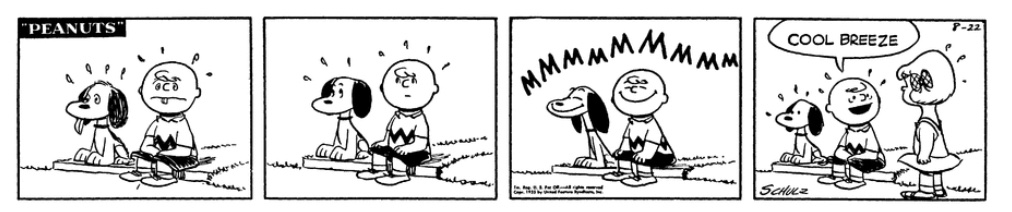
Nearly fifty years ago I was looking through a book of early Peanuts cartoons while I waited for my violin lesson. One of the comics showed the simple pleasure of a cool breeze on a hot day. Since that day whenever I feel a cool breeze I will pause for a few seconds and relish the wonderful feeling and remember the comic which sharpened my awareness. Isn’t amazing how very simple things can bring so much pleasure. I am grateful for the genius of Charles Schultz. Every few years I have looked for this cartoon but never was able to locate it. Today google image search finally returned the strip I was looking for.
Transformed lives are better than many lives impacted but not self propagating
We are adaptable
We can be content and grateful with just the necessities
Why Worry?
My three rethinking posts (part 1, part 2, and this one) were written at the end of December 2021, but I delayed posting until plans for my retirement had been settled. I think anyone reading this would realize I was transitioning and didn’t want to send that signal before my boss and company were ready for others to know.
Independence –> Interdependence
For most of my life I have strived to be independent. To be able to take care of myself. In high school I imagined being self sufficient, living off the grid: to grow my own food and to get power from renewable sources. Throughout my adult life I have had thoughts of living on a sailboat or in an RV, having everything I needed for life in a small, movable space. I wanted a small cocoon of safety and security, a core I could always trust.
The simple / off-grid / independent dream was fueled by fears rather than maximizing what I most wanted. My fears didn’t want to be dependent on others who might fail me. I also wanted to be free from the fear of failing others who depended on me. You can’t be totally independent and also be an integral part of a community. You have to welcome help and provide for others when you are able. I have discovered my deepest joy has come from being in a healthy community and having good personal relationships. Relationships built on love that has no agenda. An independent life might be “free” and “safe”, but it is also impoverished.
I have found building a strong community requires time and the parties to have a willingness to engage. Ten years ago it seemed inconceivable to leave an existing community and start over. Ironically, the community I wanted to keep was fraying, and I was successfully building a new community. After Libby died many of my friends pulled away. A few years later when I switched churches to join Jackie many of my friends from the old church were too busy to get together. Jackie and I found that when we initiated and invested we have been able to build a new community. Our new community doesn’t have the depth I experienced in the past, but it is deepening as time goes on.
A VC I recently met (and has just exited the Bay Area) observed that a lot of people come to the bay area from across the world to make their fortune and leave their mark. That’s what he did. They are so focused on their mission (and often lacking interpersonal skills) that relationships are purely instrumental… it’s all about extending a professional network. You can get a first meeting, but you won’t hear from people for a second meeting if you aren’t a useful connection. My daughter told me about how she would regularly be snubbed by people as soon as they realized that she wasn’t someone who could connect them to other high tech people who could help their career. On top of this is a busyness caused by the drive to succeed. Even my most intentional friends often get caught up in the busyness. If these weren’t enough of a challenge, there is the high cost of living which makes the area more transient than many locations. The local ethos makes it hard to build and maintain healthy communities.
Jackie and I recently spent six weeks in Santa Rosa. We attended several meet ups, talked with some neighbors, and attended a few churches. Santa Rosa Christian Church did an amazing job welcoming us. Even though they knew we were just evaluating the area they were happy to engage. I found people in Santa Rosa significantly more open than the people I encounter in Mountain View. We later found Portland to be even more community oriented.
For the last thirty years I have tried to resistant some of the more toxic aspects of the bay area culture. I have tried to be a light in the darkness. I am tired. There are many things that are great about the bay area, but community is a definite negative. The time we spent on Santa Rosa felt a bit like being welcomed home. We haven’t settled our long term plans, but we will be exploring where to base the next season of life. We would like to be be someplace where people prioritize deep personal relationships and community.
High Impact Now –> Exponential Future
I have always wanted to have a positive impact on the world and leave it in a better condition than I found it. I tend to be a utilitarian. I thought about this in terms of an equation
total good = number-of-people-impacted * positive-impact
Estimating number of people is fairly strait toward. Quantify impact is hard. I think people’s lives have a physical, mental, spiritual, and a relational component. I have always been unsure how to balance these things. Equally weighted? Is there is a priority order? Maybe there is a minimize level required after which it’s better to impact other areas. How to factor in diminishing returns?
I have come to see that focusing on small acts on love is the key to lasting and significant impact to human flourishing.
When I look at the Bible, when I look at Jesus teachings and life, I don’t see admonitions in terms of maximizing good. I see a focus in a much smaller domain. How we are treat our neighbor and our family. One could say it was a tactical focus. Part of me is inclined to say “Ah… that’s because they didn’t have the technology we have today that gives us huge leverage. Back then you could only influence a small number of people personally, now we can touch millions, if not billions of people.” While technology, the printing press, phones, computers, etc provides leverage and it impacts individuals, it doesn’t transform. The impact is not self sustaining.
Sidenote: I just finished reading the book Four Thousand Weeks which has lot to contribute to the topic of working on things that matter, though there are some misses because he doesn’t understand the interplay between finite and eternity. I haven’t incorporated any of observations from his book in this post.
I have noticed that I get a greater sense of satisfaction from helping one person personally than working on a project that potentially impacted millions of people. Why was that? Could it be hinting a something I might have been missing? I was reminded about the power of compounding. Jesus’ focus on his 12 disciples not the crowd. Robert Coleman captured this beautifully in the book The Master Plan of Evangelism. At the beginning, the strategy seems slow and ineffective, but over time it literally touched the whole world. While a bit artificial there are several videos which try to show how one simple act of kindness (love) can spread virally and the movie Pay it Forward. Love is an unlimited resource because it comes from God. It is the only resource that grows as you share it. Living a simple and loving life which slowly leads to transformation in other individuals will bring about more goodness than doing something that impacts millions of people but doesn’t replicate beyond that. This is a topic I will write more about later (first attempt posted).
Ten years ago I decided to look for an opportunity to work on a product which would positively impact millions of people. One of the best places to do that is in a bay area high-tech company. I believe the work I contributed to at 23andMe had a small impact while I was there, and will have a profound impact to millions of people in the future due to the amazing database and how I think that will impact drug discovery. I am going to shift my focus from making high impact products to finding ways to bring the transforming power of love into the hearts of people. This is best accomplished through personal interaction. Few will see the impact of this sort of “work”, but I believe it will have a larger long term impact that something that would be seen by millions of people today.
We are Adaptable
Jackie regularly encourages me to stop planning/worrying and to live in the present. She tells me that if something has to change in the future, we will adapt. This often comes up when talking about savings / long term investments but this comes up in a number of areas. My default is to save money for the future. Jackie is more interested in finding ways to make the most of the moment. She isn’t advocating being wasteful, but rather optimizing decisions for what we see now, rather than what might be in the future.
Ten years ago I was learning a lot about how people experienced grief and worked through significant trauma. One common lens for this was looking at people’s happiness. Studies had repeatedly discovered that in the face of a difficult situation, most people recover and return to a baseline happiness within 9-18 months. In the field of positive psychology this is referred to as adaptive hedonism. We get used to a new normal. If you come into a lot of money there is a brief boast, but then it feels normal. Likewise, suffer an extreme lost, such as losing use of legs will initially be crushing and continue to have implications throughout life. Loss aversion makes it seem even more horrible. Yet, most of people who have experienced this loss return the approximately the same level of happiness and contentment they had before the loss. There are some people that these sort of losses actually have a transformative effect, where they are actually better after the loss.
As with grief, we adapt to our changing financial situation. The difference between “want” and “need” is a few weeks. That is to say that something which you consider a luxury becomes a “necessary” once you have gotten used to it. This is an example of adaptive hedonism. This can also work in reverse. While we fear losing material wealth, so long as we have “the basics” discussed below, we are able to adapt. In some cases, we might do better because we have been freed from an excessive focus on what we used to have.
People who adhere to stoic philosophy encourage devotees to regularly deprive themselves to experience that they are OK with less. To systematically desensitize loss aversion. Having these experiences can greatly reduce fears. This is closely related to learning to be content with the basics I described below. One of the way I practiced this was spending a bit of time as a digital nomad. I only had what was easily carried on my back and stayed in a very basic studio apartment. My time wasn’t as pleasant as home, but it was perfectly fine.
I used to assume that my standard of living had to be maintained. Likewise I used to say that I can’t plan on spending less until I had actually done it. Yet I have lived a more frugal life. Jackie regularly reminds me that we can adapt. Rather than wasting time worrying about the future, constantly evaluating decisions today to ensure we can maintain our current standard of living, I will focus on living in the present, being generous, and trust in God’s goodness and the ability to adapt that God has built into every person.
With Food, Clothing, and Shelter I Will be Content
While I don’t desire typical “luxuries”, I have a tendency to strive to have more than “just the basics”. I can lose track of what is actually required for a good and rich life. The apostle Paul wrote in I Tim 6:8 “But if we have food and clothing, with these we will be content.” I like a modern variant
What’s the worst that can happen? Well, the worst that can happen is that I’d have a backpack and a sleeping bag, and I’d be eating oatmeal. And I’d be fine. I think if you do that once or twice … you don’t necessarily have to live like that, but knowing that you can be content is tremendously empowering.
Survey is after survey has found that people’s “happiness quotation” increases with wealth until they have adequate food, clothing, and shelter. Additional wealth does not reliably increase people’s happiness after that. Some of the most unhappy people I know have amassed a fortune, yet they don’t seem to enjoy the fruits of their labor. This suggests thats we should strive to achieve basics, and tread carefully if we strive beyond that.
Our modern society expectations have been strongly influenced by media produced in the US which has popularized a “middle class” lifestyle, if not the lifestyles of the rich and famous. Much of the world now has expectations that go beyond the basics Paul talked about: a subsistence diet and clothing to wear which provides adequate protection from the elements. The modern “basics” include “tasty” meals, a wardrobe, a house with running water, electricity, heat, and likely air conditioning. The cost of these modern “basics” in most US cities is $50-70k/year. There are people who feel they have a “rich life” living well below these numbers. For example advocates of FIRE, like Mr Money Mustache enjoyed a “rich life” spending less than $30k / year, and there are folks who have moved to other countries happily living on less than $20k / year. Of course location changes what is possible as does health care. There are high expense areas like San Francisco, where the basics are going to be more expensive. A room just large enough for a mattress and access to a bathroom and kitchen can easily cost >$1000/month.
People often expect that the better off they are financially, the happier they will be. Ironically, the people with the most life experience know in their hearts this isn’t the case. I often ask people near the end of their lives for some of their happiest memories. More often than not, the memories they share are during a period of time that were financially challenging. Not deprivation — they knew they didn’t have to go hungry — but they only had money for the “basics”. I would hear about an ultra-budget recipe that was “so good”, stories of how some device was jerry-rigged to keep working, cuddling under a blanket to keep warm in the winter, funny activities they engaged in to make “ends-meet”. Each of the stories typically included how they drew closer to the family or community.
I know when I think about some of my happiest times I was living with just the basics. My first year of college didn’t go well, so I stopped school ramped up my part-time “student” (or is that slave wage) job. For a couple of years I lived in a house with a dozen other guys that had one shower and slept in a homemade bunk bed with around three feet between my mattress and the ceiling. I didn’t own a car and had a small number of possession. I ate meals that were generally rice and beans or ramen noodles , with splurges that included eggs, mac&cheese, or tuna fish, because those were affordable and easy to prepare foods. I didn’t feel deprived, because my peers were living in a similar manner. It was enough. I wasn’t thinking about acquiring more things or making more money. I was in a community, and had a purpose.
In retrospect I could have had a higher standard of living. Once I switched to working full time I could have afford to have an apartment of my own, purchased some nice furniture, etc. Instead I was sharing a portion of my wages with people who had less than I did. I would cover friends when we went out for a beer after evening meetings or taking them out for a meal at a restaurant. What gave me joy was not spending money on myself but using my “extra” money to bless others.
In more recent years I have taken retreats or mini-sojourns where I lived very basically leaving most of my material goods behind. I had one or two changes of clothing, something to sleep on, and the most basic kitchen utensils. Did this pose any problem? No, it felt liberating.
Ten years ago in the midst of a lot of struggle and change I decided that freedom to spend money without worry was the freedom I craved. At that time I forgot something that I have known for years. To be content and not to want more is a greater freedom. As I have been consciously working to spend less I have been finding my contentment growing. For example, my shopping diet felt challenging at the beginning. The diet was preventing me from buying things I wanted, that I had some sense I needed. After a few months the diet did not feel restrictive. It felt like freedom. It gave me a powerful tool to push against the consumerism which surrounds us.
True story, Word of Honor: Joseph Heller, an important and funny writer now dead, and I were at a party given by a billionaire on Shelter Island.
I said, “Joe, how does it make you feel to know that our host only yesterday may have made more money than your novel ‘Catch-22’ has earned in its entire history?” And Joe said, “I’ve got something he can never have.” And I said, “What on earth could that be, Joe?” And Joe said, “The knowledge that I’ve got enough.” Not bad! Rest in peace!”
Today I strive to be grateful that I have adequate food and shelter, and not to worry beyond today. The gratitude is going well, the staying focused on today is a work in progress ;).
Planning Worry isn’t Fruitful
I used to say that I didn’t worry about money. I am just a responsible planner. The truth is I put quite a bit of my sense of security and well being into the money I had accumulated. My finances are in a much better shape than the average American, but I still find myself thinking about, worrying about money. Was I having troubles paying for food or shelter? No. Was there something I “needed to do” but couldn’t afford it? Again, the answer was no. What was I worrying about? Would I have enough money to maintain my current lifestyle when I was 95 years old without being a burden to others. That’s kind of crazy. I want enough money to be able to shield myself from unnecessary pain, and have enough of a buffer that I can weather any financial storm. I was looking for security that I can only come from trusting a loving, omnipotent God.
Accurately predicting what the world will be like 50 years out is nearly impossible. We know the economy will change, companies will grow and/or shrink, old companies will fail, new companies will come into existence. For example, Exxon is the only company that was the top 20 of Fortune’s 500 list in 1960 that is still in the top 20 today. Of the current top 20, only six of the companies even existed in 1960, that doesn’t include Walmart which was formed in 1962. Powerful companies from the 1960s like US Steel (5th in 1960) is now 172nd. Next, there is no telling what will happen with inflation, bank stability, world stability, etc. It’s also difficult to predict what an equivalent of a “current lifestyle” would be. Some things which sound like science fiction might be considered basics of life, while things that are currently high value luxuries might be undesirable. Finally, my values, my expectation of lifestyle might radically change.
The Bible is filled with admonitions to trust God. To remember that He cares for us and loves us. That He created a world that was filled with a natural bounty to provide for our needs. Psalm 23 is one of the most commonly quoted passage along these lines. In the Sermon on the Mount (Matt 6:27) Jesus observed “And which of you by being anxious can add a single hour to his span of life?” Bible is also filled with stories of how wise men saved during prosperous times which enabled their community to thrive when the days were more difficult. One of the most striking stories was how God used Joseph to save an entire region during an extended drought.
What’s an appropriate level of planning and savings? I am still working on that, but I know it’s more trusting God and less planning than I have in the past. I often try to control circumstances in the hope that this will bring happiness and safety. I know this is foolish. Control circumstances is at best illusionary. Striving for happiness detracts from experiencing joy which is far better. Absolute security can only come from trusting a loving and omnipotent God. It seem I learn these lessons, forget them, and then have to re-learn them every few years.
What’s Next?
I don’t expect radical changes in our lifestyle. We will continue on our slow but steady path toward a simpler life. We know that unless there is a huge surprise we can afford our current lifestyle for several years even if we had no new money coming in. After that? I am sure things will change, but I am not sure how. Our investments might go up (our portfolio went up over 20% during first part of the pandemic?!) or down (my 23andme stock dropped >90% post IPO). We don’t know what will happen to the rental market. Property which is cash flow positive now could end up being a money sink.
If money is getting tight we will sell our home and use that to live the years we have left. I expect that the sale of our home would enable us to live in a low cost city in the USA, or “affordable” country like Portugal. Maybe my 23andMe stock evaluation will skyrocket when their drug discovery pipeline brings new drugs to the marketplace. In that case, our struggle will be to find ways to give money away. Maybe there will be some sort of economic disaster which leaves only enough money to move into a small camper, live with relatives in Taiwan, or move into a tiny apartment. Any of those options would be ok. I know that I can be content with the basics and that Jackie and I will together build a community.
Come now, you who say, “Today or tomorrow we will go into such and such a town and spend a year there and trade and make a profit”— yet you do not know what tomorrow will bring. What is your life? For you are a mist that appears for a little time and then vanishes. Instead you ought to say, “If the Lord wills, we will live and do this or that.”
In part I shared several of the changes that had a high impact on my mid-life reset in 2011 after my wife passed. Ten years later I am even more confident that those were were worthwhile. In this post I am going to reflect on several decisions I made ten years ago. This is a description, not a perscription. My views have evolved over the last ten years. My next post will share how I would approach similar decisions today.
TL;DR
Value financial independent
Financial security and freedom is more important that total freedom regarding time
Find a job that pays well and that can have a positive impact on the world.
As the first year of my sabbatical was drawing to a close I asked the question, “What’s next?” I knew I wanted my life to have meaning and significance. I had really benefitted from having time to care for myself. I was really enjoying working with people at church especially the young adults, and having time to walk along side people who were struggling with difficult circumstances. I would love to continue doing exactly what I had been doing. I wondered, would it be possible? Could I “afford” to continue my lifestyle which was focused on loving people in the present moment?
Financially Independent!
I was inspired by Your Money or Your Life focus on life energy and Mr Money Mustache example of financial freedom. My first thought was to figure out how to be financially independent and then I could use my time as I wished. Could I lower my expenses and reinvest my assets into something that would produce enough income to live on?
Historically a 4% withdraw from the market is sustainable factoring in market growth and inflation, but I like more certainty and like to plan for the likely worst case. I built a model using numbers from the worst contingous 30 year period of time (1969-1998). General inflation was 5%. Stock market returns were 7%. Housing in USA didn’t appreciate significantly, in the bay area appreciation was at least 5% (didn’t find hard numbers, this is an approximation). On top of this I assumed social security wouldn’t pay out, I would receive no inheritance from family, and medical costs would raise faster than the general inflation rate. If my living expenses were less than 2% of my total assets, I would be “safe”.
I wanted to be sure that I could stop working for a paycheck, and that I would never have to work. My thinking was if I run out of money in the future, I would have to go for a minimum wage job because my technical skills would be too far out of date to be relevant. I would rather work a few years with a high salary than work many years at a low salary at the end of my life.
I looked at my spending over the previous years. My spent was significantly higher than the typical FIRE advocate. I knew that any budget which had me spending less money was just a theory. Until I lowered my spend for a couple of years I couldn’t be certain what my burn rate would be. My saving had not hit my “number”, so I was going to have to find a source of income to close the gap. I wanted to figure out a strategy to be financially secure.
I discovered that if I extracted the money in my house, moved to a low cost area, and lived in a minimalist home I could hit my number. I told myself that I couldn’t move for several years. I rationalized this decision saying that I didn’t want to disrupt my son’s life after losing his mother. While true, it’s also true that I didn’t want to move out of the bay area for several of my own reasons: I love how accessible the outdoors are, having Stanford next door, my community, and I didn’t want to lose the freedom that I thought money provided me (described below). I decided that I would make moderate attempts to lower my spend, but not make changes which impacted my “freedom”. I wouldn’t become ultra-frugal. Once I went back to work my saving would grow quickly and/or I could revisit leaving the bay area once my son had launched into life and had make himself a home.
Enjoy the Freedom and Security that Money can Provide
Ten years ago I would have said I am not too concerned about money, I am just a responsible planner and don’t want to be a burden to others. I don’t drive a Porsche, vacation at exclusive resorts, or have multiple homes. I am a Toyota Corolla person. Getting the Prius with the leather seats and a sunroof was an almost sinful splurge justified by it being the last car Libby would drive. Vacations were primarily camping at national parks or visiting friends and/or family. We purchased a house 20 years ago in a decent neighborhood that had been built to provide affordable starter homes in the 1950s. The neighborhood demographic reflected this when we moved in with a mix of people in the “trades” and working professionals. Now most of the original owners seem to have moved to Oregon where retired life is cheaper, and the new owners are primarily high tech engineers.
I couldn’t have told you at the time, but money was still a dominate factor in my thinking. My luxury was freedom from financial worry (though I still worried about the future) or constraint. I didn’t need to budget because income normally exceeded spending and we had a good size buffer. We had enough money to care for ourselves, give generously, and save for a future retirement. I couldn’t go out and purchase a luxury sports car, boat, are vacation cabin, but I had no desire to do that. We regularly support charities, and could also give a large gift that would put some fundraiser over the top. If there was something we thought was important we could just fund it. For example, the not-for-profit medical facility that Libby work for would really benefit from a rather expensive piece of equipment, but there was no budget for it. We donated money to the practice so they could purchase the equipment.
When Libby considered going back to school to get an AuD money wasn’t a consideration. She didn’t need the degree and it wasn’t likely to increase her pay or job opportunities, but she wanted to continue her mastery of the field. When I wanted to improve my fitness through cycling I learned that the gold standard for guiding training would be to use a power meter. At the time power meters + bike computer cost around $1800. Using heart rate and time is almost as effective as training with power. The equipment to measure and track heart rate could be acquired for less than $100. I went with the power meter since that was the “best” approach.
Bottom line: I valued the freedom not having a budget more than the freedom to spend my time on exactly what I wanted to be doing. Hmm.. I said I was inspired by Your Money or Your Life, but it didn’t seem to impact now. My future self was inspired, but my current path was going in a different direction.
Work on Something That Pays Well and Has Impact
It seemed like the responsible course of action was to re-enter the working world and earn a salary. The open question was what sort of work. Timothy Keller’s book Every Good Endeavor was particularly encouraging. I was very touched by his observation that excluding immoral / criminal “work”, no work is more honorable than any other. The humble cleaner contributes to humankind’s thriving just as a surgeon does. That said, I wanted to maximize my impact. Brian McLean’s Everything Must Change helped me consider the different areas / issues I could work on that would Make a Difference. After much thought, conversations, and prayer I found myself planning to once again work on large scale computing.
Why did I return to working on computing infrastructure? Part of the reason is that I have developed significant mastery. I am proud of the teams and services I have built over the years. I cherish feedback from a former coworker that he trusted me as much as anyone he has ever worked with to design, build and operated complex computing infrastructure. This was significant since he has worked with some of the top leaders in at places like Apple and Google. I also felt that working in high tech gave me a large amount of leverage. Being ability to touch millions (if not billions) of people’s lives. Other options might have allow me to personally impact another persons life, but I told myself that total impact was better from my high tech world.
Another factor was that all the other paths I considered would require significant time back in school which would cost money and then “reward” me with a significantly lower salary when I started a new career. I wasn’t prepared to admit it at the time, but I really didn’t want to take such a large step “backwards”. There is the popular saying “Do what you love and the money will follow”. My guiding principle over the years has been slightly different
if there are multiple worthwhile things you can do, choice what will pay well.
I first made this decision in college. I was interested in psychology and computer science. Clinical psychologists need years of school and then would receive a modest salary. I could work as a computer scientist with little additional school for good pay with the possibility of large payouts due to stock options. I could pursue psychology as a hobby for little money: read books, attend seminars, help people through peer counseling, coaching, etc. Pursuing computer science as a hobby would have required me to buy expensive hardware. The decision seemed obvious at the time.
So as a middle aged person I decided I would return to the world of high tech startups where I would receive high compensate enabling me to maintain my lifestyle and save enough to be able to retired in my 60s. As always I wanted to work on something that had high impact and encouraged thriving. I won’t work on a product I think is junk or that I think hurts society. For example, I won’t work for a company that promotes porn or gambling. I have no interest in working for Facebook. In the previous couple of years I found improving health and fitness really made a difference in the quality of my life. Working on a product which was targeted at improving health seemed like an excellent way to have a high impact on a large scale. My job search target:
location: short commute from home. I didn’t want to waste time in a commute and I had come to really enjoy a mostly carless existence
product: something that would positively impact people’s health
role: something that would leverage my experience
size: somewhere between 20-200 people
team: people I could learn from an enjoy working with
I found several companies that seemed to fit this profile. The first company I found had a role open that was a bit different from what I had done in the past. They took me on conditionally, a bit like an internship. After around 6 months it was clear it wasn’t a good match. I quit and renewed my search. A few weeks later I stumbled across an opening at 23andMe. They were close enough that I could jog to work, had a role that matched my skills, and had a long term strategy which could really make a difference in health care. I was back to the world of work.
Did the Plan Work?
It’s ten years later. What I set out to do has been accomplished
My son has “launched” and seemed to be doing well in Washington state.
My savings and investments continued to grow. By my old standard (even in light of current inflation and the stock market dip) I have saved enough to retire out of the bay area while retaining my freedom from budgeting. With my new perspective (will be in my next post), I can afford to “retire” and stay in the bay area if I chose to for now. If/when the 23andMe stock starts to be evaluated like a drug discovery company (or just recovers to the IPO price) I can afford to retired in the Bay Area using my original formula or maybe I will need to sell everything and move someplace significantly cheaper.
I have been able to enjoy financial freedom for the last ten years. The only complication is that my wife Jackie loves to radically improve houses. We don’t have money to buy all the houses she wants to renovate.
If I had decided to switch to a field like clinical psychology I would be just starting my second career. It would be several more years for me to reach mastery. I would need for work for at least ten years before I would be financially independent. So it seems like I chose well. Or did I?
Around the time I was making the decisions I have written about here, I posted Money Advice.
Read midlife reset part III to see how my thinking has changed in the after ten more years of life.
I am troubled by the increasingly polarized “discussions” I hear on many podcasts, in social media, and in person. I am not just talking about politics. I see the same sort of thing when people are discussing diets, system architectures, training programs, or child raising. Often I see people making bold, absolute claims. They will often cite others who hold the same position. They are so sure of themselves. Anyone who holds a different perspective is at best an idiot, and at worse evil. I would recommend the book Love Your Enemies which discusses what can be done about this.
In the past other people’s certainty would catch my attention. If their position was different from mine it would make me pause and ask the question “What have I missed?”. I would engage and ask questions.
I have started to process these statements quite differently. When I hear people making absolute statements I will tread more carefully and possibly disengage. I have concluded that when people make such strong claims, it is a sure sign of the Dunning Kruger Effect. DKE a cognitive bias by which people with lower expertise have a tendency to over estimate their expertise. [A nice article about DKE by Mark Manson]
When I am just starting to learn a new topic I know I am ignorant. As I gain some knowledge my confidence grows. Often within a few months, certainly within a year I am convinced that I have got a strong grip on the content. I know I was a poster child for DKE in my twenties. Below are just two examples of this. After several decades of life I hope I am no longer so suseptable, but I can’t be certain.
After studying cognitive science for a few months I challenged one of my professors because he was advocating a position that my “common sense” and “study” concluded was too simple to product meaningful results. In those days he couldn’t “prove” his approach, computing was much less powerful. Today GPT suggests he might have been right 🙂
I read a book calledGreen Lettersabout a year into my Christian faith. The first chapter was called “Time” and explored how it took time for people to develop. It had the following text:
We might consider some familiar names of believers whom God obviously brought to maturity and used for His glory — such as Pierson, Chapman, Tauler, Moody, Goforth, Mueller, Taylor, Watt, Trumbull, Meyer, Murray, Havergal, Guyon, Mabie, Gordon, Hyde, Mantle, McCheyne, McConkey, Deck, Paxson, Stoney, Saphir, Carmichael, and Hopkins. The average for these was fifteen years after they entered their life work before they began to know the Lord Jesus as their Life, and ceased trying to work for Him and began allowing Him to be their All in all and do His work through them.
I thought about all that I had accomplished in my first year as a new Christian. In my mind I was pretty advanced. I had surged past several of my peers. I was sure that I wasn’t too far behind these heavy-weights. Surely it was possible to hit the sort of maturity Stanford talked about in just a few years. 15 seemed excessive. More than thirty years later I know these great men and women are still far more advanced than I am, and that I was an arrogant child in those early years.
Thankfully, I was raised to practice continual learning. I would continue to drive myself to learn and master a field. As time proceeded I ran into more and more situations where I discover I missed something. My strong positions needed caveats. Rather than looking for evidence that confirms my beliefs, I start looking for exceptions to my perspective. This is called the scientific method. Constructing experiments which can falsify our beliefs. Several times I had to abandon a position and start over.
These days you will rarely hear me make absolute statements. I am all too aware of my limitations. I have learn at least a bit of humility. I hold most of my positions less firmly. There are some which I still have extreme confidence in, but the number of these is quite small, and I am open to be convinced I am wrong but strong enough evidence. That is to say that these beliefs are falsifiable. I have come to understand that there are limits to what I can be certain of, and am careful not to go too far. I have written a bit about this in my post about truth.
Back to my “friends” who loudly make absolute statement. Their certainty is a sign to me that they really don’t have a clue. I also suspect they are have taken up residence in an echo chamber where everyone else has the same perspective. It’s nearly impossible for people in this position to rethink their position since there is such strong peer pressure to conform.
Rather than arguing I will ask a simple question. “Is there any information or evidence that would make you question your position?” If they can’t come up with anything I will typically try to disengage. If they can identify something, there is room for an interesting interchange.
Good Alternative: Strong Opinions Held Loosely
I first heard this phrase on Peter Attia‘s wonderful podcast The Drive. The guests are typically at the top of their fields, with both academic and practical experience in the topic they are discussion with Attia. For example someone who is well published, with a PhD in nutrition science, and also held weight lifting records discussing the interplay of nutrition and training. This guest, and nearly all the other guests rarely make any absolute statements. The guests often caveat their observations. They offer tentative conclusion, often indicating gaps that they hope studies will drill into sometime in the future. Often they suggest experiments which could either support, or falsify their theory. This is the sign of a real expert rather than someone who just thinks they know something.
The other thing I have enjoyed with several of Attia’s guests is that they are offering a perspective which is slightly out of step with commonly accepted positions of the general professional community. I think this is because professional communities can operate a bit like echo chambers. Once a belief or perspective gets established, it’s difficult to displace, even when the is data which contracts the belief. In the book The Structure of Scientific Revolutions Thomas Kuhn described how fields go through periodic paradigm shifts. I think Attia often select people who work will ultimately lead to such a shift. They aren’t crazy, out on the fringe folks, but rather people who have been insiders who are rethinking what was “accepted” as scientific fact.
I recently talked with a student I mentored years ago about some mid-life course corrections he was considering. This prompted me to think about my mid-life transition in 2011-2012 as I grappled with losing Libby to cancer. The follow is a remembrance of what changed then, and how I think about these issues ten years later.
TL;DR
Live in the now. Leave slack and hold your plans lightly.
Take care of your health. Life is more enjoyable and you are more able to care for others
Prioritize loving people. Initiation and be present
Simplify! Focus on the essential so you don’t waste your time on lessor things
Spend time in nature to have your perspective adjusted and experience awe.
There is also a part II about perspective on money 10 years ago, and part III what I am thinking now.
Live Now, Hold Plans Lightly
In 2009 my wife was diagnosis with breast cancer. We knew she wasn’t going to beat the cancer, but we had hopes (plans) that she would be able to see our junior high aged child graduate high school and successfully launch into life. Unfortunately, Libby’s health declined more quickly than we expected. After a couple of years we knew that Libby wasn’t going to be able to see our child finish high school. In the spring of 2011 we thought we still had a few years. We made a plan to proceed with a “normal life” for our child’s sake, and that when there was around a year left for me to stop work and doing whatever would be most meaningful to Libby. We did decide that all our vacations would be to places on Libby’s “bucket list”. That summer we took the one and only such trip: Alaska. In September Libby’s health took a sudden turn for the worst and we realized we didn’t have a year left, likely just a few months. I took a short term leave of absence from work to care for Libby. It turned out we had just a few weeks before she died. All my plans fell apart.
After a few months my short term leave was ending and returning to work was looming. I wasn’t sure how to hold everything together when I returned to work. I shared my feelings with a friend. He asked “Are you going back to work now because you need the income or just because that was your plan?” I indicated that finances didn’t force me to immediately return to work. He encouraged me to take a year away from work and not worry or plan for the future. I immediately I felt a huge relief. I contacted my boss who graciously accepted my resignation. Over the next year I was free to attend to daily life. I enjoyed the time so much that I extended my break from work into a three year sabbatical.
I decided that during my break I wanted to step away from the “go go” Bay Area culture. When I moved to the Bay Area in 1992 I noticed that that people overfilled their calendars with a heavy bias toward succeeding in their career. A response to “Want to get a beer / ice cream / whatever this evening?” was “My daytimer has a 90 minute slot open 3 Thursdays from now at 7:30, should I pencil you in?”. I tried to resist the drive to be consumed by activity and leave time to care for others. I set aside a couple of evening each week which I won’t pre-schedule, so I could have slack to response to unexpected needs or opportunities. Over the years I had allowed the slack time to be filled up, often by work that wasn’t completed during the day. I also noticed that I was so intent on “making a difference” that I experienced what Watchman Nee called “The Thing in Hand”: being over committed and unable to response to an opportunity which were infinitely better.
I decided that I wanted to be quick to respond to immediate needs and slow to make long term commitments. I was inspired by the story of the “good Samaritan”. I felt challenged to think about how to engage the world around me. In the story a number of people were too busy, or maybe too callus, to care for someone in need, while the hero of the story took the time to care for a stranger. During my sabbatical I committed myself to be open to whatever opportunities that came up.
I was deeply moved by the book A Praying Life by Paul Miller and inspired to cultivating a more contemplative life rooted in prayer. This seemed like a great antidote to the over committed lifestyle. I signed up for a nine month Ignatian Exercises program at the Mercy Center. As a result of these influences I found that I was more grateful and more accepting of others. My perspective had shifted from asking the question “What do I want to happen?” to “What is God doing? How can I participate?”
In the following 10 years I got pulled back into the frenetic bay area lifestyle working for start-ups. I filled my calendar with more activities than was wise and found myself trying to figure out how to have the most impact in the world. Alas, I stopped looking to see what God was doing. I am striving to move back to a more contemplative life that is committed to loving my neighbor without an agenda, being less planned and more open to what God is doing.
Take Care of Your Health
Early in my sabbatical by son was concerned about my health and said he didn’t want to become an orphan. This broke my heart! The issue that concerned him wasn’t major, but I was stressed, overweight and out of shape. I knew this would ultimately shorten my life and reduce what I would be able to do. I decided I needed to take better care of myself.
The video 23.5 Hours produced by Reframe Healthlab motivated me to walk rather than drive whenever possible. I walked for at least an hour each day. My walks often combine a bit of exercise, completing an errand, and maybe talking to a friend, listening to a podcast, praying, or just enjoying being outside. I found that besides improve my fitness, walking encouraged me to slow down and be more connected. I found the time helped me be more mindful.
I joined a gym and started working out, improved my diet, and worked to get more sleep. I found that as my strength increased and my body composition improved that I felt better, had more energy, was sick less, able to take on all sorts of challenges that might have seem “too much” in the past. I also came to recognize that I function very poorly when in pain or sick. When I am healthy it is much easier for me to care for others. I have written up some details about having a healthy and fit life.
Today I am over 60, and am still gaining strength and continue to have small improvements in my body composition. I am a fan of Dr. Peter Attia‘s take on optimizing for healthspan and training for the centenarian olympics. I believe It’s well worth spending 1-2 hours per day in physical activities that promote health. This might seem like a lot of time, but the benefits are well worth the time, even for people who are “very busy”. I have let busyness impact my sleep, not been as careful to avoid foods I am allergic to, and allows stress to build which has resulted in me experiencing migraines. I am developing some new habits that will ensure better sleep and avoiding health issues brought on by my food allergies.
Prioritize Loving People: Initiation and Presence
Jesus said that the greatest commandment was to love God and to love others. If this is the greatest commandment, then we won’t go wrong centering our lives around building loving relationships. Articles about regrets people had at the end of their lives highlighted that most people work too much, and love too little. I have so much I would like to share about the nature of love, but that will have to wait for another day. For now let me provide a basic definition. Love is willing good toward someone else, independent of what you get in return. Love doesn’t have room for “keeping score” or taking revenge. Love is about caring for another person.
Libby’s and my relationship was far from perfect, there was genuine love in both directions. Losing Libby was a huge blow. On top of this, many of Libby and my friends pulled away after Libby died. I guess they weren’t sure how to relate to a young widower. Very few people initiated time with me. I wondered if this was because they saw me as too needy.
I discovered that the lack of initiation had nothing to do with me, it’s a common experience in the Bay area. I asked 47 people how many times someone (besides me or a family member) had initiated personal time with them in the past month outside of a work context. Only 2 people could identify this happening more than once! Several people then said “I haven’t initiate time either. I want to change that.” This led me to conclude that initiating time with others is vital to building loving relationships. I made a goal to initiate time with at least one person each day: share a meal, take a walk, work out at the gym, or just connect over the phone.
I found that presence is the greatest gift we can offer people. When we are with someone they are our focus. We aren’t thinking about what opportunities we are missing. We are attentive to the person we are with without any second thoughts. Recently a friend noted that being present with others in the midst of difficult situations was often the path to finding “Hidden Gold”, where we discover something amazing that we won’t have seen unless we were with people in the midst of difficulties.
Over the last ten years my initiating with others had wained and really dropped during COVID. There are a number people that I call at least once / week to catch up and a few people I regularly get together with in the area. In the last several years my amazing wife Jackie has kept me engaged with other by initiating gatherings, reminding me to initiate with others, and her engaging spirit whenever we are out. Jackie and I try to have others over at least once a week, mixing old friends and new acquaintances. We have found that having 6 people together is a really great dynamic. More than 6 always end up with multiple conversations happening at the same time. During COVID we set up our back patio so it was possible to have people over for a meal, talk, and maybe watch a movie while maintaining physical distance with good air flow. Of course I try to spend time with my family. My favorite time during the week is Saturday morning when Jackie and I hike together for a few hours and have an uninterrupted time to share our hearts with each other. I still recognize the value of being presence and strive to deeply listen. I am working to break my tendency to lookup information on my phone related to the conversation.
Simplify
My dad taught me to appreciate simplicity in all things. During my mid-life reset I decided to simplicity my life. To focus on what was important and strive to remove what wasn’t adding value. I tried to apply this in all areas of life. I started by adopting a minimalist approach to my possessions. Holding on to what added value and getting rid of what wasn’t useful or life giving. I then tried to apply this same approach to many areas of life along the lines discussed in the book Essentialism. I worked to simplify my theology, or more exactly, I focused my thinking on key truths and chose not to be so sensitive to the things of lessor weight. No exactly compromise, but to be less insistent. I have regularly seen the benefits of subtraction and also seen how hard it is.
Today I see many advantages which have come from embracing simplicity as a value. I see the freedom and ease of life that having less stuff has provided. We have watched several friends spending a number of painful months figuring out of what to purge and downside in preparation for moving. We have seen other friends whose weekends are often filled with chores to care for their home, cars, and stuff. Largely due to embracing a more minimalist life, Jackie and I were able to easily move our entire household over a weekend with just one day of preparation, and later to do experiments as a digital nomad with just a couple of days preparation (packing and prepping our home to be used by someone else via AirBnB). A focus on what is most essential and looking for simple answers has brought more peace into my life, and I think has enabled me to work well with a larger group of people.
Spend time in Nature
I have written a page about how it’s extremely beneficial to spend time in “nature”. I have little to add here. My mid-life reset included make time each day to walk, run or ride my bicycle among trees and nature. To be refreshed daily, rather than only making time on the weekends for outdoor activities. I have continued to keep this practice and am incredability thankful that I live in area that natural beauty is so easily accessed. When I feel stuck, frustration, when I am facing what seems to be intractable problems, I found walking among the trees in a local park helps me reset my perspective and gives me hope. When feeling completely overwhelms, seeing the powerful and untamed waves on the coast settles my heart. I often experience a sense of awe and wonder.
Treating others as valuable by taking the time to really listen and to be present in the moment is one of the most impactful practices anyone can engage in. Not thinking about what’s next. Not thinking about how to respond, but giving people our whole attention.
A friend was telling me about how he had been learning to be present with others. Rather than trying to arrange his life so that he only had “pleasant” experiences, he was taking on whatever circumstances came his way. He was finding “hidden gold” nearly every day in his encounters with family, friends and coworkers. The hidden gold was the opportunity to be present, and really listen to people. Often these opportunities existed because there was some difficulty that he wished the other person hadn’t experienced but if the unfortunate circumstance hadn’t occurred, they likely wouldn’t have been talking. These encounters resulting in a feeling of connectedness, with others feeling that they were cared for, that they were loved. In the process he was discovering amazing things about other people’s lives. As he was describing this experience he asked the question:
Is it really this simple? Just to be with people and listen to them? In my personal and professional life no one ever told me how powerful this is. Do people just not see it or is it so obvious that no one thought to tell me? No, that’s not it, because so few people do this.
My answer was that it really is that simple. I noted that I have encounter material advocating the importance of presence and listening, but that it is something that seems to be under appreciated, and practiced even less than it is acknowledged.
The first time I remember being challenged to be more present was when I read the Oswald Chambers biography Abandoned in God which described how he was present with people even when “better opportunities” showed up. The book suggested Chambers was present with Jesus which led him to be attention to others. While I was inspired by the description of Chambers, I was had little success being so focused on others.
Igantian Exercises. These exercises were designed to help people experience Jesus in a real and personal way. Along the way, we were taught how to be present with the other participants. Each week we were reminded that besides our journey with Jesus, that we were there to witness the journey others were on which required us to avoid interfering with or commenting on someone else’s experience, to avoid crosstalk. I chafed under the no crosstalk rule but in the end I came to see how powerful it could be. Rather than imposing what I thought someone should attend to, I got to witness God doing amazing things in someone’s life. I described this in my post about nature of truth and progressive revelation:
Early on in the Ignatian exercises, a dear lady shared something that “God had showed her”. I wanted to jump up and say “No, that’s not possible. Here are five Bible passages that clearly show what you said is wrong.” During these exercises we don’t engage in “cross talk” (e.g. don’t comment on other people’s experiences) but rather stand in witness to what God is doing. Several months later, at the end of the exercises, this women’s life had changed more for the better than any of us. Her sharing at the beginning was what she was able to understand where she was at then. The following months God continued to moved her, showing her more and more truth, growing her understanding. I would bet at the end of the exercises, she would disagree with her earlier statement, yet it was a stage she had to pass through to her greater understanding.
For several years after doing the Ignation exercises I kept being present with others at the forefront of my mind and tried to practice it each day. I still failed, sometimes spectacularly like when I found myself speaking rather than listening and when I was more focused on my plans than being present. Alas, I got busy with work and forgot to stay focused on listening and being present. There was so much that I “needed” to get done. I didn’t “have time” to listen, to slow down and be present. During this time I found my life became poorer, and I didn’t have a sense of excitement, looking forward to what I might discover each day. Thankfully, I have once again been reminded of how important it is to respectfully listen and to be present. I am once again finding life a great adventure. Some material that has really helped me:
Stephen’s Ministry Training. Stephen’s ministry is a global which trains people to “walk along side” people in need. The program emphasizes not “fixing” peoples problems but being with them. Much of the training is about how to listen well and help others find their own answers.
Karen Seidman‘s training offered to some of the leadership team when I was working at 23andme. Karen models effective listening, showing respect, and being present. She had excellent material about trust, growth, listening, and providing effective feedback. Along the way she shared her experiences with how deep listening – listening for the values/positive intent under the surface can enable effective engagements and significantly increase the likelihood of being able to influence people who would normally dismiss your concerns. She encouraged us to listen for understanding, getting to the “Yes! You Understand!”, which is best accomplished when we assume good intent: looking for shared values, and with a desire to bless others. Side note: She reminding me of Chris Argyris’ ladder of inference and introducing me to David Rock’s scarf-model which I have found very helpful. Finally, I will comment the short meditation The Moment of a LIfetime.
I use feedly to subscribe to around 100 RSS feeds which generates around 400 messages a day. I scan the subject lines, open those that look interesting, and save in Evernote Bear those that I might want to reference at a later time. In the past I also use Flipboard which allowed me to combine RSS feeds with twitter and other social media streams. Flipboard’s UI is great for browsing, but was frustrated that it didn’t track what I had seen already.
Great and Infrequent
I find each of these authors thoughtful and well worth the time to read their relatively long posts.
Wait but Why? Deep dive into all sorts of topics with stick figure illustrations
Paul Graham: Thoughtful essays by one of the founders of Y-Combinator
Study Hacks: Cal Newport, one of the advocate for Deep Thinking
Cool Tools: Kevin Kelly and friends. Sort of a weekly dose of the the Whole Earth Catalog.
All Things Distributed: Warner Vogels’ (CTO of AWS) musing about technology and computer science
DCRainmaker: Covers in amazing detail technology related to triathlon sports: swimming, running, cycling. I don’t think I have ever disagreed with a assessment made by Ray. If I need to replace or purchase gear that Ray writes about I just read his recommendation and purchase. No additional research required.
Many of the podcasts I listen have associated blogs which I follow
Past Loves (But No More)
Lifehacker: Too many ads both, have to switch from my RSS reader to the website to read the full content
Becoming Minimalist and other blogs about Minimalist. Seems to rehash the same material over and over. Great when getting started, but once you have internalized simplicity / minimalist / etc not that helpful.
Irrational Exuberance: Will Larson’s musing about leading engineering organizations. Not doing this anymore
Slashdot: The original hacker news site. Generally get more from Hacker News
Medical / Fitness
There are countless people who blog on topics like fitness, health, longevity, etc. Some are repeating what was “accepted wisdom” in the mainline western medical community. I fear these folks are stuck a disease model, reductionist mindset. There are the kooks who embrace any alternative to western medicine, not mater what the evidence is. Finally, there are people who are thinking outside the box. I don’t agree with the following people on everything, maybe not even a majority, but they are thoughtful, tend to actually experiment / use data, and seem genuinely interested in improving people’s health and fitness. These folks do a mix of podcast and blog posts.