San Francisco is a beautiful, world class city. There are numerous museums, places of nature beautiful, great food, and well known tourist spots. You could easily spend several weeks exploring San Francisco and only scratch the surface. The SF City Pass can be a good deal. The greater SF bay area has more Michelin stars than NYC… for a list of them check out sf-eaters site. If I was going to try to stuff highlights of San Francisco into a few days I would recommend the following:
South of Market (SOMA) – Mostly
Take CalTrain to the city. Check out SF Modern Art. Thee are plenty of lunch options around the museum. My favorite places are the Samovar Tea House and InSitu (closed) which is inside SF-Moma. If folks are worn out, head home, otherwise consider explore Chinatown and take a cable car ride.
Haight-Ashbury: for a flashback to the summer of love
the Castro: for lively SF counter culture
Russian Hill, Bernal Heights, Twin Peaks: for the views and the hidden stairways
Glen Canyon Park
Pier 39 & Waterfront
The Pier itself is a tourist trap, and isn’t worth a lot of time IMHO, but it does provide access to the ferries which can take you to Alcatraz, Angel Island, etc.
I would recommend taking two days to explore the area around Monterey. If you had a lot of time you could make it a four day leg and continue down Route 1 to Hearst Castle / San Simeon, Morro Bay, San Louis Obispo, and then come back via Route 5 (and listen to the audio travelogue Invisible 5). For additional ideas I would recommend checking out Monterey Tourist Info and Big Sur. I understand that monarch butterflies are once again wintering in George Washington Park in Pacific Grove.
MONTEREY DAY ONE
Under normal conditions, it will take approximately 1.5 hours to reach Monterey from Mountain View. [85 South, to 101 South, to 154 West, to Highway 1 South. If you are going to the aquarium you can attempt to find free street parking, but it’s often easier to park in one of the city owned pay for use lots.
Aquarium: I would suggest starting the day at the Monterey Bay Aquarium. Monterey has what might be the best aquarium in the world. I like it better than the aquariums in Boston, Chicago, Seattle, Baltimore, and Maui. It is easy to spend an entire day at the aquarium. Unlike many museums, the cafeteria actually serves reasonably tasty food at reasonable prices. I would recommend eating in the aquarium to maximize time. If you want to eat outside the aquarium remember to get your hand stamps so you can you can return.
Lodging: Once you are done with the aquarium I would suggest getting into a hotel and clean up after your day. There are a wide variety of hotels in the area. The cheapest options in the area are some of the “budget” nation chains how have hotel or motels 10-20 minutes north of Monterey on Route 1 in towns like Seaside. It is also possible to find reasonably inexpensive room in some of the small mom & pop hotels in Pacific Grove. Finally, there is the minimalist but pretty Asilomar. The Four Sisters Inns, The Centrella (Pacific Grove), and Tickle Pink Inn (Carmel) are nice, reasonably priced (for the Monterey peninsula) B&Bs. I would recommend not staying in any of the national luxury hotel chains unless you have a major discount. If you going to spend that sort of money ($250-400/night) I would recommend staying in out of the specialty hotels or high end B&B. Hotel Pacific sometimes has packages which makes it reasonably priced. At the higher end is the Old Monterey Inn, one of the most romantic B&Bs, and the Spindrift Inn which is a small luxury hotel.
Dinner: Enjoy a nice meal in one of the fine restaurants on the area. I would recommend, passionfish (Pacific Grove, Sustainable sea food with a South American influence), Flying Fish Grill (Carmel, Mexico meets Japan), Fishwife (Pacific Grove, good prices for good fish), Pacific’s Edge (south of Carmel, Continental, great view at sunset, pricy), Anton and Michael (Carmel, French inspirited), Patisserie Boissiere (Carmel, French Bistro) and Tarpy’s Roadhouse (near the airport, American food). Many people like the cozy atmosphere at Fandango (in Pacific Grove) and the food at Fresh Cream. I would skip Roy’s at Pebble Beach because it is no where near as good as a Roy’s in Hawaii and can be quite noisy. I would also skip Montrio, which as a good reputation, but I found the food un-inspired. If you want something a bit lower key stop by one of the places on Fisherman’s Wharf like the Old Grotto which serves calm chowder in a bread bowl. Places I haven’t tried but would like to visit sometime include French Poodle (Carmel), and Cypress Grove (Monterey).
Evening Stroll: Enjoy the Monterey Coastal Trail which is a flat path which circles most of the peninsula.
MONTEREY DAY TWO
Point Lobos: A trip to the Monterey peninsula would not be complete without stopping at Point Lobos State Reserve, one of the most beautiful places on the planet. The parking fills up as the day progresses. If there is a line to get in you can park by the beach just north of Point Lobos and walk in. The whalers cabin has a small display tracing the history and often overlooks sea otters playing and eating in the small bay. Cypress grove provides view views of the Monterey peninsula as you wander through a cypress grove. In the winter it’s possible to see whale migrating from the high points along the trail.
Lunch: There are several nice picnic spots in Point Lobos if you bring food with you. Otherwise you could backtrack ten minutes the the Crossroads shopping center which has Rio Grill which is a very tasty Californian bistro, get a burger at R G Burgers, or try one of the other restaurants in the shopping center. The other option is to continue down to Big Sur. In Big Sur I would recommend stopping at Nepenthe for pricy sandwiches with an wonderful view or the Big Sur Bakery which doesn’t have a view but does have extremely nice selection of sandwiches, pasta, and wood fired pizza (and wonderful chocolate pudding sometimes).
Big Sur: There are a number of nice day hikes in Big Sur State Park as well as access to cold water beaches. The drive south of Big Sur is quite scenic. Around twenty minutes south of Big Sur is Julie Phiffer State Park which is typically a bit less crowded than Big Sur. There is a nice hike which takes you through some redwoods, past a small waterfall, under Route 1 and eventually gives you a very nice view of the Pacific Ocean.
Carmel: Eventually it time to turn around and head back to the Mountain View. Between Point Lobos and Carmel is a functioning Carmelite monastery. The chapel has a simple beauty. The grounds have a stations of the cross scatter though a modest but well maintained garden. A bit closer to Carmel, around the corner from the Crossroads shopping center, is the Historical Monterey Mission. If you have seen missions before I would skip the Monterey Mission… it’s sort of depressing, but you could check it out if you want to see a bit of California history. I normally skip downtown Carmel unless I am stopping for food. but it can be a fun place to stroll around and watch people. Carmel started out as an art colony but has turned into a place filled with rich folk’s second (or third homes). You can still find plenty of art galleries, but only extremely successful artists can afford to live in Carmel. You will also find a number of high end stores, and restaurants.
Monta Loma (MLN) is a great neighborhood which has a real community. Long before nextdoor, the community had a website, mailing list and later a wiki. We have block parties, a gardening group, CERT team, etc. There was (and maybe still is) a babysitting coop. MLN is located near many high tech employers like Google, Facebook, LinkedIn, and Apple. Google X is located at the edge of the neighborhood. MLN is close to Stanford, Foothill College, Stanford Hospital, Camino Hospital. Caltrain provides access to San Francisco, and San Jose is a reverse commute drive.
Monta Loma was constructed in the 1950s as affordable housing in a “California Modern” style by three different developers. It’s on the northern end of Mountain View, adjacent to Palo Alto, and Los Altos. The neighborhood is bordered by the roads San Antonio, Middlefield, Rengstorff, and Central Expressway. Originally the residence were people in the “trades” and “white collar workers” looking for starter homes. Many never “upgraded” because they loved the neighborhood. In the late 1990s the demographic shifted as the original residents retired to less expensive locations and the houses (now selling from ~$2M) were generally only “affordable” to people in high tech. Like the rest of the Bay Area, the neighborhood is multi-cultural with a significant number of people who were born outside of the USA. When I walk through the neighborhood park I often hear English, Russian, German, Mandarin, Spanish, Hebrew, plus a number of languages I can’t identify.
CalTrain San Antonio Station provides transportation up and down the peninsula with connections to other public transportation include BART, the Santa Clara Light Rail system, and a variety of bus lines.
Bikeways routes to many local companies including Google, Stanford, LinkedIn, and Facebook. Lime used to has bikes by the train station, but I haven’t seen them in awhile.
Cars have fairly easy access to 101, 280, and 85. There are a few cars in the neighborhood listed on Turo. Enterprise, Hertz, and Avis have small rental car offices within a couple of miles. In the past I found good rates from acar which is a local rental company a mile from the neighborhood.
Groceries & Supplies
Within a 1-2 miles of Monta Loma:
Trader Joes: Quirky grocery store beloved by it’s patrons. Reasonably priced, small but well curated set of fresh foods, with a very tasty selection of prepared and frozen foods, especially their appetizers.
Whole Foods: Sometimes pricy organic groceries. Whole Foods has a nice selection of prepared foods. Whole Foods also has an Amazon pickup-drop off center.
Crossroads Speciality Foods: imported European, middle eastern, and west African foods.
Walmart, Target, Costco: classic big box stores with just about everything you might need
Drug Store: Safeway in The Village at San Antonio, Target, and Costco have “in store” pharmacy. The closest 24-hour drug store is now the Walgreens at Grant and El Camino.
Restaurants
Within a mile of Monta Loma I would recommend
Hobee’s: longtime local favorite spot closed. People love their blueberry coffee cake, but many of us eat a portion and bring the rest home. Branch in Palo Alto still open.
Poke Bar location inside Ava’s on Castro street is a bit more than 1 mile, but it’s the closest Poke place and one of Jackie’s favorite
Also within approximately a mile there are a number of other restaurants including: Rincon Sabroso, Baji’s Cafe, Wild Onion Bistro, China Wok, Fairchild Public House, Mendocino Farms, Dong Lai Shun, Veggie Grill, Boba Bliss, Mizu Sushi, The Counter, Chilli, Gen Korean BBQ, Wingstop, Sushi 88, Chef Chu’s, Esther’s German Bakery, Teaspoon Los Altos, Pasta Mart, Noodle Talk, Sushiko, A Good Morning, Veggie Garden
There are more options a short drive to Castro Street in Downtown Mountain View, Main Street in Los Altos, California Avenue in Palo Alto, and University Avenue in Palo Alto. For the best food you will want to head up to San Francisco or to the Napa Valley, but there are a number of restaurants in the mid-peninsula / South Bay I would recommend. Most are chef / owner operated:
Flea Street Cafe (Menlo Park, Farm to Table). Vegetable tasting plate is always good
Manresa (Los Gatos, Farm to Table, Michelin 3Star). Amazing food with a fixed tasting menu for a high price.
Alice’s Restaurant (Woodside, Brunch & Burgers) At skyline drive and 84. Great place to stop while biking, hiking, or motoring near Skyline.
Fast food that is within a couple of miles includes: In-and-Out Burgers, Panera Bread, Five Guys, Jersey Mike’s Subs, Krispy Cream Donuts, Subway, McDonalds, Peet’s Coffee, StarBucks, Little Caesar’s Pizza, Panda Express, Chipotle, KFC, Taco Bell, Jack in the Box… I am sure there are others as well.
Monta Loma Park – tiny park used by families with pre-school aged children.
Rengstorff Park – community pool, skate park, picnic area with grills
Eagle Park – community pool, large fields
Shoreline Park – Where Mountain View meets the bay. Picnic area, kids play area, small “lake” where you can rent small sailboats and paddle boats. A couple of small restaurants, a historical house you can rent for gatherings all connected by a multi-purpose path which goes from near the SFO airport down to Sunnyvale.
Shoup Park – Los Altos. A pretty redwood grove with a small creek, picnic area with grills, and a “party house” that can be rented for gatherings.
Rancho San Antonio – Closest park into the Santa Cruz foothills. Rhus Ridge is the closest trailhead. The parking lot is typically full. Often need to park at Foothill College and walk to the trailhead.
Wunderlich Park – A bit further (in Woodside), but one of our favorite. Nice hikes including the possibility of a mid-hike lunch of Alice’s Restaurant on Skyline drive.
Bicycling – Not a “park”… a number of good road bike routes. I understand the Santa Cruz hills have a number of great mountain bike paths, though I have no personal experience.
Greenmeadow is the nearest community in Palo Alto. The have a community pool that accepts memberships from outside the neighborhood, but is quite expensive
Palo Alto Online is published by The Palo Alto Weekly and has a lot of useful information.
Google WiFi Mesh network access points easily install and just work when you have an area than a single WiFi router isn’t sufficient. There may be faster / more featureful options out there, but the Google devices work flawlessly and are visually appealing.
LG OLED55B6P SmartTV for family / friends movie night and other group activities that use a screen. I would be content using the screen on my laptop or even iPhone for the occational video streaming I watch. That said, the picture quality is amazing and the webOS based controls work well.
Apple Mac mini. The Mini is compact, low noise, with a good collection of ports, has enough CPU, memory, and disk for my needs, and plays well in the Apple eco-system which I am committed to until my next refresh in a few years. It is overpriced compared to non-Apple hardware.
KEF LS50 wireless monitor speakers with a built in DAC and amplifier designed for the speakers. Good quality sound that fills a room, excellent for near field use in a nicely designed, compact package. Can take TOSlink, USB, Bluetooth, analog, and several IP based streaming protocols inputs over ethernet or WiFi. Roon can stream directly to it over the network, but it’s not Roon-Ready so can’t be synchronized with other Roon-Ready systems. The iOS remote application is poor. I drive the LS50 via USB on a Mac Mini running Roon which remove the need for the KEF remote and the speakers can be synchronized with other Roon Ready end-points giving me whole house music. I still prefer the sound quality of electrostatic speakers with audiophile grade full electronics, but I am happy that I downsized my stereo so I could focus on other things.
Roon software isn’t really an item, but it effected many of my decisions related to audio playback. Roon integrates my iTunes library which is made up of CDs ripped using ALAC codex with the TIDAL streaming service to provide loseless audio to multiple speakers around the house. Roon would be perfect if the remote clients supported off-line caching of music so playlists and favorite music was accessible when out of the house. I carry music on my phone by exporting play lists from Roon to TIDAL, and then use the Tidal client on my iPhone to do offline playback. If I didn’t care so much about sound quality the family would use Sonos speakers combined with Spotify for whole house music.
Pulse Flex Wireless Speaker allows me to have syncronized whole house music since it’s Roon Ready. It also supports inputs via USB, Bluetooth, AUX, a number of streaming services like Spotify, and many free sites via URIs. Has a decent iOS and Android remote control app. Controls on the top let you select one of 5 user-defined “channels” without using the remote. I have the optional battery pack so it can be used in our backyard. It can be used away from it’s home, but you have to reconfigure it’s WiFi settlings which is a pain. Sound quality is significantly less than KEF LS50. For people who aren’t using Roon, I would recommend Sonos: for it’s lower price point, better streaming options, and slightly more processed sound quality which everyone but audio purists like me typically prefer.
JBL Pulse Bluetooth Speaker for when my family wants music for a group away from home, and wants things to just work without hassle.
Brother MFC-J880W Multifunction Printer, Scanner, Fax, Copier has been a reliable device for me unlike several other multi-function devices which failed within a year. WiFi enabled, supports AirPrint, Google Print, and several other standards.
La Crosse Battery Charger which does a great job charging any combination of 1-4 AA or AAA batteries. Eneloop Pro Batteries are the best rechargeable batteries I have found. Near maximum capacity for the form factor while retaining most of their charge for months.
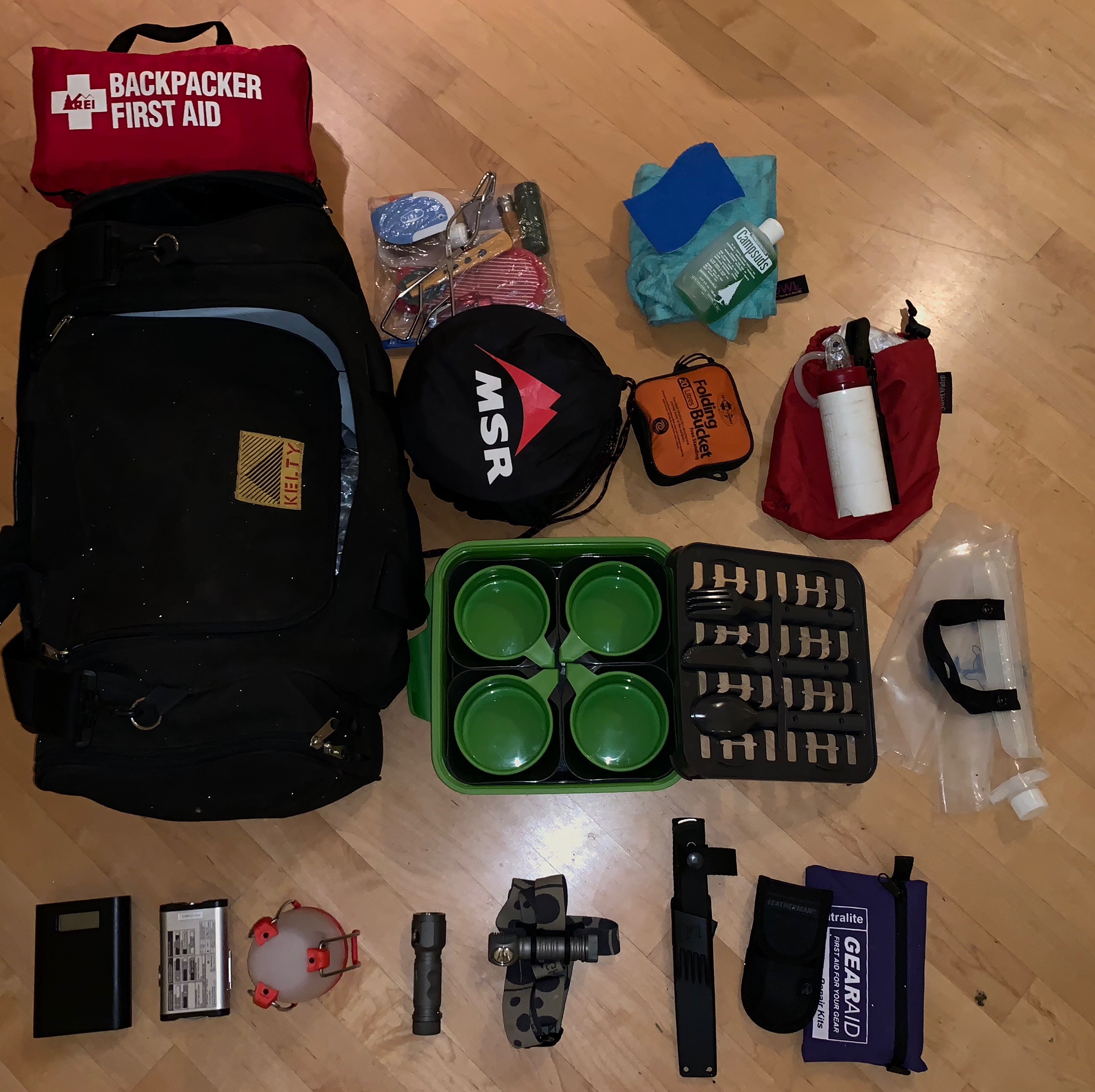
Duffel Bag with three compartments which I use for first aid supplies, my “outdoor kitchen” + water treatment/holding, and finally lighting / repairs. Items held in the duffel listed below:
Misc utensils for kitchen: matches/lighter, mixing spoon, strainer, can opener, pot holder, etc
Packtowel, Scrubbing spong, Campsuds
MSR Duralite Cookset. Inside also my cookset for group backpacking trips: 1.3L Evernew Ti Pop, Snowpeak GigiPower Stove, Fuel Canister, Silicon Bowl/Cup, and MSR folding Foon.
Foldable Water Bucket, Water Filter, Playtus Water Containers
REI Dinnerware Set for 4 including wash basin, drying rack, and cutting board
Plastic Dish tub (not shown)
Trashbags, Foil (not shown)
18650 Batteries in Charger which doubles as USB power supply. AA Batteries in a Charger which doubles as a USB power supply
Zebralight SC600 Flashlight, and H600 Headlamp which use 18650 batteries. There are several other flashlights and headlights I recommend.
Black Diamond Apollo Lantern which is a perfect size and amount of light for car camping or emergency lighting in a house in the case of a power outage. Built in rechargeable battery with the ability to use three AA batteries if the internal battery has been fully discharged and you need light.
Fallkniven F1 fixed blade knife and a Leatherman. There are numerous other good knives I would recommend.
Gear “Repair Kit” with zippers, glue, grommets, rope, safety pins, etc.
Insulated Wine Tote (not shown) which is a good size for a bottle of wine, some snacks, and a couple of glasses for two person picnics in the park.
KitchenAid Immersion Blender for many mixing, blending, and whisking tasks. There are better models on the market, but this one is good enough for my needs.
In have an updated list which captures what I am using now.
In 2019 am using pretty much the same gear in 2018. This shouldn’t be a surprised. Several years ago Minimalism led me to simplify my stuff, keeping just the items that are regularly used and give me joy. This year I moved a number of items from “my” list, to a not fully complete list of items which are shared family gear.
Items in bold are exceptionally great… I regularly finding myself telling people about them. I am happily use items marked with “*”, but they won’t be replaced if lost. Making this list was originally inspired by one bag lifestyle and Tynan’s Gear posts. I hope this list might encourage others to surround themselves with items that truly bring them joy and remove items that are a burden… and not to encourage people to just consume more. My traveling list is a subset of the items in this post.
Everyday Carry Items
Flexon eyeglass frames with high index progressive lens (not shown). Seeing clearly is such a blessing. I break most frames within a year of getting them. Flexon last me several years. My current pair was purchased in 2010, though the lens have been replaced a few times when my prescription was updated.
Garmin 935 Watch: is a do everything watch which is light enough that I don’t mind wearing it everyday. It has adequate integration with my phone and provides every fitness and activity tracking feature I want with better accuracy than most other smart watches. I appreciate the alert on the watch when it loses bluetooth connection with it’s paired phone that reduces the likelihood of leaving the phone behind. There are a number of other sport watches I would recommend if you wanted to spend less money.
Victorinox Rambler Pocket Knife is the smallest, most usable tool I have found with a phillips head & flat screwdriver, scissors, knife, bottle opener, and nail file. Even though the blade is tiny, TSA will confiscate this knife. When flying I switch to a Swiss+Tech Utili-Key which is not as usable as the Rambler, but for years has made it through TSA checkpoints without being confiscated. I have notes on other knife options.
Apple iPhone Xs on Verizon. I “upgraded” from a iPhone 6. The camera is much better and I can make it through a normal day of use without needing to recharge. I miss my earphone jack, and the phone is too big to use with one hand, and I find the face unlock inconsistent. I wish Apple would release a smaller (SE sized) phone with a good display, modern CPU, and fingerprint reader. I am not “happy” with my iPhone Xs, but it’s the best options I have found for me.
Apple AirPods have decent sound quality while letting in ambiance noise providing situational awareness, stays in place during the most vigorous exercise, no wires to get tangled, has good user interface with Apple products (would be perfect if I could change volume) and ok with others, acceptable sound quality, the ear buds run 5 hour, fully recharges in 20 minutes, with a carry case which can recharge them 4-5 times. With Apple products they just work! They aren’t rated for water resistance, but after more than a year of using them while sweating heavily, rides and runs in the rain they continue to function flawlessly.
Zojirushi Double Walled Mug (1 + 1*) can easily be used one handed, locks so it doesn’t open accidentally, pours at the perfect speed, the mouth is wide enough for ice cubes, and best of all does a better job insulating than any other double walled mug I have used. Liquids stay fairly warm or cold for up to 24 hours. I have a silver colored mug. I often misplaced it at work. When it was misplaced for more than a week, I purchased a replacement thinking it was lost for good. Realizing findability was important, I purchased a Deep Cherry color mug which is much easier to spot across the room. After several weeks I found my original Silver mug. Now I have the Red mug which lives at work, and the silver which I use when not at work. Zojirushi makes a number of other excellent styles of mug and Snowpeak makes a beautiful Titanium double walled mug.
Tech “Survival Kit” which is stored in a small pouch. RAVpower Portable Charger/Flashlight is small enough to fit in my pocket while proving power to recharge my phone. Aukey Ultra Compact USB Charger is one of the smallest chargers with two slots and up to 2.4A amps. 6” USB Lightning, USB micro, and USB-C cables with some adaptor tips which let me connect pretty much any two USB devices. A USB thumb drive because sometimes I need to transfer / store files. An Olight Universal Magnetic Battery Charger powered by USB, and can be used with pretty much any size battery. and charges both 1.5V NiHM and 3.7V LI batteries.
Macbook 13″ Pro Laptop (for work). I have tried using tablets but still find myself prefering a real laptop. I would love to find a lighter and more compact laptop, but I like 13” screens, and am still pretty much committed to OSX because it has the applications I use and the good integration with iOS devices. When not doing work (vacations) I am trying to only bring my iPhone and leave laptop behind.
Matador Freerain24 is a nicely designed daypack which: carries well even when running, weights only 5.5oz, easily folds into it’s own pocket, and keeps contents dry even in the worst rain. I actually own a PNW Sea to Sky Waterproof Backpack which is a ripoff of the Freerain24. Used every day for more than a year. Generally good shape, but the coating on zipper slowly breaking down and leaking a bit in heavy rain.
ZebraLight H51 (not shown) with an AA eneloop battery, and headband weight 3.5oz. It has 6 regulation output levels which include lumens/runtime : 0.2/19 days, 8/39h, 30/10h, 200/55min. I use the lowest setting for basic proximity lighting I bump up to 8 lumens for tasks when I need to see accurate colors or when I am walking on establish paths, 30 lumens when running on streets. I use higher settles for night hiking or bouncing off ceiling to light up a room. I have the standard (non floody) reflector: the beam has a hot spot with enough throw for wayfinding and enough spill to be useful for close up tasks. The headband is comfortable, removable, with a glow in the dark holder which makes it easy to find at night. The only thing this light is missing is a battery life indicator which exists in the later version. When stored, I unscrew the tail-cap 1/3 a twist to prevent accidentally it turning on. I have a post about flashlights.
Home Electronics
Apple Mac mini. Needed more storage, memory, and CPU than my 2013 MacBook Pro. The Mini is compact, low noise, with a good collection of ports, and plays well in the Apple eco-system which I am committed to until my next refresh in a few years. It is overpriced compared to non-Apple hardware. This is an experiment to see if when I am away from work and home I can “live” just using an iPhone.
KEF LS50 wireless monitor speakers with a built in DAC and amplifier designed for the speakers. Good quality sound that fills a room, excellent for near field use in a nicely designed, compact package. Can take TOSlink, USB, Bluetooth, analog, and several IP based streaming protocols inputs over ethernet or WiFi. Roon can stream directly to it over the network, but it’s not Roon-Ready so can’t be synchronized with other Roon-Ready systems. The iOS remote application is poor. I drive the LS50 via USB on a Mac Mini running Roon which remove the need for the KEF remote and the speakers can be synchronized with other Roon Ready end-points giving me whole house music. I still prefer the sound quality of electrostatic speakers with audiophile grade full electronics, but I am happy that I downsized my stereo so I could focus on other things.
Sennheiser HD800 Headphones* for when I want very high quality sound and don’t want to bother others too much (sound does leak). These are the second best sounding pair of headphones I have ever used, at 1/3 the cost of the best (Stax SR-009). I have a headphones post with additional information.
Nekteck 4-port 72W USB C Charger with 1 USB-C and 3 traditional USB ports which allows me to charge every device I use on a daily basis from a power brick, including the 13” MacBook Pro from work. When the MacBook Pro isn’t being charged can rapidly charge all my devices. Replaced an Anker 60W PowerPort+ 5 which didn’t support PD 12V@3A.
Google WiFi Mesh network access points easily install and just work when you have an area than a single WiFi router isn’t sufficient. There may be faster / more featureful options out there, but the Google devices work flawlessly and are visually appealing.
Bathroom
Withering Body WiFi Scale (Not shown) makes it easy to track weight which is well integrated to Garmin, Fitbit, MyFitnessPal, LoseIt, and numerous other health tracking eco-systems.
Oral-B/Braun 4000 Electric toothbrush (Not shown). Oral-B and Sonicare both make excellent toothbrushes which are significantly more effective than using a manual toothbrush.
Listerine Floss (not shown) is the most effective dental floss I have used. Gentle to the gums while still getting plague and food wedged between teeth out.
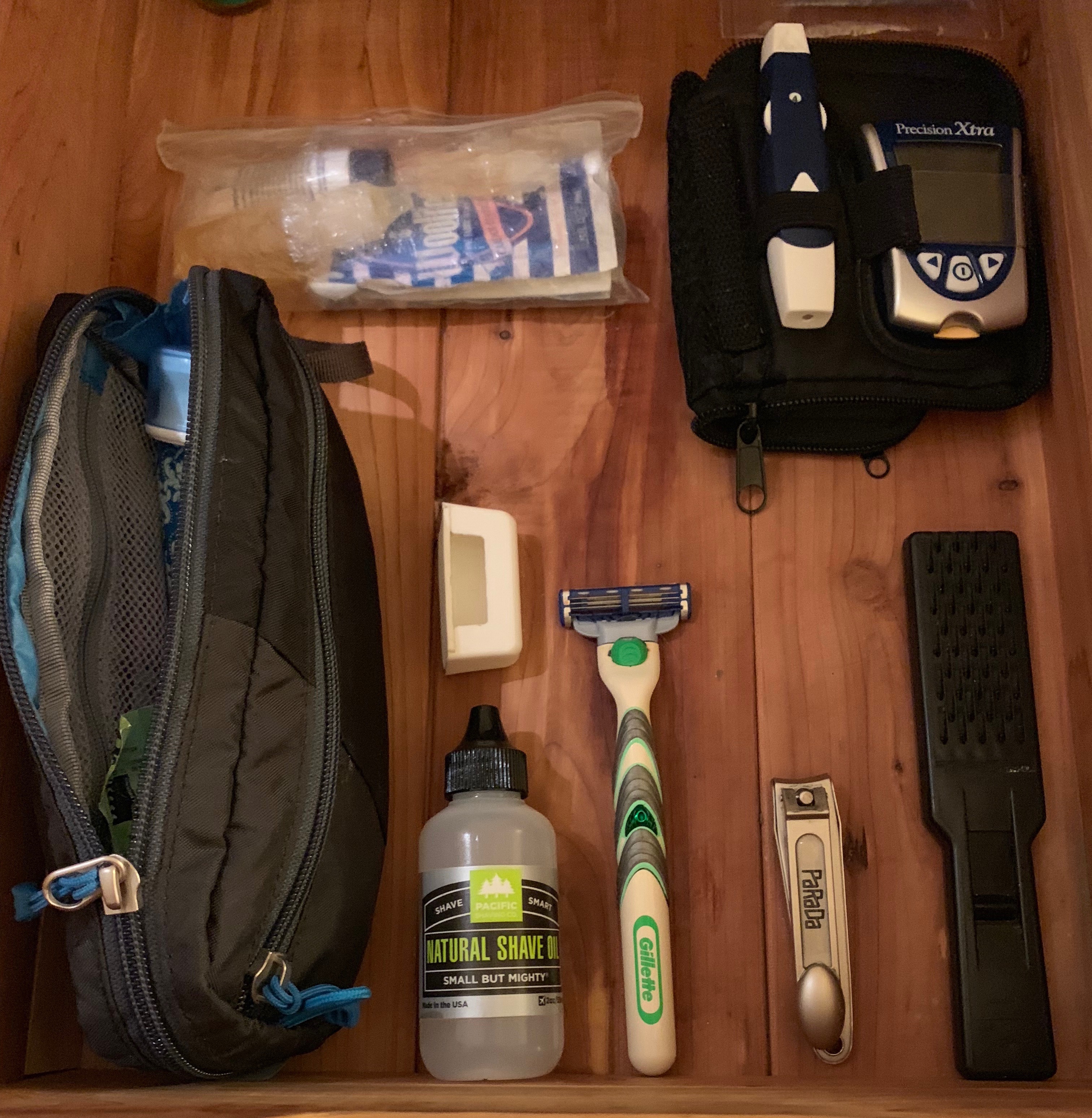
REI Micro Shower Bag is the perfect size for my toiletry kit while providing just enough organizational features to make it easy for me to find everything quickly. Holds all bathroom items when traveling. Inside has first aid kit which includes waterproof Band-Aids, antiseptic wipes, anti biotic cream, superglue, a couple of safety pins. Small size HumanGear GoTubb to store aleve and a few nyquil caplets and a Violife Slim Sonic toothbrush.
Gillette Mach-3 Razor + Pacific Natural Shaving Oil. I am sure there are better razors and many people would suggest that shaving oil is a prep step which should be followed by shaving cream… but I have found this combination effective, reasonable cost effective, and compact when traveling.
Ziplock bag with two weeks work of supplies: dropper bottles filled with Dr Bronner Soap, Shaving Oil, shampoo, skin lotion, and a few single use woolite packets
Tom Bihn Synapse-25 Backpack is my travel luggage. Wonderfully designed with just the right amount of organizational features. Large enough for nearly every trip I have taken, while small enough that it fits under every seat I have used and has never been viewed as “luggage” by transportation operators. The laptop cache works brillantly. Have notes about other travel packs.
Patagonia Ultralight Courier Bag* is perfect size for day use and compact enough that I can pack it away in my backpack when moving between towns. Easy access without taking it off, in hot weather maximized ventilation, and can be used at the same time that I am carrying a backpack.
Water Bottle Sling Nancy brought back from South America. Great for days I just need water and nothing else. Sometimes borrow my wife’s Chico Water Bottle Sling because it can hold my water bottle + my umbrella or windbreaker.
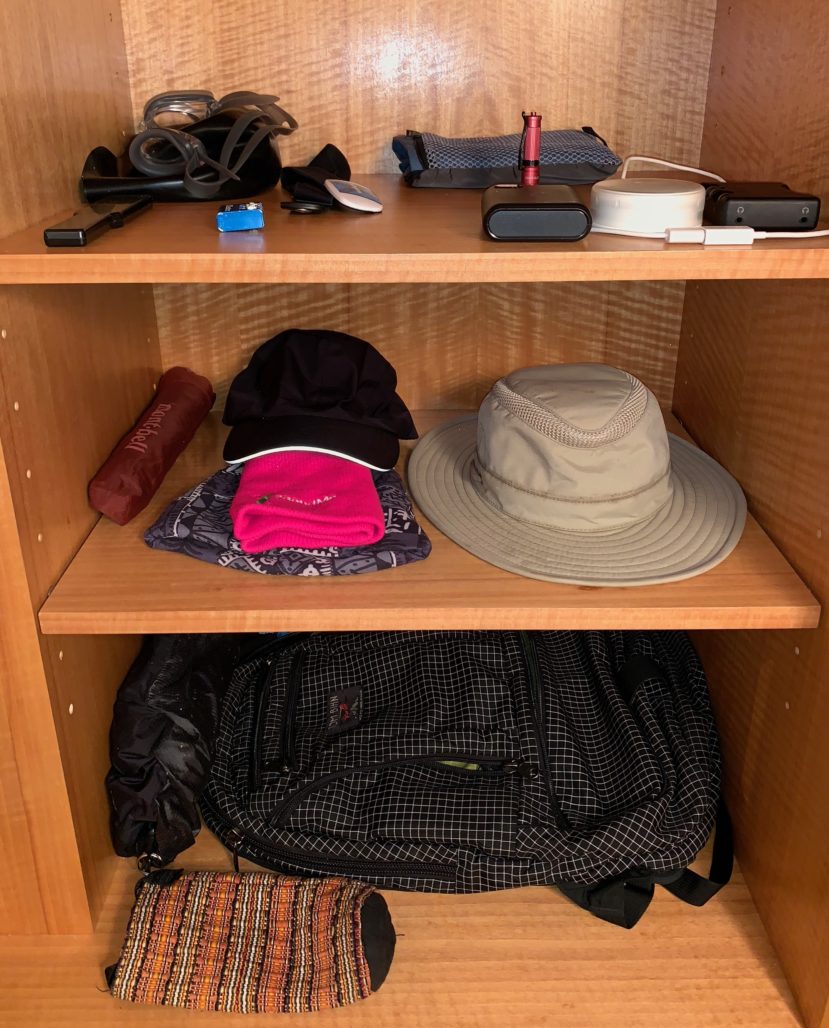
Montbell Trekking Umbrella* has the best balance I have found between small/light and canopy size. It has survived 40mph wind/rain storms. In warm to hot weather much more comfortable than wearing a rain jacket but doesn’t adequately protect my legs in a hard rain.
PolarBuff is a versatile item which can be used as a neck cozy, balaclava, beanie, hair band, and in a number of other configurations. I typically use it as a beanie.
23and Stocking Hat* lives in my daypack for days when it is particularly cold and I want a bit of extra warmth. Not technically needed, but a way to show my company spirit.
Tilley LTM6 Hat provides good sun protection while offering decent ventilation. I think it’s one of the more stylish hats which provides good sun protection. My wife says I am wrong… that my SunRunner is better looking, but is willing to put up with me wearing this hat when the sun is big. I have a list of other hats that you might prefer.
REI eVENT Rain Hat: a discontinued ball cap made from waterproof / breathable eVENT. Used when hiking or running when I know it’s going to be raining.
Mountain Hardware Grub Gloves (not shown) medium weight PowerStretch gloves with a quilted mitten cover which folds away into the back of the glove making it comfortable to wear in a wide variety of conditions.
Sleep Mask by Bedtime Bliss (not shown) which lets me get an extra hour of sleep in the morning because the sun coming up doesn’t immediately wake me and helps if I take a nap during the day.
PackTowel Ultralight (Bodysize/XL) dries amazingly quickly, is compact, and is very effective. The XL is large enough that I can wrap it around my waist like a small sarong. For awhile I used a medium/face size which packs in a tiny space. I found the face size sufficient for me to dry myself after a swim or shower, but I am willing to carry a larger towel for the added versatility and ease of use.
TYR Corrective Optical Performance Goggles so that I can actually see when I am swimming. I keep the goggles with a generic swimming cap because some pools require them, and small combination lock.
Stryd Footpad (not shown) captures run’s intensity better than using pace or heart rate. The Garmin Running Dynamics Pod might be a cheaper way to get the same sort of data. The RunScribe Plus now syncs to Garmin and other eco-systems and might provide more actionable insights about running form that other running power meters.
Wahoo Tickr X Heart Rate Strap because optical heart rate monitors aren’t sufficiently accurate for HRV measurements and aren’t responsive enough to track interval training. I mostly use it as a basic HRM, but if you use the Wahoo fitness app there are a number of other metrics that it can record. There are plenty of good HRM including Garmin’s Tri HRM which can be worn swimming and the Viiiva HRM which can be used to bridge other sensors between BlueTooth and ANT+. These days I mostly use Power rather than heart rate to track intensity, and the optical HRM on my Garmin 935 is almost good enough to replace the strap.
Westone 5ES custom In-ear-monitors (IEM) with excellent sound quality and comfortable enough to wear on 14 hour flights. They reduce noise by 35db which makes travel much less fatiguing for me while being much smaller and having better sound quality than active noise canceling headphones. Stored in a medium size HumanGear GoTubb with adapters.
Radsome EarStudio ES100 bluetooth/DAC/headphone amplifier allows me to use Westone IEM (or other wired headphones) with my iPhone Xs. The ES100 is tiny, with good sound quality (though Chord Mojo is noticeably better) and able drive Sennheiser HD800 to reasonable sound levels.
Chord Mojo DAC* offers a nice design, good quality sound, good price / performance ratio, portability, has enough power to happily drive Sennheiser HD 800, and has an internal battery which enables it be driven via USB from phones and portable DAPs. I have written about other DACs.
Ainope 10K mAh Portable charger for when I need to power devices for several days without access to a power outlet or for long flights without USB power in the seat.
Olight I3S EOS Flashlight* is slightly larger than the single AAA battery which powers it. Selectable output of 8,50,80 lumens permits the user to make a trade-off of runtime vs brightness. I have other lights which should rendered this flashlight unnecessary, but when I take walks around the neighborhood at night I find myself reaching for this tiny light. I have notes about other flashlight and headlamps.
Kindle PaperWhite* (not shown) lets me carry the majority of my library with me and every book can be displayed with large print for my aging eyes. Love being able to quickly search for notes / hi-lighted passages. I miss physical books and knowledge retention with paper books is still better than when using an e-reader, but the connivence of the Kindle outweighs this for me. I often use the Kindle reader on my phone, but the larger display surface of the Paperwhite, much longer battery life, and usability in sunlight means the PaperWhite goes on most trips I take.
Clothing
I have notes about selecting clothing for an active life which goes in detail about how to select clothing for a wide range of activities and conditions.
Outlier New Way Shorts (3) are nice looking shorts which fit me perfectly, don’t have cargo pockets, are durable and dry reasonably quickly. They are pricy but I haven’t found any shorts I like as much.
North Face Paramount Shorts* (not shown) were the best shorts I could find on a trip where I needed a part of shorts. I appreciate the zipper stash pocket, and they were better than all there other shorts I tried on, but they just don’t fit as nicely as my new way shorts.
Zootsports Performance Tri Shorts works well cycling, running and swimming. They are comfortable for all the activities I engage in, in a wide range of conditions. They have reduces issues with chaffing, dry fairly quickly, and are reasonably comfortable when wet. They have side pockets large enough to hold some nutrition and my phone so I don’t need to use a special cycling jersey. I never need to think about what shorts to wear when I am going to engage in vigorous physical activities…. I just grab my pair of zoot.
Columbia/Montrail Titan Trailrunning Shirt: Omni-Freeze fabric that helps cool when working out in moderate to hot conditions. Super light weight and breathable. Anti-stink is reasonable.
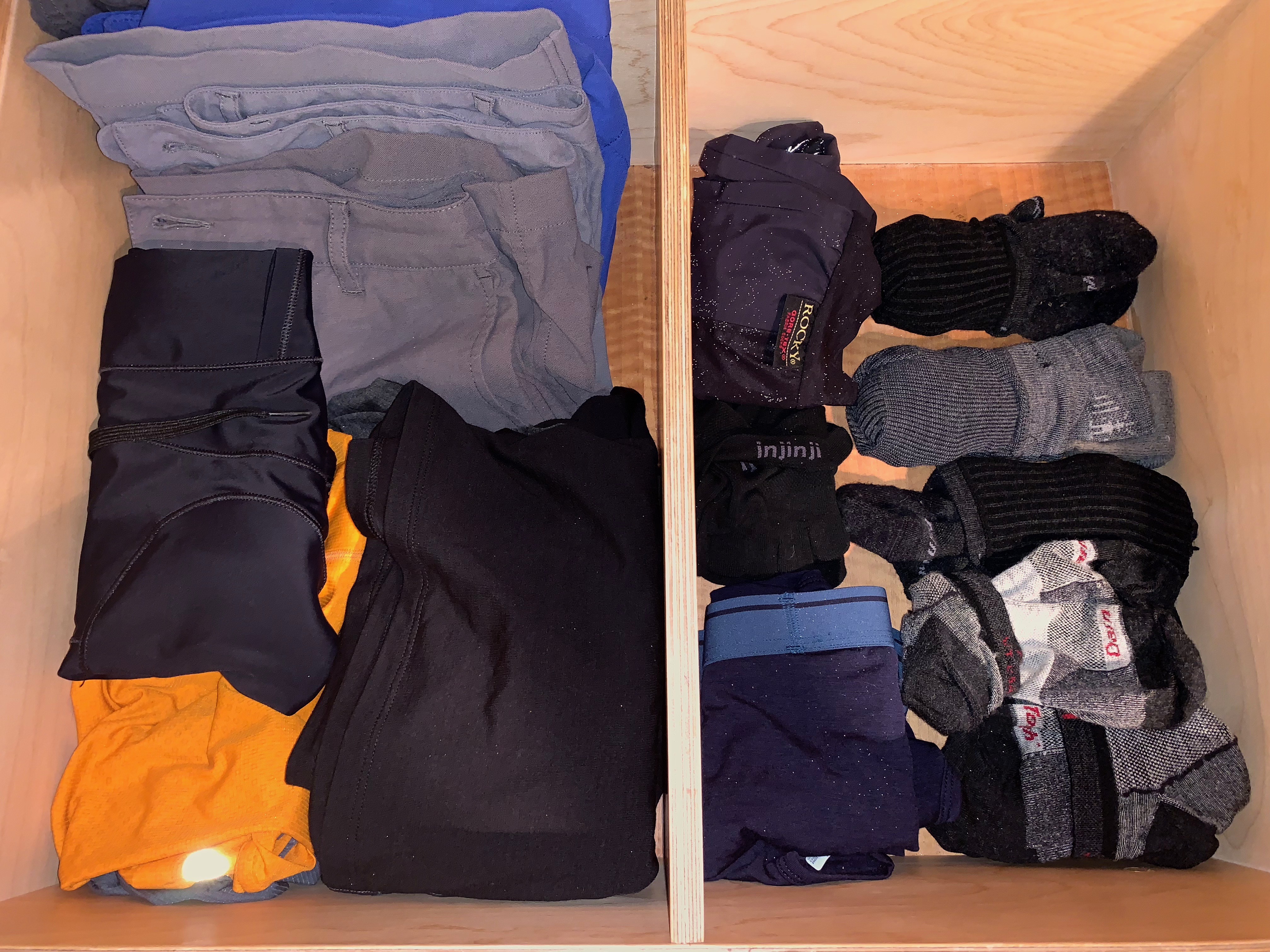
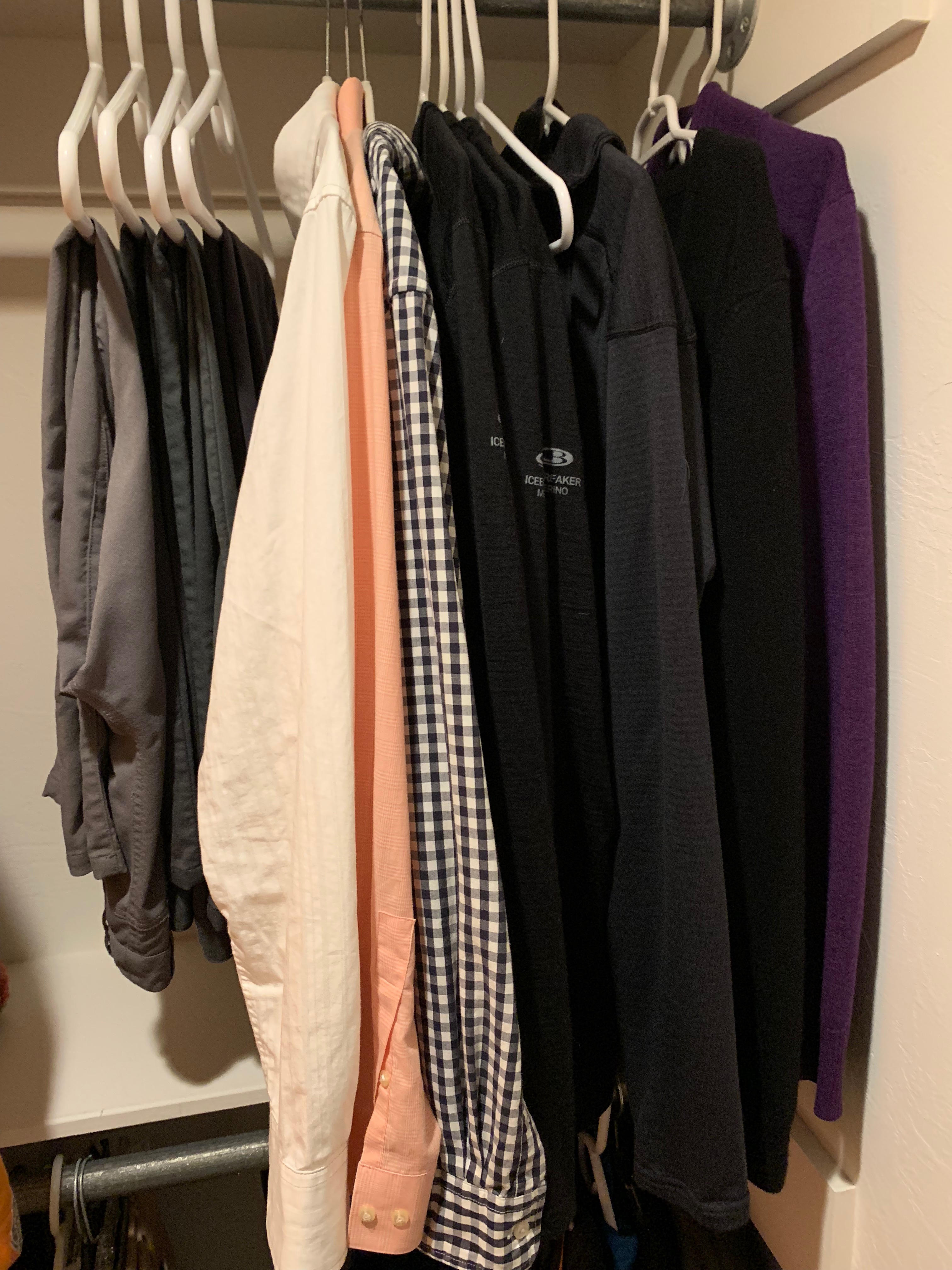
Icebreaker Anatomica Tee-shirt (4) merino wool with just a bit of lycra for a body hugging fit. This tee-shirt fits me perfectly, looks good, is super comfortable, doesn’t smell after several days of wear on the road, and dries fairly quickly. There are two downside. First, they are pricy especially in view that they wear out more quickly that a cheap cotton tee. Second, they don’t work as well as synthetics when engaged in high energy activities where you are sweating a lot. There are a number of other good merino wool shirts from Smartwool, Outlier, and Wool&Price.
Icebreaker Anatomica Briefs (4) the most comfortable underwear I have worn. Downsides are that they start getting holes after a year and they are expensive. Some people prefer boxer style but I see no reason to have extra fabric on my thighs. Good alternatives are the synthetic travel oriented briefs from Ex Offico and the comfortable but expensive underwear from Saxx.
Darn Tough Socks (8) are unsurprisingly durable since they come with a lifetime warranty. I found they fit and perform very well and come in a wide variety of thicknesses, lengths, and colors. I like the endurance light socks. Icebreaker and the Smartwool PhD line are good alternatives.
Injinji Ultralight Toe Socks (2) for long distance runs / hikes. Generally I prefer wool, but I found light weight wool toe socks get holes very quickly so I use the CoolMax, original weight version.
Rocky Gore-Tex Socks are the best way I have found to keep my feet reasonably clean, dry and warm in messy back country conditions. Often worn with Keen sandals to maximum breathability and speed drying once they are out of the water.
Keen Clearwater CNX are the lightest sandals Keen makes. I liked the minimalist sandals made by luna and Xero Shoes but the toe protection of the Keens makes them a clear winner for me. If worn with gray socks they can pass for shoes. Comfortable in a wide range of conditions. I can run in them when I don’t have my Alta running shoes with me.
Alta Running Shoes are the best running shoes (trail and road) that I have used. Wearing these shoes with toe-socks has allow me to do marathon length runs and 20+ mile days backpacking with no blisters or foot pain. Just one week after purchasing my first pair of One V2.5 I completed the Big Sur Marathon without issue. I like the models with minimal cushion. I currently use One V3 for road running and the Superior V3 for trails.
Vivobarefoot Gobi II are extremely light weight, zero-drop, minimalist ankle boots which can be worn with casual clothing and my wife tells me they are acceptable to wear with a suit. Love them because they are light weight and comfortable. Two downside are that they take longer to put on and take off than low rise shoes and my feet can feel tired if I have been walking 14+ miles each day, for several days.
Carots Shoes* are formal looking zero drop shoes. These are the only minimalist shoes I have found that looks like traditional dress shoes (heels and and tapered toe) that are sufficiently comfortable for day long wear. These were purchased before I discovered that the Gobi II were acceptable footwear with my suit.
Skinners* (Not Shown) Socks with durable flexible coating on bottom so they can be used like shoes. Small and compact. Use as slippers, when I biking somewhere and then want to walk around without cleats, or when I am in the mood for barefoot running.
Topo Running Shoes (Not Shown) are zero drop minimalist running shoes. My model is a bit lighter than their current zero drop road running shoe. These shoes live at work for the days I ride my bike and don’t want to clomp around with cleats all day or carry shoes back and forth to work.
Outlier Slim Dungarees (4) Soft shell pants in the style of jeans. Wonderful fit, looks good, excellent mobility. Thanks to the NanoSphere treatment very stain and water resistant. They are perfect except when it’s >80F and I am active. They seem pricy, but the per day cost of wearing is about the same as denim jeans. Maker & Rider makes a nice alternative.
White Dress Shirt for when I need to be dressed up.
Peach Button Down Shirt* for when my wife wants me to wear something at is a bit different than normal (for me).
Black/Grey/White Checked Button Down Shirt* for when my wife wants me to wear something nicer than a tee-shirt but less than a suit, white shirt, and tie.
Icebreaker Wool Hoodie: (4) Oasis 200wt merio wool hoodie with 1/4 length zipper. Worn when it gets too cool to wear just a tee-shirt. Icebreaker has discontinued this model. Also have 3 in storage which will come out when these wear out.
Patagonia Capilene Thermal Weight Hoody for cool/cold weather outdoor activities. Without wind protection the grid weave lets air flow through letting heat vent out. With a shell it insulates well. Comfort down to 30F when running without a shell, below that with a shell. When walking keeps me comfortable down to 40F when combined with a wind shirt. I am reasonably comfortable engage in high energy activities when it’s 65F by fully opening the zipper and pushing the sleeves up to my elbows. Dries amazingly quickly and feels more comfortable than any other shirt I have used when it’s wet.
Grey Cashmere V-neck Sweater for fall and winter evenings that when I should wear something a bit more dressed up than my wool hoody and/or want more insulation.
Mid-Weight, Purple Merino Wool Sweater* for cool days or when I want to wear something that isn’t black.
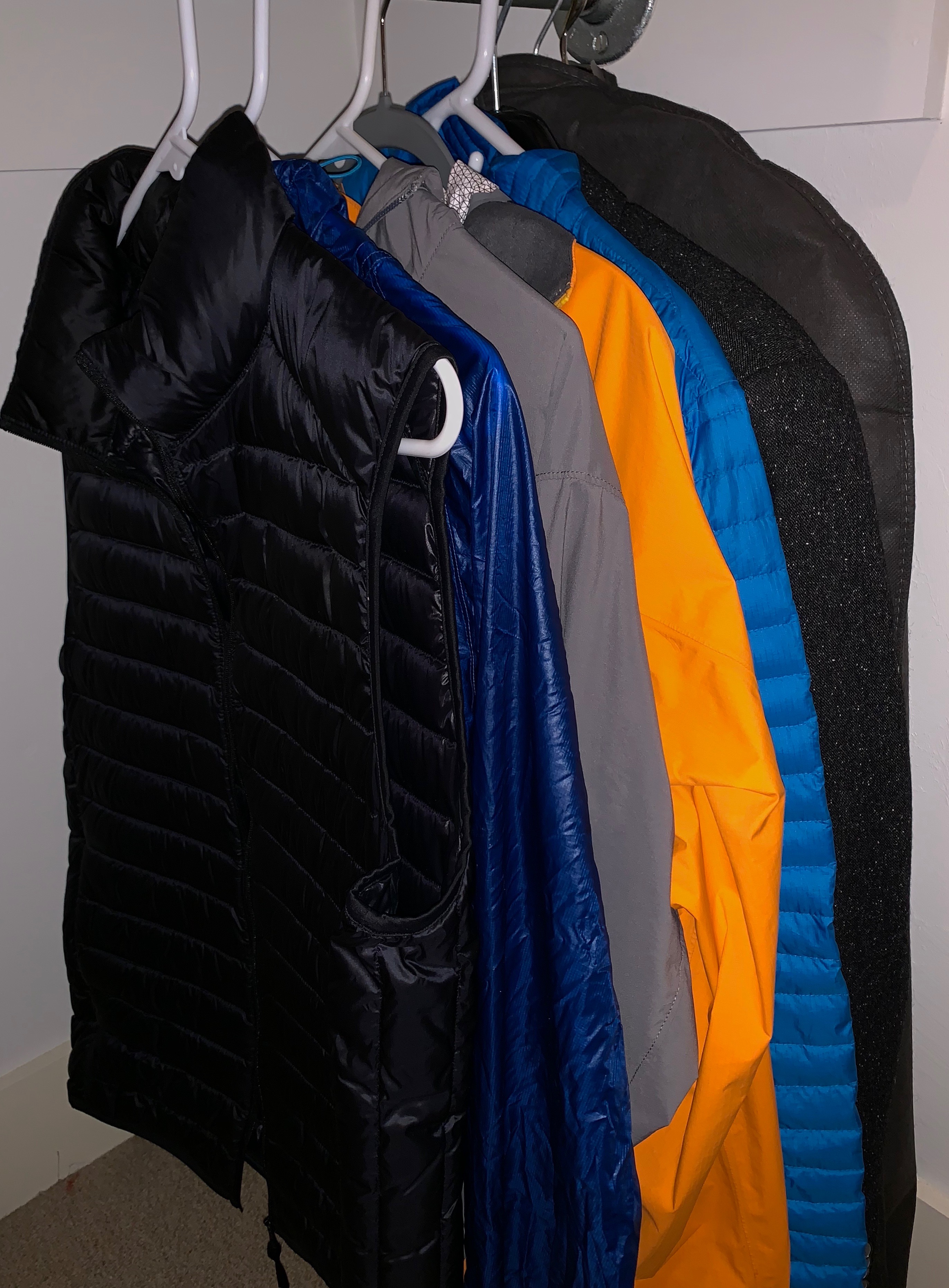
Uniqlo Ultralight Down Vest is decent quality, low price, with just the right amount of insulation for me. Combined with my sweater and a shell keeps me warm enough in the coldest weather I encounter in the SF Bay area.
Montbell Tachyon Windshirt a 1.8 ounce wind shirt that can be compressed into something slightly larger than a cliff bar. Windshirts, especially when combined with a air permeable middle layer provide comfort over a huge range of conditions. This lives in my daypack.
Westcomb’s Focus LT Rain Jacket has been pulled out of storage because in the last few rain storms the zipper on the ArcTeryx Norvan SL has leaked so much that I don’t use it when I expect to be out in the rain for an extended period of time. While not as breathable as the Norvan SL, the Focus doesn’t leak. Other options are discussed in my post about rain gear.
Zpacks Vertice Rain Pants (not shown) are simple, light, breathable, waterproof rain pants. Used when commuting by bike, hiking, or backpacking in the rain.
Patagonia Down Shirt* with 23andMe logo. A jacket which provides adequate insulation for around the town use in the SF Bay Area. Allows me to show my company spirit and my wife thinks it looks better than the combination of the above items. The Patagonia Micro Puff Hoody using PlumaFill insulation would be better for back country use thanks to it’s superior water resistance. The Montbell inner down jacket continues to be the price performance champ, and Uniqlo’s down jacket is a good alternative for someone on a tight budget.
Boss Blazer Jacket used when going out and it’s appropriate to be wearing something more dressy than a hoodie, but a full suit is too formal. On cool evenings I sometimes wear the blazer over my shirt rather than taking a more traditional “outdoor” jacket.
Boss Wool Suit slim/european cut in suit cover bag. Fits me perfectly though not bespoken. First suit that I wear rather than the suit wearing me. Light enough that it’s usable in the summer. I use it anytime I need to be very dressed up: weddings, funerals, special nights out on the town. Have two ties… one that is “serious” and one that is “fun”
Backpacking / Winter Clothing
I have a 3-season packing list which makes use of a number of the items on this list and has several items which are specific for backpacking. In addition to the items on my backpacking list, I have several items which come out when I am heading to the mountains and expect snow.
Patagonia Cap 3 Tights: which go under normal pants and/or rain pants when facing below freezing conditions.
GoLite Snow Cap: polarguard insulated bomber style hat which can be layered over other hats. Fairly windproof, warm, and light weight.
Outdoor Research Meteor Mitts: which have a removable 300wt fleece inner mitt which folds back to let you use your fingers and a durable, waterproof shell.
Mountain Hardware Tempest Gloves: ultralight light weight water resistant shell with modest liner. Great dexterity.
Gaiters: for keeping snow out of shoes/boots and the lower legs dry.
Bicycling Stuff
Cervelo R3: pricy but amazing road bicycle. Comfortable enough for an endurance ride, but responsive like a race bike. Fitted with an Infinity Seat, and a small seat bag which holds a pump, inter-tube, bike tool, and 2 tire levers. Moots makes some great Titanium bikes but you have to special order them.
Giro Air Attack Shield Helmet provides protection, good ventilation while having a very streamlined aerodynamic profile. Has snap on optical shield which is great because with my eye prescription, it’s hard to find sports oriented sunglasses. If you ride a bicycle, wear a helmet!! I am alive today because I was wearing a helmet when I was in an accident. Giro has newer models which have better ventilation and aerodynamic profile and also cheaper models that will protect your head just as well for less money.
Felix BC21R Bike Headlamp which was purchase when my Expilion 850 was stolen. The BC21R uses a removable 18650 rechargeable battery. I think I slightly preferred the quality of light from the Expilion, but the BC21R works well enough to stick with it, and I do appreciate that the battery can be charged outside light housing.
Power Tap P1 Pedals because I like objective measures about how my physically conditioning is changing. The Garmin Vector 2 pedals integrate better into the Garmin eco-system, use standard Keto cleats, and are lighter / more streamlined at about the same price point.
Bicycling Shoes with Cleat for PowerTap peddles.
Wahoo Fitness Kickr* is a great trainer for when you can’t get outside. Integrated power meter and variable resistance which can be controls via ANT+ or BlueTooth. Wahoo build the Kickr with an open API so there are numerous companies which have applications which can control the Kickr.
Sentimental
There are a several items I have kept as a specific way to honor people I have lost.
Libby’s pins of a nativity scene and of a mother and child. Originally worn by Libby on special occasions they became daily decorations for the hats she wore during chemotherapy. They remind me of Libby’s courage and the two things most important to Libby, family and Jesus.
Carl’s Rolex Oyster Watch to remember his craftsmanship, love of teaching, and ironically his frugality.
Jules’ sculptures of musicians made from nails because he passed on a love for music and art.
WWII Era Wool Blanket (not shown) Originally owned by Carl or maybe even my grandfather. It has been on countless fishing and camping trips and to virtually every picnic and outdoor concert I have ever attended. Everything I see the blanket I think of my dad and many wonderful moments.
Potentially Retired
The following items weren’t used last year. I have put them aside for the next year to see if they get pulled back out.
Wool and Prince Blue Oxford Shirt a blue dress shirt my wife loves. Crisp look and a slim fit while still having all the advantages of 100% wool, but haven’t really needed a light blue color shirt.
Outlier Air Forged Oxford Shirt Fits me well, made from durable nylon weave so it dries quickly and doesn’t wrinkle when traveling while looking nicer than many “travel” shirts. Hasn’t been used because I live in wool tees or hoody when traveling.
Icebreaker Long Sleeve Oasis Crew orange & grey color which was a Christmas gift to add some color to my wardrobe but I tend to use my hoody.
Retired in 2019
North Face TKA80: Fleece which is lighter weight and less bulky than most. Fleece starting to pill. Might eventually replace it with Montbell’s Chameece Inner Jacket, but for now wool sweaters are working fine.
Black Diamond Alpine Start Jacket is one of the lightest weight soft shells made today. Moderately air permeable, schoeller nansphere treatment for excellent DWR, fair bit of stretch for ease of movement. Purchased as an experiment for high aerobic activities in cold weather. While the tight weave and Nanosphere treatment is amazing, wets through in heavy rain after 30 minutes. Either I need wind protection which is provided by the Tachyon, or I need read rain protections in which case I use the Focus LT in cool conditions or I just get wet and keep activity level high to stay warm.
ArcTeryx Norvan SL Rain Jacket is one of the lightest, most breathable rain jacket currently available. I can actually wear it comfortably jogging in cool, rainy weather. Alas… the zipper leaks too much in heavy rain.
OR SunRunner Cap ball cap with a removal veil that is very packable. Downside is that it looks a bit silly when used with the veil and air flow when using the veil is less than when I wear the Tilley.
Petzl Bindi is a very light weight, but pricy rechargeable headlamp which works well for urban running. Retired because it was lost after a run. When I need a headlamp for running make use of the Zebralight H51 from my backpacking gear which is a bit heavier but has a better beam.
Cygolight Expilion Bike Headlamp are bright enough to illuminate when I am riding fast and has a swappable rechargeable battery. “Retired” because it was stolen.
Anker 60W PowerPort+ 5 with 1 USB-C and 4 traditional USB ports has enough ports to charge every device I use on a daily basis including my 13” MacBook Pro. Replace to get 12V@3amp PD charging mode on USB-C port and a smaller unit. The need for 12V went away when gave up on the One Netbook, so replacing this wasn’t actually needed 🙁
One Netbook One Mix 2 Yoga Pocket Notebook is a 19 ounce full PC running Windows 10 with 8GB RAM, a 256GB SSD, and a 1920 x 1200 touch screen. Screen was too small for my aging eyes, and I feel unsafe running Windows 10 due to how much malware is targeted at it. Owned briefly.
Punkt MP02 Minimalist Phone. Owned briefly. Was considering switching from a iPhone to a MP02 + iPod Touch, but the MP02 is missing bands which would make it usable on Verizon and it was a bit larger than I expect.
Weight of Glory is a sermon delivered by C.S. Lewis in the Church of St Mary the Virgin, Oxford. The sermon was first published in THEOLOGY, November, 1941, and by the S.P.C.K, 1942. This and several other pieces by Lewis were combined in the book also called The Weight of Glory. Internet Archive and a copy of the Indian edition of this book, and an audio version.
I posted a PDF transcript of Weight of Glory in 1988 because it had a significant impact on my faith and life. After many years I received a very polite “Take Down” notice from the copyright holder. I learned that while the copyright had expired in a number of countries, the copyright was still in effect in the USA?! I removed my copy. I will bring it back once the copyright expires in the USA. Someone, hopefully out of the USA, has posted a PDF of the sermon.
People in Canada and other locations that have a 50 year limit on copyright you can find the Weight of Glory contained in the freely available in the e-book Transpositions and other Addresses.
I looked in the eyes of everyone going by and I saw their secret beauty that was born in them that no one can take from them. That magnificence of spirit, soul, whatever you want to call it.” He said, “The only problem would be I wanted to fall down at their feet and worship each one that went by.” He said, “If we could see each other that way there’d be no more need for war and cruelty. The world would be a different place.
Jackie says “Weee….”, Mark says “Whatever”. We are different
Not a week goes by when Jackie and I don’t have a serious argument…. and I am so thankful for this because our arguments grow our understanding and character. The root of our arguments is often that we see the world from different perspectives. As we argue, we learn more about each others life experiences, cultural background, and personality. I am learning how ego-centric my perspective is, and sometimes learn that what I think is true is merely an opinion, or worse, plain wrong. Together we are learning what is truth and good.
Sometimes I discover an apparent disagreement isn’t a disagreement. Rather, we are talking about the issue from a different perspective. In these cases I learn that I am being too sensitive and/or too narrow in how I think and talk. Sometimes I am jumping to conclusions and misjudging what Jackie is saying. Sometimes the argument reveals how one of us (or sometimes both of us) are wrong. We find that our biases or fears were making it difficult to see the truth. Often we find a viewpoint we can agree on. Sometimes we agree to disagree. In these cases we have struggled through the issue enough to recognize and respect each others perspective, but have not been persuaded to adopt the other’s perspective.
Myers-Briggs classifies me as a “J”, while Jackie is a “P”. I like plans, closure, and certainty. Jackie likes freedom, experience, and possibilities. There are strengths and weaknesses to each of our approaches. By working together we help each other have a richer and more balanced life experience.
Jackie Helps me Let Go of the Illusion of Control
I want a safe life which I control. I know that this is an illusion, that there are many things outside my control, but that doesn’t stop me from trying to keep life safe and controlled.
Jackie pulls me out of my safe comfort zone. She is always after me to try new things even when the outcome is uncertain or could be embarrassing. Jackie encourages me to take risks. This is not something that comes to me naturally. I don’t like failing or doing things poorly. I don’t want to look silly or foolish. While this is “safe”, it often means there are great opportunities that I would miss with my risk adverse approach. G. K. Chesterton wisely noted that “Anything worth doing is worth doing badly.”
Jackie reminds me to live in the present and trust God’s provision. She tells me to not worry about tomorrow; for tomorrow will care for itself. Each day has enough trouble of its own. (Matt 6:34).
Finally, Jackie reminds me that no matter how carefully I plan for the future, I have little control over what will ultimately happen. That planning 5-10 years in the future is great hubris and typically a waste of time, just as James 4:13-16 says Come now, you who say, “Today or tomorrow we will go into such and such a town and spend a year there and trade and make a profit”— yet you do not know what tomorrow will bring. What is your life? For you are a mist that appears for a little time and then vanishes. Instead you ought to say, “If the Lord wills, we will live and do this or that.” As it is, you boast in your arrogance. All such boasting is evil.
I Help Jackie Hold Course
Jackie is much more impacted by her emotions and immediate circumstances than I am. If things get uncomfortable, or seem not to be working well, she is very quick to change direction. If a new opportunity comes up, she sometimes forgets promises or commitments that were made earlier.
I help keep Jackie anchored and moving forward when things get difficult. I remind her that just because things are getting uncomfortable doesn’t means she is going the wrong direction. I help Jackie practice what Ignatian exercises refers to as the discernment of spirits, When it’s “dark”, be patient, don’t change directions, keep going the same way until there is enough light to adjust direction.
My role is often to help Jackie not feel overwhelmed by her emotions, but to hold firm to what she knows. As Eph 4:11-16 states: And he gave the apostles, the prophets, the evangelists, the shepherds and teachers, to equip the saints for the work of ministry, for building up the body of Christ, until we all attain to the unity of the faith and of the knowledge of the Son of God, to mature manhood, to the measure of the stature of the fullness of Christ, so that we may no longer be children, tossed to and fro by the waves and carried about by every wind of doctrine, by human cunning, by craftiness in deceitful schemes. Rather, speaking the truth in love, we are to grow up in every way into him who is the head, into Christ, from whom the whole body, joined and held together by every joint with which it is equipped, when each part is working properly, makes the body grow so that it builds itself up in love.
Every Saturday Jackie and I take at least a couple hours to walk in one of the parks in our area or we might be further afield at some state or national park. Within a few minutes of beginning our walk I can feel myself relaxing. I periodically go on solo backpacking trips, my version of a personal retreat. Not only do I come home refreshed, but often I will have insight into how to resolve what had been an intractable problem.
My first choice for a vacation is to spend time in the outdoors which has included around 90% of US national parks. My outdoor activities are primarily:
running: 9-45 miles/week depending on season and training program
walking, hiking, backpacking: 12-17k steps daily walking, at least one >6 miles walk with Jackie, large range on special activities
bicycling: 0-150 miles/week depending on how much running and hiking I am doing
When I was younger, I spent quite a bit of time canoeing, climbing, fly fishing, kayaking, sailing, and a variety of winter activities such as skiing. I have dabbled with geocaching. I am no longer regularly engaging in these activities.
Keep close to Nature’s heart, yourself; and break clear away, once in a while, and climb a mountain or spend a week in the woods. Wash your spirit clean from the earth-stains of this sordid, gold-seeking crowd in God’s pure air. It will help you in your efforts to bring to these people something better than gold.
Originally Published in 1991 Minor updates 2005, 2021
“How many IT staff does an organization need?” is a commonly asked and difficult to answer question. There is no magic ratio. There is no ideal staffing level. The appropriate number of a staff depends on what the IT organization is responsible for and the level of service expected in each area of responsibility.
[toc]
This post is primarily about classic enterprise IT staffing… what happens inside a company or a university where IS/IT solutions are delivered. While related, running a production service which is delivering software as service is quite a bit different from enterprise computing. There was a brief article in CIO which demonstrates what happens when you benchmark enterprises against service providers. I discuss some of these issues in my Hints for Operating High Quality Services. James Hamilton has noted that in mega scale operations, human staff accounts for less than 10% of overall costs.
There was a nice graph found in the slide deck Impliance: an Information Management Appliance by folks from IBM Research which captured how staffing costs have gone up in comparison to the cost of hardware for enterprise computing. In a production environment, there is typically significantly more investment make into infrastructure and tools, work is often shared between an engineering group and an operations group, and there are often economies of scale that I only hint at in this paper.
What IT Staff Do
There are number of different kinds of work that IT teams are often responsible to deliver.
User Services (e.g. Helpdesk)
How much hand-holding is expected? Some sites have users who are pretty self-sufficient; other sites have users who need assistance for everything they do. Can your users take care of themselves or do they need and want the administrator to perform even the simplest tasks for them? For example, I have a friend whose users demand that he perform the most basic tasks for them (such as moving their files from one directory to another). Anything that isn’t simply invoking the text editor or reading mail is “UNIX” and hence a job for the administrator. This sort of support requires a ratio something like one administrator for every four users.
Does the site want you to conduct workshops or prepare extensive local documentation? To what extent are you expected to consult on technical issues? Do you concern yourself with just the operating system like OSX or is the Helpdesk assisting with applications, or even development tools? For example, let’s say your site has heavy users of TeX, Mathematica, C++, Python, X11, R, MySQL, and Google G-Suite. Is user services supposed to be able to answer detailed questions on all those topics? Few people are experts at all these things. Development of expertise in any given topic area requires time to play, experiment, and mature in that area, and there are limits to the number of areas someone can master.
Software Support
How much public domain software or freeware do people want installed? What level of support are they expecting? Installing RPMs is typically fairly easy. Just compiling and installing software doesn’t take much time. Often though, software doesn’t just compile and install properly. Often there are conflicts between packages which can be challenging to resolve. There are often assumptions in the software which need to be changed before the software can be used at a given site. In addition, administrators are often expected (and rightly so) to continue maintenance of the software (bug fixes, security patches, and what not) and to become an expert in the use of the software. Compiling and installing (coupled with frequent patches) or many hardware/software platforms can make this incredibly time consuming for even just a few software packages. The time this takes varies with the quality and complexity of the software. Keeping a current version of kermit or perl isn’t hard (I wish everyone did as nice a job as Larry Wall has with perl); keeping up with g++ is much more time-consuming.
Cloud Services Support
Increasingly today, organizations use cloud services to solve their business problems. Staff time for Cloud services are often under estimated because they tend to be distributed. First is the cost of on boarding. Often this is as soon as someone using a company credit card to sign up for a service, but that is not sustainable. First, the billing really need to be going to the organization, not an individual. More important though is insuring the correct people have access, and than when people’s roles changes, or they leave the company, the right thing happens.
In the best case, the SaaS can leverage an existing account management systems such as Google Apps, enterprise single sign-on system like Okta, or an internal AD service if it provides an externally reachable SaML endpoint. Can has to be made to insure that disabling a single sign-on account blocks access (some systems also permit access against a service specific credential). Generally on boarding apps is around 1 man week / app which you factor in learning about the service, arranging integrations, producing appropriate documentation.
Beyond getting a SaaS plumbed in, there are a wide range of possible costs depending on the complexity of the integrations, how much customization is required, and whether there will be a need for the IT team to provide customer support.
ERP System
In our increasingly complex and regulated world, organizations have to track and manage a wide range of processes. As the pace of work has increased there is the perception that data needs to be available in real-time but has lead to the adoption of Enterprise resource planning (ERP) systems. The best know systems in this space are SAP and Oracle’s suite of applications. In the mid-tier there are companies like Netsuite and Workday. For small businesses, Quickbooks is commonly used.
In smaller orginiztions ERP systems are often managed by the team that is responsible for the function. Finance takes care of the the accounting software. Human Resources often takes care of whatever tools are used to manage headcount, and uses whatever system finance has selected for doing payroll. In these cases IT staffing is fairly minimal and is typically focused providing a server and insuring that it’s data is regularly backed up.
As a company grows and size and complexity, the requirements of these systems can grow massively. It’s beyond the scope of this post to discuss estimating the staffing requirements for ERP systems, but I will make one observation. In almost all cases, it’s a bad idea to customize ERP systems to exactly match your existing business processes. Whenever possible you should use a system as close to out of the box as you can, and if the choice is change your process or customize the software, change your process.
Custom Software
Many organizations don’t have a dedicated software engineering department, so the IT staff is called on not just to manage software provided by vendors but also to create — on demand — tools for the user community. This is understandable, especially in small sites where the IT staff might be the only professional programmers. If there is this expectation, time must be allocated for this development process.
Site Planning/Administration Overhead
How much site planning is the administrator expected to handle? Must the administrator know that the average person generate 115 watts, and how to factor that and heat loads from machines to scale appropriate AC/heating loads and power? How much paperwork is there?
Hardware/Network Maintenance
Who crawls through the ceiling to pull wires? Who finds the flaky transceiver when the Ethernet starts to go crazy? When a workstation dies, does a secretary just call your vendor and wait, or are more creative solutions required? Do you do board level repairs? Does your site buy all its peripherals ready-to-install or do you save money by purchasing components and do the integration yourself? Having IT staff do any of these things takes time.
Anticipate Technology
Is the IT staff supposed to anticipate new technology and advise the company about new approaches? Most places I have worked expect the IT staff to have a good feel for the state of the art and new technology that looks promising (not just products, but research, too). Anticipation is often necessary given many sites have a three-to-six year planning or depreciation schedule. Keeping up with our field isn’t easy. There are a variety sources one much draw upon to stay current. I have found a variety of good sources for current information. Trade rags can give you a picture of what is being sold, blog (and other electronic media) is great for questions regarding current issues and problems. Professional journals from ACM, IEEE, etc are useful to see what is happening on the almost done research front. There is no substitute however, for a good network of professional contacts. This network can be maintained with phone calls, electronic mail, participating in online communities, and attending conferences.
My Ratios
The best way to estimate the number of administrators needed is to figure out what level of service is required and how various factors (for instance networking infrastructure and heterogeneity of the machines being supported) will affect the the fulfillment of those responsibilities. Rarely are system administrators doing only “administrator” tasks. The first part of this article will detail the tasks that I find myself performing in addition to the normal “administrator” tasks, such as backups, installing new users, operating-system maintenance, and so forth. Additional tasks are presented (for the most part) in the form of questions. The second part details some of the various factors that will affect staff levels. The third part details some simple perspectives that system administrators can adopt to make their environment more easily administrable. Finally, I will end by quickly examining some ratios which might help you to approximate your staffing needs.
The following is a very rough set of rules I use to estimate staffing requirements. Your mileage will vary. I should note that these numbers assume maintaining a reasonably stable environment. Rapid turnover of user base, machines, abnormally frequent software changes, growth of the environment, etc results in more work and effect the ratios.
Type of Work
Units of labor to deliver best practice performance and scaling factors
End User Service
1 unit to 50 users who get good service. 1 unit for every 200 who get basic service, and (e.g. students in an educational factory) assuming 8×5 support. Not needed if you are running the service with a seperate customer care organization. Ratio has to go up if you want help desk to run extended hours.
24 x 7 Support (Partners, clients, etc)
Doing a 24×7 NOC which requires proactive notification and rapid problem resolution scales against the complexity of the service that is being managed and the number of high touch clients. Places that really care about this have a step in cost of 14 people… a manager, an assistant manager, three shifts, with each shift having two people, one shift running sunday-wednesday, and the other running wednesday-saturday so there is overlap between teams, clean handoffs, and times to do group training. Less that this can easily result in shifts not being covered. For example, having a single person / shift can fail if the night shift person falls asleep, or if someone working one of the weekend shifts gets sick. This doesn’t count folks to escalate to. The number of people needed per shift is related to how much normal work there is, and how many simultaneous disasters the team is expected to be able to handle.
Operating System Management
2 units for each make of OS requiring basic support. If you are pushing the OS beyond mainstream / tested scale add an addition 4 units. Doing very complex things requiring hacked kernels, non standard device drivers, etc then add 4 units. If you really care about security add an additional 12 units. Need functionality which isn’t in the kernel at this time and/or something more than basic jumpstart or kickstart for installation and management? Manage this like a software development project and get good engineers working on it.
1 unit for every 50 boxes if you can’t protect the OS and system configurations from the users (Windows in many environments) or where there is high customization which has to be done by IT staff. 1 unit for every 200 boxes if you can protect the OS from the users without hindering the user, but can’t be automatically build / rebuild / update OS and software without IT oversight. 1 unit for every 400 boxes which have network based software installs (compute clusters or fully automated user workstations with configuration management). Extremely large scale operations (1,000s of machines running completely cookie cutter) scale more like 500 boxes / unit and might scale as high as 2500 boxes/unit at a google scale where you can afford to lose full racks / service units without needing to immediately take action.
Appliance Support
1 unit for each simple app. 4 units for any complex app which staff are expected to be power users. Initial deployment of apps is typically time consuming. When large number of apps are deployed need to account for the time it takes staff to context switch / “swap in” information.
Simple Network Services
1 unit for every two basic services: httpd, DNS, mail, printing, SAMBA, etc. Add 2 units if you want them to have better than 99.8% availability. Add 2 unit if you care about security. Add 1 unit if you are scaling larger than the average. Add 4 if you are scaling to mega size and are beyond what the software was designed for. If you are completely beyond scale, treat a development project and staff accordingly with engineers.
Complex Network Services
Highly variable. For example, multi-terabyte database used for data mining could easy consume multiple DBAs + multiple senior system administrators who specialize in performance tuning and large scale storage system.
Network Connectivity
Scales against number of network devices, number of networks, security issues, complexity of routing, HA requirements.
Coordination and Management
The larger and more complex an organization, the more there is a need for coordination roles. People who focus on human management, systems architecture, program management, project management. This is quite complex. It would be presumptuous to suggest a ratio.
A solid SAGE II system administrator can handle 4 units of work. A strong SAGE III system administrator can handle 8 units of work. A superior SAGE IV system administrator can handle 12 units of work. There are some rare individuals who have both deep and broad experience, are out of the box thinkers, high EQ, and incredibly focused and production. While they don’t scale against human tasks like end user support better than a SAGE IV level person, they scale significantly better on the technical / systems work. This is related to the lore that there are some developers who are 10x better than a “normal” developer. Over my career have have had the pleasure of working with several of these exceptional performers. This counting system is loosely based on an equation proposed by Sherwood Botsford and found in the comp.unix.admin FAQ. A some point I will update the counting to use my SRE Skill Matrix (excel).
Other Issues
Site with one administrator are not very desirable.
They are a fact of life since many small sites can neither afford nor justify more than one system administrator. It is difficult for one person to have the breadth of knowledge and experience to run a really first-class site, no matter how few machines it has. There will always be some area that is not the strength of a sole administrator.
Another problem is that the site with a single system administrator has a single point of failure: when the administrator is on vacation (or gets run over by a bus), the site is vulnerable. Carrying a pager on vacation isn’t my idea of fun; however, no one can predict when a crisis might occur. Of course, it’s hard to interest a high-level person in a job that also involves changing the backup tapes and crawling through the ceilings.
The more homogeneous a site is, the easier it is to support.
The number of different platforms supported (different machine architectures or different operating systems) increases the complexity of the support task. Upgrading the operating system will have to be done at least once by hand for each platform. Each operating system has it own idiosyncrasies that must be learned and mastered. Most sites want all the platforms to appear identical so that their users can sit down on any of the workstations and get work done. This requires that each platform have identical tools, window systems, etc. This can greatly increase the amount of work the administrator must do. In the best of circumstances this means recompiling programs for each platform. In the worst circumstances, it involves porting software, and fighting with vendor-supplied software. My personal nightmare is trying to support all of X11R4 (from MIT), DECwindows, OSF/Motif, and Sun’s OpenWindows on three different platforms.
Larger sites can exploit economies of scale.
Large sites can expand their administration staffs less rapidly than the number of users (or workstations) grows. The reason for this is that as your staff gets larger it is possible for people to specialize. This specialization permits individual staff members to develop a depth of expertise that enables them to understand all the issues on a given topic and solve more quickly whatever problems crop up.
Secondly, larger sites can leverage off previous work. The first installation of a machine or piece of software is always the most difficult. The second is easier. By the time you have done 50 or 100 installations, you have developed automatic scripts and can do installations in your sleep. I have seen large sites at a 1:100 administrator-to-machine ratio where things ran pretty well. I must caution the reader though: this sort of ratio is only feasible with top-notch people working in a carefully engineered environment with many hundreds of users. Most sites can’t get productive work done with this sort of ratio. This sort of ratio also limits the professional growth of members of the system staff because they will spend most of their time with the day-to-day issues and fire-fighting. This is a shame since an organization’s most valuable resource is its people.
Increased SA Efficiency
Decreased SA Efficiency
Automation Standards (policy, architecture) Effective monitoring Common tools Robust IS security Tight control over what gets loaded on HW/SW baseline Redundancy of critical services Separating services (single service machines) Good training program Detailed disaster recovery plans, by system System which don’t require backups
Diverse hardware baseline Diverse software baseline Lax IS security Little or no training A staff that is reactive, not proactive ad-hoc backups or no backups
High Availability Sites Require higher staffing.
Site which need to be highly available (e.g. greater than 99.9% service delivery) will require a higher level of staffing. The reason for this is you need people who can respond almost immediately to any service issues (e.g. 24×7 coverage, ideally at least 2 people deep who can do first and second level resolution, and be able to escalate to subject area experts). You also need to have multiple people for each subject area who are able to diagnosis and resolve complex issues quickly.
What About Other Platforms?
The platform which is being supported makes a great deal of difference. My experience is that support of Macintosh and UNIX communities take approximately the same staffing levels. Historically support of PCs running any Microsoft OS seems to require at least double the staffing and delivers a lower level of service. Since Windows XP the ratio doesn’t need to be as high… but I still find administration scales better on UNIX than Windows.
Other People’s Ratios
In the last few years there have been a lot of people who have talked about the ratios they think are reasonable. It is common to hear people talking about staff/user ratios of 1:60 where there is some variation in the population and a lot of custom work, and staff/user ratios of 1:150 (or higher) in locations that can use “cookie cutter” solutions, eg universities with hordes of undergraduates or enterprises where people are using computing as a tool rather than looking to innovate on the machines that are being administered. A more realistic set of ratios (based on best practices in the field rather than vendor white pages on TCO) was the Mega Group’s Improve staffing ratios article. There are a number of other studies that have found that in the real world most organizations have not been able to support ratios greater than 30:1. A Mitre study from 2000 suggested that the ratio is 47:1 +/- 17%. In a video about User to Technician Ratios by Justin Nguyen a base ratio of 60:1 was suggestion, with a number of factors which impacts this ratio.
An example of over inflated numbers can be found in Staffing for Technology Support, a white paper for education institutions. Unfortunately, these folks are trying to apply staffing ratios from MIT’s Project Athena to the rest of the world. This is flawed for three reasons. First, most sites don’t have the sophisticated tools that Athena had. Second, Athena had people who make Athena run which were not capture in their ratios: student volunteers that did a lot of work and hard core system programmer that developed tools which met MIT’s requirements. Finally, MITs user population is not an average user population.
David Cappuccio of the Gartner Group suggested in his article Know The Types: Sizing up Support Staffs that there are two ratios that you need to consider. The first ratio is staff to users, an attempt to capture the human part of the equation. This ratio is looking at how many people you need to do what is often called Tier I, help desk, or user support. The second ratio is the number of machines and subsystems per staff, that is capturing how many people are needed to take care of the technical infrastructure. While I like David’s framework, I think that his ratios are too high for user support, and that he has failed to capture the diverse set of technologies most organizations deploy: there is much more than print, file, web, and database servers. There are directory, security, messaging, and collaborative services. To complicate matters, many sites are heterogeneous requiring extra efforts to make one service work for all clients, or worse, resulting in the need services which are based on the client platform. A final complicating factor is that these services often have complex interactions and dependencies which makes them more difficult to deploy and maintain. The result is that David’s ratios will result staffing which will be able to deliver only the most basic services at an adequate level.
The itbenchmark blog has a number of postings on the topic of staff sizing.
Conclusion
The number of administrators required varies greatly from site to site. The one constant is that there are rarely enough system administrators for the responsibilities that they have. At the time this was originally written, I found it was possible for a single person to maintain up to 220 machines (with three different platforms) and give adequate user services to a fairly sophisticated user population of around 80 people. My time is divided between user services (30 percent), general system administration tasks (20 percent), installing new machines and hardware/network support (10 percent), software installation and maintenance (30 percent), custom software development and tracking of trends (35 percent), and site planning (10 percent). You will note that this adds up to 135 percent.
History of this Post
In 1991 I posted a note to Usenet responding to a question about staffing ratios. Rob Kostad asked me to expand that short note into an article which ran with the title “How Many Administrators are Enough?” in the magazine Unix Review, April 1991. Over the years I have made some, mostly minor updates to the original article. One of these days I will rewrite it completely. While this article was written a long time ago, I find that the ratios are still pretty accurate. If you think I am wrong, send me mail with your experiences.
I tend to prefer mildly spicy food with complex combinations of tastes. Southwest, Mexican, Indian, Thai, Fusion, Californian, and especially Pacific Rim. I can enjoy classic French and Vietnamese, but the subtlety is sometimes lost on me. Great meals involve more than food. It also is about being with people I love and an atmosphere that allows connection and where it’s not too noisy.
Best Meal Ever
A Pacific Cafe, Kauai. HA. Everything was excellent, but the pan-seared mahi-mahi with garlic and sesame was unbelievably good when owner/chef Jean-Marie Josselin was on-site. The meals were merely excellent when he was minding one of his other establishments. Some people have described their food as better than sex. This restaurant is closed now, but the chef has opened a new establishment called JO2 which was good, but I felt fell sort of A Pacific Cafe.
Second Place… It’s Not Just the Food
Fresh caught Mountain and Rainbow Trout cooked over an open fire after hiking to Adelaide lake in Cloud Peak Wilderness with my dad.
Hole in the wall Uyghur restaurant in Urumqui, China. We asked if the “chicken dish” was still on the menu. The owner walked out the door. Five minutes later he returned carrying a freshly slain chicken by it’s claws. He said “Yes, I can make that for you.” 30 minutes later I had the freshest chicken dish in my life. More than that, the owner and his family welcomed us and shared their love of food and seemed to have real joy serving their customers.
Terras, St Helena, CA. French meets Pacific Rim. Quiet, intimate setting, great service. The perfect place to celebrate with someone dear to your heart. It was the best place my wife and I have shared a meal. (Closed in 2018)
Recommended
The following are places I recommend. Most are without reservation. There are a few places I list here as a reminder what to skip… they are restaurants which have a good reputation, but I was unimpressed.
Greater San Francisco & Penisula Area
There are a bunch of restaurants I need to add to the list below. In the mean time I will note that all of the bay area michelin stars restaurants I have visited have been tasty, though some were overpriced. Some of favorite have been
Manresa, Los Gatos, CA. Wonderful farm to table restaurant which always delivers. It has gotten quite pricy in recent years but wonderful food and service and not pricy compared to other michelin 3 star.
Chez Panisse, Berkeley, CA. Alice Water’s wonderful establishment.
Flea Street Cafe, Menlo Park, Farm to Table. Seemed to be one of Steve Job’s favorite resturants.
Orchard City Kitchen, Campbell, Farm to Table small bites. Tasty, nice combination of sweet and spicy, though maybe a bit too much sweet.
There are lots of places… Need to pull my list from elsewhere.
French Laundry, Yountville, CA. Hearld as one of the best restaurants in the world. The meals I have was excellent, but I didn’t find it heads and shoulders above other top destinations. I have enjoyed dining at Terra more and a lot less money and without having to make reservations nine months in advance. Alas, Terra is now closed.
Ad Hoc, Yountville. Yet another Thomas Keller place. High end comfort food at a bargain price given quality and quantity of the food. Fun, casual atmosphere. Food served family style. Spicy fried chicken which is typically only available 1 Sunday / month is amazing. Offer food for take away as well as in restaurant.
Auberge Du Soleil, Rutherford, Michelin 1Star. Classic food, excellent service, great view of the valley.
The Charter Oak, St Helana. Where Tra Vigne used to be. Good outdoor seating. Tasty food.
The Restaurant at Meadowood, St Helena, 3star. Has been closed for retooling for a couple of years. Should be re-opening soon. Will be interesting to see what comes back.
Latoque, Yountville, French. Pricy, well executed food, nice atmosphere, but not as good as the prices are high.
Bistro Jeanty, Yountville, CA. So/so food. I would pass
Brix, Saint Helena. Tasty food, nice garden behind the restaurant
Picobar, Calistoga, Nice food in front of the Solage resort
Jake’s on the Lake, Lake Tahoe, CA. Part of a chain based in Hawaii. Pacific Rim like.. but the fish isn’t as fresh as in Hawaii.
Tahoe House, Lake Tahoe, CA. Great bakery.
Hawaii
M by Jeremy Shigekane, Oahu, Hawaii. Chef driven farm to table menu. Possiblity my favorite restaurant which is still open.
Canoe House, Big Island, Hawaii. Located in the Mauna Lani Resort. Fish in an incredible sauce, great service, and atmosphere. The back deck is a great place to watch the sun set.
Roy’s Kahana Bar & Grill, Maui. Chocolate cake for desert a must. They treat children well.
Spago at 4 Seasons Resort in Wailea, Maui. Wonderful meal with great service. They treat children well.
David Paul’s Lahaina Grill, Maui. Interesting Pacific Rim fusion.
King and I, Kauai. HA, Thai. Pad thai so/so, but everything else was great. Rice noodles in prawns was excellent.
Merriman’s, Waimea, HA, Pacific Rim. Good, but over-hyped. Daniel Thiebaut was better and cheaper, but is now closed.
Paolo’s Bistro, Pahoa, HA
Duke’s. Tasty food though I find restaurants listed above better.
Arizona
Euro Cafe, Mesa, AZ. Eclectic
RoxSand, Scottsdale, AZ. Southwest meet California. Excellent service
Christophers Bistro, Scottsdale, AZ. French meets California
Rancho Pinot Grill, Scottsdale, AZ. Very good wine list. Very good service. Brought out free champagne to celebration Libby’s Au.D.
Cowboy Club, Sedona, AZ. In the 1990s this was a great place. Interesting southwest food, has fun serving staff that had fun attitudes and good food. Portions too large. In 2007 and 2008 we visited again was were disappointed. Food and service were only fair for moderately expensive prices… I would skip it.
Yavapai Restaurant, Sedona, AZ. Tasty but expensive southwest cuisine. Very good service.
New Mexico
Geronimo’s, Santa Fe, NM. Classic white table cloths and food to go with it.
Saxon, Santa Fe, NM. The best Mexican food I have ever had. Wonderful moles, quiet atmosphere, with good service.
Anasazi, Santa Fe, NM, Lots of wild game, very nice breads
Santacafe, Santa Fe, NM, New American / Southwest
Paul’s, Santa Fe, NM, New American / Southwest
Coyote Cafe, Santa Fe, NM, Southwest. Over-hyped. Try other options in the city.
Elsewhere
Ataula, Portland, OR. Amazing Spanish tapas. Lively atmosphere, but quiet enough that you can talk.
Ambria, Chicago, IL. New French.
K-Paul’s Louisiana Kitchen, New Orleans, LA.
Palm Court Restaurant, Cincinnati, OH. New American
Back Porch Cafe, Outer banks, NC. Bourbon pecan chicken very good.
Dahli Lounge, Seattle, WA, Seattle cuisine
Wild Ginger, Seattle, WA
The Inn at Little Washington, Washington, VA
Kinkeads, Washington DC, Seafood
Obelisk, Washington, DC..
Gerard’s place, Washington, DC. French, very small, chef owned & operated.
Citronelle, Washington, DC. French (from California)
Georgia Brown’s, Washington, DC. Southern, lots of politicians eat here. Food like fried catfish, shrimp and grits, she-crab soup.
City Lights of China, Washington, DC. Chinese, not much atmosphere, but terrific food.
The Grill from Ipanema, Washington, DC. Brazilian
Primanti, Pittsburgh, PA. Overhyped, but good memories with friends.
Leah and Louise, Charlotte. Tasty modern southern cooking. Casual, by art center.
Tra Vigne, Saint Helena, CA. Very good Italian food at a reasonable price.
Jovanna’s. Palm Desert, CA: Chef owned and run bistro. Good food. Friendly atmosphere which is a relief from the general snootiness of Palm Springs / Desert higher end eateries. You should try the fun crispy spinach appetizer
Gaylord’s Fine Indian, Menlo Park, CA. Other branches still exist
Stokes Adobe, Monterey, CA. Mediterranean / Californian.
Zibibbo, Palo Alto, CA. Seattle cuisine. Can be uneven… but generally quite good
Daniel Thiebaut, Waimea, HA. Pacific Rim
Jocco, Los Altos, CA. Mediterranean/Californian – lamb & bread pudding really good
Benbo, Palo Alto, CA. Great kababs
Spagio, Columbus, OH. California spa food. In the mid 90s has some of the best food in Columbus. Originally was called the Gourmet Market doing much richer fair.