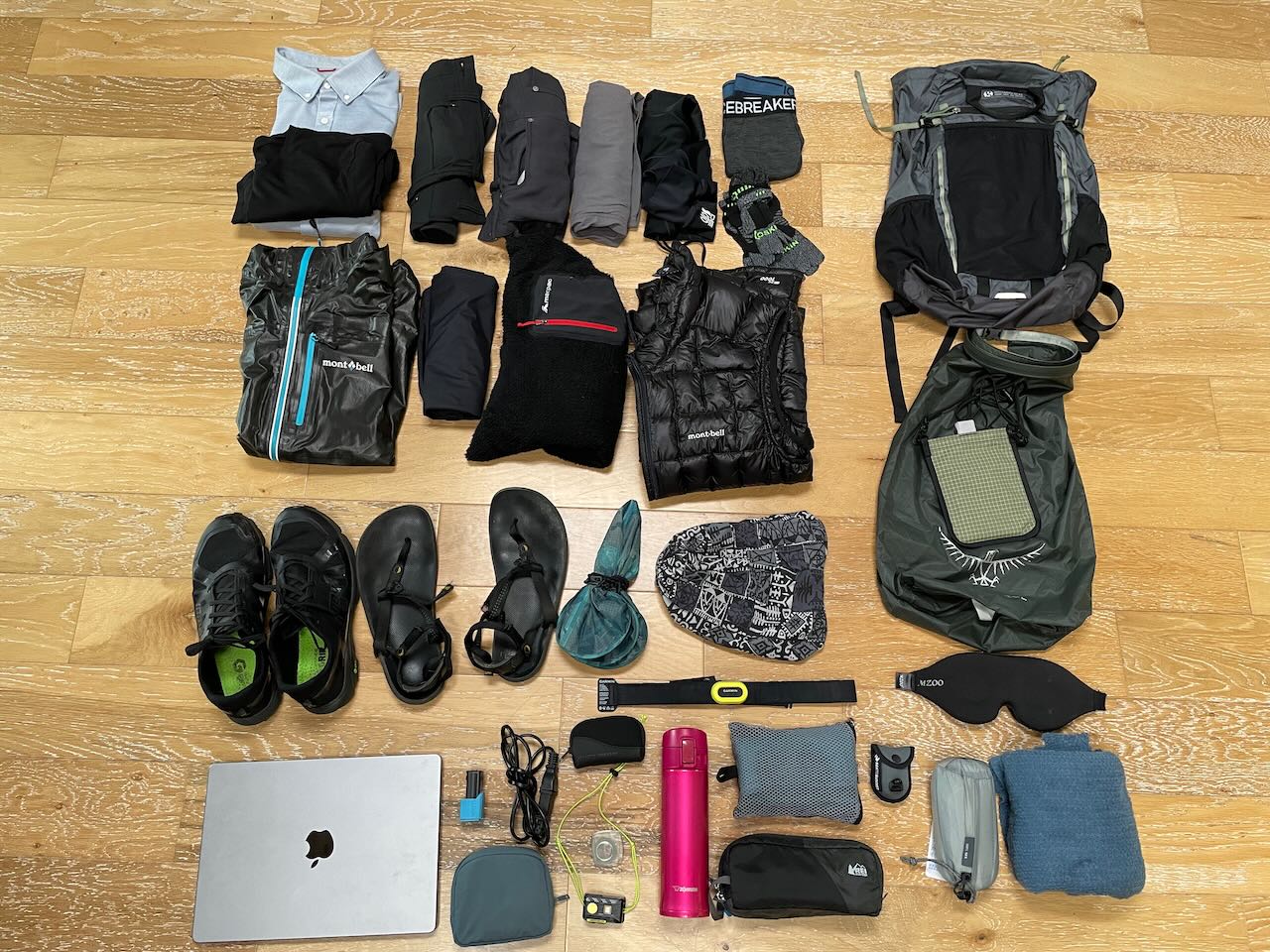
Category: travel

  • Recommended Clothing

    I recommend clothing that can be comfortably worn day after day for a wide variety of activities while still looking good. When in the outdoors no one cares how you look, but in urban environments it can make a difference in how people treat you. When in doubt, dress up rather than down. My packing / traveling light page has a section about selecting clothing for the journey. I have a number of posts with a clothing tag that have more detailed recommends including:

    [toc]

    Versatility

    My clothing is typically made from technical fibers or merino wool which provides good mobility, light weight, fast drying, and odor/stain resistant. I use mostly the same clothing for daily urban life, travel, done in a day outdoor activities, and extended time in the backcountry. Given my mixed use, I generally constrain clothing styles and colors to be something that would be considered “business casual”, acceptable in a typical business meeting or at a nice restaurant. For example, no cargo pockets on the thigh. I use some specialized clothing when engaged in vigorous exercise because these activities benefit from more specialized clothing.

    I use my everyday “urban” clothing on trips that mix cities with the backcountry. When my backpacking trips leave and return from home my backpacking clothing tends to be hand-me-downs from daily life. When a clothing item is looking a bit too worn or stained to wear to a nice restaurant, they get relegated to my “backpacking clothing” bag. I can get more use from the old clothing in situations no one cares about apperances, and avoid excessive wear on newer items which is caused by many outdoor activities.

    Layering

    Conventional  wisdom is that you should dress in three layers: a base to manage moisture, a middle to provide insulation, and a shell to protect you from the elements such as wind and rain. In colder conditions it is common to have multiple insulation layers which can be added or removed to maintain comfort over a range of conditions.

    A slight variant of this system is to use a windshirt over the base layer. When people are engaged in high output aerobic activities the combination of high breathable base layer like the Patagonia’s Thermal Weight Capilene Hoody and a light weight unlined windshirt such as the ArcTeryx Squamish or a rain shell that has high MVTR such as those made from Gore’s Shakedry fabric can keep the wearer comfortable for a surprising range of conditions. When activity level drops or if the conditions turn harsh (significantly below freezing), insulation and/or a heavier shell can be placed over the wind shell. Softshells are the cold weather variant of a base + windshirt, providing more insulation while maintaining good breathability. Softshells work well when the wearer is highly active facing variable conditions

    Minimize Moisture Absorption

    Managing moisture is critical to comfort and safety. Heat loss when immerse water is 24 times more effective than if you are standing in still air. While a soaked garment isn’t as effective, it can chill you more than standing naked. Ideally, you want clothing to stay dry. It’s not always possible to keep clothing dry, so the best mitigation is to select clothing which minimizes water retention and dries quickly. Polyester absorbs the least water, followed by nylon (which is a bit more durable) and then wool which has the bonus of resisting odor. There are a variety of wools including sheep (merino particularly nice, icelandic warm), goat (cashmere – luxury but very fragile), alpaca (warmest/weight), and possum (found in AU and NZ). Cotton is an inappropriate material for highly variable conditions.  Cotton can absorb more than four times of its weight in water and can take five times as long to dry as some synthetics! Silk, Rayon, and a host of other fabrics are better than cotton but not great. I have more on the page Water Retention In Clothing.

    A nice side effect of quick drying clothing is that on extended trips in the back country or when you are adventure traveling you can wash your clothing in the sink or river and be able to wear them almost immediately. This reduces the amount of clothing you need to carry without being grubby or smelly. All of my clothing normally dry overnight if spun dry or squeezed with a towel after washing. The exception is when it’s >90% humidity and <65F… some items are slightly damp after 7 hours.

    Select the Right Amount of Insulation

    There are four things which effect how warm you feel: your base metabolism (do you run “hot” or “cold”), the environmental conditions you are experiencing (temperature and wind), the amount of insulation you are wearing, and your activity level! Richard Nisley posted a wonderful graph illustrates how these factors are inter-related as does his revised paradigm for estimating garment comfort limits.  I found Richard’s graph very helpful in selecting the right set of garments for a trip or event. My caveat is that I seem to require around 1/2 the insulation Richard recommends except when I sleep. When your activity varies so does the amount of insulation you need. You want to avoid wearing clothing which is too warm. Most people take 10-20 minutes to “warm up” from their activity. If you are going to be highly active like going for a run or an uphill hike, you want to wear clothing that will be comfortable once you are “warmed up”. Either you need to plan to remove a layer after a short bit, or be prepared to be chilled / cool at the beginning. When engaged in multi-day activities like wilderness backpacking I often bring insulate which is warm enough for “light activities” in the evening, but does not keep me warm enough in the middle of the night. I will often eat “dinner” early and then hike at a moderate (no sweating) pace until dark and then immediately get under my quilt. In the morning I immediately start hiking and eat breakfast once it warms up a bit. This means I need clothing that are much less insulating than something that would keep me comfortable when sitting around at the coldest time in the day. I have also found Richard’s graph is a great reminder that besides adding or removing clothing layers, a highly effective way to maintain a comfortable temperature range during the day is by altering activity level.

    Know How Much Durability is Needed

    People are often concerned about the durability of clothing that will be worn in the back country or for an extended period of time while traveling. Many manufacturers encourage people’s fear and sell seriously overbuilt clothing, often  labeled “Expedition Proven” or some such thing. The truth is, very few people, even those on expeditions, need clothing that is so overbuilt. Unless you are facing continuous hard-wearing conditions, lighter weight clothing will have close to the same lifetime as the over-built clothing. There are many advantages to selecting items which aren’t overbuilt: you save weight, save space, often get better performance and spend less money. It is possible to go so light that durability is effected. Several manufacturers make clothing which is aimed at extreme athletics looking for the lightest weight performance, which comes at the expense of durability.

    How “Dressy”?

    In the outdoors, no one cares about what your clothing looks like. Function, not form or style matters way more. Stains are often a badge of honor indicating you actually got “out there”. When we come back to urban environments you will often be judged by the clothing you wear. Clothing covered in dirt, stains, or holes (that weren’t fashionably applied) often results in the wearer being treated less well than they would if they were “dressed up”. It’s useful to have some clean clothing, or be able to clean your outdoor clothing before engaging with “polite society”. To some extent, people who are considered particularly attractive or powerful/high status can “get away” with more casual clothing. You can almost never be too dressed up, but you can easily be not dressed up enough.

    There are many areas in the US and SEA where clothing can be very casual: sandals, shorts and a tee-shirt are normal and acceptable for both men and women, and won’t get a second look in sophisticated restaurants and important event. On the other hand, there are many places where this sort of attire would be perceived as inappropriate if not disrespectful. It’s important to know what are the expectations of the environments you are in. For example, in some locations, men don’t wear shorts, only boy do this.

    It used to be that in nicer venues men were expected to wear closed toe leather shoes, nice slacks and a blazer, women nice shoes or sandals, a nice skirt / blouse or dress. Venues / events which have higher expectations explicitly state their requirements: semi-formal, formal, black tie, etc. Since COVID I have noted that in most situations men and women can get away with a loose business casual.

    Men can be as informal as clean running shoes, nice jeans or slacks (but not joggers), and a button up shirt. Some places a polo shirt is ok, but personally I won’t “risk it”, and I find button down shirts more versatile. I love these evolving standards because well styled high performance clothing appropriate for outdoor adventures are also acceptable for more urban activities.

    Standards in many place have also loosen for women. Nice sandals or shoes, attractive slacks or skirt, and a nice top. I am not specifying top… women seem better than men at understanding what looks nice. My wife has found a sleeveless hiking dress which can optionally be combined with a blouse works really well. In some countries, especially when a distance from “international class” cities, women are expected to be “modest”. This means wear skirts or dresses which go below the knee and tops that at least cover the shoulders. Women not so clothed are assumed to be prostitutes or “loose” and could find themselves harassed by locals.  In many Muslim countries women are expected to keep their heads covered with a scarf or a hat.

    In cooler weather, a nice sweater is often perceived as being more dressy than wearing a shirt covered by an outdoor jacket / fleece. A blazer is better still. I recommend suits and blazers made from super 140 wool and for people who travel a lot, or the clothing from Bluffworks. Recently the “Chore Jacket” has become fashionable alternative to a blazer, though I don’t really “get it”.

    Price / Performance “Tiers”

    My experience is that clothing (and most other products) comes in a number of “tiers”. Generally they go up in performance and cost. In my experience “value” products are the best products in terms of number of uses / cost. Generally the ratio of performance / cost starts to go exponential as you approach “the best” performance. With expensive products I generally look for the “knee of the curve”, were I am getting the best performance before the prices start to raise exponentially. Often the price difference between cheap and best clothing is small enough for me on an absolute scale, that I am willing to go for “the best”.

    • Fast Fashion: All about the “style” TODAY and quickly becomes dated. Cheap (almost disposable) fabric, poor workmanship. Great if you want something that looks like the cool kids and will be worn out by the time the new style comes out. H&M, Zara, Shein, Boohoo, etc. Bad for the planet and the workers. I never buy these.
    • Value: Typically use classic style, decent material, decent workmanship maximizing performance/price. In the 1980s this was Land’s End and L.L. Bean. These days I think of Muji, Uniqlo, Kirkland brand at Costco, Everlane, maybe Old Navy. This is what I historically purchased and still do if I am going to put excessive wear on the item.
    • Name Brand: Clothing that used to be good quality materials, good workmanship, that are designed for a specific application, performance characteristic, and are stylish. The first company that comes to my mind is Nike but there are many. I rarely see an advantage of name brand these days. It used to be it guaranteed better quality than value priced items, but that is not alway true now. A lot of name brands attach their logo to clothing which doesn’t have the same quality are their core / original productions… especially items sold at “factory outlets”.
    • Top Performance: Clothing that uses top materials, excellent workmanship, and great design. When you put it on it just feels right and the garment feels tailored to move with you. The seams are a thing of beauty. Often uses innovated techniques. Many products from Arcteryx exemplify this level of clothing. I often find there are numerous little details that they pay attention to that other companies don’t. Taken together it elevates a piece of clothing from something that gets the job done to something I love every time I pull it out. I am lucky enough to be able to afford these items when I really care.
    • Luxury: The logo makes the item cost >5x what any normal company would charge for an equivalent product of the same quality. Prada, etc. I never purchase these for myself nor would I normal wear them.

    My Choice

    I go into greater detail in each of the above posts and in my personal gear page, but a quick summary of my clothing:

    • Icebreaker Anatomica Tee-Shirt (Merino Wool). Comfortable wide range of temps. UPF 20-30. Dries overnight. Very odor resistant. Adequately durable.
    • OR Astroman Button Up. UPF50+ shirt that is reasonable comfortable in hot weather, keeps bugs from biting me, and looks like a dress shirt when under a jacket. A jack of all trades, master of none.
    • Outlier AMB Merino Wool Button-up. ~UPF30, resists wrinkles, looks like a traditional dress shirt, very comfortable, dries overnight.
    • Icebreaker Anatomica Briefs. Most comfortable briefs I have found.
    • Outdoor Research Ferrosi Transit Pants: Decent looking pants made from nylon but don’t have that “swish” of some technical fabrics. Durable, reasonable fast drying. Can wear with a sport jacket or on the trail.
    • Xoskin Toes Socks: No blisters!
    • Smartwool Socks: Durable, Comfortable
    • Luna Sandals: Light, comfortable, durable. What I would wear all the time if I could get away with it.
    • Inov-8 Trailfly G 270 Trail runners in all black: when the route is too technical for the Luna or when I have to wear close toed shoes. I get 1500 miles / pair, about triple most trail runners. Has been accepted in 3-star Michelin restaurants and at many dressy events.

    Outerwear

    • Macpac Nitro Hoody (Polartec Alpha Direct) Comfortable in a huge range of conditions depending on how much you block air movement. Dries super quickly. Reasonable warmth/weight ratio. Reasonably compressible. If never going into backcountry would likely replace with a cashmere sweater which is more dressy looking.
    • Gore Shakedry shell. Most breathable waterproof material I have used. Doesn’t wet out in long rains. Can double as a wind shell.
    • Montbell Plasma 1000 Vest (Down) Light and compact insulation for core.
    • Patagonia Micro Puff Hoody Jacket. Keeps me comfortable 25F lower than whatever clothing I am wearing. Typically layered over other clothing when in sub-freezing conditions.

    Exercise

    When engaged in vigorous physical activity (running, bicycling, fastpacking, etc) items are part of my mix

    • De Soto Mobius Tri Shorts or XoSkin Compression Shorts + Sun Protection Leg Sleeves: reasonably comfortable when wet, minimized chafing, pockets on the thighs and hips which keep things from bouncing when running.
    • Xenith Delta Tee + sun protection arm sleeves. Dries perfect speed to help keep me cool. Very good odor control for a synthetic. Doesn’t bind when soaked.
    • Black Diamond Alpine Start Jacket. CPM somewhere between 40-60 making is perfect for high output activities. NanoSphere treatment makes it quite water resistant. One of the highest MVTR measured in a wind shell.

    Additional Thoughts

    Ryan Jordan’s The Dirt Catwalk: Modern Layering, and Andrew Skurka’s Core Backpacking Clothing are proven and field tested examples of clothing systems for a wide range of conditions. Understanding Layering Using Patagonia as A Guide by Nick Gatel is insightful and a bit of a history lesson. Keith Conover is an MD at University of Pittsburgh Department Emergency Medicine who has devoted several decades to search and rescue in the Appalachians. Keith has regularly updated his Clothing Materials page since 2000 and also has usefulcontent in chapter 4 of his Search and Rescue Handbook which covers clothing and other equipment. Richard Nisley’s article A Revised Paradigm For Estimating Garment Comfort Limits provides an in-depth model for evaluating clothing.  I would also recommend checking out the somewhat dated articles Andy Kirkpatrick’s (aka pyschovertical)  The Art of Not Suffering (2008) and BPL Clothing (and Sleep) System for Mountain Hiking (2001). I would also look at the the various BPL forum posts by Richard Nisley and Steven Seeber. There have been some wonderful research done at the institutes housed U.S. Army Natick Soldier Systems Center (NSSC). Alas, finding their publications is harder today than it was in the early 2000s. DeputySean’s Guide to Summer Wear is an opinionated set of recommendations for good sun protection for hiking in summer alpine conditions. Frank Revelo’s clothing theory, clothing rejected, and clothing current is a an interesting take… very appropriate for the treks he takes.

    I wonder if clothing which makes use of graphene such as graphene-x and vollebak could be a game changer… but for now I am highly skeptical. I am unlikely to spend my own money to test it out given I think it’s just hype. The only real user review I found was not exactly positive.

    I am just starting to learn more about sun protection. A good starting paper about properties that impact the protection of fabrics.

    My Stay warm notes might provide some insight into clothing choices.  Finally, I would recommend the tips in winter running for people who engage is very high energy activities in cold weather. See my others posts with clothing tag for specific recommendations.

    There is some very sophisticated science being applied to clothing material. Examples include Schoeller’s nanospheres which virtually clean itself, a treatment from Avelana and Roudiere which is first being applied to wool which has some thermoregulation properties much like Outlast, several Japanese companies are making garments that generate heat when they get wet, materials which are normally soft but stiffed to provide protection during an impact developed by d3o, and clothing as a battery. Some folks are claiming that high concentrations of some metals speeds recovery time which I am somewhat skeptical of. There is also a trend toward mixing different materials using tools like thermal mapping to guide the level of insulation, moisture transfer characteristics, etc to different parts of the body. There was an interesting article comparing Sir Hillary’s Clothing on Everest to what we wear today. While this comparison is interesting, his system wouldn’t fair as well against a more careful selection of modern clothing. There was an interesting thread about Clothing Science and Folklore on backpacking.net. There is a classic article called General Principles Governing vSelection of Clothing for Cold Climates by Paul Siple of the U.S. Army from 1951 which provides useful background information. Many of Richard Nisley’s postings on BPL are filled with useful, science based information.FabricLink has a decent index of high performance materials and Keith Conover wrote up his experiences with different clothing materials. The US military has spent a lot of time and money working on clothing materials. You also might be interested to look at a discussion about the performance characteristics of the new protective combat uniform and a review of the PCU.

    Low Cost

    Performant clothing doesn’t have to be expense. Most of my pages identify reasonably priced options. If I was asked to build a modestly priced wardrobe to handle a wide ranges of conditions I would recommend:

    • Trail running shoes (all black)
    • Costco Merino Wool Socks (6) $22
    • 32 degree mesh boxer briefs (6) $25
    • 32 degree airmesh tees (4) $20
    • Nylon or Polyester Hiking Pants (2) – $25/pair at Costco, Sierra, etc
    • Long Sleeve Nylon Button Up Shirt – $45 from Sierra
    • 100wt Fleece – $25
    • Down Puffy – <$80 Uniqlo, Costco, Decathlon, Sierra
    • Either a light rain shell with pit zips or a wind breaker + poncho – <$100
  • San Francisco Bay Area

    … with a focus on the mid-peninsula.

    There are a number of general websites which cover the bay area including Yahoo Bay AreaSFGate (Chronicle & Examiner)San Jose Mercury NewsCitySearch SFYelp and Craigslist.  This post is mostly about living in the SF bay area. I have a separate post about visiting Northern California as a tourist.

    Mid Peninsula Neighborhoods:  The best public schools in the middle peninsula seem to be Cupertino (especially the magnet schools), Palo Alto, and the Mission District in Fremont.  Mountain View and Los Altos metrics aren’t as good at Palo Alto High School, but the kids are a lot less stressed. I think they hit an ideal balance of encouraging kids to excel without weighing them down with too much. Girl’s Middle School, located in Palo Alto, is an excellent private school. Across the Bay is Fremont which has a very high Chinese population and excellent schools. See the California School Dashboard for school performance numbers… but remember that these numbers are more an indication of the social-economic status of the kids than the raw quality of the education. The more investment parents make, the better the kids experience.

    Weather:  The weather in Mountain View is great!  It’s normally sunny with comfortable temperatures.  I joke that we don’t have weather, we have climate.  Every now an then it will get below freezing in the middle of a winter night.  The temperature crosses 90F several times a year.  It rains periodically between Nov-Apr… but the sun will often come out on the same day. Most of the year you can plan outdoor activities without concern that the weather is going to spoil your plans.  If the weather in Mountain View is too boring, cool off 10-20 degrees on the coast by Half Moon Bay, head to Pacifica for some fog, or go inland and get baked in the central valley.  If you need snow, head up to Lake Tahoe.

    Events: Any given day the question is not if there is an interesting event, but do I have time for one or two.   Movies (mid peninsula), Shoreline AmphitheatreStanford Lively ArtsPalo Alto WeeklySF Arts MonthlyMetroActiveSF weeklyBestofBerkeleyLos Altos OnlineCuportino Parks and Recreation,  American Conservatory Theater (ACT), Berkeley Rep TheaterBayArea Concerts.  You could also check dothebay,  zvents and upcoming for various events. Kid friend events are covered at chatterblock. I appreciate Oak Guild trying to get good dialog going on tough issues.

    Museums: Our family really enjoys the California Academy of Sciences in Golden Gate Park and you have Fine Arts Museums of SF right around the corner.  SF Modern Art is excellent. The Exploratorium is one of the best science museums in the world.  Adults as well as kids will have a great time.  Where else would you find The Tech Museum and the Computer History Museum but in silicon valley.  Younger children will enjoy the Children’s Discovery Museum (San Jose) and the Bay Area Discovery Museum (Sausalito).  The Coyote Point Museum has good exhibits about ecology, a tiny zoo, in the midst of a very nice park.  Palo Alto Junior Museum is a grear place for the under five set with a few exhibits which change periodically and a small collection of animals.  The Canter Museum at Stanford is small but often has interesting exhibits.  

    Outdoors: There are a lot of good hiking which is covered at Bay Area Hiker, Gurmeet.net Hiking and Kevin’s Hiking Page. Our favorite local parks are Wunderlich County Park (close by, mostly shaded hiking with food stop .5 miles off trail at Alice’s Restaurant), Henry Cowell State Park (redwood and path by San Lorenzo River), Muir Woods (great redwoods), Sam MacDonald County ParkMemorial Grove County Park (closest redwoods – off Alpine, near Sam MacDonald), and Natural Bridges State Beach (old link) in Santa Cruz for the butterflies, tidal pools, and the interesting geology.  Of course there many other state parks & beaches which are fun to visit. There are a number of excellent Meetup.com groups and local Sierra Club chapters that sponsor group hikes. Some other resources can be found at Bay Area BackcountryRidgetrail, and Midpeninsula Open Space. It can be fun to mix geocaching. into some hikes. Trail runners should check out the site trailstompers. Check out doing miles if you are looking for longer day hikes. The book  Camping and Backpacking the San Francisco Bay Area by Matt Heid provides complete list of places you can camp in the Bay Area. There are a number of local zoos: Happy Hollow in San Jose (good for small children – rides included in admission), SF Zoo (our favorite… lemurs exhibit is really great), the Oakland Zoo, and Deer Hollow Farm (farm animals) located at Rancho San Antonio County Park.  We also like outdoor ice skating Oct-Apr at  Winter Lodge in Palo Alto.  Webb Ranch off Alpine Road is a great place to learn how to ride horses.  Alcatraz is always interesting and Filoli Gardens is a beautiful site to visit.

    Food: [This section is will be updated soon. Some more recent notes on my great meals page.] tend to agree with reviews found in Zagat SF.  Michael Bauer maintains the SF Chronicle Top 100 restaurant list.  Chez Panisse (Berkeley), Lark Creek Inn,  Pearl’s Cafe (Fremont), Eos (SF), Cafe Kati (SF), Banana Leaf (Milpitas), 369 Shanghai Restaurant (San Jose), Darda (Milpitas), Restaurant Gary Danko (SF), Zuni Cafe (SF), Aqua (SF), Isa (SF).

    Transportation:  I try to use mass transit when possible, so when I head up to SF I use Caltrain.  I don’t have daily exposure to commute traffic since I walk or bike to work, but I understand traffic is pretty awful these days, especially 85 north in the morning, and 85 south in the afternoon. Google Maps is likely the best way to see how traffic is moving.  The San Jose Airport (SJC) is more convenient than SFO when I can get flights there.  SJC – AirportMonitor lets you watch flights in real-time.  When we fly out of San Francisco Airport (SFO), we often use SkyPark Airport Parking.  Sometimes fares out of Oakland Airport are cheaper than SJC or SFO.  If you mostly use mass transit but need a car periodically check out Zipcars, Getaround, and Turo.

    Churches & Service: My recommendations on good churches page. See Volunteer Info Center for links to most of the organizations which operate in the bay area.

    Higher Education: Colleges in the area include Stanford (Campus Map), UC Berkeley (UCB Extension Continuing Ed),  Foothill/DeAnzaSan Jose StateSanta Clara University, and UC Santa Cruz (UCSC  Extension Continuing Ed)

    Government: Bay Area Governments has links to city & county governments and other useful info.

    Do You Want to Live Here?: If you are thinking about moving to the bay area, the McCormack’s  Relocation Guides and/or Relocating to the San Francisco Bay Area and Silicon Valley could be useful books. The SFBay is a vibrant, multi-cultural area filled with interesting people who have come from all parts of the world, an active art and music scene, lots of great restaurants, and countless outdoors activities.  Within a few hours drive in a car are wondrous destinations: wine country, Lake Tahoe (skiing, hiking, etc), rugged ocean coastline and beaches, and incredible parks like Yosemite. There is nowhere else on the planet that can match the SFBay area for high tech opportunities: a combination of world class universities, a critical mass of high tech companies, a culture of collaboration, and 70% of the world’s VC money.  There is a dark side: the area’s materialism exemplified by the pursuit of wealth, and the busyness of people which make forming authentic communities difficult.  On the other hand, I have noticed the materialism and pace of life which has characterized the SFBay has been spreading throughout the USA, even into the mid-west where there are not as many opportunities, and companies haven’t figured out that an accelerated life means companies need to be flexible.  The cost of living in the SFbay is very high… mostly because of the high cost of housing. Some people have raised an  alarm over price of homes, suggesting that housing is a bubble which is about to pop. Right now monthly rents are significantly cheaper than what mortgage payments would be for a similar home. My personal belief is that unless someone already owns a home in an expensive market, purchasing a house in the bay area does not make good financial sense at this time… but I could easily be wrong since I still can’t believe how much people are paying today. Pay in the bay area is a bit higher than other areas, see salary.compayscale.comsalaryscout.com, or indeed.com for real data, but this doesn’t cover the added cost of housing.  [Unless you are moving into the area from a location with equally high priced housing, you are going to be renting.]  People from small cities or towns complain that buildings are packed to close together, there are too many people, and that house lots are measured in feet, not acres.  People from large cities complain that the area is too spread out without adequate mass transit.  The Bay area is very secularized, with less than 5% of the populate attending religious services each week.  We are hopefully done with rolling blackout and liquification during earthquakes for awhile.  For another take, a survey of people about best things about the bay area.

  • Travel

    There are many reasons to travel. Some people travel to get new experiences. Others to discover the human condition is universal. Travel can be an expanding experience. It’s also possible to travel in a little “cocoon” which doesn’t move you out of your comfort zone and is merely entertainment. I appreciated the article 20 things I learned from travelling the world by gary arndt. I believe travel is over-rated (a critique of travel), and that if you really inhabit this movement of time, your current locale, that you would be overwhelmed by delight.

    Prepare

    These days, especially if you have a smart phone, you can get away with amazingly small amount of planning. I have done trips were we do our “planning” during breakfast, but generally I like to do a fair bit of planning before I go.

    Destinations

    Packing

    I am of the “one bag” mindset. That is minimize what you bring so everything can fit in a single, carry-on size bag to maximize your freedom.

    Other Concerns

    Sharing Economy & Community

    Service / Volunteering

    Mixing travel with service / volunteering / culture exchange can be extremely rewarding. Often you need to pay for the opportunity. Some will do an exchange of room/board for service. Be aware that many of these opportunities are scams. The other issue is that often volunteering doesn’t really help that much. Often a small amount of money in the hands of the people (such as micro financing) is much more effective. For long term service, things like the Peace Corp, Doctors without Borders, etc do great work, but you won’t be moving around. Some decent shorter term options:

    • servas – housing for service and understanding
    • WorkAway – no personal experience, but met a few people who liked it
    • wwoof – organic farming

    Low Cost Travel, Nomadic Life

    I am not a fan of the nomadic life for two reasons. First I really value community which is often best cultivated in a fixed location. Second, while working, I find the overhead of navigating life in a new location over taxes me. I don’t have the energy to deal with a new city and give my work my all.

    Tickets and Transport

    Hotels and Inns

    Food

    Misc Travel Info

  • Maui

    Maui is more touristy that I like.  The culture (except around the eastern coast) feels more like California than Hawaiian: go-go, play hard, have lots of fun, rather than a more lay back and enjoy life as it comes to you.  If you are looking for recreation rather than relaxation, Maui would be a great destination.

    ACTIVITIES:

    Swim and hang out on a beach

    Stop by the overlook for Ho’okipa Beach Park and see the amazing surfers

    Hawaii Nature Center, 875 Iao Valley Road, Wailuku 808-244-6500.  Museum open 10am-4pm.  Rainforest walk is at 11:30am and 1:30pm we days, 11:00 & noon on weekends.  The walk takes two hours.  The museum is good for 6-14 year olds for 30-60 minutes.

    Take a boat trip and see Dolphins, Whales, turtles, and/or Fish.   http://www.pacificwhale.org/ is well regarded.

    Maui Ocean Center Aquarium, Maalaea Harbor Village.  Nice aquarium focused mostly on local fish.  Much smaller than Monterey Bay aquarium… but the fish are much more colorful.

    Drive up the Volcano. The drive, the park its set in, and the view at the top is worth it. You drive above the clouds and its a very different Maui from the shoreline. If you hike down into it take lots of water and sunscreen.  Check weather: 1/3 of the time the top is socked in and you won’t get much of a view.  There are a number of companies which provide bikes and rain gear to cruise down the Volcano.

    FOOD:

    I have found Bruce & Kolleen’s Maui Restaurants & Maui Dining Guidefairly helpful.

    Roy’s Kahana Bar & Grill – Pacific Rim, Kahana Gateway, 4405 Honoapi ‘ilani Hwy (808/669-6999).  Good. Mostly a dinner place.  Kid friendly (two appetizers provided, but pasta only option for non meat eaters.)

    Maui Bake Shop & Deli

    Spago at 4 Seasons Resort, Wailea, 879-2999.  Dinner only.  In and out doors with nice view.  Nice menu, extra choices for kids.  

    David Paul’s Lahaina Grill, 667-5117.  Signature is tequila shrimp with firecracker rice which is excellent.

    Kula Lodge.  Decent food with a great view down from the Volcano.  377 just before 378. 878-153

    Chez Paul.

    Hali’imaile General Store – New Hawaiian. 900 Hali’imaile Rd, Hali’imaile (808/572-2666). This place is close to airport. In the middle of nowhere, so get directions before attempting. 

    PacificO – 505 Front Street, Lahaina, 667-4341

    IO, 505 Front Street Lahaina, 661-8422.  New pacific rim.

    The Gazebo,  a breakfast shack, walking distance from Napili Kai, near Kapalua. Great macadamia nut pancakes.

    Manana Garage, 33 Lono Ave, Kahului 873-0220 (ka’ahumanu intersection across from Chevron).  South american with pacific rim ingredients.  Theme around 1960s garage.  A small toy box provided to kids which is an old toolbox.

    Anuenue Room, Ritz-Carlton Kapalua Hotel.  Try the lamb and Grand Marnier / Chocolate souffle.

    Nick’s Fishmarket.  Kea Lani Resort, Wailea, 879-7224

  • Hawaii – The Big Island

    I love the Big Island. You get a more more diverse experience than any of the other islands.

    General Hawaii Information

    Hawaii: Off the Beaten Path by Sean Pager is a bit dated now, but I have found it to be the best single guidebook which covers all the Hawaiian islands though hotels and restaurants are likely out of date now.  I have yet to be disappointed by anything which was recommended in this book and there are very few things we have discovered which weren’t listed in this book.  The Hawaii Revealed books and now Smartphone apps are written by opinionated authors who provide greater detail than most guides.  I have found they list activities that are sometimes missed by other guides, but have found their restaurant assessments uneven. Konaweb is a very old school website which still has useful information.

    If you are looking for a B&B and don’t want the hassle of screening them try contacting Hawaii’s Best Bed & Breakfasts run by Barbara and Susan Campbell.  They have good taste and high standards. 

    Hawaii Wildlife Guide by Les Beletsky is a decent single volume book covering much of the wildlife you will find in Hawaii. Big Island Hikes is a good resource. Dolphins and other Cetaceans blow bubbles underwater and then use the bubble rings as toys. The Coffee Times has a number of interesting articles about Hawaiian history and culture.

    Kona Coast (and other places on the western side)

    We typically fly into the Keahole airport. The airport is in the middle of an old lava flow which is still mostly barren rock.  The airport tends to be hot and uninviting. If you are coming from Kauai getting off the plane might come as a shock and you might wonder if you have made a mistake.  Fear not.  The Big Island has a lot going for it.

    Kailua-Kona

    Around 15 minutes south of the airport is the city of Kailua-Kona.  This is the largest city on the island. There are a lot of condos, vacation homes, and few big hotels, as well as a number of small shopping centers. Kailua-Kona isn’t particularly Hawaiian, it could easily be a resort town in Florida. We found the Walmart to be one of the best places to pick up miscellaneous items.

    The old airport grounds are now a large public beach.  The marina at south end of the town is the debarking location of the Fair Wind, one of the better snorkeling cruises in the islands.  The Fair Wind has a lot of repeat business which speaks to how they treat guests.  Like most cruises the boat leaves early in the morning with a continental breakfast, sails down the coast to the Captain Cook Monument where they anchor off the coast for snorkeling and lunch before returning to the marina. They also have a smaller faster boat which goes to two destinations including one that almost always has sea turtles.  Joshua Lambus sometimes leads underwater tours. Hawaii Forest and Trail arranges a number of outdoor tours.

    Hawaiian Oasis is a very peaceful B&B which is a modest drive from Kailua-Kona. The original owners Mike and Christina Raymond designed the B&B (originally called Puanani B&B) and did did the landscaping which covers more than 2 acres. When it originally opened it was featured in Sunset magazine in April 1995 as one of the ten most beautiful places to stay in the west.  The facilities include a weight and exercise room, Jacuzzi, lap pool with BBQ area,  tennis court, access to a washer / dryer, and WiFi Internet access.

    None of the meals we had in Kailua-Kona were truly outstanding.  Ulu Ocean Grill, Beachcomber and La Bourgogne were decent. Some of my favorite are now closed including the Indonesian cuisine Sibu Cafe, and the Pacific Rim cuisine at Sam Choy’s Restaurant.

    Kona Coast

    South of Kailua-Kona are a number of small towns along Route 11.  This is the Kona Coast known for it’s coffee farms which often let you tour the grounds and sample freshly made coffee.  Very close to Kailua-Kona is the Heavenly Hawaiian coffee farm. As you head south along Route 11, you will find a numerous other coffee farms and a number of small towns.  Much of this route is above 1000 feet, cooler than Kona and can be foggy.

    If you head down Napoopoo Road you will find the Napo’opo’o Beach park which looks out onto Kealakekua Bay. The bay is a marine sanctuary which provides some of the best snorkeling in the Hawaiian islands and is frequented regularly by playful dolphins. Most of the snorkeling cruises which leave from Kailua-Kona come to this bay which houses the Captain Cook memorial. There are a number of companies which rent sea kayaks which launch from the Napo’opo’o Beach park. I used to recommend kayaking across the bay to the Captain Cook Memorial for the snorkeling, but I have heard (but not confirmed) that you can no longer pull the kayaks up at the memorial.

    You should not miss the Pu’uhonua O Honaunau National Monument otherwise known as the Place of Refuge.  This is a recreation of a village which provided a refuge to early Hawaiians who violated kapu (laws). Sea turtles are often found in the small bay. There are a number of nice places to eat a picnic, hike, or take a swim.

    If you want to eat a meal in this part of the island I would suggest The Keei Cafe (best food), The Aloha Cafe (nice view), Aloha Angel Cafe also known as Aloha Theatre Cafe for reasonable food with a funky atmosphere.

    Kahala Resort Area

    North of Kailua-Kona is the Kahala area. There are a number of huge resorts.  Some people who visit the big island spend their entire time at one of these luxury resorts.  The resorts have many amenities, great restaurants, lots of activities, and beautiful beaches. This isn’t my thing, but lots of people love it. The Mauna Lani Hotel is arguably the best of the resorts. Besides all amenities found at the other resorts, the Maina Lani has what might be the best beach and the Puako Petroglyphs. Happily you don’t have to stay in the hotel to visit the beach or the petroglyphs. If you are looking for a good beach though, check out Hapuna Beach State Park which is the best beach I have ever visited and is always voted to be the best beach by locals. North of the resorts is Lapakahi State Historical Park which is a recreation of an ancient Hawaiian fishing village.

    All the resort hotels have excellent restaurants. The best meal we have eaten on the Big Island was served at Mauna Lani’s Canoe House. The restaurants at Mauna Kea and the Four Seasons (Pahuia) are also excellent. Roy’s Waikoloa Bar and Grill continues like most members of the chain deliver excellent food.

    Waimea, North Coast, and Mauna Kea

    Waimea Region is upland from the coast. It is one of our favorite places to stay. The pace of life seems slower than Kailua-Kona or Hilo. Thanks to the elevation the temperatures are cooler than much of the island while still being sunny. The beaches of the Kahala coast are only twenty minutes away. Waimea is the home to a number of cattle ranches including the famous Parker Ranch.

    Waimea Gardens B&B is one of the nicer B&Bs.

    There are a number of good restaurants around Waimea. In the past we really liked the Pacific Rim Cuisine at Daniel Thiebaut and breakfasts at The Maha Cafe but they are closed now :(.  We also enjoyed lunch at Aioli and Meeiman’s (more reasonably priced than dinner).  We thought Edelweiss was decent but over rated and not a great value when comparing the food to the prices we had to pay.  On the way to Hilo in Honokaa is Tex Drive In which has good burgers and yummy malasada (donuts without a hole).

    North of Waimea is the Waipi’o Valley which is one of the least developed parts of the island. Some people just stand at the overlook. The valley is nearly 1,000 feet below the overlook. If you aren’t feeling up to a hike you can arrange for a ride to the valley. The road is very rough… I think horseback is the best option if you aren’t hiking. The Waipio Valley Artworks is my second favorite gallery on the island. There used to be an amazing TreeHouse B&B in the valley, but it’s currently a private residence.

    Mauna Kea is more than 13k feet above sea level (making in effect the highest peak when you realize than there are an additional 20k feet from sea level to the sea floor).  On top of Mauna Kea are the  Mauna Kea Observatories.  The observatories aren’t extremely welcoming to visitors, but they occasionally host educational events.  There is a welcoming center at 9000 feet on the Kona side.  They have good quality amateur telescopes, hot chocolate and some of best sky watching I have ever experienced. Saddleback Road is often described as a four-wheel drive road. It’s all a sham to discourage people from drive up. Initially the road is in moderate condition.  Then there are a few miles which is basically a dirt road. Then, the road becomes a beautifully paved road. The weather tends to be 30F or more cooler than the coast, so either bring a winter jacket or go with one of the tours that provides warm clothing. The welcome center used to have warm jackets that you could borrow, but I believe this practice has now ended.

    Hilo & Puna Coast

    Often be overcast and rainy.

    World Botanical Gardens

    Panaewa Rainforest Zoo

    Fish market will be disappointing if you have been to the Tokyo market.

    Kapoho tide pools are great for snorkeling.

    Recommended food: Hilo Bay Cafe, Sombat’s (Thai), Don’s Grill (local food with great pies), Pescatore (classic Italians) Paolo’s Bistro (chef owner Tuscany food, friendly staff). The first time we ate at the Cafe Pesto we had an excellent meal. The second visit was just ok.

    Volcanoes

    You have to visit the Hawaii Volcanoes National Park.  In this area you should expect the temperature to be 10-20 F less than the rest of the island, and you should expect constant rain when you visit the volcanoes. Beside hiking you should stop at the Volcano Art Center.

    West of the Volcanoes is the Punalu’u black sand beach where you can normally find sea turtles and good tide pools.

    Rather than staying in the the park itself, I would recommend staying at one of the local B&Bs or the quant Kilauea Lodge which has pleasant housing and one of our favorite restaurants on the island.  The food at Kiawe Kitchen was “ok”. I found the food at Thai Thai to be very disappointing. How can Thai food be bland?!

  • Kauai

    Kauai is a the very definition of a lush tropical island. Several movies were made here. Life in Kauai runs on a Hawaiian schedule which is slower than a typical US location. Years ago a grant was given to widen the bridge between Princeville and Wainiha from one lane (cars have to take turns) to each direction having their own lane. The locals successfully killed the project because they wanted to keep things slow.

    General Information

    Hawaii: Off the Beaten Path by Sean Pager is a bit dated now, but I have found it to be the best single guidebook which covers all the Hawaiian islands though hotels and restaurants are likely out of date now.  I have yet to be disappointed by anything which was recommended in this book and there are very few things we have discovered which weren’t listed in this book.  The Hawaii Revealed books and now Smartphone apps are written by opinionated authors who provide greater detail than most guides.  I have found they list activities that are sometimes missed by other guides, but have found their restaurant assessments uneven. 

    If you are looking for a B&B and don’t want the hassle of screening them try contacting Hawaii’s Best Bed & Breakfasts run by Barbara and Susan Campbell.  They have good taste and high standards.

    Hawaii Wildlife Guide by Les Beletsky is a decent single volume book covering much of the wildlife you will find in Hawaii. Dolphins and other Cetaceans blow bubbles underwater and then use the bubble rings as toys. The Coffee Times has a number of interesting articles about Hawaiian history and culture.

    Sites to Visit

    Koke’e State Park: on the south west end of the Island.   As you drive up to the park you have numerous overlooks into the 3000 foot canyon which has been called the Grand Canyon of the Pacific.  Nice hiking trails.  At the top of the park is Kalalau lookout where you can look down on the Na Pali coast.  It can get cold and wet so bring a sweater and a rain jacket. Sometimes it’s so foggy you can’t see more than 5 ft.

    Limahuli Garden and Preserve: 1000 acres of beautiful plants with breath-taking scenery all around http://www.ntbg.org/gardens/limahuli.php

    Na Pali Coast:  Most people aren’t up to hiking the full length of the coastal trail.  The two other ways to see the coast are by boat or by helicopter.  Both are great experiences.  Depending on the time of year, the seas might be pretty rough resulting in either an exciting (or awful) trip depending on how susceptible to motion sickness you are.  We really enjoyed Catamaran Kahanu.  Captain Lani was great. Boats used to leave from the north side of the island which got you to the coast quicker, but there have been some issues raise by the EPA, so your only option might be leaving from the southern coast.  Most of the boat trips include a 1-3 hour snorkeling stop which can be a lot of fun.

    Food to Eat

    If you order fish in any restaurant, you can hardly go wrong… the fresh fish is great!

    Jo2 is Jean-Marie Josselin new restaurant. Food was decent, but not as amazing as I remembered his previous restaurant, A Pacific Cafe.

    Bali Hai in the Hanalei Bay Resort: I don’t normally like hotel restaurants, but the view is glorious at sun down, the food was excellent, and the service was outstanding.

    King and I: Good Thai food.  I didn’t like the Pad Thai, but all the sea food dishes were excellent.  They had an appetizer of shrimp with had a number of rice noodles poked through and then cooked.  It was wonderful.

    Tidepool’s in the Hyatt Regency in Poipu has good food and a fun atmosphere.  You seem to be sitting in grass-thatched huts, surrounded by pools filled with koe. The Hyatt is an amazing hotel.

    Barbecue Inn:  Reasonably priced family food in downtown Lihue.

    Roys: A well known Hawaiian chain. The food in Hawaii is much better than in the state side restaurants. 

  • Water Retention in Clothing

    The post was corrupted and I haven’t been able to find a good archive of it. I pulled some text in from another page in May 2025 as a starting point, but this really needs a complete rewrite, updated references, and some corrections. I have run many tests, several of them better constructed since first posting this. I need to find that data and include it here. Maybe this will happen sometime before the end of 2025 🙂

    Managing moisture is critical to comfort and safety. Heat loss when immerse water is 24 times more effective than if you are standing in still air. While a soaked garment isn’t as effective, it can chill you more than standing naked. Ideally, you want clothing to stay dry. It’s not always possible to keep clothing dry, so the best mitigation is to select clothing which minimizes water retention and dries quickly.

    Polyester absorbs the least water, followed by nylon (which is a bit more durable) and then wool which has the bonus of resisting odor. There are a variety of wools including sheep (merino particularly nice, icelandic warm), goat (cashmere – luxury but very fragile), alpaca (warmest/weight), and possum (found in AU and NZ). Cotton is an inappropriate material for highly variable conditions.  Cotton can absorb more than four times of its weight in water and can take five times as long to dry as some synthetics! Silk, Rayon, and a host of other fabrics are better than cotton but not great. The article why cotton kills explores this topic in more detail. There are several treatments that can be applied to these materials which make them even better at resisting water absorption such as Schoeller’s nanospheres

    A nice side effect of quick drying clothing is that on extended trips in the back country or when you are adventure traveling you can wash your clothing in the sink or river and be able to wear them almost immediately. This reduces the amount of clothing you need to carry without being grubby or smelly. All of my clothing normally dry overnight if spun dry or squeezed with a towel after washing. The exception is when it’s >90% humidity and <65F… some items are slightly damp after 7 hours, most most are completely dry (e.g. not even 1gram of extra weight from the water).

    My experience is that water retention (called regain in the industry) is driven by three inter-related issues. The base material, the fiber (how the material is assembled into fabric), and the thickness of the fabric. For example, even though nylon absorbs 2x more water than polyester, a thin nylon woven shirt (like light weight supplex) can have the same water retention / drying properties as a knit polyster base. See the BPL thread about water absorption in textiles and look for posts by Stephen Seeber, especially is “By the Numbers” posts.

    Over the years I have read people talk about how much water various materials absorb. Most of the time the numbers seemed low, so I ran some simple tests to determine how much water was absorbed by various garments that I use (which is a combination of material, fiber, and weight/thickness). Alas, I have misplaced the spreadsheet with all the results.  So the following data is (1) possibly wrong because I don’t have a great memory (2) wasn’t super rigorous (3) wasn’t a pure apples to apples test.  I didn’t use the same weight for each material.  Rather I used the shirts I owned. The specific shirts I remember included: 

    Polyester: light weight powerdry
    Polypro: light weight base layer (20 years old or so)
    Cotton: Haines beefy-tee with a logo from my work
    supplex nylon: RailRider Eco Mesh
    wool: smartwool light weight tee
    rayon: aloha button up shirt
    bluesmith hydrophobic shirt (polyester+nanospheres)

    First Test: Weight the garment, submerged it under water and kneaded it, pull it out dripping wet, weight it, squeeze everything out I could get out, weight again, wear for 30 minutes, weight again. Something that was pretty surprising is that when I did this test, the dripping weight was much higher than I expected. with the exception of the bluesmith shirt which was only 1.2x, nearly everything was at least 2x, wool being 3x, cotton 4x, and rayon 5x. After 30 minutes of wear, the figure were something like bluesmith 1.05x, polypro 1.2x, supplex 1.3x, polyester 1.3x, wool 2x, cotton was 2.5x. Not as large a difference as I would have expected. 

    Second Test: I concluded that the kneading the item fully submerged wasn’t a good test. It was most likely measuring void space in the garment and how easy a super saturated garment would release moisture rather than what it would absorb so I tried what I though was a more “reasonable” simulation. The real life situation I was wondering about was what would happen to my base layer after my windshirt fully wet out… how much water would be absorbed and how quickly would it dry out. The second experiment’s steps were: 

    1. Weight the garment
    2. Placed it on top of a sink filled with water
    3. Briefly pressed it into the water repeatably for 30 minutes
    4. Shake item. Weight
    5. Squeeze. Wear 30 minutes. Weight

    When I did this the number were significantly different. Polypro and polyester were less than 1.1x gain after the shake, and more or less completely dry after 30 minutes. Nylon was 2x gain after the shake, and about 1.1x weight after 30 minutes. Wool and acrylic were something like 2.5x after shake, and around 2x after 30 minutes. Cotton was 4x after the shake, 2.5x after the squeeze, and 2.4x after 30 minutes of wear. I am pretty hazy on the acrylic and rayon. My memory was the acrylic was around wool, and the rayon was worse than cotton after the squeeze, but had already surpassed cotton after 30 minutes of wearing. After one hour of wearing I hung the clothing in a location that the temp ranged between 45-50F with a relative humidity of approx 70%. Eight hours later then cotton shirt still felt wet. The wool was still damp, but reasonably comfortable.Everythng else was comfortably dry.

     My personal conclusions were the that polyster / polypro didn’t absorb a lot of water. Supplex absorbed more, but was sufficiently thin without voids so it dried quickly. I was unimpressed with wool. Cotton really sucks because not only does it suck up the water, but it didn’t want to let go.  This more or less matched my experience in the field.

    The backpackinglight.com folks did a more rigorous field test: comfort moisture transport in wool and synthetic clothing. They found that wool took 50% longer to dry than polyester. My personal experience was that it takes longer than that, but we were using different fabrics and fabric weights than what I was using, and I believe invested more effort into having a true apples to apples comparision,

    The champ will likely be nanotech clothing fabric.

    Related

  • Visiting Northern California

    The following recommendations I have given friends from outside northern California who were planning a vacation here.  Northern California Best Places has a lot of other ideas, though it’s a out of date now. These days you can get a “look” at many places through Google Street View, and if it’s not, maybe the SF virtual tour will have it. I also have some notes about living in the sf-bay area.

    Transportation

    Your first and last day will most likely involve an airline flight and transportation to/from the airport. The San Jose Airport (SJC) is a smaller airport which I have found typically is the easier to get in and out of. The San Francisco Airport (SFO) is the largest airport and typically has the larger number of flights to any given destination. Sometimes fares out of Oakland Airport are cheaper than SJC or SFO.  Relative to Mountain View, SJC is 20 minutes, SFO is 45 minutes, and Oakland is around 60 minutes. It is possible to get to Mountain View from SJC via Light Rail (though it’s slow), or from SFO via CalTrain. A taxi/uber/lyft will typically be around $25 from SJC, and around $50 from SFO.

    Areas to Explore

    Most people think to visit the typical tourist stops such as Chinatown, Pier 39, the Golden Gate Bridge, etc.  Make sure to visit some of the incredible parks in the area.  Whenever I have friends visiting for a more than a few days we will spend at least one day south around the Carmel / Monterey area with a  mandatory stop at Point Lobos State Park, and one day north in the Golden Gate Recreation Area (especially Muir Woods). Below are areas I would recommend visiting if you have time, in rough, priority order.

    • San Francisco: culture, museums, food, parks. 2-3 days.
    • The general SF Bay Area and Mid-Penisula
    • Napa Valley & Wine Country: Wine! Food! 1-3 days.
    • Santa Cruz and Coastline: Redwoods, butterflies, sea lions, beaches. 1 day.
    • Monterey Penisula & Big Sur: picturesque coastlines, world class aquarium, and good food and art boutiques. 1-2 days.
    • Yosemite: One of the most spectacular parks in the world. You should spend at least three days and visit the Valley floor, Marapoa Grove,  and Tuolumne Meadows. 3-4 days.
    • Tahoe: Tahoe is pretty… but unless you have a lot of time, I would skip Tahoe so you have more time as Yosemite. 3-4 days.
    • Northen California Redwoods: If you have another 3-6 days, head north of San Francisco. There are a number of cute towns along the coast, and the wonderful Redwood State & National Parks region just below the Oregon border.


  • Packing & Traveling Light

    I have used a single carry-on size bag when traveling for most of my life. I didn’t realize this was uncommon until my wife and I did a multi-week service trip in 1996. Both of us brought everything we needed for sub-freezing weather in carry-on sized travel packs. This permitted us to each bring two check-through bags for materials that we would deliver to the project without paying shipping charges. Our colleagues brought several bags for their own use. This post was written to answer their question

    How did you managed to get everything into a carry-on bag?

    This was originally a long email which I added to my website the next year. The core content of this post remains the same, but I’ve made several updates—most recently in 2025—for clarity, to fix broken links, and to update references to products. I’ve also incorporated a few changes based on lessons learned since I first wrote this. Today this approach is often referred to as “onebag” travel. I believe this term was coined by Doug Dyment in the late 1990s. There is an active /r/onebag subreddit which discusses this approach.

    [toc]

    TL;DR

    This post is a 15 minute read. If you are in a hurry here are the highlights:

    • Enjoy the freedom of have just one bag you can be easily carried to maximize your ability to enjoy the experience
    • Use a pack (avoid wheels) which is 20-35l rather than trying to find a maximum approved carry-on. The larger the bag, the more stuff you will bring whether you need it or not
    • Bring 2-3 sets of clothing. You don’t need more. Make sure they are easy to wash and dry quickly. If you want to avoid a near nightly washing ritual, bring a week’s worth of clothing. For me this would be 7 pairs of underwear, and 3 pants and shirts.
    • Layer your clothing for varied conditions. “Base” or next to skin layer, insulating sweater / fleece / or my typical preference alpha direct, a puffy if cold, and an unlined rain shell that can be used separately or together with the other clothing. Maybe an ultralight wind shirt depending on how active you will be and how light / breathable you rain shell is.
    • Don’t be influenced by the “spotlight effect”. You notice your appearance way more than others do. Relax!
    • Don’t pack for your fears. You don’t need to pack assuming the worse case. Unless you are somewhere very remote you can replace most things at a local store. We live in a global economy.
    • Cell phones are invaluable tools for travel so bring it. Consider leaving all other tech behind so you can focus on your experiences in a new location.
    • The best thing to bring is a good attitude. Be flexible, gracious, thankful, and kind. Welcome new experiences and people. Curiosity is a superpower.

    Advantages of Traveling Light

    I have found when I am carrying a light bag (<14lb with load transferring hip strap, <8lb if just shoulder straps) I feel an incredible sense of freedom. My bag doesn’t weigh me down physically or psychologically. The following are some of the reasons you might appreciate onebag travel:

    1. Transportation becomes simpler and easier. You have a light bag you can manage yourself. You don’t have to find someone who can transport a number of large bags. For example, some remote towns use motorcycles with (and without) a sidecar as taxis. Imagine trying to hold onto a number of huge bags while sitting in a sidecar or on the back of the motorcycle.
    2. You are able to dynamically adjust your plans. If you have a tight connection you know your bag will be with you, wherever you end up. If you need to get something out of your bag you can. You can easily carry your luggage while engaging in fun activities. For example, we decided to explore Portugal’s Algarve coast. We didn’t know which town we would stay in. Our rail pass let us hop on and off in each city and explore until we decided where to spend the night. Only then did we book a room and drop our packs.
    3. Can be more focused on people and experiences, less on stuff. You will spend less time fighting with your bags and have less to keep track of. You will spend less time on the trip thinking about “Is this the right outfit?” “Should I use X or Y today?” Less decision fatigue.
    4. Packing light lets you use your check through luggage allotment for medical supplies and other items for service trips. Or, if you found a large, perfect gift for someone, you can bring it back as your check-through luggage.
    5. You don’t need to worry about items in your checked luggage being damaged, frozen, stolen, lost, or delayed. Fun video of bags being loaded. To be fair though, less than 1% of bags are reported lost, though more are delayed or temporarily misplaced.
    6. You don’t have to wait for check through bags to arrive on the carrousel. My unscientific observation is that when I am waiting with travel companions who checked luggage, we spend an extra 30-50 minutes in the airport waiting for bags, and 5-50 minutes waiting to check in.

    I would encourage everyone to taking a trip that is at least a week long while bring only one carry-on size bag or personal size item. I think you will find it’s enjoyable and freeing. For a bit of humor and inspiration, check out Lessons Learned from Luggage Lost. When you return home consider simplifying your life. If you want to push things you could try packing like a camino pilgrim, or go for zero bag like this guy’s no pack.

    Remember the traveler’s motto: It’s better to bring half of what you think you need, and twice as much money. Unless you are in a very remote / isolated location, you will likely be able to purchase anything you need. Some other onebag platitudes.

    Luggage?

    One of the first questions people ask is “What bag should I get if I am traveling light?”. I generally recommend that It’s more important to figure out what you are going to carry inside the bag than which bag. Use hints below to select what you will bring on your trip. Bag selection will be easier when you know what it will contain. A bag you already own might work such as a classic nylon “book bag” or gym duffel. If you don’t have a bag which can hold all the things you plan to bring I suggest putting everything you plan to carry in a duffel or shopping bag(s) and goto a store like REI or Decathon and see how it loads into the packs they carry. In the best case you found your bag. In the worst case, you realize you have way too much stuff to carry comfortably and need to trim more. Most likely you know the size of a bag you are looking for, have identified one bag which will work, and can now do a bit of online searching to see if you can find a bag which meets all your criteria. There is one caveat to figure out what you are taking and then select a bag that will hold it…

    A generalization of Parkinson’s law is that the demand on a resource expands to match the supply of the resource if the price is zero. When it comes to luggage it means that you will have a tendency to fill your bag. I mention this because when people start onebagging they often look for a bag that is a “max size” carry-on. This will often lead them to over pack.

    Even experienced travelers are susceptible to over packing. Over the last fifty years I have taken trips to the same destination which were of identical duration with the same expected conditions. I generally used whatever was my “standard” bag of the time which has ranged ~15L-46L. Each trip generally filled the bag with things that I asserted were “needed”. What was the difference? Some of it was experience and more compressible items, but mostly it was the smaller bags forced the question “Is this necessary?” The smaller the bag, the more frequently my answer was “no”.

    If you are new to onebagging, I often recommend getting a bag that’s a bit smaller than you think you “need”, because you will discover there are several items which aren’t actually needed. I can’t remember ever regretted carrying a smaller bag, never felt like I didn’t bring something that would have enhanced the trip. If anything, the trip was more enjoyable. When I carried the larger bags I sometimes did regret bring as much as I did because items ended up not being used and on long walks the bag felt like a burden.

    There are exceptions to this recommendation. The first are people who are big. For example the clothing of someone who is 7ft tall with size 47 feet will have troubles fitting into a bag that works well for my 5ft wife. The second exception are people who are engaged in special activity which required a lot of gear, or gear which can’t be carry-on and they aren’t going to rent at their destination. Special note to photographers. Do you actually need 2 bodies, 6 lens, numerous filters, 6 batteries, and a pocket camera? If you are doing a wedding the answer could be yes, but often a single body and 1 or 2 lens might actually unlock your creativity and improve your eye. Finally, there are people who are going to be in a location for an extended period and the supplies and items they need for day to day life can’t be acquired locally and won’t fit in a bag which is carry on approved. In some cases the supplies won’t fit into a single check-through bag.

    Many airlines used to define carry-on bags as being 45 linear inches which enabled people to bring bags / objects longer than 22″ such as a garment bag or back country backpack. These items often had to go into the overhead bin sidewise which means someone else might not have room for their bag. These days the largest permitted carry on is typically 22x14x9in (55x35x23cm) which perfectly fits most overhead storage areas. It’s possible to overstuff soft side bags to the point that they will not fit, even it the bag is theoretically the “permitted” dimensions. There is a summary of common carry one restrictions, and an exhaustive periodical table of carry on size limitation. When it doubt, check with your carrier. The packhacker site list which airline a bag is guaranteed to qualify as a carry on.

    I generally recommend people use a carry-on sized travel packs. If you are going to be walking a lot, get a trekking pack. I sometimes hear people rejecting travel packs because they are ugly / unstylish. These days there are a number of companies that make travel packs which are urban sheik.

    I would suggest staying away from wheeled bags in most cases. They cost more, add weight, and hold less than a good travel pack. Wheeled bags are a pain to use on stairs, cobblestone, and other uneven surfaces. There are legible reasons to select a wheeled bag: being physically unable to carry a backpack or when need to bring more / heavier luggage than what can be carried on the back. Heavier rolling bags can use up almost 1/2 of carry-on weight limit (7kg) which is common on many airlines outside the USA. I like the design features of the Peak Design Roller Pro but it is expensive and heavy. I have been impressed with the quality of Briggs and Riley which is backed by a lifetime warranty which you typically don’t need to use. Downside is that it’s pricy and heavy. TravelPro, especially the Platinum Elite line are well designed, have a lifetime warranty (that you will likely use… especially if you bag is a spinner), and as light as you are likely to find. I have heard positive things about AWAY (budget), Rimowa (pricy, striking design, shows damage), Pelican Air (maximum protection for contents), and LuggageWorks (heavy, ugly, but durable with replaceable parts). I prefer bags made from ballistic nylon to hardshell for three reasons. When there is a tight fit they can squish, they hide signs of wear better, and they don’t crack… failure is recoverable.

    Daily Use Bag

    All but the most minimalist travelers typically want a smaller bag for “daily” use when they aren’t in transit. Some travel packs have a zip-off daypack which I generally don’t recommend. The attached daypacks typically makes the main bag too thick to be carry on legal and rarely has the characteristics I would want for my day use bag. The exception for me is the Osprey Daylite that combines with the Fairview/Farpoint. The Daylite (and Daylite+) have a decent set of features, and can hang off the shoulder straps in front of you making more useful than when it hangs on the back of the pack.

    If your daily carry is moderate, I recommend using a light courier / guide / crossbody bag because it’s usable when a travel pack is on your back, provides easier access than a daypack during the day, and allows your back to breath. Folks from reddit keep a spreadsheet of fanny and slings. If you are carrying a bit more I recommend using a “stow-away” or “packable” daypack. These packs have no structure so you have to use care in packing them. I have found the Mystery Ranch In-and-Out Pack and the daypacks from Gossamer Gear are the most comfortable for me. I have been happy carrying 10lb in these for moderate distances. The REI Flash 18 and Matador packable daypacks are also pretty good. I have heard good things about the Aer Go Pack 2, but it doesn’t have a sternum strap, is a bit pricy, and I have no need to try another packable bag. Many of the other packable daypacks I found to be uncomfortable, even when packed carefully… but your experience might be different. For example, my wife likes her first generation ultra sil nano daypack made by Sea to Summit which was uncomfortable for me.

    My Bag Choice

    These days I mostly use a Gossamer Gear Vagabond Jet (review of Vagabond). When I need to carry more than what is comfortably handled in the Vagabond I use my wilderness backpack, a Zpacks Arc Hauler 50l. The Arc Hauler is larger than I need, and doesn’t have good organizational features but it fits in the carry-on sizers and enables me to comfortable carry around 22 lbs for many miles / hours. For around town I used a Decathalon Packable 15L Courier Bag which weights just 4oz and costs 8 Euros.

    Clothing for the Journey

    I have a number of pages about clothing. The follows are observations about the selection of clothing for extended travel.

    Limited Number / Easily Combined: If you are going on a trip that is more than a week, plan to wash your clothing rather than trying to bring outfits for every day of the trip. We will talk about washing clothing later. There are two common strategies when bringing a small amount of clothing. The first is to look the same everyday. Have all your clothing be the same color so things always match. Black, grey or white are common choices. The other approach is to select clothing which can be mixed and matched: colors which coordinate / compliment, layers which can be varied for look and comfort, different textures, and some simple accessories like a scarf which can transform the way you look. See posts about “daily uniforms” and capsule wardrobes. FYI: Some countries ban civilians from wearing camouflage clothing. A good way to overcome the common fear of “running out of clothing” is to use only the clothing you are planning to take at home for a couple of weeks. This can’t always be done, for example if you live in a tropical climate and are traveling somewhere that is sub-freezing, but in most cases you can run some simple experiments at home to build confidence.

    Layered: If are are facing moderate to cold weather you should take a layered approach for warmth. Seasoned travelers and backpackers are very familiar with the idea of layering which combines a next to the skin base layer, with 0 to several “mid” or insulating layers, and finally a shell for protection from wind and/or rain. Once the temperatures are below 45F, using high loft / puffy insulation is typically recommended since it saves weight and packing space. I have found that the combination of long-underwear, hiking pants and shirt, a wool sweater, a puffy insulated vest, light weight waterproof/breathable jacket, scarf, hat and mittens keeps me comfort when walking around down to 15F. I can mix and match the various layers so I am comfortable when it is 30F, 50F, and even 70F.  For more thoughts on this, see my clothing page. Sidenote: fleece are versatile outdoors, but a nice wool sweater can make you look more “dressed up” as well as keep you warm. I typically bring a light weight windshirt because they are so useful. If I expect rain and cooler conditions, I will bring a rain jacket, and add rain pants if I am going to spend an extended period of time outdoors. If it’s going to be warm and/or dry, I will sometimes skip bring a rain jacket, bringing a small umbrella or go without and just get wet.

    Localized/Formal?: You should adjust the style of your clothing to the local sensibilities and event requirements. The most formal environments expect men’s daily wear to be slacks, a button up shirt, blazer and maybe a tie. Beach towns and other places that are laidback it’s perfectly acceptable to wear flip-flops, boardshorts, and a tee shirt into a high end restaurant. Since COVID men can typically get away wearing running shoes, jeans, and a polo shirt. I recommend taking it up to business casual … nice looking pants and a button down shirt. I have a bit more about how dressy on my clothing page. Women aren’t so free. When away from “international class” cities women are often expected to wear skirts or dresses which go below the knee and blouses that at least cover the shoulders. Sometimes people worry that they will look like a tourist. They want to blend in. The fact is no matter what clothing you wear you will look like a foreigner. Your body language, the way you move will give you away even if you are wearing exactly the same clothing (not to mention you language or accent). I have a friend who is Indian and spent the first 18 years of his life in India and then came to the USA for college and stayed for work. He typically returns to India for a month each year. He is immediately identified by the locals as a foreigner because he no longer moves like a local, maintains too much personal space, etc. Don’t worry if you look a bit different so long as what your are wearing doesn’t not violate some taboo.

    Frequency of Washing: Most of the time clothing doesn’t need to be washing after one day of wear with the possible exception of underwear. The number of times a garment can be worn without washing varies depending on the type of fabric, your unique biology, environmental conditions, and your activity level. I am normally comfortable wearing denim jeans two days in a row, but if sweating heavy from heat or high activity, I might want to change after just a few hours. I have found untreated polyester clothing, especially shirts get really smelly after just one day of activity and a quick hand washing doesn’t always remove the smell. Some of the anti-stink treatments such as Polygiene or Xstatic seem to keep odor down for 2-3 days. I found nylon is more resistant to picking up odor, and a light rinse will typically wash out odor. Wool clothing can often be worn for a week without washing. More on my personal care heresy post.

    Washing: So let’s get back to washing clothing. If you are staying someplace that has a washer, and even better, washer/drier you are in a great situation. If you don’t have easy access to a washing machine you can go to a laundromat, use a service, or hand wash your clothing. Most long term travelers are prepared to hand wash clothing. The more minimalist packers will often wash their clothing each night as part of the bedtime routine which allows them to eliminating the need to carry a change of clothing. Many people use a small bottle of Dr Bronner’s soap for their laundry. There are also detergent sheets which don’t have the risk of spilling. A single sheet should be able to cover 2-4 sink washings. It’s also possible to use shampoo or body wash. I know people who clean their clothing while they shower. I have tried this but had trouble getting my clothing completely clean. I have found washing machines are more effective than my hand washing. Sinks often don’t hold water for more than a minute or two. Two common solutions are bringing a universal plug or bringing as small waterproof bag that you fill with water. There is the purpose made Scrubba bag, but I think it’s unnecessarily heavy. There was a reddit thread about handwashing clothing techniques.

    Fast Drying: When you don’t have access to a drier, it’s extremely useful to have clothing which can dry overnight. This means avoid clothing made from cotton. Fast dry clothing is typically made from fabric that don’t absorb much water such as light weight polyester, nylon, or <160gsm merino wool. It’s good to know how quickly your clothing will dry before you go on the trip. I encourage running a simple experiment. Weight your clothes. Hand wash them then and hang them up to dry. Every few hours weigh them. Record the time when they weigh the same as before the wash. You now have a baseline of how long it’ll take to dry. They’ll dry faster in the sun, slower when it’s cold or high humidity. You can speed the drying by squeezing excess water out, roll the garment in a dry towel, and then twist the towel to tighten around the garment. Unroll after a few minutes and hang up your garment. Some people carry a small clothing line, though I haven’t found one necessary: most lodging will have something that will let you dry the clothing (clothing line, hangers, back of a chair, etc). When in a rush, you can squeeze excess water out of fast dry materials and put them on wet. They will be uncomfortable for a bit, but movement and body heat dry them in around a hour.

    How Many Clothing? I typically bring 2-3 sets of clothing, which lets me go a week between washings other than underwear which I wash nightly. I strive to use a machine which is more effective than my hand washing. I have been known to wear my rain gear while doing my wash so everything gets cleaned. There are some people who love clothing and want to bring many sets of clothing to have a lot of variety. People who want this sort of variety typically need to bring a larger bag or get their variety by having a small core with accessories. Some people feel compelled to wear a different outfit every day and are afraid that others will notice they are wearing the same thing over and over. Get over this fear. Many successful people wear a “uniform” every day. Guess what… either people don’t notice as described by a female art director, or it becomes something of a trademark such as Steve Job’s turtleneck & jeans. Also, when traveling many people will only see you one day. The first approach is to have a single set of clothing that you wash and dry over night. This works, but there might be times when you are wet / muddy from a day of hiking without time to clean your clothing before a nice dinner. Many minimalists I know bring go with 2 sets of clothing so they have something to wear while their clothing are being washed or 3 sets: wear, wash/drying, ready to go / clean.

    Recommended Brands? Outlier and Wool and Prince make pricy, but superior travel friendly clothing for me: great materials, fit, and quality finish. Bluffworks and Makers and Riders make excellent clothing for men and women. Uniqlo makes clothing which is travel friendly at reasonable prices. There are plenty of other travel friendly clothing for men and women from prAna, Royal Robbins, Rohan, lululemon, and many other companies that are associated with the “active life” and sold at stores like REI. These cloths are marketed as being for fishing, hiking, or travel. BTW: I would typically skip clothing made by lululemon due to the frequent reports of them wearing out prematurely. While the above are brands I recommend, you don’t need expensive clothing to travel lightly. You likely already own some fast drying clothing. Examine the materials your clothing are made from, especially clothing for sports, yoga, etc. Often you can find bargains at places like sierra.com. My clothing pages have low cost options at the bottom of the page and I have some hints for finding low cost backpacking gear which will overlap with adventure travel.

    Women specific: I am a guy, but I have observed what works for my wife, and several female friends I have traveled with. Many of them love variety and how clothing is creative self expression. One of the most versatile clothing items is a sleeveless or strappy dress made from light weight and fast drying fabric. It can function as a LBD in more formal settings and also works well hiking in the wild or around town. These dresses come in a variety of length, though I will note than mid-thighs to a bit above the knee seems to be the most versatile. As conditions change it’s easy to pull on / take off leggings to keep legs comfortable and to pee in the bushes. A shirt or sweater can be worn under or over the dress to vary your look. My wife loves the Decathlon Exploor Dress which is modestly priced (around $21) and typically is available in a couple of solid colors and 1-3 fun patterns. She loves that it has a discrete pocket and still looks fresh after being worn more than 100 days. Pricier with even more color / pattern selections is the Lightheart Backpacking dress. There are similar dresses from activewear companies like Columbia, Patagonia, TitleNine, Nike, and Athleta which are wrinkle resistant, light weight and fast drying. Years ago a friend recommended the  Infinity Dress because they can wear it in multiple styles and Macabi Adventure Skirt because it can be worn as shorts, pants, or a skirt. As mentioned above, an accent piece like a scarf or jewelry can change your look / provide variety. Check out /r/HerOneBag for other ideas.

    Hats! Don’t forget to bring a hat. If you are going to be someplace sunny, you should bring a hat with a wide brim to reduce the risk of sunburn, keep your head cool, and protect your eyes from too much light. It is best to bring a hat which can be rolled/folded up and can take a lot of abuse. In hot, sunny conditions I would recommend the geeky, but highly effective hats from Sunday Afternoons, the classic Tilley Hat, or something like the compact OR Sunrunner Cap. If cold weather is at all likely, bring a wool or polyester stocking hat or a buff. It will take up very little room, and will help keep your warm. In modest conditions you lose 10% of your heat through your neck and head, but the percent goes up to almost 50% when a person is so cold they are entering hypothermia. In other words, the colder you feel, the more important it is to protect your head and neck.

    Footwear! The best footwear to bring will depend on the local conditions and weather. In most cases I recommend bring a pair of trail runners of the appropriate color for your wardrobe. In very cold locales, insulated boots are wonderful. Many of my urban oriented / fashion conscious friends seem to love Chelsea boots (Blundstones, LEMS, etc). In hot climates sandals are great. You should always bring one pair of shoes that you would be comfortable wearing for a whole day on your feet while walking several miles. If these shoes are not be appropriate for everywhere you want to go, then bring a second pair of shoes which would be appropriate. I typically wear a pair of trail runners (all black, or all white) and some minimalist sandals. If I need to be extra dressed up I will swap one of these with a pair of Vivobarefoot Gobi II ankle boots. There are a number of minimalist shoes which others find effective. In many international locales when using a shared bathroom you will want to have shower thongs (or use your sandals) when you take a shower or go into the bathroom since the floors can be nasty.

    Thrifting Approach: If you love putting together outfits try Jessi Arrington approach: wear one set of clothing as you travel, bring multiple pairs of underwear, and go thrifting for the rest of your clothing in the city you arrive in. Wear the clothing while in that city, and then donate or sell the them to a thrift store as you leave town.

    Make-up, Toiletries, First Aid, and Safety

    One of our companions on the China trip said to us “There is no way I could fit everything into a carry on bag, my make-up would nearly fill your bag, leaving room for little else. My response was that I understood that she wanted to look her best and this could be accomplished with less than she was carrying. My wife Jackie is often noticed by others (in a good way) due to her unique style, her great smile, and her enthusiasm for life. Her inner life shines out. In the Bible, I Peter 3 says “But let your adorning be the hidden person of the heart with the imperishable beauty of a gentle and quiet spirit, which in God’s sight is very precious”. Jackie brings make-up: a foundation to keep her skin health (and protected from the sun), and eye liner, and a lipstick or two. It all fits into what used to be an eyeglass case. Most people over estimate what others notice, this is called the spotlight effect. Unless you have a very unusual condition or are a runway model, it is likely that only you, and maybe some overly critical women will noticed if you don’t have “perfect” make-up. From what I can tell, most men notice make-up less than women do.

    All of my toiletries, first aid, and repair items can fit into a quart size Glad BigZip plastic bag.  In recent years I have switched to a small nylon bag to avoid creating plastic waste. I now use a 100sense body bar carried in a flatpak soap case which removes my need to bring “liquids”. Liquids normally need to be taken out of your bag when passing through security and must be in containers no larger than 3 oz / 100ml.  In the past I have been able to reuse containers made for samples and items provided by hotels.  If you can’t find containers to reuse, you could buy some from easytraveler or alltravelsizes. Don’t take full-size items (normal size bar of soap or a tube of toothpaste), but use the travel/sample size, if not a smaller amount in an appropriately size container. Hint: try measuring the amount of toiletries you use for the duration of your trip when at home, and then pack that amount. For example, a full size (6.3oz) shampoo/body bar gets me through >200 showers. In parts of the world, toilet paper is not common, nor are flush toilets. You might want to bring some toilet paper / wipes or a bidet attachment for your water bottle.

    Dehydration can be an issue for travelers, especially when you are flying. Make sure you drink enough. Safe drinking water is extremely important. In some countries, the tap water is not safe to drink. These days the filters are small, easy to use, and extremely effective. Make sure whatever filter you get is able to remove or kill viruses. You should always have something to carry safe water in. I have some notes about treating and carrying water. I like the Platypus Water Bags because they are durable and collapse nearly flat and Zojirushi Double Walled Mug because it insulated better than any other double wall container I have tested and has a flawless design.

    Pick-pockets are common in some locations, especially where travelers/tourists carry significantly more money than the average daily local wage. Naïve rich tourist (and that is how we are viewed most places) are often careless, and might have more than a month’s wages for the easy taking. Don’t be a victim. People with good situational awareness can be safe carrying the wallet in a front pants or inside jacket pocket. I would recommend most people carry their valuables in a travel wallet under there clothing. Note: the classic travel wallets don’t work well for all people. For example, short women who need to wear dresses might have problems finding security wallets which do not create an unsightly bulge not to mention being able to get to the wallet without undressing. I have found that the ankle security wallets work pretty well. There are also a number of the travel companies sell vests which are specifically designed for traveling. These vests have pockets inside which can be sealed against pickpockets. While some travel vests make you look like a foreign correspondent (lots of oversize pockets), there are a number of very fashionable vests which can add color to wardrobe and don’t make you stand out as a “tourist / photo-journalist”.

    Flying with Children

    Flying with infants is fairly strait forward. They tend to sleep alot. When they are awake play is easily done in the seat. You make sure they are drinking or sucking on something when the plane is taking off and landing to encourage their ears to equalize. Toddlers are a real challenge. They want to MOVE. Most have a short attention. Having an infant as a lap kids was no big deal. A toddler as a lap kid is typically an exercise in patiences and good humor. If you can afford to buy a seat for them, I would strongly encourage you doing that, especially if it a long flight. Whatever rules, practices etc you have at home… hold onto them loosely while flying. For example: no screen time, if a movie or iPad entertains them, take the win. Key is to recognize when your child’s attention span is at its limit and introduce some new activity. Things that worked for us, or we have seen work for others:

    • Age appropriate applications / videos
    • Reading a book… we would bring a couple of favorites and ideally a new book by the same author
    • Play dough
    • Vinyl sticker that can be placed and removed. I have seen parents use simple post-it notes or masking tape
    • Yummy Snacks!! Especially those they like but normally don’t give them
    • Games with small movements like patty cake
    • Observation games like “I spy”
    • Look at photo album of the people we are visiting
    • Finger puppets

    An idea from others which makes good sense. Create a “gift bag” for the people in the seats around you. Use a zipper lock snack size bag filled with some combination of:

    • Pair of foam ear plugs.
    • chewing gum
    • chocolates
    • AND A note that says:

    “Hello! My name is [child’s name]. I’m sitting [in Seat XX] with my parents, [your names]. But this is my first flight ever. It’s all VERY new to me, and I don’t know how I’ll react. I’ll do my best, but I may be scared and anxious. My parents are going to do their best. This baggie isn’t much, but it’s a small gift to help with the flight. And — please stop by the say hi!”

    The older they get, the easier travel will become. Someday they can take you on a trip. It’s only fair :).

    For people without children. Have a bit of compassion and don’t let a fussy kid be an excuse for a bad mood. You can’t control the circumstances, but you can decide how you respond. At least be grateful that YOU aren’t having to care for a very unhappy child.

    Extras

    One of the best things you can bring back from your trip are pictures. Use your cell phone and/or bring a camera. Modern smart phones can now takes very respectable picture in daylight and acceptable picture when lighting is less than ideal. If you are on a trip focused on sporting events, wildlife, or night time activities I would strongly recommend bringing a camera with a high quality sensor and a lens with appropriate level of magnification. Take a look at the “How to Use a Point-and-Shoot” or read David Pogue’s Digital Photography: The Missing Manual before you go on your trip.

    In the USA, especially in larger hotels, it is common to get clean linens every day. At a minimum you expect to have fresh linens when you get a room. All hotels are not like this, especially if you are far from mainstream tourist areas or in a budget hotel. Even if you don’t normally use pajamas, you might want something that you can sleep in. I know a number of people who bring a pair of silk pajamas because they feel nice and take up almost no room. Long underwear can double as pajamas if you need them to. Some people like using “sleeping sacks” (maybe treated with permethrin to reduce the risk of bedbugs). Having a clean pillowcase to lay your head on is also very nice.

    Gift giving is common outside the US. You might want to bring some small gifts. Especially if someone makes you a home cooked meal or shows great hospitality. Handmade items are always appreciated. A small needlework, a drawing, a small bag or pouch decorated by hand. Postcards from your home town, chocolate, small pins, LED lights, small calculator, or a key chain with something nifty on it. A great way to delight small children is learn to make animals out of balloons.

    Cell Phones: If you want to use your cell phone when traveling internationally there are several options. People on T-mobile or Google Fi just go. International roaming is very reasonable, though data speeds won’t be great. For everyone else you have four choices. (1) Get a local SIM.  Typically if you are in a country for 1 week or more, this is the most economical option plus data speeds with be significantly better then roaming. (2) Enable international roaming on your existing phone plan and pay large sums of money. Often >$10/day, $100/month (3) Use a service like Gigsky or Airalo which gets you an eSIM on the go (4) Switch your phone to WiFi only, and just use your device when there is WiFi present.

    Noise Reduction: Planes and trains can be quite noisy. Noise is fatiguing so it’s good to cut it down. There are a number of companies such as Bose that make noise reducing headphones which use active sound cancelling to reduce noise. Sound isolating in the ear monitors are able to deliver higher quality sound and are able to block more sound that active sound cancelling systems. Check out Etymotic, Shure, and JH Audio.

    Other Technology: Many people feel compelled to bring technology with them. Tablets, computers, gaming handsets, all sorts of electronic devices. There is nothing wrong with any of these objects. It is possible that each of them can enrich your journey. But before you pack your favorite electronic gear, ask yourself questions like Do I really want to bring this with me? What will happen if I don’t hear the latest news? Maybe I will relax more? Am I really going to use this laptop, or is it going to be a three pound weight around my neck? Make sure how you have a backup plan in case your electronic device gets broken or lost. I often need to do some work while traveling so that typically means I bring a work laptop with me, and possibly either a portable second screen or an iPad I use as a second screen via Sidecar.

    Musical Instrument: Most people enjoy live music / singing together. There are portable guitars that are moderate size. A penny whistle, recorder, or harmonic can be fun. There are some modern electronic instruments which are compact as well as apps for smart phones.

    Mindset

    Let your trip be a growing experience… be willing to be pushed beyond your day to day comfort zone.  You might find books like The Art of Pilgrimage by Phil Cousineau & Huston Smith encouraging. Key to a great trip is to be flexible. Realize no matter how much planning you have done, things will go “wrong”. It’s important not to let these changes upset you. Rather, view them as opportunities to learn / experience things you didn’t know you needed. As discussed in my lessons from the Camino your best tools for travel will be:

    • Gratitude
    • Generosity
    • Kindness
    • Openness to the unexpected

    [The following text is copied from Eagle Creek Inc. “Responsible Travel” page published in the 1990s]

    Travel can first and foremost be a learning experience. We learn about the culture and land we visit and we learn about ourselves. Traveling to remote and unusual places, far from the standard and well-traveled tourist destinations, can rekindle our adventure spirit and renew a sense of perspective in our daily lives. 

    Such places are often very sensitive to outside disruption and exist in a delicate cultural or environmental balance. As travelers, each of us holds a responsibility to protect this balance. Eagle Creek offers the following suggestions for all of us: 

    Understand and Observe Local Customs: Acquaint yourself with the culture and customs of the lands you visit and respect them. Other cultures may take offense to certain innocent and unassuming gestures. For, in some societies people do not wish to be photographed without their permission.

    Support the Local Economy: Stay in locally owned establishments. It gives you better cultural exposure to the region and it is of direct economic benefit to the community. Avoid chain hotels, which often channel profits out of the region or country. Eat the local cuisine. Why waste your taste buds on totally familiar foods you have at home and are not indigenous to the area. Enjoy the provincial fare which supports the local eateries, growers, fishermen, wineries, etc. Buy local crafts. Avoid souvenirs mass produced in Chinese or Korean factories. Your purchases should support local artisans and help perpetuate their traditions, crafts and culture.

    Be Patient and Positive: Remember that travel means strange languages and unfamiliar surroundings. Expect the unexpected. Try not to get frustrated and don’t be afraid to ask for help. Courtesy is usually responded to with kindness. Delays, detours, and other inconveniences will occur. Be patient, be positive, and remember to smile!

    Before You Go

    Find someone who will take care of your residence. You will want someone to pick up your mail (or have the post office hold your mail), water your plants, feed your pets, etc.

    Pay all your bills before you leave. If important bills are likely to arrive after you leave, but come due before you get back, leave checks with the person taking care of your mail which have been filled out with as much information as possible and leave pre-addressed stamped envelopes.

    Take care of any medical issues. Make an appointment to see your doctor at least three months before you leave. Discuss any health issues that you have been putting off dealing with, and find get whatever vaccinations you need. Likewise, make appointments with other medical practitioner such as your dentist or optometrist if you haven’t seen them recently. As long as you are taking care of yourself, go get your hair cut.

    Learn the basics of the common dialect / language. I like Pimsleur. I have heard mixed reviews about learning using duolingo. Remember to use Google Translate, or one of the purpose built translators which are even better when you exceed your ability

    If you don’t have a passport and valid visa, start the paperwork early. Passports used to take six-eight weeks to be processed which can grow to a number of months. Visa will often take a number of weeks. If you are unable to get a passport fast enough for your trip, contact you US congressman’s office since they can often speed up the process. There are a number of organizations that expedite visa if you are short of time. Make sure you leave someone with important documents such as your will, health information, copies of your passport and visa.

    Pick up some local currency from your bank before you go. Many places will have a variety of business that don’t take credit cards. It’s good to have a modest supply of money as you arrive. For many currencies, banks often require an order to be placed a week in advance.

    Example Packing List

    The following was my packing list in early 2023. For a more complete description of these items see my yearly gear for life list. If a trip includes camping as well as travel in cities, I also have a example of a urban+wild camping packing list.

    Interesting Packing Lists

    I have been inspired by, and learned from packing lists made by people who are minimalists, “digital nomads”, and/or engaged in infinite / perpetual / permanent travel.

    Resources

    My Travel Resources:  My other travel links. URL: https://verber.com/travel/ and https://verber.com/travel-tips/

    How to See the World on $25 a Day or Less: A wonder web site by John Gregory which suggests meeting people is the best part of traveling. Last update 2009. URL: https://web.archive.org/web/20220314025517/https://www.artoftravel.com/

    Footloose and Fancy-Free in the Third World:  Great tips on adventure travel, especially in the 3rd world by Randy Johnson.  Last updated in 2011. URL: https://web.archive.org/web/20110527055428/http://www.ease.com/~randyj/rjfootls.htm

    Vagabonding: An Uncommon Guide to the Art of Long-Term World Travel by Rolf Potts. Good advice for extended travel across the world. This is a great book, it referenced the page you are reading 🙂 URL: https://www.amazon.com/dp/B000FBFMKM/

    Solo Guide: A simple site with around 180 brief city guides and some good recommendations on gear and packing. URL: http://sologuides.com

    Joshua Project: Web site about distinct peoples (ethnic) groups of the world. List comes from a Christian perspective, but interesting to anyone wanting to discover different cultural groups. URL: http://www.joshuaproject.net/

    Leo Babauta has written a lot about a minimalist lifestyle which includes thoughts about traveling. URL: https://zenhabits.net

    How to Pack in Just a Carry-On: The thought process of trimming down what you bring from a minimalist perspective. URL: https://www.becomingminimalist.com/how-to-pack-in-just-a-carry-on/

    Rick Steves’ Travel Tips:  Great recommendations, mostly focused on light weight travel in Europe.  URL:
    http://www.ricksteves.com/travel-tips. Also he has a 45 minute video about packing light

    The Compleat Carry-On Traveler: What to Take, What To Take It In, How to Pack It. by Doug Dyment. My packing list was influenced by Doug’s. URL: http://www.onebag.com

    Travel Independent’s What to Pack. Good write-up which is very similar, but has a prettier layout than this page. http://www.travelindependent.info/what-to-pack-travel.htm

    Sierra Trading Post: Mail order catalog which has quality outdoor gear at 30-70% retail prices. URL: https://www.sierra.com

    Magellan’s: Mail order catalog which has every imaginable travel gadget. Some of them are even useful. URL: https://www.magellans.com/

    REI: The classic mail order catalog for backpackers and other outdoor enthusiasts. URL: https://www.rei.com

    Some Useful Reddit /r/onebag Posts

    A major part of travel is to leave stuff behind. The more you leave behind the further you will advance… Your enjoyment of travel is inversely proportional to the size of your luggage. This is 100% true of backpacking. It is liberating to realize how little you really need.

    From Excellent Advise for Living – Kevin Kelly