Category: travel

  • Gear 2025

    I have found simplicity to be a useful lens in life. Simplifying my stuff has provided freedom, remove unnecessary friction, while enabling me to pursue what is important to me, aka what I consider a meaningful life. The following is a complete list of everything I own. This list might look minimalist to the average person living in the SF Bay Area, and luxury for people who live in much of the world. Making this list was inspired by zenhabit’s one bag lifestyle and Tynan’s Gear posts. I also have a list of items shared by our family. Please do not allow your possessions to become the basis of your self-worth, security or well being.

    Items in bold are exceptionally great. I happily use items marked with “*” but I would not automatically replace them. If I was a “true minimalist” I would get rid of them. The (year) is when the item became a standard part of my life, /year indicates when I re-purchased.

    [toc]

    Bags

    For the last three years I have been living out of my “bags” as we have continued out semi-nomadic life. We plan to be more settled by the end of this year.
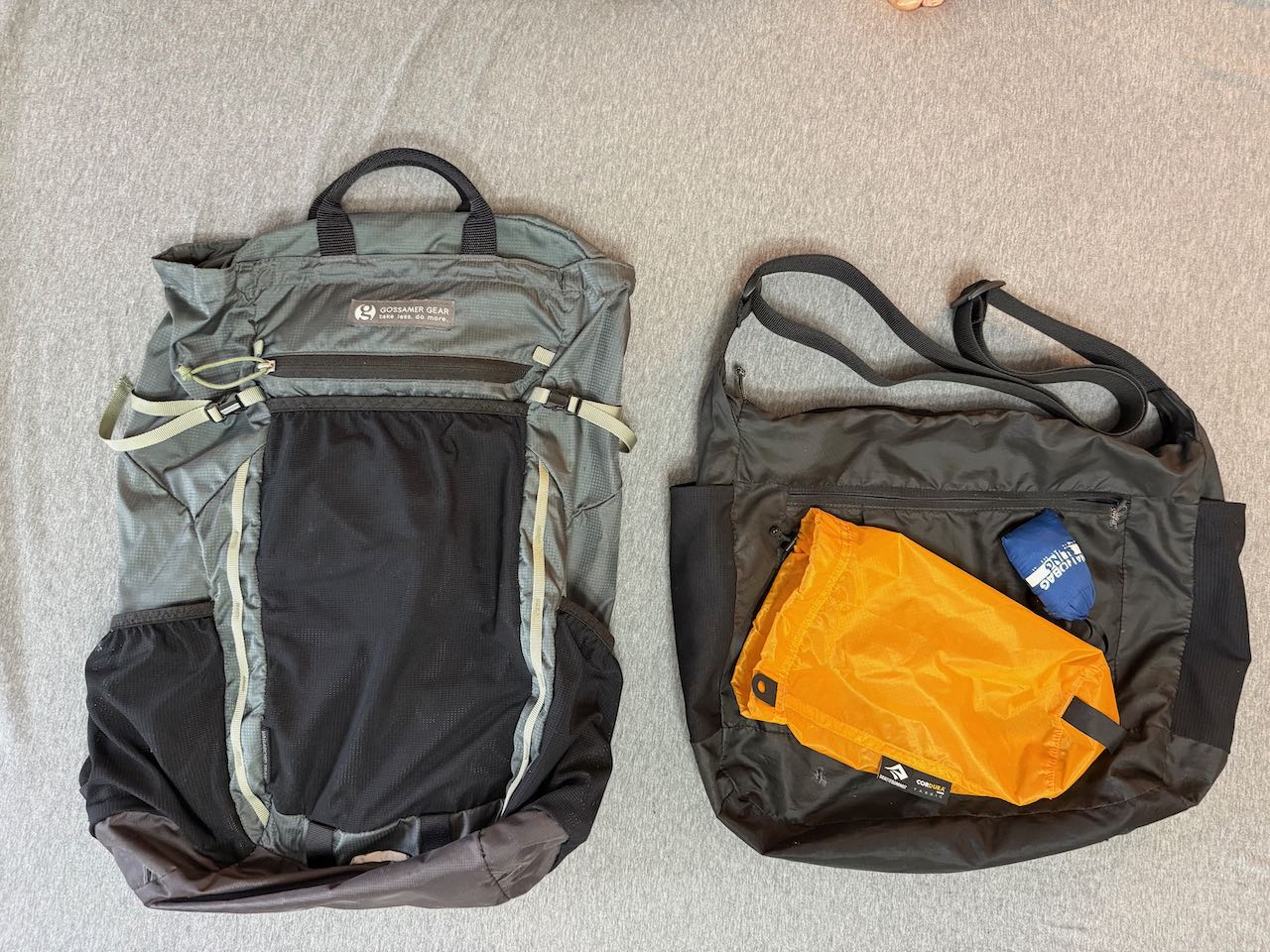
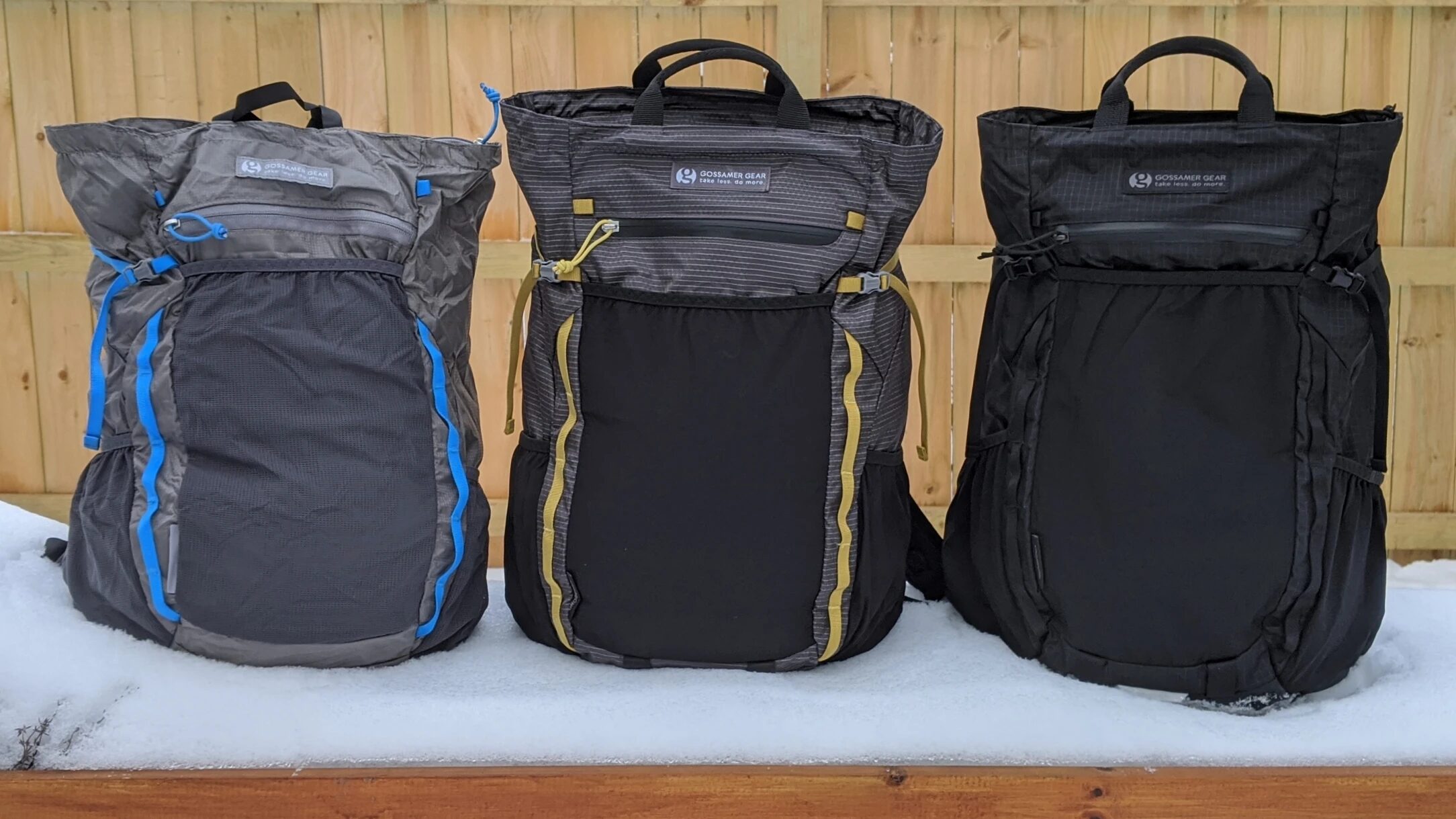
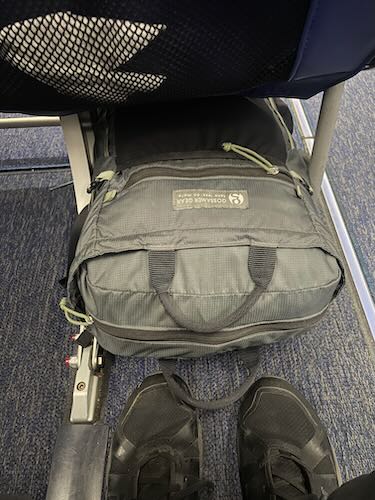
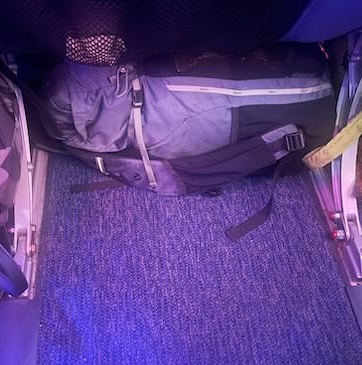
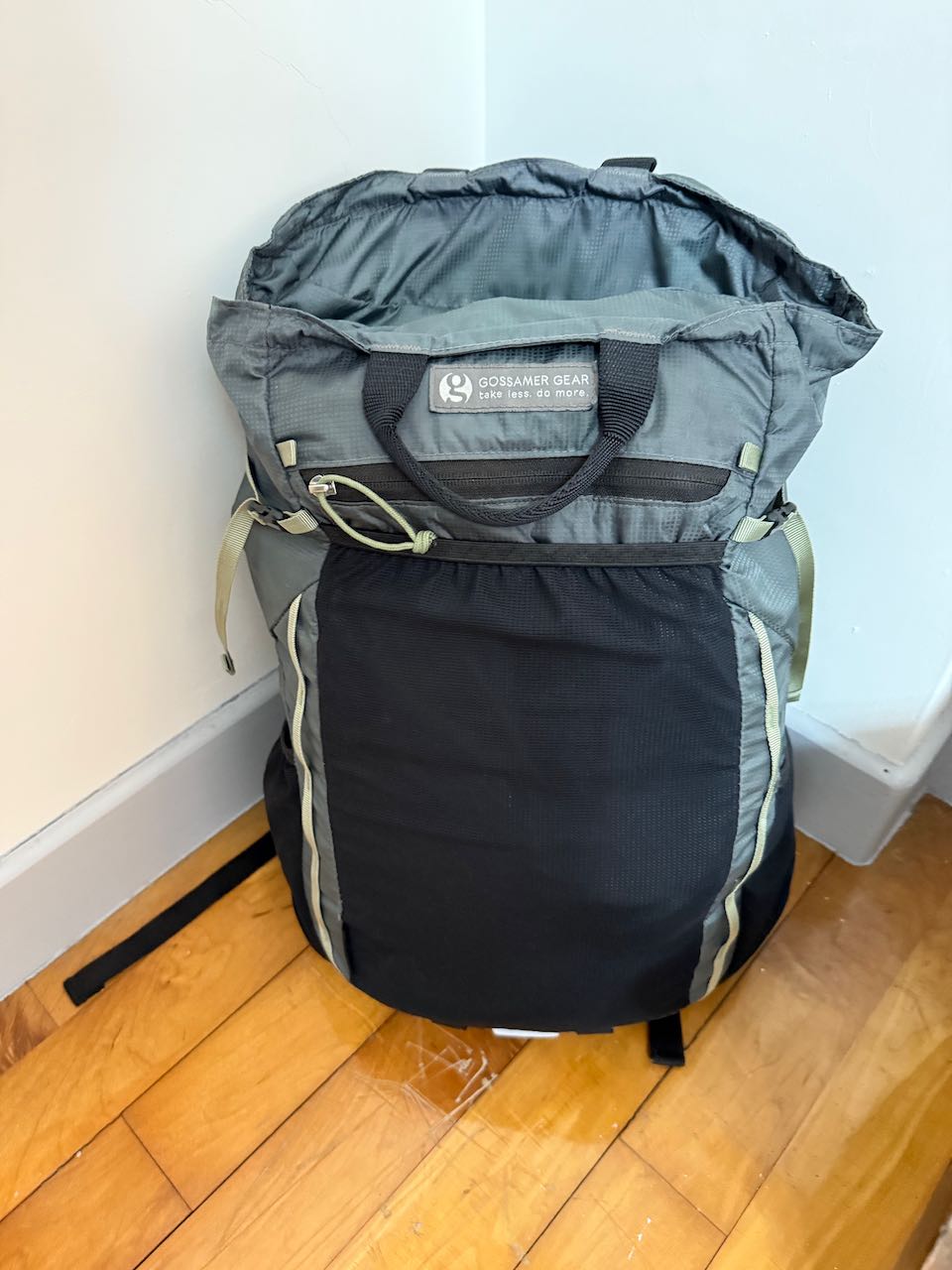
    • Gossamer Gear Vagabondmy review (2022) a 23L day pack which is light weight, comfortable to carry for extended periods of time, works well for EDC, and is large enough to hold everything I take when traveling. 46x27x15cm (18/10.75/5.75inches) filled with my normal gear is small enough to squish into every “personal item” sizer I have encountered and under the seat in front of me. While access is not as easy as a clamshell style bag, I have no problem retrieving items by feel because my clothing and stuff sack have different textures. Stands up on its bottom makes access on the go easy. I am using the discontinued Trail model. The current Jet model has some nice upgrades. I have a list of other travel and trek packs.
    • Decathalon Packable 15L Courier Bag (2023) Used when most of my gear can be left behind. Easier to access on the go than a backpack and no sweaty back. Large enough to hold anything I might need, unstructured so light loads still feels small and can be worn under my slim fitting coat. Carrying >4lbs for an extended time is uncomfortable for my shoulder. The bag has several small holes in the fabric after 1.5 years of everyday use. I expect I will get a few more years use out of it, but find the lack of durability disappointing. I have used other ultralight bags whose fabric showed no wear after similar use. On the other hand, it was only €8.
    • S2S Ultra-Sil Stuff Sack (2017) 2.5l stuff sack made from silicon nylon.  Many uses: keep small items together, hold dirty clothing, washing bag, trash bag. 
    • Nanobag Sling* (2023) is a 19l bag which weights just 20 grams and compresses to the size of a roll of lifesavers. Shoulder strap has a tendency to narrow under load, which makes it a bit uncomfortable when used for an extended time. Great for when we are buying groceries which don’t fit in whatever other bags we are carrying.

    Everyday Carry (EDC)
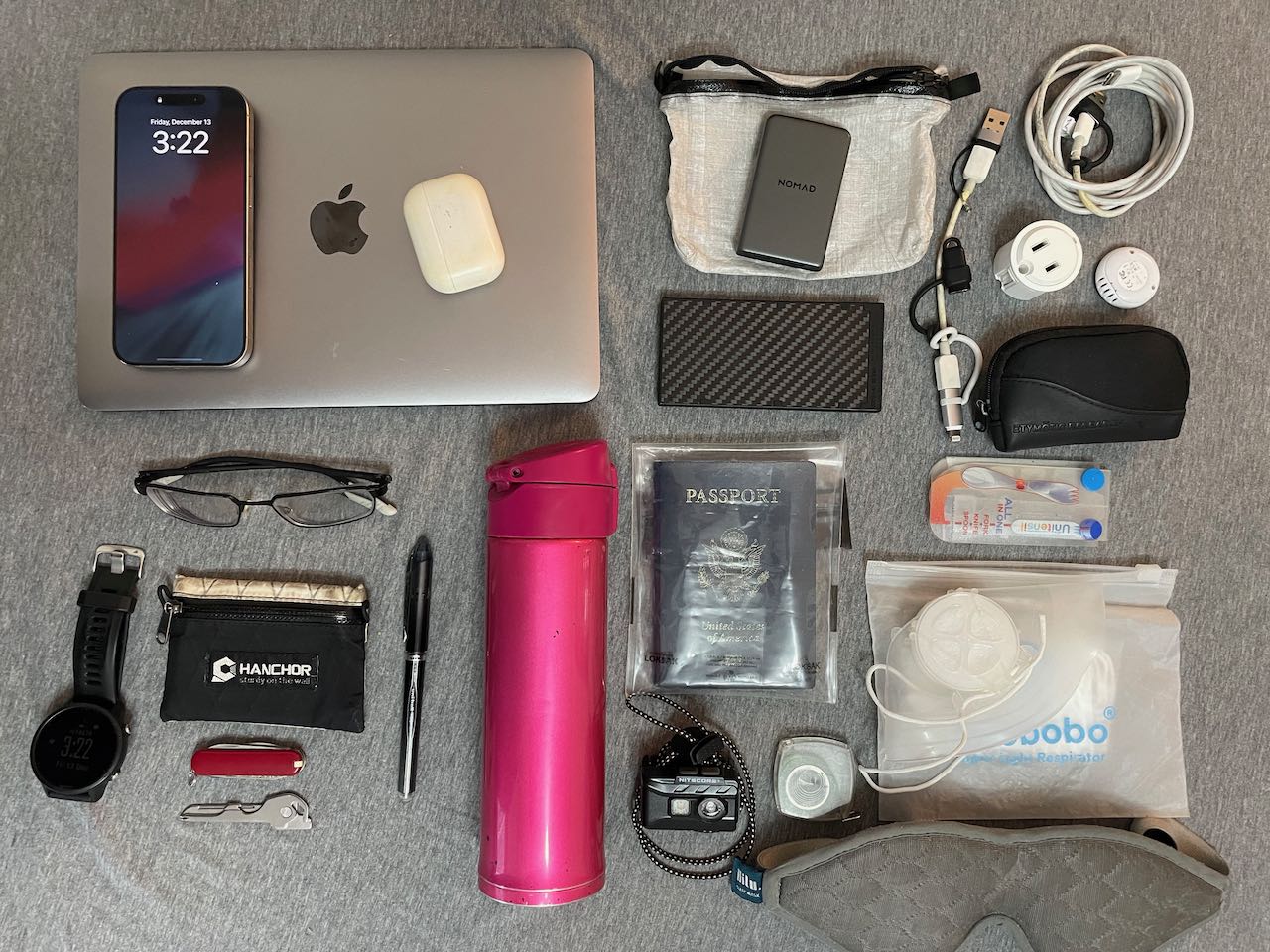
    Apple Based Computing

    I am in the Apple eco-system due to the intersection of security, ease of collaboration/sharing, and quality of applications. I have additional details about the technology I use.

    • MacBook 12″ from 2017 (2023) This is the last ultra portable made by Apple. It’s 2lb, decent keyboard, and enables me to complete daily tasks with a minimum amount of friction. Can’t run the current version of OSX but security patches are still available. I could use OpenCore Patcher to run current OS, but not willing to risk bricking it right now.
    • Apple iPhone 16 Pro (2024) Too big, but can’t find a usable small phone :(. Camera on the 16 pro is quite good, appreciate the action and camera button, and the satellite messaging might be useful. On T-Mobile (2022) which has good international coverage but mediocre coverage in USA compared to Verizon. Purchased the 16Pro when my iPhone 12 mini’s battery couldn’t last more than a few hours.
    • Apple AirPod Pros (2021/2023) are nicely integrated with the Apple eco-system and just works. Noise reduction is “ok”, and the “ambient mode” provides situational awareness. The case is part of the “Find My” eco-system.  Downside is battery can’t be swapped when it no longer holds a charge. I have written about other headphones.
    • MacBook Pro 14-inch (2006/2022) When I am at home this is the device I use. When I am traveling it is left running in a safe location and I access it remotely via Tailscale. Holds the family’s archives: pictures, videos, ripped CDs, digitized books, and documents. I could change workflows so everything lived in cloud, but current system is working well. I select a configuration with enough storage for 2x my current usage (4tb at the time of purchase) and the maximum memory available which has allowed me to use the same MacBook Pro for >5 years before I feel the need to upgrade.

    Other Technology

    “Tech Kit” items are stored in a small litesmith zipza pouch (2023) which is the perfect size, mostly waterproof, light, and a different texture than anything else in my bag so easy to find by touch. I am hoping that I will soon only have devices that use USB-C and will be able to do away with the adapters.

    • Nomad 65w Slim Charger (2024) hangs down rather than out so doesn’t lever itself out of loose outlets and packs well. 65W to one slot, 45W/20W when using both. Replaced an Anker 523 which is powering devices in our home. My wife loves her tiny 30w Anker Nano. For people who need three outlets, Anker 735 and Minix P1 and P3 are pretty good. If you need more power / more outlets I would think about getting something that has a removal cord rather than plugs directly into the wall like the Baseus 100W … because heavy watt chargers are getting so heavy that it will leverage itself out of the outlet. Snug plug can help prevent this problem.
    • Nitecore 10000 Gen2 (2023) power bank with USB-A out C in/out. Lightest and most compact 10k battery I have found. Comfortable in my pocket while charging my phone. Can slowly charge my MacBook or mostly power the MacBook while charging my iPhone. Supports pass through charging so I can charge this battery while my MacBook is plugged into. Has a bug that when you hold the “low power” button too long it puts the battery in standby mode which is only ended when you plug it in to be charged which is fixed in Gen3. Spreadsheet of many power bank options.
    • Cables: A 6ft USB-C cable, 2 6″ USB-C cables
    • Adaptor tips from USB-C to (Lighting, Garmin), and 2 USB-C to A converter.
    • Mogics Adapter MA1 (2023) is the smallest and lightest universal power adaptor I have found. For type E remember to unscrew and extended the type C prongs. Some trouble in UK outlets due to round pins: sparking until I got it set properly. BTW: The best visual display of outlet types I have found.
    • Tempo Logging Thermometer (2022) which lets me keep track of the conditions I experience.
    • Etymotic HF3 (2013/2023) Great sound isolation. Provides me with around 40db of noise reduction which is better than any consumer grade active noise cancelling headphones I have tried. Carried with FiiO KA11 (2024) USB-C DAC and airplane double jack adaptors. Second foam eartips for when current pair stops sealing.

    In Pockets / On my Body

    • Flexon Frames (1995/2020) last an average of 8 years. Yearly replace lens… currently using high index progressive lens with Transitions XtrActive Polarized (2023) that go from almost clear and unpolarized to 90% light blockage which is polarized! Eyeglasses are an incredible blessing.
    • Garmin 955 Watch (2022) accurately tracks my activities and measures my fitness level. Has decent integration with smartphones and notifies me when I have left my phone behind. I find the data I get from Garmin to be higher quality than most other wrist worn sensors, being close to medical / lab grade when paired with external sensors. Better battery life than the Apple Watch with physical buttons which work with sweaty fingers. The display on the 965 is a significant improvement but I am happy enough with my 955 not to upgrade. There are other good sport watches.
    • Hanchor Mica (2023) a tiny wallet / coin purse which holds my IDs, 1 credit card, 1 debit card, a few bills, coins when needed. Using a Chase Sapphire Reserve card for this season of life. Annual fee is ridiculous, but benefits have more than paid for the fee last few years. Really appreciate that the points can be transferred to the frequent flying programs we use, and the access to airport lounges has been a lifesaver.
    • Victorinox Swiss Army Rambler (1999/2015) is the smallest, usable tool I have found with a blade, phillips head & flat screwdriver, scissors, bottle opener, and nail file. I am on my 3rd Rambler after losing a couple to TSA in the early 2000s. I have some notes about other knives.
    • Swiss+Tech Utili-Key (2002/2023) Replaces my Rambler when flying and none of my companions is using a check-through bag where I can stash my Rambler. The Utili-Key has made it through TSA checkpoints over 160 times without being confiscated, but isn’t as usable as a Rambler pocket knife. On third Utili-Key due to misplacing them.
    • Uniball Vision Elite .5mm Pen (2015/2024) Writing feel approaching Pilot V5 and doesn’t leak after plane flights!

    In My Bag

    Items are carried in whatever bag I am using for the day. I used to carry the charging and power kit listed above, but my phone’s battery lasts long enough that it’s not necessary.

    • Zojirushi Double Walled Mug 16oz (2013/2017) can easily be used one handed, locks, pours at the perfect speed, the mouth is wide enough for ice cubes, and insulates better than every other mug I have tested. When air temp is ~80F and the mug is exposed to the sun, 6 small ice cubes in cool water have just finished melting in around 3 hours – water temp is 35F. In 68F conditions ice lasts most of the day. In many countries you you can fill mug with ice (no water) and get through airport security. Once through, add water and you can have icy cold water for your flight. I have a Deep Cherry color mug which is easy to spot. When I want to go extra light weight, I swapped it for either a SmartWater bottle or a 2L Platypus bottle.
    • Passport with a Chipolo Card Spot (2023) so I can use Apple’s “Find My” for my passport. Used to cross borders, checking into hotels, getting cell service, etc. Stored in a loksak aloksak which protects it from water, and is large enough for passport + my phone + my wallet if I go swimming.
    • NU20 classic (2024) 38 grams. Adequate regulation on medium and low settings. Has a flood, spot, and red light. Used when I need hands free light: making repairs, hiking at night, etc. Lit our kitchen during a power outage by bouncing light off ceiling. Can be locked to prevent accidentally turning on. Four LEDS to indicate battery level. UCB-C for changing and can be powered by an external source making it useful in extreme cold or when needing long runtimes. Replaced an original Nicore NU20 headlamp which I gifted to someone on our travels. There are many other good flashlights.
    • 6 Foot Tape Measure (2023) I often need to measure things. Was confiscated by security in UAE because it’s a weapon?! Replace with the same tape measure I used in the past… moderately priced but not the most durable.
    • Fold-it-flat Unitensil Spoon/Fork (2015) Often useful when traveling and we purchase food at grocery stores rather than restaurants.
    • Totobobo mask (2023) which is almost as effective as N95, and easier to breath through. Mask + replacement filters are more compact that carrying a number of M95 masks. I like the BOTN KT94 and the classic 3M N95. For other good options see Masknerd reviews. N95 properly worn provides significant more protection than cloth or the basic surgical masks.
    • Sleep Mask (2022) helps me get longer / better sleep because it stops external light from disturbing me.
    • Small first aid kit, not shown here – travels in toiletry kit shown below, moved to daily use at destination.

    Clothing
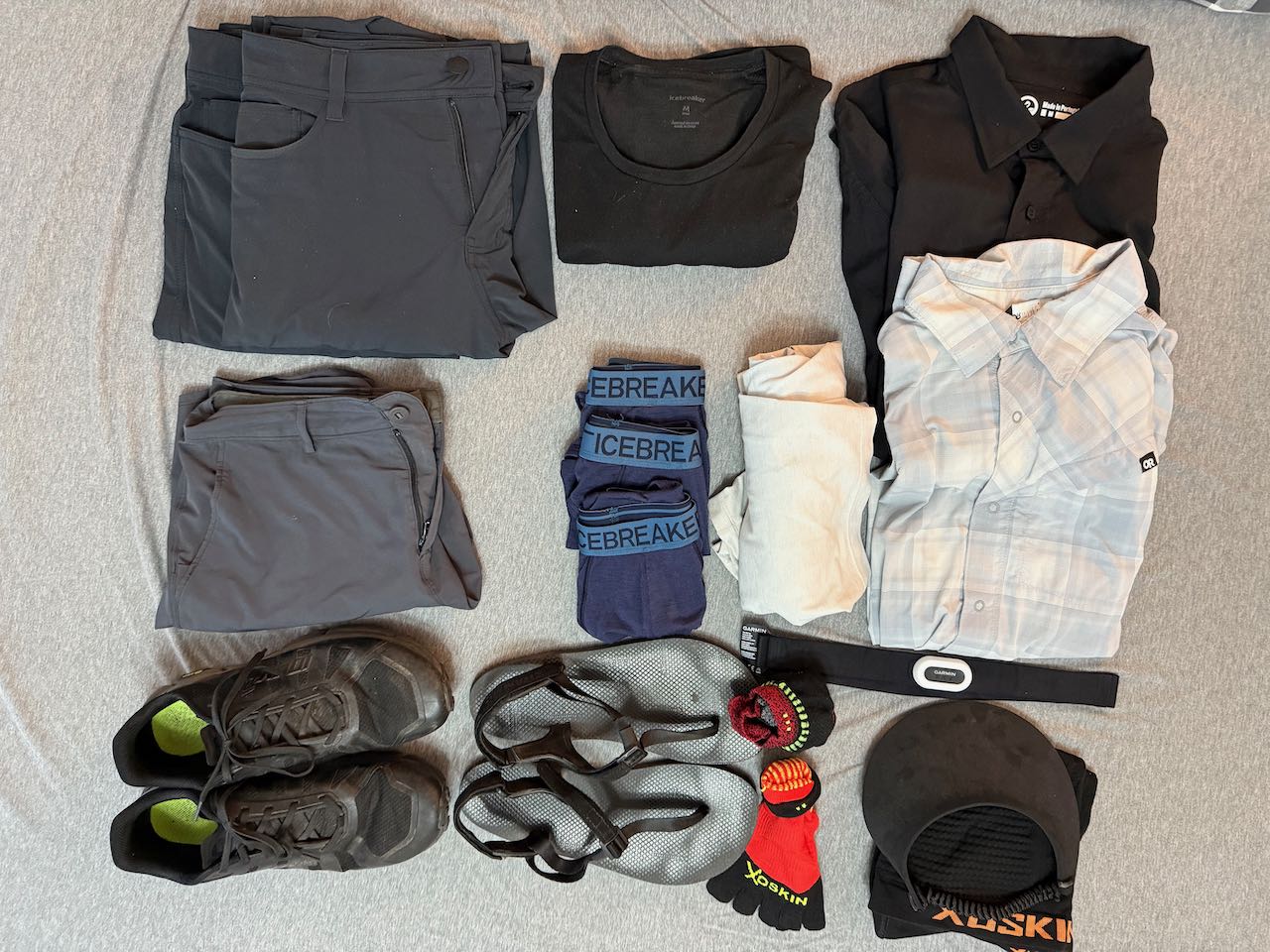
    I have notes about selecting clothing for an active life which goes in detail  about how I select clothing for a wide range of activities and conditions. I often engage in wilderness backpacking and exercise daily which typically includes a run. In normal circumstances my clothing dry overnight after being washed and then squeezed with a towel to jumpstart drying. The following items have been acceptable in every circumstance I faced in the last five years.

    • Outdoor Research Ferrosi Transit – 2 pair (2023/2024) Acceptable looking in urban settings while providing good mobility. Dries in a few hours and are comfortable in hot weather. I have some concerns about long term durability… noticed some light pilling near my knee after around 120 days of wear but only noticeable when my eye is inches from the fabric. Time between washing required varies between 1 day (muddy trails in hot weather) to 6 days (urban, low activity, cool temperatures). In cool conditions I will swap one pair of Ferrosi with a pair of Outlier Slim Dungarees which are more durable and better looking. Other good pants.
    • Patagonia Hydropeak Hybrid Walk Shorts (2023) dry in a couple of hours while hanging, faster when wearing. They are very comfortable, give me good freedom of movement. Not excessively “technical” looking. They can function as a swim suit, but if I am going to be on a beach for multiple weeks I will retrieve my Bluesmith board shorts described in the “beach section” below from as not to offend my wife’s sensibilities.
    • Icebreaker Anatomica Briefs – 4 pairs (2014/2021) the most comfortable underwear I have worn. They dry overnight and resist odor. I get around 600 days of wear before the waist band deforms and small holes appear. Only downside is that they bunch up a bit in hot weather when carrying a backpack. In the past I found the synthetic briefs from Ex Offico were pretty good but their quality has dropped. I have heard Uniqo Airism, 32 degree mesh, and Duluth Trading Buck Naked briefs are great, but no personal experience. When going light I bring two pairs: one to wear, one to wash/dry.
    • Icebreaker Anatomica Tee-shirt (2014/2021) merino wool with a bit of nylon for durability and a bit of lycra for a body hugging fit. This tee-shirt fits me perfectly, is super comfortable, doesn’t smell after a week+ of wear, dries overnight, and my wife likes how the shirt looks on me. UPF between 15-30? I get around 500 days of wear before an Anatomica Tee looks tired, and 600 days before the first small holes appear. This is my default shirt unless I am want something covering my arms (sun protection or warmth). I think Icebreaker makes the best merino tees, but there are a number of other good options from Smartwool, Outlier, Wool&Prince, and several other companies. While I love merino wool, there are advantages to synthetic technical-tees: absorb less water, dry more quickly, and are more cost effective because they tend to be cheaper and longer lasting.
    • Arcteryx Cormac Hoodie (2023) A casual UPF 50 shirt. Slightly textured which I find reasonably comfortable when I am hot and sweaty. When using a crystal deodorant resists odor for 3+ days of normal activities, 2 day of vigorous activity. Provides full sun protection. Resists stains pretty well so spills generally clean with a quick rinse, but after 130 days of use there were stains which won’t come out. Thankfully light stains on the heather mostly blend in. I found this shirt dries in less than 3 hours after being squeezed, rolled in a towel and hung in a cool indoor room with modest ventilation. When hung in bright sunlight it dries in less than 1 hour. Also dries in less than 1.5 hours when I am wearing it in moderate temperatures and humidity. This is my default shirt for “outdoors” / “athletic” activities. The Outdoor Research Echo is a good alternative for many: lighter, cooler feeling, with a slimmer fit, and good anti odor. Unfortunately for me, the Echo’s UPF is 15-20 has resulted in me getting sunburn when I spend all day outdoors in locations which have >10 UV Index. I have notes about other base layers.
    • Outlier AMB Merino Wool Button Up Shirt (2019) Very comfortable. Nice looking, resists wrinkles and if I don’t spill food on it can be worn for more than a week without washing. Dries overnight. Good air permeability, surprisingly comfortable in warmer conditions. My default long sleeve shirt when in urban environment. No longer made.
    • OR Astroman Button-Up* (2023) UPF 30-50, light weight long sleeve button-up shirt. Jack of all trades, master of none. If I could only have one shirt, this is what I would take. Good sun protection and reasonably comfortable in hot conditions, but not as comfortable as Cormac Hoodie. Reasonably dressy, but the slash pocket, tendency to wrinkle, and lack of fabric structure isn’t as dressy as a good wool, cotton, or linen button-down shirt. Resists odor for 2-4 days at “normal” activity levels, 1-2 when highly active. Dries in a few hours when hung up after washing. Carrying now because my wife doesn’t like me wearing clothing that looks the same every day and sometimes the versatility is useful.
    • Xoskin Toe Socks – 2 pairs (2022/2024) prevents blisters forming between my toes when walking or running for extended distances. I have worn one pair 30 days in a row doing ~20 miles of hiking each day without blisters. They weren’t stinky after six days of continuous use (and not washing) while backpacking in sandals, though they are more prone to pick up odor after several hundred miles of use or when encased in shoes. Gets ~700 miles before first hole appear. With darning can often make it to 1100 miles.
    • Shammas Elite Maximus (2024) I love the feel of running almost barefoot and the small space they take when packed. The Shammas replace a pair of Luna Venado Sandals which wore out after 1400 miles. I find the Shammas lacing system more comfortable and they have better traction than any Luna I have used, and they have better ground feel than Bedrock sandals… hoping they last as long.
    • Inov-8 Trailfly G 270 (2022/2024) Zero drop trail running shoe with a 12mm stack. Great fit for me: just enough room for my toes to splay while gripping my heel perfectly. Used for backpacking or trail running when the terrain is too challenging for my sandals or when I need to wear closed toe shoes. They have been acceptable footwear in snobbish establishments and no one has ever commented about them. I wear in transit and pack my sandals. The graphene infused soles are more durable than typical trail runners. At 1400 miles the uppers still look good and there is still a bit of tread on the highest wear areas of the sole. The V2 of this shoe reinforcements switched from a flat black are a shiny grey which makes them a bit less discreet. I have heard it claimed that Nike Pegasus Trail 4 might be even longer lasting though I am highly skeptical.

    Sports / Exercise

    • Garmin HRM-Pro (2021) gets higher accuracy during interval training than built in optical sensor on smart watches and works when swimming. Also provides running power which has been somewhat useful. Supports ANT+ and Bluetooth.
    • Foam Visor (2023) Keeps sun, rain, and sweat out of my eyes when running or hiking and doesn’t absorb water when worn in the rain. Typically combined with a hood which protects neck and ears.
    • Xoskin Compression Shorts (2023/2024) Great for many highly energy activities. Has eliminated chafing on long, hot runs, and of course work fine in less demanding circumstances. Ok as a swim suit. No pockets, but items placed on the leg are held in place by compression. Not durable enough to cycle in without shorts over them. When not subjected to extreme abrasive conditions, first hole appeared after around 600 hours of use, but performance is still good.

    Outerwear
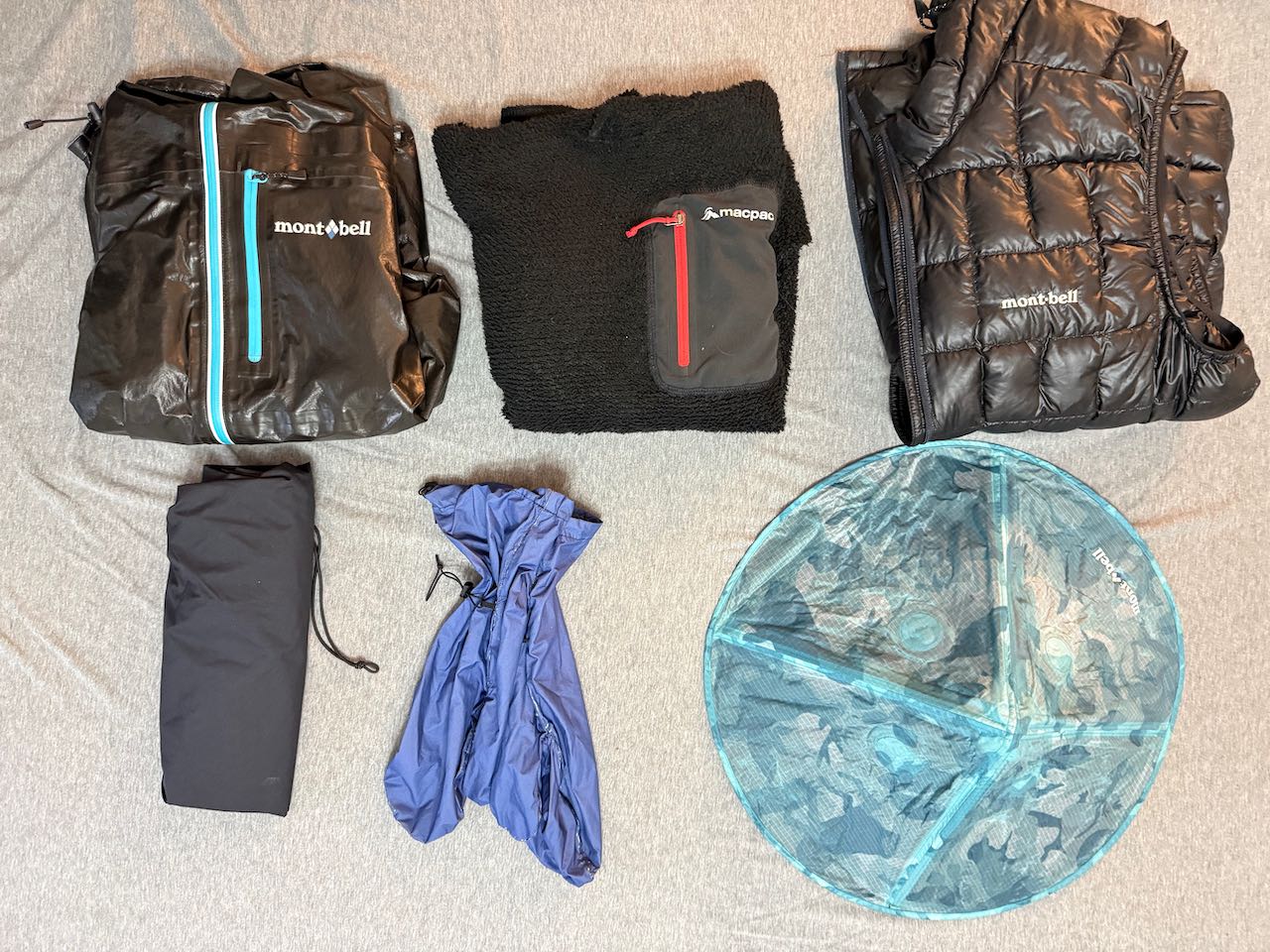
    The following clothing allows me to be comfortable at all actively levels when the temperature is 25F or warmer, and colder if I am engaged in high aerobic activities like running or cross country skiing.

    • Montbell DryPeak Jacket (2022) made from Shakedry. I can actually wear it and not be soaked by sweat when active! I have done zone 2 runs for 2 hours in 48F rain with just 1 gram of water accumulating. Waterproof and doesn’t wet out. Works well as a wind shell. Shakedry is somewhat fragile and is discontinued… hope something equally performant comes out soon. Other options are discussed in my post about rain gear.
    • Macpac Nitro Pullover (2021) Made from Polartec Alpha Direct (90gsm). Almost no water absorption and dries super fast. Very air permeable… I can feel air flow at walking speed in still air. Very light insulate without a shell, surprisingly warm under a shell. Great when active in cold conditions. Worn whenever my shirt isn’t warm enough. I am comfortable sitting in 68F wearing the Nitro and a tee-shirt, but when I pull up the hood and layer on a shell I am comfortable down to 40F doing light work (walking 2mph flat terrain), and in colder conditions when more active. Not as fragile as it looks but guessing 1/4 the lifetime of a classic fleece. There are lots of good options for an insulation layer.
    • Montbell Plasma 1000 Down Vest* (2021) Incredibly light weight vest which provides moderate insulation for my core. I have the Japanese version which has pockets. With a long sleeve shirt and shell I am adequately comfortable down to around 45F. When combined with a tee-shirt, Macpac Nitro, and a shell allows me to be comfortable while walking down to 30F. Combined with Nitro and Micro Puff keeps me warm enough in any winter conditions I am likely to encounter in the next few years. More acceptable looking over button down shirt / under blazer than my hoodie. Less than perfect for me: cut is a bit too boxy the neck doesn’t seal well.
    • Enlightened Gear Visp Rain Mittens (2022) Super minimalist protection for hands. Keeps my hand comfortable from freezing to around 50F when engaged in modest activity.
    • Montbell Umbrero Rain Hat (2021/2023) is a 1.8oz folding hat which fully shades my face, ears, and neck. It’s fully waterproof but still provides the best ventilation of any hat I have used. It deforms but usable in <25mph winds. I paint the inside for UV protection. I think it’s silly looking, and periodically have people point and laugh… but I have also received compliments and have had people chase me down to ask where they could purchase one for themselves. The tube inside the brim breaks after 2-3 years of everyday use. There are lots of other good hat options.

    Toiletries
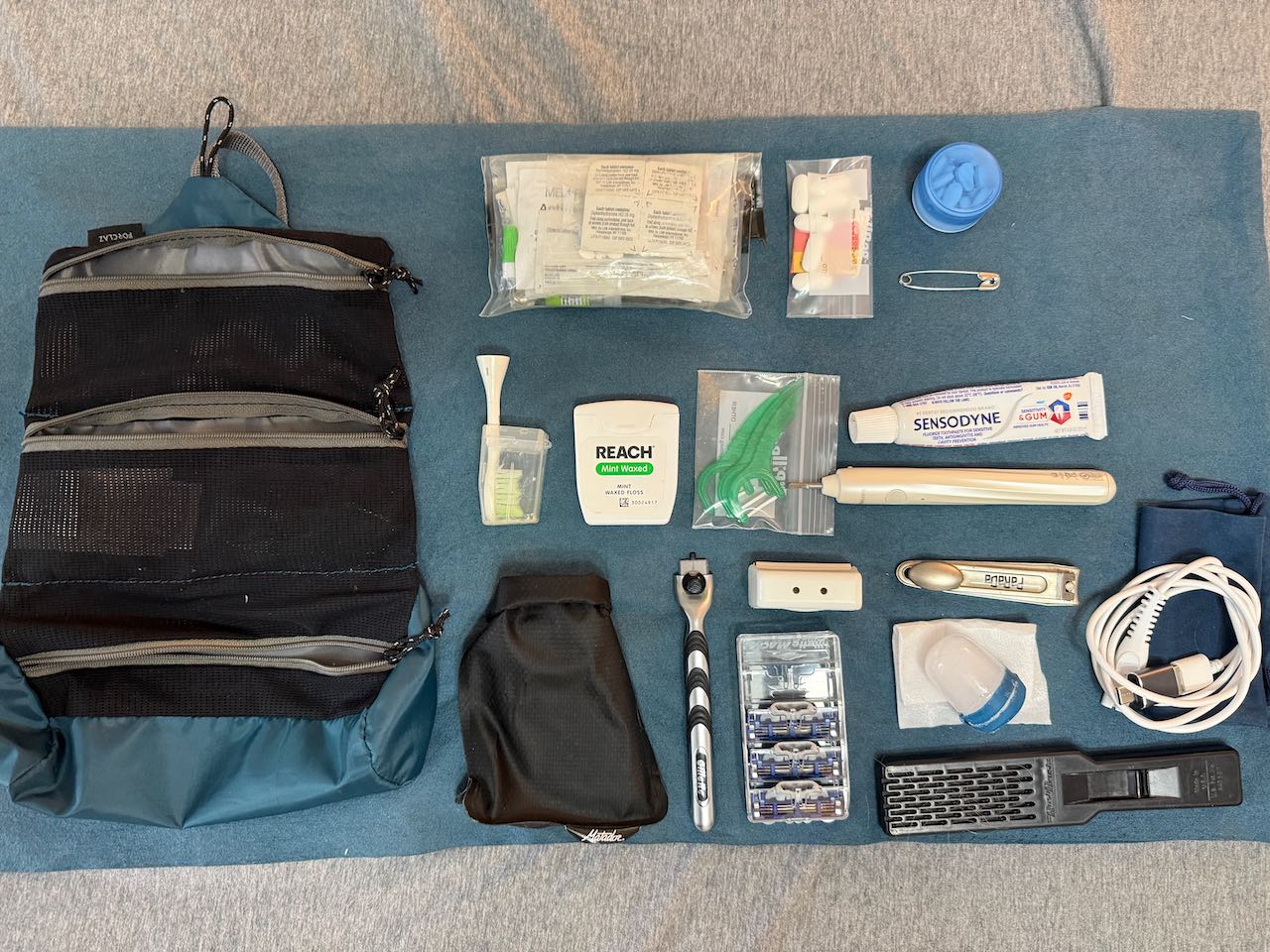
    • Decathlon Ultralight Toiletry Bag (2024) is the perfect size for my toiletry kit and make it easy for me to find everything quickly. Replaced REI Micro Shower Bag (2017) which made it hard to find what I was looking for. Top section holds first aid kit, middle things for teeth/lips, and the larger bottom section holds everything else.
    • First Aid Kit: Band-aids, single use benzoin tincture, compeed blister pads, antiseptic wipes, antibiotic cream, superglue, a couple of safety pins, and a few doses of nyquil and benadryl, small HumanGear GoTubb to store aleve.
    • Philips One Toothbrush (2024) Electric toothbrush that is compact, easy to use, comfortable in the hand, and reasonably effective. Use a full size Oral-B I am not flying to my destination. A charging adapter, though picture shows the original charging cable. Why doesn’t the Philips use a standard USB-C socket?!
    • Reach (rebranded Listerine Woven / Ultraclean) Floss (1996/2022) is the most effective dental floss I have used. Gentle to the gums while still getting plague and food wedged between teeth out. I believe it has been discontinued but still possible to find stock. My dentist has recommended coco floss as a good replacement though it’s more than twice as expensive.
    • Toothpaste and Toothpicks
    • 100senses body bar (2019/2024) which takes care of all my cleaning needs without drying out my sensitive skin or making my hair feel like straw. One bar lasts around six months. There are better shaving creams and detergents to wash clothing, but it’s been good enough and simplifies life for me.
    • Matador Flatpack Soap Case (2020). The Flatpak lets the soap dry out better than a ziplock bag, but it’s far from magical. In high humidity conditions I have had soap fail to dry after a couple of days. It doesn’t work very well as a case while showering.
    • Gillette Mach-3 Handle (2024) and enough blades (1999/2021) for my next trip segment. Use around 11 blades / year. Costco often sells large packs of the blades at a discounted price. The handle I have used since 1999 broke.
    • PaRaDa Nail clipper (2014) are large and heavy but effective and the trimmings catcher is brilliant. I have been saying for years that I will replace it with something lighter and more compact but I haven’t done it yet.
    • Retractable Bristle Hairbrush (1994) Compact and more effective than a comb for me.
    • Daily Medicine – not shown (2024) – Comprehensive preventative medical checkup in TW recommended some medicines to take daily.
    • Crystal Deodorant (2023) Simple Potassium Alum crystals. Years ago I ran an experiment and discovered if I showered regularly, no one could tell that I didn’t use deodorant. I suppose I have lower BO than some people. After >10 years I gave this deodorant a try after reading about them on /r/onebag. I notice that my shirts go a day or more longer before they pick up body odor. Carrying a 1.5 oz stick which shows little wear after 2 years of use. It’s best to apply right after a shower since it needs to be wet and works best on clean skin. It’s not an anti-perspirant nor doesn’t cover up existing odor. Rather it produces it environment that is hostile to the odor creating bacteria. Removed from case… rubber band to make it easier to grip.
    • A micro fiber cleaning / storage bag for my glasses
    • PackTowel Ultralight Body Size – discontinued (2009) Dries in less than 3 hours after I dry myself when hanging indoors, faster in sun, is compact, weights just 3oz. Large enough that I can wrap it around my waist like a small sarong. I found the face size sufficient for me to dry my body, but I am willing to carry a larger towel for the added versatility and ease of use. There are other travel towels.
    • I acquire sunscreen wherever I am. I try to select SPF >=50, considered very low risk for health, and reef safe when near the ocean. The sun screens in EU are way better than in the US because the FDA hasn’t approve some of the newer options. Such a shame since they are reportedly are safe, feel better on the skin, and often don’t leave you looking like a ghost. If the trip is short and I don’t have any sun screen from the EU left I will bring a Neutrogena Mineral stick. Around town where I don’t need to worry about form factor or TSA I will pick up whatever is the top rated sun screen that is liked by both consumerlab and ewg.

    Putting it Together

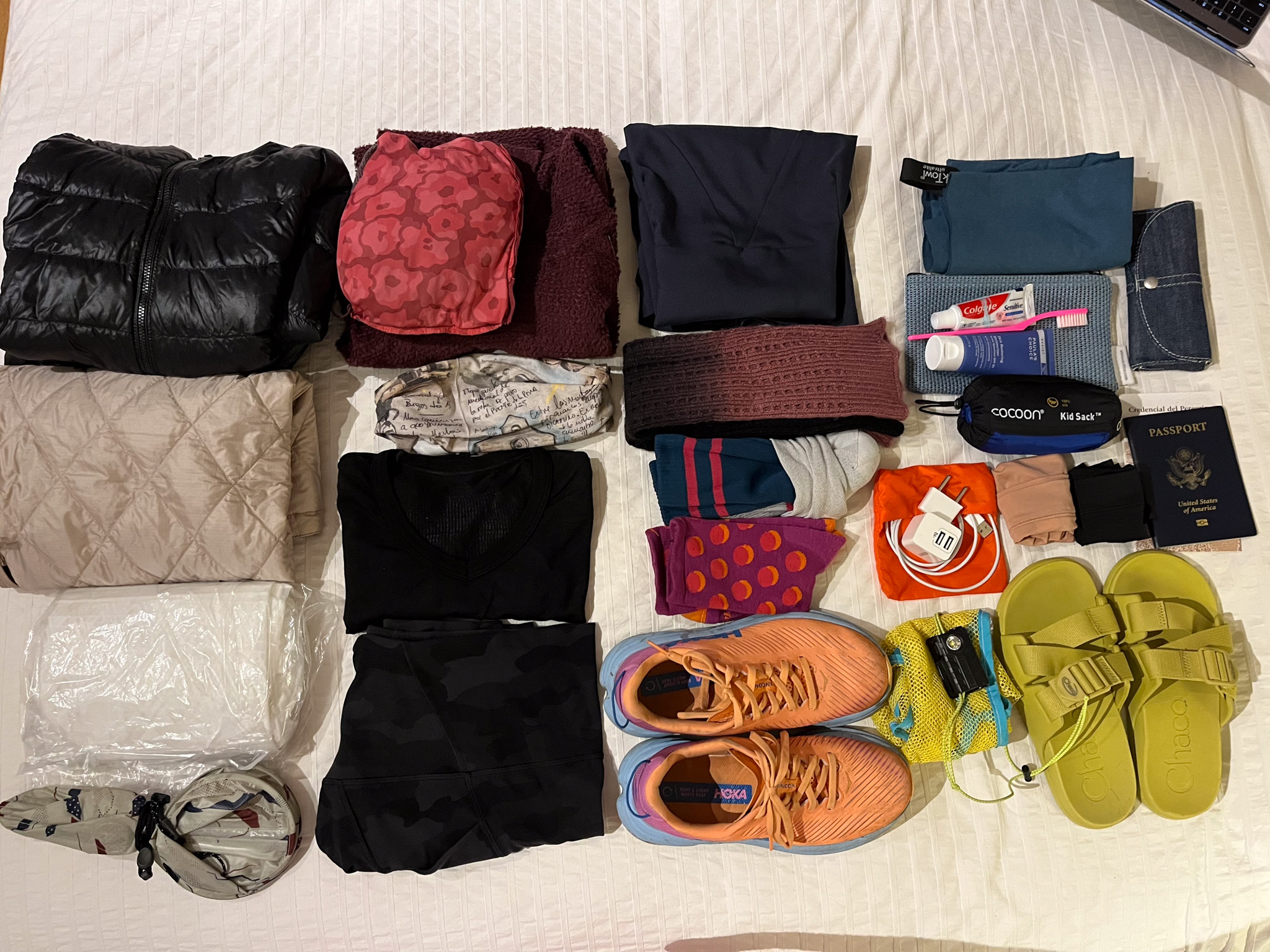
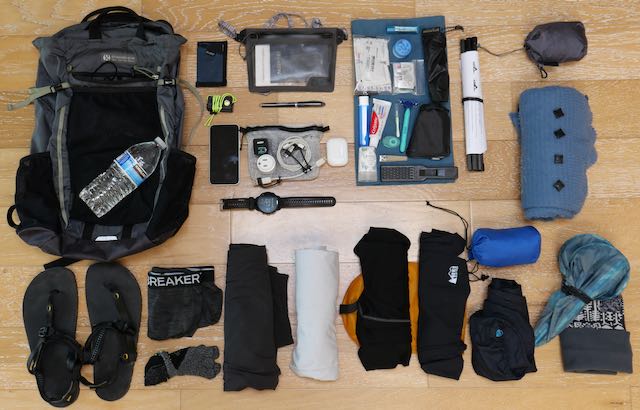
    Below is a picture of everything ready to be packed. Sandals, hat, and water bottle typically go in the side pockets, but can also be packed in the top of the bag if I need to put my bag in an airline sizer box. The bottom row goes into the bottom of the pack, vertically. On top of my clothing goes toiletry kit and outerwear. Top row is sometimes carried in the Decathlon bag, or sometimes laptop is inserted into my backpack, the Decathlon bag is packed in the backpack, and the other items go into the two zippers pockets of the Vagabond.
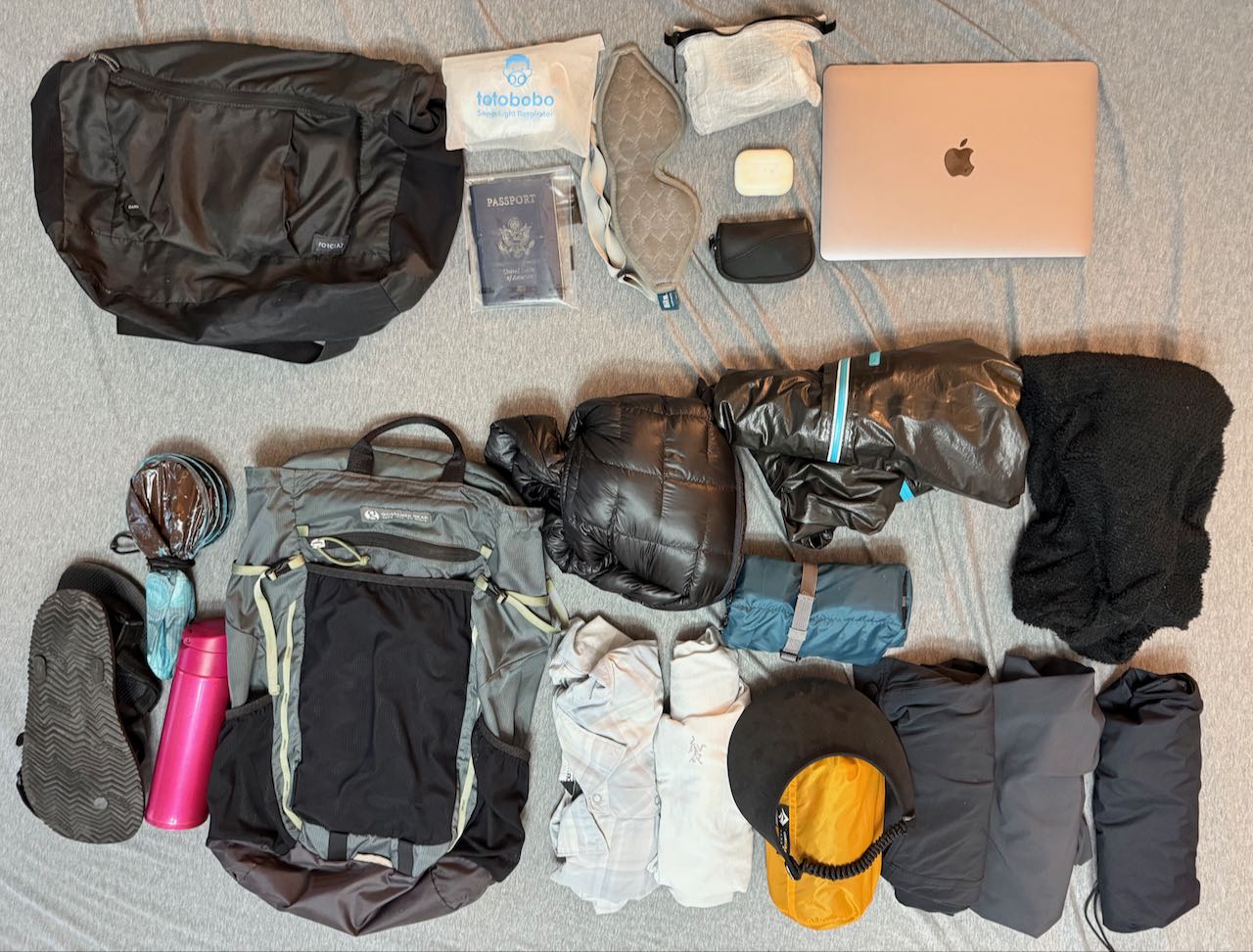
    Ready to Pack
    Packed with room left on top (will fit into a 16″ sizer). My packing list is what’s with me right now.

    Used When I Drive From “Home Base”


    Household Items

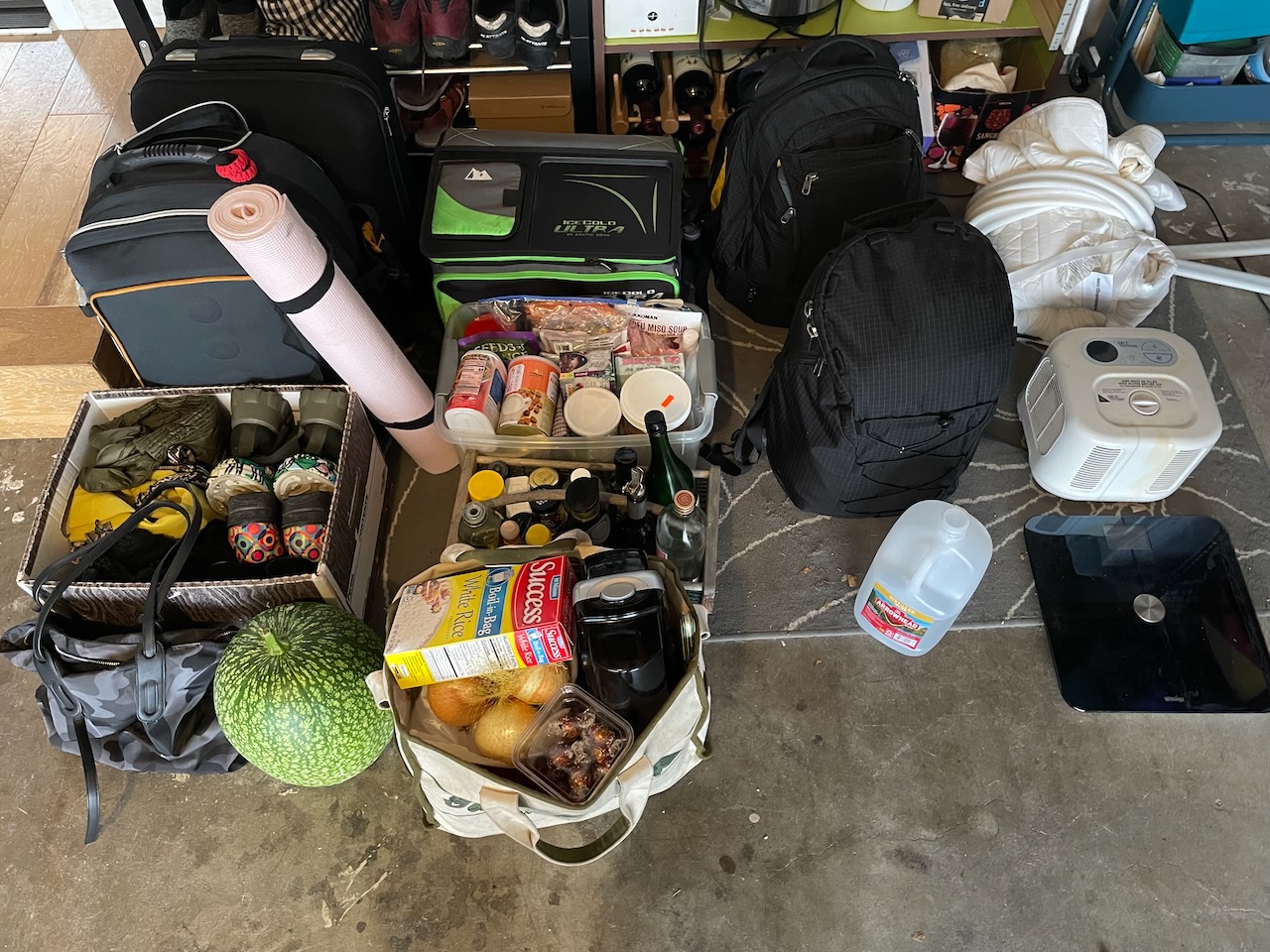
    The following are used whenever they can be easily transported to where we are staying for >2 weeks. If we are flying to a destination, they are stored in our car until we return. We also have a cooler and some kitchen tools and staples we have put aside for when we travel by car.

    • Tom Bihn Smart Alec (2022) durable bucket style day pack. Stands up by itself and is easily accessible through the top zippered opening without spilling. In this season of life this pack has two functions. When we are using planes as our transportation it is filled with the items I am not using, and is stored in the trunk of our car. When at home or at destination we drove to, it functions as my office storage. It is also the perfect size to hold two folding chairs and food for a picnic and works well as a grocery bag.
    • Oral-B/Braun 6000 Electric toothbrush (2016) and USB powered charger. A recent meta analysis concluded that the rotational approach of Oral-B is likely superior to approach of Sonicare, but both are significantly more effective than manual brushing and the electric toothbrushes like the Quip which relies on a brushing motion. Battery lasts less than a week now. Will need to replace at some point.
    • Pulse Flex Wireless Speaker (2017 & 2022) allows us to have synchronized whole house music and plays nicely with other BlueSound products and can be combined into a reasonable quality stereo system. We have the original Flex speaker and the updated Flex 2i. It also supports inputs via USB, Bluetooth, AUX, a number of streaming services like Spotify, and many free sites via URIs. Has a iOS and Android remote control app which works but has a somewhat awkward UI. Controls on the top let you select one of 5 user-defined “channels” without using the remote. I have the optional battery pack so it can be used outdoors. Sound quality is significantly less than KEF LS50 but better than most portable speakers, the speakers on our phones and the built-in speakers on TVs. When using them away from home primarily play lossless music which is stored on a thumb drive plugged into the back of the speaker. For most people I would recommend Sonos: for its lower price point, better streaming options, and slightly more processed sound quality which everyone but audio purists like me prefer. Even cheaper are products from Audio Pro.
    • Withering Body WiFi Scale (2014) makes it easy to track weight which is well integrated to Garmin, Fitbit, MyFitnessPal, LoseIt, and numerous other health tracking eco-systems. Body composition numbers not accurate. Having trouble getting it to switch WiFi networks.
    • ChiliPad (2019) which cools or warms water which flows through a mattress topper. I need to be significantly colder than Jackie to sleep soundly. When under our bed the heat exchanger not able to hit the cooling target, but it has been fine when sitting out. We tried an eightsleep system which much quieter but not worth the added cost to us. I didn’t find the automatic temperature adjustment of the eight sleep particularly helpful and the sleep tracking wasn’t significantly better than my Garmin watch.

    Variety “Travel” Clothing

    Extra clothing which is normally stored in our car during this season of nomadic existance, which is useful when we drive to a destination. Most of these items are not as versatile as what I carry with me all the time, but typically superior for specific conditions. When I am not space constrained they get added into my clothing mix.

    • Outlier Slim Dungarees – 2 pairs (2014/2019) High-tech nylon pants in the style of jeans. Gives me an almost tailored fit, looks great, good mobility and durability. Thanks to the NanoSphere treatment very stain and water resistant. Dry overnight. They are perfect when it’s <75F and I am inactive, <55F when active. When highly active and >70F the seam that runs along the inner thighs chafes. In hot weather prefer OR Ferrosi Transit pants. Over time the pants stretch out a bit especially around the knees which make them a bit less slim fitting. I get more than 550 days of use before there is any signs of wear: light pilling at the top of the pocket I use the most. I have yet to completely wear out a pair though I have retired a few pairs after a pen leak created a large stain and after I lost weight and needed to switch to a smaller waist. When paired with nice shirt, and blazer have been accepted in situations which called for semi-formal dress. The hiking pants I wore in the past couldn’t do that. I have repeatedly had women say “Where did you get those pants? They look great. I want to buy a pair for my husband.” SD seem pricey but it depends what you compare them to. When considering the cost / day of wear ($0.07/day)… they are 5x the cost of mass market nylon pants which don’t fit me that well, 2x the cost of higher quality nylon pants from companies like Prana and Patagonia, and about the same cost per day as Levi 501 jeans if you retired them when the knees are blown out. Maybe an indulgence, but I don’t think them as a luxury item when I see $1390 nylon shorts from Prada. Current pairs I am wearing were acquired in 2017. They are going to be discontinued. If you want a pair, buy them now.
    • Outlier New Way Shorts (discontinued) 2 pairs – (2014/2017) are nice looking shorts which fit me perfectly, are durable, and resist stains. The first place place for wear to show up is the mesh to drain the pockets develop holes. These shorts feel like they were tailored for me. I can’t put into words how “right” they feel each time I put a pair on. The fabric is thick enough to prevent items in my pocket from really standing out. They are pricy but I hadn’t found any shorts that I liked as much. They can function as a swim suit but aren’t ideal for that use because they take 2x times to dry as some of my board shorts and my wife observed “they don’t look like a proper swim suit.” Still wearing the first pair I purchased.
    • Minus33 Mid-weight Merino Mock Turtleneck (2023) Purchased for cooler days when I want something bit more casual than button down shirt but dressier than a hoody. Warm enough that I don’t need a sweater when it’s cool, but not overly warm when sitting around indoors. Have been able to wear for more than a week with no noticeable odor retention.
    • Patagonia Cool Daily Hoodie (2022) Comfortable hoodie, resists odor for 4 days when somewhat active, provides moderate sun protection which I believe is good enough when I am indoors much of the day or in locations with moderate UV index. Patagonia removed any UPF claims because between their initial testing and production the UPF performance dropped / was inconsistent (from >50 to 17-45, average 34). Use when my Cormac hoody is dirty.
    • Second Icebreaker Anatomica Tee-shirt in grey which is typically used for high intensity exercise.
    • Darn Tough Socks – 2 pair (2013/2019) are unsurprisingly durable since they come with a lifetime warranty. Icebreaker and the Smartwool PhD line are good alternatives. Worn out and replaced 2 pair of the no show light socks after >4000 miles of use for each pair. None of my light crew have been worn through yet.

    Lives in Car

    I leave some items in car trunk in case we encounter unexpected conditions. I rarely use these items personally, but have often loaned them out to friends who weren’t prepared for the weather we encountered.

    • Gossamer Gear Vagabond Packable (2021) 23L pack which is comfortable to carry and easily packs away in my larger bag. This is by far the most comfortable carrying packable day pack I have ever used. Most packable daypacks feel like a sack with straps designed to fit a non human.
    • Tilley LTM6 Hat* (2014) durable hat that provides good sun protection. I prefer the LTM8 which has more ventilation. Replaced a 20 year old canvas Tilley that was lost on a river trip.
    • Icebreaker Quattro Hoodie* (2012) is a medium weight merino wool sweatshirt. After several years of near constant use starting to pill and is a bit stained, so has been “retired” to the car.
    • ArcTeryx Squamish Wind Shell* (2012) is a 5oz windshirt with an air permeability of ~30 CFM. When combined with a heavy base or light middle layer provide comfort over a huge range of conditions. Comfortable against the skin. Best replacement would likely by the Mountain Hardware Kor.
    • Montbell EX Wind Shell (2023) Weights just 56grams and easily fits in my pants pocket. Provides decent wind protection while still being fairly breathable. Used for done in a day activities that have no risk of rain.
    • Patagonia Micro Puff Hoody (2020) Keeps me comfortable ~25F lower than I would be without the jacket. Provides just the right insulation for me for winter nights in the SF Bay Area and shoulder season backpacking in the sierras. Combined with down vest or Nitro Hoody it’s just right for winter trips in the sierras. Reasonably light and compressible. Long enough to cover my blazer.
    • Keen Clearwater CNX* (2014/2018) are the lightest sandals Keen makes. The toe cap has been effective at protecting my toes. When worn with gray socks they can “pass” for shoes most of the time. Keens ground feel is a bit “dead”.

    Backpacking Gear

    I have a 3-season packing list which makes use of a number of the items on this list and has several items which are specific for backpacking. I have not taken pictures of any of these items. The “winter gear” is not used “at home” because the Bay Area never gets cold enough to need these items, but they are pulled out when traveling to winter destinations. These are stored in a old Coke crate in the garage.

    • Hanchor Tufa (2023) 40L pack which weights 26oz and carries up to 22lb with great comfort, usable up to around 27lb. I found it more comfortable than the HMG SW2400. When the rolltop is fully cinched down qualified as carry on for most airlines. When lightly packed has passed for a personal size item, can scrunch into many personal bag sizers. Beautifully made. Most of the body is 100D PC so highly water resistant without the risk of delimitation.
    • Osprey Ultralight Drysack (2021) Used as a liner to protect against rain, can be used to wash clothing on trips if I am sharing a bathroom and can’t soak my clothing in the sink, and as a giant “clothing packing cube”. Sometimes used to separate dirty from clean clothing.
    • Gossamer Gear Whisper (2023) Ultralight shelter for one person which weights 9oz. Uses two hiking poles to stay up, and 7 stakes. Has bug netting around the perimeter, and you provide your own floor (I typically use polycro). Provides bug and rain protection for typical 3 seasons use, 2.5 above treeline? Lots of room with easy access and exit.
    • Durston X-Pro 2 (2022) Ultralight shelter for two people that weights 20oz. Good performance for 3+ seasons. Used it in moderate snow without problems. Easy to set up provided there is a flat space. Footprint in a bit larger than some 2-person shelters. Large vestibules. Very easy to use.
    • NunatukUSA Ghost Quilt (2003). 16oz, comfortable to 30F, have comfortably pushed it down to 15F when wearing my clothing and outerwear. This is the second version of one of the first backpacking quilts commercially made. A bit narrower than more modern quilts with a tiny footbox which I like because it makes it easy to ventilate my feet when I get too hot.
    • NEMO Tensor All Season Insulated Pad (2023). 13oz. Warm enough for me to use down to 10F. More comfortable and less noisy than NeoAir pads I used I’m the past. Replaces an Therm-a-Rest NeoAir UberLite which repeatedly develop leaks.
    • Trail Designs ULC Caldera, Gramcracker esbits Stove, MLD 850ml Pot. (2009). 4.5oz cooking set which fits inside the pot. Easy, efficient, compact. Couldn’t ask for something better, except the Tri-Ti version which can burn wood as well as esbits and alcohol.
    • HydraPak 28mm Water Filter (2023). 2oz, can push more than 1l / minute through it with modest pressure. So little pressure is required that I can actually use it inline between a water bladder and a hydration tube. Attaches to SmartWater and Platypus water containers. Huge improvement over my old filter whose flow requires much more force as it has been clogging. Just remember to give it a good soak if fully dried out before the next trip, otherwise you will have very slow flow for around 60 minutes during the first use.
    • Garmin InReach (2020). 3.5oz. Satellite communication device. Can send an SOS and do short 2-way text messages. Take on solo trips when in locations without a lot of human traffic so my family doesn’t worry about me. I have found it works with tree cover and in most canyons, but in these conditions will often take 30-45 minutes to get a message out or receive messages. There were time it did not work in a slot canyon. Much faster when it have a broad view of the sky. Can be using with a smartphone, or the numeric pad on the device.
    • Patagonia Terrebonne Joggers (2023) Very light weight polyester pants which provide a good range of motion, are very light, pack up small, UPF 40. Dry in less than 2 hours when hung indoors, less than 1 hour when wearing after being completely soaked in a rain storm. Very breathable and comfort in hot weather. Downside is that the pockets are a bit shallow so items fall out when sitting down.
    • Patagonia Cap 3 Tights (2007): added to my legs when facing continuously below freezing conditions.
    • Outdoor Research Meteor Mitts (2004): which have a removable 300wt fleece inner mitt which folds back to let you use your fingers and a durable, waterproof shell. Can use the shells without liner when it’s warmer. The magnets on the inner mitt detract from overall comfort. Many people replace the liners. Dries faster than all-in-one handwear.
    • Buff PolarBuff (2003) Generally I use the hoods on my garments, but sometimes I want extra insulation for my neck or head.
    • Manzella Power Stretch Touch Tip Gloves (2023) Light weight gloves that I can mix/match with shell mittens. Hands have been ok Visp mittens down to 20F.
    • Traction Devices* (2020): Gives trail runners and other shoes grip on snow and ice. Picked up when we were facing icy trails in Grand Canyon without footwear with sufficient traction. Don’t remember the brand and it’s not stamped into the chains. When doing a lot of winter trips I would use screw shoes.
    • OR Gaiters: (<1988) for keeping snow out of shoes/boots and the lower legs most dry.
    • Hostel sleep system: 48″ x 62″ piece of Polartec Alpha Direct 4004, 120gsm (2022) compressible warm blanket which is a $20 piece of bulk fabric, MLD Bag Liner (2023) 3oz 10D nylon sleep sack, in a Sea2Summit 2.5L Ultra-Sil Stuff Sack (2022). For stays in basic hostels and alberques that don’t provide bedding of any sort. Comfortable for sleeping down to 55F. The sack is snug but not too tight, keeping the blanket well positioned when cold. As it warms move blanket to outside of the sack or remove completely. Blanket can be warm like a shawl during particularly cold days. I will likely get a bigger piece of alpha direct, add a head slit so it can be worn as a poncho and get a larger sleep sack if I am regularly staying in the dorm style hostels.

    Stored during our travel (2022-2025?)


    Bicycling Gear & Clothing
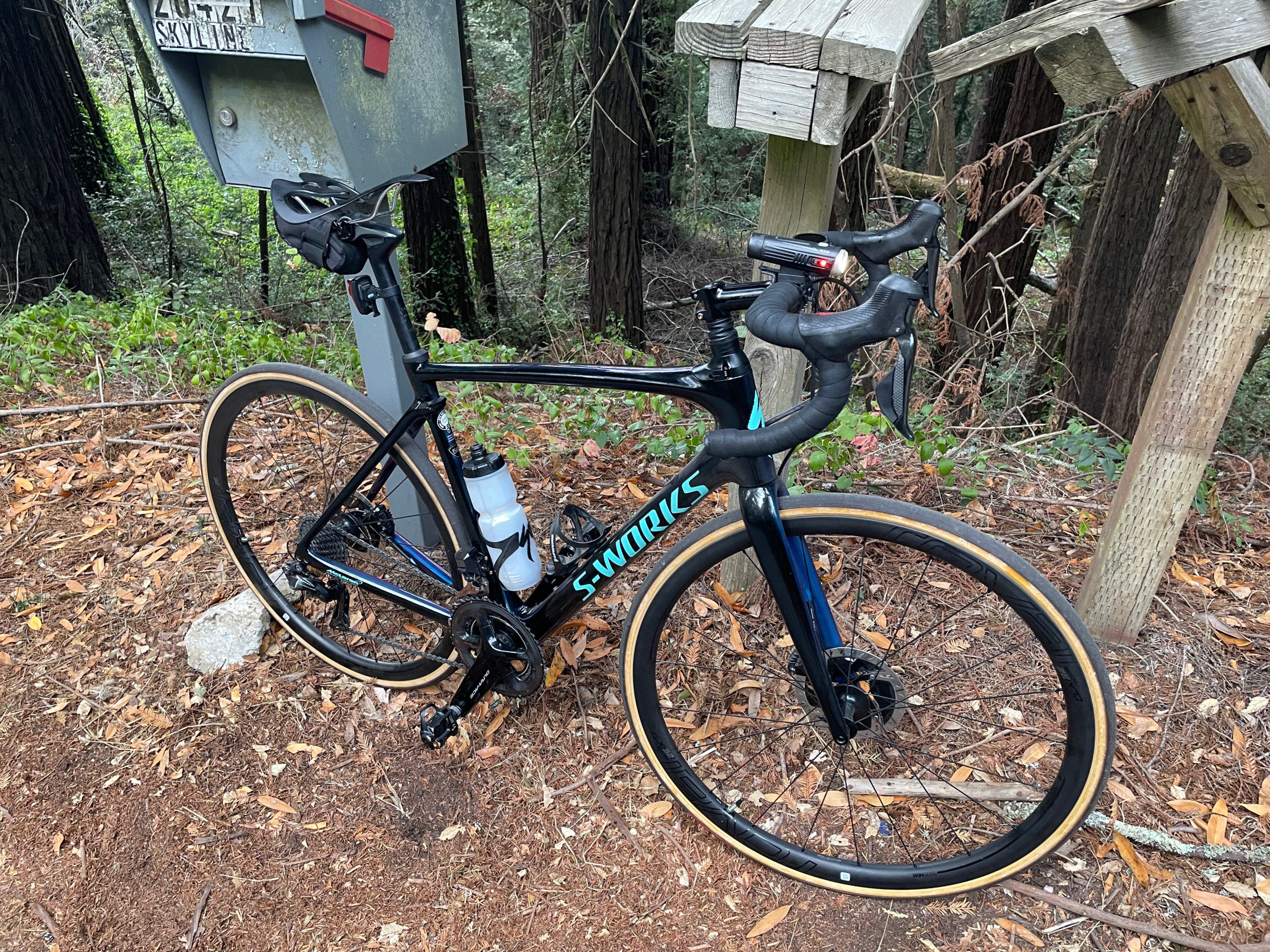
    • Specialized S-works 2019 Roubaix (2021) an endurance bike that smooths out the road making it easy to be confident on less than ideal road surfaces with a responsiveness that approaches the Cervelo R-series. A huge improvement from the 2013 version of the Roubaix. Fitted with an Infinity Seat (weird looking but the most comfortable seat I have used), 2 water bottle cages, and a small seat bag which holds a pump, tubolito, bike tool, and 2 tire levers. I have a charger for DI2 which is powered via a micro USB cable gets used every month or so. Otherwise it sits in the garage.
    • Cervelo R3* (2013/2015). Replaced with identical bike when my first was stolen. Comfortable enough for an endurance ride, responsive like a race bike, great for climbing. Wore out drive train which has now been mostly replaced… still looking for Rotor chain rings. Now primarily lives on a Kickr for indoor “rides” and is my “spare bike” and if my Roubaix is out of action or an out of town friend wants to go for a ride.
    • Felix BC21R Bike Headlamp and Cygolite Hotshot Pro 150 (2019) The BC21R uses a removable 18650 rechargeable battery. I don’t love the Felix but it’s getting the job done and the swappable battery is very handy.
    • Power Tap P1 Pedals (2015) because I like objective measures. No longer made. The Garmin Rally pedals use standard Keto cleats, and are lighter.
    • Bicycling Shoes (2013) with cleats for PowerTap peddles. No idea the brand.. they were the cheapest shoes I found at a local bike shop. They are near the end of their life, but I haven’t found a shoe that is as well ventilated so I continue to squeeze a few more miles out of them by regluing the seams.
    • De Soto Mobius Tri Shorts (2018/2021) Can be used forcycling, running, and swimming. They used to be comfortable for all the activities I engage in when the temperature is above freezing. For many year reduced issues with chafing, dries fairly quickly, and are reasonably comfortable when wet. They have side pockets large enough to hold some nutrition and my phone so I don’t need to use a special cycling jersey. I get around 1000 hours of use from each pair before the elastic no longer provides any compression. Never had a pair develop holes. For many years I loved using these because I never need to think about what to wear for vigorous physical activities…. I just grab a pair of tri-shorts. Recently I have been chafing on my male parts when running in hot conditions so now not used for hot weather running.
    • Xenith Delta Shirt (2021/2022) is the most comfortable shirt I have worn when sweating heavily. The shirt maintains air permeability and doesn’t stick when wet. The shirt dries at the perfect rate: faster than wool or cotton, but slower than classic “fast dry” shirts, and feels cool against the skin. I have also found that is it the most odor resistant synthetic shirt I have tried, though not as good as wool. Only UPF 30. Use a ArcTeryx Cormac on longer rides.
    • Black Diamond Alpine Start (2021) is a 6oz hoodless ultralight soft-shell which is very air permeable (30-60 CFM depend on who did the measurement… feels like 45cfm to me) and extremely water resistant thanks to the Schoeller NanoSphere treatment. Very comfortable in high wind <60F doing normal activities, bicycling at tempo pace (~220watts / ~18mph) when it’s <55F or doing a zone 2 HR runs when it’s <50F. In a light rain find it easier to manage moisture than a Shakedry shell because the higher air permeability helps me dump heat (reducing the amount I sweat) while resisting the rain. Normally I like a hood, but the lack of a hood is useful when cycling and running with a hat. Windshirts are great!
    • Pearl Izumi P.R.O. Barrier WxB Cycling Gloves (2021) Keep hands comfortable on rides when it is cool and maybe wet. Cheap thanks to a clearance sale at sierra.com. Likely better gloves but they are getting the job done.
    • Giro Air Attack Shield Helmet (2013/2016) provides protection, good ventilation while having a streamlined aerodynamic profile. Has snap on optical shield. On my second Air Attack helmet due to a crash which broke the helmet but protected my head. If you ride a bicycle, wear a helmet!! I have been able to walk away from at least two accidents thanks to the protection of a helmet. Helmets don’t lead to more injuries due to a false sense of security. These days there are helmets which are more aerodynamic than mine, and also cheaper while providing equivalent protection.
    • Wahoo Fitness Kickr (2013) is a trainer for when it’s not convenient to hit the road. Integrated power meter and variable resistance which can be controlled via ANT+ or BlueTooth. Very useful if doing structured training based on power.
    • o2Trainer – not shown (2022) Working on improving my breathing. Not used enough to have an opinion.

    “Variety” Clothing
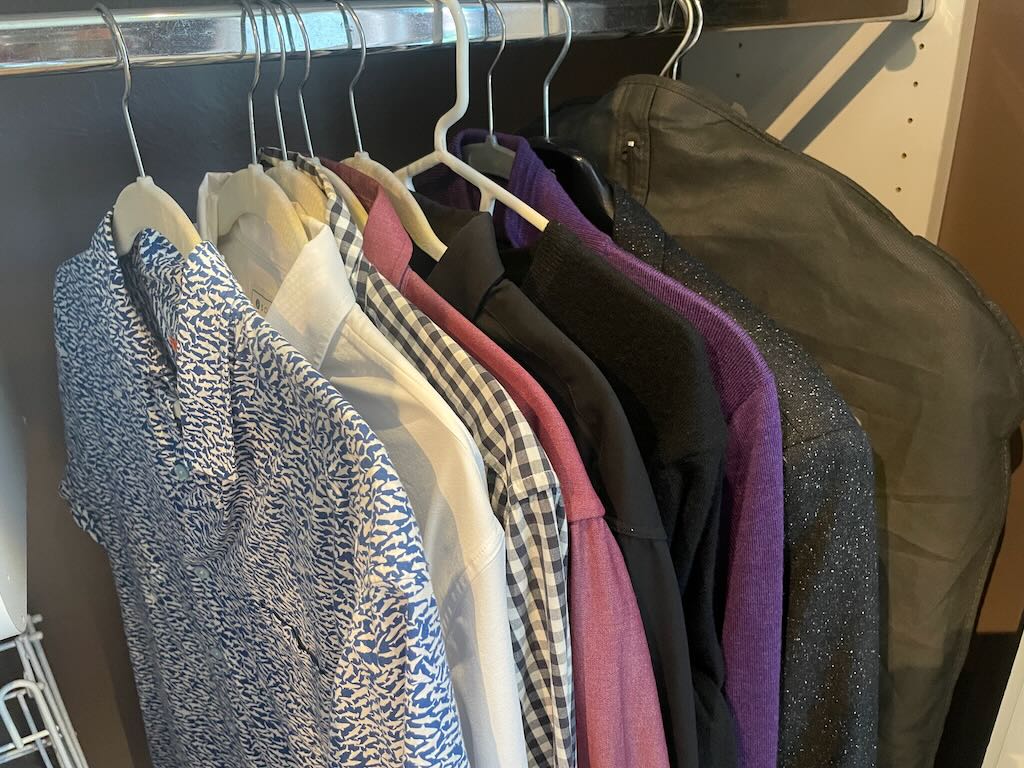
    While I normally like to wear my “uniform”, I know my wife likes variety in my clothing, and likes when I get “dressed up”. I sometimes call the following my “Jackie clothing”. All of these items can be rolled over their hangers and be stored in a $4 Ikea Frakta Duffel (2022) along with my beach items and stored “replacement” clothing items.

    • Toni Richards Hawaiian Shirt (2019) Everyone needs at least one shirt for “Hawaiian shirt day” though some might argue that white and blue with sharks rather than flowers isn’t very Hawaiian. I find the cotton lawn fabric used by Toni Richards to be one of the most comfortable materials when it’s hot and humid. Alas, UPF is quite low.
    • White Cotton Button-up Shirt* (2012) Was my default when I want to wear something more formal than a tee-shirt. Appropriate in almost any setting. Shirts which have more sun protection and dry more quickly have replaced it.
    • Muji Black/Grey/White Checked Button Up Shirt* (2013) for something that is casual but a bit more dressed up than my tee-shirt or hoody. Gift from Jackie.
    • Western Rise Unlimited Button Down* (2022) Blue Merino / Polyester blend button down shirt. My wife tells me it also looks like it was just ironed as it comes out of the my pack. Reported to be UPF 40. Fairly air permeable, resists odor, comfortable in a wide range of conditions. Dries quickly enough to hand wash at night and be ready to be worn the next morning. Can wear 4 days without any odor. It’s a great shirt for “urban” use.
    • Wool and Prince 210wt Burgundy Oxford Shirt* (2020) Slim fit, classic oxford cloth look while being 100% wool. Christmas present.
    • Banana Republic Purple Merino Wool Sweater (2013) for cool days or when some color is called for. Purple is the color of royalty… so it can function as a Christmas or Easter sweater. Gift from Jackie.
    • Grey Cashmere V-neck Sweater* (2019) for fall and winter evenings when I need more warmth than just a shirt and my hoody is too casual. Love cashmere but durability is low, it pills very quickly.
    • Boss Blazer* (2014) for dressy events in the fall and winter that don’t require a formal suit. Have found that it doesn’t wrinkle when packed carefully in my backpack while traveling between locations. Christmas present.
    • Bluffworks Hopsack Blazer* (2022) Blazer which doesn’t wrinkle, can be washed in a machine, and is light enough to wear in hot weather. If the Bluffworks Telex model existed when purchasing a travel blazer, I would have purchased it rather than the Hopsack.
    • Boss Wool Suit (2012) slim/european cut in super 140 wool. Fits me perfectly though not bespoken. First suit that I wear rather than the suit wearing me. Light enough that it’s usable in the summer. I use it for weddings, funerals, and special nights out on the town. I won’t naturally choose to wear a suit, but sometimes it’s appropriate.
    • Alpaca Blend Socks* (2021) are soft, warm, and cushioning with non slip “dots” on the bottom.
    • Vivobarefoot Gobi II (2017/2022) are comfort, zero-drop, minimalist ankle boots which look good with casual clothing or dressed up in a suit. I have used them around town, hiking in the backcountry and even run in them. Sending my original pair to be resoled after walking more than 1500 miles. With an occasional brush and polishing the uppers still look good after repeatedly soaked in rain storms, covered in mud, etc. Unlike shoes with breathable nylon uppers, keeps sand and dust away from my feet and socks. They are generally not needed given current dressing standards, I can typically get away with trail runners.
    • Softstar Zen Moccasin* (2021) Comfortable slippers for cold days.
    • Ultrafino Santa Fe Hat* – not shown (2021) is “Panama” straw hat. Alas, this hat’s weave is so tight that the ventilation is minimal, and the brim isn’t large enough to consistently shade my face and neck. The function of this hat isn’t as high as I expected, but I have held on to it because it’s a great looking hat that I will sometimes wear to a party when the UV index isn’t too high (like early evening).

    Beach / Water Clothing and Gear

    When we spend extended time near a tropical beach these get pulled out.
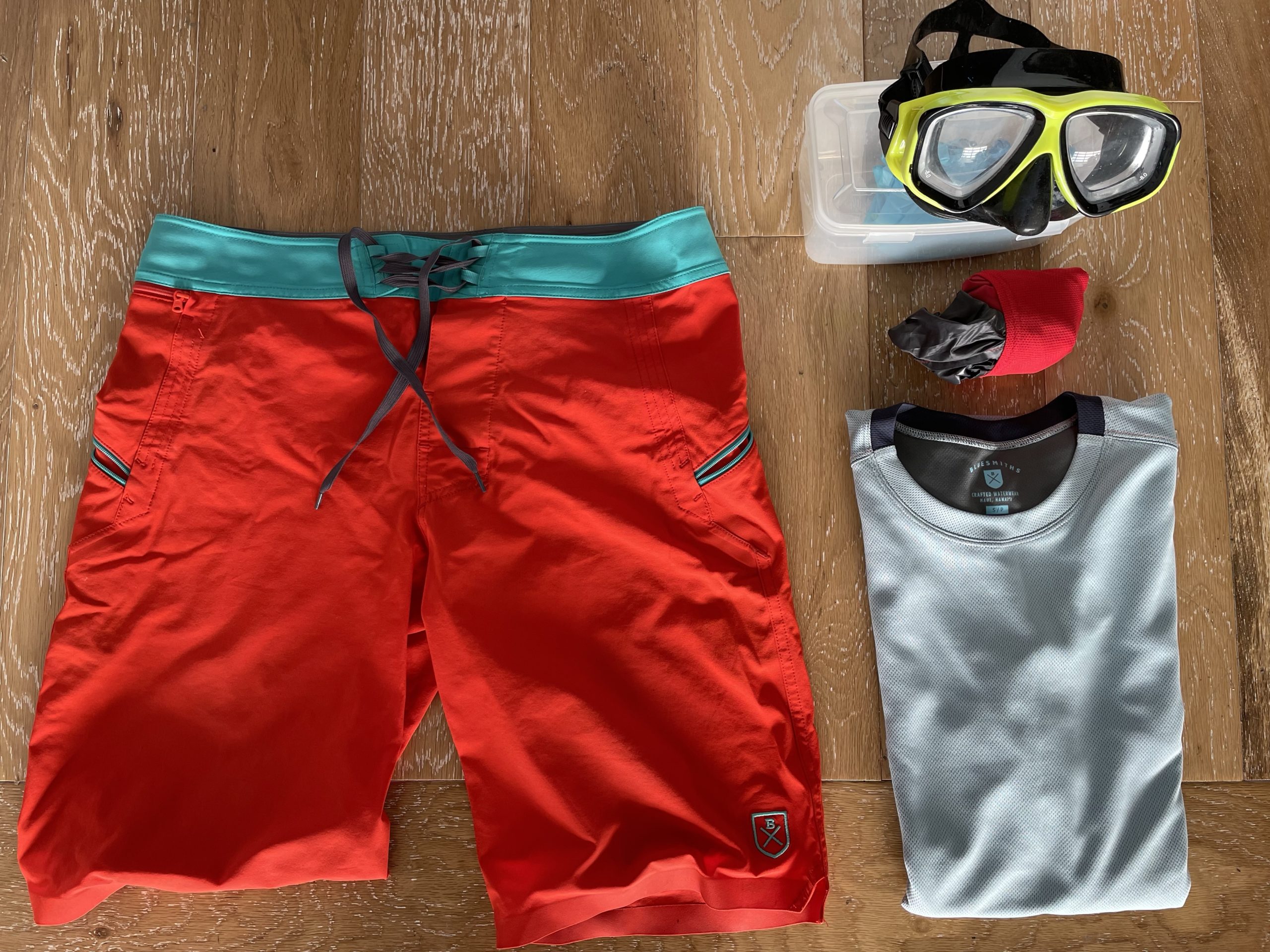
    • Bluesmith Spartan Board Shorts* (2016) For days that I am living in swimming suit, going in an out of the water. These shorts dry very quickly. Could use my other shorts if I was trying to minimize more.
    • Patagonia R0 Longsleeve Shirt* (2022) UPF 50 shirt for water activities. Tight fitting, dries quickly. Jackie approved. Picture has my retired Bluesmith shirt rather than white R0.
    • Matador Pocket Blanket* (2019) to sit on when at the beach.
    • Matador Droplet Wet Bag* (2019) which holds items on the way to the beach, and wet items on the way home.
    • Yeesam Prescription Snorkeling Mask (2019) which lets me actually see underwater life when snorkeling rather than just blurs and flashes of color!
    • Akona 2mm Neoprene Socks – not shown (2019) Prevent my toes from getting ripped up when using flippers. Sometimes used with sandals if I am constantly going in and out of water or with my cycling shoes if doing an extended ride is cold rain.
    • TYR Corrective Optical Performance Goggles not shown (2012) so that I can actually see when I am swimming in pools.

    Sentimental Items

    There are a several items I have kept as a specific way to honor people I love or past experiences.
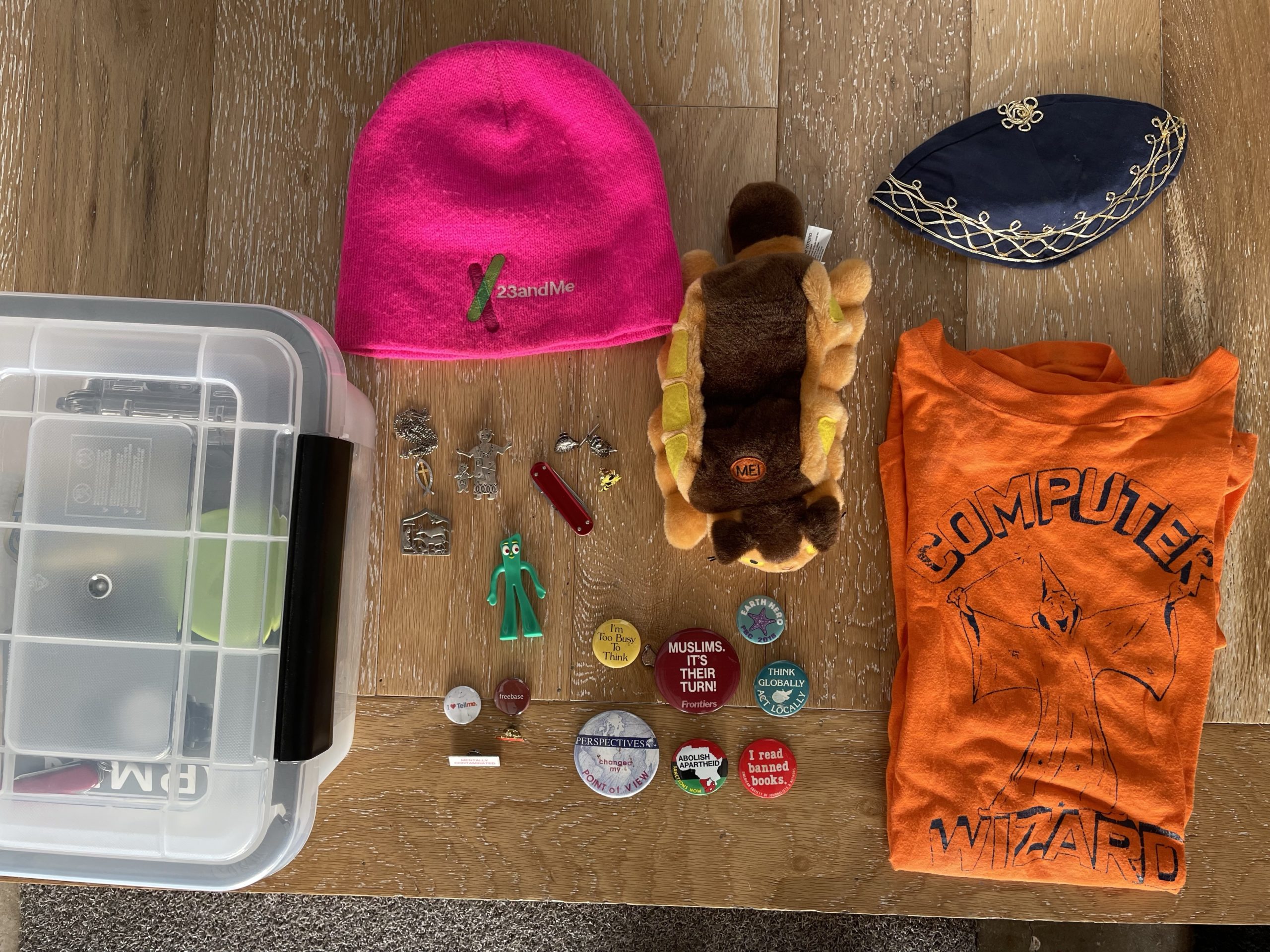
    Box which I store these things, my spare glasses, some old documents, etc.

    • Various buttons collected over the years related to projects or movements that were important to me.
    • Libby’s pins (<2000) of a nativity scene, a mother and child. Originally worn by Libby on special occasions, they became daily decorations on the hats she wore during chemotherapy. They remind me of Libby’s courage and the two things most important to Libby, family and Jesus.
    • Gumby (2011) which was given as a reminder that when life is difficult, we need to be flexible.
    • Dad’s (<1980) tie tacks and Alox Swiss Army Knife which remind me of his love of the outdoors and his care for his students.
    • Knit Cap with 23andme logo (2016)
    • CatBus Plushy (2018) given to me by Jackie. It reminds me of the gentle film My Neighbor Totoro. I wanted a real CatBus, but no one can find one for me 🙂
    • Computer Wizard’s Tee Shirt (1977) from high school group club… still fits. Not shown: 23andme Tee-Shirt (2016) Hashicorp Cycling Jersey (2021)
    • Grandpa’s Yamaka (<1980)

    Stored – Replacement Clothing

    These items will be pulled out when my current clothing wears out. Most of these items were purchased on close-out, on sale, lightly used. A few were purchased at full price when I realized an item was “perfect” for me, and there was a risk that I won’t be able to repurchase due to the model being discontinued or changed by the manufacturer. A few of the items were used for time, and then I decided to drop the number of items I have in a weekly rotation so they were sent to storage. It’s useful to have have an unused items purchased at the same time as one which is in “heavy rotation” to see how much wear and tear accumulates over time.

    • 1 pair of outlier slim dungarees (2019)
    • 2 outlier new way shorts (2014-8)
    • 2 western rise evolution pants (2022)
    • 2 icebreaker tee shirts (2018-2021)
    • 1 arcteryx cormac shirts (2023)
    • 3 pairs of icebreaker briefs (2019-2021)
    • 6 pairs of darn tough socks (2015-2019)
    • 2 pairs xoskin socks (2022)
    • GoreWear R7 trail running jacket (2020/2022)
    • 1 Montebell Peak Dry Jacket (2023)
    • Macpac Nitro hoodie (2022)
    • 2 delta tee-shirts (2022).

    Stored – Possibly Retire

    • Tom Bihn Passport Pouch (2022) Small pouch which is large enough to hold my passport, phone and everything that might be in my pockets when passing through security checkpoints. In high crime cities I wear it under my shirt. Haven’t needed it.
    • Entchin Fanny Pack (2020) Inexpensive fanny pack which is a good size for half day activities. Can hold a headlamp, mini first-aid/emergency kit, water bottle, a protein bar, and small volume jacket. Use rather than daypack so my back is ventilated. The bucket has broken three times and is being held together by tape. Looked at a bunch of much more expensive fanny packs, but not work as well. Closest was the REI Trail 5 but when I put my water bottle in a holster it gets in the way of my arms as they swing.
    • Gossamer Gear Gorilla (2012) An older version of the Gorilla which I used when doing multi-night backcountry trips or urban travel when I am carrying more weight / volume than appropriate for the Vagabond. Its weights just 28oz, comfortable carries up to 25lbs for tens of miles in a day, has survived thousands of miles, and works as a carry-on bag. My size L is actually 23″ long, but has been able to fit in airline sizers and overhead luggage bottom in first if not overpacked and placed at an angle. Sidenote: The first generations of the Gorilla carried pretty well, the current generation connects the frame directly into the hip belt which has been stiffened compared to the first generation improving it’s carry characteristics. Likely being replaced by Hanchor Tufa which is more carry-on friendly and as comfortable to carry up to 22lb which is the most I typically have.
    • REI Swiftline Running Shorts Shorts* (2022) are very light shorts which dry quickly and pack down into a tiny space. Useful for running, working out in the gym, and as sleep wear. They can be used for swimming in a pinch. Over the years I have purchased these sorts of minimalist shorts, used them a bit, ultimately sold them because they weren’t being used, only to re-acquire a pair. I now know to store these away until the next time I think they would be a good idea.
    • Patagonia Capilene Thermal Weight Hoody (2009) for cool/cold weather outdoor activities. Without wind protection the grid weave lets air flow through speeding the release of heat. With a shell it provides some insulation. Comfort down to 30F when running without a shell, below that with a shell. When walking around town keeps me comfortable down to 45F when combined with a wind shirt with hoods up. I am reasonably comfortable engage in high energy activities when it’s 65F by fully opening the zipper and pushing the sleeves up to my elbows. Dries amazingly quickly and feels more comfortable than any other shirt I have used when it’s wet in cool conditions. Mine was actually called Capilene 4 because it pre-dates the renaming to “thermal weight”. Likely retire because light base + macpac alpha direct hoody is more versatile and has better performance.
    • Castelli Light Arm Sleeves* (2021) and Leg Sleeves* (2022) UPF 50 sun protection I combined with short sleeve shirt and shorts to avoid hassle of sunscreen. When in direct sunlight, limbs actually feel a bit cooler than when uncovered. Using the Arcteryx Cormac hoody so don’t need arm sleeves.
    • CoolNet UV Buff* (2022) Protects my neck and ears from sun and also functions as a headband to keep sweat out of my eyes. A set of magnets made to “pin” race bib to a shirt keeps the buff from riding up and exposing my neck. Often using the Arcteryx Cormac hoody so don’t need any more.
    • HiFiMan RE800 Silver IEM (2022) Light weight, good quality sound which doesn’t completely cut me off from my environment. Used when I want to listen to music without disturbing family. Great deal at $90.
    • Apple iPad Air 4 + Smart Keyboard Folio + Magic Keyboard for iPad (2021) Purchased as a second monitor (via Sidecar) for MacBook for when I am working away from home. I have found the iPad also works well for consuming media. The Folio keyboard is compact making it compact for onebag travel, but the keyboard feel is mediocre and not stable enough to use on the lap. I tried to do most of my “personal” computing on the iPad with a Magic Keyboard to see if a iPad could replace a laptop: it was a failure. There is too much friction integrating information from several windows and often the app experience on the iPad fell short when compared to the experience on a real laptop or Chromebook. This is my third iPad since they were first introduced. While each was useful for a particular task, I have yet to find it a compelling device for general use. A portable UCB-C powered screen is more effective for me as a second screen. I have mostly abandoned using the iPad. Jackie tried and gave up on “live on it”. Lives in garage for when exercising using Kickr and is taken to meetings when I want to take notes and a laptop would be too intrusive.

    Retired

    • Carots Shoes* (2017) are formal looking zero drop shoes. These are the only minimalist shoes I have found that looks like traditional dress shoes (heels and and tapered toe). They are sufficiently comfortable for an evening, but I won’t want to walk or stand for an extended period of time. My Gobi II are formal enough for any events I am likely to attend in the future.
    • Luna Oso Flaco Sandals (2022) I can walk 25 miles / day for a week on hard surfaces and my feet are still feel good. Has decent ground feel and pack very compactly. Good traction on trails. The wings are must more convenient that the “traditional” lacing. They irritate the side of my foot when I run without socks (fine for walking). Bedrock Sandals are very similar. I find Shammas sandals more comfortable. Worn out.
    •  Tommy John’s Air Briefs (2022) are really wedgy-proof and dry very quickly except for the waist band. Lost in a washing machine.
    • Radsome EarStudio ES100 (2018) bluetooth/DAC/headphone amplifier allows me to use wired headphones with devices missing a headphone jack. Can also function as a USB DAC. The ES100 is tiny, with decent sound quality (though Chord Mojo is better) and can even drive Sennheiser HD800 to reasonable sound levels. Not in situations that require a BlueTooth receiver or improved sound quality over the earphone jack.
    • AWS AC-650 Digital Pocket Scale (2012) a small scale which makes it easy to weight food on the go.
    • Kindle Oasis (2019) Lets me carry the majority of my library and every book can be displayed with large print for my aging eyes. Love being able to quickly search for notes / highlighted passages. I miss physical books and I know knowledge retention is better when reading paper books, but the convenience of the ebooks outweighs this for me. The Oasis ergonomics allows reading with a single hand and I like the warm backlight in the evening. I have been tempted by e-paper Android tablet such as those made by Boox which are a more versatile devices.
    • Rudy Project Ketyum Frames with Transitions DriveWear manufactured by Sports Optical* (2021) provides excellent protection for my eyes while cycling and any other daytime activity. Ketyum is one of the few wrap around frames that can handle a prescription as strong as mine. The lens are thick but not too heavy. Transition lens work well during daylight but are a bit too strong at dusk.
    • Trailbum Gnu Rain Cape (2023) Ultralight 3.5oz rain protection. Nice because it protects me and my pack. I wrote up a description of using this poncho combined with a piece of polartec alpha direct as a poncho liner. My wife “stole” it.

    Do not lay up for yourselves treasures on earth, where moth and rust destroy and where thieves break in and steal, but lay up for yourselves treasures in heaven, where neither moth nor rust destroys and where thieves do not break in and steal. For where your treasure is, there your heart will be also

    Matthew 6:19-21
  • Travel Tips, Hints and Hacks

    I have always appreciated when people make a collection of tips, hints, or hacks which encapsulate lessons they have learned in short, pithy statements. I really enjoyed Kevin Kelly’s Excellent Advice for Living: Wisdom I Wish I’d Known Earlier and his more recent 50 years of travel hints. Glen Van Peski has numerous “Pro Tips” which get dispensed in person and in his newsletters. Interactions with Glen and the post 83 things i have learned reading /r/onebag have informed and inspired me to write down what I have found useful. The following are my tips for onebag / travel. This is a work in progress and will be updated and cleaned up over time.

    Attitude Matters

    1. You aren’t in control. Your plans will be changed by circumstances. It’s best to be flexible and find joy in the surprises that come. In “the moment” these disruptions will be hard, but often they will be your best memories in a few years.
    2. Being gracious and kind will make things better for you and everyone around you.
    3. Assume that people are good and have the best intentions. Re-evaluate if a particular person continues to behave badly.  Don’t attribute to malice what can be explained by incompetence.
    4. Don’t be afraid of looking stupid. Ask for directions, ask for clarification if you don’t understand, don’t pretend you understand if you don’t. Be curious and learn.
    5. If you don’t like the table in the restaurant, the room in the hotel, whatever, ask if you can change.  They might say no, but they might also say “yes”.  Read about “Rejection Therapy”.
    6. A major part of travel  is to leave stuff behind. The more you leave behind  the further you will advance. – Kevin Kelly
    7. Occasionally “pay it forward”… pay for your drink (or whatever) and leave money to cover the next person.  You might make that person’s day who really needs something good to happen.
    8. Don’t complain, even when it’s justified. If there are issues, record them so in the future you can do a retrospective to see if there are any constructive lessons. The most likely lesson is shit happens and we need to be flexible.

    Disaster Prep

    1. Take pictures of all your critical documents and have it on a cloud accessible drive which doesn’t require your phone for access. This includes IDs, credit cards, important phone numbers, and prescriptions. Make sure the data is stored using zero knowledge encryption and uses multi-factor authentication that isn’t dependent on your phone to access. Ideally this would be a service which uses a token card for authentication / key storage. A decent alternative is to use a service like ProtonDrive which supports revokable, time bound access links with unique passwords. Carry the link and password on a piece of paper you hide. If you lose the paper just invalidate the link and create a new one.
    2. A US$100/100€ bill stash somewhere (hidden wallet, inside phone case, etc) can pay for a taxi ride, food, low cost hotel, etc if your wallets gets stolen or the ATM eats your card.  When you have the option, use ATMs that support NFC which can’t eat your card.
    3. Note down the emergency numbers for the country you are going to in advance.
    4. Don’t feel bad if you are feeling sick or if you don’t feel like completely filling your day. You can likely return some other time.
    5. Don’t assume / be surprised when someplace is closed. Adapts. Always good to have a plan B.

    Transit

    1. These days, missing a flight is “expensive” and time consuming since getting the next flight is often challenging. On the other hand, there a much better things to do than sit around in an airport. The amount of time it takes to get through airports vary so there isn’t a universal rule like “get to the airport 2 hours early”. I have found 1 hour works well for me in most airports (e-tickets, no baggage, TSA-Pre). The optimal answer is more complex.
    2. Noise is fatiguing.  Bring something to reduce the sound: ear plugs, noise isolating in-the-ear monitors, or active noise canceling headphones.
    3. Thinking hard while travel is fatiguing. Rest, read “airplane” books, listen to engaging podcasts, or watch entertaining videos if you want to be fresh when you arrive at your destination.
    4. No one can reach you when on an extended flight. It’s a great time to have an extended, uninterrupted time if you want to do focused work which doesn’t require large amounts of space.
    5. Ice isn’t considered a liquid by security in the vast majority of countries.  You can fill your water bottle up with ice before getting to the airport and get through security.  Once past add water.  If you like cold water. The other option is to stop at a bar or Starbucks after security and ask for ice.  Be nice and leave a tip as a thank you if you didn’t buy something.
    6. Offline maps should work even if you don’t have data. Just remember to download the maps before you need them. Note: I have found Offline Google Maps don’t always work. In the back country I used to like Gaia but find its price has gone up for a shittier product. Organic Maps and mapy.cz are free and look promising.
    7. When facing the possibility of jet lag, make sure you get out in the sunshine first thing in the morning, strive to avoid naps, and push yourself to stay up to bedtime in your new time zone.

    Health, Safety, Hygiene

    1. Use at least SPF 30 sunscreen, and reapply if out for multiple hours. Skin cancer is serious and you need to work to prevent it throughout your life.  If you wait until you are old to be careful, it’s too late. If you are near the ocean, use reef safe sunscreen to protect the wildlife.
    2. Protect your lips with lip balm that includes spf protection.
    3. Bring earplugs. Loud noise (>85db), especially for prolonged durations will ultimately damage your hearing. The damage is accumulative, so you won’t notice it right away. Additionally, noise is fatiguing and can disturb your sleep.
    4. Bringing solid soap and deodorant to avoid the hassle of take out liquids for security checks. Matador’s soap bar bag is a good way to avoid bringing fixed size soap case.
    5. Carry a small first aid kit and know how to use the items as well as how to improvise using daily items you carry. A first aid kit is not only about you. You might not save a life, but you might brighten a person’s day or at least relieve a bit of pain when you share. Maybe you will make a new friend.
    6. Single use superglue is great for closing wounds.
    7. You loose a lot of electrolytes after being sick and when sweating heavily which can lead to cramps. If you aren’t in a major city bring one or 2 sachets of electrolytes with you.
    8. With the possible exception of underwear, clothing doesn’t need to be washed after every use and some other personal care heresies
    9. Rubbing alcohol in a spray bottle doubles as hand sanitizer and disinfectant for smaller wounds. When sprayed in the armpits of shirts combined with hanging the shirt overnight will kill the bacteria and can reduce the frequency you need to do laundry. – Effective but I don’t bother with this anymore.

    Daily Life

    1. Power outlets are often placed in inconvenient locations. If you only change a single device bring an extra long UCB cable. If you charge multiple devices, a small extension cord with moderate length USB cables might be more efficient.
    2. Outlets are often in short supply in airports. Having multiple outlets on your USB power, an extension cord, or outlet expander allows you to share the outlet with others. You might make a friend in the process.
    3. There are times that power isn’t available to recharge your phone which is likely critical to your travel activities. Bring a power bank. Ideally one that has two outlets so you can share if with someone who is desperate. It’s best if the power bank supports passthru through, so you can charge it, and whatever devices are connected to it at the same time.
    4. USB-C to other USB connection adapters are typically more compact than bring multiple cables.
    5. Always bring a pen. Often forms need to be filled out and pens will be in short supply. I recommend the Uniball Vision Elite .5mm Pen which was designed to survive pressure/depressuring of air flights.
    6. Hitchhikers Guide to the Galaxy is right, don’t forget your towel. An ultralight body size towel can also function as a sarong, double as covering clothes in temples, blanket, emergency triangular bandage, sun shade, and when hung from a bunk in a hostel dorm gives a bit of privacy.
    7. A small dry bag can keep items dry in the rain, be used as a laundry bag, stash wet clothes on travel days, hang off your bag to extend volume and protect your things in a down pour. Doing laundry in a drybag works all the time, the sinks are sometimes corroded, can be too tiny or don’t hold water.
    8. Buy/use devices which can be powered either by USB or are 100-240VAC.
    9. Be sure to have the proper power adapter for the countries you will be in. I am very fond of Mogics Adapter MA1 which is a universal adaptor which is just slightly larger than adapters for a single country.
    10. For people in the US, T-Mobile plan is great when traveling internationally to many countries. 5gb of fast data / month with adequate coverage. Using services like Airalo or websites like esimdb.com to purchase e-sims online is fast and easy. The downside is the providers are often second tier or second priority traffic. Typically the best coverage and prices are when you purchase a SIM for a top rated carrier in the country. Often they have kiosks in the airport, but sometimes you have to go into town. In many countries it is much easier to get a physical SIM card rather than getting a e-SIM card.

    Packing – General

    1. Your enjoyment of travel is inversely proportional to the size of your luggage. This is 100% true of backpacking. It is liberating to realize how little you really need. – Kevin Kelly
    2. make a packing list and don’t bring anything which is not on the list
    3. When in doubt, leave it out. You will rarely hear yourself say: “I wish I’d brought more stuff”
    4. Pack and repack in the same locations / order to establish a habit. This will significantly reduce the odds you will leave something behind.
    5. Don’t bring the biggest bag you can… you will just fill it.  Bring a bag which is just slightly smaller than you think you need.  This will help you decide if something is really needed.
    6. Leave your expensive jewelry at home, you don’t need it.
    7. Remember that most places you can re-acquire nearly everything you bring, especially consumables like shampoo, razors, etc. If you are on a long trip only bring what you need for the first few days. For short to moderate length trips bring everything you need so you don’t have to purchase something you won’t use up.

    Clothing

    1. Two days of clothing as all you need for any length trip if you wash them as needed, though many people prefer 3 sets. It’s possible to get by with a single set of clothing… but if you are in a shared space with others, this doesn’t work very well.
    2. Normally a pair of trail runners and light sport sandals which are comfortable when on your feet all day is the right combination of footwear.
    3. Layer your clothing to cover variable conditions. Typically a tee-shirt, button down shirt, sweater or light fleece, rain shell, and a packable puffy jacket will provide comfort from below freezing to the hottest summer day.
    4. Take clothing that can be mix and matched. Don’t bring “outfits” which can’t be combined with your other clothing. Many people go non chromatic (all black, grey, or white). Others have colors which blend.
    5. Clothing doesn’t need to be washed after every use.
    6. Use clothing made from fabrics which can drive overnight. This allows you to wear them all day, wash them just before bed, and wear them the next day. A way to speed drying is once you have squeezed out excess water, roll your wet clothing in a towel and then twist and hold the tightened towel for a few minutes.
    7. Merino Wool is costly but for me is worth the price as it is odor resistant, quick drying and feels very nice. 150gsm fabric is perfect for underwear / tees.
    8. Protect your head from sun with a hat or hoodie because skin cancer  is a serious risk as you age. Your older self with take you.
    9. People notice what you are wearing much less than you do. Don’t fall pry to the spotlight effect.
    10. Even if your clothing matches “locals”, they can tell you are a visitor from your body language, attitudes, etc.  Don’t worry that you look different, but take care to avoid taboos / disrespectful attire. Clothing standards vary, especially when getting out of international class cities.
    11. Dress codes have relaxed since 2020 (COVID). Odds are you don’t need a suit, evening dress, or fancy shoes. Some places in the US and SEA you can get away with sandals, a clean pair of shorts and a nice tee shirt. In most other places, special events, sacred spaces there will have higher standards… typically business casual. In my experience so long as “formal attire” isn’t specified, if you are clean with your hair in order, clothing in good shape (clean, no stains, no holes) is likely acceptable anywhere:
      • running shoes
      • “normal” pants (e.g. no cargo pockets, zipoff legs, etc), knee length skirt or dress
      • button up shirt / blouse, nice sweater, or mono colored tee under a blazer / nice jacket
    12. When in doubt, it’s better to be over dressed than under dressed.

    Food

    1. A folding spoon and/or chopsticks are quite useful when you buy food a grocery stores.
    2. Bring a few resealable ziplock or silicon bags for snacks or sandwiches you make from grocery stores or restaurant leftovers.
    3. If you are cooking while traveling, bring some spices and pick up a small bottle of olive oil once you have cleared security.
    4. Don’t buy dairy products from street vendors that have been out all day without refrigeration. There is a good chance you will spend the next day in the bathroom.

    Misc

    1. Most cities have free walking tours. The first day in a new city take a walking tour to get oriented.
    2. Be willing to pay for local guides. Sometimes they seem expensive, but they are cheap compared to the overall travel costs and can greatly enhance your experience.
    3. Staying in a hotel can be less hassle than renting a place, but after 3 days the extra living space, access to a kitchen, laundry equipment, etc is well worth the extra hassle.
    4. TripAdvisor won’t help you find excellent food / lodging / etc, but it can help you avoid bad options.
    5. Take pictures.  They will greatly help you remember in the coming years.  Many of my strongest good memories persist because I have pictures.
    6. When you use a locker, parking space, etc take a picture of the spot and a second showing the area nearby. The geotag of the picture will get you close, the close up will get you the rest of the way. If the system spits out some sort of receipt, take a picture of it in case it gets lost.
    7. Plan your trips around things that are interesting to you rather than “destinations” or “must see” locales.

    Related Material

  • Packing for the Camino

    This post has been extracted from my camino page because the most common question we have gotten from friends was about what we carried. They already knew something about the Camino itself and most wanted to understand how we managed to “go so light” for a trip in May (temps were 37-72F). If you want to learn more about the Camino de Santiago or preparing for a pilgrimage see my full Camino page. I also posted a take-aways from the camino and a photo journal.

    [toc]

    Jackie and I really enjoy embracing radical simplicity when walking the Camino. It helped us experience life as a pilgrim. We felt free and liberated during the walk. We found joy in discovering how little we needed, that we didn’t have to make decisions about what clothing to wear or items to use, and the little daily rituals that we developed like washing our hiking clothing each day. Post Camino, I am still living out of onebag, though using more stuff than when walking the Camino.

    My original packing list had a base weight of 5.5lb and could fit into a 14l bag. At the end of the trip I updated my camino 2023 lighterpack list to include everything I carried on the heaviest day including several items I won’t take in the future. The picture below is nearly everything I carried or wore:

    On the walk I picked up some skin lotion and a 15l folding messenger bag to used after this trip (we don’t have Decathlon in US). There are a few items I added at the last minute (packing for fears) that aren’t in the picture and generally weren’t used. When Jackie’s Achilles tendon started to hurt I carried a few of her items. This raised my “base” pack weight to 7lb. The heaviest total weight was 11 pounds when I was carrying extra water and a fair bit of leftover food / snacks.

    Everyone I have talked with that wasn’t an experienced light-weight onebag traveler or ultralight backpacker said they brought too much stuff. They often either gave away the unnecessary items, shipped them home or to Santiago. Several people who have done multiple Caminos told us that any item not used by the time you got to Burgos isn’t needed, and you should be dropped. I encourage everyone to treat the Camino like a pilgrimage and leave behind excess baggage and live in the moment. I have some general notes about packing light aka onebag travel which might be helpful to someone packing for the Camino. There are people who go even lighter such as such as Tim Evans’s 7L fanny-packing list for Shawn’s 7-10l fannypack packing

    Example Summer Packing List

    It’s pretty warm in the summer and you don’t need to bring a lot.

    • Hiking clothing made from thin nylon, polyester or merino wool which can dry overnight. My recommendation would be:
      • nylon hiking pants that are quick dry like Outdoor Research Ferrosi, prAna Brion or a hiking dress
      • fast dry shirt that is high UPF like ArcTeryx Cormac, OR Astroman, Mountain Hardware Crater Lake, or if UPF 15-20 is enough for you, the very comfortable OR Echo
      • non cotton underwear. Light weight bra or swimsuit top.
      • trail running shoes or hiking sandals that fit you well with a roomy toe box, I like Inov-8 Trailfly G 270 and Luna sandals
      • Non cotton socks, I like Xoskin toe socks (2 pairs)
    • Clothing to wear while your clothing are drying and to sleep in such as a pair of fast drying running shorts and light weight merino wool tee
    • rain gear: light weight poncho
    • insulation: an alpha direct hoody, 100wt fleece, or sweater made of wool, alpaca, or cashmere.
    • sun hat: something with wide brim or veil such as those made by sunday afternoon
    • small first aid kit focused on foot care: compeed bandages are great for protecting skin about to blister
    • toothbrush
    • water bottle such as reusing a smart water bottle
    • a 50F rated sleeping bag or sleep sack + a light blanket/quilt if staying in hostels / albergues
    • Modest size travel towel if staying in hostels, or maybe even if you are staying in full service hotel every night: see towel entry, hitchhiker’s guide to the galaxy.
    • phone, charger, and cable
    • light / comfortable pack to hold the above items

    When needed (which is less frequent than you might expect) you can wash you hiking clothing in a sink, shower, or machine if one is available. That’s all you need.

    Hiking poles are not generally necessary, though if you are used to using them, bring them… just remember they have to be checked baggage when flying. If everything else you are bringing is carry-on, you can use a cardboard “poster tube” to ship your poles.

    In the spring and fall you would want to add insulation, and extra pair of socks in case they don’t fully dry over night, and maybe rain pants or a rain skirt.

    Pro Tip: Don’t bother with “dress up” clothing while walking the Camino. Restaurants are used to pilgrim attire: shorts, tee shirts, slides/sandals. If you need fancy clothing on a trip paired with your “Camino”, ship them to Santiago to be stored until you are done, no reason to carry them while you are walking. There are a number of services such as Casa Ivar which can help. Jackie and my first stop after the Camino was the UK. After after spending a week in Paris, before walking the Camino, we posted our extras including “dress up clothing” to a friend’s home in the UK.

    Footwear

    The single most important item you bring is footwear. I think minimalist shoes are the best way to go IF you have used them for at least six month. Otherwise I would generally recommend wearing trail runners or hiking oriented sandals. Sandals are often seen as people recover from bad blisters which makes me wonder if they won’t be the best “shoes” to start with. I have written up a brief comparison of boots vs trail runners. It’s important that you use whatever footwear you have selected (or identical models) for an extended time before the Camino to give your muscles a chance to adapt. For example, going from traditional shoes with a heel to zero drop trail running shoes is a good way to end up with achilles tendonitis. For people who are prone to getting blisters I would recommend sizing up your shoes by 1 size and wear 2 pairs of socks: a thin liner made of coolmax or nylon closest to your foot, and a thick wool sock worn “inside out” so the fuzzy part is against the shoe, and the smoother side is facing inward toward the liner and your foot. Another good option are Xoskin toe socks. I have zero blisters after walking thousands of miles in Xoskin toe socks. I had pre-blisters from other socks heal while wearing Xoskin socks while doing 15 mile days.

    Backpack

    The second most important item is your backpack. People who complete the Camino generally use outdoor oriented pack which are between 20-40L in volume. For people carrying less than 10 lbs, there are many good options. If you are carrying more than 10 lbs you will want a pack that has a hipbelt which is capable of transferring the majority of the weight to your hips rather than just stabilizing the pack. I have a post about selecting a good trekking pack.

    Sleeping “Gear”

    Most people walking the Camino will spend one or more nights in an albergue dormitories which are often mixed genders in the same room. You should have some clothing to sleep in. Tip: if you are in the bottom bunk near the wall, you can hang your towel to provide a bit more of privacy.

    Albergues typically don’t provide linens. Many pilgrims bring a light weight sleeping bag (rated for 40-50F) which removes the need to worry about sheets and blankets. I prefer to use a silk or nylon sleep sack which is paired with a light weight quilt or blanket. When it’s warm you can use just the sleep sack. A good quality down backpacking quilts can cost $300, but if you only need enough insulation for sleeping inside (say rated for 55F), then there are a number of light weight down or synthetic outdoor blanket / quilts which are less than $100, such as hangtight shop blanket. Costco sometimes has a down throw blanket for around $25. A classic poncho liner, aka woobie is another option. Some folks find that just a sleep sack combined with their outwear can work. Clothing which are warm enough for “light work” in 40F (a typical spring morning) should be warm enough for sleeping indoors when the room is >=60F. I used a sleep sack and a piece of Polartec Alpha Direct 90gsm fabric which was used as a blanket at night, and as a scarf, shawl, vest, or poncho liner during the day. I wrote up a description of this in a post about my poncho system.

    Keep it Light

    For people who are used to luxury & comfort, don’t just prepare yourself to “rough it”, but embrace a simple and more communal experience. It is especially important to minimize what you bring because you will be carrying everything for many miles each day. If your bag feels heavy before you start walking, you are bring too much and it will get worse as the days progress.

    Conventional wisdom is that people should carry a backpack that’s <25% of their body weight. This is reasonable for moderate distances but will be fatiguing on a longer hike. There were several experiments evaluating how pack weight impacted soldiers physical performance. A key finding was that on all day exercises, fit/trained soldiers had a measurable increase of fatigue and a drop in agility when they carries more than 10-12% of their lean body weight. This matches my personal experience: I feel no more tired at the end of a 20 miles carrying 17lb as compared to carrying no pack. My one caveat that when over 8 lbs I need to shift some weight to my hips or shoulder pain will be fatiguing through the day. My wife found her sweet spot is <7lb.

    Some people ship their bag(s) town to town via a transfer service and carry a small daypack which holds only what they need for the day. This costs 4-6Eu for one time, and around 150Eu for an entire journey. I would recommend not planning to do this as a regular practice, though it can be useful if you are trying to recover from an injury or fatigue. If you going to use a transfer service I would recommend using a duffel which does not need to be expense. We saw a number of people using $4 Ikea frakta duffels. Realize that mistakes can be made, and you might find your transfer bag misplaced for a day or two. For people who are finding lodging as they go, using a transfer service can add stress and complications since you don’t know where to ship your bag on days you don’t have a reservation. Warning: Several traditional alberques have banned “suitcases” or transfer services from delivering because the alberques exist “to serve pilgrims, not tourists.”

    It’s better to bring twice the money you think you need, and half the stuff. It fairly easy to pick up items that you forgot, lost, or are damaged along the way. Worse case is a 20 minute taxi ride to a larger town. Several of the town along the Camino have a Decathlon store, which is the Ikea of outdoor equipment and clothing. There are also a number of stores which cater to nearly all the needs of pilgrims (shoes, clothing, backpacks, toiletries, etc) such as Boutique du Pelerin in St Jean Pied de Port, Caminoteca in Pamplona, Pilgrim Oasis in Carrión de los Condes, etc. Most of the towns have a small store near or on the Camino route which sell comfortable shoes (almost all sell Hoka) and some other items that pilgrims might need.

    Food and Water

    Unlike backcountry backpacking, you rarely need to carry much food or water because you will be in the next town before you need more. Generally .5-1L of water will be enough if you periodically stop at a cafe / food trunk for a drink and make use of the fountains. You will want more water on the hottest days. Before walking, you might figure out how much water you need. I discuss this in my post about water treatment and containers. You might want to carry some food with you when entering a less populated area on Sunday because the groceries / cafes / restaurants might be closed or have hours which are incompatible with your schedule. I liked granola bars and Laughing Cow cheese which doesn’t have to be refrigerated. Of course, if all the food options are closed you can treat it as a day of fasting.

    Jackie’s Pack

    The following is a picture of the contents of Jackie’s backpack for the Camino. She used a 15 year old Camelbak hydration pack which was retired at the end of the Camino. Jackie runs colder than me so she brought more insulation that I did. While my strategy was to use my blanket for warmth during the day, hers was to use insulating clothing + a silk sack for sleep. This works well because night time temperatures inside the albergues required about the same amount of insulation as walking in the coldest mornings.

    OuterwearClothingMisc Other
    Uniqlo Down Jacket
    Montbell Insulation Skirt
    Ikea Rain Poncho
    Montbell Umbrero Hat
    Macpac Nitro Alpha Direct Hoody
    Montbell Windbreaker
    Buff
    2 Yoga Pants
    Decathon Dress (Navy)
    +2nd Decathon Dress (Colorful)
    Underwear (not shown)
    Leg Warmers
    Waterproof Socks
    Wool Socks
    +Compression Socks
    Trail Runners
    Slides

    +Merrill Sandals
    Towel
    Toothbrush / Paste
    Moisturizing Sunscreen
    Glasses
    Sleep Sack
    Cell Phone, Charger , Cable
    Passport
    small fabric shopping bag
    Notebook, Pen
    Headlamp
    +Ankle Brace
    +Knee Brace
    +Tiger Balm & CBD Lotion
    Initial Items, Items Offloaded, “+” indicates items added. Buff wasn’t used. Waterproof socks used only a few times. Leg warmer not used after compression socks was purchased. Jackie didn’t bring first aid… she made use of the kit I brought.

    I am not in control. I am not in a hurry. I walk in faith and hope. I greet everyone with peace. I bring back only what God gives me. – Murray Bodo, The Pilgrim’s Credo

  • Vagabond Review

    I have carried the Gossamer Gear Vagabond Trail more than 2500 miles over last few years for EDC, done in a day outdoor activities, and onebag travel which included walking 500 miles of the Camino Santiago Frances route from SJPP. Between Jan 2023 and March 2025 I lived out of a Vagabond Trail as we explored locations that might be “home base” for the next season of life. I found the Vagabond provided nearly perfect functionality for me. I have a list of what was in my pack for much of 2024, and what I am generally carrying now.

    The Vagabond had three variants. The Packable and Trail models are now discontinued. The urban oriented Jet variant is still sold. I originally picked up the packable to supplement other bags. I found it the most comfortable carrying packable daypack I had ever used. I liked it so much I picked up the Trail version so my wife and I could both use a Vagabond pack. I started using the Vagabond Trail as my primary onebag in 2023. In May 2025 I switch to using the Jet which was gifted to me. The Jet is made from a slightly heavier black grid fabric which has a more tech / urban vibe and added a padded laptop slot. The external dimensions of the all the Vagabond models are the same, but there is a bit less volume inside the Jet due to heavier material, padded laptop sleeve and back panel which is a bit thicker.

    Description and Design

    The Vagabond is top loading using a zipper to close the main compartment. Weights are 10oz packable, 18oz trail, 24oz jet. The packs are listed as 23l with dimensions of 46x27x15cm (18/10.75/5.75inches). I believe the main compartment is 17l with the other 6l being the external mesh pockets. The Vagabond is a bit thinner than many daypack which keeps the load close to the back with a corresponding loss of volume.  Except when grocery shopping I think this is the right trade off.  I feel agile wearing the pack. I have never had a problem fitting pack under the seat in front of me on a plane except when a support beam bisected the under-the-seat space. When it’s slightly under-filled the Vagabond can compress into every airline “personal item sizer” I have encountered including EasyJet, Spirit, RyanAir, Vueling, and Wiz so long as the side pockets were not filled. There are some airlines that officially restrict personal item thickness to just 10cm like EVA which would make the Vagabond too thick unless under packed, but we were not sized by them and my bag fit under the seat. Pictures under the seat of a Southwest Boeing 737 on an aisle, and sideways in the middle seat.

    The pack has loops which enable attaching waist strap.  I found the Gossamer Gear Fast Belt provided good stability but wasn’t particularly helpful transferring load. The ULA Ratpack belt is able to transfer enough weight I could carry 13lb all day without pain (8lb is my limit without hip belt).

    The pack has a flat bottom, and can stand upright on its own.  This makes it very convenient to access when you place it on the ground while minimizing how dirty it will get. The Jet model has an extra durable, waterproof bottom.

    The pack has 5 mesh pockets: a stash pocket on the front of the pack, traditional side pockets, and on the shoulder straps. The pockets are made of a mesh material which is adequate but not optimal durability.  I have torn the mesh on the front pocket of my vagabond trail (it was repairable).  I believe the Jet mesh is more durable than what was used on the discontinued models. The front pocket is large, and works well for items such as a jacket, towel, or a small laptop that I stash when preparing to go through security checkpoints. The side pockets are pretty standard, with room for two 16oz water bottles or one larger bottle. I found items were retrievable while wearing the pack. I love the shoulder pockets and use them constantly. Items placed in these pockets are easily accessible, and when I set the pack down they aren’t in the dirt unlike pockets on hip belts.

    The pack has a floating laptop sleeve against the back. If the pack is reasonably full, the laptop won’t hit the ground if you are careless when setting the bag down. In the packable and travel models the sleeve is the same material as the pack body. In the Jet, the laptop pocket is padded with foam, and has a second slot for a tablet and a small zippered pocket for small items.

    The packable and trail has two solid pockets… one near the top of pack’s front and a second in exactly the same location on the inside of the pack. I use the outside pocket for small items I don’t need to access constantly and the inside pocket for items I can’t afford to lose such as my passport.  Being on the inside of the pack makes it a bit more resistant to pick pockets and any item that might fall out of the pocket would end up inside the pack rather than on the ground.  If the pockets are completely filled they might make it a bit difficult to insert and remove large items from the bottom of the pack, though this hasn’t been a problem for me. The Jet shifted the inside pocket to the padded laptop sleeve.

    Use

    I liked the idea of the tote handle but didn’t use them much. They are too short to hang the Vagabond over my shoulder.  When holding the pack by the one or both handles it was nearly impossible to unzip the top.  On the other hand, the side compression straps worked pretty well. I could access the main compartment without stop walking or putting the bag down. I would release one shoulder strap and swing the pack in front of me to grab one of the compression straps on the side of the pack.  This provide enough tension that I could then unzip the pack with my other hand,  retrieve whatever I needed. I would switch hands to close the the zipper. I found then the pack was only partially full, that items stays in the pack without needing to close the zipper.

    Sometimes it is difficult to access items at the bottom of a top loading pack. I didn’t find that this issue with the Vagabond. As mentioned earlier, the Vagabond is a bit thinner than many packs, so items tend to fill space front to back.  I load my larger / less frequently needed items near the bottom of the pack vertically next to each other. The combination of a stuff sack and varied materials made it easy for me to identify items by feel to pull them out.  These items provide a shelf for the rest of what I pack which get layered on top. The only issue I had was my laptop can sometimes get caught on the top zipper.

    I have read several people complain that the top collects things like leaves which can then end up in the bag when you unzip the top.  I didn’t experience this.

    Performance – Carry Comfort

    I have some shoulder issues which limits how much weight I can carry on my shoulders without pain. I found the wide and padded shoulder straps on the Vagabond Trail and Jet allows me to comfortably carry more weight on my shoulders than just about any pack I have tried.  I was able to get up to around 12lbs for a few hours, and to 8lb for all day use without any pain. I also carried 13lb all day when I using a ULA waist strap without pain.  The Vagabond was as comfortable as every shoulder only pack I have used up to 15lb which includes packs with harness style straps. 

    Something that surprised me was that it was more “comfortable” for me than a brand new GoRuck GR1 when carrying 30lbs of iron plates + 10lbs of rice. I don’t recommend doing this regularly… the frame sheet in the trail seemed to be slightly deformed. I should note that goruck lovers say you need to break in the shoulder straps before they are really comfortable. To keep the plates from shifting in the vagabond I had to fill the space using a rolled foam pad.

    Materials and Finish

    Finish is good, excellent when considering the price.

    The Packable and Trail are made from 70d Robic… light but durable enough for on trail or around town use. The Jet is made from 210D Robic which I think is the optimal weight/durability for long term use unless you really abuse your pack (I don’t).

    Today I favor Robic over waterproof fabrics because it’s reasonably durable and doesn’t seem to degrade over time like PU coated material or composite / laminated fabrics. I think a heavier Robic fabric impregnated with PC or silicon would be great. The laminated UltraX fabric and bonded ALUULA Graflyte looks promising… we will see how durable they are after a few years of real use.

    Improvements

    The following are improvements to the Vagabond Trail that I sent to a friend at Gossamer Gear. Several of the changes were made to the Jet even before I sent made my suggestions.

    • More durable / waterproof fabric for the pack’s bottom. Fixed in the Jet
    • A slightly stiffer separator between the laptop / hydration sleeve and the main compartment would make placing and removing the laptop easier when the pack is full. Fixed in the Jet.
    • Separate the outside and inside pockets to make it bulge less. Fixed in the Jet.
    • slight angle side pockets  to make access easier when pack in on the back.
    • The top zipper and the zipper for the front pocket unzip in same directions.
    • It would be nice if the top zipper could be locked closed. Either loops on the zippers or a way to secure the zippers to one side of the pack.
    • I never needed it, but a couple of lash points on the bottom of the pack would be nice to attach a sleep pad or yoga mat.
    • Pole loop on the front
    • Maybe a U shaped zipper on the top would provide better access for larger items. I now think this would be a bad idea.

    Related

  • A Tale of Four Towels

    TL;DR. If you are looking for a small, light, fast drying towel to use while backpacking or traveling, I recommend the PackTowel Ultralight which now seems to be discontinued. I found I can effectively dry my body with a 25″x35″ towel, but the body size lets me wrap the towel around my waist or be worn like a shawl which can be useful.

    While in Japan, I visited Hiker’s Depot a wonderful store dedicated to ultralight backpacking. I purchased a “quick dry”, packable towel which was very fuzzy and felt nice against the skin on one side, with an open waffle pattern on the other side which looked like it might enable rapid drying and also make a cozy scarf. My wife tried the towel after using an onsen. I strapped the towel to the back of my pack. It seemed to dry in less than 30 minutes while we were drinking tea. Excellent I thought, maybe it’s time to retired the PackTowel Ultralight I have used for the last 10 years. Or maybe not…

    When I got home I compared four towels. The terrycloth bath towel that lives in our bathroom, a Turkish towel that lives in our car for emergencies, a Packtowel “Ultralight”, and my new towel.

    The test was simple using a real world scenario: drying my body after a shower and then hanging the towel inside, no sun, 60F, 60% humidity. The method was

    • Weight towel
    • Take shower
    • Dry off with the towel
    • weight the towel
    • hang it up
    • reweight every 30 minutes until it reaches original weight

    I did this measurement for each towel four times, taking back to back showers so the conditions were similar for all the towels and rotating the order of which towel was used first. Each towel was consistent with itself on the four cycles so I didn’t feel the need to collect additional data.

    TowelDrying TimeWeight Gain (gm)
    New Towel2.5 hours20
    PackTowel Ultralight3 hours33
    Turkish5 hours40
    Terrycloth20 hours49

    Towels drop between 1-7 grams / 30 minutes, mostly between 3-5 grams / 30 minutes.

    Something I immediately noticed was the time to dry was related to the amount of water that was absorbed. I was reminded of By The Numbers: Testing the Performance of Mountain Hardwear AirMesh Garments – Backpacking Light which was doubly appropriate because not only did this report cover drying time, but the fabric that triggered the investigate was Teijin octa, which is the fabric in my new towel.

    Subjective Experience

    • The Teijin octa towel got me functionally dry, but I didn’t feel 100% dry.
    • I felt dry after using the pack towel but the drying process required more care than the heavier towels.
    • The Turkish towel was easy to use but felt rough against the skin.
    • The Terry towel was the easiest to use – you could just wrap yourself and wait a couple of minutes and been nearly dried. It felt the best, and apparently got me slightly drier than all the other towels.

    Analysis/Conclusions

    • While Teijin octa has a number of nice properties, it’s not ideal as a towel. It seemed to absorb less water, and took longer to dry when considering how much water it absorbed
    • The PackTowel untralight is 1/3 the weight of the Turkish towel, making it the more absorbent towel / weight. From other times I also found it was the least painful to use when I had a bad sunburn.
    • The Turkish towel certainly dries faster than a traditional terry towel. The added durability compared to the Pack Towel makes a Turkish towel more appropriate for these multiple use cases but with a substantial weight penalty
    • Thick terry cloth towel dried significantly more slowly that the thin towels, even when controlling for the amount of water absorbed. It seems like it sucks the water deep into the material and then is slow to release it. There is a good reason nice hotels often have heated towel racks.

    A towel is the most important item a Hitchhiker can carry. Ford Prefect and his fellow hitchhiker and friend Roosta both emphasise the importance of towels throughout Hitchhiker’s and are both known to carry one with them at all times. Although towels are repeatedly mentioned in every version of Hitchhiker’s, they are only seen visually in the television series and 2005 film

    https://hitchhikers.fandom.com/wiki/Towel
  • Traveling Begins

    For the next 2-3 years we will be traveling. partially to explore the world, partially to determine where we will spend the next season of our lives. We decided not to sell our home in Mountain View, but to rent it out given the high rent and that it seems like a good investment to hold on to. We are living out of 1-2 bags, and Jackie has some capsule wardrobes that are stored in a location we can periodically access.

    Traveling actually started a couple of years ago. A bit after COVID hit we traveled to Portland to investigate the possibility of buying an investment property, and maybe relocate there. Since then we have spent time in several cities, purchased some property in Santa Rosa, I retired, and our youngest got her own apartment. For the next two to three years we are fully embracing a semi-nomadic existence as we figure out where our home based will be for the next season of life. Our first stop is Santa Cruz for December. Close enough to support our youngest as she is figuring things out, far enough that she won’t feel crowded, and we get to experience living in Santa Cruz rather than just visiting for a day. We are traveling heavy as we finish consolidating life in preparation of spending significant time out of the country.

    Jackie’s bags, shoes, and shark fin melon on the left, food we needed to clear out of the house, Mark’s two bags, chilipad, and our scale.

  • Trekking Packs

    Trekking packs are similar to travel packs, but put more of an emphasis on carry comfort and typically optimizes the volume to weight ratio. Trekking packs are often a bit narrower than typical carry-on sized travel packs and taller than typical personal sized daypacks. Travel packs typically prioritize organizational features, ease of access, rectangular shape to optimally fit in carry-on spaces, and an “urban vibe”. Classic backcountry backpack tend to be larger than trekking packs. Ultralight backpackers who use low volume gear can use “trekking” packs for fully self supported back country trips / wild camping. Later in the post are some notes about “wild” backpacking in a carry-on bag.

    [toc]

    My Definition of Trekking

    I think of trekking as travel which involves a significant amount of walking while carrying all the gear you will need. Nights are typically spent in huts, hostels, guest houses, inns, or yurts. These trips might be a few days or more than a month if walking longer trails like the Camino De Santiago, Kumano Kodo, or the Alpe Adria Trail. Unlike classic wild / wilderness / backcountry backpacking, you typically don’t need to carry a shelter or cooking gear. Food and water are typically easily acquired. Sometimes you don’t even need to carry your next meal because there will be a cafe or pub between your day’s start and stop points.

    Being carry on, or even personal size is highly desirable for a trekking pack to reduce the risk of loss, damage and delay when flying, and to enable using budget airline tickets which only permit a personal size / underseat bag. There is a summary of common carry one restrictions, and an exhaustive periodical table of carry on size limitation.

    My Choice

    When I can keep the volume of my gear below 20l, and the weight below 12lbs, I use a Gossamer Gear Vagabond (my review). Above 8lbs I attach an ULA Ratpack waist strap to shift some of the weight to my hips. When I need more volume or need to carry more than 12 lbs I switch to a Zpacks Arc Hauler 50l which is carry-on size when the roll-top is rolled down to the frame, and can carry up to 22-25lb comfortably. The Arc Hauler is too big to be used for everyday activities if I am exploring a town without all my gear. I pair it with a very inexpensive Decathalon Packable 15L Courier Bag.

    Minimizing Weight

    Before talking about packs, a few words about what you put into the pack when trekking. I strongly encourage people to adopt what is often called a minimalist, ultralight, or pilgrim approach. I have some notes about traveling light and some traveling tips which captures lessons I have learned over the years which includes not just what to carry, but also how your attitude makes all the difference. Rather than bringing lots of luxuries, bring only the essentials. Let being unencumbered be your luxury. My Camino packing list is an example of a pilgrim approach.

    Conventional wisdom is that people should carry a backpack that’s <25% of their body weight. This is reasonable for moderate distances but will be fatiguing on a longer hike. There were several experiments evaluating how pack weight impacted soldiers physical performance. A key finding was that on all day exercises, fit/trained soldiers had a measurable increase of fatigue and a drop in agility when they carries more than 10-12% of their lean body weight. This matches my personal experience: I feel no more tired at the end of a 20 miles carrying 17lb as compared to carrying no pack. My one caveat that when over 8 lbs I need to shift some weight to my hips or shoulder pain will be fatiguing through the day. My wife found her sweet spot is <7lb.

    Roughly Personal Size Packs

    Generally when trekking, I recommend people to keep their load as light as possible with a volume <=30L which would allow the pack to qualify as a carry-on, if not personal size item. For people who are able to go very light, I recommend looking at:

    • Gossamer Gear Vagabond Jet: at 46x27x15cm 18/10.75/5.75 inches carry-on acceptable all airlines and if you don’t overfill it, will fit into the personal items sizer for many airlines and under most seats. One of the most comfortable to carry packs for me… likely thanks to excellent shoulder straps, the torso length not being too short, and the body not being too deep. Reasonably light weight, appropriately durable, with good enough organizational features since it’s a small bag. I like how I can access on the go. Side pockets can be accessed while wearing and the shoulder strap pockets are very useful. The optional GG Fast Belt does a nice job stabilizing, the ULA Ratpack belt can actually provide some weight transfer.
    • REI Flash 22: a light, minimalist top loading pack with stabilizing hip belt and a small brain on top. Surprisingly comfortable carry given it’s minimal padding.
    • ULA Dragonfly: 30L, good shoulder straps, durable, pricy. A /r/onebag favorite. Now has optional waist straps which are somewhat load transferring. It’s a bit tall for budget airlines personal items, but if under-filled, it will fit into the airline sizers and under the seat. I find the Gossamer Gear Vagabond more comfortable to carry, but if you want more volume and/or more convenient access, this bag is worth considering.
    • Decathlon 22l MH500: Reasonably priced, nice features, 10y warranty, a bit heavy, has a frame and hipbelt which can transfer load if your torso isn’t too long.

    I used a Matador FreeRain24 for a couple of years, but when it wore out I found v2 wasn’t as comfortable to carry. I used to recommend that Matador Beast 28 but the current version’s narrowing shape and dimensions makes it more of a pure outdoor daypack. I was intrigued by the Zpacks Bagger Ultra 25L but it doesn’t have a hydration / laptop sleeve, nor any waist belt. There are some very inexpensive and light packs sold by companies like 4Monster, 3F UL, Naturehike, and others (see frugalhiker) via Amazon or aliexpress. I haven’t found them particularly comfortable to carry, but other people seem satisfied. There are some other “personal size” travel packs which are compact, but I think they are only marginally comfort.

    Lightweight Packs

    In my mind what distinguished a light weight pack is that it has a hip belt which can comfortably support >80% of the packs weight, the shoulder straps are only needed for stabilization. There are three key features for this to work

    1. A comfortable hip belt. This typically requires a combination of padding and some sort of rigidity which can not be provided by webbing.
    2. Proper size. The length between the hip belt and shoulder needs to match your torso length. You might be lucky and be a “standard” size. Otherwise you will either need a custom made pack, or one that has adjustable torso length. Hill People has a decent description of fitting a pack and ULA video about fitting a pack.
    3. A “frame”: Typically some combination of framesheet, stays, or hoop which keeps the body of the pack rigid. A well designed frameless pack can provide a virtual frame through tight, careful packing, though it’s rare for this to work for more than 15lbs.

    Some packs which have effective suspension systems and should quality as carry-on for most airlines:

    • ZPacks Arc Hauler: Size small and medium will be carry-on compliant if you roll the top down to the frame (21.5in). It has been suggested that size tall will fit if you unhitch the stays and place them inside the bag on the diagonal but you don’t see how that would work. Comfortable carry up to 25lb, and just 20oz weight. I would recommend the optional lumbar pad.
    • ULA Camino: Very well made from good quality materials. I found it to be as comfortable carrying 30 lbs as any pack can be 🙂 thanks to a good frame, shoulder straps, and hip belt which are offered in a number of sizes. It is a max size carry-on for major US airlines when the rolltop is rolled all the way down, but can be let out to provide more volume if you aren’t worry about carry on size limits. For example, all your gear fits in the compressed form, but the top can expand so you have room for multiple days of food and water. Pack itself is heavier than a classic ultralight pack, but reasonable given the durability of its materials. Access is from top and front. When made from Ultra fabric there is a bit of stiffness, so even when empty the pack doesn’t flop down making it easier to pack. Not the best pack to compress, so not great when carrying a small volume load.
    • Osprey Farpoint/Farview: Not as good weight vs volume of other packs, but carries well with more “travel luggage” features, and has an adjustable harness so it can fit a range of torso lengths well. Effective volume seems smaller than the advertised 40l.
    • Hanchor TUFA: a pack with a clean design and a pad pocket which provides a frame which is effective up to 22lb for me and I have used it up to 30lb. I found its carry comfort slightly better than the HMG SW2400. Size “R” is 22” tall, but if slightly under filled can be pressed into 18” sizer since the foam pad will flex. They also make the Hanchor Marl which has a suspension which is comfortable with heavier weights and the Breccia Travel which is carry-on sized if you don’t fill the brain.
    • Six Moon Designs All Day Pack: Haven’t seen it in person but seems promising for some people. 50oz weight, 35 or 45L, SMD “Flight” suspension, suitcase style opening.
    • REI Rucksack 40l: Bag seems to have been made for adventure travel. Has a frame, load transferring hip belt, several torso sizes, top/front zipper opening. I don’t find it a particular comfortable carry, but others seem to like it. Around 3lbs. Size large is listed as 22.5inch, my tape measure reads 23 inch so be sure not to overpack.
    • Mystery Ranch Coulee 30: 22.5in tall but can typically fit in carry-on if you don’t overpack. A bit heavy, but comfortable carry. Not good if you carry a laptop.
    • Decathlon 30l MH500 Reasonably priced, nice features, 10y warranty, but is heavy, and not as much usable volume as several of the packs listed here, but does have a back which is somewhat ventilated. Carry on size if you don’t fill the brain.
    • Gossamer Gear Gorilla: one of the most comfortable packs for me carrying less than 25lb. Light fabric so has less “structure” than some other packs which makes loading / unloading less convenient than a number of the packs listed here. Previous versions of the large with frame is 23”, but so long as it’s slightly underfilled, will fit diagonally in 21” sizers and goes in overhead strait so not taking up extra space if carefully placed. Not sure if this is true the the >=2024 model years.
    • Durston Kakwa 40: 23″ long and a bit stiff, so will be an issue with airlines that are really strict about carry-on dimensions. Nice design at very good price for the design, quality, and materials. Some people love carry comfort. I found the the shoulder straps good and the hip belt decent but not class leading.
    • Hyperlite Mountain Gear Southwest 2400: all but the “tall” size are 21″ or less. Very durable and weather resistant. The hip belt produced hotspots for me and I found the shoulder straps so/so… I like the shoulder straps on my Gossamer Gear Vagabond better. Beloved by some who do ultralight wilderness backpacking. The Waypoint looks promising but I have no personal experience with it. Smaller volume than SW2400, lighter, wider shoulder straps with pockets. Removable hip belt.
    • Dan McHale’s packs are works of art. His “Plug and Go” stays which have an extension on a swivel would enable a pack to quality for personal or carry on dimensions, but support a longer torso when carrying the bag.
    • Osprey Talon/Tempest 22: A Camino trail favorite of people from North America, though often people use the larger sizes which have to be checked. Comfortable to carry with some nice technical / organizational features. Easy to overpack because it’s too deep for carry-on sizers.
    • Northern Ultralight & SWD: Cottage gear companies which are reported to make some excellent backcountry packs. No personal experience but several people I trust and correspond with really like their packs. Likely too tall to be carry-on.

    Some of the ultralight companies listed below also make packs with optional light frames. I was impressed with a friend’s KS Ultralight pack that has optional external stays. It occurred to me that if the stays could be broken into two pieces, or maybe removed and packed diagonally, the pack could easily compress into a sizer for flights, and then the stays could be re-inserted which would give support for people with a long torso.

    There are some travel packs which have frames, load transferring hip belts. I have yet to encounter one (other than the Osprey Fairview/Fairpoint) which was particularity comfortable), and they tend to be heavier that the packs listed above.

    Ultralight Packs

    Ultralight packs sometimes called frameless packs were first popularized for long distance backpacking on the pacific crest trail and are now used for a variety of activities. These packs typically weight less than 1 lb and have no built in structure other than maybe a thin sheet of foam or a sit-pad which is attached to the back of the pack. Proper packing is critical to carry comfort. Most of these packs support the weight via shoulder straps, though some packs use something more like a vest to spread the weight over the entire torso which also keeps the pack stable when you move rapidly. Some packs offer minimalist waist belts which primarily stabilize the pack, though might be able to transfer some load off the shoulders and onto the hips. Conventional wisdom is that frameless packs are good up to 20 lbs +/- 5lb (I think it’s 15lb +/- 5lb), and beyond that it’s better to use a pack with some sort of frame. I have more about ultralight backpacks on my Wilderness Backpacks page.

    I haven’t been following ultralight packs closely but many of my backpacking buddies do use ultralight packs. The following are manufacturers that the highly experienced folks I interact with recommend:

    • Atom Packs (UK): Built to order (semi-custom), multiple size with light frame and belts which can be optionally added.
    • Dandee Packs: custom made: select shoulder straps, materials, torso length, volume, accessories.
    • Durston Gear Wapta: a very well designed ultralight pack using innovative materials and construction. I have found this pack to be more comfortable to carry than any frameless pack I have tried except the long discontinued StarLite pack made by SMD.
    • Gossamer Gear: One of the earliest companies making ultralight gear. Good range of products, several of which can be configured with frames. Factory made and easily ordered. Typically very good performance / cost ratio.
    • Granite Gear: Virga 2 not lightest but durable, reasonably priced and I found it more comfortable than most of the frameless packs I tried in 2010.
    • KS Ultralight Gear: Built to order (semi-custom) with many options. Have a couple of light frame options and an effective hip belt.
    • LifeAF Packs: Built to order (semi-custom)
    • MountainSmith Scream and Zerk: Mass produced (no waiting). Harness style shoulder straps
    • MLD: one of the grandfathers of ultralight packs
    • Palante: Handmade frameless packs with minimal customization
    • Nashville Cutaway Pack: Built to order (semi-custom) with harness style attachment
    • Six Moon Designs: One of the early makers of ultralight packs that can be configured a number of ways. Factory made and easily ordered. Many people love their packs. The discontinued StarLight pack was the most comfortable ultralight packs I used. The last pack I tried didn’t work for me, but I am not sure why.
    • SWD: Built to order (semi-custom)
    • Japanese companies
    • Zimmerbuilt: custom made backpacks

    Mixing Backcountry and City

    One of my passions is mixing urban and back country travel. For people who are interested, I have my packing list for these sorts of trips. Jeremy Maluf goes lighter than I do. There are many threads on reddit about this.

    The big issue when mixing onebag (urban carry on) travel with multi-day wilderness backpacking in moderate to colder conditions is having enough volume for the food and water when in the back country, but for the bag not to be floppy/empty when in the city. There are four ways to manage this:

    1. Use a bag which compressed and/or “expandable”. A good example of this is the ULA Camino, which you can vary volume by how much the roll-top is let out, or a pack which has well designed compression system.
    2. Leave front country items behind. If there is a place to safely store the items you only use in the city, like a laptop, formal clothing, etc then you can free up space for food.
    3. Move items (ideally high volume but soft) into a stuff sack which you lash onto your pack, leaving room inside for denser items.
    4. Limit wilderness trip duration yo what will fit in your bag. This might require some days to cover more distance than you would normally.

    Remember that there are items that you can’t take carry-on. I often modify my normal backcountry packing list to be carry-on friendly.

    • Hiking Poles. Do without and bring carbon fiber “tent poles” with rounded ends for use with my shelter.
    • Metal Stakes. I carry-on wooden chopsticks to be used as stakes. Some people have reported that plastic and carbon fiber stakes have made it through security, but I have no personal experience trying these.
    • Knife. I buy a cheap knife at the destination
    • Fuel. I buy fuel as the destination.

    Sometimes I don’t want to make compromises in which case I will check through my poles, stakes, and knife in a cardboard “poster tube”.

    For people who carry larger backpacks which have to be check through, I recommend wrapping it in something. I think a good option is the iconic blue duffel bag from Ikea which zips closed. They are durable enough, large enough to hold a full backpack, cheap ($6), and are light enough and compact enough that you could just carrying it for your return flight. The other option is many airports offer a wrapping service. They will wrap your pack in heavy duty plastic.

    Other hints about flying to reach backpacking destinations.

    Other Recommendations

  • Camino de Santiago

    [toc]

    The Camino de Santiago is an amazing experience for nearly everyone. For some, it’s a once in a life time experience. For others, it is repeated regularly, it’s part of their life’s rhythm. Almost all are touched by what is called the Camino spirit. This is the combination of kindness, curiosity, and openness without judgement shared among the pilgrims and the people they encounter. Walking the Camino can be quite inexpensive. If you are prepared to sleep in a bunk bed inside a large dorm space and keep food expenses down, the total cost (other than transportation to get to/from the trail) can be as low as €35/day, €1200 to complete the full Frances route in a bit more than a month. Jackie and I stayed in places that provided a private bedroom (often private bath), and ate typical pilgrim meals with a few Michelin star meals mixed in. The cost for the two of us was $3300 for 32 days. Tour companies are happy to take care of all your arrangements, but this will be significantly more expensive (2-4x). Using a tour company is unnecessary, but for some, the simplicity is worth the expense.

    Jackie and I had hoped to walk in 2020 but COVID happened. Shortly after my retirement in 2022 Jackie and I simultaneously realized we could walk the Camino. We completed the 500 miles / 800km from SJPP to Santiago de Compostela along the Frances Camino on June 7, 2023. I posted a follow-up Lessons Learned on the Camino and our polarsteps photo journal.

    History

    The Camino de Santiago started out as a Christian pilgrimage, but as interest has exploded, devout Christians are small portion of the >400,000 people who travel along “The Way” each year. In May 2023 an average of 500 people were leaving SJPP each day, and even more people were doing the last section starting in Sarria. For people used to the “typical” wilderness thru hikes like Appalachian or Pacific Crest Trail it would be useful to read Ten Reasons not to Hike The Camino de Santiago and a counterpoint What you can expect from the Camino de Santiago. The Camino is much more social and a lot less wilderness.

    For some background / history check out 2000 Years of the Pilgrimage which starts with the life of James and ends in the 21st century.  In the 9th century pilgrims couldn’t hop on a plane to return home once they reached the “destination”, that was just the half way point for their journey. The goal of the pilgrimage was to visit Santiago de Compostela Cathedral which is reported to hold the remains of the Apostle James. We don’t know for certain it’s James, but it was someone very important in the Christian community from the 1st century. The space was treated as special (no other burials) through the 8th century when it was publicized as the burial spot of James. Over time several common routes to this spot developed and then were forgotten.  In the 1950s there was a renewed interest in the pilgrim routes and a program to welcome pilgrims was developed. Through the 1980s there were very few pilgrims. In the early 1990s the president of Galicia started to promote the pilgrimage and arrange for the municipal alberques to be built. Next, numerous associations sprung up such as the American Pilgrims which has local chapters such as Northern California.

    Physical Preparation

    Walking ~15 miles / day for 30+ days is challenging for most people, even those who are young and fit. On our walk we encounter many people who were struggling with the constant walking. The majority of people didn’t have trouble with the aerobic demands of say going up the steeper hills, but rather the accumulated wear and tear on their lower bodies due to walking miles day after day. Nearly everyone had sore feet and muscles. The most common issue was blisters which will be addressed later. Some developed more serious conditions such as achilles tendonitis, plantar fasciitis, or shin splints. All of these come from people placing a significantly higher load on their feet and legs than normal.

    The best way to prepare for the Camino is to slowly increase the amount of walking you do each week. Doing a long walk each weekend is not going to be sufficient. In the running community there is a rule of thumb: your weekly mileage should be 3 times the race distance you are training for. Long distance walking isn’t running a race, but I think it’s a good starting point. In the case of the Camino this would suggest that if you are planning to do 15 mile days, that you should walk >=45 miles in a week, with at least one day that is close to the average day you plan to walk on the Camino. I would recommend work up to doing 3 miles each morning and evening (listen to a podcast or audio book if you need to make the most of your time) 5 days, and a 15 mile walk once a week. You could also look for ways to turn your daily activities into walks. For example, I typically walk to get groceries. Since I have to carry the groceries home this means that the trips are more frequent. A nice side effects is our food is fresher.

    When doing your training, it’s important to carry a backpack that has the same weight you would be carrying on the Camino and using the shoes you will wear on the Camino. The slope of the shoe from heel to toe (called the shoe’s drop) changes the demands on your muscles and especially your achilles tendon. Many people wear shoes with moderate to high heels in daily life and use shoes which are near zero drop on the Camino. This can lead to achilles tendinitis.

    The book Fix Your Feet is filled with valuable information for people doing long walks.

    Mental / Spiritual Preparation

    Some people do the Camino as a tourist. That is collecting a set of experiences and crossing the activity off a “bucket list” while staying as comfortable as possible. My perspective is that walking the Camino, especially if you are doing the full Frances Camino, is too much of an investment to approach the journey merely as a tourist. We did the journey as pilgrims. Jackie and I walked with an intention to be open to all we would experience, and to be a blessing to all the people we encountered.

    Pilgrimages provide an environment to step outside everyday life and encounter something greater. Pilgrimages typically involve facing challenges. Pilgrimages aren’t meant to be easy or “relaxing”. It is said the Frances way has three distinct sections. The body: which challenges you physically as you adapt to walking 15 miles a day or so. The mind: between Burgos through Astorga where the landscape can be a bit monotonous. The final section is the Soul where you’re finding your true heart.

    I was considering doing a 30 day variant of Spiritual Exercises of St Ignatius. I started a thread asking if there was any material / recommendations combining the exercises and the Camino. Based on the feedback, I decided that the Camino de Santiago will be too social to be fully immersed in the Ignatian exercises unless I joined a group lead by an experienced director. Doing the spiritual exercises as a walking retreat might be best done on the quieter Camino Ignaciano some other time. Rather, this might be the opportunity to really listen to my fellow pilgrims.

    The best mindset is to lay aside expectations and to embrace the moment by moment experiences. Allow yourself to slow down and notice what you are experiencing on the Camino.

    Some resources that might help you prepare:

    while on the journey

    Social Media

    Nancy Frey has documented how Smart phones and WiFi has altered the Camino experience on her site Walking to Presence. For many people this has resulted in a deeper connections with “home” during the Camino, and less of a connection with people on the Camino. I believe everyone should think carefully about how much they will make use of connectivity. Our experience was less is more. To focus on being present with the people and environment you are experiencing on the Camino, and not worry about “back home”.

    We removed most apps (especially social media, and filtered email). We used a route guide, map, translation app, bible, audio recorder, and a daily devotional app. We also have WhatsApp installed, not to interact with people back home, but to manage reservations and coordinate get togethers with pilgrims we met. The one exception was we installed Polarsteps which we posted to, but never look at feedback. We decided to using polar steps for two reasons. Most important was to honor a request from Jackie’s father who wanted to follow along because he was unable to join us. Secondly, it forced us to daily record a bit about the day.

    Timing and Route

    The common view is that the best months are April, May, September, and October. You are missing the worst of the summer heat and the crowds due to school being out. You also miss the harsher weather / closed services during the winter. The temperatures in the fall and spring are cool which is perfect for hiking in, generally (7-18C, 45-65F) though it could be colder or warmer. It is likely there will be several days of rain in the spring. The fall has less risk of rain, but larger crowds. I would note that during holy years there are typically an extra 100k catholics walking the Camino. The next holy year is 2027.

    Any of the guides listed below will provide all the information you will need to plan a journey along the Camino de Santiago. An easy starting point would be the online planning resources from the Village to Village guide.

    All the guides break the journey into daily stages. Most complete the journey in ~33 stages. Many of the stages are identical across the guides with slight divergence and then resynchronizing in a few days. Jackie would like to do the Camino Frances again at a slower pace. The standard 30-33 stages provide enough time for the walking, house keeping, and experiencing community with fellow pilgrims, but not enough time to fully explore the history, culture, and architecture. The traditional first stage from SJPP is one of the longest and toughest. Discussion of how to handle it / where to stay.

    Traditions & Important Sites

    • Remember loved ones lost with wooden cross along the way
    • Drink Rioja wine from fountain of Bodegas Irache, just outside Estella (early in the typical stage 6).
    • Leave a burden behind, symbolized by a rock from home (or maybe the laptop you are carrying) at Cruz de Ferro, the Iron Cross (stage 24)
    • Wash in the stream at Lavacolla, just outside Santiago. In ancient times there weren’t showers each night. The pilgrims would wash and change into their best clothing to enter the city.
    • Pilgrim’s Mass (offers in serveral locations)

    Zero Days

    Some people plan “zero days” to explore a city’s sights and sounds. Other times zero days are to recovery from an injury or illness. The best recommendation is to take a zero day when you body tell you to, and skip zero days you might have planned if your heart wants to continue to walk. Commonly recommended towns for zero days:

    • stage 3 – Pamplona (lively town, food). I think it’s a bit early, but helpful for people who aren’t experienced walkers who might need to swap some of their gear, get a massage, etc.
    • stage 7 – Logrono (good size town known for wine and hundreds of tapas places, especially along Laurel street)
    • stage 13 – Burgos (arch, museum, cathedral)
    • stage 20 – Leon (arch, food, I think the most beautiful cathedral in the world)
    • stage 22 – Astorga (arch)
    • stage 25 – Villafranca

    The follows are some towns which the community has indicated are good places to consider if you want a quiet rest:

    • stage 5 – Estella
    • stage 10 – Santo Domingo or Grañón
    • stage 14 – Castrojeriz
    • stage 17 – Villalcázar de Sirga
    • stage 18 – Sahagun
    • stage 19 – Mansilla de las Mulan
    • stage 26 – O’Cebriero

    Interesting Sites (History, etc)

    The follows sites / towns might be worth exploring as you pass through:

    • stage 6 – blacksmith shop 200m before the fountain.
    • stage 24 – Ponferrada castle
    • stage 26 – O’Cebriero church
    • stage 28 – Arthur Lowe’s art studio on main trail, 1 mile from where the detour to Samos splits off
    • stage 28 – Samos monastery (if you take the detour)

    Festivals Along the Way

    An incomplete list which of seasonable festivals. See moon guide for additional festival. Here is a sampling of festivals

    • Festa do Cocido in Lalin, February
    • Easter, Sunday, April
    • Festa do Maio – celebrations in Villafranca, Pontevedra etc, end of April, beginning of May
    • Ascension, May
    • Fiestas de San Bernabé in Logroño, June
    • Saint John and Midsummer celebrations take place in many other seaside towns  and also in Santiago de Compostela, June

    Sleeping & Housing

    There is a huge range of housing. The cheapest is using a tent or staying in one of the free alberques in the dorm. Most alberques will be between €8-15 for a bed in the dorm. Private rooms run between €30-60. There are some very nice inns, hotels, and AirBnB that are €60-100 / night. Finally there a luxury, 5 star hotels such as the Parador properties which are in restored historical buildings and cost hundreds of € / night.

    Nearly all the land along the routes are privately owned. Historically it’s been harder to find a camping spot than a bed in a alberque (hostel for pilgrims), hostel, or hotel. Most years I would recommend forgoing camping and leave the typical back country backpacking gear behind (tent, stove, sleeping pad, sleeping bag warm enough for outdoors, etc). The 2023 season seemed to be stressing the system due to a backlog of pilgrims whose trip was delayed by COVID, and a number of alberques that haven’t re-opened since the pandemic. I would still recommend using the alberques, just that you should make reservations.

    Alberques (guide to alberques) are the cheapest, most available, and more common option. All alberques have dorm style housing. Many have communal dinners or a common kitchen. Linens and blankets are often not provided in the dorms… so unless you have have made reservations for every night and confirmed they will provide all you need, you should plan to bring a sleeping bag, or a sleep sack + quilt/blanket, a towel and at least a bit of soap. More on this in the gear section. The downside of the dorms is that you don’t have privacy, snoring and others moving around can interrupt sleep. Ear plugs and sleep masks are highly recommended. Many of the alberques have private rooms for extra money which often have ensuite bathrooms and provide linens and towels. Jackie and I think that a private room in an alberque is ideal, allowing a good night of sleep, intimate time as a couple, while experiencing community with other pilgrims.

    There are also hotels, guest homes, pensions, and inns which provide housing. If you are traveling during peak season I would encourage pre-booking accommodations a few months before your trip. If you have a reservation and don’t need it, please cancel it.

    Many people worry about bedbugs, especially in the alberques. We didn’t encounter any bedbugs nor did anyone we traveled with. From reports I have read online and from friends’ experiences in previous years bedbugs will be found occasionally but are uncommon. If you stay in a location that has bedbugs, there is nothing that can guarantee you won’t be infected. There is some evidence that treating your sleeping gear with Permethrin will provide some protection. If you end up picking up bedbugs, washing your body throughly and then washing all your clothing and gear in 140F water will kill them.

    Packing & Gear

    My original packing list had a base weight of 5.5lb and could fit into a 14l bag. At the end of the trip I updated my camino 2023 lighterpack list to include everything I carried on the heaviest day including several items I won’t take in the future. The picture below is nearly everything I carried or wore:

    On the walk I picked up some skin lotion and a 15l folding messenger bag to used after this trip (we don’t have Decathlon in US). There are a few items I added at the last minute (packing for fears) that aren’t in the picture and generally weren’t used. When Jackie’s Achilles tendon started to hurt I carried a few of her items. This raised my “base” pack weight to 7lb. The heaviest total weight was 11 pounds when I was carrying extra water and a fair bit of leftover food / snacks.

    Everyone I have talked with that wasn’t an experienced light-weight onebag traveler or ultralight backpacker said they brought too much stuff. They often either gave away the unnecessary items, shipped them home or to Santiago. Several people who have done multiple Caminos told us that any item not used by the time you got to Burgos isn’t needed, and you should be dropped. I encourage everyone to treat the Camino like a pilgrimage and leave behind excess baggage and live in the moment. I have some general notes about packing light aka onebag travel which might be helpful to someone packing for the Camino. There are people who go even lighter such as such as Tim Evans’s 7L fanny-packing list for Shawn’s 7-10l fannypack packing

    Example Summer Packing List

    It’s pretty warm in the summer and you don’t need to bring a lot.

    • Hiking clothing made from thin nylon, polyester or merino wool which can dry overnight. My recommendation would be:
      • nylon hiking pants that are quick dry like Outdoor Research Ferrosi, prAna Brion or a hiking dress
      • fast dry shirt that is high UPF like ArcTeryx Cormac, OR Astroman, Mountain Hardware Crater Lake, or if UPF 15-20 is enough for you, the very comfortable OR Echo
      • non cotton underwear. Light weight bra or swimsuit top.
      • trail running shoes or hiking sandals that fit you well with a roomy toe box, I like Inov-8 Trailfly G 270 and Luna sandals
      • Non cotton socks, I like Xoskin toe socks (2 pairs)
    • Clothing to wear while your clothing are drying and to sleep in such as a pair of fast drying running shorts and light weight merino wool tee
    • rain gear: light weight poncho
    • insulation: an alpha direct hoody, 100wt fleece, or sweater made of wool, alpaca, or cashmere.
    • sun hat: something with wide brim or veil such as those made by sunday afternoon
    • small first aid kit focused on foot care: compeed bandages are great for protecting skin about to blister
    • toothbrush
    • water bottle such as reusing a smart water bottle
    • a 50F rated sleeping bag or sleep sack + a light blanket/quilt if staying in hostels / albergues
    • Modest size travel towel if staying in hostels, or maybe even if you are staying in full service hotel every night: see towel entry, hitchhiker’s guide to the galaxy.
    • phone, charger, and cable
    • light / comfortable pack to hold the above items

    When needed (which is less frequent than you might expect) you can wash you hiking clothing in a sink, shower, or machine if one is available. That’s all you need.

    Hiking poles are not generally necessary, though if you are used to using them, bring them… just remember they have to be checked baggage when flying. If everything else you are bringing is carry-on, you can use a cardboard “poster tube” to ship your poles.

    In the spring and fall you would want to add insulation, and extra pair of socks in case they don’t fully dry over night, and maybe rain pants or a rain skirt.

    Pro Tip: Don’t bother with “dress up” clothing while walking the Camino. Restaurants are used to pilgrim attire: shorts, tee shirts, slides/sandals. If you need fancy clothing on a trip paired with your “Camino”, ship them to Santiago to be stored until you are done, no reason to carry them while you are walking. There are a number of services such as Casa Ivar which can help. Jackie and my first stop after the Camino was the UK. After after spending a week in Paris, before walking the Camino, we posted our extras including “dress up clothing” to a friend’s home in the UK.

    Footwear

    The single most important item you bring is footwear. I think minimalist shoes are the best way to go IF you have used them for at least six month. Otherwise I would generally recommend wearing trail runners or hiking oriented sandals. Sandals are often seen as people recover from bad blisters which makes me wonder if they won’t be the best “shoes” to start with. I have written up a brief comparison of boots vs trail runners. It’s important that you use whatever footwear you have selected (or identical models) for an extended time before the Camino to give your muscles a chance to adapt. For example, going from traditional shoes with a heel to zero drop trail running shoes is a good way to end up with achilles tendonitis. For people who are prone to getting blisters I would recommend sizing up your shoes by 1 size and wear 2 pairs of socks: a thin liner made of coolmax or nylon closest to your foot, and a thick wool sock worn “inside out” so the fuzzy part is against the shoe, and the smoother side is facing inward toward the liner and your foot. Another good option are Xoskin toe socks. I have zero blisters after walking thousands of miles in Xoskin toe socks. I had pre-blisters from other socks heal while wearing Xoskin socks while doing 15 mile days.

    Backpack

    The second most important item is your backpack. People who complete the Camino generally use outdoor oriented pack which are between 20-40L in volume. For people carrying less than 10 lbs, there are many good options. If you are carrying more than 10 lbs you will want a pack that has a hipbelt which is capable of transferring the majority of the weight to your hips rather than just stabilizing the pack. I have a post about selecting a good trekking pack.

    Sleeping “Gear”

    Most people walking the Camino will spend one or more nights in an albergue dormitories which are often mixed genders in the same room. You should have some clothing to sleep in. Tip: if you are in the bottom bunk near the wall, you can hang your towel to provide a bit more of privacy.

    Albergues typically don’t provide linens. Many pilgrims bring a light weight sleeping bag (rated for 40-50F) which removes the need to worry about sheets and blankets. I prefer to use a silk or nylon sleep sack which is paired with a light weight quilt or blanket. When it’s warm you can use just the sleep sack. A good quality down backpacking quilts can cost $300, but if you only need enough insulation for sleeping inside (say rated for 55F), then there are a number of light weight down or synthetic outdoor blanket / quilts which are less than $100, such as hangtight shop blanket. Costco sometimes has a down throw blanket for around $25. A classic poncho liner, aka woobie is another option. Some folks find that just a sleep sack combined with their outwear can work. Clothing which are warm enough for “light work” in 40F (a typical spring morning) should be warm enough for sleeping indoors when the room is >=60F. I used a sleep sack and a piece of Polartec Alpha Direct 90gsm fabric which was used as a blanket at night, and as a scarf, shawl, vest, or poncho liner during the day. I wrote up a description of this in a post about my poncho system.

    Keep it Light

    For people who are used to luxury & comfort, don’t just prepare yourself to “rough it”, but embrace a simple and more communal experience. It is especially important to minimize what you bring because you will be carrying everything for many miles each day. If your bag feels heavy before you start walking, you are bring too much and it will get worse as the days progress.

    Conventional wisdom is that people should carry a backpack that’s <25% of their body weight. This is reasonable for moderate distances but will be fatiguing on a longer hike. There were several experiments evaluating how pack weight impacted soldiers physical performance. A key finding was that on all day exercises, fit/trained soldiers had a measurable increase of fatigue and a drop in agility when they carries more than 10-12% of their lean body weight. This matches my personal experience: I feel no more tired at the end of a 20 miles carrying 17lb as compared to carrying no pack. My one caveat that when over 8 lbs I need to shift some weight to my hips or shoulder pain will be fatiguing through the day. My wife found her sweet spot is <7lb.

    Some people ship their bag(s) town to town via a transfer service and carry a small daypack which holds only what they need for the day. This costs 4-6Eu for one time, and around 150Eu for an entire journey. I would recommend not planning to do this as a regular practice, though it can be useful if you are trying to recover from an injury or fatigue. If you going to use a transfer service I would recommend using a duffel which does not need to be expense. We saw a number of people using $4 Ikea frakta duffels. Realize that mistakes can be made, and you might find your transfer bag misplaced for a day or two. For people who are finding lodging as they go, using a transfer service can add stress and complications since you don’t know where to ship your bag on days you don’t have a reservation. Warning: Several traditional alberques have banned “suitcases” or transfer services from delivering because the alberques exist “to serve pilgrims, not tourists.”

    It’s better to bring twice the money you think you need, and half the stuff. It fairly easy to pick up items that you forgot, lost, or are damaged along the way. Worse case is a 20 minute taxi ride to a larger town. Several of the town along the Camino have a Decathlon store, which is the Ikea of outdoor equipment and clothing. There are also a number of stores which cater to nearly all the needs of pilgrims (shoes, clothing, backpacks, toiletries, etc) such as Boutique du Pelerin in St Jean Pied de Port, Caminoteca in Pamplona, Pilgrim Oasis in Carrión de los Condes, etc. Most of the towns have a small store near or on the Camino route which sell comfortable shoes (almost all sell Hoka) and some other items that pilgrims might need.

    Food and Water

    Unlike backcountry backpacking, you rarely need to carry much food or water because you will be in the next town before you need more. Generally .5-1L of water will be enough if you periodically stop at a cafe / food trunk for a drink and make use of the fountains. You will want more water on the hottest days. Before walking, you might figure out how much water you need. I discuss this in my post about water treatment and containers. You might want to carry some food with you when entering a less populated area on Sunday because the groceries / cafes / restaurants might be closed or have hours which are incompatible with your schedule. I liked granola bars and Laughing Cow cheese which doesn’t have to be refrigerated. Of course, if all the food options are closed you can treat it as a day of fasting.

    Jackie’s Pack

    The following is a picture of the contents of Jackie’s backpack for the Camino. She used a 15 year old Camelbak hydration pack which was retired at the end of the Camino. Jackie runs colder than me so she brought more insulation that I did. While my strategy was to use my blanket for warmth during the day, hers was to use insulating clothing + a silk sack for sleep. This works well because night time temperatures inside the albergues required about the same amount of insulation as walking in the coldest mornings.

    OuterwearClothingMisc Other
    Uniqlo Down Jacket
    Montbell Insulation Skirt
    Ikea Rain Poncho
    Montbell Umbrero Hat
    Macpac Nitro Alpha Direct Hoody
    Montbell Windbreaker
    Buff
    2 Yoga Pants
    Decathon Dress (Navy)
    +2nd Decathon Dress (Colorful)
    Underwear (not shown)
    Leg Warmers
    Waterproof Socks
    Wool Socks
    +Compression Socks
    Trail Runners
    Slides

    +Merrill Sandals
    Towel
    Toothbrush / Paste
    Moisturizing Sunscreen
    Glasses
    Sleep Sack
    Cell Phone, Charger , Cable
    Passport
    small fabric shopping bag
    Notebook, Pen
    Headlamp
    +Ankle Brace
    +Knee Brace
    +Tiger Balm & CBD Lotion
    Initial Items, Items Offloaded, “+” indicates items added. Buff wasn’t used. Waterproof socks used only a few times. Leg warmer not used after compression socks was purchased. Jackie didn’t bring first aid… she made use of the kit I brought.

    Blisters

    Jackie and I have been blister free, even for extended journeys like 500 miles of the Camino from SJPP… but we seemed to be exception. Many (most?) people get blisters on extended trips, especially people wearing hiking boats. Most people were able to manage their blisters and continue to walk. A significant number of people we met on journeys like the Camino needed to add a zero day and/or take a taxi or bus to shorten their daily walking to give their feet time to recover.

    The first step is to try to prevent blisters. Blisters develop when your skin is exposed to friction, especially when wet or hot. Most important is to remove friction, specially lateral shear forces (good short video). This means that you shoes need to be roomy enough for your toes to splay without being so large that your feet slide around. If you shoes / boots are stiff, you will need something that provides a cushioning. Wearing two socks, a thick wool sock turned inside out, and a thin synthetic liner sock is one of the most effective solutions. More information about this on my recommended socks page. You also want to keep your feet dry when possible. This is typically best achieved by wearing fast drying, well ventilated shoes or sandals. Avoid waterproof shoes and boots. In rain they don’t really keep your feet dry due to feet sweating, and they hold moisture when it’s dry.

    Second, as soon as something doesn’t feel right apply treatment, don’t wait for a blister to appear. Sometimes changing your laces or adjusting your socks is all that is needed. Most of the time adding something to protect you skin. My experience is that KT-tape and Compeed blister bandages are the most effective treatments. Duct tape works pretty well. Some people swear by “hiker’s wool” but I have no experience with it. I don’t find Moleskin very effective.

    Third, if you develop blisters treat them. Start by draining them and then clean gently. Next you need to make sure they don’t get worse. One option is to leave a small thread in the blister to allow it to drain and then put a breathable protective bandage over them. The method I use is to squirt a bit of superglue (I bring some single use tubes) into the blister. This keeps the loose skin from tearing and makes a durable barrier which protects the tissue under the blister.

    For more information about caring for your feet, read the book Fix Your Feet.

    Guide Books and Apps

    There are a variety of guidebooks and applications designed to help people successfully navigate the Camino de Santiago. All the guidebooks provide information about the route itself and places to stay. Some provide a day by day schedule. Others provide information which allows the pilgrim to decide were they want to stop.

    • A Pilgrim’s Guide to the Camino de Santiago by John Brierley is the classic english language guidebook (don’t buy it in kindle form, terrible formatting, no hotlinks!). It breaks the route into discrete stages. Many people follow his stages woodenly which typically means that the villages listed at the end of each stage will be more crowded. Brierley includes selection about ‘the mystic path” and “personal reflections” which can be enriching, but annoy speople wanting a purely practical guidebook for a long hike.
    • Moons Guide is the only guide which highlights food, and focused more on local culture, detailing local festivals and annual events but is somewhat dated. Several of the restaurants mentioned are now closed.
    • Wise Pilgrim is a very practical guide which is reported to be the best  iOS/Android App. The app supports offline maps. The full content is available as a Kindle and Paperback book.  Much of the content is also freely available of their website. Has booking.com links for any of the lodging that supports online reservations, and WhatsApp links for any lodging that can contacted that way which is great for non Spanish speakers. The paid version has the best offline map (which includes several of the alternative routes). Downside is that it sometimes crashes but always restarted.
    • TrekRight Camino Guide is a iOS Guidebook application. UI needs work but is one of the most complete online guides. Trail notes, offline maps, indications of service in town include grocery stores, some good details sbout each of the lodging locations. Missing booking links and WhatsApp contacts found in Wise Pilgram. Has a notes, flags, highlights flags.
    • Buen Camino De Santiago by Carlos Mencos is available for IOS, Android. What a bit awkward to set up, provides a nice view of your daily stages. Has incorporated a bunch of content from wikipedia and some video clips to provide background to the version towns along the Camino.
    • Camino Guides by Gerald Kelly  is available as an iOS/Android app, Kindle, paperback, and a downloadable PDF. Gerald also makes a free version of the PDF available (which is missing maps and historical background). 
    • Village to Village Guides by Anna Dintaman & David Landis is a practical guide, and has a good online supplement
    • FarOut (aka GutHook) is a hiking oriented mapping guide which focuses on the trail, water sources, etc rather than the towns. I don’t see the point with how well the trail is marked.
    • Camino Ninja is a free app that is well regarded. The author died in 2022… but the people doing Camino Love are keeping it alive and are working to pull the data into their app.

    Particularly Helpful Apps:

    • WhatsApp is used by many businesses along the Camino including a number of the taxi companies and alberquea.
    • Google Translate lets you communication with people you don’t share a common language with. Our experience was English and Spanish were the most useful / common languages used. We heard a significant amount of Portuguese, Korean, French and German. You can download language modules so the app can work offline.
    • The camera to help you remember people and places.

    Resources

    • caminodesantiago.me is a very active online community run by Ivar Rekve, a resident of Santiago de Compostela.
    • santiago.forwalk.org is a very well done website. They have a number of “pre selected” routes / stages with information about what services are available with pictures and links to make reservations.
    • Route Planner which lets you choice start/end locations, and then select the villages you want to stop in  (lists type of accommodations but no description of them). For these selections the website can generate a number of files including a path to be viewed through google earth, gps waypoints,  and a schedule in a nice, spreadsheet readable table
    • American Pilgrims; Online Resources is a list of other resources that are freely available on the Internet.
    • then we walked camino guide: web pages for people who have done the camino 9 times in the last 11 years.
    • Stingy Nomads Camino de Santiago Guide seems filled with useful information from a couple that has recently walked many of the routes.
    • camino adventures: information about some of the other Caminos
    • onestepthenanother: Recommendations for pilgrims on several trails
    • /r/CaminoDeSantiago/
    • backpackinglight camino thread
    • gronze.com: in spanish, but google translate can make it quite useful
    • Metroblue: Best weather app I have found. The weather maps are really useful. iOS

    Stories

    History, Culture, Architecture

    The Camino is steeped in history. Having a sense of the history and culture and enrich the journey. While walking the Camino you will pass some classic architecture. Some resources to appreciate this background:

    • The Pilgrimage Road to Santiago: The Complete Cultural Handbook by David M. Gitlitz won’t tell you anything about the modern cities, hostels, or amenities but will give you an in-depth look into the history of the path you are walking.
    • Iberia by James Michener isn’t about the Way, but provides a good amount of background about this region of Spain.
    • History of Spain: Readable and engaging history book
    • Beginners Guides to Architecture on the Camino: Some good threads on caminodesantiago.me

    Random Hints / Practices

    • Be curious and ask questions of the people you meet. There are many amazing stories you will hear, and many reasons people are walking the Camino. Good questions: “Why are you walking the Camino?” “What have you learned during your walk?” “How has the Camino changed you?” “What are some of the hightlights of your walk so far?”
    • Make a list of people you meet and take pictures of help your memory. Maybe consider asking how you could pray for them and make prayer cards.
    • Get used to Spanish schedule. Breakfast is a slightly sweet pastry and a coffee, maybe a spanish tortilla. Lunch is generally 1:30-3:30. Dinner starts at 8 PM. Many stores are closed in the mid afternoon and on Sundays.
    • As you enter new cities look for a poster with a list of local taxi phone numbers and take a picture in case you are injured and need transportation. Often in the entry of hostels, sometimes there is a poster near the entry / exit to the town. When you take a new picture delete your old picture. For non Spanish speakers, try putting the number in to WhatsApp or iMessage and see if they are on one of those platforms. If so, you can send them messages which includes your location and your request that you translate into Spanish using a translation program.
    • If you are having trouble finding a place to stay on the Camino look a few km on either side, There are often hotels and guest homes that are pretty close, several will offer free pickup and return to the Camino so you don’t have extra walking.
    • Walking takes hours to go between towns, but a taxi and bus takes tens of minutes. It’s pretty quick and not that expensive to return to a town to retrieve something you left behind. Realize just because a town has buses doesn’t mean they have buses that go to where you want to go.
    • Once a week stay someplace with a washing machine. They are way more effective at cleaning clothing than hand washing.
    • If you are bring a cell phone, have WhatsApp loaded. It seemed to be the universally used communication tool along the Camino for many businesses and most of the pilgrims. Take a screen shot of your QR code (settings, click on the QR code icon next to your name). If you don’t have connectivity and want to exchange contact information with someone just have the scan or take a picture of your QR code which will save the hassle (and eliminate errors) of them getting your contact info.
    • Each morning I would stop at first church I came to that was open. I would go inside, if there was a nun present thank her and then sit down to reflect of what I had to be grateful for and then to pray for the coming day and the people I had met along the way. Doing the make the rest of the day better.
    • If you walk from SJPP, prepare for things to change in Sarria. There are many more people and many are more tourist than pilgrim. First, don’t judge them, everyone is walking a different road. It will be much harder for them to experience the Camino spirit, but try to share it with them. To avoid the massive crowds try leaving before 7am or after 9:30. Most of the tours / packaged trips have a breakfast which is between 7-9am.
    • If you want to get a Compostela, use the pre-register website a couple of days before you finish and get a barcode. You will likely be in and out in 5 minutes rather than waiting in line for hours.
    • For people biking the Camino… have a bike bell. Its sound is pleasant and universally understood. Saying “coming through” only works if people understand you language and is more jarring that a bell.

    Re-Entry from a Pilgrimage

    Many people talk about how jarring it is to return to “real life” after a pilgrimage like the Camino. After a month of a slow paced life characterized by simplicity, quiet, and community they found themselves facing a hustle / hurry culture that is filled with noise and often more oriented toward competition than community. It is easy to get overwhelmed and to return to old patterns and habits, leaving the Camino experience something remembered fondly, longed for, but divorced from daily life. As I have talked with people about their post Camino experiences there are several things which seem to have kept the Camino spirit alive for many. The following is a summary of the advice I have heard about how to live into the Camino experience once the walk is complete.

    • Set aside some quiet time (ideally a week or more) between the end of your Camino and starting back to “normal” life to have time to think, pray, journal, and reflect on your experiences. Identify what you learned, how your perspective has changed, how your values have shifted or strengthened. Ask yourself what is important in light of your Camino experience?
    • Consider your life before the Camino and ask the question “How did my pre-Camino life align with my post-Camino understanding?”. It is likely that you will find places the two don’t align. Realize that if you don’t make explicit changes, your post-Camino life will likely look exactly like your pre-Camino life.
    • Identify changes you would like to make as your return to “regular life”. Many try to change everything, fail, and quickly give up. Rather make a list of things you would like to change and then decide on one item you will start with. Break it up into manageable steps and find ways to turn it into a habit and then a lifestyle. The book Atomic Habits is a great resource for this sort of planning. Once something has gotten established, look at your list and make the next change.
    • The most common change I heard from people was making sure they left slack in their schedule so they weren’t constantly forced to react to life. There were moments to reflect and choose a response. Many found that adding a time each day to just be was key. For some this was time to sit, reflect, and maybe write a few sentences in a journal. For others it was a quiet walk in their neighborhood or a nearby park.
    • The second most common change I heard was people striving to build a genuine community. Often, they had been part of some sort of a community before the Camino, but the experience fell far short of their Camino experience. In some cases people have found that by intentionally investing and initiating in their community they were able form a genuine community. In other cases people realized that where they were putting their time wasn’t working and that they should try something different.
    • Set a date for your next Camino 🙂

    All of these items suggest that what’s key is to identify what you loved about the Camino and then to identify little things which will remind you and keep your grounded, anchored to those things.

    I am not in control. I am not in a hurry. I walk in faith and hope. I greet everyone with peace. I bring back only what God gives me.

    Murray Bodo, The Pilgrim’s Credo
  • A “Digital Nomad” Experiment

    TL;DR

    • A digital nomad lifestyle is a great way to figure out your preferences, interests, passions, and values, but generally is not the best way to pursue what you discover. Most digital nomads settle somewhere to build community.
    • For many people, the increased opportunities to learn and grow outweighs the nomadic life “tax” for a season of life.
    • Life as a digital nomad requires you to minimize stuff so that you can increase the possibility of new experiences.

    [toc]

    I became intrigued by the digital nomad lifestyle in the 1980s. I got to know a number of the early digital nomads, and followed many more via blogs / websites. My minor claim to fame was that Rolf Potts noted in his book Vagabonding that my travel light page provided useful information. The majority of the digital nomads I got to know “settled down” after 2-4 years, almost all within 10 years. The most cited reason for “settling down” was because they had discovered what was most important to them was deep connections, and that the best way to pursue that was to live someplace where they could build a community. An example of this is Mark Manson who wrote a piece about his experience as a digital nomad and after 8 years settled into a city. Four Thousand Weeks (chapter 13: The Loneliness of the Digital Nomad) has insights into how external constraints can make it easier to build community resulting in greater joy. The spiritual aspects of this are nicely explored in the book The Power of Place.

    I have experimented working as a “digital nomad” over the years. In the last couple of years I lived as a nomad in Portland, Charlotte, Ashville, Denver, and Santa Cruz. Next will be several locations outside the US. I have been using my “nomad” trips as a way to explore new cities to determine if the next season of life will continue to be based in Mountain View, CA or new city. Rather than reading about possible locations I believe it’s better to check out a location for 1-2 months to get as sense of an area and then lived there for 6-12 months before making a hard commitment.

    The first half of 2022 our home was going to be under utilized due the household (except me) taking an extended trip to see family in Taipei, an extended vacation in Europe, and spending time in Santa Rosa to work on a property. This seemed like a perfect time to let someone rent our home via AirBnB which would provide net positive cashflow while provide an opportunity for me to further experiment with a digital nomad life. I work full time for HashiCorp, a remote first company which makes it easy to live pretty much anywhere. Much of my work is meetings with people who are primarily in timezones associated with the Americas which encouraged me to stay in those timezones.

    As previous trips, the core of what I will use fits into a 23l, carry-on size bag. I am staying in AirBNBs which have a kitchen so I can prepare my own meals. Originally I was thinking spending the first month in San Jose Costa Rica, but that isn’t going to work out. I will have to try Costa Rica at some later date. Over the next four months I am staying in seven places, three cities, not counting our vacation. The following is a combination of the lessons I learned on past trips and current trips.

    There is a “moving” tax

    Each move requires around five hours beyond the actual travel time. This includes time to clean out fridge and pack, load/unload baggage, assess a new place, unpack, and prep a new kitchen for real cooking.  Emotionally, it seems like it takes two or three days to adjust to a new physical location, and maybe a week before life within the abode is fully settled.

    There is a “new” tax

    We have refined / optimizing our home and life to support our activities. The utensils we use are easily accessible in the kitchen.  Supplies are ready to go and near where they are used. We know the most efficient path to destinations, where to acquire everything needed, what parks have easy access / adequate parking, safe bicycling routes, etc. Daily friction has been minimized.

    Each geographical location change requires several weeks to adjust on the basics. During the first couple of weeks normal “life maintenance” activities like getting groceries, exercising, etc take significantly more energy than when doing these activities in a location that is well known. For example:

    • groceries shopping requires you finding a store has the products you are looking for (some of which might not be available in any of the stores) and then you need to figure out the stores layout. What is a 10 minute frictionless trip to a “home groceries store” could be a 30 minute exercise of frustration which results in only part of a shopping list filled.
    • running requires finding a good route. Once you have a new route you need to memorize it. Eventually you might have enough context to be able to improvise your routes. When home it’s possible for the run to be almost fully on automatic, allowing the time to be focused on the experience or something you are thinking about rather where is the next turn I need to make, oops… I missed it, can I continue this way or do I need to backtrack?

    After the first few weeks the most common activities will proceed smoothly, but there will continue to be friction each time you try to do something that you haven’t tried in the new location.

    I know people who move daily or weekly. That wouldn’t work for me. I would want to spend at least two month in a location which provides time to get through the learning curve and to have time to enjoy a location.

    Sidenote: High quality Internet service is critical. I have been spoiled by AT&T Fiber. When Internet service has been flaky (thanks Comcast) it really disrupts productivity and produces significant stress which spill into all of life.

    Need “Recovery Time” from “Work”

    In the last two years my work has been filled with a lot of collaborative meetings over zoom. While I typically feel energized when meeting in person, meet over zoom typically leaves me feeling emotionally exhausted. Others have written about the cost of zooming. When “daily life” doesn’t have a lot of friction, it provided time for me to “recharge”. I could then jump into “fun” without realizing that work had taken a fair amount emotional energy.

    The “new” tax resulted in my daily activities often costs emotional energy rather than provide a time to recharge. As a result it’s hard to really “enjoy” a new location on the days I am working. I discovered that it was hard to even enjoy eating out on workdays because when I am tired from work it’s hard to eat healthy food.

    During a vacation I can enjoy a “go-go” agenda filling up almost every spare moment. It’s different when I am working remotely. On the days I am not working (the weekend) I need some time to recharge. I have been able to enjoy my new location, but I only have energy for a few activities or experiences. Then I need a recharge so I am ready to work the next week.

    I can explore an area more completely in a couple of weeks during a vacation than a couple of months while I am working.

    Workspace matters

    For much of my professional life, I have done a fair bit of work using a laptop which was actually sitting on my lap. I could sit in our living room or anywhere that had a comfortable chair or couch.  I have come to realized that when I was doing that work,  I was typically doing focused work. Real-time collaboration was typically not required. When I needed close collaboration I would go into “the office”.

    In the world of remote work I have found that my laptop screen does not have enough real-estate. I need at least a second high resolution screen which can hold “my work” while the laptop screen is used for video conferencing. At home I use a 27 inch 4K display mounted right above my laptop which works quite well.

    When traveling I initially tried using an iPad Air via Sidecar as my second monitor, but that didn’t work so well. First, I want more real estate. Second, I found that the connection to the iPad was unstable and I had to reset it several times each day due to marginal WiFi in many AirBnBs.  Later I realized I should have used a USB to tether the iPad. I switched to using a portable 14” 4K display which is tethered to my my laptop via a USB-C cable. I have found the portable screen’s connect is stable and it’s lighter and more transportable than an iPad. Displaying at full resolution makes the characters too small for my poor eyes, so I scale the display. I don’t have a way to mount it above my screen, so it sits to the side. When I look at it – for example when taking notes during a meeting, I am looking away from the camera on my laptop which can mis-communicate that I am not paying attention. I now know there are second screens that can attach to my laptop. If I was flying between locations I would make do, but since I was driving between locations, I retrieved the folding desk I use at home and my 27″ monitor which easily fit in our car’s trunk for transport. The desk is small enough I can set up just about anywhere. This allows my workspace to be just like home wherever I am.

    When working remotely in a space that doesn’t have walls and door that separate me from others I find myself distracted and not able to focus fully on the people in the virtual meeting. Using earbuds/headphones can lessen this need, but I find myself very self conscience in these situations which impacts my ability to be present, and focus on the people I am meeting with.  I learned of the article “The invisibility cloak illusion: People (incorrectly) believe they observe others more than others observe them” from a Hidden Brain podcast which reinforced my concerns of doing private things in public spaces. My solution now is to only book locations which proves me with a work space that gives me walls and a door between me and other people.

    The Challenge of Community

    I value community. Regularly moving locations can make forming and maintaining community very challenging. I keep in contact with my closest friends with weekly “walking” phone calls. We have found talking while we walk in our neighborhoods or nearby parks works better than zoom calls. I think this is because zoom calls require us to process visual signals which is taxing, but the fidelity isn’t good enough to get useful signal.

    As a nomad you will need to purposefully engage and initiate to find community. We have found that when we jump in, volunteer to help, initiate time that a fair number of people (outside the Bay Area) are happy to engage. Leverage your interests, passions, hobby, and professional networks to find community. The traveling entrepreneurs I know often look for workspace, professional societies, and alumni organizations to tap into. They have found that if they offer to host gathers for the group they are quickly welcomed. We have attempted to meet people via meetup.com (mostly hiking groups) and by attending a local church. We try a new church each week until we find one that practices grace and hospitality. So notes about finding a good church. Besides attending Sunday morning worship we will attempt to join some sort of mid-week activity to get to know people on a personal level. We expect most of the relationships we start will be short lived, but they have been rewarding. Ten years ago I wrote about how I discovered the benefits of being open to surprising relationships and still find this to be true.

    One thing we really miss when being digital nomad is that it can be difficult to host gatherings. Many AirBNB agreements ban “parties” or even having a guest or two. It’s also challenging to find a reasonable cost airbnb which is well suited to hosting gathers.

    Some people are using their nomad experience to build community. They do this by staying in shared housing which is filled with other digital nomads. When they “click” with others, they select their next destination as a team. Over time small clusters of people become a roaming band.

    AirBNB Expectations

    People have different standards. This can be obvious when reading AirBNB reviews. Some people talk about how nice a place is and how well it was cleaned, but others complain about the same location. While the conditions might be different I believe this is more of a reflection of people’s expectations. Some people are expecting the same sort of care found in high end hotels where every surface has been scrubbed by professional cleaners. Other people’s standards would be more typical of someone’s personal home. For example, most people would clean surfaces like counters, sinks, floors, etc on a regular basis, but generally don’t completely unload their cabinets each time they are cleaning their home.

    Renting our Place Out While Nomading

    Over the years we have simplified our “stuff”. This enabled us to box up and move most of our “personal” items into the garage in a couple of hours. There are a few pieces of art that we couldn’t replace which we moved into a protected space, one closet and one cabinet that we left personal items with with a sign which said “personal”. Otherwise we left all our family gear for our guests to use and enjoy. We have found guest generally treated out stuff with respect. A few things were broken, much like what would have happened if we were living at home.

    We have experimented with what to leave in the fridge and cupboard. I though leaving our complete collection of spices, oils, staples, and maybe some goodies in the fridge would be appreciated. Jackie suggested just the bare basics would be better. I have come to believe Jackie was mostly right, that a much more curated and “fresh” set of supplies is preferred with the fridge being sparkling clean on the inside.

    When people are staying in your place, everything that has ever been an issue for you, even if it happens only once every six months will happen to your guest within the first few days. It’s likely a few new things will happen that have never occurred in the past or you never noticed. It’s critical to have someone who is local, available, and can help care for your guests. Quick and friendly response is often more important than immediate resolution. Many of the issues were very simple. I expect that if people were in their own home they would have figured things out themselves and not asked for help.

    People don’t read “manuals” or long documents. If you want to impose rules or restrictions it’s best to have something that convenes that “just in time”. For example, one place I stayed in put a small dowel which stopped a closet door from opening. This let me know that space was for their private items. The space didn’t need to be secured. I was going to respect their space. There were a few spaces in the same place that didn’t have this treatment which I mistook to be available to me until I later read the manual.

    What I am  Using (Minimalism)

    I have been using being a nomad as a way to further explore minimalism. I am using my typical travel/packing list with “high sweat exercise”, and “sunny” added. All of my “personal” items fits in a 23L daypack. Since I am often driving rather than flying between location I have decided to bring some additional items. I am bringing both my personal and work laptops (Apple MacBook Pros). For the first part of the trip I will also have a 26L daypack filled with various documents and office supplies to prepare my tax return. Finally, I am bringing some family gear which is also discussed below.

    Entertainment

    • Roku stick. Nearly everyplace we have stayed has a smart TV with an accessible HDMI slot. Rather than having to configure the smartTV with our streaming services we just connect the Roku stick to the WiFi and immediately have all our content configured and ready to go.
    • Bluesound Flex Speakers: Configured as a stereo pair. Surprising good sounding for their size. Allows us to listen to music together without cringing at the sound quality of standard TVs or the speakers on the iPhone.

    Fitness

    I originally decided to bring some fitness equipment to avoid having to find a gym. I am back to doing a slightly modified “simple 6” workout and riding my bicycle. Items carried include:

    • Withing Body Weight Scale: Isn’t letting me change it’s WiFi network. My solution was rename my iPhone to be the same as our home network, set the password to be the same as home, and turn on hotspot compatibility mode. This allows the scale to update via my phone’s Hotspot.
    • adjustable kettlebell
    • door-jam pull-up bar
    • bicycle
    • helmet
    • cycling shoes
    • Pump
    • chain lube
    • charger for bicycle di2
    • oLight magnetic battery charger for lights and power meter peddles

    Transporting these items is a slight hassle. I would prefer heavier weights, but they won’t fit in the Mini Cooper. If I was going to be a digital nomad “full time” I would either need to development a body weight only workout plan or join a gym near wherever I was staying. For my last stay I joined a gym to get heavier weights, a rowing machine, and a pull up bar because my door jam bar didn’t fit where I was staying.

    Kitchen, Food

    I (later we) are cooking most of out meals rather than eating out. I am bringing a number of kitchen items which are often absent in the places I have stayed:

    • Kitchen scale
    • SodaStreamer + 1L water bottle (to avoid purchasing bottled soda water)
    • Sharp chef and paring knives (because most places have dull, crappy knives)

    I am transporting whatever food hasn’t been consumed and a few staples in a folding cooler and a large re-usable shopping bag. Staples I am carrying:

    • Favorite teas
    • Red Pepper Flakes
    • Cajun Spice
    • Curry
    • Olive Oil
    • Good Balsamic Vinegar
    • Sliced Raw Almond (which I roast as needed) 
    • Mustard
    • Garlic
    • Ginger
    • Lemon Juice

    Sleep

    I initially left my ChiliPad behind. Since I am by myself right now I can drop the temperature of the room I am sleeping in without making Jackie uncomfortable. I hoped this would let me sleep as well as I do with the ChilliPad. No such luck. I am finding that without the ChilliPad I wake up each time I transition from REM sleep and am less rested at the end of the night. This has confirmed to me that the ChilliPad is really been useful. Furthermore, my resting heart rate has been higher during this time. The second half on this journey I am using my ChiliPad and find I am sleeping better.

    The Story Continued

    My wife and I continued to travel for several years after this post was made. For several of the destinations we flew rather than drove. In those locations we left all the extras behind. Everything I used was in a 23l daypack. Within the first couple of days in a new city I would find a gym to join and gave up cycling as a sport since it was not particularly transportable when flying. Instead, I focused on running and using an indoor rowing machine.

  • Personal Care Heresies

    If you listen to popular culture and the ads which “inform” us about acceptable conduction you would be inclined to believe that there are numerous specialized products and activities that we must engaged in for the sake of properness. I ran a series of experiments in the last fifteen years to see if these were actually necessary. Here are a few results. This was possible because I have friends and family who were willing to humor my experiments and give me candid feedback.

    [toc]

    Wearing Clothing Multiple Days Between Washing

    I discovered that the number of days I could wear a particular clothing item without washing it varied significantly depending on the material of the garment and the conditions I experienced. For example, denim jeans worn in extreme heat felt like they needed to be washed after a few hours. Polypro long underwear would get super stinky after a day of use, and after extended use would still smell after being washed. All clothing, including wool, does accumulate at least a minor odor (at least for me) after a day of vigorous activity in hot weather. At the other extreme, I found I could wear wool clothing for several weeks in cool conditions without any noticeable odor or feeling of uncleanliness provided I didn’t spill food or end up in the mud. I will note that determining odor / cleanliness wasn’t just me, but others who were willing to give me candid feedback. This was how I learned that while wool is generally odor resistant, that it will pick up a mild odor when using the same shirt at the gym, engaging is highly vigorous (HIIT) exercise over multiple sessions. Many clothing manufacturers will recommend to maximize the useful life of a garment, it is best not to wash it after each use, because the washing introduces wear and tear that isn’t necessary needed. The one exception I found was underpants. See below.

    Rules of Thumb

    • untreated polyester – 1 day
    • good anti stink polyester – 1 day highly active, 2-3 days normal
    • cotton – little testing with inconsistent results
    • nylon treated – 2 days highly active, 3-4 days normal
    • wool – 4 days highly active, weeks normal

    Underwear

    People seem to divide into three camps. First are people who go “commando” and generally think underwear is unnecessary at best, and a problem at worst. On the opposite end of the spectrum are people who believe you should wear a fresh pair of underwear each day. They are disgusted at the suggestion that someone would wear underwear two days in a row. To them it’s gross and/or unsanitary. Some of these people are comfortable wearing pants or shirts multiple times before washing them. These people will either have enough pairs of underwear to be swapped daily until the rest of their clothing are washed (typically 5-7 days) or the have a few pairs of underwear and wash one pair each night. Finally, there. are people who are comfortable wearing underwear several days in a row. Often they will do a “sniff test” to determine when the underwear should be changed.

    I am mostly in the underwear changed everyday. There are some situations that going commando makes sense, but in most cases wearing underwear helps keep the rest of your clothing clean reducing the frequency thy need to be washed. Underwear is small. light, and can be quickly washed and dried. I have tried wearing underwear for multiple days. The number of days that the underwear passed a sniff test and felt fresh varied greatly. The daily temperature and my activity level had a great effect on the number of days I would reuse a pair of briefs. For most of the year it seems like I could get 3-4 days of use, especially when in locations that had bidets. While wearing underwear multiple days seemed to work fine, I noticed that after several months my bottom was more prone to irritated.

    When I travel I typically bring three pairs of underwear, and try to wash the worn pair at the end of the day. When home, I have enough underwear that I can switch each day while doing laundry once / week.

    Handwashing Clothing

    In my experience, using a machine to wash clothing takes less effort and is more effective than hand washing. Hand washing can be effective, but it requires some patients. Besides taking time on agitate the clothing, you need to give it time to soak. I know that I have a tendency to not to spend enough time when hand washing. After a couple on weeks doing hand washing, the clothing seems slightly fresher after running through a machine washing and drying cycle. I am sure part of this is the machine is more efficient. I suspect another part of this is that laundry detergent is more effective as cleaning clothing than products designed to clean the body. It’s worth noting that some fabrics have their lifetime shorted by machine washing. Don’t be afraid of hand washing, but take advantage of machine washing when appropriate.

    Wearing the “Same” Clothing Everyday

    Over the last several years I have come across numerous “style” articles about people who have chosen to radically simplify their personal wardrobe often adopting a personal uniform. A few examples:  Insanely successful men wear the same thing every day, the women’s  why i wear the same thing to work everyday. As in the article Shoppers on a ‘Diet’ Tame the Urge to Buy observed: often no one notices people are wearing the same style/color clothing day after day. People are sure others will notice a lack of variety of their clothing style, but this often comes from spotlight effect bias.

    Deodorant

    I am sure that body odor varies person to person and is impacted by diet (like eating a LOT of garlic). My personal experience is that if I washed my arm-pits at least once a day (either shower or using a damp wash cloth) and after vigorous exercise, no one noticed when I stopped using deodorant. This wasn’t just because they were being polite. I explicitly said “I am running and experiment not using deodorant. I had expected you would notice… and it’s ok if you did. In fact, if you don’t tell me I am smelly I am going to continue the experiment… so if I am smelly tell me and save yourself and everyone else.” While there is a slight odor if someone was to stick their nose into my arm pit, there was no perceivable odor for everyday activities. No one indicated I “smelled” or should end this experiment.

    While I went years without using deodorant without any issue, I now use Potassium Alum crystals. Ammonium Alum is supposed to be similar. It’s best to apply right after a shower since it needs to be wet and works best on clean skin. It’s not an anti-perspirant and doesn’t cover up existing odor. Rather it produces it environment that is hostile to the odor creating bacteria. My $5, 1.5oz crystal is now 1oz after three years of daily use, and it has nearly eliminated odor, even when I am doing a hard workout without the risk of underarm stains or clogged pores. I found my shirts go an extra day or two before I can detect any sort of smell from use.

    Shampoo

    I went two months using no shampoo, though I did get my hair wet when I took a daily shower and/or swam. The first week I felt my hair was a greasy mess and didn’t feel good. After around a week things stabilized. My hair no longer felt greasy and looked fine. I asked several people if they noticed a change in my hair. No one had. While my hair didn’t feel greasy, I noticed that it felt “heavier” than when I used shampoo. After several months I went back to using shampoo because I enjoyed the activity of washing my hair and I preferred the “lighter feel” after I used shampoo on my hair. Note: hair care products are critical if you regularly using a chlorine swimming pool. The chlorine is extremely damaging to hair, you should use a shampoo formulate for swimmers.

    I tried to use Dr. Bronner’s all-in-one liquid soap as a shampoo. For a bit more than a month it seemed to work well but then my hair texture begin to feel more like straw than hair and I abandoned the experiment, concluding that it was too harsh for continuous use on hair.

    For several years I have used 100 sense body bar as my all-in-one soap/shampoo/shaving cream and found it works well. One of my experiments was getting my hair cut, and then using the body bar on one side of my head, and Aveda products made for my hair type on the other side. After two months I met with a couple of hair professionals. I told them that each side of my head had been treated differently, but not what was different. I asked them if they could detect any difference. Both indicated that both sides were “healthy”. One didn’t think there was any detectable difference, the other (ironically an educator for Aveda) had a very slight preference for the side using Aveda but couldn’t identify why she preferred that side. The 100 sense bars lasts around 200 showers when used for hair, body, and shaving and I don’t have a plastic container to recycle. I have tried some less expensive bars, but so far I like the 100 sense bar the best and find it’s worth the price for the simplicity it gives me.

    Body Wash / Soap

    Unless I was working in a dirty environment (digging in the garden, backpacking in dusty conditions, working in the shop, etc) I don’t need to soap to clean most of my body. Just letting water run over my skin is sufficient with four exceptions. I found that washing my hands, armpits, groin, and ass greatly benefit from some sort of cleaning product. I know some people who will add feet to this list. I found that my skin that was sometimes “dry” and other body parts that tended to be “oily” generally cleared up after a few weeks when I stopped using cleaning / moisturizing products and gave my body’s system time to adapt. The exception to this is during dry winters I sometimes need to moisturize my hands and forehead. I expect this will vary person to person. I have never had extreme skin problems which may need serious treatments.

    Backpacking Hygiene

    It’s often reported backpackers on extended trips are extremely smelly. While this can be the case, it doesn’t have to be. There are a number of things that can enable a backpacker on an extended trip, without access to regular showers reasonably clean and not stinky:

    • Washing your hands after pooing and before every meal or snack.
    • Each night take a hiker’s bath: with a wet cloth clean under your arms, your groin, and your feet. This helps keep odor down and removes minerals which accumulate on the skin from sweating.
    • Whenever possible (I try to every day or two) rinse hiking clothing out in water and when possible hang on the sun. When available, run them through a machine with soap. Don’t use polyester clothing. Even if washed in a machine, it has a tendency to hold on-to odors.
    • Sleep in something other than your daily hiking gear.

    Do not let your adorning be external—the braiding of hair and the putting on of gold jewelry, or the clothing you wear— but let your adorning be the hidden person of the heart with the imperishable beauty of a gentle and quiet spirit, which in God’s sight is very precious.

    I Peter 3:3-4 (ESV)