Category: simplicity

  • Shopping Diet Retro June 2020

    I strive to be grateful for my material possessions and not fall into the trap of consistent consumption. For the last several years I limit my purchases to consumables and replacing items that wore out for most of the year, aka a shopping diet. Think of this as intermittent fasting applied to purchasing.

    When I break from my shopping diet every 6 months or so, I normally review items that have accumulated on my “wishlist”. Typically 70% of the items that made it on to my list get dropped, they just don’t feel compelling after the “cooling off period”, 20% stay on the list, they seem relevant but aren’t compelling. 10% of the items on the list I decide to purchase. Then I take some time to reflect on my spending patterns to see what I can learn. This year my lessons were:

    1. Mindset has an huge impact on behavior
    2. I can be lured into “retail therapy” just like everyone else.
    3. Retail therapy give a small boast to a sense of control, this is fleeting
    4. Pausing the shopping diet only needs to be for a week to process wishlist
    5. During the break only purchase items that are already on my wishlist. New items should go on to my wishlist to be reviewed in my next break after a cooling off period.

    Mostly Compliant “Before”

    I was doing pretty well on my shopping diet for the first part of 2020… then it started to fall apart around two months into shelter in place. More on this later. Until May I avoided falling into a shopping mindset, successful resisted calls to “check out great deals” or spend a lot of time researching products I would ultimately conclude I didn’t need. There were some purchases made that weren’t consumables:

    • Merrell Men’s Vapor Glove 4 Sneakers (2 pairs), and Hoka Trail Runners to replace worn out runners – actually, maybe these are consumables 🙂
    • Battery for 2012 MacBook Air – only ran when plugged in
    • Several books selected by reading group, not available through the library
    • Pixel2 for trip to Europe that was later canceled. Buying a refurbished Pixel and using Google Fi for a month would have been cheaper than Verizon roaming charges and less hassle than getting multiple local SIM cards. My first generation iPhone SE battery is mostly dead so the Pixel is now my primary phone.

    Shelter in Place

    Like most people, “shelter in place” changed my day to day life. The biggest change was in-person gatherings were replaced by Zoom calls. Using the built in speaker on my MacBook was OK when it was just me, but when Jackie and I were doing calls with groups it just didn’t seem to be working. I purchased a Jabra 510 Bluetooth speaker. It didn’t help significantly, but ended up being extremely useful when then the speaker in Jackie’s old MacBook Pro died.

    During the shutdown it wasn’t possible to go to the gym. I didn’t want to lose fitness and gaining weight. For a couple of months I was running (Little Sprint Intervals) which was helping overall fitness, but I could tell I was slowly losing muscle in my upper body. I thought about doing a pure body weight exercise, but I felt overwhelmed by the countless possibilities I found on the web and in the recommended book Overcoming Gravity: Systematic Gymnastics Bodyweight. In May I decided to going with something simpler:

    We also picked up a Pulse Oximeter on the theory that it would be one of the best measures of whether going into the hospital would be prudent.

    Compliance Breakdown

    Stuck at home during shelter in place and not meeting with people face to face led to more time using the computer. When I can’t DO things, I tend to research things. For example, since my favorite locations for backpacking were closed and international travel was near impossible, I look at sites about backpacking and travel. Alas, many sites which are about activities ends up having a fair amount of content about the gear one uses for the activity. I found myself reading more gear posts then I have for several years, which led me to want to buy, even though I was previously happy with the items I currently owned and I won’t be able to use the items I purchased given shelter in place. My rationalizations:

    • This company might not survive, I should get this item now
    • Supply chain might be disrupted, it might be a year before I could purchase this
    • People are losing jobs… buying things supports companies I believe in

    I also justified several purchases saying “this really needs to be replaced” when it was clear it could hang on for months or years. In reality, I was just looking for things that I could control, or that would give me that little dopamine rush of making a purchase:

    • Voormi River Run Shirt
    • Outlier Slim Dungarees to replace a pair that my wife tells me was worn out.
    • GORE Wear R7 Goretex Shakedry Hooded Rain Jacket to replace ArcTeryx Norvan SL which I ebayed because the zipper isn’t waterproof
    • GoalZero Sherpa 100AC + SUAOKI 60W folding Solar Array (sort of like people buying too much toilet paper… prepping for things going badly).
    • Breville BOV800XL Toaster/Oven to replace our Krupps Toaster Oven that was still working but was having a problem with the door
    • Mohu Leaf Antenna… old antenna was failing to work, but we weren’t really needing it because we rarely watch TV
    • Grilling tools. Ours went missing, but could have used kitchen utensils
    • Glass Storage Container to replace cracker acrylic canister
    • Bucky 40 Eye Mask because old one was falling apart but still working
    • Booties

    Shopping Month: Too Much License

    For the last few years I have a month when I give myself permission to purchase items which aren’t replacement or consumables. This year there was only two items I would have purchased following my normal process:

    • Sony RX100 Mk VI Camera + Batteries because I want optical zoom and better low light performance than a camera phone.
    • Voormi River Run Shirt (which I purchased before the break month)

    This year I was in a “shopping mindset” which started during the shelter in place. I had a hunger to buy things. There were a number of items from my wishlist that I had deferred in past years and would have continued to defer, but since I was in a shopping mindset I choice to buy:

    • RunScribe to get better analytics to understand my running stride.
    • Second Patagonia Thermal Weight Hoody
    • Dreem2 to improve sleep
    • Obihai Obi200 VoIP Adaptor: lets me send and receive faxes over Google Voice
    • Small Buddha Board to exercise some creativity

    Worse, I found myself looking at “deals” posted on social media and doing all sorts of product research which led me to make a surprising number of impulse purchases. When I started my retro I realized what was happening, and was able to return several of my purchases which I really didn’t need. Here is what I purchased:

    • Tom Bihn Synik-30 for extra room on trips that the Synapse was just a smidge too small and the ease of the full zip opening would be nice.
    • Sharge Portable USB Charger to consolidate my on the go charging needs into single device
    • USB-C Battery Pack since I have a number of devices that are USB-C now.
    • Used Google Chromebook ($150 dollar experiment) to see if I could live on just a Chromebook… getting tired of Apple’s prices and my 2012 Air is really feeling slow.
    • Ventilated Back Panel for GG Gorilla
    • Water Bottle Fanny Pack because my wife really wanted me to retire my Patagonia 15L Ultralight Courier Bag… she said it made me look like a homeless person.
    • Replacement Milwaukee battery… old ones weren’t holding charge as well as they used to
    • Drop 40L Backpack… returned. My 2009 Gossamer Gear Gorilla is fine.
    • Six Moon Designs Gatewood Cape & NetTent… returned. My 2010 Zpacks Hexamid still gets the job done.
    • Titanium Double Walled Water Bottle… returned. No better than my 2013 Zojirushi.
  • Shopping Diet + A Retro

    We live an an era which encourage us to consume ever more products, always looking for what would be better than what we have. I strive to be content with adequate shelter, clothing, and food and grateful for the material possessions which grace my life. One of the ways I fight against the drum beat of rampant consumerism is by going on a shopping diet. The idea of a shopping diet has been around for awhile. Two example of this were NYT articles Shoppers on a ‘Diet’ Tame the Urge to Buy and My Year of No Shopping.

    A shopping diet is when you choose to stop purchasing anything that isn’t essential for a period of time. Think of this as intermittent fasting applied to purchasing. Most people seem to diet for between 3 months to a year. My definition of essential is food, household consumables like cleaning supplies, toilet paper, razor blades, and items that regularly wear out like tires for my bike and running shoes. I do permit myself to purchase gifts for others, items that are to be given away such school supplies for under-resourced students, and household goods my wife asks me to pick-up for one of her projects (typically something for the garden).

    In the middle of 2016 started my first diet. I didn’t purchase anything for myself for 12 month except to replace (1:1) items that wore out or broke. I did buy food, pay for activities, and I let myself purchase kindle books on my wishlist whose price had dropped to below $2.

    I was amazed at how much of an impact the shopping diet had on my time and focus. I started to experience that “owning less is good, wanting less is better”. I was able to resist many impulses to buy things just by reminded myself I was on a shopping diet. If the temptation was particularly strong I would place the item on a wishlist. When I ended my first shopping diet after a year I reviewed the items on my wishlist (there were over 100 items). What I found (and continue to find as a have done additional diets):

    • 70-80% of the items were no longer desired. If I would have given into my impulse the item would likely have been used briefly and then put on a shelf. I move the items from my wishlist to a “Rejected” list. Interestingly, there are several items that re-appear on my wishlist over the years only to be rejected and second or third time after a “cooling off” period.
    • 10-20% of the items I didn’t have an immediate need for, but are still desired. Those get moved to my public “Stuff” or “Home” wishlists that my family uses when they want to purchase a present I would appreciate.
    • 5-10% of the items on my wishlist that I would immediately use and I purchase during my shopping diet break.

    After a year I ended my diet. I thought it had provided a good reset to my consuming behavior, but I found shopping started to take more of my time and energy after several months, so toward the end of 2017 I restart my shopping diet as a lifestyle. I am on the shopping diet for six months, take a short break, and then restart the diet. During the break I review the previous six months to see if there are any lessons I need to learn. Initially I permitted myself to purchase “whatever made sense” during my break which resulting in me picking up things I really didn’t need. These days (still doing this practice at the end of 2024) I only permit myself to purchase items that were on my wishlist before I took the break. If there is something that catches my attention during the break it goes onto the wishlist to be considered during my next break.

    This post was written at the end of my second shopping diet. The lessons I have learned:

    • “technology news” and “social media” is increasingly covert advertising
    • many of my impulses to purchase items are short lived
    • my shopping and purchasing desires are often driven by ego rather than need
    • I over optimize for the “perfect”

    After several years I wrote up an additional shopping diet retro 2020 because after several years of being fairly compliant with my shopping diet I repeated violated my diet in a six month period of time. I learned when stressed I can fall for the allure of retail therapy and the “therapy” wasn’t very helpful. Note to self: when I find myself doing a lot of product research and shopping, I need to ask the questions “What is stressing me? What feels out of control? How am I having trouble trusting God?”

    Tech News and Social Media is Advertising

    It seems that many of the news outlets, blogs, twitter feeds etc which used to feature information seem to be filled with “reviews” and “news” which promotes consumer products.  For example, in a recent week almost 1/3 of the articles in lifehacker were about products which are now on sale. Maybe it’s always been that way and I am just noticing this trend but I think this is a trend of advertising appearing as content. For example, why is there articles about the 2018 Miata getting a boast in horsepower in a blog about computer technology?! I am sure several of the articles I see now see are paid “product placement”. Even if I didn’t ultimately purchase one of these items, it ended up taking time as I researched the deal and spent time wondering if this was something I might need. Now I just ignore any “deals” I see. In the next few months I am going to see if I can modify my news sources and filtering rules to be more about important ideas and technologies, and less about new consumer products that someone thinks I should buy.

    Desire is Often Short Lived

    I have found a shopping diet very liberating. It seems I am often exposed to “great deals”, “must have products”, etc which would often have me considering purchasing an item which I had no idea I needed or desired minutes before I saw the advertisement or read the “news” story. During the shopping diet I was committed to not purchasing things, so it was much easier to ignore these bids for my attention, especially sales that ran for a limited time.

    Sometimes I wasn’t able to just dismiss the appeal of an item. Rather than break my diet, or spend lots of time researching it, I would drop the item into a wishlist and then put it out of my mind. This week I finished my diet and looked at  the wishlist accumulated over the last six months.  I immediately was able to dismiss nearly 70% the items on the list. A “cooling off” period from my initial purchase impulse allowed me to I realized that I had no need or lasting desire. Around 10% of the items I decided to purchase because they were still desirable and I would immediately put them to use. The last 20% were still desirable, but I wouldn’t immediately use. I left them on the list for future consideration.

    Shopping can be Drive by Ego

    One item on the wishlist I dismissed  was the very pricy shure kse1500 electrostatic headphone system. Finding this on my wishlist surprised me. A few years ago I decided that a pair of Sennheiser H800 headphones driven by a Chord Mojo DAC was my “end-game” headphone system. [Since then I downsides to some much less expensive IEM] Great headphones are a waste because I would rather use speakers so Jackie and I can enjoy the music together.  Why was I tempted to purchase some pricy headphones that I wouldn’t use that much?

    The first reason I considered purchased these headphone was driven by my curiosity. I was interested to see if these headphones were as wonderful as reviews suggested, and how my perceptions compared to the people who wrote such positive reviews. Second, I was experiencing a bit of  FOMA… what if these reviews were correct?  Maybe I was missing out of some amazing sounding headphones which could bring me musical bliss. Third, these appealed to an imagined future life which allowed me to have superior sound quality while having great freedom of movement. Unfortunately, while all three of these reasons made purchasing these headphone attractive, that was an even stronger reason these headphones had ended up on my shopping list. I wanted to be an expert consumer.

    I realize I take a fair bit  of my identity from having good taste and from having a comprehensive knowledge of a product space. I felt compelled to find “the very best” items. Ugh. This is about ego and identity. That I know what is world class.

    When I think about the legacy I want to leave, it’s not that I am an expert consumer, it’s that I have made this world a better place and had a positive impact on people I encounter. Being an expert consumer is not something that significantly advances either of these things. I don’t want to spend my time refining my ability to be a good consumer. I don’t want to invest countless hours creating and then maintaining web pages about products that people consume. Going forward I want to minimize or eliminate time writing product reviews or maintaining product lists. I want to spend my time investing in people.

    I Over Optimize for the “Perfect”

    I am rarely content if something is just “getting the job done”. I generally want to use things which are “perfect”. While I keep the total number of object I own down, it doesn’t guarantee that I am not being driven by materialistic hunger or that my mind is focus on better things. I can obsess over whether I have selected exactly the right item. If I am not 100% happy with something I am willing to continue to search for the perfect item. Sometimes this means that I continue to purchase a type of product even after I have one that is getting the job done. If I find something that is better, I eBay or gift my existing items to someone who could make good use of it and purchase the improved item.

    An example of this behavior is I have a backpack which I have been using since 2009. It works fine (Gossamer Gear Gorilla). There are a few things that could be improved. In the following 10 years I have likely tried 5-6 packs to see if I could find one that I like better. So far, nothing has been sufficiently better that it made sense to change to a new pack. This is exacerbated if I have some big adventure planned. My first instinct is to ask “How should I optimize my gear?” I am striving to be content if my gear will “get the job done”. I am seeing progress… I don’t immediately go out and purchase new gear for a new adventure, but it’s still a strong inclination.

    A Less Radical Approach?

    Rather than an extended diet, you could do a short term shopping pause. In the minimalist community it common to hear people talk about the “one item in, one item out.” Another variance of this for people who have a gear heavy hobby is that changing gear has to be financially neutral. This is often implemented by having all hobby related purchases (and profits from ebay) going through a paypal account. These practices do stop the ever growing pile of stuff, and lead to more mindful consumption. I would suggest that we don’t want to be more mindful consumers… we want to be creators and producers. A shopping diet is a complete reframing rather than a way to limit excesses.

    Another approach is to ask 7 simple questions before buying something.

    As for the rich in this present age, charge them not to be haughty, nor to set their hopes on the uncertainty of riches, but on God, who richly provides us with everything to enjoy. They are to do good, to be rich in good works, to be generous and ready to share, thus storing up treasure for themselves as a good foundation for the future, so that they may take hold of that which is truly life.

    I Timothy 6:17-19
  • Simplifying Stuff

    Francis Schaeffer observed that we live in a world that worships “personal peace and affluence”. Our culture tells us that we should put comfort above all else which leads to a self centered life. Advertisers buy our attention to convince us more stuff will make our lives better. They tell us we should “keep up with the Jones” if not the rich and famous. This encourages us to be dissatisfied with what we have rather than to be grateful. This sort of outlook leads to a consuming hunger that never satisfies our hearts. Additionally, once we have upgraded one item, many are affected by the diderot effect driving an upgrade of everything we own.

    [toc]

    The minimalist movement rejects the materialistic driven society while looking for something better. People are discovering once their basic needs are met, that more stuff doesn’t make them happier. You can see a growing interest in topics such as downsizings, decluttering, tiny houses, one bag lifestyle, and how kids don’t want their parents stuff.

    Minimalism has been a useful tool for me. I like Joshua Becker’s definition of minimalism found on his blog becoming minimalistThe intentional promotion of the things we most value and the removal of anything that distracts us from it”. Minimalism in its best form is about making space for what’s most important. Marie Kondo realized that spending time with her kids was more important than being perfectly tidy. Brian Gardner points out that minimalism isn’t about stuff, but redefining our relationship with “stuff” is often the starting point for people on a path toward minimalism. The book The Longing for Less points out that minimalism can lead to a dark pattern of favoring style over substance.

    I would recommend Josh Becker’s book Minimalist Home: Room by Room for people are trying to minimize stuff in their home.

    My Path

    I was first introduced to the idea of minimalism by watching my dad’s example. It wasn’t called minimalism… we called it simplicity. If something was working, no reason to upgrade it. No reason to buy something to impress others… function ruled. My dad’s greatest pleasure might have been simply being outside, experiencing nature. I learned to love simplicity and nature. I dreamed of building a small sustainable cabin like Henry David Thoreau described in Walden. I didn’t want to be weighed down by lots of stuff, with the possible exception of books and music.

    In college I became a Christian and joined a church community that leaned toward a communal lifestyle dedicated to service. I was introduced to the Christian discipline of simplicity by Richard Foster’s writings, was challenged by a talk by Ralph Winter about a wartime mentality and Ron Sider’s book Rich Christians in an Age of Hunger. I tried to resist the “gospel” of personal peace and affluence. I desired a life which was light on stuff and heavy on meaning and purpose.

    I found that getting married and then having a child made it harder to maintain a minimalist lifestyle. It’s not that minimalism is incompatible with being a good spouse or parent, but when more people are involved, it gets more complicated. It’s often easier to just add an activity or item than to figure out what would be most valuable to the family as a whole while not overly restricting any individual. In the quest to provide the “best life” for my family, more got added than was necessary. We resisted giving fully into the consumer oriented culture: we drove a modest car, purchased a house that was affordable on one income, kept commute short, was generous to charities, and tried to put time into activities that mattered. Still, life grew ever more full with things and activities that didn’t matter to me. What’s sad is some of the things and activities didn’t really matter to the rest of the family either… I just thought they did.

    In 2011 life was uprooted when I lost my wife Libby to cancer. I found myself in a new chapter of life. I wanted a simpler life full of meaning. I was concerned that I would pass on my dreams because I was afraid to give up my high-tech salary and the comforts it purchased. I decided that I needed to learn to live with less stuff and less money so that I would be free to pursue whatever God had for me. Six years later I share my life with my new wife Jackie as we seek to live meaningful lives. My gear and family gear pages list what we are currently using.

    Simplify Clothing by Adopting a Uniform

    Many of the articles I read about minimalism suggested the first place to start downsizing is clothing. It’s one of the easiest areas for people to take a more minimalist lifestyle, and it’s something that you experience every day. People often start this process by removing clothing they no longer wear. Project 333 is one way to explore this. As people gain experience they often build a capture wardrobe (for some ideas women check out build your first capsule, capsule that lasts, men rank & style, how to make a capsule) which select a small number of clothing items that can be mixed and match, often with some accessories which can change the “look” of the outfit.

    My approach was a bit more radical. None of my clothing fit well because I had just lost more than 30 lbs. I decided to purchase all new clothing and then give away all my old clothing except for my sandals and running shoes. I had read about wearing a uniform in Insanely successful men wear the same thing every day and the women’s version why i wear the same thing to work everyday. I was intrigued by some of the traveling minimalists whose clothing fit in a small daypack. I purchased only what I needed and would be happy to wear every day.  It was summer and I had nothing that required me to dress up.  I purchased 3 pairs of shorts, 3 black wool tee-shirts, underwear and a windbreaker. I picked the number 3 because this would be enough for me to go at least a week between wash days. In the fall I added a few pairs of long pants, a wool hoody, and some winter outerwear. As Christmas approached I purchased a suit, a tailored button up shirt, and a pair of nice shoes for a friend’s upcoming wedding and so I had appropriate clothing to attend an unforeseen event that required more formal clothing, like a funeral :(.

    I love my “uniform” for several reasons. The first reason was unexpected. Every time I put my clothing on I feel grateful. My clothing are comfortable and feel like “me”, not a costume I am wearing to please others. I found my heart content. Second, I enjoyed the simplicity of life and that I was eliminating unnecessary decisions. Every morning I will take whatever is on the top of the stack of nearly identical items and get dressed which requires no thought or planning. Finally, I found I spent a lot less time “shopping” and am able to resist “deals” which used to lure me to buy things that I really didn’t need or enjoy wearing. I can now immediately tune out advertisements because my uniform is all I need. I only purchase clothing when something is wearing out, and then it’s a simple replacement… I purchase the identical item.

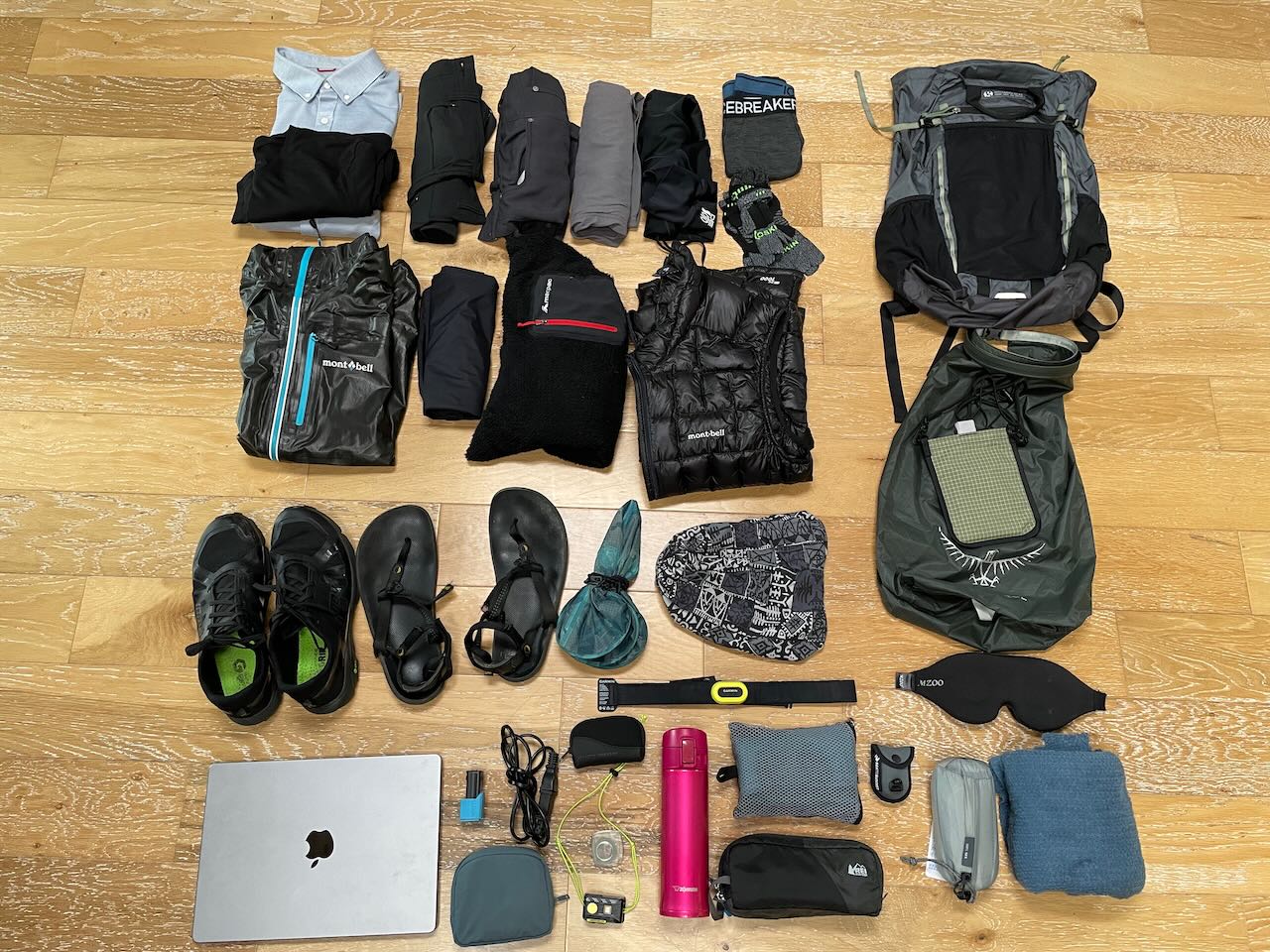
    Update: Between 2021-2025 I lived a mostly nomadic life. I decided to reduce the clothing I used to something that fit into what budget airlines classify as a personal size bag to keep travel expenses low, give me great freedom while in transit, and as an experiment to see was the least amount of stuff that would allow me to live the lifestyle I wanted. I used a 23 L Gossamer Gear Vagabond (my packing list). This required changing some of my clothing to items that worked over a wider range of conditions and would reliably dry in less than six hours in non optimal conditions. This meant I swapped several items in my “uniform” to items that were usable in a wider range of conditions. Alas, these replacement items are not as optimal for specific conditions (e.g. jack of all trades master of none). Now that we are living in our home again, I have retrieved the clothing that was my original uniform from storage, and added them back to my daily rotation.

    My nomadic experiment taught me that it is possible to fit clothing which covers conditions that ranged between 20F-100F in a personal size bag, but this required me to be more focused on “stuff” which sometimes took energy away from the rest of life. Going forward I plan to:

    • Use an ultra minimized uniform when engaged in purposeful journeys which involve a lot of walking, such as when we did the Camino. This simplicity was joyous.
    • When traveling in a single “climate”, use my normal uniform which lets me go 7 days between washing and fits into a personal size bag.
    • If I am going to be in widely different climates on a single journey use a carry-on size bag, and use my “normal” uniform in each of those climates. The extra airfare and weight to carry is worth the simplicity / quality of experience in day to day life.

    Declutter Home

    Once I had cleaned out my clothing closet I decided to declutter the rest of the house. I started with some basic principles from the book Organizing from the Inside Out which stressed everything should have a place near whether it was used, ideas from web page Declutter Every Room in Your House and a few few practices from Marie Kondo’s book Spark Joy. I decided that the best thing for me would be to work on one room at a time, get the room completely finished and then move onto the next room. There are several decluttering strategies which have helped others.

    I started with the kitchen. The drawers were filled with countless utensils, many of which I didn’t use and often were on top of the utensils I was looking for. I pulled everything out of the drawers. In the process I found that we accumulated several of the same utensils because we “replaced” an item we had “lost”. Once the drawers were emptied I selected only the items I was sure I would use at least weekly. I thought about how I worked in the kitchen and stored the utensils near where they were used. Everything else went into several boxes placed in the garage. I found that a bit of creativity often allowed me to avoid the hassle of going into the garage to retrieve the rarely used utensil. Over the next six months I retreived just few items from the garage. After six months I gave all of the unused utensils away. I found the streamlined kitchen made cooking more enjoyable. When I needed something, I would pull the drawer open and immediately see what I needed. I also found that a well organized drawer was attractive to my eye compared to a drawer crowded and filled to the brim with items.

    Once the kitchen was completed I worked through the house using a method similar to Declutter Every Room in Your House. After the “first pass” I just continued to remove things that weren’t added value to life using principles very similar to Colleen Madsen’s Ten Principles to Help Anyone Clear Clutter. There are plenty of other articles, blogs and books about minimalism that have been helpful as I trying to simplifying “stuff” in the house, but most don’t add substantially to Colleen’s simple post. After a while I found material on minimalism to be a bit repetitive, though each person has a different backstory to tell which can be inspiring.

    When Jackie and I got married we combined out households. Thankfully, we were quite compatible and found that we both wanted a fairly simple and uncluttered home. The number of “family” items grew slightly compared to what each of us would have had in a house by ourselves, but way short of doubling. For example, the core of our kitchen is pretty much the same as what one of us would have owned (Jackie’s plates, my mugs, a mix of our glasses). There was some growth where one of us used something regularly that the other didn’t such as Jackie’s wok, and my baking pan and blender. Our extras were used to equip other households.

    We saw a great benefit from our minimizing when we moved out of the house I had lived in for 26 years. We managed to pack the house on Friday in 10 hours and were fully moved into our new home by the end of the weekend: all our stuff was put away, all the moving boxes were folded flat, and pictures had been hung on the walls.

    Challenges to Minimizing Stuff

    I used to struggle giving things away because I might need them some day. I have come to believe someday is often so far away it never arrives. Meanwhile, the items sits around, taking up space and not being used. Something that has really helped me let go of currently unused objects is that I can imagine the object I am no longer using crying to fulfill it’s purpose.  It’s saying “I want someone to love me”, much like the toys in the movie Toy Story just want a child to play with them. If I am not loving the object by using it, I am happy to sent it to a home that will love and care for it. As I have practiced downsizing, it has become easier as my confidence has grown. There are only three times that I gave something away, only to discover I really wanted it back. In each case, I was able to re-aquiring the item without difficulty or a high cost.

    Sometimes I know it will be difficult to re-aquire an item because it’s one-of-a-kind, handmade, or no longer manufactured. In these cases I will set these items aside in a “holding” box. If I don’t think about these items in a year, I give them away on the theory I won’t miss them in the future because I will have forgotten I ever had them.

    The harder I worked to acquire an object the less likely I felt comfortable giving it away or selling it. I would focused on the labor I had invested. I have come to appreciate that rather than thinking about what it cost to acquire an object, I should think about the cost of replacing it in the future. These days using services like Amazon, eBay, etc can significantly reduces the work to find the right object, and ever increasing efficiencies in industry often reduces the cost of items over time. When factoring in the cost of storage, it is often cheaper to sell or give away an item, even if you will need to repurchase it several years later.

    Another challenge are items that have sentiment value. I came to realize that pictures are almost as good (sometimes better) to promote good memories that the item would trigger, while requiring no physical space, and are easily accessible anywhere at anytime. So I tag these special photos so I can easily immerse myself in memories. There are some sentimental items I have held on to which I specifically choose to keep as a way to honor someone who was very special to me.

    The final challenge was the sunk cost. I had spent money on the item. In most cases I would get significantly less money when I sell it than when I purchased it. I comforted myself by thinking about the value I got from the item when I used it compared to the amount of value I would get in the future with minimal use. I think about the joy others would get from using it.

    I found that the hassle of selling, especially the emotional roller-coaster of trying to get a “fair” price was a high emotional cost which delayed my selling items. Ultimately I developed a simple system. I would look to see what my item sold for on eBay. If it was less than $40 I would give it away. I don’t like Goodwill. I look to get the item to people who will actually use them. Clothing goes to homeless shelters or taken to events (like activity meet-ups) where people use the items I am getting rid of. Items over $100 I try to sell of craigslist to avoid the hassle of shipping. If no one was interested in the item I sell them on eBay.

    My Biggest Challenge: Books

    The most difficult thing for me to downsize was my book collection. To me, books are sacred. I grew up in a family that cherished books and learning. I like to think of myself as educated and an intellectual… having lots of books is part of that self identity. When I started to downsize my book collection I had eleven, or was it fourteen, full size (36″ x 72″) bookcases completely full, often with books double deep. I couldn’t bring myself to part with my old friends in one go, it took several years.

    I started by looking at large reference books since these had the lowest emotional attachment and took a disproportionate amount of space. Those no longer used, or that could be replaced by resources freely available on the Internet were given away. I replaced any reference materials I used regularly with electronic versions. Even though this cost money, it saved space and made the materials more useful to me.

    Next, I went through my books and asked the question “Is this a book I am likely to re-read or recommend to someone in the next few years?” If the answer was no, I gave it away. I was down to less than five bookcases.

    The first difficulty were books I hadn’t read. Often there is a reason I haven’t read the book after purchasing it. Maybe I started the book but just couldn’t get “into” it. Maybe my interests changed or I had purchased the book because someday I knew I would be interested in the topic. It seemed wrong to give away something I hadn’t used, but I realized I didn’t have enough time to read all the books I am interested in. Keeping these unread books just made me feel guilty. Any books that I didn’t have hopes to read in the next year I gave away.

    I changed tacts to identifying books I really wanted to keep. I asked the question  “Which of these books changed my life or I think it’s so great that it might change someone else life?”  Those got put into a special bookcase, set off to be scanned, or in some cases purchased for my Kindle and given away.

    For all the remaining books I asked “Can I get this book again?” I looked up each book on Amazon. If it was still in print I put it on an Amazon wishlist and I gave the book away confident I could get it back if I needed to. What’s left? Less than one bookcase of largely out of print books. Every quarter or so I looks through the remaining books and ask the question “Do I think I am going to ever read this book or loan it to someone?” Each time I do this there are several books my answer is”no”, and they get donated to friends of the library. If you are struggling with downsizing books you might appreciate the post 6 Mindset Hack to Declutter Books.

    2022 update: Of the thousands of books I have given away, there are less than than a dozen that I have re-purchased, and only one book that was a bit of work to get. I am generally glad that I pruned my books, but there have been some costs. I find it harder to find information that I had learned in the past. The physical books, arranged by topic make it easier to retrieve memories. Being surrounded by books, especially the unread books, often inspired me in a way that ebooks don’t. Nassim Taleb has inspired several articles about the value of the  anti-library (unread books), and having more books than you will ever have time to read because it keeps us aware of all that we don’t know. The Japanese call this tsundoku.

    The Process Continued

    I considered doing the 100 Items Challenge, but decided my attention would be on how to curate possessions rather than on living. Rather that shooting for a particular number, I just asking the question “Does this item enrich my life on a regular basis?”. If the answer was yes, I would keep it. Otherwise it went into a box that would ultimately be given away or sold. I repeat this pruning exercise at the end of each year. I posted a Great Stuff for Me which records where this process has taken me. Along the way there were a couple areas that took some focused attention.

    Electronics

    I had to work at simplifying electronics… I am a technologist and a geek. I consolidated all the data I needed onto my laptop (backed up into the cloud) which removed the need to have a file server in the house. I stopped running a computing infrastructure appropriate for a medium size business by switching to use Google Apps and a few other cloud services. In the process I got rid of several servers, a lot of upkeep, and a number of older computers I was holding on to “just in case”. Three large moving boxes filled with cables was reduced to three quart size ziplock bags. I realized I really didn’t use the home phone and answering machine so they were dropped and I just used my cell phone. Rather than multiple portable audio devices I decided I would use my phone or if I didn’t have my phone, forgo music. Rather than having multiple stereo systems with a complex (and somewhat fragile) streaming infrastructure I switched to a single system based around my computer and audiophile grade powered speakers.

    Cameras

    Camera equipment was another area that took a fair amount of work. I had a high end pocketable camera that I had with me always (a Sony RX100) because you never knew when you might need to take a picture. I had a camera that was particularly good for in low light conditions without a flash that was perfect for candid shots at events. Finally I had a couple of camera bodies, and numerous interchangeable lens. I had several tripods, flashes, and camera bags. One camera bag could hold nearly all my equipment. Another was good for outdoor events, and I had my original Domke F-5XB which I used whenever I wanted to minimize the amount of camera gear I carried. Every time I was going somewhere I would have to figure out what camera gear to take, and then what bag to use.

    My downsizing came in three stages. The first was reducing my gear down to the pocketable camera which I always carried, one camera with a couple of lens, and some accessories which would fit into the Domke bag. If an event was “photographic” in nature I would grab the camera bag, otherwise I would use the pocket camera. After awhile I noted that I wasn’t grabbing the camera bag very often. I just didn’t want to carry it around. I was mostly happy to make do with the pictures from my pocket camera. A couple of years later I realized that I wasn’t happy with my pocket camera. My camera didn’t focus as fast as my phone (the newest version of the RX100 is much better), it didn’t geotag pictures, and was too big to be in my pocket all the time. I also noted that while the RX100’s image quality was better than my phone camera, I found the Pixel 2 and the iPhone X to be “good enough” in most situations. I sold my RX100.

    Now I am using the camera on the iPhone and am generally happy. I can always rent equipment for a specific event, like when we went whale watching or for a trip to Hawaii. Most of the time I would rather focus on the event than hassle with the camera. Besides, there is almost always someone else with a good camera who is happy to share the images they captured when were were together. The best of both worlds.

    Update 2025: Every few years I have purchased and then sold a compact cameras that I hoped would produce better image quality with better UI than my phone. This has included a Sony RX100VI, a Panasonic LX100II, and a Panasonic GX9 + pancake lens. I am back to using an iPhone for pictures. Based on past experience, I don’t think I will be content with a compact camera. If I was really going to devote myself to photography, it would something with a larger sensor (Fuji, Sony interchangeable lens, Leica)… but I know I am not willing to carry it with me at this time.

    Shopping Diet

    In the middle of 2016 I went on a “shopping diet”. I decided that I wouldn’t purchase anything new for myself in the next year except to replace (1:1) items that wore out or broke. Of course I would buy food, pay for activities, and I let myself purchase kindle books that whose price had dropped more than 80% since I put it on my wishlist. I also permitted myself to purchase gifts and items needed by other family members. I was amazed at how much of an impact the shopping diet had on my time and focus. I never realized how much the constant bombardment of “deals” I see in social media drove my consumption. Even if I didn’t ultimately purchase the item it ended up taking time as I researched the deal and spent time wondering if this was something I might need. Now I just ignore any “deals” I see. I started to experience that “it’s better to want less than to have less.” After a year I ended my diet for a few months, but found shopping started to take more of my time and energy, so toward the end of 2017 I decided to make this a lifestyle. At the end of the fall and spring I review my list of item to potentially purchases, buying just those that were still compelling and be glad that I avoided more than 70% of my purchase impulses.

    In 2021 My wife and I were talking about retirement. We decided to rent our house and try living in different cities. This meant a bit of streamlining of the house so others could live in it, and getting the items we used daily down to something that would fit in our Mini Cooper, if not luggage when we flew to our destination. As of 2023… my core items fit in a 23l daypack. I have a 26l bag which holds items I use through the year but aren’t currently needed. I have a 75l Ikea duffel bag which is storing clothing I am not going to use in the next 2 years, and 75l box which is holding all my outdoor gear except for my bicycles.

    We periodically stay in our home for month at a time. This allows us to access our storage, give the yard some extra care, and enjoy the home we love. When it’s time to continue our journey it takes a couple of hours to “depersoanalize” our house (pack luggage, move extra clothing into storage, box up our irreplaceable items). Our cleaning service does the final prep and we are off for several more months.

    Related Posts

    for we brought nothing into the world, and we cannot take anything out of the world. But if we have food and clothing, with these we will be content.

    1 Timothy 6:7-8 (ESV)
  • Minimalism & Simplicity

    My father taught me the value of simplicity. He didn’t need to update an item if it was still working. He didn’t need to purchase something to impress others. Dad was suspicious of people who attacked problems with complicated solutions.  Complex solutions typically demonstrated that people were using the wrong paradigm.  He would often say that if you couldn’t explain something on a napkin or two then you most likely didn’t really understand an issue.

    I see the same thing in the spiritual realm. The heart of the Christian gospel is so simple, that we resist it, we are ashamed of it, or we want it to be more complicated so we can proudly master it.  I see this in myself, but I strive to hang onto the core, simple truths. Years ago, one of my teachers was at seminary.  He was proud and excited to be taking several advanced courses. He shared his schedule with friend also attending the seminary. His friend shared his schedule which included a remedial course on the doctrine of grace. My teacher was surprised and asked why his friend wasn’t taking the more advanced course.  His friend’s response humbled him “Because I can’t think of anything I would rather spend my time considering.  God’s grace is so tremendous.  I could spend hours reflecting on it.” We need to major in the important things.

    I have been reflecting a bit on a close relative of simplicity: minimalism.  Doing less, consuming less, owning less to focus on things that are more important.  There are a wide range of range of ways people embrace “minimalism”, I like Josh’s rational minimalism. Living in the “developed” world, it’s easy to get caught up with our culture which produces an almost unlimited hunger for more and more stuff which can choke out life.  People find themselves working harder and harder to maintain an extravagant lifestyle. My father’s influence has given me a slight tendency to be a minimalist, to hold onto only what’s important.  I have discovered how paring things down can improve the quality of life.  I found that minimizing what I pack on trips makes the journey easier and more rewarding. Likewise, I found that a minimalist approach to backpacking (a close relative of ultralight backpacking) can make trips more enjoyable and the task of preparing and packing easier.  I would like to be as ruthless in life at home.

    I have tried, with some small success, to live a minimalist life style. For years, I have been inclined to give things away that I am not using on the theory that there are people who could make better use of the objects, wanting to be a good stewart, though these days it goes a bit beyond that.  Libby would talk to objects (cars, pots, stuff animals) as if they were people… so now rather that seeing objects as just things to be use, and I can almost hear them calling to be used, to allow them to fulfill their purpose and calling.  Anyone who has seen the Toy Story movies can imagine this.  So if I am not using something, I can almost her the object calling out to be put in a situation where it will be loved and used.  Yet, I am far from minimalist today.

    Several years ago my family visited the ghost town in Bodie.  One of the things that struck me was how small the houses were.  Even the house for the town lawyer, one of the most prominent town members was small. Some of the homes were in the process of being restored, and repopulated with the objects that people who have likely owned.  What struck me was how little stuff people had.  There was no need for a large house, because it was mainly holding people, not things. Today, at least in the western world, our homes have become storerooms for our stuff.  The modern day bigger barn.  What was yesterday’s luxuries are quickly becoming today’s “necessities”.  We are consume more are more.  I doubt it is sustainable, or good stewardship.  Thankfully, I believe it is possible to get off the merry-go-round.

    While I believe it is possible for people to turn minimalism into a god which has no lasting value, I believe we are called to simpler lives.  I was challenged by The Minimalists 21 Day Journey.  If I was living alone I would likely have given it a shot, but I am not going to disrupt my child’s life right now, things are hard enough as they are.  But, we have been going through things and asking the questions “Are we using this?  Do we feel a deep attachment?”  If not, we are trying to find someone who would find better use of this object.

    I have been very challenged by I Tim 4:8, that with food and clothing, Paul was able to be content.  Today, I couldn’t be content with just those things, but I hope and prayer, that someday I will be.

  • Lessons from Dad

    As I reflect on my father’s life, and can’t help but be struck by what a powerful influence he was on me.  I fear that while my adolescent rebellion against him was mild, it was long lived.  It took me a long time to see my father clearly.  I regret not seeing my father for the man he was earlier in my life, and I regret not spending more time with him when I had the chance.  I don’t recall my dad giving me many words of advise, but his life, his example, spoke volumes.

    Loyalty & Family

    Family was of supreme importance to my dad.  Even when his wife divorced him to marry his best friend, he never spoke a harsh word about either of them to me.  He supported their decisions in my sister and my  lives.  It was clear that he wanted my sister and I to have a good family experience with our mother and step father, and would do nothing to undermine that experience.  I think it was extremely important to him to be supportive of his children.  While my dad could be critical, he was always supportive of me as a person.  He made it clear that my sister and I should be committed to the other, and always look out for each other.  He was overjoyed to be a grandparent.  In an age where families drift apart, he worked hard to stay close not only with his sister and children, but with his nieces and nephews as well.

    Simplicity

    My dad loved simplicity in all things.  The first place you could observe simplicity was his lifestyle.  Unlike many people, he always lived well within his means.  He didn’t feel compelled to upgrade, update, or otherwise “keep up with the Jones”.  If the clock radio purchased in 1972 continued to provide the time and had a functioning alarm,  there was no reason to replace it.  He never seemed to worry about brands or status symbols, he was just concerned that “the job would get done”.

    Dad also looked for simplicity in his professional life.  I think he believed that if a solution, device, principle, etc wasn’t simple enough to be explained on one or two napkins, then you had the wrong approach and were making things too complex.  He was always suspicious of people who tried to attack difficult problems with extremely complex solutions.

    Love Nature

    My finest times with my dad were in the outdoors.  He loved to hike, backpack, fish, and canoe.  He loved watching animals in the wild, especially birds.  Dad could sit for hours watching birds.  I remember him telling me of a series of meetings he had at Xerox PARC.  Almost nothing was initially accomplished because the conference room looked out over a field where there were a number of hawks soaring and hunting.  He just couldn’t tear his attention away from the hawks and focus on the physics at hand, and didn’t regret this at all.

    My father had a deep respect for the natural world.  He found time to enjoy the world God has created, and spent time learning about the wonders of creation.  He took the time to read the works of great naturalists and spent time in the wild observing and learning with his own senses.  I think he had a great sense of wonder, and loved to discover and explore.  This continues even after his first stroke with naturalist lead trips.

    The Beauty and Value of Science

    My dad was an scientist and an experimentalist. Why speculate when you could give it a try, measure the results, and then draw your conclussions from real data. While I am naturally more comfortable in the world of mystery and mysticism, my dad taught me to value the concrete. To look at real data. To run experiments and look at the results rather than relying exclussively on intuition.

    Humble Service

    My dad was a brilliant man… evident from an early age.  He never finished high school because he was selected by a Ford Foundation for a special scholarship program and sent to Yale.  He continued on to Rochester, and then to University of Colorado to finish his PhD.  He was working in the field of integrated optics before people knew it was a field. His rapid wit was recognized by anyone who spend more than a few minutes with him.  Yet he was never arrogant.  He had a sense that his intellect and abilities were a gift, something that should used, not bragged about.

    Respect for Others

    I never saw Carl put other people down.  That’s not to say that he couldn’t be blunt, but that he addressed real issues he thought could or should be fixed. He didn’t snipe at people are make statements for the purpose of hurting others. You didn’t have to wonder if he was trying to manipulate you or hide things. What you saw was what you got. Carl was forthright when speaking to others. 

    Carl was quick to hear other people out, and liked to bring the best out of others. He loved collaborating with others, and had no problem letting others take the lead in areas where they were stronger than he was. He also was happy to give people a chance, even if they hadn’t proven themselves yet. Just after I had gotten my drivers license he some family to visit just outside of Pittsburgh, PA. Some of my best friends had just moved to Pittsburgh to attend CMU… I hoped to visit them.  So off we went. Once we got to the cousins home my dad gave me the keys, told be when to be back, and sent me on my way. This doesn’t sounds like a big deal… but I had a brand new license and had spent all my time in an automatic transmission car. He was giving me his brand new stick car to drive when I had less than 1 hour of time driving a stick where the streets were flat, while Pittsburgh is notoriously hilly. Somehow I got to CMU and back on time without crashing his car… but I wasn’t confident that this would be the outcome… but Carl thought it was worth the risk.

    Charity

    I grew up knowing that charity was important.  I saw my father’s example, giving time and money to charities that he thought were worthy.  At an early age I was encouraged to donate portion of the money I received for my birthday and holidays to an appropriate charity. 

    Emotional Honestly & Communication

    Alas, this was a lesson that I mostly learned through a negative example.  Like many men of my father’s generation, he has a very hard time telling people how he felt.  It was extremely difficult for him to say “I love you”, or “I am proud of you”.  These are words that I longed to hear, and never heard directly from his lips.  While it was hard for him to be honest about his feelings with the person in question, he was able to be honest with others.  So while he might have a hard time telling my sister how much he respected my sister’s commitment to her kids, he was able to tell me and his wife.

    Watching my dad struggle with expressing emotions taught be the importance on learning to be emotionally honest with people, especially the people who are most important to me.  I don’t want people to long for an encouraging or affirming word from me, which I desire to give, but find myself unable to speak.

    A Rolex… a touchstone?!

    One of my most prized possessions is a Rolex watch that was my dad’s. Now if you knew my dad or you read the above text you would likely say “Carl owned a Rolex?”  Indeed, for as long as I can remember, dad only wore the most basic analog (he was and optics guy) Timex that most likely cost $10. So how does a Rolex fit in? It was a gift that he received when one of his students completed his PhD. Did dad switch to this fancy new watch? Nope. He kept wearing his Timex because it got the job done. Did he ever wear the Rolex? Yes, when his wife or friends requested that he wear a nicer watch when going to formal events. Why do a love this watch? Because it represents for me his commitment to quality, his profession, and to his students, and that fact that he would have never purchased the Rolex for himself. You can tell when I am really missing my dad. My $15 digital (I am a computer guy) Timex is replaced for a day or two with the Rolex.

    Facts and Figures

  • Packing & Traveling Light

    I have used a single carry-on size bag when traveling for most of my life. I didn’t realize this was uncommon until my wife and I did a multi-week service trip in 1996. Both of us brought everything we needed for sub-freezing weather in carry-on sized travel packs. This permitted us to each bring two check-through bags for materials that we would deliver to the project without paying shipping charges. Our colleagues brought several bags for their own use. This post was written to answer their question

    How did you managed to get everything into a carry-on bag?

    This was originally a long email which I added to my website the next year. The core content of this post remains the same, but I’ve made several updates—most recently in 2025—for clarity, to fix broken links, and to update references to products. I’ve also incorporated a few changes based on lessons learned since I first wrote this. Today this approach is often referred to as “onebag” travel. I believe this term was coined by Doug Dyment in the late 1990s. There is an active /r/onebag subreddit which discusses this approach.

    [toc]

    TL;DR

    This post is a 15 minute read. If you are in a hurry here are the highlights:

    • Enjoy the freedom of have just one bag you can be easily carried to maximize your ability to enjoy the experience
    • Use a pack (avoid wheels) which is 20-35l rather than trying to find a maximum approved carry-on. The larger the bag, the more stuff you will bring whether you need it or not
    • Bring 2-3 sets of clothing. You don’t need more. Make sure they are easy to wash and dry quickly. If you want to avoid a near nightly washing ritual, bring a week’s worth of clothing. For me this would be 7 pairs of underwear, and 3 pants and shirts.
    • Layer your clothing for varied conditions. “Base” or next to skin layer, insulating sweater / fleece / or my typical preference alpha direct, a puffy if cold, and an unlined rain shell that can be used separately or together with the other clothing. Maybe an ultralight wind shirt depending on how active you will be and how light / breathable you rain shell is.
    • Don’t be influenced by the “spotlight effect”. You notice your appearance way more than others do. Relax!
    • Don’t pack for your fears. You don’t need to pack assuming the worse case. Unless you are somewhere very remote you can replace most things at a local store. We live in a global economy.
    • Cell phones are invaluable tools for travel so bring it. Consider leaving all other tech behind so you can focus on your experiences in a new location.
    • The best thing to bring is a good attitude. Be flexible, gracious, thankful, and kind. Welcome new experiences and people. Curiosity is a superpower.

    Advantages of Traveling Light

    I have found when I am carrying a light bag (<14lb with load transferring hip strap, <8lb if just shoulder straps) I feel an incredible sense of freedom. My bag doesn’t weigh me down physically or psychologically. The following are some of the reasons you might appreciate onebag travel:

    1. Transportation becomes simpler and easier. You have a light bag you can manage yourself. You don’t have to find someone who can transport a number of large bags. For example, some remote towns use motorcycles with (and without) a sidecar as taxis. Imagine trying to hold onto a number of huge bags while sitting in a sidecar or on the back of the motorcycle.
    2. You are able to dynamically adjust your plans. If you have a tight connection you know your bag will be with you, wherever you end up. If you need to get something out of your bag you can. You can easily carry your luggage while engaging in fun activities. For example, we decided to explore Portugal’s Algarve coast. We didn’t know which town we would stay in. Our rail pass let us hop on and off in each city and explore until we decided where to spend the night. Only then did we book a room and drop our packs.
    3. Can be more focused on people and experiences, less on stuff. You will spend less time fighting with your bags and have less to keep track of. You will spend less time on the trip thinking about “Is this the right outfit?” “Should I use X or Y today?” Less decision fatigue.
    4. Packing light lets you use your check through luggage allotment for medical supplies and other items for service trips. Or, if you found a large, perfect gift for someone, you can bring it back as your check-through luggage.
    5. You don’t need to worry about items in your checked luggage being damaged, frozen, stolen, lost, or delayed. Fun video of bags being loaded. To be fair though, less than 1% of bags are reported lost, though more are delayed or temporarily misplaced.
    6. You don’t have to wait for check through bags to arrive on the carrousel. My unscientific observation is that when I am waiting with travel companions who checked luggage, we spend an extra 30-50 minutes in the airport waiting for bags, and 5-50 minutes waiting to check in.

    I would encourage everyone to taking a trip that is at least a week long while bring only one carry-on size bag or personal size item. I think you will find it’s enjoyable and freeing. For a bit of humor and inspiration, check out Lessons Learned from Luggage Lost. When you return home consider simplifying your life. If you want to push things you could try packing like a camino pilgrim, or go for zero bag like this guy’s no pack.

    Remember the traveler’s motto: It’s better to bring half of what you think you need, and twice as much money. Unless you are in a very remote / isolated location, you will likely be able to purchase anything you need. Some other onebag platitudes.

    Luggage?

    One of the first questions people ask is “What bag should I get if I am traveling light?”. I generally recommend that It’s more important to figure out what you are going to carry inside the bag than which bag. Use hints below to select what you will bring on your trip. Bag selection will be easier when you know what it will contain. A bag you already own might work such as a classic nylon “book bag” or gym duffel. If you don’t have a bag which can hold all the things you plan to bring I suggest putting everything you plan to carry in a duffel or shopping bag(s) and goto a store like REI or Decathon and see how it loads into the packs they carry. In the best case you found your bag. In the worst case, you realize you have way too much stuff to carry comfortably and need to trim more. Most likely you know the size of a bag you are looking for, have identified one bag which will work, and can now do a bit of online searching to see if you can find a bag which meets all your criteria. There is one caveat to figure out what you are taking and then select a bag that will hold it…

    A generalization of Parkinson’s law is that the demand on a resource expands to match the supply of the resource if the price is zero. When it comes to luggage it means that you will have a tendency to fill your bag. I mention this because when people start onebagging they often look for a bag that is a “max size” carry-on. This will often lead them to over pack.

    Even experienced travelers are susceptible to over packing. Over the last fifty years I have taken trips to the same destination which were of identical duration with the same expected conditions. I generally used whatever was my “standard” bag of the time which has ranged ~15L-46L. Each trip generally filled the bag with things that I asserted were “needed”. What was the difference? Some of it was experience and more compressible items, but mostly it was the smaller bags forced the question “Is this necessary?” The smaller the bag, the more frequently my answer was “no”.

    If you are new to onebagging, I often recommend getting a bag that’s a bit smaller than you think you “need”, because you will discover there are several items which aren’t actually needed. I can’t remember ever regretted carrying a smaller bag, never felt like I didn’t bring something that would have enhanced the trip. If anything, the trip was more enjoyable. When I carried the larger bags I sometimes did regret bring as much as I did because items ended up not being used and on long walks the bag felt like a burden.

    There are exceptions to this recommendation. The first are people who are big. For example the clothing of someone who is 7ft tall with size 47 feet will have troubles fitting into a bag that works well for my 5ft wife. The second exception are people who are engaged in special activity which required a lot of gear, or gear which can’t be carry-on and they aren’t going to rent at their destination. Special note to photographers. Do you actually need 2 bodies, 6 lens, numerous filters, 6 batteries, and a pocket camera? If you are doing a wedding the answer could be yes, but often a single body and 1 or 2 lens might actually unlock your creativity and improve your eye. Finally, there are people who are going to be in a location for an extended period and the supplies and items they need for day to day life can’t be acquired locally and won’t fit in a bag which is carry on approved. In some cases the supplies won’t fit into a single check-through bag.

    Many airlines used to define carry-on bags as being 45 linear inches which enabled people to bring bags / objects longer than 22″ such as a garment bag or back country backpack. These items often had to go into the overhead bin sidewise which means someone else might not have room for their bag. These days the largest permitted carry on is typically 22x14x9in (55x35x23cm) which perfectly fits most overhead storage areas. It’s possible to overstuff soft side bags to the point that they will not fit, even it the bag is theoretically the “permitted” dimensions. There is a summary of common carry one restrictions, and an exhaustive periodical table of carry on size limitation. When it doubt, check with your carrier. The packhacker site list which airline a bag is guaranteed to qualify as a carry on.

    I generally recommend people use a carry-on sized travel packs. If you are going to be walking a lot, get a trekking pack. I sometimes hear people rejecting travel packs because they are ugly / unstylish. These days there are a number of companies that make travel packs which are urban sheik.

    I would suggest staying away from wheeled bags in most cases. They cost more, add weight, and hold less than a good travel pack. Wheeled bags are a pain to use on stairs, cobblestone, and other uneven surfaces. There are legible reasons to select a wheeled bag: being physically unable to carry a backpack or when need to bring more / heavier luggage than what can be carried on the back. Heavier rolling bags can use up almost 1/2 of carry-on weight limit (7kg) which is common on many airlines outside the USA. I like the design features of the Peak Design Roller Pro but it is expensive and heavy. I have been impressed with the quality of Briggs and Riley which is backed by a lifetime warranty which you typically don’t need to use. Downside is that it’s pricy and heavy. TravelPro, especially the Platinum Elite line are well designed, have a lifetime warranty (that you will likely use… especially if you bag is a spinner), and as light as you are likely to find. I have heard positive things about AWAY (budget), Rimowa (pricy, striking design, shows damage), Pelican Air (maximum protection for contents), and LuggageWorks (heavy, ugly, but durable with replaceable parts). I prefer bags made from ballistic nylon to hardshell for three reasons. When there is a tight fit they can squish, they hide signs of wear better, and they don’t crack… failure is recoverable.

    Daily Use Bag

    All but the most minimalist travelers typically want a smaller bag for “daily” use when they aren’t in transit. Some travel packs have a zip-off daypack which I generally don’t recommend. The attached daypacks typically makes the main bag too thick to be carry on legal and rarely has the characteristics I would want for my day use bag. The exception for me is the Osprey Daylite that combines with the Fairview/Farpoint. The Daylite (and Daylite+) have a decent set of features, and can hang off the shoulder straps in front of you making more useful than when it hangs on the back of the pack.

    If your daily carry is moderate, I recommend using a light courier / guide / crossbody bag because it’s usable when a travel pack is on your back, provides easier access than a daypack during the day, and allows your back to breath. Folks from reddit keep a spreadsheet of fanny and slings. If you are carrying a bit more I recommend using a “stow-away” or “packable” daypack. These packs have no structure so you have to use care in packing them. I have found the Mystery Ranch In-and-Out Pack and the daypacks from Gossamer Gear are the most comfortable for me. I have been happy carrying 10lb in these for moderate distances. The REI Flash 18 and Matador packable daypacks are also pretty good. I have heard good things about the Aer Go Pack 2, but it doesn’t have a sternum strap, is a bit pricy, and I have no need to try another packable bag. Many of the other packable daypacks I found to be uncomfortable, even when packed carefully… but your experience might be different. For example, my wife likes her first generation ultra sil nano daypack made by Sea to Summit which was uncomfortable for me.

    My Bag Choice

    These days I mostly use a Gossamer Gear Vagabond Jet (review of Vagabond). When I need to carry more than what is comfortably handled in the Vagabond I use my wilderness backpack, a Zpacks Arc Hauler 50l. The Arc Hauler is larger than I need, and doesn’t have good organizational features but it fits in the carry-on sizers and enables me to comfortable carry around 22 lbs for many miles / hours. For around town I used a Decathalon Packable 15L Courier Bag which weights just 4oz and costs 8 Euros.

    Clothing for the Journey

    I have a number of pages about clothing. The follows are observations about the selection of clothing for extended travel.

    Limited Number / Easily Combined: If you are going on a trip that is more than a week, plan to wash your clothing rather than trying to bring outfits for every day of the trip. We will talk about washing clothing later. There are two common strategies when bringing a small amount of clothing. The first is to look the same everyday. Have all your clothing be the same color so things always match. Black, grey or white are common choices. The other approach is to select clothing which can be mixed and matched: colors which coordinate / compliment, layers which can be varied for look and comfort, different textures, and some simple accessories like a scarf which can transform the way you look. See posts about “daily uniforms” and capsule wardrobes. FYI: Some countries ban civilians from wearing camouflage clothing. A good way to overcome the common fear of “running out of clothing” is to use only the clothing you are planning to take at home for a couple of weeks. This can’t always be done, for example if you live in a tropical climate and are traveling somewhere that is sub-freezing, but in most cases you can run some simple experiments at home to build confidence.

    Layered: If are are facing moderate to cold weather you should take a layered approach for warmth. Seasoned travelers and backpackers are very familiar with the idea of layering which combines a next to the skin base layer, with 0 to several “mid” or insulating layers, and finally a shell for protection from wind and/or rain. Once the temperatures are below 45F, using high loft / puffy insulation is typically recommended since it saves weight and packing space. I have found that the combination of long-underwear, hiking pants and shirt, a wool sweater, a puffy insulated vest, light weight waterproof/breathable jacket, scarf, hat and mittens keeps me comfort when walking around down to 15F. I can mix and match the various layers so I am comfortable when it is 30F, 50F, and even 70F.  For more thoughts on this, see my clothing page. Sidenote: fleece are versatile outdoors, but a nice wool sweater can make you look more “dressed up” as well as keep you warm. I typically bring a light weight windshirt because they are so useful. If I expect rain and cooler conditions, I will bring a rain jacket, and add rain pants if I am going to spend an extended period of time outdoors. If it’s going to be warm and/or dry, I will sometimes skip bring a rain jacket, bringing a small umbrella or go without and just get wet.

    Localized/Formal?: You should adjust the style of your clothing to the local sensibilities and event requirements. The most formal environments expect men’s daily wear to be slacks, a button up shirt, blazer and maybe a tie. Beach towns and other places that are laidback it’s perfectly acceptable to wear flip-flops, boardshorts, and a tee shirt into a high end restaurant. Since COVID men can typically get away wearing running shoes, jeans, and a polo shirt. I recommend taking it up to business casual … nice looking pants and a button down shirt. I have a bit more about how dressy on my clothing page. Women aren’t so free. When away from “international class” cities women are often expected to wear skirts or dresses which go below the knee and blouses that at least cover the shoulders. Sometimes people worry that they will look like a tourist. They want to blend in. The fact is no matter what clothing you wear you will look like a foreigner. Your body language, the way you move will give you away even if you are wearing exactly the same clothing (not to mention you language or accent). I have a friend who is Indian and spent the first 18 years of his life in India and then came to the USA for college and stayed for work. He typically returns to India for a month each year. He is immediately identified by the locals as a foreigner because he no longer moves like a local, maintains too much personal space, etc. Don’t worry if you look a bit different so long as what your are wearing doesn’t not violate some taboo.

    Frequency of Washing: Most of the time clothing doesn’t need to be washing after one day of wear with the possible exception of underwear. The number of times a garment can be worn without washing varies depending on the type of fabric, your unique biology, environmental conditions, and your activity level. I am normally comfortable wearing denim jeans two days in a row, but if sweating heavy from heat or high activity, I might want to change after just a few hours. I have found untreated polyester clothing, especially shirts get really smelly after just one day of activity and a quick hand washing doesn’t always remove the smell. Some of the anti-stink treatments such as Polygiene or Xstatic seem to keep odor down for 2-3 days. I found nylon is more resistant to picking up odor, and a light rinse will typically wash out odor. Wool clothing can often be worn for a week without washing. More on my personal care heresy post.

    Washing: So let’s get back to washing clothing. If you are staying someplace that has a washer, and even better, washer/drier you are in a great situation. If you don’t have easy access to a washing machine you can go to a laundromat, use a service, or hand wash your clothing. Most long term travelers are prepared to hand wash clothing. The more minimalist packers will often wash their clothing each night as part of the bedtime routine which allows them to eliminating the need to carry a change of clothing. Many people use a small bottle of Dr Bronner’s soap for their laundry. There are also detergent sheets which don’t have the risk of spilling. A single sheet should be able to cover 2-4 sink washings. It’s also possible to use shampoo or body wash. I know people who clean their clothing while they shower. I have tried this but had trouble getting my clothing completely clean. I have found washing machines are more effective than my hand washing. Sinks often don’t hold water for more than a minute or two. Two common solutions are bringing a universal plug or bringing as small waterproof bag that you fill with water. There is the purpose made Scrubba bag, but I think it’s unnecessarily heavy. There was a reddit thread about handwashing clothing techniques.

    Fast Drying: When you don’t have access to a drier, it’s extremely useful to have clothing which can dry overnight. This means avoid clothing made from cotton. Fast dry clothing is typically made from fabric that don’t absorb much water such as light weight polyester, nylon, or <160gsm merino wool. It’s good to know how quickly your clothing will dry before you go on the trip. I encourage running a simple experiment. Weight your clothes. Hand wash them then and hang them up to dry. Every few hours weigh them. Record the time when they weigh the same as before the wash. You now have a baseline of how long it’ll take to dry. They’ll dry faster in the sun, slower when it’s cold or high humidity. You can speed the drying by squeezing excess water out, roll the garment in a dry towel, and then twist the towel to tighten around the garment. Unroll after a few minutes and hang up your garment. Some people carry a small clothing line, though I haven’t found one necessary: most lodging will have something that will let you dry the clothing (clothing line, hangers, back of a chair, etc). When in a rush, you can squeeze excess water out of fast dry materials and put them on wet. They will be uncomfortable for a bit, but movement and body heat dry them in around a hour.

    How Many Clothing? I typically bring 2-3 sets of clothing, which lets me go a week between washings other than underwear which I wash nightly. I strive to use a machine which is more effective than my hand washing. I have been known to wear my rain gear while doing my wash so everything gets cleaned. There are some people who love clothing and want to bring many sets of clothing to have a lot of variety. People who want this sort of variety typically need to bring a larger bag or get their variety by having a small core with accessories. Some people feel compelled to wear a different outfit every day and are afraid that others will notice they are wearing the same thing over and over. Get over this fear. Many successful people wear a “uniform” every day. Guess what… either people don’t notice as described by a female art director, or it becomes something of a trademark such as Steve Job’s turtleneck & jeans. Also, when traveling many people will only see you one day. The first approach is to have a single set of clothing that you wash and dry over night. This works, but there might be times when you are wet / muddy from a day of hiking without time to clean your clothing before a nice dinner. Many minimalists I know bring go with 2 sets of clothing so they have something to wear while their clothing are being washed or 3 sets: wear, wash/drying, ready to go / clean.

    Recommended Brands? Outlier and Wool and Prince make pricy, but superior travel friendly clothing for me: great materials, fit, and quality finish. Bluffworks and Makers and Riders make excellent clothing for men and women. Uniqlo makes clothing which is travel friendly at reasonable prices. There are plenty of other travel friendly clothing for men and women from prAna, Royal Robbins, Rohan, lululemon, and many other companies that are associated with the “active life” and sold at stores like REI. These cloths are marketed as being for fishing, hiking, or travel. BTW: I would typically skip clothing made by lululemon due to the frequent reports of them wearing out prematurely. While the above are brands I recommend, you don’t need expensive clothing to travel lightly. You likely already own some fast drying clothing. Examine the materials your clothing are made from, especially clothing for sports, yoga, etc. Often you can find bargains at places like sierra.com. My clothing pages have low cost options at the bottom of the page and I have some hints for finding low cost backpacking gear which will overlap with adventure travel.

    Women specific: I am a guy, but I have observed what works for my wife, and several female friends I have traveled with. Many of them love variety and how clothing is creative self expression. One of the most versatile clothing items is a sleeveless or strappy dress made from light weight and fast drying fabric. It can function as a LBD in more formal settings and also works well hiking in the wild or around town. These dresses come in a variety of length, though I will note than mid-thighs to a bit above the knee seems to be the most versatile. As conditions change it’s easy to pull on / take off leggings to keep legs comfortable and to pee in the bushes. A shirt or sweater can be worn under or over the dress to vary your look. My wife loves the Decathlon Exploor Dress which is modestly priced (around $21) and typically is available in a couple of solid colors and 1-3 fun patterns. She loves that it has a discrete pocket and still looks fresh after being worn more than 100 days. Pricier with even more color / pattern selections is the Lightheart Backpacking dress. There are similar dresses from activewear companies like Columbia, Patagonia, TitleNine, Nike, and Athleta which are wrinkle resistant, light weight and fast drying. Years ago a friend recommended the  Infinity Dress because they can wear it in multiple styles and Macabi Adventure Skirt because it can be worn as shorts, pants, or a skirt. As mentioned above, an accent piece like a scarf or jewelry can change your look / provide variety. Check out /r/HerOneBag for other ideas.

    Hats! Don’t forget to bring a hat. If you are going to be someplace sunny, you should bring a hat with a wide brim to reduce the risk of sunburn, keep your head cool, and protect your eyes from too much light. It is best to bring a hat which can be rolled/folded up and can take a lot of abuse. In hot, sunny conditions I would recommend the geeky, but highly effective hats from Sunday Afternoons, the classic Tilley Hat, or something like the compact OR Sunrunner Cap. If cold weather is at all likely, bring a wool or polyester stocking hat or a buff. It will take up very little room, and will help keep your warm. In modest conditions you lose 10% of your heat through your neck and head, but the percent goes up to almost 50% when a person is so cold they are entering hypothermia. In other words, the colder you feel, the more important it is to protect your head and neck.

    Footwear! The best footwear to bring will depend on the local conditions and weather. In most cases I recommend bring a pair of trail runners of the appropriate color for your wardrobe. In very cold locales, insulated boots are wonderful. Many of my urban oriented / fashion conscious friends seem to love Chelsea boots (Blundstones, LEMS, etc). In hot climates sandals are great. You should always bring one pair of shoes that you would be comfortable wearing for a whole day on your feet while walking several miles. If these shoes are not be appropriate for everywhere you want to go, then bring a second pair of shoes which would be appropriate. I typically wear a pair of trail runners (all black, or all white) and some minimalist sandals. If I need to be extra dressed up I will swap one of these with a pair of Vivobarefoot Gobi II ankle boots. There are a number of minimalist shoes which others find effective. In many international locales when using a shared bathroom you will want to have shower thongs (or use your sandals) when you take a shower or go into the bathroom since the floors can be nasty.

    Thrifting Approach: If you love putting together outfits try Jessi Arrington approach: wear one set of clothing as you travel, bring multiple pairs of underwear, and go thrifting for the rest of your clothing in the city you arrive in. Wear the clothing while in that city, and then donate or sell the them to a thrift store as you leave town.

    Make-up, Toiletries, First Aid, and Safety

    One of our companions on the China trip said to us “There is no way I could fit everything into a carry on bag, my make-up would nearly fill your bag, leaving room for little else. My response was that I understood that she wanted to look her best and this could be accomplished with less than she was carrying. My wife Jackie is often noticed by others (in a good way) due to her unique style, her great smile, and her enthusiasm for life. Her inner life shines out. In the Bible, I Peter 3 says “But let your adorning be the hidden person of the heart with the imperishable beauty of a gentle and quiet spirit, which in God’s sight is very precious”. Jackie brings make-up: a foundation to keep her skin health (and protected from the sun), and eye liner, and a lipstick or two. It all fits into what used to be an eyeglass case. Most people over estimate what others notice, this is called the spotlight effect. Unless you have a very unusual condition or are a runway model, it is likely that only you, and maybe some overly critical women will noticed if you don’t have “perfect” make-up. From what I can tell, most men notice make-up less than women do.

    All of my toiletries, first aid, and repair items can fit into a quart size Glad BigZip plastic bag.  In recent years I have switched to a small nylon bag to avoid creating plastic waste. I now use a 100sense body bar carried in a flatpak soap case which removes my need to bring “liquids”. Liquids normally need to be taken out of your bag when passing through security and must be in containers no larger than 3 oz / 100ml.  In the past I have been able to reuse containers made for samples and items provided by hotels.  If you can’t find containers to reuse, you could buy some from easytraveler or alltravelsizes. Don’t take full-size items (normal size bar of soap or a tube of toothpaste), but use the travel/sample size, if not a smaller amount in an appropriately size container. Hint: try measuring the amount of toiletries you use for the duration of your trip when at home, and then pack that amount. For example, a full size (6.3oz) shampoo/body bar gets me through >200 showers. In parts of the world, toilet paper is not common, nor are flush toilets. You might want to bring some toilet paper / wipes or a bidet attachment for your water bottle.

    Dehydration can be an issue for travelers, especially when you are flying. Make sure you drink enough. Safe drinking water is extremely important. In some countries, the tap water is not safe to drink. These days the filters are small, easy to use, and extremely effective. Make sure whatever filter you get is able to remove or kill viruses. You should always have something to carry safe water in. I have some notes about treating and carrying water. I like the Platypus Water Bags because they are durable and collapse nearly flat and Zojirushi Double Walled Mug because it insulated better than any other double wall container I have tested and has a flawless design.

    Pick-pockets are common in some locations, especially where travelers/tourists carry significantly more money than the average daily local wage. NaĂŻve rich tourist (and that is how we are viewed most places) are often careless, and might have more than a month’s wages for the easy taking. Don’t be a victim. People with good situational awareness can be safe carrying the wallet in a front pants or inside jacket pocket. I would recommend most people carry their valuables in a travel wallet under there clothing. Note: the classic travel wallets don’t work well for all people. For example, short women who need to wear dresses might have problems finding security wallets which do not create an unsightly bulge not to mention being able to get to the wallet without undressing. I have found that the ankle security wallets work pretty well. There are also a number of the travel companies sell vests which are specifically designed for traveling. These vests have pockets inside which can be sealed against pickpockets. While some travel vests make you look like a foreign correspondent (lots of oversize pockets), there are a number of very fashionable vests which can add color to wardrobe and don’t make you stand out as a “tourist / photo-journalist”.

    Flying with Children

    Flying with infants is fairly strait forward. They tend to sleep alot. When they are awake play is easily done in the seat. You make sure they are drinking or sucking on something when the plane is taking off and landing to encourage their ears to equalize. Toddlers are a real challenge. They want to MOVE. Most have a short attention. Having an infant as a lap kids was no big deal. A toddler as a lap kid is typically an exercise in patiences and good humor. If you can afford to buy a seat for them, I would strongly encourage you doing that, especially if it a long flight. Whatever rules, practices etc you have at home… hold onto them loosely while flying. For example: no screen time, if a movie or iPad entertains them, take the win. Key is to recognize when your child’s attention span is at its limit and introduce some new activity. Things that worked for us, or we have seen work for others:

    • Age appropriate applications / videos
    • Reading a book… we would bring a couple of favorites and ideally a new book by the same author
    • Play dough
    • Vinyl sticker that can be placed and removed. I have seen parents use simple post-it notes or masking tape
    • Yummy Snacks!! Especially those they like but normally don’t give them
    • Games with small movements like patty cake
    • Observation games like “I spy”
    • Look at photo album of the people we are visiting
    • Finger puppets

    An idea from others which makes good sense. Create a “gift bag” for the people in the seats around you. Use a zipper lock snack size bag filled with some combination of:

    • Pair of foam ear plugs.
    • chewing gum
    • chocolates
    • AND A note that says:

    “Hello! My name is [child’s name]. I’m sitting [in Seat XX] with my parents, [your names]. But this is my first flight ever. It’s all VERY new to me, and I don’t know how I’ll react. I’ll do my best, but I may be scared and anxious. My parents are going to do their best. This baggie isn’t much, but it’s a small gift to help with the flight. And — please stop by the say hi!”

    The older they get, the easier travel will become. Someday they can take you on a trip. It’s only fair :).

    For people without children. Have a bit of compassion and don’t let a fussy kid be an excuse for a bad mood. You can’t control the circumstances, but you can decide how you respond. At least be grateful that YOU aren’t having to care for a very unhappy child.

    Extras

    One of the best things you can bring back from your trip are pictures. Use your cell phone and/or bring a camera. Modern smart phones can now takes very respectable picture in daylight and acceptable picture when lighting is less than ideal. If you are on a trip focused on sporting events, wildlife, or night time activities I would strongly recommend bringing a camera with a high quality sensor and a lens with appropriate level of magnification. Take a look at the “How to Use a Point-and-Shoot” or read David Pogue’s Digital Photography: The Missing Manual before you go on your trip.

    In the USA, especially in larger hotels, it is common to get clean linens every day. At a minimum you expect to have fresh linens when you get a room. All hotels are not like this, especially if you are far from mainstream tourist areas or in a budget hotel. Even if you don’t normally use pajamas, you might want something that you can sleep in. I know a number of people who bring a pair of silk pajamas because they feel nice and take up almost no room. Long underwear can double as pajamas if you need them to. Some people like using “sleeping sacks” (maybe treated with permethrin to reduce the risk of bedbugs). Having a clean pillowcase to lay your head on is also very nice.

    Gift giving is common outside the US. You might want to bring some small gifts. Especially if someone makes you a home cooked meal or shows great hospitality. Handmade items are always appreciated. A small needlework, a drawing, a small bag or pouch decorated by hand. Postcards from your home town, chocolate, small pins, LED lights, small calculator, or a key chain with something nifty on it. A great way to delight small children is learn to make animals out of balloons.

    Cell Phones: If you want to use your cell phone when traveling internationally there are several options. People on T-mobile or Google Fi just go. International roaming is very reasonable, though data speeds won’t be great. For everyone else you have four choices. (1) Get a local SIM.  Typically if you are in a country for 1 week or more, this is the most economical option plus data speeds with be significantly better then roaming. (2) Enable international roaming on your existing phone plan and pay large sums of money. Often >$10/day, $100/month (3) Use a service like Gigsky or Airalo which gets you an eSIM on the go (4) Switch your phone to WiFi only, and just use your device when there is WiFi present.

    Noise Reduction: Planes and trains can be quite noisy. Noise is fatiguing so it’s good to cut it down. There are a number of companies such as Bose that make noise reducing headphones which use active sound cancelling to reduce noise. Sound isolating in the ear monitors are able to deliver higher quality sound and are able to block more sound that active sound cancelling systems. Check out Etymotic, Shure, and JH Audio.

    Other Technology: Many people feel compelled to bring technology with them. Tablets, computers, gaming handsets, all sorts of electronic devices. There is nothing wrong with any of these objects. It is possible that each of them can enrich your journey. But before you pack your favorite electronic gear, ask yourself questions like Do I really want to bring this with me? What will happen if I don’t hear the latest news? Maybe I will relax more? Am I really going to use this laptop, or is it going to be a three pound weight around my neck? Make sure how you have a backup plan in case your electronic device gets broken or lost. I often need to do some work while traveling so that typically means I bring a work laptop with me, and possibly either a portable second screen or an iPad I use as a second screen via Sidecar.

    Musical Instrument: Most people enjoy live music / singing together. There are portable guitars that are moderate size. A penny whistle, recorder, or harmonic can be fun. There are some modern electronic instruments which are compact as well as apps for smart phones.

    Mindset

    Let your trip be a growing experience… be willing to be pushed beyond your day to day comfort zone.  You might find books like The Art of Pilgrimage by Phil Cousineau & Huston Smith encouraging. Key to a great trip is to be flexible. Realize no matter how much planning you have done, things will go “wrong”. It’s important not to let these changes upset you. Rather, view them as opportunities to learn / experience things you didn’t know you needed. As discussed in my lessons from the Camino your best tools for travel will be:

    • Gratitude
    • Generosity
    • Kindness
    • Openness to the unexpected

    [The following text is copied from Eagle Creek Inc. “Responsible Travel” page published in the 1990s]

    Travel can first and foremost be a learning experience. We learn about the culture and land we visit and we learn about ourselves. Traveling to remote and unusual places, far from the standard and well-traveled tourist destinations, can rekindle our adventure spirit and renew a sense of perspective in our daily lives. 

    Such places are often very sensitive to outside disruption and exist in a delicate cultural or environmental balance. As travelers, each of us holds a responsibility to protect this balance. Eagle Creek offers the following suggestions for all of us: 

    Understand and Observe Local Customs: Acquaint yourself with the culture and customs of the lands you visit and respect them. Other cultures may take offense to certain innocent and unassuming gestures. For, in some societies people do not wish to be photographed without their permission.

    Support the Local Economy: Stay in locally owned establishments. It gives you better cultural exposure to the region and it is of direct economic benefit to the community. Avoid chain hotels, which often channel profits out of the region or country. Eat the local cuisine. Why waste your taste buds on totally familiar foods you have at home and are not indigenous to the area. Enjoy the provincial fare which supports the local eateries, growers, fishermen, wineries, etc. Buy local crafts. Avoid souvenirs mass produced in Chinese or Korean factories. Your purchases should support local artisans and help perpetuate their traditions, crafts and culture.

    Be Patient and Positive: Remember that travel means strange languages and unfamiliar surroundings. Expect the unexpected. Try not to get frustrated and don’t be afraid to ask for help. Courtesy is usually responded to with kindness. Delays, detours, and other inconveniences will occur. Be patient, be positive, and remember to smile!

    Before You Go

    Find someone who will take care of your residence. You will want someone to pick up your mail (or have the post office hold your mail), water your plants, feed your pets, etc.

    Pay all your bills before you leave. If important bills are likely to arrive after you leave, but come due before you get back, leave checks with the person taking care of your mail which have been filled out with as much information as possible and leave pre-addressed stamped envelopes.

    Take care of any medical issues. Make an appointment to see your doctor at least three months before you leave. Discuss any health issues that you have been putting off dealing with, and find get whatever vaccinations you need. Likewise, make appointments with other medical practitioner such as your dentist or optometrist if you haven’t seen them recently. As long as you are taking care of yourself, go get your hair cut.

    Learn the basics of the common dialect / language. I like Pimsleur. I have heard mixed reviews about learning using duolingo. Remember to use Google Translate, or one of the purpose built translators which are even better when you exceed your ability

    If you don’t have a passport and valid visa, start the paperwork early. Passports used to take six-eight weeks to be processed which can grow to a number of months. Visa will often take a number of weeks. If you are unable to get a passport fast enough for your trip, contact you US congressman’s office since they can often speed up the process. There are a number of organizations that expedite visa if you are short of time. Make sure you leave someone with important documents such as your will, health information, copies of your passport and visa.

    Pick up some local currency from your bank before you go. Many places will have a variety of business that don’t take credit cards. It’s good to have a modest supply of money as you arrive. For many currencies, banks often require an order to be placed a week in advance.

    Example Packing List

    The following was my packing list in early 2023. For a more complete description of these items see my yearly gear for life list. If a trip includes camping as well as travel in cities, I also have a example of a urban+wild camping packing list.

    Interesting Packing Lists

    I have been inspired by, and learned from packing lists made by people who are minimalists, “digital nomads”, and/or engaged in infinite / perpetual / permanent travel.

    Resources

    My Travel Resources:  My other travel links. URL: https://verber.com/travel/ and https://verber.com/travel-tips/

    How to See the World on $25 a Day or Less: A wonder web site by John Gregory which suggests meeting people is the best part of traveling. Last update 2009. URL: https://web.archive.org/web/20220314025517/https://www.artoftravel.com/

    Footloose and Fancy-Free in the Third World:  Great tips on adventure travel, especially in the 3rd world by Randy Johnson.  Last updated in 2011. URL: https://web.archive.org/web/20110527055428/http://www.ease.com/~randyj/rjfootls.htm

    Vagabonding: An Uncommon Guide to the Art of Long-Term World Travel by Rolf Potts. Good advice for extended travel across the world. This is a great book, it referenced the page you are reading 🙂 URL: https://www.amazon.com/dp/B000FBFMKM/

    Solo Guide: A simple site with around 180 brief city guides and some good recommendations on gear and packing. URL: http://sologuides.com

    Joshua Project: Web site about distinct peoples (ethnic) groups of the world. List comes from a Christian perspective, but interesting to anyone wanting to discover different cultural groups. URL: http://www.joshuaproject.net/

    Leo Babauta has written a lot about a minimalist lifestyle which includes thoughts about traveling. URL: https://zenhabits.net

    How to Pack in Just a Carry-On: The thought process of trimming down what you bring from a minimalist perspective. URL: https://www.becomingminimalist.com/how-to-pack-in-just-a-carry-on/

    Rick Steves’ Travel Tips:  Great recommendations, mostly focused on light weight travel in Europe.  URL:
    http://www.ricksteves.com/travel-tips. Also he has a 45 minute video about packing light

    The Compleat Carry-On Traveler: What to Take, What To Take It In, How to Pack It. by Doug Dyment. My packing list was influenced by Doug’s. URL: http://www.onebag.com

    Travel Independent’s What to Pack. Good write-up which is very similar, but has a prettier layout than this page. http://www.travelindependent.info/what-to-pack-travel.htm

    Sierra Trading Post: Mail order catalog which has quality outdoor gear at 30-70% retail prices. URL: https://www.sierra.com

    Magellan’s: Mail order catalog which has every imaginable travel gadget. Some of them are even useful. URL: https://www.magellans.com/

    REI: The classic mail order catalog for backpackers and other outdoor enthusiasts. URL: https://www.rei.com

    Some Useful Reddit /r/onebag Posts

    A major part of travel is to leave stuff behind. The more you leave behind the further you will advance… Your enjoyment of travel is inversely proportional to the size of your luggage. This is 100% true of backpacking. It is liberating to realize how little you really need.

    From Excellent Advise for Living – Kevin Kelly