Category: relationships

  • Seeing People

    How we see people has a huge impact on how we interact with them. If you expect the worst from someone, that’s what you will see and you will be tempted to treat them with contempt. If you expect the best of someone, you will tend to engage with empathy and connections.

    This post was prompted by a conversation with a good friend this morning. He was feeling drained from conversations with hateful people, and honestly, I understood. I’ve felt that same fatigue and frustration. But instead of offering him the empathy he needed, I jumped too quickly to a “solution.” Still, beneath my response, I believe there is a truth that has the power to transform how we experience others.

    We were made in the image of God. Then we turned away from Him—breaking His heart, our own character, and the world around us. And yet, even in the brokenness, remnants of that original beauty remain.

    A cracked mirror still reflects. In the same way, flawed people still reflect the glory of God. My dear friend Lynne Fox often reminds me that there is no such thing as pure evil—only the corruption of something originally good. When we learn to recognize that glimmer of God’s image in others—the divine spark, if you will—it changes everything. I believe this is one of the great secrets to truly living into the Kingdom of God, this enables people to experience the Camino spirit.

    Jesus saw the fractured reflection of God in people. You can see it in his compassion, in how he responded to the broken, the outcast, the sinner. He saw what they could be, not just what they were.

    Many great spiritual leaders have shared this way of seeing. Mother Teresa, inspired by Matthew 25:40, wrote:

    We try to pray through our work by doing it with Jesus, for Jesus, to Jesus. That’s why we are able to see Him in the broken body, in the abandoned child, in the hungry man. Each one of them is Jesus in disguise.

    C.S. Lewis explored this idea in The Weight of Glory. Thomas Merton reportedly experienced a moment of clarity in which he saw people in their true, radiant dignity. The book Abandon to God recounts how Oswald Chambers had an extraordinary ability to be fully present with others—I wonder if that was because he saw God in each person, recognizing that God was right there in the moment.

    I have found that when I intentionally look for God’s image in people, I can find it. And when I do, my interactions shift. Conversations become richer, relationships more meaningful. But if I’m not looking for the good, it’s all too easy to focus on flaws, to be irritated, disappointed, or even cynical.

    I know I’m only scratching the surface here, and I want to explore this further. But even if this thought is incomplete, it feels too important to delay sharing.

    Related

  • Take Less, Do More

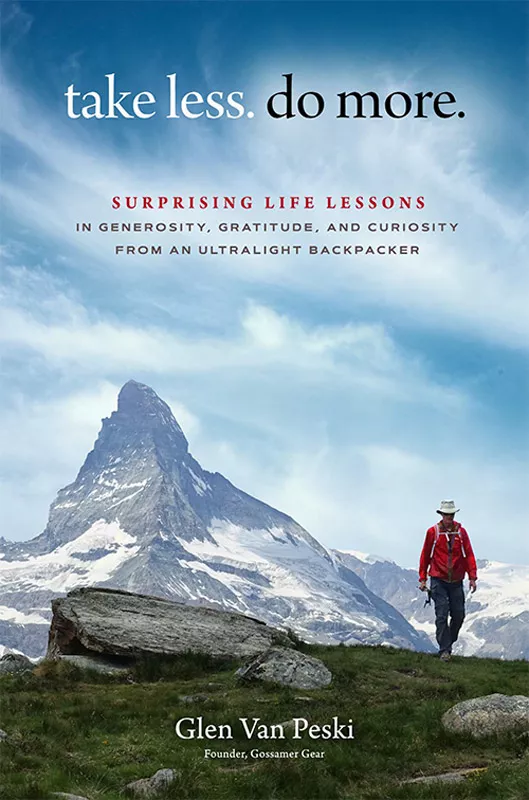
    Take Less, Do More is a refreshing departure from the typical books about voluntary simplicity, ultralight backpacking, or minimalism. Rather than centering on our relationship with “stuff” the book focuses on how we engage the world around us influences our life.  Many books in this genre would go into great detail about  downsizing possessions, selecting the right gear, etc. Glen talks about these things in the chapter entitled “Know Your Gear”… but a much stronger theme through out the book is embracing generosity which is the best counter-narrative to a life focused on consumption.

    The author, Glen Van Peski, is a well know thought leader and innovator in the world of ultralight backpacking. Glen (and his wife Francie) are also some of the most generous people I know. I first “met” Glen on-line in the backpackinglight yahoo groups discussion forum more than two decades ago. I was impressed by his humble spirit, out of the box thinking, and experimental / engineer approach. As I have gotten to know Glen better I found my initial impression to be strengthen, and I have come to appreciate how he leads an intentional, thoughtful life of engagement.

    Throughout the book Glen shared how a life with margin that provides space to  notice and respond to the world around us, especially other people,  produces a rich and meaningful life. That being less conscious of one’s self, and more aware of others is liberating and enriching, far beyond what one experiences if they were only focused on maximizing their happiness.

    Each chapter is built around several personal stories from Glen’s life. From these experiences Glen draws out principles that can be applied, perspectives to shape one’s viewpoint, and/or insightful observations which might help sharpen one’s understanding. Some of the stories I already knew, some I learned while reading the book, all of which I appreciated.

    Side note: I think a great practice is to identify key stories that you want to shape your life, take the time to write them down, and regularly share them with others.

    You don’t need to be into backpacking to enjoy this book. While several of the stories in this book take place on backpacking trips, the stories are about human connection which is universal. “Know Your Gear” is the only chapter that gets into nitty-gritty details. Non-backpackers could skip this chapter, though reading it might expand your perspective. There are better books about how to be an ultralight backpacker, this is a book about life.

    I shared the idea of a shopping diet with Glen. A bit longer write-up about shopping diet.

    Chapter 1 has a story about a trip Glen led to Buckskin Gulch which included Dan Buettner (best known for his work on Blue Zones), Matthew McConaughey, and several other famous people. A great compliment to Glen’s story is Ali Selim’s humorous trip report from the perspective of one of the participants who was doing his first backpacking trip.

    Glen has a website with resources, articles, and the option to subscribe to his newsletter. Gossamer Gear is the the ultralight gear company that Glen started. I would recommend the interview between Glen and Francis Tapon.

    If you enjoy Take Less, Do More, there are several books I would recommend:

    • Lighten Up!,  a short, humorous book about how to lighten what you carry when backpacking. Written by one of the original moderators of the backpackinglight yahoo group.
    • Chasing Hope, a memoir by journalist Nicholas Kristof, who still believes in and practices truth telling. Nicholas care for others comes through. Why am I not surprises that he and Glen are friends 🙂
    • Walk in a Relaxed Manner, A memoir about walking the Camino de Santiago, and the lessons learned on that road.
    • Practicing the Way,  A wonderful take on what a life following Jesus could be like.  A life filled with grace and generosity rather than judgement and self-centeredness.
  • Model of Maturity

    The following is an integration of material from Life Model Works and what I have learn while coaching and mentoring people since the 1980s.

    TL;DR

    • We first learn about love from our families. These first lessons inform our attachment style and become a lens we interpret our interactions with others through.
    • We mature in love which starts with accepting love and can grow into us being able to give love to people who are outside our family and even community.
    • A significant part of maturing is learning to manage our emotions which is different from controlling our emotions. This allow us to return to a healthy state.
    • The lack of people who modeled love and/or trauma retards growing in maturity until it is properly processed.
    • Classic “spiritual disciplines” are tools we use to grow and process life. These disciplines help us to turn our emotions into servants rather than our masters, and rewire or brains to have responses like Jesus.

    Love is the Measure and Goal

    We were made by God to experience love in the context of relationships. A concise definition of this sort of Godly love is:

    willing good toward someone else, independent of what you get in return

    This type of love is a verb and requires us to make choices and take actions.  This is a love that is offered with no expectation of a response or reciprocation.  

    The most important task set before each of us by God is learning how to love. Our ability and willingness to love others is the best measure of our maturity.

    Attachments

    God provided parents, marriage, the family to make love concrete. Our relationship with our parents is the first, and often the strongest influence of our understanding of what love is.  These early experiences frames our understanding of love which is called our attachments style. 

    Attachment theory postulates that there are four common patterns for this parent / child interaction. The attachment style we learned from our parent will affect how we form attachments with people and with God later in life. A healthy attachment allows us to take risks.

    ATTACHMENT STYLESParent Unable to LoveParent Able to Love
    Child feels Worthy of LoveDismissive-Avoidant: Often maintain some distance from their partners. They may feel that they don’t need close relationships and can be self-sufficient. They often seek independence and can appear to avoid attachment altogether.
    Secure (Healthy): Comfortable with emotional closeness and are also able to depend on others and have others depend on them. In relationships, they are generally honest, open, and equal, with a balance of giving and receiving.
    Child feels Unworthy of LoveFearful-Avoidant/Disorganized: Desire emotional closeness but tend to feel uncomfortable with emotional intimacy. They often struggle to trust others and to depend on them, fearing being hurt if they allow themselves to become too close.Anxious-Preoccupied: Seek high levels of intimacy, approval, and responsiveness from their partners. They can be overly dependent on their relationships for their self-esteem. They often worry about their partner’s willingness to love them and are generally insecure about their relationships.

    It’s important to note that people are not stuck in any particular attachment style.  It is possible for people to learn to have healthy attachments. Indeed, learning to have healthy attachments is a key aspect of growing into maturity.

    Stages of Development

    Maturing in love starts with accepting love and ends with us being able to give love to people who we have no connection to.  There is a natural progression for people with a healthy / secure attachments. This progression can be broken into stages that are built on top of each other. To truly mature requires developing the skills in each stage before progressing to the next stage.

    • Infant: Learning to receive care and comfort
    • Child: Able to ask for what’s needed. Able to self care.  Learn to work hard. Learning to return to joy from negative emotions
    • Adult: Both centered. Act as yourself and return to joy, and take responsibility for one’s actions
    • Parent: Able to give without looking for anything in return. Nurture your children and help them return to joy
    • Elder: Be a parent to the community. Will adopt those without family.

    Emotional Regulation

    It’s worth noting that healthy attachment requires experiencing separation and cycles of disappointment followed by repair.

    No one can “control” their emotions. Emotions are unconscious and can’t be directly controlled. There is no healthy way to “stop feeling” emotions. That said, it’s possible, in fact healthy, to choose how we respond to our emotions.

    While we can’t control our emotions, a significant part of maturing is learning to manage our emotions which allow us to return to a healthy state, much like an immune system fights off an infection. I like to say our emotions are like the sensors on a car. When emotions rise up it’s a signal saying “There is something you should notice”. Often it means something needs attention. Sometimes it’s an overly sensitive detector. As we mature and make good decisions we are able to down/up regulate our emotions. To see a bit of joy and fan it into something big. To feel a bit of anger, recognize that we are misinterpreting a situation and calm down. In most case, pausing for 30 second to a few minutes before responding to a strong emotion is a good idea.

    Road Blocks to Maturity

    Deprivation

    The lack of healthy attachment (deprivation) will result in a person failing to go through this progression which makes it impossible for them to mature in love. Before a person who has experience deprivation can move forward, they need to experience what they were deprived of. For many, this is experiencing unconditional love. This doesn’t have to be someone who is a “parent” to them. It can come from being a part of a healthy community where the members take care of each other.

    Trauma

    Trauma retards our maturity until it is properly processed.  People often partition off trauma which lets them cope in the moment but causes problems in the future.  Trauma reduces our ability to learn because we are avoiding looking at the issue. Overcoming trauma requires being able to clearly clearly see and grieve over the trauma, and then move forward.

    Overcoming Roadblocks

    The solution, no matter the age of a person, is to develop relationships with people who can form healthy attachments, and then to progressively develop these skills. People can’t progress unless they are in the context of a health community. Thankfully, people who are chronologically adults with extensive life experience can develop skills in months to a year that take a younger individual years to develop.

    Spiritual disciples are the tools we use to grow and process life. These disciplines help us to turn our emotions into servants rather than our masters.

    Additional Material

    Related

    • Who We Are, How We Change
    • Embodiment
    • Essentials of Community
  • Optimal Group Sizes

    The optimal size of a group is first determined by the function of the group. A group will need the requisite skills, abilities, experience, and manpower to accomplish its goal. In addition to function, there are cognitive and social underpinnings which influence the optimal size of a group. Studies suggest optimal group size tends to cluster around 5, 15, 50 and 150.

    Dunbar’s Number

    Robin Dunbar, an anthropologist and psychologist, proposed that 150 is maximum size of a group that can maintain stable social relationships, where each member knows every other member and how they relate to each other. For a group of this size to remain cohesive, as much as 42% of the group’s time would need to be devoted to maintaining relationships which is can only happen when the group is in close proximity and with strong survival pressures. See the Dunbar’s Number wikipedia article which provides additional background information and optimal social networks (the paper) which provides insight from modeling. 

    Dunbar also identified a sequence of sizes for cognitively efficient social groups: 5, 15, 50, 150, and 500. Each of these sizes represents different layers of social relationships, varying in the strength of these relationships.

    Other Theories

    The largest group size that can maintain effective coherence, deep trust and highly efficient communication is generally considered to be relatively small, typically under 10, though the exact number can vary depending on the context and the nature of the group’s interactions.  It has been suggested that online groups might be able to function effectively at higher numbers of participants. There are a variety of theories and research topics in psychology, sociology, and organizational studies that can help identify factors which determine the optimal size of a group:

    1. Small Group Theory / Dynamics (3-20 members): Research in small group dynamics typically finds that groups of around 3 to 8 members are most effective for tasks requiring close collaboration and communication. In such small groups, members can form strong interpersonal relationships and maintain a high level of mutual understanding.  When the goal is to foster deep connections and effective communication in a community setting the community can grow to around 20 people with smaller groups within the larger community can ensure everyone feels heard and supported.
    2. Communication Network Theory: As group size increases, the complexity of communication channels also increases exponentially, making efficient communication more challenging. Smaller groups allow for more direct and clear communication.
    3. Collective Intelligence Theory: This theory would support a group size that balances diversity of thought with the ability to make collective decisions effectively, which could align with a smaller to medium-sized group.
    4. Steiner’s Model of Group Effectiveness: This model would favor a group size that maximizes productivity (in terms of community support and cohesion) while minimizing losses due to potential group conflicts or inefficiencies.
    5. Social Loafing Theory & Ringelmann Effect: These theories suggest that in smaller groups, members are more likely to contribute actively and take responsibility, which is vital in a community.

    Teams at Work

    When it comes to teams taking on a technical task, Amazon has popularized the idea  of the Two-Pizza Teams, that is effective meetings and teams are small enough that 2 pizzas can feed the gathering.

    Highly functional start-ups can easily grow to 50-150 people and keep good alignment of collaboration across the company. After this alignment tends to pull apart as subgroups interests come into conflict. As a group grows it’s impossible for everyone to recognize, much less “know” each other. Individuals gravitate to only knowing members of their team.

    The most effective strategy when a company is more than 150 people is to identify people who can be interfaces for the other teams. The works best if you have a personal relationship with one or two people in each of the teams who you can build trust with, and who can represent this team to you. This often works best if the person is not the manager or director of that team. Having relationships with people in other teams naturally occurs when people join an organization which was smaller than 50 people, when the company was small enough to know everyone. As the company grows larger, these early team members typically know at least one person in every major group. People who join companies when they are larger, this has to be an intentional activity. Smart companies provide opportunities for people to interact with members of other teams personally, in a context free of work pressures.

    Often a mission is too large to be taken on by a small team. A common solution to this is build a hierarchy of teams with middle managers with one or more directors or executives that leads the group. When (not if) projects fall behind expectations there is a temptation to add additional people. This always ends badly. See the classic book The Mythical Man Model for a description of this.

    The most extreme example I saw of how a large team can be hampered by size was a skunkworks project of around 8 researchers at Xerox PARC that built a product based on a series of tools that were in common use at PARC. At the same time a “clean sheet” product team was assembled to create a very similar product. The product team grew to 250 people and failed to deliver a useful product after two years of work. Eventually that team grew to 750, then downsizes and refocused. After five years they finally produced a product that was mostly competitive with the product the researchers had been selling to customers for the previous five years.

    Often the best solution for taking on larger missions is to have a network of autonomous teams which collaborate. This approach was eloquently discussed in Team of Teams by General Stanley McChrystal.

    Group Sizes at Church

    I have been part of church groups which ranged from a couple of people, to several thousand. It seems to me that

    Discipleship: Discipleship is often portrayed as a one-to-one meeting of a “master” and a “student”, where the master is passing on their experience. While this can work, I have observed that this sort of intentional life transfer works best in the context of a small group where people have both the opportunity to learn, and to share, help, serve, teach each other.

    Life/Community Groups: Truly sharing life with others takes time. People need to be able to share what’s happening with them on at least a weekly basis. This level of sharing can’t happen in the group is more than 15 people or so. More than that, and people don’t have enough opportunities to share.

    Medium Size Groups: Over the last two millennium, churches typically were 50-150 people. This is large enough for the full diversity of gifting to be present while;e small enough that everyone can recognize each other. In meetings of this size there aren’t opportunities for everyone to share with the entire group each week, but it’s small enough that people will have repeated contact with each other to the point they will have some understand of others needs and ways they they could be of service.

    Large Size Groups: In the USA there has been a trend toward mega-churches which are able to efficiently make use of resources. For example excellent teaching, run programs which require a lot of people, build spaces to serve the community, etc. People who only attend these large groups will not find the sort of community that church was designed by God to provide. Many of these churches encourage people to join life groups… but I think this is sub-optimal. First, people might not be ready to join a community group. Second, community groups are too small a context for people to learn about and use their gifting. Medium size groups which are more open are very helpful.

    Other Groups

    Over the years Jackie and I have experimented with the optimal size of a dinner group which has the goal of people getting to know each other and share life. We found that 6 seemed to be optimal in providing diversity while providing opportunities for each person to contributed. Conversations naturally flow with effective turn taking. When the group grows to 8-12 we have seen that a skilled facilitator are able maintain a good environment, but without a facilitator the quieter people often don’t have an opportunity to contribute, and side conversations will start.

    Further Investigate?

    The following are papers and books which examine issues related to how the size of groups impacts the groups function.

    1. What is the Ideal Team Size to Maximize Productivity
    2. how to assemble a team with dunbar’s numbers
    3. dunbar’s number in social architecture
    4. Effective teams for the military is a life or death matter. The core of the military are fire-team and squad. A discussion of how function has impacted the size of a squad.
    5. The Magical Number Seven, Plus or Minus Two: Some Limits on Our Capacity for Processing Information by George A. Miller: While not about group size per se, this seminal paper on cognitive processing limits indirectly informs theories about optimal group sizes, especially in contexts requiring intensive communication and coordination.
    6. Group size and the trust, cohesion, and commitment of group members Shane Drew Soboroff. Dissertations that examines how group size affects trust, cohesion, and commitment in group members.
    7. Why individuals in larger teams perform worse by Jennifer Mueller: examines who as group size increases, individual’s perception of support shrinks.
    8. Communication and Group Decision Making Randy Hirokawa & Marshall Poole. This book provides insights into how group size affects communication and decision-making processes within small groups.
    9. Research of George Homans. Best know for his paper “The Human Group“. This is a foundational text in understanding group dynamics.
    10. Group Dynamics by Donelson R. Forsyth: This comprehensive textbook. Several sections, such as group coherences, collective behavior, and communication talk about how size has an impact.
    11. The Five Dysfunctions of a Team by Patrick Lencioni: Addresses team dynamics, indirectly touching upon group size issues.
    12. Designing Team-Based Organizations by Susan Albers Mohrman, et al.: Discusses organizational design and team size in the context of knowledge work.
    13. Group Creativity: Innovation Through Collaboration by Paul B. Paulus and Bernard A. Nijstad: Explores how group size affects creativity and innovation.
    14. A Meta-Analysis of Group Size Effects in Electronic Brainstorming: More Heads are Better than One – Alan R. Dennis & Michael L. Williams
    15. The Difference: How the Power of Diversity Creates Better Groups, Firms, Schools, and Societies by Scott E. Page: Addresses how diversity in groups, influenced by size, affects performance.
    16. The Wisdom of Crowds by James Surowiecki: This book discusses how large groups can be remarkably intelligent and are often smarter than the smartest people in them
    17. Team of Teams by General Stanley McChrystal: Examines of in the face of a chaotic world, small teams which are given significant autonomy with the ability to partner with other teams are significantly more effective that large, top down organizations.
  • Grief

    This has been a grief filled week. My sister’s husband Don passed away on Monday. It that wasn’t enough, most of my close friends have had some new grief in the last few weeks. Finally there is the horrible devastation from the Israel / Hamas war and the “civil” war in Sudan. This morning Hidden Brain’s Podcast came to the top of my queue with its timely content: Healing 2.0: Life After Loss which got me reflecting on what I know about grief.

    Not a Linear Progression

    My first observation is that everyone is different, and no one goes through the so-called “stages of grief” in a linear fashion. I think the stages of grief are more “modes of responding”. We have a tendency to jump between all of the reactions. Often little things will result in very strong responses. This is normal. The grief process is messy and chaotic.

    The other thing is that it’s good to pull back from the grief when it’s too much. This isn’t denial or avoidance. We don’t have to be pressing into grief all the time. It’s healthy to oscillate between grief and simply living.

    The period of grieving is highly variable. Some people process deep grief in months… these people are outliers. There are others who never recover, such as people who suffer from PTSD… each time their memories are triggered it’s like a fresh trauma. Most people get through the worst of their grief in a couple of years, though the grief might flare up at the oddest times when something triggers a memory, a regret, etc.

    Most People Don’t Help

    Most people are not very good at helping you grieve. They are uncomfortable and want to do or say something to make their discomfort, and maybe yours, go away. This is a period that is uncomfortable and no words are going to change that.

    Some people will want to identity with you, and will bring up how they “understand” your grief because of X, where X is something that will seem to be on a completely different scale like they broke up with their boyfriend of six months as compared to the lost of a spouse of 30 years.

    All I can say is that it will get better in time, and that there will be people who will be a surprise blessing.

    In one of my lowest moments a gentleman I barely knew came up to me, put his arm over my shoulder, looked me in the eye, and said “It’s hard”.  When he saw that I got it, he smiled at me and walked away.  I knew he understood my pain, that I wasn’t alone, and that somehow it would get better. I think that brief interaction carried me for more than a month. Trust that when you most need it, God will bring people by who will speak to your heart and be a source of encouragement.

    My recommendation to people who are grieving is figure out who are the people and activities that are the most comforting and helpful, and make sure that’s what you concentrate on. Maybe it’s your closest friends and favorite activities, but don’t be surprised if it’s people you just met or a new activity. I have met a number of people who were never runners, cyclists, or hikers, but found that they ran, pedaled, or walked their way out of their grief. I started several new friendships with people who were able to support me in the midst of my grief.

    If you know someone who is grieving, don’t try to fix them. Be willing to sit in that difficult place with them, and talk about whatever they want to talk about. Often what people need to hear is what that gentleman told me. “It’s hard”, with an indication that you really see their pain and won’t run because of it. Sometimes no words are best.

    What Ifs?

    When faced with deep grief it’s common to play the “what if” game. This is an endless rabbit hole which will bring nothing but pain. I was willing to permit myself one or two what if? in a sitting, but then I would remind myself that it’s not going to be helpful and find something else to think about.

    For example, After I lost Libby to cancer I found myself wondering if we should have chosen more extreme measures, been more aggressive to find experimental treatments, etc. There were people who indicated we should have fought harder, who had hopes that Libby could have been miraculously cured if only…, that we shouldn’t have given up and switch to hospice care when we did.  I had some comfort that Libby and I had talked extensively, she had written a living will, and most importantly that Libby knew she was  going to see the Lord, something she deeply desired to do. Our hope is in eternity, not now.

    Good Memories

    Remembering and looking at the richness of life together can be very healing in time. I found writing down memories particularly helpful. The day I lost my dad I wrote a tribute to him. Likewise, when one of my mentors, Doug Goins passed. I couldn’t do that with Libby because the emotions were too strong. Several months later I was able to write  27 years of blessings. I also found looking through my pictures and orginizing them, especially make some “Best Of…” albums was really helpful.

    Self Care

    During a time of severe grief it’s really important to time take care of yourself. Get sleep, if you are having trouble sleeping be willing to take meds for a bit. Take care of your body and find time to feed your soul. Listen to music… it helps most of us move into places, to face emotions that we might have trouble accessing otherwise. Get outside. Walk in a forest. Get some exercise.

    Caring for Someone Grieving

    If someone you care about is deep in grief find little ways to help them. Often to drop off a meal, or if they would prefer, take them out or have them come to your place for the meal. Don’t say “If you need something, ask and I will be happy to help”. Most people don’t have the energy to self advocate. Rather I recommend observing what they are doing and then make a specific offer of help.  If you can’t come up with something ask what’s really hard for them, what’s a struggle, or overwhelming them right now. Based on that answer ask if they would permit you to take a very specific action you have determined would lighten the load on them.

    Whatever you do, don’t ghost your friends because you are uncomfortable. If the person is a close friend consider calling them on some sort of regular interval… somewhere between daily and weekly so your friend will know they haven’t been forgotten. This is especially important after a few month when most everyone else goes back to normal, and some people might be pressing the grieving person to “get on with life”

    Talk about the person (or whatever is at the root of the grief). Avoiding is not a help.

    I also want to say something to all the women out there whose friend has their her husband. Support your friend. Include her as an honorary member of your family. She is not going to steal your husband. I have heard far too many stories of women who were struggling with the lost of the husband to have most of their friends distancing from them. Don’t do it.

    Embrace Life

    The USA we have a narrative of the transformational trauma. What doesn’t kill you will make you stronger. I think this puts a huge pressure on people in the midst of deep grief which isn’t helpful. There are people who go through a massive transformation, but they are the exception. Most people struggle through the trauma to emerge much like they were with one exception. Nearly everyone who has gone through major trauma have more compassion and empathy for others.

    There are times that your physiological reactions with knock you back and your emotions will run wild. There is nothing you can do to stop these emotions. What you can do is choose your response. We can observe and slowly direct our thoughts. What helped me the most was to choose life. To look for beauty, to find things that I could be grateful for, to look at things that gave me hope, to watch for people being kind to each other.

    Loneliness

    If you are anything like me, once the crush of functioning and a sense of numbness fades, you will face a crushing loneliness, just a huge sense of emptiness is likely going to one of those hard things you will face. Nothing will make it go away, but in time, it will heal. I found loneliness can transform into solitude.

    If you have someone who is grieving the lost of someone, make it a point to check in on them. Not so much in the first couple of weeks, but after that when everyone else is going on with their lives. Encourage the grieving person to have good outlets. Maybe they have enough friends (and it will take several) who understand enough to be good companions. Maybe encourage them to check out GriefShare or other support organization.

    Other Material

    Resources

    There are organizations that exist to support people who are going through seasons of grief. Virtually everyone I know who has facing significant grief have indicate that spending time with others who have (or are currently) struggling through grief has been very helpful. People who actually understand. Many religious organizations sponsor group but don’t require people to share their faith nor do they proselytize.

    • Kara in Palo Alto, CA is a comprehensive center that provides individual counseling as well as facilitated support and counseling groups. They have a great program for kids.
    • GriefShare online and locations around the US. Typically meets monthly.
    • Stephen Ministry is a program that trains people to walk along side people who are facing hard things. Not to solve problems, but to be present, to act as a sounding boarding, ask good questions, and connect people to good resources. Their “locator” isn’t on the website anymore. Google “Stephen Ministry” your city to get a list of churches which provide this service.

    Blessed be the God and Father of our Lord Jesus Christ, the Father of mercies and God of all comfort, who comforts us in all our affliction, so that we may be able to comfort those who are in any affliction, with the comfort with which we ourselves are comforted by God.

    II Cor 1:3-4 ESV
  • Love: The Heart of Goodness

    Unconditional love is the most powerful and important force in our world. Love is the heart of our connections and communities, possessing the remarkable power to mend fractured relationships and bridge gaps between people. Love not only opens our hearts to others but also serves as a potent catalyst for learning and personal growth. Love is an essential element for the well-being of individuals. Writing about love is a daunting task. I’m unable to do it justice AND the topic is so important I have to try.

    In the Christian faith, love is central. It is a defining characteristic of God, as stated in I John 4:16. Jesus declared the greatest commandment to be the love for God and neighbor (Matt 22:37-40). Paul followed up noting all the commandments find their fulfillment in love (Rom 13:8, Gal 5:1). Love becomes the unmistakable mark of a true follower of Jesus (John 13:35) and stands as the singular fruit of the Spirit (Gal 5:22).

    How did Christianity go from a fringe and persecuted faith to a national “religion” of the Roman Empire in 300 years and went on to shape most of the core values in the modern world? It wasn’t through violence or force. It was through gentle, humble love for “the other”: caring for the sick, the poor, anyone in need. In short, loving neighbors. Unfortunately, Christians often forget that true power is love, rather than economic, political, or military power which is ultimately impotent. [Sidenote: Tom Holland’s book Dominion covers how the church has oscillated between leaning into love and into power and what came from those orientations]

    What is Love?

    The word love is used in a variety of ways: a preference for a product, romantic infatuation, deeply caring for a friend or family member, and many other things. In Greek there are four different words that translate into the English word “love”. I believe the Greek word “agape,” often described as “unconditional love,” comes closest to my definition of love. My favorite definition:

    Love is willing good toward someone else, independent of what you get in return

    I think there are some simple tests to determine if you are being loving in this way:

    • Are you happy to do something good for the person you love anonymously?
    • If someone gets an opportunity that you wanted, can you rejoice and encourage them?

    Sometimes agape love is called sacrificial love, which I have come to see as poor phrasing. First it can convene a sense that this sort of love necessitates pain. Second, some people perceive this as diminishing the value of the loved person, or places the lover in a superior position. I don’t like the term because a sacrifice isn’t involve at all, love is operating on a completely different plane. The “sacrifice” is merely temporal or material things, existing in “chronos” time. The joy of seeing the person flourish is operating in the realm of eternity, or “kairos” time. Imagine being offered the best experience of your life for a $1 fee, or even $1000. Is that fee a sacrifice? Jim Elliot aptly remarked, “He is no fool who gives what he cannot keep to gain what he cannot lose.”

    As a new convert to Christianity I had a vision that God poured love into my heart, and that my job was to let His love flow through me to touch others. My breath prayer for many years has been “Lord so fill me with your love that it overflows onto others”

    A Renewable, Exponential Resource

    Gentle and Lowly by Dane Orthlund got me thinking about how love is an infinite resource because it comes from God’s nature. Better yet, it grows as it is shared. When you love someone in a true manner, you are passing on the love God put into your heart. As you “use it”, God refills your heart with more love. Now your heart is full and the person you loved has more as well.  If they turn around and love someone, their heart can be refilled by God and the amount of love  grows exponentially. Numerous videos try to capture what happens when people “pay it forward“. People have noted that simple acts of kindness can become viral and even boomerang back.

    I have seen how small, simple acts of love change others. I wrote a bit about my “samaritan experiment” in Relational Openness and Delightful Surprises. Maybe the best way to impact the world is in simple acts of love to neighbors. People underestimate the impact of small acts. I plan to write about this later.  For now, check out Hidden Brain’s A Secret Source of Connection.

    The Measuring Stick

    Given that love is a defining characteristic of God, and seems to be the most important commandment for His followers, it would make sense that love should be the basis of our ethics, the rooting of our decision making process, the heart of our values. When things are unclear “what is loving” can be like a searchlight in the dark.

    Jesus said that the rest of the world should judge whether we are his followers by the love we have for each other. I know seeing the love between members of a church led me to become a Jesus follower.

    As an ambassador of God (I Cor 5:16-20) our first mission is to demonstrate and tell people about God’s love. Our lives should have integrity, that is we shouldn’t just talk about loving others, but live it out.

    Likewise, our church should be judged based on whether we are loving people rather than just caring about orthodoxy of belief. Do we deeply understand that it’s God’s love, not our righteousness, that has us in His family? Are we humble? Do “sinners”, “unGodly”, people who are broken or discarded by our society feel welcome and comfortable at our church? They should. After all, these were the people Jesus loved unconditionally, and who enjoyed hanging out with Jesus. Do we care for people that no one else does because there will be no “return” of that investment? We should live this way.

    The Heart of Lasting Impact

    I noted in my post about revisiting mid-life decision that I have concluded that when it comes to making a long term impact of the human experience, that loving people is the key. It’s impact will often not be seen now, but give the likely exponentially growing impact, it will hugely impactful in a few generations.

    Further Reading

    Owe no one anything, except to love each other, for the one who loves another has fulfilled the law.  For the commandments, “You shall not commit adultery, You shall not murder, You shall not steal, You shall not covet,” and any other commandment, are summed up in this word: “You shall love your neighbor as yourself.” Love does no wrong to a neighbor; therefore love is the fulfilling of the law.

    Romans 13:8-10 ESV
  • People are More Important Than Things

    I am forever thankful to my friend Craig and an unnamed housemate who helped me to understand that I had to choose whether I loved people or things more.

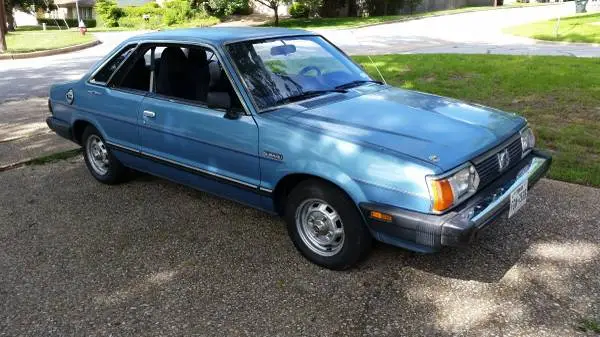
    I purchased my first car on a Thursday afternoon and proceeded to drive it to where my house church was meeting.  Right after the meeting ended my friend Craig asked if he could borrow my car. There was a young lady who lived 10 miles away who needed to get home soon.  Craig wanted to talk with her, and if he didn’t drive her, it was going to be several weeks before they would get their next chance.

    This was my new car. I had only driven it about a mile. I wanted to drive it.  On the other hand, I had been carless for a couple of years and had housemates loan me their cars. I was grateful for their kindness and felt it wouldn’t be right to refuse my friend.  I handed him my key and joined a conversation with someone who lived in the house we were meeting in.

    When the conversation ended, I realized that everyone  had headed to a restaurant / bar we would frequent after the meeting.  I wouldn’t be able to join them and had to walk around 3 miles back to my home.  I was pretty grumpy. A couple of hours later my housemates started to return from the restaurant having clearly enjoyed the time hanging out with each other. I was really starting to regret loaning Craig my car.  I was thinking “It’s fine to share, but it was foolish to loan out my car.  Look what I missed out on.”

    Then a phone call came.  It was Craig.  He told me he has been in an accident. This was believable.  We used to say that the strongest evidence that guardian angels exist is that Craig had never been in an accident. I wanted to scream “You crashed my new car?  I only got to drive it one mile before you destroyed it?!”, but I didn’t. I was relieved that Craig was calling me rather than  police officer showing up to report Craig’s death or severe injury.  I had lost a friend less than a year earlier to a tragic traffic accident.

    I clamped down my anger and the words  “Are you ok?  Where are you? Do you need us to pick you up?” spilled out of my mouth.  Craig told me that he could get home.  The left front quarter panel was damaged, but he was able to pull it away from the wheel so he could drive it home.  I said “Thank God you are ok.  That’s the most important thing. Get home and we can figure out next steps later.” 

    As the phone call ended one my housemates said in a self satisfied voice “That’s why I don’t loan my car to others.”

    In that instant I knew I was at a crossroad.

    I had the example of several of my housemates  who had freely shared their cars with me.  I respected their character and saw how they cared for others. They were people I admired and wanted to be like.  They were willing to take the risk of their things being damaged.  Then there was this other housemate. His life was characterized by selfishness. He protected all his possessions and wasn’t willing to share. He was a negative role model. Someone who I didn’t want to be like.

    Without thinking I said  “And that’s why I am going to continue to loan my car out.”  Thankfully I stopped my outburst before I finish my thought  “because I don’t want to be a selfish #$^!% like you” and he didn’t catch how condescending I was toward him in that moment.

    From that day on I committed to care more about people than my things. That when I loaned things out to do it with the mindset that I was giving the item away.  So if it was damaged or not returned I would be ok, and if it came back in good shape I could rejoice.

    Craig wasn’t in an accident. He thought it was a funny prank.  When I learned my car was ok I was tempted to kill Craig, but decided to forgive him, and to be thankful that I had learned a valuable life lesson. For a couple of decades Craig was embarrassed by his prank… to which I always told him I am ever so grateful he did it because it was a crystallizing moment which has been instrumental in my life. In the years since that incident I continue to loan things to Craig 🙂

  • It All Comes Down to Love – Jack Kornfield

    Snipped from The Tim Ferriss Show Transcripts: Jack Kornfield (#684). BoldItalic added by me for emphasis

    Jack Kornfield: In all these years, my understanding really is that it comes down to love. I’ve met [inaudible 01:05:26]. And lamas, and gurus, and lamas and everybody else in between in my industry. And some of them are fabulous. But there’s a really interesting thing that you can have these powerful experiences and still be a little bit of a jerk. Just getting real about it because — 

    Tim Ferriss: There’s a lot we have going around.

    Jack Kornfield: Our consciousness is like a mandala and we can awaken some dimensions of it. So you have an Olympic-level athlete who’s an emotional idiot. You have a professor of nuclear physics, most brilliant, and she can’t find her shoes or her body. We can develop ourselves in some areas, but it turns out unfortunately, that doesn’t always go over to another area. And so there’s a kind of halo effect where people think, “Oh, this person is a spiritual teacher and they’ve had these spiritual experiences. I’ll go ask them for marriage advice or advice for sexuality.” They don’t know shit about marriage.

    So this is our human nature. If we’re actually to become wise, we need to direct our attention to body, to emotions, to relationships, to thought. We actually need to become wise in those major dimensions of our life. And we can’t expect that of people just because they have a certain title or robe or anything else. But having said that, my measure now for myself: are you loving? Am I loving? Are they? And that love isn’t just like, oh, sweet Valentine love, but can you be in this world and can you love it with all its imperfections? And can you bring that spirit of care and love in the middle of what’s tragic and what’s beautiful? That’s a liberated heart.

    Tim Ferriss: So love, let’s underscore this. For people who are listening, this might sound like a really strange question who are thinking to themselves, “Well, I love my dog, I love cheesecake. Love my kids.” If they have kids, let’s say, but maybe they’re like, “I’m not sure if I would recognize or even know the feeling of what it is to love the world.” Maybe they feel like they might be color blind to the first-person experience of feeling that.

    Jack Kornfield: It’s a gorgeous question.

    Tim Ferriss: Is it just something they can intuit or could you expand on that?

    Jack Kornfield: It’s a gorgeous question. You remember Einstein said that, “The task for humanity is to widen our circle of compassion, or you could call it love to include all of humanity and all of nature in its beauty.” And so we start by loving that which is right around us. It’s natural, your dog, your children, the partner, the people you care about and maybe your neighbors. And now we’re talking about, “Well, what is wisdom and what is liberation?” And it’s that widening of the circle so that when you are moving through the world, it’s not just that person over there is an object, but they become more and more a part of your family. 

    There’s a beautiful monument to a mystical experience. Going back to your asking about that in Louisville, Kentucky on, I think it’s on Fourth Street, Fourth and Walnut. And the great Christian mystic Thomas Merton left his monastery and was walking down the street in the middle of Louisville and he said, “I’d come from the monastery. We were all trying to be holy and close to God and have all these spiritual experiences the way one does and pray and so forth. And I was walking down the street and all of a sudden it came to me. I looked in the eyes of everyone going by and I saw their secret beauty that was born in them that no one can take from them. That magnificence of spirit, soul, whatever you want to call it.” He said, “The only problem would be I wanted to fall down at their feet and worship each one that went by.” He said, “If we could see each other that way there’d be no more need for war and cruelty. The world would be a different place.So this monument, a public monument to a mystical experience, what it does is it says that this is possible, but more than that, there are beautiful trainings to do it.

    One of my favorite trainings is trainings in loving-kindness meditation. There’s bunches of it on my website in [inaudible 01:10:17]. And lots of other colleagues and teachers. And it turns out if you practice it like anything, it grows. You start with people close to you and then those in a little wider circle and gradually extend it. And for me, for example, I’m out on the street or I’m driving or something and I’m a bit of a speed freak. I can sit quiet in temptation, but my general M.O. is to get stuff done and move through the — just — anyway. And so if somebody’s driving slowly and meandering and not being a good driver in front of me and I get annoyed or even on the sidewalk, people are blocking it and not aware that I have something important I’m trying to get down, whatever, and I feel a little moment of irritation arise, which it will, I look and I see them, not as they are now, but as they were — as I imagine them at three or four years old, completely innocent child, they all were that no matter what things happened to them. And I go, “Oh, yeah, I see who’s in there. That’s like [inaudible 01:11:24]. I see that there’s that person doing the best they can and there’s that child that that’s in there.” 

    And instantly my heart changes and I go, “Oh, yeah, there’s a kind of — I wish them well, may they be safe and whatever dance they’re in, may they be protected.” And this quality of love, and kindness, and compassion, it’s grown because I practice it some, it’s where I want to live, but it’s more than that. I see it or sense it as the best expression of enlightenment. All those other things or experiences, they lead us back to love. And if they don’t, I’m not sure that they matter that much.

  • Lessons from the Camino

    The following is a list of the lessons I learned, beliefs that were strengthen, and/or topics which frequently came up in discussions with other while walking the Camino. Walking the Camino provided a wonderful opportunity to consider what makes a meaningful life. The book Walk in a Relaxed Manner by Joyce Rupp is far more in-depth and insightful than this post.

    [toc]

    TL;DR

    • The best part of this journey is experiencing the “Camino spirit” which is exhibited by most of the pilgrims and many of the residence along the way: the default response to others is kindness, curiosity, openness/vulnerability.
    • Simple acts of love and kindness can be life changing for both the “giver” and the “receiver”. If everyone’s response to others was kindness and compassion the world would be a completely different, better, place.
    • The Camino can be a transformative experience. People who benefit the most take time to reflect on their Camino journey, identify what they have learned, and then make changes in their life informed by what they have learned and regularly remind themselves what’s important.
    • The best physical preparation for the Camino is increasing the milage you walk each week in the six months before leaving. Doing once a week training hikes won’t adequately prep you for 30+ days of walking. The people who have the least physical struggles were walkers.

    Life Lessons

    • Love is the ultimate measure of a life.  Love spreads through connections and multiplies: the giver and receiver both grow love. This can result in exponential rather than merely linear impact.
    • The Camino Spirit is:
      • default is to be kind (loving) to everyone encountered
      • no judgement of others, instead curiosity when differences are encountered. Miroslav Volf would say everyone was an “us” not a “them”.
      • choosing to be vulnerable, sharing deeply and honesty which builds connection
    • Walking the Camino forces us to slow down and have space in our lives to notice what is going on in our and others lives. This is something that everyone wanted to bring back with them from the Camino. People who have done multiple Caminos reported that over time they returned to a more hurried pace. One of the reasons they returned to the Camino was to get a reset. Busyness and chasing after “success” will choke the Camino spirit out when you return home.
    • Life changing community can develop almost instantly when a super-majority has chosen to be in the Camino spirit. This is partially fueled by a self selection bias of who walks a Camino. Being on a shared journey helps brings people together.
    • Community is the key to a flourishing life and community is what many people discover on the Camino. Community requires:
      • Time / Availability / Slack. If you are always busy then you won’t have time for community. True community can only form when people are able to share their lives together. Life isn’t predicable. If your community activities are restricted to a tightly defined time-box you will miss out.
      • Care / Love / Acceptance. As mentioned above, love is so important. Healthy communities require the members to choose to love each other and the world around them.
      • Vulnerability. People need to drop their guards and lower their masks so people can truly seem them. Without vulnerability the bonds in the community will be weak.
      • Something bigger than the individuals of the group. What psychologists can transendence. Community that is only focused in itself will stagnate. It needs something bigger than itself.
    • What seems insignificant to you can be life changing for others. Don’t underestimate power of simple acts of loving your neighbor. Thank people when they have made a difference in your life. Often they have no idea they had any impact on you. Your thanks will be an encouragement.
    • The skill of listening well is hard to be developed, but is worth the effort. I often fail to listen because I am so busy formulating answers and fixes rather than listening to truly understand and be empathic.
    • Presence is maybe the greatest gift we can give to someone.  Really seeing people and being with them. Giving them our full attention, and not looking for something better in the moment.
    • Everyone is fearfully and wonderfully made. Cherish, honor, and respect others even if they are being an idiot in the moment.
    • Being a great companion requires dropping expectations and being delighted by another which results in an ease of interactions and great satisfaction.
    • Living out the Camino spirit has many similarity of what Christians would call kingdom living.
    • You can maintain a Camino spirit by cultivating gratitude, remember to put other people first, and leaving slack in your schedule so you can respond to unexpected needs.
    • Sometimes suffering isn’t about us, it’s to prepare us to help others. God loves all his children and will sometimes let one child suffer so all his children can thrive.
    • Don’t blame others. We are responsible for how we respond to all situations. If you give that away, you will always be dependent on other for a sense of happiness.
    • Contentment = CurrentReality – Expectations. We can be happy in very difficult circumstances if we don’t have any expectations, and miserable in situations that nearly everyone would be delighted by because our expectations are extremely high.
    • There is great joy and freedom when simplicity is embraced. Pack and live lightly.
    • Intentional minimalist / essentialism / simplicity focused on making time for what’s most important and getting rid of obligations and possessions that keep us busy and/or distracted.
    • Minimalist can lead to people being hyper focused on stuff, constantly trying to prune things down to a “perfect” set. Minimalism at it’s best understands that stuff is only useful when it enables spending time on meaningful activities and is best when stuff fades into the background.
    • Prayer is good, and has been at the heart of most of my most profound experiences. Yet I am not consistently praying.  This is stupid and needs to change.
    • We all hunger for transcendence because we know in our hearts that there is more than our eyes can see. Some people try to find this in nature and art but this isn’t sufficient.
    • If you don’t push a particular ideology and are genuinely curious, most people are happy to share their spiritual (or none spiritual) journey and you can hear some amazing stories. Ask questions, don’t give answers. Often these people will be interested in learning about your journey. Don’t preach at them, share what you have experience and let them decide what they think. Don’t expect or insist they agree with you. If you are interested… this is a description of my journey.
    • When people share something significant in common, like walking the Camino, other differences aren’t very important. We heard no one spewing nationalistic rhetoric. Rather than “my country is better than yours” I heard a lot more “oh, we do the same” or “We don’t do that, tell me more about…”. The only time I didn’t always see empathy / compassion is the pilgrim vs “tourist” divide in the last 100km.
    • If you want to go fast, travel by yourself. If you want to go far, travel with others. You don’t notice the miles if you are in a good conversation, and you are able to help and encourage each other when difficulties are encountered.
    • The symbolism of the Iron Cross is powerful… identify the weights you are carrying, and drop them at the cross.
    • For many people, the “Camino Spirit” persists for several months and then tends to fade. Key to keeping “in the Spirit” is to leave slack in your schedule to you can be attentive to others, and to remind yourself regularly to prioritizing contributing to your community.

    Practical Hints

    • I found two questions open up many great conversations. The first is “Why are you walking the Camino?” The second was “You don’t have to believe in it… but if someone was going to pray for you during this journey, what would you want them to pray for / about?”
    • Many people we met were carrying too much stuff and found their bag to be a burden. The people who seemed unburdened by their packs were carrying less than 15lbs. Here is a packing list for my next Camino which is less than 10lbs.
    • The right footwear makes a big difference when it comes to preventing blisters. Minimalist sandals like the Shammas Elite Maximus (Bedrock, Luna, Earthrunners, etc) are great provided you have trained your feet before embarking on a long walk. I had no blisters and no foot issues, even after 30 mile days. Ironically I have several people each day ask “Are you hiking in those sandals?” to which my answer was “Yup.. from SJPP. They are the only footwear I brought.”
    • Most people found private or 2 person rooms greatly enhanced sleep quality. Unless money is really tight, they are worth the cost. If not doing semi-private rooms be sure to have eye mask and ear plugs.
    • When you meet people that you “connect with” take their picture and exchange contacts on WhatsApp so you can stay in contact. There are a number of people I would have liked to stay in contact with from some of the first days, but we never saw each other again because we were walking at different rates. WhatsApp QR codes are the easiest way to exchange contact info. If you are using WiFi and don’t have cell coverage take a screen shot of your WhatsApp QR code for others to scan, and take a picture of their QR code for when you having Internet connectivity to connect.
    • Orginize items in your pack based on where you use them. Unpack and pack them the same way each day so you don’t forget anything. For example even if they are different, put things that going next to the bed in the same bag: charger for phone, eye mask, lotion you put on as you get out of bed.
    • The best physical preparation for the Camino is increasing the amount that you walk everyday. Weekly training hikes by themselves are not adequate to get your body ready for a month of continuous walking.
    • Bicyclists on mixed use trails should use a bell to warn hikers of their approach. It is universally recognized and doesn’t seem to startle people.
    • People who are walking as part of a tour can miss out on some of the Camino Spirit because they often travel in a bubble which keeps them from a broader interaction with other pilgrims. If you are in a tour group make a point to meet people outside the tour.
    • At the end of the day it’s hard to recognize people when hats are off, sunglasses put away, and people of freshly showered. If you are meeting someone for dinner and they haven’t arrived, double check to make sure they aren’t already there.
    • We could have sold 90+ Montbell Umbrello Hats. They are incredibly practical and made a lot of people smile. We often had people ask for selfies with us or to borrow the hat so they could have their picture taken wearing one.
    • Some more hints on my Camino page.

    Snippets of Stories

    One of the best parts of the Camino was hearing people vulnerably tell stories from their lives. I don’t feel free to share full stories without people’s permission… but some short fragments of stories I witnesses or heard to give a sense:

    • Retired minister who yearly does 750 tax returns free of charge for the poor in his community which is greatly appreciated by them and grew his empathy and understanding of what people were facing.
    • 72y old gentleman with a lot of grit who adjust his plans so as not to damage his body because he had nothing to prove.
    • A man with terminal cancer walking to Camino to prepare to be his very best self in his last year of life. When he walked the Camino in the past he found the power of kindness, the value of being present with others, and the clarity of a simple life make him better and more loving to all those he came in contact.
    • A couple that came together years ago when one of the parties came to realize the other wouldn’t hold them back but would always strive to lift them up. We could feel their gentleness just by sitting next to them in a restaurant. Though they faced some serious challenges they were joyous and thankful.
    • A couple who met on the Camino and found they enjoyed discovering the Way together. They were learning each others language and enjoying each others company. The had a joy and ease that was breathtaking because they have no expectations other than to be companions as they walked.
    • A vision impaired gentleman who noted that he has a super power… that people strived to be their very best when they saw his cane… being kind and generous to him with this could spill into the rest of their lives.
    • A women who help many of us see the “boring and ugly” Meseta with new eyes… such as how the wind move the grain like waves on the ocean.
    • A gentleman who lost his wife on the Camino 5 years ago who is finishing the walk they started, leaving little memorials each place that would have been special to his wife and sharing his experience of what makes a meaningful life.
    • Many stories of people who were burned out and recovered during their walk finding energy and joy during the Camino. One gentleman said “I was a broken man… on the Camino I was restored.”
    • People who had trouble “letting go” and so were carrying a laptop to keep tabs on things “back home”. It would have been appropriate to leave the laptop at the Iron Cross, but they took the more practical approach of shipping it to Santiago.

    Resources I Shared Frequently

    • Excellent Advice for Living – Kevin Kelly’s 450 tweet size bites of wisdom. This is an expansion of his 68 bits of advise.
    • The idea of training for the Centenarian decathlon. Ideally start in teens, as soon as possible, but it’s never too late, especially if you didn’t do a lot of exercise in your earlier life.
    • Design Your Life – Burnett & Evans. Run small experiments and design yourself into a good life rather than trying to figure everything out and then a grand plan to accomplish everything.
    • Life Worth Living – Volf, Croasmun, & McAnnally-Linz. This book provides a toolkit to explore and determine what is a meaningful life for you.
    • Harvard Study which reveals how good friendship and personal relationships are the most significant factor to health and happiness.
    • Interview with Tom Catena the only doctor serving 750,000 people in the Nuba Mountains in Sudan. Humility, simplicity, what’s important, and resiliency. Support the Sudan Relief Fund.
    • How to Build a Happy Life podcast by the Atlantic. First season was by Arthur Brooks. Other seasons followed with different hosts.
    • Books by Arthur Brooks, Richard Rohr, and Parker Palmer for their life affirming and gracious content.
    • The Good and Beautiful God – James Bryant Smith. Identifies many of the false narratives of what God is like that we believe, and encourages us to have a clearer, and more healthy understand of God’s nature and what He wants for us. Not discussed during our Camino but excellent is Practicing the Way – John Mark Comer which explores some practices which align us with Jesus’ way, a life guided and powered by love.
    • Kindness Diaries follows Leon as he travels around the globe, and then from Alaska to Argentina by relying on the kindness of strangers who freely provide him food, fuel, and a place to sleep.
    • My Unsung Hero from Hidden Brain. Encouraging stories of lives changing by simple acts of kindness
    • Lectio 365: A devotional application which provides 5-15 minutes of content each morning and evening.
    • Six Streams of Spirituality promoted by Renovare for a balanced faith and what living out those streams might look like.
    • How many people miss what the parable of the prodigal son is about, and the gracious insights of Ken Bailey.
    • My notes about the Camino
    • My Packing Light Page
    • My Healthy and Fit Page
    • My advise about money

    Re-Entry from a Pilgrimage

    Many people talk about how jarring it is to return to “real life” after a pilgrimage like the Camino. After a month of a slow paced life characterized by simplicity, quiet, and community they found themselves facing a hustle / hurry culture that is filled with noise and often more oriented toward competition than community. It is easy to get overwhelmed and to return to old patterns and habits, leaving the Camino experience something remembered fondly, longed for, but divorced from daily life. As I have talked with people about their post Camino experiences there are several things which seem to have kept the Camino spirit alive for many. The following is a summary of the advice I have heard about how to live into the Camino experience once the walk is complete.

    • Set aside some quiet time (ideally a week or more) between the end of your Camino and starting back to “normal” life to have time to think, pray, journal, and reflect on your experiences. Identify what you learned, how your perspective has changed, how your values have shifted or strengthened. Ask yourself what is important in light of your Camino experience?
    • Consider your life before the Camino and ask the question “How did my pre-Camino life align with my post-Camino understanding?”. It is likely that you will find places the two don’t align. Realize that if you don’t make explicit changes, your post-Camino life will likely look exactly like your pre-Camino life.
    • Identify changes you would like to make as your return to “regular life”. Many try to change everything, fail, and quickly give up. Rather make a list of things you would like to change and then decide on one item you will start with. Break it up into manageable steps and find ways to turn it into a habit and then a lifestyle. The book Atomic Habits is a great resource for this sort of planning. Once something has gotten established, look at your list and make the next change.
    • The most common change I heard from people was making sure they left slack in their schedule so they weren’t constantly forced to react to life. There were moments to reflect and choose a response. Many found that adding a time each day to just be was key. For some this was time to sit, reflect, and maybe write a few sentences in a journal. For others it was a quiet walk in their neighborhood or a nearby park.
    • The second most common change I heard was people striving to build a genuine community. Often, they had been part of some sort of a community before the Camino, but the experience fell far short of their Camino experience. In some cases people have found that by intentionally investing and initiating in their community they were able form a genuine community. In other cases people realized that where they were putting their time wasn’t working and that they should try something different.
    • Set a date for your next Camino 🙂

    All of these items suggest that what’s key is to identify what you loved about the Camino and then to identify little things which will remind you and keep your grounded, anchored to those things.

    My Next Steps

    • Finish nomad experiment and select the location for the next season of life.
    • Arrange my schedule so I have regular personal (1-to-1) time with people I care about and enough slack to respond when surprises come up.
    • Be more intentional to build community. Not wait for it to happen or be invited in to something that already exists but to initiate time with individuals and group events which will encourage bonding.
    • Improved my listening skills and practice the art of being present. Continue to deepen understanding of love.
    • Set aside time each day to pray.
    • Plan to do another Camino in 2026.

    I am not in control. I am not in a hurry. I walk in faith and hope. I greet everyone with peace. I bring back only what God gives me.

    Murray Bodo, The Pilgrim’s Credo
  • Men Are Generally Happy People, Why?

    The following is one of the posts that makes the rounds a bit like a chain letter. No idea who the original author is and how it has changed from when it was first written. My wife received it from a friend as we were talking about several of these items which made me think to post it here. We both think it’s a fun read… whether your are a male or female. What’s described seems to be western, maybe US cultural norms. Friends from Hong Kong found several of the observations missed.

    What do you expect from such simple, mostly innocent creatures? 

    Your last name stays put. The garage is all yours. Wedding plans take care of themselves.  Chocolate is just another snack.  You can never be pregnant. You can wear a white T-shirt to a water park. You can wear NO shirt to a water park. Car mechanics tell you the truth. The world is your urinal. You never have to drive to another gas station restroom because this one is just too icky. You don’t have to stop and think of which way to turn a nut on a bolt.

    Wedding dress – $5,000. Tux rental – $100. New shoes don’t cut, blister, or mangle your feet. Your underwear is $8.95 for a three-pack. Two pairs of shoes are more than enough. You almost never have strap problems in public. You are unable to see wrinkles in your clothes. One wallet and one pair of shoes – one color for all seasons.   You can wear shorts no matter how your legs look. A five-day vacation requires only one suitcase.

    One mood all the time. Phone conversations are over in 30 seconds flat. You know stuff about tanks. You can open all your own jars.

    You get extra credit for the slightest act of thoughtfulness. If someone forgets to invite you, he or she can still be your friend.

    Everything on your face stays its original color. The same hairstyle lasts for years, maybe decades. You only have to shave your face and neck. Wrinkles add character. You can ‘do’ your nails with a pocket knife.  People never stare at your chest when you’re talking to them. You have freedom of choice concerning growing a mustache…

    You can play with toys all your life.

    You can do Christmas shopping for 25 relatives on December 24 in 25 minutes. No wonder men are happier!

    NICKNAME  ·        If Laura, Kate, and Sarah go out for lunch, they will call each other Laura, Kate and Sarah. ·    If Mike, Joe and John go out, they will affectionately refer to each other as Buz, Mullet, and Rooster.

    EATING OUT  ·     When the bill arrives, Mike, Joe and John will each throw in $20, even though it’s only for $32.50.  None of them will have anything smaller and none will actually admit they want change back. When the girls get their bill, outcome the pocket calculators.

    MONEY.     A man will pay $2 for a $1 item he needs. A woman will pay $1 for a $2 item that she doesn’t need but it’s on sale.

    BATHROOMS  ·     A man has six items in his bathroom: toothbrush and toothpaste, shaving cream, razor, a bar of soap, and a towel ·   The average number of items in the typical woman’s bathroom is 337. A man would not be able to identify more than 20 of these item

    ARGUMENTS  ·    A woman has the last word in any argument.  ·   Anything a man says after that is the beginning of a new argument.

    FUTURE  ·     A woman worries about the future until she gets a husband ·  / A man never worries about the future until he gets a wife.

    MARRIAGE  ·     A woman marries a man expecting he will change, but he doesn’t.·     A man marries a woman expecting that she won’t change, but she does.

    DRESSING UP  ·     A woman will dress up to go shopping, water the plants, empty the trash, answer the phone, read a book, and get the mail.·     A man will dress up for weddings and funerals.

    NATURAL  ·    Men wake up as good-looking as they went to bed  ·   Women somehow deteriorate during the night.

    LAST THOUGHT FOR THE DAY. A married man should forget all his mistakes.  There’s no use in two people remembering the same thing for the rest of his life! 

    So, send this to all our beautiful, sweet, loving, caring and sharing ladies who we cherish and adore and can’t do enough for and wish we could more, who we hope will continue to be our queens and who have a sense of humor …. and to other men who enjoy reading.