Category: personal

posts that are about my life

  • Lessons from Dad

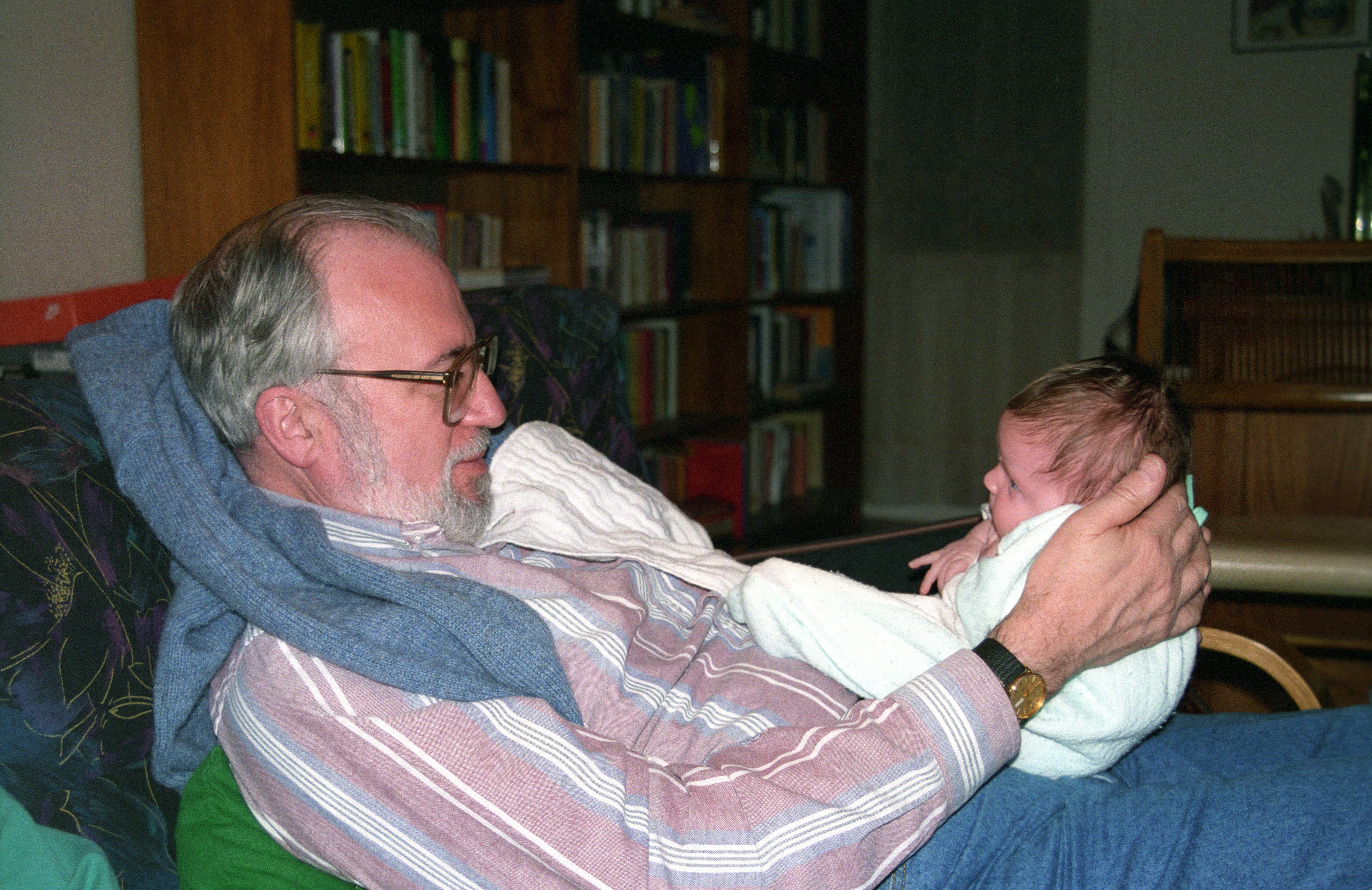
    As I reflect on my father’s life, and can’t help but be struck by what a powerful influence he was on me.  I fear that while my adolescent rebellion against him was mild, it was long lived.  It took me a long time to see my father clearly.  I regret not seeing my father for the man he was earlier in my life, and I regret not spending more time with him when I had the chance.  I don’t recall my dad giving me many words of advise, but his life, his example, spoke volumes.

    Loyalty & Family

    Family was of supreme importance to my dad.  Even when his wife divorced him to marry his best friend, he never spoke a harsh word about either of them to me.  He supported their decisions in my sister and my  lives.  It was clear that he wanted my sister and I to have a good family experience with our mother and step father, and would do nothing to undermine that experience.  I think it was extremely important to him to be supportive of his children.  While my dad could be critical, he was always supportive of me as a person.  He made it clear that my sister and I should be committed to the other, and always look out for each other.  He was overjoyed to be a grandparent.  In an age where families drift apart, he worked hard to stay close not only with his sister and children, but with his nieces and nephews as well.

    Simplicity

    My dad loved simplicity in all things.  The first place you could observe simplicity was his lifestyle.  Unlike many people, he always lived well within his means.  He didn’t feel compelled to upgrade, update, or otherwise “keep up with the Jones”.  If the clock radio purchased in 1972 continued to provide the time and had a functioning alarm,  there was no reason to replace it.  He never seemed to worry about brands or status symbols, he was just concerned that “the job would get done”.

    Dad also looked for simplicity in his professional life.  I think he believed that if a solution, device, principle, etc wasn’t simple enough to be explained on one or two napkins, then you had the wrong approach and were making things too complex.  He was always suspicious of people who tried to attack difficult problems with extremely complex solutions.

    Love Nature

    My finest times with my dad were in the outdoors.  He loved to hike, backpack, fish, and canoe.  He loved watching animals in the wild, especially birds.  Dad could sit for hours watching birds.  I remember him telling me of a series of meetings he had at Xerox PARC.  Almost nothing was initially accomplished because the conference room looked out over a field where there were a number of hawks soaring and hunting.  He just couldn’t tear his attention away from the hawks and focus on the physics at hand, and didn’t regret this at all.

    My father had a deep respect for the natural world.  He found time to enjoy the world God has created, and spent time learning about the wonders of creation.  He took the time to read the works of great naturalists and spent time in the wild observing and learning with his own senses.  I think he had a great sense of wonder, and loved to discover and explore.  This continues even after his first stroke with naturalist lead trips.

    The Beauty and Value of Science

    My dad was an scientist and an experimentalist. Why speculate when you could give it a try, measure the results, and then draw your conclussions from real data. While I am naturally more comfortable in the world of mystery and mysticism, my dad taught me to value the concrete. To look at real data. To run experiments and look at the results rather than relying exclussively on intuition.

    Humble Service

    My dad was a brilliant man… evident from an early age.  He never finished high school because he was selected by a Ford Foundation for a special scholarship program and sent to Yale.  He continued on to Rochester, and then to University of Colorado to finish his PhD.  He was working in the field of integrated optics before people knew it was a field. His rapid wit was recognized by anyone who spend more than a few minutes with him.  Yet he was never arrogant.  He had a sense that his intellect and abilities were a gift, something that should used, not bragged about.

    Respect for Others

    I never saw Carl put other people down.  That’s not to say that he couldn’t be blunt, but that he addressed real issues he thought could or should be fixed. He didn’t snipe at people are make statements for the purpose of hurting others. You didn’t have to wonder if he was trying to manipulate you or hide things. What you saw was what you got. Carl was forthright when speaking to others. 

    Carl was quick to hear other people out, and liked to bring the best out of others. He loved collaborating with others, and had no problem letting others take the lead in areas where they were stronger than he was. He also was happy to give people a chance, even if they hadn’t proven themselves yet. Just after I had gotten my drivers license he some family to visit just outside of Pittsburgh, PA. Some of my best friends had just moved to Pittsburgh to attend CMU… I hoped to visit them.  So off we went. Once we got to the cousins home my dad gave me the keys, told be when to be back, and sent me on my way. This doesn’t sounds like a big deal… but I had a brand new license and had spent all my time in an automatic transmission car. He was giving me his brand new stick car to drive when I had less than 1 hour of time driving a stick where the streets were flat, while Pittsburgh is notoriously hilly. Somehow I got to CMU and back on time without crashing his car… but I wasn’t confident that this would be the outcome… but Carl thought it was worth the risk.

    Charity

    I grew up knowing that charity was important.  I saw my father’s example, giving time and money to charities that he thought were worthy.  At an early age I was encouraged to donate portion of the money I received for my birthday and holidays to an appropriate charity. 

    Emotional Honestly & Communication

    Alas, this was a lesson that I mostly learned through a negative example.  Like many men of my father’s generation, he has a very hard time telling people how he felt.  It was extremely difficult for him to say “I love you”, or “I am proud of you”.  These are words that I longed to hear, and never heard directly from his lips.  While it was hard for him to be honest about his feelings with the person in question, he was able to be honest with others.  So while he might have a hard time telling my sister how much he respected my sister’s commitment to her kids, he was able to tell me and his wife.

    Watching my dad struggle with expressing emotions taught be the importance on learning to be emotionally honest with people, especially the people who are most important to me.  I don’t want people to long for an encouraging or affirming word from me, which I desire to give, but find myself unable to speak.

    A Rolex… a touchstone?!

    One of my most prized possessions is a Rolex watch that was my dad’s. Now if you knew my dad or you read the above text you would likely say “Carl owned a Rolex?”  Indeed, for as long as I can remember, dad only wore the most basic analog (he was and optics guy) Timex that most likely cost $10. So how does a Rolex fit in? It was a gift that he received when one of his students completed his PhD. Did dad switch to this fancy new watch? Nope. He kept wearing his Timex because it got the job done. Did he ever wear the Rolex? Yes, when his wife or friends requested that he wear a nicer watch when going to formal events. Why do a love this watch? Because it represents for me his commitment to quality, his profession, and to his students, and that fact that he would have never purchased the Rolex for himself. You can tell when I am really missing my dad. My $15 digital (I am a computer guy) Timex is replaced for a day or two with the Rolex.

    Facts and Figures

  • Faith

    Everyone has a personal faith. Some people place their faith in traditional religions while others collect ideas from various sources and create a unique, personal faith. Sometimes people put their faith in social or political movements. Still others place their faith in progress or technology, that is the future. Not everyone has a well thought out faith, not everyone recognizes what their faith is, but everyone lives by some sort of faith.

    UPDATE 2025: The core of my faith hasn’t changed, but a number of the references needed to be updated. I have also added a bit of what the last 35 years has taught me since first writing this post.

    [toc]

    What is Faith?

    So what is faith? It is trusting in something you can’t prove and living based on those core beliefs. That’s not to say that faith is irrational, or that there isn’t evidence backing your conclusion, just that you have to go beyond what you can see. Even the pure “rationalist” has to make a “leap of faith” to trust their thinking as discussed by Timothy Keller in his Authors@Google talk. A great illustration of this comes from the book Flatland. Just as the two dimensional residents of Flatland struggled to imagine the greater reality of three dimensional space, so we struggle to see the full reality that goes beyond what we can see with our eyes. C.S. Lewis’ discussed this struggle in  The Weight of Glory. There is a spiritual dimension that anyone can discover, but no one sees naturally.

    My “Faith” Journey

    I grew up in a secular Jewish home. I had faith that I was a good person who could make a difference in the world. I had faith that science and the advances in technology would ultimately address any problem. In my teens I discovered that I wasn’t as good as I had hoped. I could be selfish or cruel when I wanted to be gracious and kind. I started to fear there was more evil in the world than good, and wondered if there was any hope. I also started to see how technology was a two edge sword, useful to do great good, but often came with unintended consequences and could be misused. Would mankind destroy ourselves and our planet?

    I read the books of many faith traditions and several philosophical systems from Autobiography of a Yogi to Zen Mind, with the Bible, the Koran, Mere Christianity and many others books in-between. Nothing gave me the answers I was looking for. I decided that there must not be a God. I started to think that the nihilists were right. In the midst of this my heart longed for hope. Then one night I woke up and felt the need to pray for a friend (who I later learned was in grave danger). It was odd, I don’t recall praying before that night, and even stranger was praying to a God I didn’t believe in. Over the next couple of years I found myself continuing to talk to God, even though I doubted there was a personal God, nor did I hear any reply.

    One day a friend succeeded in getting me to a bible study after persisting for months. The study from James 2 made sense. One of the observations the teacher made was that if Christianity was true, it should make a huge difference in people’s lives. I thought “Exactly… that’s why Christianity must not be true, Christians are such hypocrites”. I looked around the study. There were people I had known for several years. I was fairly self-righteous, and thought I was better than they were. Yet, I could see a love, a unity in that community that I couldn’t explain, and that I wanted. I later learned the Bible (John 13:35) noted “By this all people will know that you are my disciples, if you have love for one another”. Maybe there was something more to Christianity than the hypocrisy I was so quick to point out. The teacher called for people to commit themselves to Jesus. All of a sudden, everything I read in the last few years snapped into focus: foremost the amazing life of Jesus described in the the book of John and C.S. Lewis’ Liar, Lunatic, Lord argument. That night I became a follower of Jesus.

    Over the next few months I continued to examine my new faith. Did it truly make sense, or was it an emotional reaction to a meeting? I reread the gospels and several books from the New Testament. I learned much of the material found in Discovering God which convinced me that I could trust the Bible. The more I investigated my new faith, the more it made sense. I concluded that I really did think the Christian faith was true. Furthermore, I had a sense of God’s presence in my life. I started to see God’s hand in the world. Decades later, I find the core of my faith unchanged. I still encounter things I just can’t get my head around. Life is filled with paradoxes which defy understanding. When I encounter something that is beyond me, I have learned to admit I don’t understand and then I choose to wait for God to make it clear.

    The Core of My Faith

    My faith is centered on a person, Jesus. On who He is, what He did, and what He taught. In a sentence I would say “Jesus loves me and gave me a new life which I didn’t deserve.” Romans 5:10 put it this way “For if while we were enemies we were reconciled to God by the death of his Son, much more, now that we are reconciled, shall we be saved by his life.” I think it’s important to say Jesus rather than Christian because in the mind of many people, the term Christian is link to very un-Christian images. Saying follower of Jesus brings front stage that the Christian faith is centered on a personal relationship, not a system of beliefs, a strict code of ethics, nor is it an alignment with the political left or right. I appreciate the attempt to recapture the word Christian in Carol Wimmer’s poem entitled When I Say “I am a Christian”.

    In my original post I listed a description of my theological beliefs… but I have come to see that there is a great risk to over emphasize orthodoxy. Ultimately unconditional, self giving love is the heart of everything. That said, having a well thought out theological / philosophical system can be helpful when not held rigidly. My theological beliefs are rooted in classic orthodoxy, along the lines of the Nicene Creed. If ever wrote a personal statement of faith it would look something like the Missional Manifesto. My personal theology is more expansive that the Nicene Creed or Missional Manifesto, but I am much less dogmatic about “my” additional details. I recognize that many of my beliefs are my opinion, not fact, and not so important that I should let them separate me from others. As my friend Danny Hall says, “there are very few beliefs I would be prepared to die for.” I wrote a bit about finding unity in essentials and granting freedom in everything else.

    Gain Understanding of the Christian Faith

    I think the best way to explore Christianity is in community. I would suggest seeing if the alpha course is offered near you. These gatherings provide a place to discuss important issues. While the group is lead by Christians, all viewpoints are welcome and honest discussion is encouraged. It’s an opportunity to learn together.

    There are numerous books that explain / explore the Christian faith. I would suggest the best starting place would be reading the “book” of John found in the Bible. The books A Search for the Spiritual by James White and Discovering God by Dennis McCallam are brief but excellent guides to the process of exploring spiritual issues. The Reason for God: Belief in an Age of Skepticism by Timothy Keller clearly addresses the most common questions related to the Christian God. The identity of Jesus is the single most important issue when considering Christianity. Is there credible evidence that Jesus is the Son of God? The Case for Christ by Lee Strobel attempts to answer this question. Basic Christianity by John Stott has one of the clearest explanations of the core of the Christian faith.

    The good and beautiful series and the book/materials from Practicing the Way provide excellent frameworks to understand how Christianity, a life centered on following Jesus, works out in everyday life.

    How Faith Shapes My Life?

    I think people often make the “Christian” life too complex. They have a long list of rules, things that they should do, things they should avoid. I think it’s much simpler. I think the most important thing is to understand love. One of my favorite Bible passages that gets at the core of how following Jesus should effect our life:

    He has shown you, O man, what is good. And what does the Lord require of you? To act justly and to love mercy and to walk humbly with your Lord.

    Micah 6:8

    A similarly brief formulation was provided by Jesus:

    You shall love the Lord your God with all your heart and with all your soul and with all your mind. This is the great and first commandment. And a second is like it: You shall love your neighbor as yourself.

    Matthew 22:37-40 (ESV)

    How does this work? The life of a follower of Jesus is spent learning about who Jesus is, understanding His love, and letting His love set them free to live a meaningful and loving life. As you grow to know a friend, and to appreciate them, your life changes a bit and you take on some of their characteristics. A follower of Jesus will slowly have their life changed so that it looks more like the life of love that Jesus lived. Not because they are now following an external set of rules like the Ten Commandments, but because they have love in their heart. Book of Galatians which can be found in the Bible’s New Testament says that the fruit of the Spirit, that is the result of God working in a Christian’s life, should be love. Then this book goes on to enumerate what this love looks like: joy, peace, patience, kindness, goodness, faithfulness, gentleness, and self-control. Jesus himself said that people will know we are His followers by the love which is manifest in their community.

    Key with following Jesus is remembering that we are responding to His love. Grace, not works!! God initiated not us. My breath prayer is “Lord so fill me with your love that it overflows on others”. We shouldn’t be surprised when we fall short. The gospel is at the core of not just being “saved”, but also how we live. A few months after I had starting following Jesus, a dear friend shared an observation which has shaped my life.

    The sign of maturity is not the lack of sin because in this life you will never be free of sin, but how quickly you return to the throne of grace.

    Doug Lawver

    My Experience with Churches

    I have a seperate post which summarizes what are church essentials.

    After I decided to follow Jesus I attended Fish House Fellowship, later called Xenos, and now Dwell Community Church. There is an interesting thesis that examines the development of Dwell and Vineyard Columbus. During my twelve years at this church I along with my co-leaders started and ran small groups, conductive evangelistic Bible studies, planted a house church, started a ministry to international students, establish a missions program, and sent mission teams to Brazil and to Southeast Asia. Xenos provided a great foundation in both practical and systematic theology, advanced hermeneutics and provided an effective framework for service which I am forever grateful. The church had it’s issues… it was a bit too focused on methodology and some of the leaders, especially the younger ones, could be overly controlling because they had not yet learned how trustworthy God is, and the futility of striving to control life.

    then moved to the SF Bay Area and attended Penisula Bible Church which helped me trust God more deeply in day to day life and to find common ground with people who embraced different traditions and beliefs thanks to the example of Doug Goins and several other people of faith. At PBC I co-lead small groups, served and provided mentorship to college students, young adults, and young married couples. I coordinated the Perspectives class several times, co-lead our missions team and I participated in PBC’s intern program.

    I moved to Menlo Church, Cafe Campus to join Jackie and her (now our) daughter who loved their junior high youth program. At Menlo I was involved with small groups and Stephen Ministry.

    When Menlo closed the Cafe campus Jackie and I started to search for a new spiritual home… we aren’t completely settled yet. We continue to be involved with the Side by Side Community at Menlo. Most of our friends from Cafe ended up at A New Community Church in Menlo Park.

    Some hints about finding a good church.

    Caring for “The Other”

    The heart of orthodox Christianity is love, that is caring for others. Our identity, allegiance, and citizenship is as a member of God kingdom, not the nation/state here on earth, or tribe, our political party, or other any other human organization. We are called to care for and treat all people the same, not to favor people like “us” and be against “them” which was is eloquently explored in several of Miroslav Volk’s writings such as Exclusion and Embrace.

    Alas, evangelical churches are breaking apart due to political tensions because people have forgotten that we are Jesus’ people, not the follower of some political ideology or a political personality. The universal call to love “others” has been replaced with a political identity which is being used to separate people rather than to promote reconciliation… the mission Jesus wants us to attend to. I believe a huge issue is that the church in the USA has been victim of what Os Guinness called “cultural containment” thinking our culture is Christian without looking for how our faith and culture are in tension.

    I have a post which discusses why God calls us to love our neighbors, not to seek power!

    Additional Resources

    There are countless resources and books to explore different belief systems. It would be hopeless to try and keep a good list. When I first wrote this post one of the best sites was Websites about Religion: originally created by Wabash Center. These days I would say use a search engine.

    There are a number of other books have been pivotal in shaping my world view. Some of the most significant authors that have shaped my faith have been C.S. Lewis, Dennis McCallum, Watchman Nee, John White, Francis Schaeffer, James Sire, Os Guinness, J. Oswald Sanders, Ralph Winter, Larry Crabb, Richard Foster, Kenneth Bailey, D.A. Carson, Dan Allender, Henri Nouwen, Dallas Willard, Timothy Keller, and Miroslav Volk. I have benefited from many of the ideas popularized by Renovare.

    Now faith is the assurance of things hoped for, the conviction of things not seen. For by it the people of old received their commendation. By faith we understand that the universe was created by the word of God, so that what is seen was not made out of things that are visible.

    Hebrews 11:1-3 ESV

    in your hearts honor Christ the Lord as holy, always being prepared to make a defense to anyone who asks you for a reason for the hope that is in you; yet do it with gentleness and respect – I Peter 3:15 (ESV)