Category: personal

posts that are about my life

  • Generosity > Greed

    I have been fortunate to have several people in my life who exemplify generosity and inspire me to follow in their footsteps. In the last year I have been challenged and encouraged by Glen Van Peski’s Take Less, Do More, a class on The Practice of Generosity at Bridgetown, and the book Giving is the Good Life.

    As I was reflecting on the material from the Generosity class I was reminded of a series of experiences from around twenty years ago:

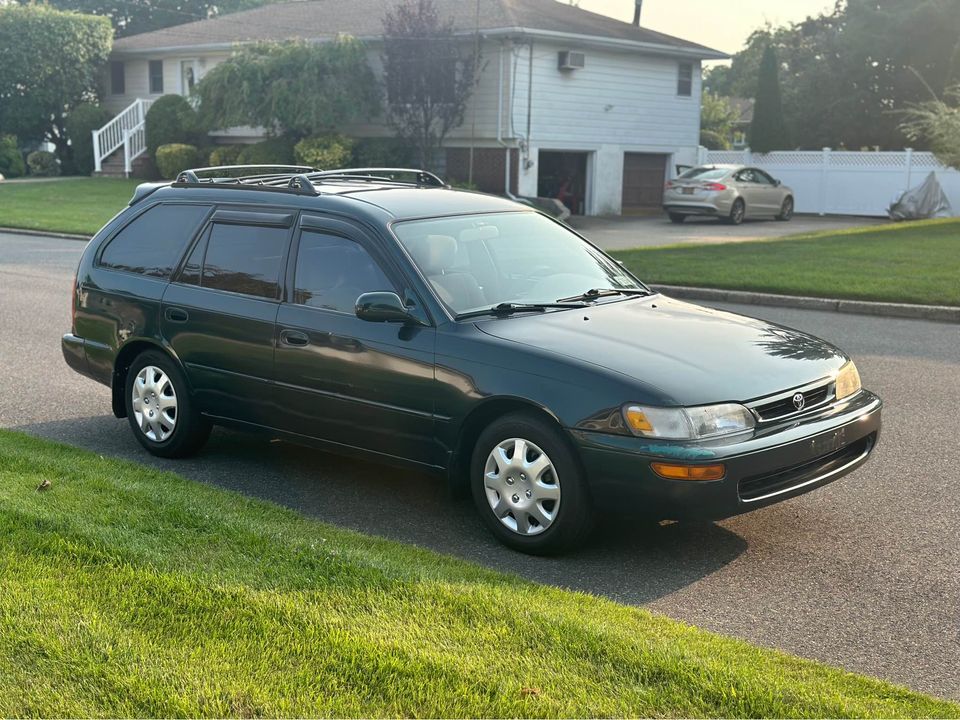
    My first couple of cars were compact Japanese sedans that were pre-owned. I was delighted to have a car that was reliable and safe. For nearly 15 years my wife and I shared a car. 1997 we decided to get a second car when I regularly had to travel further than was practical on my bicycle. We purchased a new Toyota Corolla wagon which became my wife’s car during the week, and the car we used for family activities. Our Mazda 323 became “my” car. A couple years later we determined the Mazda wasn’t safe. We replaced the Mazda with a Toyota Camry.  The Camry became my wife’s car, and the car we used going someplace as a family. I “inherited” the Corolla which delighted me. I really love the Corolla, the Camry seemed too big.

    In 2000 I was working for an early stage startup. Many of my coworkers came from startups that had done very well. Our parking lot was filled with cars paid for by IPOs. Mostly Audis, a good number of BMW and Mercedes Benz, a sampling of higher end Lexus, several Porsche, at least one Jag, Lotus, Range Rover, and a Hummer (real, not a H2). I noticed these cars, but it didn’t seem to affect me. I loving my little Corolla station wagon. It was very reliable,  functional and was the perfect size.

    As I was constantly exposed the these cars my contentment slowly eroded.  I started to become  envious of the people with those nice cars.  I told myself those cars were too expensive and didn’t have a good ROI. Then I found myself reading reviews about performance cars, looking for what cars provided the best performance per dollars and could be reliable enough to be a daily driver. Then I started to consider what I might do when our company had a successful exit. I thought, “I have worked hard. maybe it would be ok to purchase a nice car.” I found I was spending an increasing amount of time thinking about cars even though our cars were completely adequate.

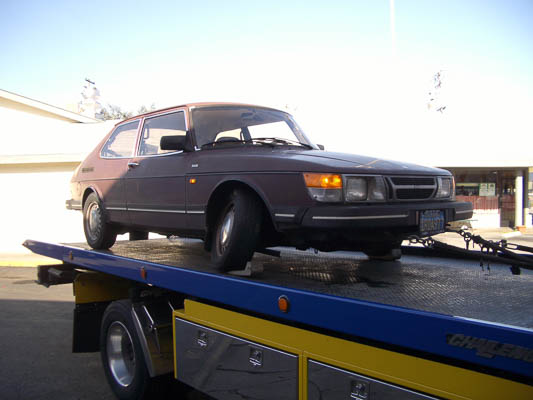
    One day my wife and I were talking with some missionaries sent out from our church.  They were spending the summer in Palo Alto and then were moving to Dallas to train future Wycliffe translators. They were worried their 1979 Saab 99 wouldn’t survive the drive to Dallas.  Even if the car made it, it didn’t have air conditioning which would be tough during summers in Dallas.  They asked us to pray for a solution or at least that the car would make the drive.

    I felt a stirring in my spirit.  I turned to my wife, she saw the expression on my face and nodded. I said to them “Your prayer has already been answered.  We have two cars, but only one is regularly used and the other only needs to be used around town a few times a week.  Lets trade.” The next week we exchanged my 1997 Corolla wagon for their 1979 Saab.  The missionaries were very thankful. One said “This is the nicest car we have ever had. We know it will serve us well.”

    Fast forward a year. An acquaintance was driving me to my work after a church retreat. As we were pulling into the parking lot I started to describe the car I wanted him to drop me next to. As he was looking across the parking lot he said “My car!”.  Turns out the Saab was originally his mom’s. It became his car during school and he used while he was working his first job. He replaced it with a nice Audi when his company had an IPO, and donated it to the church that in turn gifted it to our missionaries. We had a laughed about how it is a small world. A year later I learned Peter was going to leave his company and told my boss. We became coworkers making is a very small world.

    Sometime later I was talking with a good friend who drove a Volvo 240 station wagon that might have been older than my Saab.  We agreed that we had the two ugliest cars in our neighborhood. My car’s red paint had faded to an ugly brownish color, his color was quite splotched.  In the middle of the conversation I realized that I was no longer envious of the cars at my work. I was no longer reading car reviews. I had come to love my old Saab. I was more than satisfied… every time I drove the Saab I remembers how happy and grateful our missionaries were which made me smile. This led me to the following reflections:

    1. When I am continuously exposed to luxury, I start to think it’s normal and I grow discontent with anything less. Unless I mindfully resist the environment I am in, it will affect me. This is a close relative of adaptive hedonism.
    2. An act of generosity can reset my perspective, filling me with joy, thankfulness, and contentment. Swapping my nearly new Toyota for an old Saab had freed me from feeling envy.

    Several years later a tire rod on my Saab snapped as I was merging onto Page Mill Road. Thankful no one was injured as I jerked to a stop in the middle of an interchange.  I had to pay a junkyard to take the car away… there was no value left other than great memories and a life lesson.

    The next week I went out to test drive some cars. My dear wife said “Try whatever you like.  You have been driving the Saab… it would be ok to drive something nicer.” I test drove a wide range of cars including an Audi and a Mazda RX7 that I had lusted after a few years early. I concluded that wanted a Corolla station wagon. Alas, they stopped making them.  I ended up purchasing a VW station wagon which seemed like the most practical option and was fun to drive. After I got it, I briefly considered seeing if our missionaries would be willing to swap a newer VW for my old Corolla.  The VW felt like a sinful luxury and I really missed my Corolla.  After a few months I decided I loved my VW and didn’t need to feel guilty driving a new car.

    In 2020 I learned that my trusty Corolla was still in use. The missionaries had given it to their daughter when she went off to college and it was still providing reliable transportation.

    Cars ownership seems to provide many opportunities to grow in generosity. I earlier wrote about how a car was instrumental in crystalizing my perspective that people are more important than things.

    One person gives freely, yet gains even more; another withholds unduly, but comes to poverty. A generous person will prosper; whoever refreshes others will be refreshed. – Proverbs 11:24-25

  • Love: The Heart of Goodness

    Unconditional love is the most powerful and important force in our world. Love is the heart of our connections and communities, possessing the remarkable power to mend fractured relationships and bridge gaps between people. Love not only opens our hearts to others but also serves as a potent catalyst for learning and personal growth. Love is an essential element for the well-being of individuals. Writing about love is a daunting task. I’m unable to do it justice AND the topic is so important I have to try.

    In the Christian faith, love is central. It is a defining characteristic of God, as stated in I John 4:16. Jesus declared the greatest commandment to be the love for God and neighbor (Matt 22:37-40). Paul followed up noting all the commandments find their fulfillment in love (Rom 13:8, Gal 5:1). Love becomes the unmistakable mark of a true follower of Jesus (John 13:35) and stands as the singular fruit of the Spirit (Gal 5:22).

    How did Christianity go from a fringe and persecuted faith to a national “religion” of the Roman Empire in 300 years and went on to shape most of the core values in the modern world? It wasn’t through violence or force. It was through gentle, humble love for “the other”: caring for the sick, the poor, anyone in need. In short, loving neighbors. Unfortunately, Christians often forget that true power is love, rather than economic, political, or military power which is ultimately impotent. [Sidenote: Tom Holland’s book Dominion covers how the church has oscillated between leaning into love and into power and what came from those orientations]

    What is Love?

    The word love is used in a variety of ways: a preference for a product, romantic infatuation, deeply caring for a friend or family member, and many other things. In Greek there are four different words that translate into the English word “love”. I believe the Greek word “agape,” often described as “unconditional love,” comes closest to my definition of love. My favorite definition:

    Love is willing good toward someone else, independent of what you get in return

    I think there are some simple tests to determine if you are being loving in this way:

    • Are you happy to do something good for the person you love anonymously?
    • If someone gets an opportunity that you wanted, can you rejoice and encourage them?

    Sometimes agape love is called sacrificial love, which I have come to see as poor phrasing. First it can convene a sense that this sort of love necessitates pain. Second, some people perceive this as diminishing the value of the loved person, or places the lover in a superior position. I don’t like the term because a sacrifice isn’t involve at all, love is operating on a completely different plane. The “sacrifice” is merely temporal or material things, existing in “chronos” time. The joy of seeing the person flourish is operating in the realm of eternity, or “kairos” time. Imagine being offered the best experience of your life for a $1 fee, or even $1000. Is that fee a sacrifice? Jim Elliot aptly remarked, “He is no fool who gives what he cannot keep to gain what he cannot lose.”

    As a new convert to Christianity I had a vision that God poured love into my heart, and that my job was to let His love flow through me to touch others. My breath prayer for many years has been “Lord so fill me with your love that it overflows onto others”

    A Renewable, Exponential Resource

    Gentle and Lowly by Dane Orthlund got me thinking about how love is an infinite resource because it comes from God’s nature. Better yet, it grows as it is shared. When you love someone in a true manner, you are passing on the love God put into your heart. As you “use it”, God refills your heart with more love. Now your heart is full and the person you loved has more as well.  If they turn around and love someone, their heart can be refilled by God and the amount of love  grows exponentially. Numerous videos try to capture what happens when people “pay it forward“. People have noted that simple acts of kindness can become viral and even boomerang back.

    I have seen how small, simple acts of love change others. I wrote a bit about my “samaritan experiment” in Relational Openness and Delightful Surprises. Maybe the best way to impact the world is in simple acts of love to neighbors. People underestimate the impact of small acts. I plan to write about this later.  For now, check out Hidden Brain’s A Secret Source of Connection.

    The Measuring Stick

    Given that love is a defining characteristic of God, and seems to be the most important commandment for His followers, it would make sense that love should be the basis of our ethics, the rooting of our decision making process, the heart of our values. When things are unclear “what is loving” can be like a searchlight in the dark.

    Jesus said that the rest of the world should judge whether we are his followers by the love we have for each other. I know seeing the love between members of a church led me to become a Jesus follower.

    As an ambassador of God (I Cor 5:16-20) our first mission is to demonstrate and tell people about God’s love. Our lives should have integrity, that is we shouldn’t just talk about loving others, but live it out.

    Likewise, our church should be judged based on whether we are loving people rather than just caring about orthodoxy of belief. Do we deeply understand that it’s God’s love, not our righteousness, that has us in His family? Are we humble? Do “sinners”, “unGodly”, people who are broken or discarded by our society feel welcome and comfortable at our church? They should. After all, these were the people Jesus loved unconditionally, and who enjoyed hanging out with Jesus. Do we care for people that no one else does because there will be no “return” of that investment? We should live this way.

    The Heart of Lasting Impact

    I noted in my post about revisiting mid-life decision that I have concluded that when it comes to making a long term impact of the human experience, that loving people is the key. It’s impact will often not be seen now, but give the likely exponentially growing impact, it will hugely impactful in a few generations.

    Further Reading

    Owe no one anything, except to love each other, for the one who loves another has fulfilled the law.  For the commandments, “You shall not commit adultery, You shall not murder, You shall not steal, You shall not covet,” and any other commandment, are summed up in this word: “You shall love your neighbor as yourself.” Love does no wrong to a neighbor; therefore love is the fulfilling of the law.

    Romans 13:8-10 ESV
  • Book Themes

    I have been spending a bit of time thinking about what’s important to me, what’s shaped my life. I noticed that there seem to be themes which thread the books I love, the stories I tell, and the way I try to live. Today I was looking at the books that have most influenced me, that I most often have gifted to others, and that I have recently been recommending to friends.  I wrote down keywords that each book evoked and then counted up the number of times each of those keywords appeared.  Here is my stack ranked list with a few keywords lumped together:

    • Love, Grace, Relationships, Community: Likely should be several separate categories but it’s impossible for me to pull them apart. It starts with God’s amazing love toward us followed by the heartbreak of how people seem to get self-righteous and fail to love others. Our deep need for relationships / community. How to effectively build relationships with both people and with God.
    • Empowerment: Identifying and nurturing everyone’s skills and abilities to maximize flourishing.
    • Reflection/Truth: Truth while difficult to identify is what should drive life. An unexamined life isn’t worth living. It’s valuable to think about thinking and learn tools and methods to break problems into manageable pieces. Wisdom > Knowledge > Facts.
    • Simplicity: Key heuristic and value. Improves almost everything when applied
    • Humility/Others:  Personal perspective is limited and often misses something important. Striving to see things through other people’s eyes. Nurture compassion and check your ego at the door.
    • Systems: How people and things interact is more interesting and often more powerful than them in isolation. Look for the relationships between everything. Appreciate how small things with relationships can produce complexity.
    • Technology (has Two Edges): Technology can solve many problems and is really cool. Technology used inappropriately can do great harm. Be optimistic about what technology can do, but always ask what the unintended consequences are. Sometimes low-tech beats high tech.
    • Justice/Money:  Could be separated, but easier to think of them together. How to be good stewards of what God has provided. Use what we are given wisely, but also the need to be generous and to see that everyone flourishes. When wealth and power is too concentrated, everyone life is poorer.
    • Control/Comfort: Its folly of trying to control and strive to only experience comfort. Left to our own devices we would pursue stupid things and avoid opportunities to really learn and grow.  Worse, we will often try to control things which we have no control over, resulting in frustration.  The only thing we can truly take responsibility for is our response to situations. The best path is to trust in God’s love and respond to His prompting.
    • Work Hard: We are designed to work, to make and shape things. Idleness is soul killing. Yes we need rest, but we do best when we work hard on meaningful things.
    • Health/Exercise/Nutrition: We were gifted with a body. Take good care of it, it’s the only one you have in this life.

    I shouldn’t be surprised, but this list has a large overlap with a text I wrote called “Lessons from Life”.  While this list isn’t all my core values and beliefs, it’s a pretty good sample of them.

    What books have you read that really influenced you?  What are your core values?

  • Gratitude for Changes

    This morning I have been reflecting on, and being grateful for books, people, and events that has shaped my life. This has been brought about because I am catching up with some old friends, including one that I haven’t seen in 40 years.

    I am in Portland for most of October. It turns out I know several people here. It’s been wonderful to catch up with these old friends. To hear about their journeys and to share some of my stories. It’s also been great to meet some new people and hear how their lives have changed and lessons learned that shape their lives.

    I often share books that have moved me. I sometimes remember the content of the book, but not the title. In these cases I often pull up my post books that have really changed me. Alas, a few times the book’s title I am trying to remember isn’t on that page.

    This morning I updated the page with a couple of the books that were missing. As I was adding the book  Love Your Enemies by Arthur Brooks, I was reminded of how Doug Goins exemplified the content. Doug was full of grace and wisdom. He knew how to listen and to find common ground with others. I continue to be inspired by Doug’s generous and humble spirit, and pray that I can be more like him.

    I had planned on going for a hike today, but I missed the group. Instead, I find myself sitting on the couch, looking down on Portland, the light softened by the rain, framed by beautiful trees, warm and dry, with a cup of tea, luxuriating in the memories of blessings that have shaped my life. I don’t have time to write them all down. That will have to wait for another day.

    Are there books or people who changed your life?  If so, would you share them with me… or better yet, write a thank you note to the person or author. If they have passed, write a thank you to their spouse or family.

    Give thanks to the Lord, for he is good; his love endures forever. Let the redeemed of the Lord tell their story those he redeemed from the hand of the foe, those he gathered from the lands, from east and west, from north and south.

    Psalm 107:1-3
  • Lessons from the Camino

    The following is a list of the lessons I learned, beliefs that were strengthen, and/or topics which frequently came up in discussions with other while walking the Camino. Walking the Camino provided a wonderful opportunity to consider what makes a meaningful life. The book Walk in a Relaxed Manner by Joyce Rupp is far more in-depth and insightful than this post.

    [toc]

    TL;DR

    • The best part of this journey is experiencing the “Camino spirit” which is exhibited by most of the pilgrims and many of the residence along the way: the default response to others is kindness, curiosity, openness/vulnerability.
    • Simple acts of love and kindness can be life changing for both the “giver” and the “receiver”. If everyone’s response to others was kindness and compassion the world would be a completely different, better, place.
    • The Camino can be a transformative experience. People who benefit the most take time to reflect on their Camino journey, identify what they have learned, and then make changes in their life informed by what they have learned and regularly remind themselves what’s important.
    • The best physical preparation for the Camino is increasing the milage you walk each week in the six months before leaving. Doing once a week training hikes won’t adequately prep you for 30+ days of walking. The people who have the least physical struggles were walkers.

    Life Lessons

    • Love is the ultimate measure of a life.  Love spreads through connections and multiplies: the giver and receiver both grow love. This can result in exponential rather than merely linear impact.
    • The Camino Spirit is:
      • default is to be kind (loving) to everyone encountered
      • no judgement of others, instead curiosity when differences are encountered. Miroslav Volf would say everyone was an “us” not a “them”.
      • choosing to be vulnerable, sharing deeply and honesty which builds connection
    • Walking the Camino forces us to slow down and have space in our lives to notice what is going on in our and others lives. This is something that everyone wanted to bring back with them from the Camino. People who have done multiple Caminos reported that over time they returned to a more hurried pace. One of the reasons they returned to the Camino was to get a reset. Busyness and chasing after “success” will choke the Camino spirit out when you return home.
    • Life changing community can develop almost instantly when a super-majority has chosen to be in the Camino spirit. This is partially fueled by a self selection bias of who walks a Camino. Being on a shared journey helps brings people together.
    • Community is the key to a flourishing life and community is what many people discover on the Camino. Community requires:
      • Time / Availability / Slack. If you are always busy then you won’t have time for community. True community can only form when people are able to share their lives together. Life isn’t predicable. If your community activities are restricted to a tightly defined time-box you will miss out.
      • Care / Love / Acceptance. As mentioned above, love is so important. Healthy communities require the members to choose to love each other and the world around them.
      • Vulnerability. People need to drop their guards and lower their masks so people can truly seem them. Without vulnerability the bonds in the community will be weak.
      • Something bigger than the individuals of the group. What psychologists can transendence. Community that is only focused in itself will stagnate. It needs something bigger than itself.
    • What seems insignificant to you can be life changing for others. Don’t underestimate power of simple acts of loving your neighbor. Thank people when they have made a difference in your life. Often they have no idea they had any impact on you. Your thanks will be an encouragement.
    • The skill of listening well is hard to be developed, but is worth the effort. I often fail to listen because I am so busy formulating answers and fixes rather than listening to truly understand and be empathic.
    • Presence is maybe the greatest gift we can give to someone.  Really seeing people and being with them. Giving them our full attention, and not looking for something better in the moment.
    • Everyone is fearfully and wonderfully made. Cherish, honor, and respect others even if they are being an idiot in the moment.
    • Being a great companion requires dropping expectations and being delighted by another which results in an ease of interactions and great satisfaction.
    • Living out the Camino spirit has many similarity of what Christians would call kingdom living.
    • You can maintain a Camino spirit by cultivating gratitude, remember to put other people first, and leaving slack in your schedule so you can respond to unexpected needs.
    • Sometimes suffering isn’t about us, it’s to prepare us to help others. God loves all his children and will sometimes let one child suffer so all his children can thrive.
    • Don’t blame others. We are responsible for how we respond to all situations. If you give that away, you will always be dependent on other for a sense of happiness.
    • Contentment = CurrentReality – Expectations. We can be happy in very difficult circumstances if we don’t have any expectations, and miserable in situations that nearly everyone would be delighted by because our expectations are extremely high.
    • There is great joy and freedom when simplicity is embraced. Pack and live lightly.
    • Intentional minimalist / essentialism / simplicity focused on making time for what’s most important and getting rid of obligations and possessions that keep us busy and/or distracted.
    • Minimalist can lead to people being hyper focused on stuff, constantly trying to prune things down to a “perfect” set. Minimalism at it’s best understands that stuff is only useful when it enables spending time on meaningful activities and is best when stuff fades into the background.
    • Prayer is good, and has been at the heart of most of my most profound experiences. Yet I am not consistently praying.  This is stupid and needs to change.
    • We all hunger for transcendence because we know in our hearts that there is more than our eyes can see. Some people try to find this in nature and art but this isn’t sufficient.
    • If you don’t push a particular ideology and are genuinely curious, most people are happy to share their spiritual (or none spiritual) journey and you can hear some amazing stories. Ask questions, don’t give answers. Often these people will be interested in learning about your journey. Don’t preach at them, share what you have experience and let them decide what they think. Don’t expect or insist they agree with you. If you are interested… this is a description of my journey.
    • When people share something significant in common, like walking the Camino, other differences aren’t very important. We heard no one spewing nationalistic rhetoric. Rather than “my country is better than yours” I heard a lot more “oh, we do the same” or “We don’t do that, tell me more about…”. The only time I didn’t always see empathy / compassion is the pilgrim vs “tourist” divide in the last 100km.
    • If you want to go fast, travel by yourself. If you want to go far, travel with others. You don’t notice the miles if you are in a good conversation, and you are able to help and encourage each other when difficulties are encountered.
    • The symbolism of the Iron Cross is powerful… identify the weights you are carrying, and drop them at the cross.
    • For many people, the “Camino Spirit” persists for several months and then tends to fade. Key to keeping “in the Spirit” is to leave slack in your schedule to you can be attentive to others, and to remind yourself regularly to prioritizing contributing to your community.

    Practical Hints

    • I found two questions open up many great conversations. The first is “Why are you walking the Camino?” The second was “You don’t have to believe in it… but if someone was going to pray for you during this journey, what would you want them to pray for / about?”
    • Many people we met were carrying too much stuff and found their bag to be a burden. The people who seemed unburdened by their packs were carrying less than 15lbs. Here is a packing list for my next Camino which is less than 10lbs.
    • The right footwear makes a big difference when it comes to preventing blisters. Minimalist sandals like the Shammas Elite Maximus (Bedrock, Luna, Earthrunners, etc) are great provided you have trained your feet before embarking on a long walk. I had no blisters and no foot issues, even after 30 mile days. Ironically I have several people each day ask “Are you hiking in those sandals?” to which my answer was “Yup.. from SJPP. They are the only footwear I brought.”
    • Most people found private or 2 person rooms greatly enhanced sleep quality. Unless money is really tight, they are worth the cost. If not doing semi-private rooms be sure to have eye mask and ear plugs.
    • When you meet people that you “connect with” take their picture and exchange contacts on WhatsApp so you can stay in contact. There are a number of people I would have liked to stay in contact with from some of the first days, but we never saw each other again because we were walking at different rates. WhatsApp QR codes are the easiest way to exchange contact info. If you are using WiFi and don’t have cell coverage take a screen shot of your WhatsApp QR code for others to scan, and take a picture of their QR code for when you having Internet connectivity to connect.
    • Orginize items in your pack based on where you use them. Unpack and pack them the same way each day so you don’t forget anything. For example even if they are different, put things that going next to the bed in the same bag: charger for phone, eye mask, lotion you put on as you get out of bed.
    • The best physical preparation for the Camino is increasing the amount that you walk everyday. Weekly training hikes by themselves are not adequate to get your body ready for a month of continuous walking.
    • Bicyclists on mixed use trails should use a bell to warn hikers of their approach. It is universally recognized and doesn’t seem to startle people.
    • People who are walking as part of a tour can miss out on some of the Camino Spirit because they often travel in a bubble which keeps them from a broader interaction with other pilgrims. If you are in a tour group make a point to meet people outside the tour.
    • At the end of the day it’s hard to recognize people when hats are off, sunglasses put away, and people of freshly showered. If you are meeting someone for dinner and they haven’t arrived, double check to make sure they aren’t already there.
    • We could have sold 90+ Montbell Umbrello Hats. They are incredibly practical and made a lot of people smile. We often had people ask for selfies with us or to borrow the hat so they could have their picture taken wearing one.
    • Some more hints on my Camino page.

    Snippets of Stories

    One of the best parts of the Camino was hearing people vulnerably tell stories from their lives. I don’t feel free to share full stories without people’s permission… but some short fragments of stories I witnesses or heard to give a sense:

    • Retired minister who yearly does 750 tax returns free of charge for the poor in his community which is greatly appreciated by them and grew his empathy and understanding of what people were facing.
    • 72y old gentleman with a lot of grit who adjust his plans so as not to damage his body because he had nothing to prove.
    • A man with terminal cancer walking to Camino to prepare to be his very best self in his last year of life. When he walked the Camino in the past he found the power of kindness, the value of being present with others, and the clarity of a simple life make him better and more loving to all those he came in contact.
    • A couple that came together years ago when one of the parties came to realize the other wouldn’t hold them back but would always strive to lift them up. We could feel their gentleness just by sitting next to them in a restaurant. Though they faced some serious challenges they were joyous and thankful.
    • A couple who met on the Camino and found they enjoyed discovering the Way together. They were learning each others language and enjoying each others company. The had a joy and ease that was breathtaking because they have no expectations other than to be companions as they walked.
    • A vision impaired gentleman who noted that he has a super power… that people strived to be their very best when they saw his cane… being kind and generous to him with this could spill into the rest of their lives.
    • A women who help many of us see the “boring and ugly” Meseta with new eyes… such as how the wind move the grain like waves on the ocean.
    • A gentleman who lost his wife on the Camino 5 years ago who is finishing the walk they started, leaving little memorials each place that would have been special to his wife and sharing his experience of what makes a meaningful life.
    • Many stories of people who were burned out and recovered during their walk finding energy and joy during the Camino. One gentleman said “I was a broken man… on the Camino I was restored.”
    • People who had trouble “letting go” and so were carrying a laptop to keep tabs on things “back home”. It would have been appropriate to leave the laptop at the Iron Cross, but they took the more practical approach of shipping it to Santiago.

    Resources I Shared Frequently

    • Excellent Advice for Living – Kevin Kelly’s 450 tweet size bites of wisdom. This is an expansion of his 68 bits of advise.
    • The idea of training for the Centenarian decathlon. Ideally start in teens, as soon as possible, but it’s never too late, especially if you didn’t do a lot of exercise in your earlier life.
    • Design Your Life – Burnett & Evans. Run small experiments and design yourself into a good life rather than trying to figure everything out and then a grand plan to accomplish everything.
    • Life Worth Living – Volf, Croasmun, & McAnnally-Linz. This book provides a toolkit to explore and determine what is a meaningful life for you.
    • Harvard Study which reveals how good friendship and personal relationships are the most significant factor to health and happiness.
    • Interview with Tom Catena the only doctor serving 750,000 people in the Nuba Mountains in Sudan. Humility, simplicity, what’s important, and resiliency. Support the Sudan Relief Fund.
    • How to Build a Happy Life podcast by the Atlantic. First season was by Arthur Brooks. Other seasons followed with different hosts.
    • Books by Arthur Brooks, Richard Rohr, and Parker Palmer for their life affirming and gracious content.
    • The Good and Beautiful God – James Bryant Smith. Identifies many of the false narratives of what God is like that we believe, and encourages us to have a clearer, and more healthy understand of God’s nature and what He wants for us. Not discussed during our Camino but excellent is Practicing the Way – John Mark Comer which explores some practices which align us with Jesus’ way, a life guided and powered by love.
    • Kindness Diaries follows Leon as he travels around the globe, and then from Alaska to Argentina by relying on the kindness of strangers who freely provide him food, fuel, and a place to sleep.
    • My Unsung Hero from Hidden Brain. Encouraging stories of lives changing by simple acts of kindness
    • Lectio 365: A devotional application which provides 5-15 minutes of content each morning and evening.
    • Six Streams of Spirituality promoted by Renovare for a balanced faith and what living out those streams might look like.
    • How many people miss what the parable of the prodigal son is about, and the gracious insights of Ken Bailey.
    • My notes about the Camino
    • My Packing Light Page
    • My Healthy and Fit Page
    • My advise about money

    Re-Entry from a Pilgrimage

    Many people talk about how jarring it is to return to “real life” after a pilgrimage like the Camino. After a month of a slow paced life characterized by simplicity, quiet, and community they found themselves facing a hustle / hurry culture that is filled with noise and often more oriented toward competition than community. It is easy to get overwhelmed and to return to old patterns and habits, leaving the Camino experience something remembered fondly, longed for, but divorced from daily life. As I have talked with people about their post Camino experiences there are several things which seem to have kept the Camino spirit alive for many. The following is a summary of the advice I have heard about how to live into the Camino experience once the walk is complete.

    • Set aside some quiet time (ideally a week or more) between the end of your Camino and starting back to “normal” life to have time to think, pray, journal, and reflect on your experiences. Identify what you learned, how your perspective has changed, how your values have shifted or strengthened. Ask yourself what is important in light of your Camino experience?
    • Consider your life before the Camino and ask the question “How did my pre-Camino life align with my post-Camino understanding?”. It is likely that you will find places the two don’t align. Realize that if you don’t make explicit changes, your post-Camino life will likely look exactly like your pre-Camino life.
    • Identify changes you would like to make as your return to “regular life”. Many try to change everything, fail, and quickly give up. Rather make a list of things you would like to change and then decide on one item you will start with. Break it up into manageable steps and find ways to turn it into a habit and then a lifestyle. The book Atomic Habits is a great resource for this sort of planning. Once something has gotten established, look at your list and make the next change.
    • The most common change I heard from people was making sure they left slack in their schedule so they weren’t constantly forced to react to life. There were moments to reflect and choose a response. Many found that adding a time each day to just be was key. For some this was time to sit, reflect, and maybe write a few sentences in a journal. For others it was a quiet walk in their neighborhood or a nearby park.
    • The second most common change I heard was people striving to build a genuine community. Often, they had been part of some sort of a community before the Camino, but the experience fell far short of their Camino experience. In some cases people have found that by intentionally investing and initiating in their community they were able form a genuine community. In other cases people realized that where they were putting their time wasn’t working and that they should try something different.
    • Set a date for your next Camino 🙂

    All of these items suggest that what’s key is to identify what you loved about the Camino and then to identify little things which will remind you and keep your grounded, anchored to those things.

    My Next Steps

    • Finish nomad experiment and select the location for the next season of life.
    • Arrange my schedule so I have regular personal (1-to-1) time with people I care about and enough slack to respond when surprises come up.
    • Be more intentional to build community. Not wait for it to happen or be invited in to something that already exists but to initiate time with individuals and group events which will encourage bonding.
    • Improved my listening skills and practice the art of being present. Continue to deepen understanding of love.
    • Set aside time each day to pray.
    • Plan to do another Camino in 2026.

    I am not in control. I am not in a hurry. I walk in faith and hope. I greet everyone with peace. I bring back only what God gives me.

    Murray Bodo, The Pilgrim’s Credo
  • Traveling Begins

    For the next 2-3 years we will be traveling. partially to explore the world, partially to determine where we will spend the next season of our lives. We decided not to sell our home in Mountain View, but to rent it out given the high rent and that it seems like a good investment to hold on to. We are living out of 1-2 bags, and Jackie has some capsule wardrobes that are stored in a location we can periodically access.

    Traveling actually started a couple of years ago. A bit after COVID hit we traveled to Portland to investigate the possibility of buying an investment property, and maybe relocate there. Since then we have spent time in several cities, purchased some property in Santa Rosa, I retired, and our youngest got her own apartment. For the next two to three years we are fully embracing a semi-nomadic existence as we figure out where our home based will be for the next season of life. Our first stop is Santa Cruz for December. Close enough to support our youngest as she is figuring things out, far enough that she won’t feel crowded, and we get to experience living in Santa Cruz rather than just visiting for a day. We are traveling heavy as we finish consolidating life in preparation of spending significant time out of the country.

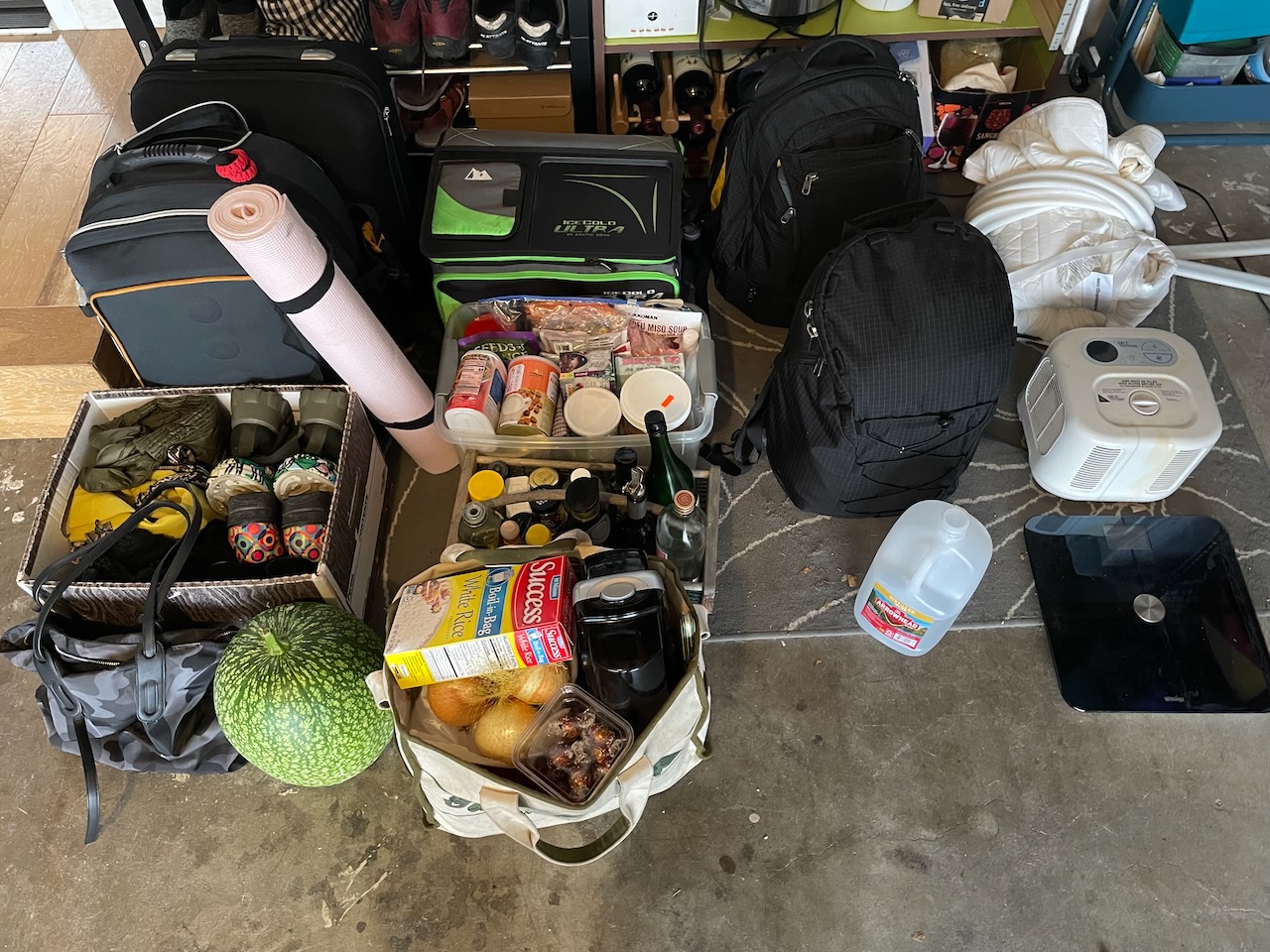
    Jackie’s bags, shoes, and shark fin melon on the left, food we needed to clear out of the house, Mark’s two bags, chilipad, and our scale.

  • Remote College Classes are Painful

    I retired this pasted summer so I would have more time to pursue my interests. I decided to sign up for psychology class at Foothill college for several reasons:

    1. I am interested in psychology, and thought having introduction class would ensure I had a broad and systematic overview of the field.
    2. In my younger years I started and stopped taking college classes because I repeatedly failed one or more of my classes. As an older, and hopefully wiser person, could I now do well in college?
    3. Provide a bit of structure
    4. An opportunity to interact with some  fellow students

    Classes Take Time

    The reading, videos embedded in lecture notes, and time to do the assignments took 10-15 hours a week matching conventional wisdom that time for a class is between 2-3x the number of credit hours. Often I would find myself watching a video for 20 minutes that explained the material in a very basic manner missing nuances that I already appreciated. It was tempting to skip the video, but I felt compelled to watch it in case it covered something I was unaware of.

    Discipline Required

    The class was 100% online. Initially I was doing the school work on my laptop in the same location I do everything else. I found it very easy to get distracted. I needed to set aside specific times to do my school work, and do the work in “study” location. When I failed to do this, I had to spend time on the weekend “finishing my work”.

    Material To Study Directed by Others

    As a student in a class, I had to attend to the material selected by the teacher. I found that there were areas that I thought the material was way to superficial and would have liked to go into much more detail. There were other areas that I had little interest in, and I don’t think are that important in the scheme of things. As a “good student” I needed to attend to what the teacher wanted and do the assignments that where assigned.

    Each week we wrote multiple mini papers (>=350 words). Some of the topics required me to radically shorten what I would naturally research and what I wrote. Others topics were so uninteresting that I had to struggle to find enough words to answer the question. In almost all the cases, a large body of life experience resulted a mismatch of the class expectations and what I would naturally do.

    To do well in the class required memorizing certain facts and definitions. For someone working in the field, having this material available for instant recall would be key. For someone who isn’t interacting with the field on a daily basis, having a framework and access to the web, or even an encyclopedia would be adequate.

    Interaction with Fellow Student Not Good in Async Classes

    Due to some delays in registration, all the in-person classes were full so I registered for the 100% remote class. Structure the class provided was slight: there was a syllabus which specified the topic for the week, the quiz could be taken at the end of the week, but a few assignments and reading lists. 

    As a fully remote class the interaction with fellow students was in a very poorly designed “discussion system” which resulted each student posting a short paper answering several questions, and then maybe a couple of comments in response to the post.  Little back and forth. Hard to really pull out people’s life experiences.

    Conclusion

    At the end of the 5th week I have a near perfect score.  I have confidence that I could go back to school and get a degree if I wanted to. Alas, I feel like I have learned very little in the class and engaged in a fair amount of “busy work”. This is not a good use of my time. I would like to skip over what I already know and focus on new material. It’s very hard to do this in a structured class.

    One thing I did learn. I can improve my ability to evaluate the quality of research studies and identify ways to improve studies. I don’t know if this is something I would have discovered in most classes, but it’s something that some of my instructors assignments helped me appreciate.

    Getting through introductory classes / basic educational requirements will be a challenge for me… not due the difficulty of the material, but because it will be boring. Succeeding in these classes will depend on “playing the school game”, not about learning.

    Online discusses of academic material really sucks. It wasn’t a discussion, it was more like people making statements to each other. It’s very unlikely I will sign up for classes that don’t have synchronic  interactions as a core part of the class.  I really feel bad for the student whose college experience is largely made up of these a-synchronic remote classes.

  • Retired

    Retirement: A stage of life when you are able to invest time without being constrained by the need to earn a salary. It becomes easier to pursue things that you think are truly worthwhile without having to make compromises. It’s possible to be “retired” and be working a job that pays you a salary if you aren’t dependent on keeping the salary.

    I expect people who read my Midlife Reset Revisited post wouldn’t be surprise that I retired July 29, 2022 after working in technology for 43 years. That’s something like 100k “work hours” and 30k hours in meeting.

    I had the privilege of working with some extraordinary people at several great institutions. I had a front row seat to major technological changes… sometimes helping them along. Much of our work stood on the shoulders of giants whose work in the 1960s and 1970s still provides wise guidance such as Butler Lampson’s Hints for Computer System Design. I had the joy of mentoring numerous students and employees. I am grateful that I could be an industry advisor to several projects associated with the CS department at UC Berkeley. It’s gratifying to see how the ideas developed in the ROC, RADlab, Tier, and like projects have spread. My workplaces have included two universities, Xerox PARC, and seven startups, five of which “succeeded” by going public or by being acquired by Google or Microsoft. Along the way we built some remarkable systems and some wonderful friendships.

    To be effective in most technical fields required many hours outside “work hours” invested in continual learning. Every 4-5 years there seems to be a new technology or approach to learn and master. Until recently I had enjoyed expanding my “systems” mastery. A signal that it was time to make a change was that I was happy to spend time learning about most any topic but distributed systems. I knew it would be useful to refresh my knowledge of container orchestration, to learn about Raft even though I paid the cost to understand Paxos, etc. I just couldn’t bring myself to do it. Yet I was eager to be reading about economics, sociology, theology, striving to understand the Krebs cycle… oh my, so much to learn, so few years left.

    I also started to notice how much of my mindspace work took: the time spent in showers, on walks, in the middle of longer bike rides, and those nights I couldn’t sleep thinking about how to advance our field or overcome a challenge at work. Rather than being energizing as it had been, it was feeling like a burden.

    My wife Jackie has been encouraging me to embrace “life” as discussed in the classic book Your Money or Your Life and not worry so much about money. It’s time to invest in what I find truly life giving. My desire is to spend more time thinking about the “human heart” and mind, less about technology. To have more time to invest in my family, local community, neighborhood, church, and some NGOs I have periodically assisted. I want to live rest of my life with wisdom, leveraging all I have learned and experienced so far investing into other people as described by Richard Rohr in Falling Upward and Arthur Brooks in Strength to Strength. I nearly made this transition 10 years ago, but I flinched.

    Short Term

    Health: I am going to step up my exercise and physical activity. Time to reactivate Strava. Times are going to be slow. After a year of stagnation it will take some time to make new PRs, but it will be fun to have more time to run, cycle and lift some weights. I will have time to join Jackie learning Tai Chi. I am making appointments for various checkups that I should have done awhile ago, and revisit my game plan for a healthy and fit life.

    Backpacking: It’s been almost a year since I have taken a backpacking trip.  I am going to find some places that aren’t burning and get away to enjoy some natural beauty and solitude. First stop Ventana. When did it become so hard to get wilderness permits for the Lost Coast?! Emigrant Wilderness in the next month. Hopefully I will be able to join a good friend on a section or two of the AT this fall.

    Learning: There are many topics I want a deeper understanding. Some study will be on my own. Some will leverage community college. This fall I am hoping to take a psychology course that my daughter is taking.  Maybe she will be a study buddy. One thing I realized is that there are more books I want to read than I have years left. I am going to focus on reading what I think will be valuable, and not feel compelled to finish a book just because I started it.

    Connections: I am going to take some time to visit family than I rarely see and meet some family members I have never met. I will have more time to spend with people from our church and neighborhood. I expect we will be having people overa couple times a week for the rest of the year. Groups of six are really great. If you have 8 or more you end up with multiple conversations. Now that I have more slack I am going to restart the “whose my neighbor?” experiment that I did when I took a sabbatical from work ten years ago.

    Contemplation: Make space to listen to my heart, to God, and to the people around me. Being more intentionally grateful, and more attentive to what’s happening around me, and living more in the moment. More consistent in my prayer life, and working through some material about pilgrimages and personal transformation in preparation for walking the Camino De Santiago, aka The Way of Saint James.

    Medium Term

    Travel: in next couple of years we are going to visit places that might be home for our next season of life. We don’t know where we will ultimately settle… leading candidates now are the Mountain View/Los Altos, Berkeley, Santa Rosa, Santa Cruz. Portland, San Jose Costa Rica, Lisbon, Portugal… but all that could change in the next two years. We will spend 1 month “scouting” locations over the next year or two. Within a couple of years we hope to narrow the options down to a few places. We plan to spend 6 months in each location before planting ourselves.

    Walk the ~500 mile Frances Camino in May 2023

    Close out work lessons?: Over the years I have made notes about all I have learned about building reliable systems. I abandoned turning my notes into finished documents years ago… but I know some people who are working on formalizing something similar. Maybe with a bit of a break from technology and management I will have enough interest to put just a bit more time into my old field.

    Long Term

    The general vector is to get better at loving God, loving neighbors and growing in faith. The specifics are still in process. My current page will give a brief snapshot of whatever is top of mind right now.

    Love is patient and kind; love does not envy or boast; it is not arrogant or rude. It does not insist on its own way; it is not irritable or resentful; it does not rejoice at wrongdoing, but rejoices with the truth. Love bears all things, believes all things, hopes all things, endures all things.Love never ends. As for prophecies, they will pass away; as for tongues, they will cease; as for knowledge, it will pass away. For we know in part and we prophesy in part, but when the perfect comes, the partial will pass away. When I was a child, I spoke like a child, I thought like a child, I reasoned like a child. When I became a man, I gave up childish ways. For now we see in a mirror dimly, but then face to face. Now I know in part; then I shall know fully, even as I have been fully known. So now faith, hope, and love abide, these three; but the greatest of these is love.

    I Corinthians 13:4-13 (ESV)
  • simple pleasures – cool breeze

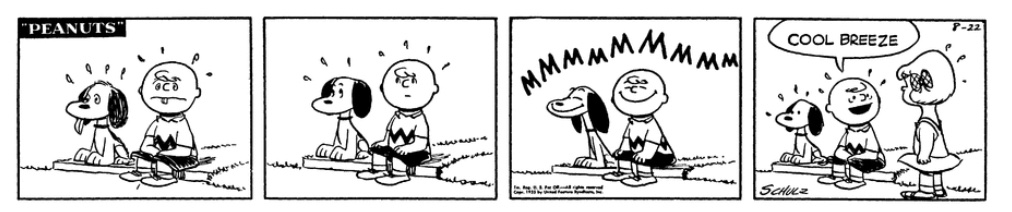
    Nearly fifty years ago I was looking through a book of early Peanuts cartoons while I waited for my violin lesson. One of the comics showed the simple pleasure of a cool breeze on a hot day. Since that day whenever I feel a cool breeze I will pause for a few seconds and relish the wonderful feeling and remember the comic which sharpened my awareness. Isn’t amazing how very simple things can bring so much pleasure. I am grateful for the genius of Charles Schultz. Every few years I have looked for this cartoon but never was able to locate it. Today google image search finally returned the strip I was looking for.

  • Midlife Reset (Part III) ReThinking 10 Years Later

    TL;DR

    • Community is better than being self-sufficient
    • Transformed lives are better than many lives impacted but not self propagating
    • We are adaptable
    • We can be content and grateful with just the necessities
    • Why Worry?

    My three rethinking posts (part 1, part 2, and this one) were written at the end of December 2021, but I delayed posting until plans for my retirement had been settled. I think anyone reading this would realize I was transitioning and didn’t want to send that signal before my boss and company were ready for others to know.

    Independence –> Interdependence

    For most of my life I have strived to be independent. To be able to take care of myself. In high school I imagined being self sufficient, living off the grid: to grow my own food and to get power from renewable sources. Throughout my adult life I have had thoughts of living on a sailboat or in an RV, having everything I needed for life in a small, movable space. I wanted a small cocoon of safety and security, a core I could always trust.

    The simple / off-grid / independent dream was fueled by fears rather than maximizing what I most wanted. My fears didn’t want to be dependent on others who might fail me. I also wanted to be free from the fear of failing others who depended on me. You can’t be totally independent and also be an integral part of a community. You have to welcome help and provide for others when you are able. I have discovered my deepest joy has come from being in a healthy community and having good personal relationships. Relationships built on love that has no agenda. An independent life might be “free” and “safe”, but it is also impoverished.

    I have found building a strong community requires time and the parties to have a willingness to engage. Ten years ago it seemed inconceivable to leave an existing community and start over. Ironically, the community I wanted to keep was fraying, and I was successfully building a new community. After Libby died many of my friends pulled away. A few years later when I switched churches to join Jackie many of my friends from the old church were  too busy to get together.  Jackie and I found that when we initiated and invested we have been able to build a new community. Our new community doesn’t have the depth I experienced in the past, but it is deepening as time goes on.

    A VC I recently met (and has just exited the Bay Area) observed that a lot of people come to the bay area from across the world to make their fortune and leave their mark. That’s what he did. They are so focused on their mission (and often lacking interpersonal skills) that relationships are purely instrumental… it’s all about extending a professional network.  You can get a first meeting, but you won’t hear from people for a second meeting if you aren’t a useful connection. My daughter told me about how she would regularly be snubbed by people as soon as they  realized that she wasn’t someone who could connect them to other high tech people who could help their career. On top of this is a busyness caused by the drive to succeed. Even my most intentional friends often get caught up in the busyness. If these weren’t enough of a challenge, there is the high cost of living which makes the area more transient than many locations. The local ethos makes it hard to build and maintain healthy communities.

    Jackie and I recently spent six weeks in Santa Rosa. We attended several meet ups, talked with some neighbors, and attended a few churches. Santa Rosa Christian Church did an amazing job welcoming us. Even though they knew we were just evaluating the area they were happy to engage. I found people in Santa Rosa significantly more open than the people I encounter in Mountain View. We later found Portland to be even more community oriented.

    For the last thirty years I have tried to resistant some of the more toxic aspects of the bay area culture. I have tried to be a light in the darkness. I am tired. There are many things that are great about the bay area, but community is a definite negative. The time we spent on Santa Rosa felt a bit like being welcomed home. We haven’t settled our long term plans, but we will be exploring where to base the next season of life. We would like to be be someplace where people prioritize deep personal relationships and community.

    High Impact Now –> Exponential Future

    I have always wanted to have a positive impact on the world and leave it in a better condition than I found it.  I tend to be a utilitarian.   I thought about this in terms of an equation 

    total good = number-of-people-impacted * positive-impact

    Estimating number of people is fairly strait toward. Quantify  impact is hard. I  think people’s lives have a physical, mental, spiritual, and a relational component. I have always been unsure how to balance these things. Equally weighted? Is there is a priority order? Maybe there is a minimize level required after which it’s better to impact other areas. How to factor in diminishing returns?

    I have come to see that focusing on small acts on love is the key to lasting and significant impact to human flourishing.

    When I look at the Bible, when I look at Jesus teachings and life, I don’t see admonitions in terms of maximizing good. I see a focus in a much smaller domain. How we are treat our neighbor and our family.  One could say it was a tactical focus. Part of me is inclined to say “Ah… that’s because they didn’t have the technology we have today that gives us huge leverage.  Back then you could only influence a small number of people personally, now we can touch millions, if not billions of people.” While technology, the printing press, phones, computers, etc provides leverage and it impacts individuals, it doesn’t transform. The impact is not self sustaining.

    Sidenote: I just finished reading the book  Four Thousand Weeks which has lot to contribute to the topic of working on things that matter, though there are some misses because he doesn’t understand the interplay between finite and eternity. I haven’t incorporated any of observations from his book in this post.

    I have noticed that I get a greater sense of satisfaction from helping one person personally than working on a project that potentially impacted millions of people. Why was that? Could it be hinting a something I might have been missing? I was reminded about the power of compounding.  Jesus’ focus on his 12 disciples not the crowd. Robert Coleman captured this beautifully in the book The Master Plan of Evangelism. At the beginning, the strategy seems slow and ineffective, but over time it literally touched the whole world. While a bit artificial there are several videos which try to show how one simple act of kindness (love) can spread virally and the movie Pay it Forward. Love is an unlimited resource because it comes from God. It is the only resource that grows as you share it. Living a simple and loving life which slowly leads to transformation in other individuals will bring about more goodness than doing something that impacts millions of people but doesn’t replicate beyond that. This is a topic I will write more about later (first attempt posted).

    Ten years ago I decided to look for an opportunity to work on a product which would positively impact millions of people. One of the best places to do that is in a bay area high-tech company. I believe the work I contributed to at 23andMe had a small impact while I was there, and will have a profound impact to millions of people in the future due to the amazing database and how I think that will impact drug discovery. I am going to shift my focus from making high impact products to finding ways to bring the transforming power of love into the hearts of people. This is best accomplished through personal interaction. Few will see the impact of this sort of “work”, but I believe it will have a larger long term impact that something that would be seen by millions of people today.

    We are Adaptable

    Jackie regularly encourages me to stop planning/worrying and to live in the present. She tells me that  if something has to change in the future, we will adapt. This often comes up when talking about savings / long term investments but this comes up in a number of areas. My default is to save money for the future. Jackie is more interested in finding ways to make the most of the moment. She isn’t advocating being wasteful, but rather optimizing decisions for what we see now, rather than what might be in the future.

    Ten years ago I was learning a lot about how people experienced grief and worked through significant trauma.  One common lens for this was looking at people’s happiness. Studies had repeatedly discovered that in the face of a difficult situation, most people recover and return to a baseline happiness within 9-18 months. In the field of positive psychology this is referred to as adaptive hedonism.  We get used to a new normal. If you come into a lot of money there is a brief boast, but then it feels normal. Likewise, suffer an extreme lost, such as losing use of legs will initially be crushing and continue to have implications throughout life. Loss aversion makes it seem even more horrible. Yet, most of people who have experienced this loss return the approximately the same level of happiness and contentment they had before the loss. There are some people that these sort of losses actually have a transformative effect, where they are actually better after the loss.

    As with grief, we adapt to our changing financial situation. The difference between “want” and “need” is a few weeks. That is to say that something which you consider a luxury becomes a “necessary” once you have gotten used to it. This is an example of adaptive hedonism. This can also work in reverse. While we fear losing material wealth, so long as we have “the basics” discussed below, we are able to adapt. In some cases, we might do better because we have been freed from an excessive focus on what we used to have.

    People who adhere to stoic philosophy encourage devotees to regularly deprive themselves to experience that they are OK with less. To systematically desensitize loss aversion. Having these experiences can greatly reduce fears.  This is closely related to learning to be content with the basics I described below. One of the way I practiced this was spending a bit of time as a digital nomad. I only had what was easily carried on my back and stayed in a very basic studio apartment. My time wasn’t as pleasant as home, but it was perfectly fine.

    I used to assume that my standard of living had to be maintained. Likewise I used to say that I can’t plan on spending less until I had actually done it. Yet I have lived a more frugal life. Jackie regularly reminds me that we can adapt. Rather than wasting time worrying about the future, constantly evaluating decisions today to ensure we can maintain our current standard of living, I will focus on living in the present, being generous, and trust in God’s goodness and the ability to adapt that God has built into every person.

    With Food, Clothing, and Shelter I Will be Content

    While I don’t desire typical “luxuries”, I have a tendency to strive to have more than “just the basics”. I can lose track of what is actually required for a good and rich life. The apostle Paul wrote in I Tim 6:8 “But if we have food and clothing, with these we will be content.” I like a modern variant

    What’s the worst that can happen? Well, the worst that can happen is that I’d have a backpack and a sleeping bag, and I’d be eating oatmeal. And I’d be fine. I think if you do that once or twice … you don’t necessarily have to live like that, but knowing that you can be content is tremendously empowering.

    Kevin Kelly quoted in Tim Ferris Blog

    Survey is after survey has found that people’s “happiness quotation” increases with wealth until they have  adequate food, clothing, and shelter.  Additional wealth does not reliably increase people’s happiness after that. Some of the most unhappy people I know have amassed a fortune, yet they don’t seem to enjoy the fruits of their labor. This suggests thats we should strive to achieve basics, and tread carefully if we strive beyond that.   

    Our modern society expectations have been strongly influenced by media produced in the US which has popularized a “middle class” lifestyle, if not the lifestyles of the rich and famous. Much of the world now has expectations that go beyond the basics Paul talked about: a subsistence diet and clothing to wear which provides adequate protection from the elements. The modern “basics” include “tasty” meals, a wardrobe, a house with running water, electricity, heat, and likely air conditioning. The cost of these modern “basics” in most US cities is $50-70k/year. There are people who feel they have a “rich life” living well below these numbers. For example advocates of FIRE, like Mr Money Mustache enjoyed a “rich life” spending less than $30k / year, and there are folks who have moved to other countries happily living on less than $20k / year. Of course location changes what is possible as does health care. There are high expense areas like San Francisco, where the basics are going to be more expensive. A room just large enough for a mattress and access to a bathroom and kitchen can easily cost >$1000/month.

    People often expect that the better off they are financially, the happier they will be. Ironically, the people with the most life experience know in their hearts this isn’t the case. I often ask people near the end of their lives for some of their happiest memories. More often than not, the memories they share are during a period of time that were financially challenging. Not deprivation — they  knew they didn’t have to go hungry — but  they only had money for the “basics”. I would hear about an ultra-budget recipe that was “so good”, stories of how some device was jerry-rigged to keep working, cuddling under a blanket to keep warm in the winter, funny activities they engaged in to make “ends-meet”. Each of the stories typically included how they drew closer to the family or community.

    I know when I think about some of my happiest times I was living with just the basics. My first year of college didn’t go well, so I stopped school ramped up my part-time “student” (or is that slave wage) job.  For a couple of  years I lived in a house with a dozen other guys that had one shower and slept in a homemade bunk bed with around three feet between my mattress and the ceiling. I didn’t own a car and had a small number of possession.  I ate meals that were generally rice and beans or ramen noodles , with splurges that included eggs,  mac&cheese, or tuna fish, because those were affordable and easy to prepare foods. I didn’t feel deprived, because my peers were living in a similar manner. It was enough. I wasn’t thinking about acquiring more things or making more money.  I was in a community, and had a purpose.

    In retrospect I could have had a higher standard of living. Once I switched to working full time I could have afford to have an apartment of my own, purchased some nice furniture, etc. Instead I was sharing a portion of my wages with people who had less than I did. I would cover friends when we went out for a beer after evening meetings or taking them out for a meal at a restaurant. What gave me joy was not spending money on myself but using my “extra” money to bless others.

    In more recent years I have taken retreats or mini-sojourns where I lived very basically leaving most of my material goods behind.  I had one or two changes of clothing, something to sleep on, and the most basic kitchen utensils. Did this pose any problem? No, it felt liberating.

    Ten years ago in the midst of a lot of struggle and change I decided that freedom to spend money without worry was the freedom I craved. At that time I forgot something that I have known for years. To be content and not to want more is a greater freedom. As I have been consciously working to spend less I have been finding my contentment growing. For example, my shopping diet felt challenging at the beginning. The diet was preventing me from buying things I wanted, that I had some sense I needed. After a few months the diet did not feel restrictive. It felt like freedom. It gave me a powerful tool to push against the consumerism which surrounds us.

    True story, Word of Honor: Joseph Heller, an important and funny writer now dead, and I were at a party given by a billionaire on Shelter Island.

    I said, “Joe, how does it make you feel to know that our host only yesterday may have made more money than your novel ‘Catch-22’ has earned in its entire history?” And Joe said, “I’ve got something he can never have.” And I said, “What on earth could that be, Joe?” And Joe said, “The knowledge that I’ve got enough.” Not bad! Rest in peace!”

    Kurt Vonnegut, The New Yorker, May 16th, 2005

    These people didn’t allow wealth to clarify what’s important nor understand true wealth.

    Today I strive to be grateful that I have adequate food and shelter, and not to worry beyond today. The gratitude is going well, the staying focused on today is a work in progress ;).

    Planning Worry isn’t Fruitful

    I used to say that I didn’t worry about money. I am just  a responsible planner. The truth is I put quite a bit of my sense of security and well being into the money I had accumulated. My finances are in a much better shape than the average American, but I still find myself thinking about, worrying about  money. Was I having troubles paying for food or shelter? No. Was there something I “needed to do” but couldn’t afford it? Again, the answer was no.  What was I worrying about? Would I have enough money to maintain my current lifestyle when I was 95 years old without being a burden to others. That’s kind of crazy. I want enough money to be able to shield myself from unnecessary pain, and have enough of a buffer that I can weather any financial storm. I was looking for security that I can only come from trusting a loving, omnipotent God.

    Accurately predicting what the world will be like 50 years out is nearly impossible. We know the economy will change, companies will grow and/or shrink, old companies will fail, new companies will come into existence. For example, Exxon is the only company that was  the top 20  of Fortune’s 500 list  in 1960 that is still in the top 20 today. Of the current top 20, only six of the companies even existed in 1960, that doesn’t include Walmart which was formed in 1962. Powerful companies from the 1960s like  US Steel  (5th in  1960)  is now 172nd. Next, there is no telling what will happen with inflation, bank stability, world stability, etc.   It’s also difficult to predict what an equivalent of a “current lifestyle” would be. Some things which sound like science fiction might be considered basics of life, while things that are currently high value luxuries might be undesirable. Finally, my values, my expectation of lifestyle might radically change.

    The Bible is filled with admonitions to trust God. To remember that He cares for us and loves us. That He created a world that was filled with a natural bounty to provide for our needs. Psalm 23 is one of the most commonly quoted passage along these lines. In the Sermon on the Mount (Matt 6:27) Jesus observed “And which of you by being anxious can add a single hour to his span of life?” Bible is also filled with stories of how wise men saved during prosperous times which enabled  their community to thrive when the days were more difficult. One of the most striking stories was how God used Joseph to save an entire region during an extended drought.

    What’s an appropriate level of planning and savings?  I am still working on that, but I know it’s more trusting God and less planning than I have in the past. I often try to control circumstances in the hope that this will bring happiness and safety. I know this is foolish. Control circumstances  is at best illusionary. Striving for happiness detracts from experiencing joy which is far better. Absolute security can only come from trusting a loving and omnipotent God. It seem I learn these lessons, forget them, and then have to re-learn them every few years.

    What’s Next?

    I don’t expect radical changes in our lifestyle. We will continue on our slow but steady path toward a simpler life. We know that unless there is a huge surprise we can afford our current lifestyle for several years even if we had no new money coming in. After that? I am sure things will change, but I am not sure how.  Our investments might go up (our portfolio went up over 20% during first part of the pandemic?!) or down (my 23andme stock dropped >90% post IPO). We don’t know what will happen to the rental market. Property which is cash flow positive now could end up being a money sink.

    If money is getting tight we will sell our home and use that to live the years we have left. I expect that the sale of our home would enable us to live in a low cost city in the USA, or “affordable” country like Portugal.  Maybe my 23andMe stock evaluation will skyrocket when their drug discovery pipeline brings new drugs to the marketplace. In that case, our struggle will be to find ways to give  money away.  Maybe there will be some sort of economic disaster which leaves only enough money to move into a small camper,  live with relatives in Taiwan, or move into a tiny apartment. Any of those options would be ok. I know that I can be content with the basics and that Jackie and I will together build a community.

    Come now, you who say, “Today or tomorrow we will go into such and such a town and spend a year there and trade and make a profit”— yet you do not know what tomorrow will bring. What is your life? For you are a mist that appears for a little time and then vanishes. Instead you ought to say, “If the Lord wills, we will live and do this or that.”

    James 4:13-15 ESV