Wind can make it feel significantly colder than the measured air temperature. This is one of the reasons that an ultralight windshirt can seem to provide a significant amount of warmth. On a recent trip to Iceland we face nearly continuous strong winds which required more clothing than I normally wear. I wanted to recalibrate my expectations of the comfort range for my clothing. To do this I reviewed how wind impacts temperature perception.
The first step was to discover what the wind speed was which is required to calculate windchill. Based on weather station data and observations I learned we faced continuous 20mph winds. In some locations the wind was regularly 30mph with gusts which exceeded 45mph.
I found that high winds seemed to cool me more than wind chill would predict. For example, I am typically comfortable walking in a pair of OR Ferrosi Pants down to freezing… but when facing 25mph winds in 50F temperatures I really appreciated wearing my rain pants which would normally cause me to overheat.
The following was largely generated via chat-gpt with some additional integration and additions based of some reference material.
Wind Speed
There are a number of scientific instruments which will measure windspeed… but they tend to be expensive and somewhat bulky. You can often get wind data through smartphone apps and websites which access weather stations. It’s also possible to estimate wind speed by observing how the wind is effecting the environment.
The Beaufort Scale is the standardized scale used to estimate wind speed based on observed conditions at sea or on land. It was originally developed in 1805 by Sir Francis Beaufort, a British naval officer, and has been widely adopted for maritime and meteorological purposes. The scale ranges from 0 to 12, with each level corresponding to specific wind speeds and associated observable effects.
Calm: less than 1 mph (0-1.5 km/h)
Land Observations: Smoke rises vertically, leaves are motionless.
Sea Observations: Sea surface is smooth and mirror-like.
Light Air: 1-3 mph (1.6-5 km/h)
Land Observations: Smoke drifts, wind direction shown by smoke.
Sea Observations: Ripples with the appearance of scales, no foam crests.
Light Breeze: 4-7 mph (6-11 km/h)
Land Observations: Leaves rustle, wind felt on face, flags start to extend, wind socks less than 45 degree angle
Sea Observations: Small wavelets, crests do not break.
Gentle Breeze: 8-12 mph (12-19 km/h)
Land Observations: Leaves and small twigs in constant motion, light flags extended, wind sock at 45 degree angle.
Sea Observations: Large wavelets, crests begin to break.
Moderate Breeze: 13-18 mph (20-28 km/h)
Land Observations: Small branches move, dust and loose paper raised, flags fly straight out. Smoke blows downwind and may be dispersed.
Sea Observations: Small waves with breaking crests, some foam.
Fresh Breeze: 19-24 mph (29-38 km/h)
Land Observations: Small trees sway, crested waves form on inland waters, windsock will be at a 90 degree angle.
Sea Observations: Moderate waves, many whitecaps, some spray.
Strong Breeze: 25-31 mph (39-49 km/h)
Land Observations: Large branches sway, wires whistle, walking against wind resistance felt. You might need to lean slightly forward to maintain balance and push against the wind. Flag flutters vigorously and may snap in the wind.
Sea Observations: Large waves, extensive whitecaps, some spray.
Near Gale: 32-38 mph (50-61 km/h)
Land Observations: Whole trees in motion, inconvenience felt walking against wind. The wind may push you off balance, especially if it is gusty. You will likely need to exert significant effort to walk into the wind, and side winds might push you sideways.
Sea Observations: Sea heaps up, foam blown in streaks.
Gale: 39-46 mph (62-74 km/h)
Land Observations: Twigs break off trees. Strong winds can make it hard to maintain balance, and you may be forced to stop or hold onto something to avoid being blown over. Gusts can catch you off guard and push you off course.
Sea Observations: Moderately high waves, foam begins to be blown in dense streaks.
Strong Gale: 47-54 mph (75-88 km/h)
Land Observations: Slight structural damage occurs, branches break off trees.
Sea Observations: High waves, dense foam streaks, rolling seas.
Storm: 55-63 mph (89-102 km/h)
Land Observations: Trees uprooted, considerable structural damage.
Sea Observations: Very high waves with long overhanging crests, heavy sea spray.
Violent Storm: 64-72 mph (103-117 km/h)
Land Observations: Widespread damage, You may find it impossible to walk against the wind, and the force could knock you over.
Sea Observations: Exceptionally high waves, sea completely covered with foam.
Hurricane Force: 73+ mph (118+ km/h)
Land Observations: Severe and extensive damage.
Sea Observations: Air filled with foam and spray, sea white with driving spray.
Wind Chill
The wind chill formula calculates the perceived decrease in air temperature felt by the body due to the flow of air.
Wind Chill Temperature (°F)=35.74+0.6215T−35.75(V^0.16)+0.4275T(V^0.16)
Where:
T is the air temperature in degrees Fahrenheit (°F).
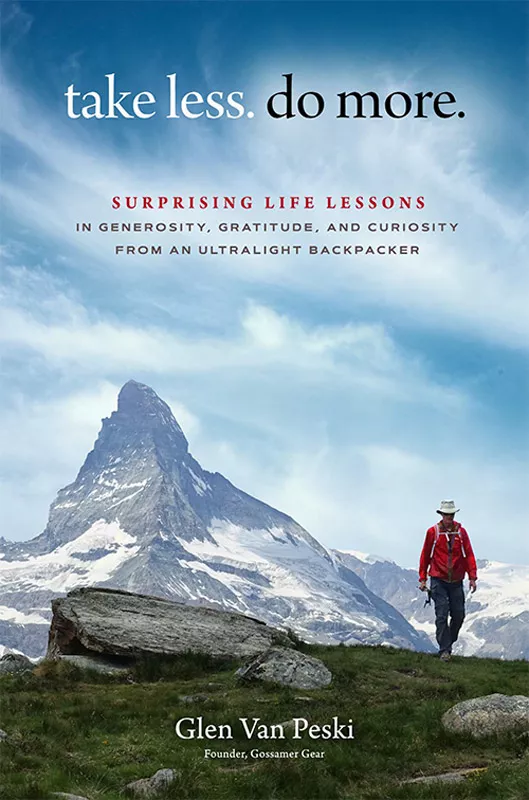
Take Less, Do More is a refreshing departure from the typical books about voluntary simplicity, ultralight backpacking, or minimalism. Rather than centering on our relationship with “stuff” the book focuses on how we engage the world around us influences our life. Many books in this genre would go into great detail about downsizing possessions, selecting the right gear, etc. Glen talks about these things in the chapter entitled “Know Your Gear”… but a much stronger theme through out the book is embracing generosity which is the best counter-narrative to a life focused on consumption.
The author, Glen Van Peski, is a well know thought leader and innovator in the world of ultralight backpacking. Glen (and his wife Francie) are also some of the most generous people I know. I first “met” Glen on-line in the backpackinglight yahoo groups discussion forum more than two decades ago. I was impressed by his humble spirit, out of the box thinking, and experimental / engineer approach. As I have gotten to know Glen better I found my initial impression to be strengthen, and I have come to appreciate how he leads an intentional, thoughtful life of engagement.
Throughout the book Glen shared how a life with margin that provides space to notice and respond to the world around us, especially other people, produces a rich and meaningful life. That being less conscious of one’s self, and more aware of others is liberating and enriching, far beyond what one experiences if they were only focused on maximizing their happiness.
Each chapter is built around several personal stories from Glen’s life. From these experiences Glen draws out principles that can be applied, perspectives to shape one’s viewpoint, and/or insightful observations which might help sharpen one’s understanding. Some of the stories I already knew, some I learned while reading the book, all of which I appreciated.
Side note: I think a great practice is to identify key stories that you want to shape your life, take the time to write them down, and regularly share them with others.
You don’t need to be into backpacking to enjoy this book. While several of the stories in this book take place on backpacking trips, the stories are about human connection which is universal. “Know Your Gear” is the only chapter that gets into nitty-gritty details. Non-backpackers could skip this chapter, though reading it might expand your perspective. There are better books about how to be an ultralight backpacker, this is a book about life.
I shared the idea of a shopping diet with Glen. A bit longer write-up about shopping diet.
Chapter 1 has a story about a trip Glen led to Buckskin Gulch which included Dan Buettner (best known for his work on Blue Zones), Matthew McConaughey, and several other famous people. A great compliment to Glen’s story is Ali Selim’s humorous trip report from the perspective of one of the participants who was doing his first backpacking trip.
If you enjoy Take Less, Do More, there are several books I would recommend:
Lighten Up!, a short, humorous book about how to lighten what you carry when backpacking. Written by one of the original moderators of the backpackinglight yahoo group.
Chasing Hope, a memoir by journalist Nicholas Kristof, who still believes in and practices truth telling. Nicholas care for others comes through. Why am I not surprises that he and Glen are friends 🙂
Walk in a Relaxed Manner, A memoir about walking the Camino de Santiago, and the lessons learned on that road.
Practicing the Way, A wonderful take on what a life following Jesus could be like. A life filled with grace and generosity rather than judgement and self-centeredness.
When I first hear the Japanese term shinrin-yoku, which is forest bathing in English, I pictured a outdoor onsen that was in the middle of a forest, or maybe a deep soaking tub which was part of an outdoor bathroom attached to a hide-away cabin in the woods.
I was wrong. I failed to read the definition or any articles about the practice. If I would have done this I would learn that forest bathing isn’t about taking a water bath when in the forest, rather it’s being bathed in the atmosphere of the forest. To be surrounded by trees and nature. The practice is lingering in nature while paying attention to your surroundings.
I now know that I have been practicing forest bathing for years. At least weekly, more frequently when I was feeling stressed, I would take a couple of hours, sometimes more, to get away from from hectic, technology driven life to walk among the trees.
On these walks I notices within a few minutes my whole posture relaxes. I find myself breathing a bit deeper, walking a bit slower. It seems like a weight has been taken off my shoulders. I strongly recommend the practice to everyone. There have been numerous studies about how getting outdoors is good for health.
Until recently I believed that I needed to get somewhere that felt like wilderness to experience the benefits of forest bathing. I thought that the minimum effective dose was a trail that was several miles long, with no city noise, and no building being visible. In the last few months Jackie and I have walked several places that didn’t have these characteristics, but seemed to have a similar effect.
I found that building that blended into the scenery didn’t interfere with the rejuvenating sense the forest bath. I also discovered than I didn’t need to have a long trail, or even feel completely away from the city. Hearing cars (so long as alarms aren’t blaring) was fine, so long as they weren’t in my line of sight. Examples of places that provided a wonderful experience included walking in Portland’s Japanese garden and around Fresh Pond (reservoir) in Cambridge, Massachusetts. I also discovered that the effect for me is accelerated when I am under a canopy of trees.
Do you find your soul and spirit rejuvenated when you walk among trees, in nature? Have you made it a regular practice?
The heavens declare the glory of God, and the sky above proclaims his handiwork. Day to day pours out speech, and night to night reveals knowledge. There is no speech, nor are there words, whose voice is not heard. Their voice goes out through all the earth, and their words to the end of the world.
This post has been extracted from my camino page because the most common question we have gotten from friends was about what we carried. They already knew something about the Camino itself and most wanted to understand how we managed to “go so light” for a trip in May (temps were 37-72F). If you want to learn more about the Camino de Santiago or preparing for a pilgrimage see my full Camino page. I also posted a take-aways from the camino and a photo journal.
[toc]
Jackie and I really enjoy embracing radical simplicity when walking the Camino. It helped us experience life as a pilgrim. We felt free and liberated during the walk. We found joy in discovering how little we needed, that we didn’t have to make decisions about what clothing to wear or items to use, and the little daily rituals that we developed like washing our hiking clothing each day. Post Camino, I am still living out of onebag, though using more stuff than when walking the Camino.
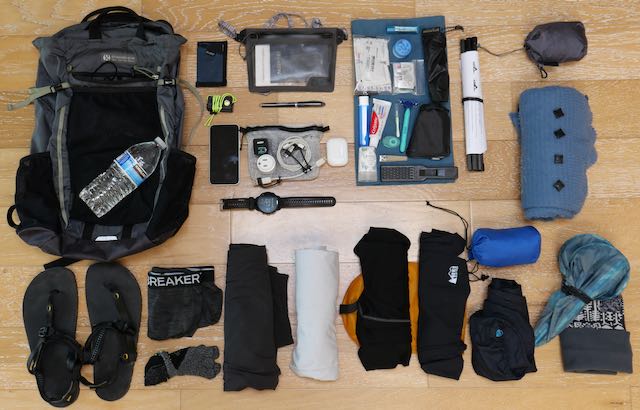
My original packing list had a base weight of 5.5lb and could fit into a 14l bag. At the end of the trip I updated my camino 2023 lighterpack list to include everything I carried on the heaviest day including several items I won’t take in the future. The picture below is nearly everything I carried or wore:
On the walk I picked up some skin lotion and a 15l folding messenger bag to used after this trip (we don’t have Decathlon in US). There are a few items I added at the last minute (packing for fears) that aren’t in the picture and generally weren’t used. When Jackie’s Achilles tendon started to hurt I carried a few of her items. This raised my “base” pack weight to 7lb. The heaviest total weight was 11 pounds when I was carrying extra water and a fair bit of leftover food / snacks.
Everyone I have talked with that wasn’t an experienced light-weight onebag traveler or ultralight backpacker said they brought too much stuff. They often either gave away the unnecessary items, shipped them home or to Santiago. Several people who have done multiple Caminos told us that any item not used by the time you got to Burgos isn’t needed, and you should be dropped. I encourage everyone to treat the Camino like a pilgrimage and leave behind excess baggage and live in the moment. I have some general notes about packing light aka onebag travel which might be helpful to someone packing for the Camino. There are people who go even lighter such as such as Tim Evans’s 7L fanny-packing list for Shawn’s 7-10l fannypack packing
Example Summer Packing List
It’s pretty warm in the summer and you don’t need to bring a lot.
Hiking clothing made from thin nylon, polyester or merino wool which can dry overnight. My recommendation would be:
nylon hiking pants that are quick dry like Outdoor Research Ferrosi, prAna Brion or a hiking dress
fast dry shirt that is high UPF like ArcTeryx Cormac, OR Astroman, Mountain Hardware Crater Lake, or if UPF 15-20 is enough for you, the very comfortable OR Echo
non cotton underwear. Light weight bra or swimsuit top.
insulation: an alpha direct hoody, 100wt fleece, or sweater made of wool, alpaca, or cashmere.
sun hat: something with wide brim or veil such as those made by sunday afternoon
small first aid kit focused on foot care: compeed bandages are great for protecting skin about to blister
toothbrush
water bottle such as reusing a smart water bottle
a 50F rated sleeping bag or sleep sack + a light blanket/quilt if staying in hostels / albergues
Modest size travel towel if staying in hostels, or maybe even if you are staying in full service hotel every night: see towel entry, hitchhiker’s guide to the galaxy.
When needed (which is less frequent than you might expect) you can wash you hiking clothing in a sink, shower, or machine if one is available. That’s all you need.
Hiking poles are not generally necessary, though if you are used to using them, bring them… just remember they have to be checked baggage when flying. If everything else you are bringing is carry-on, you can use a cardboard “poster tube” to ship your poles.
In the spring and fall you would want to add insulation, and extra pair of socks in case they don’t fully dry over night, and maybe rain pants or a rain skirt.
Pro Tip: Don’t bother with “dress up” clothing while walking the Camino. Restaurants are used to pilgrim attire: shorts, tee shirts, slides/sandals. If you need fancy clothing on a trip paired with your “Camino”, ship them to Santiago to be stored until you are done, no reason to carry them while you are walking. There are a number of services such as Casa Ivar which can help. Jackie and my first stop after the Camino was the UK. After after spending a week in Paris, before walking the Camino, we posted our extras including “dress up clothing” to a friend’s home in the UK.
Footwear
The single most important item you bring is footwear. I think minimalist shoes are the best way to go IF you have used them for at least six month. Otherwise I would generally recommend wearing trail runners or hiking oriented sandals. Sandals are often seen as people recover from bad blisters which makes me wonder if they won’t be the best “shoes” to start with. I have written up a brief comparison of boots vs trail runners. It’s important that you use whatever footwear you have selected (or identical models) for an extended time before the Camino to give your muscles a chance to adapt. For example, going from traditional shoes with a heel to zero drop trail running shoes is a good way to end up with achilles tendonitis. For people who are prone to getting blisters I would recommend sizing up your shoes by 1 size and wear 2 pairs of socks: a thin liner made of coolmax or nylon closest to your foot, and a thick wool sock worn “inside out” so the fuzzy part is against the shoe, and the smoother side is facing inward toward the liner and your foot. Another good option are Xoskin toe socks. I have zero blisters after walking thousands of miles in Xoskin toe socks. I had pre-blisters from other socks heal while wearing Xoskin socks while doing 15 mile days.
Backpack
The second most important item is your backpack. People who complete the Camino generally use outdoor oriented pack which are between 20-40L in volume. For people carrying less than 10 lbs, there are many good options. If you are carrying more than 10 lbs you will want a pack that has a hipbelt which is capable of transferring the majority of the weight to your hips rather than just stabilizing the pack. I have a post about selecting a good trekking pack.
Sleeping “Gear”
Most people walking the Camino will spend one or more nights in an albergue dormitories which are often mixed genders in the same room. You should have some clothing to sleep in. Tip: if you are in the bottom bunk near the wall, you can hang your towel to provide a bit more of privacy.
Albergues typically don’t provide linens. Many pilgrims bring a light weight sleeping bag (rated for 40-50F) which removes the need to worry about sheets and blankets. I prefer to use a silk or nylon sleep sack which is paired with a light weight quilt or blanket. When it’s warm you can use just the sleep sack. A good quality down backpacking quilts can cost $300, but if you only need enough insulation for sleeping inside (say rated for 55F), then there are a number of light weight down or synthetic outdoor blanket / quilts which are less than $100, such as hangtight shop blanket. Costco sometimes has a down throw blanket for around $25. A classic poncho liner, aka woobie is another option. Some folks find that just a sleep sack combined with their outwear can work. Clothing which are warm enough for “light work” in 40F (a typical spring morning) should be warm enough for sleeping indoors when the room is >=60F. I used a sleep sack and a piece of Polartec Alpha Direct 90gsm fabric which was used as a blanket at night, and as a scarf, shawl, vest, or poncho liner during the day. I wrote up a description of this in a post about my poncho system.
Keep it Light
For people who are used to luxury & comfort, don’t just prepare yourself to “rough it”, but embrace a simple and more communal experience. It is especially important to minimize what you bring because you will be carrying everything for many miles each day. If your bag feels heavy before you start walking, you are bring too much and it will get worse as the days progress.
Conventional wisdom is that people should carry a backpack that’s <25% of their body weight. This is reasonable for moderate distances but will be fatiguing on a longer hike. There were several experiments evaluating how pack weight impacted soldiers physical performance. A key finding was that on all day exercises, fit/trained soldiers had a measurable increase of fatigue and a drop in agility when they carries more than 10-12% of their lean body weight. This matches my personal experience: I feel no more tired at the end of a 20 miles carrying 17lb as compared to carrying no pack. My one caveat that when over 8 lbs I need to shift some weight to my hips or shoulder pain will be fatiguing through the day. My wife found her sweet spot is <7lb.
Some people ship their bag(s) town to town via a transfer service and carry a small daypack which holds only what they need for the day. This costs 4-6Eu for one time, and around 150Eu for an entire journey. I would recommend not planning to do this as a regular practice, though it can be useful if you are trying to recover from an injury or fatigue. If you going to use a transfer service I would recommend using a duffel which does not need to be expense. We saw a number of people using $4 Ikea frakta duffels. Realize that mistakes can be made, and you might find your transfer bag misplaced for a day or two. For people who are finding lodging as they go, using a transfer service can add stress and complications since you don’t know where to ship your bag on days you don’t have a reservation. Warning: Several traditional alberques have banned “suitcases” or transfer services from delivering because the alberques exist “to serve pilgrims, not tourists.”
It’s better to bring twice the money you think you need, and half the stuff. It fairly easy to pick up items that you forgot, lost, or are damaged along the way. Worse case is a 20 minute taxi ride to a larger town. Several of the town along the Camino have a Decathlon store, which is the Ikea of outdoor equipment and clothing. There are also a number of stores which cater to nearly all the needs of pilgrims (shoes, clothing, backpacks, toiletries, etc) such as Boutique du Pelerin in St Jean Pied de Port, Caminoteca in Pamplona, Pilgrim Oasis in Carrión de los Condes, etc. Most of the towns have a small store near or on the Camino route which sell comfortable shoes (almost all sell Hoka) and some other items that pilgrims might need.
Food and Water
Unlike backcountry backpacking, you rarely need to carry much food or water because you will be in the next town before you need more. Generally .5-1L of water will be enough if you periodically stop at a cafe / food trunk for a drink and make use of the fountains. You will want more water on the hottest days. Before walking, you might figure out how much water you need. I discuss this in my post about water treatment and containers. You might want to carry some food with you when entering a less populated area on Sunday because the groceries / cafes / restaurants might be closed or have hours which are incompatible with your schedule. I liked granola bars and Laughing Cow cheese which doesn’t have to be refrigerated. Of course, if all the food options are closed you can treat it as a day of fasting.
Jackie’s Pack
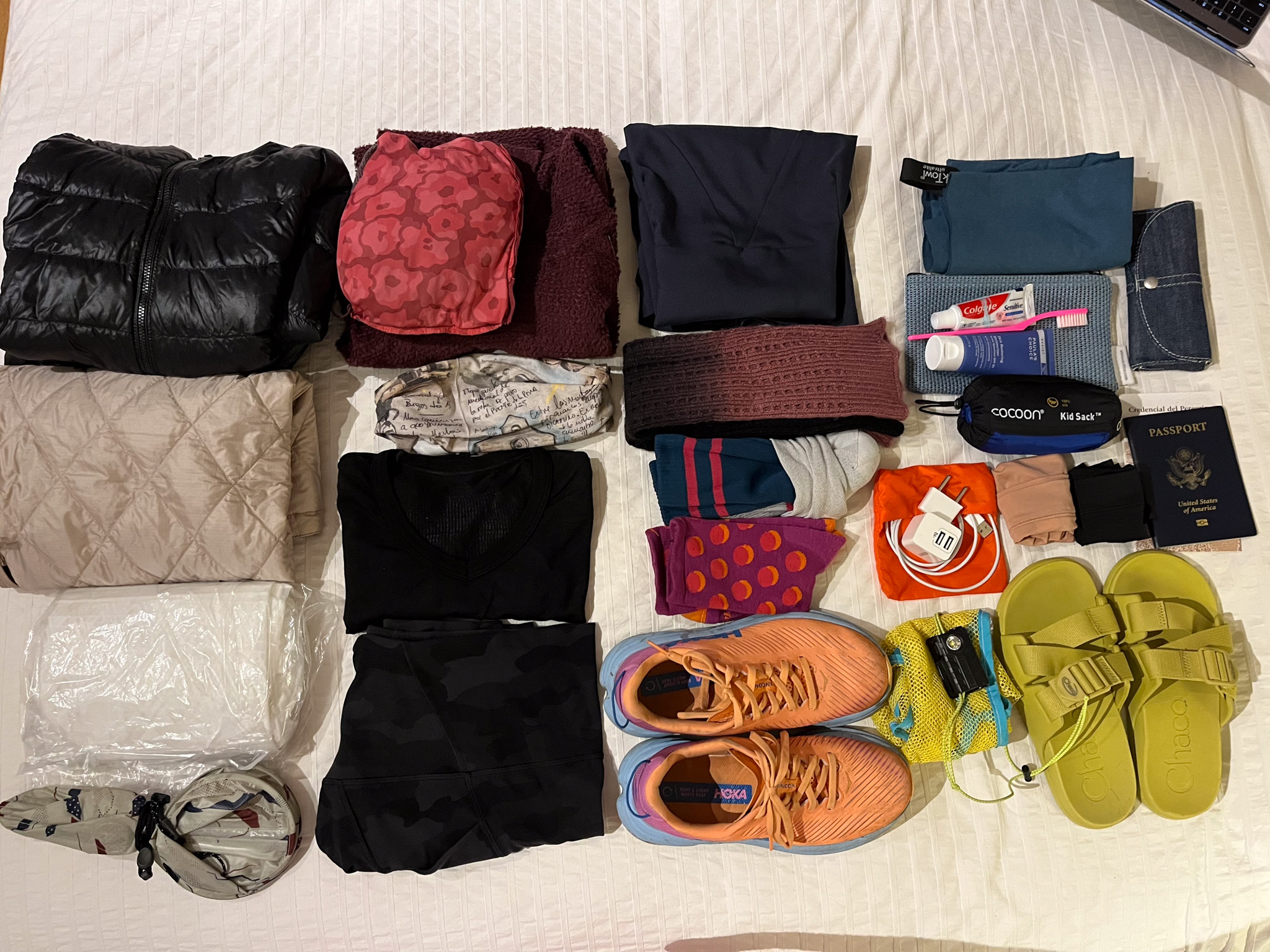
The following is a picture of the contents of Jackie’s backpack for the Camino. She used a 15 year old Camelbak hydration pack which was retired at the end of the Camino. Jackie runs colder than me so she brought more insulation that I did. While my strategy was to use my blanket for warmth during the day, hers was to use insulating clothing + a silk sack for sleep. This works well because night time temperatures inside the albergues required about the same amount of insulation as walking in the coldest mornings.
Outerwear
Clothing
Misc Other
Uniqlo Down Jacket Montbell Insulation Skirt Ikea Rain Poncho Montbell Umbrero Hat Macpac Nitro Alpha Direct Hoody Montbell Windbreaker Buff
Initial Items, Items Offloaded, “+” indicates items added. Buff wasn’t used. Waterproof socks used only a few times. Leg warmer not used after compression socks was purchased. Jackie didn’t bring first aid… she made use of the kit I brought.
I am not in control. I am not in a hurry. I walk in faith and hope. I greet everyone with peace. I bring back only what God gives me. – Murray Bodo, The Pilgrim’s Credo
I have carried the Gossamer Gear Vagabond Trail more than 2500 miles over last few years for EDC, done in a day outdoor activities, and onebag travel which included walking 500 miles of the Camino Santiago Frances route from SJPP. Between Jan 2023 and March 2025 I lived out of a Vagabond Trail as we explored locations that might be “home base” for the next season of life. I found the Vagabond provided nearly perfect functionality for me. I have a list of what was in my pack for much of 2024, and what I am generally carrying now.
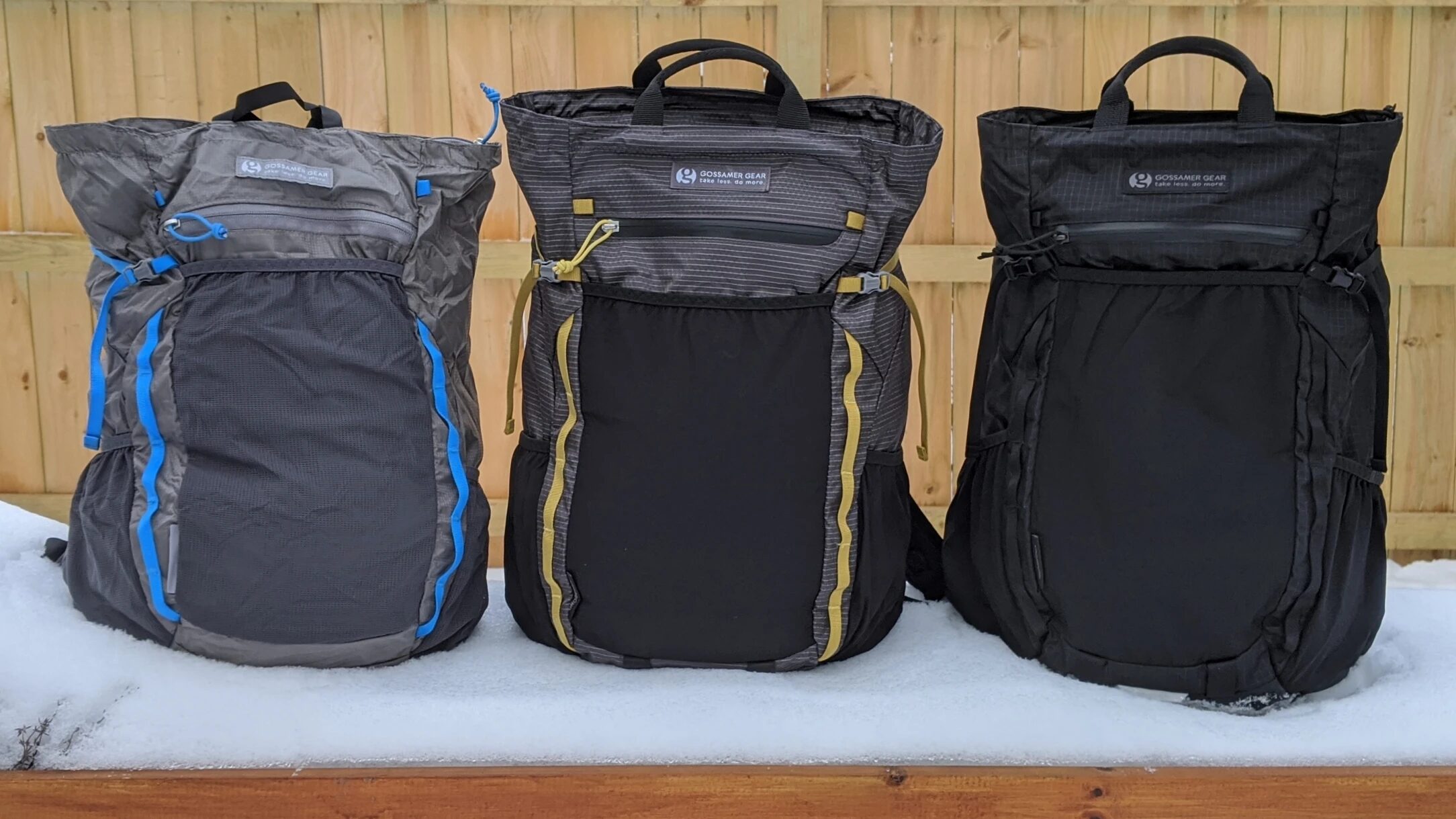
The Vagabond had three variants. The Packable and Trail models are now discontinued. The urban oriented Jet variant is still sold. I originally picked up the packable to supplement other bags. I found it the most comfortable carrying packable daypack I had ever used. I liked it so much I picked up the Trail version so my wife and I could both use a Vagabond pack. I started using the Vagabond Trail as my primary onebag in 2023. In May 2025 I switch to using the Jet which was gifted to me. The Jet is made from a slightly heavier black grid fabric which has a more tech / urban vibe and added a padded laptop slot. The external dimensions of the all the Vagabond models are the same, but there is a bit less volume inside the Jet due to heavier material, padded laptop sleeve and back panel which is a bit thicker.
Description and Design
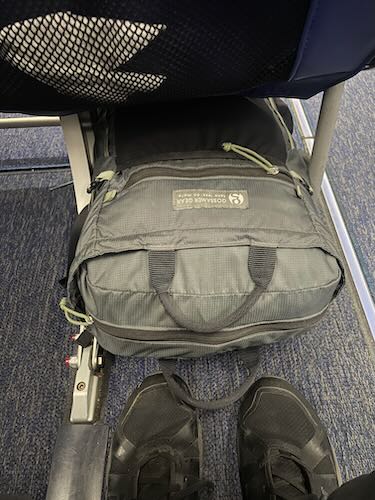
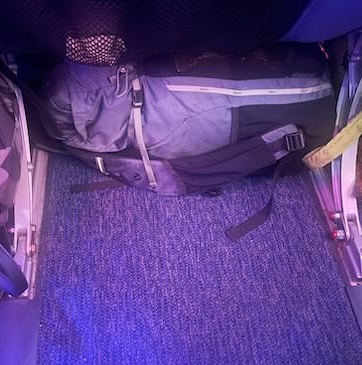
The Vagabond is top loading using a zipper to close the main compartment. Weights are 10oz packable, 18oz trail, 24oz jet. The packs are listed as 23l with dimensions of 46x27x15cm (18/10.75/5.75inches). I believe the main compartment is 17l with the other 6l being the external mesh pockets. The Vagabond is a bit thinner than many daypack which keeps the load close to the back with a corresponding loss of volume. Except when grocery shopping I think this is the right trade off. I feel agile wearing the pack. I have never had a problem fitting pack under the seat in front of me on a plane except when a support beam bisected the under-the-seat space. When it’s slightly under-filled the Vagabond can compress into every airline “personal item sizer” I have encountered including EasyJet, Spirit, RyanAir, Vueling, and Wiz so long as the side pockets were not filled. There are some airlines that officially restrict personal item thickness to just 10cm like EVA which would make the Vagabond too thick unless under packed, but we were not sized by them and my bag fit under the seat. Pictures under the seat of a Southwest Boeing 737 on an aisle, and sideways in the middle seat.
The pack has loops which enable attaching waist strap. I found the Gossamer Gear Fast Belt provided good stability but wasn’t particularly helpful transferring load. The ULA Ratpack belt is able to transfer enough weight I could carry 13lb all day without pain (8lb is my limit without hip belt).
The pack has a flat bottom, and can stand upright on its own. This makes it very convenient to access when you place it on the ground while minimizing how dirty it will get. The Jet model has an extra durable, waterproof bottom.
The pack has 5 mesh pockets: a stash pocket on the front of the pack, traditional side pockets, and on the shoulder straps. The pockets are made of a mesh material which is adequate but not optimal durability. I have torn the mesh on the front pocket of my vagabond trail (it was repairable). I believe the Jet mesh is more durable than what was used on the discontinued models. The front pocket is large, and works well for items such as a jacket, towel, or a small laptop that I stash when preparing to go through security checkpoints. The side pockets are pretty standard, with room for two 16oz water bottles or one larger bottle. I found items were retrievable while wearing the pack. I love the shoulder pockets and use them constantly. Items placed in these pockets are easily accessible, and when I set the pack down they aren’t in the dirt unlike pockets on hip belts.
The pack has a floating laptop sleeve against the back. If the pack is reasonably full, the laptop won’t hit the ground if you are careless when setting the bag down. In the packable and travel models the sleeve is the same material as the pack body. In the Jet, the laptop pocket is padded with foam, and has a second slot for a tablet and a small zippered pocket for small items.
The packable and trail has two solid pockets… one near the top of pack’s front and a second in exactly the same location on the inside of the pack. I use the outside pocket for small items I don’t need to access constantly and the inside pocket for items I can’t afford to lose such as my passport. Being on the inside of the pack makes it a bit more resistant to pick pockets and any item that might fall out of the pocket would end up inside the pack rather than on the ground. If the pockets are completely filled they might make it a bit difficult to insert and remove large items from the bottom of the pack, though this hasn’t been a problem for me. The Jet shifted the inside pocket to the padded laptop sleeve.
Use
I liked the idea of the tote handle but didn’t use them much. They are too short to hang the Vagabond over my shoulder. When holding the pack by the one or both handles it was nearly impossible to unzip the top. On the other hand, the side compression straps worked pretty well. I could access the main compartment without stop walking or putting the bag down. I would release one shoulder strap and swing the pack in front of me to grab one of the compression straps on the side of the pack. This provide enough tension that I could then unzip the pack with my other hand, retrieve whatever I needed. I would switch hands to close the the zipper. I found then the pack was only partially full, that items stays in the pack without needing to close the zipper.
Sometimes it is difficult to access items at the bottom of a top loading pack. I didn’t find that this issue with the Vagabond. As mentioned earlier, the Vagabond is a bit thinner than many packs, so items tend to fill space front to back. I load my larger / less frequently needed items near the bottom of the pack vertically next to each other. The combination of a stuff sack and varied materials made it easy for me to identify items by feel to pull them out. These items provide a shelf for the rest of what I pack which get layered on top. The only issue I had was my laptop can sometimes get caught on the top zipper.
I have read several people complain that the top collects things like leaves which can then end up in the bag when you unzip the top. I didn’t experience this.
Performance – Carry Comfort
I have some shoulder issues which limits how much weight I can carry on my shoulders without pain. I found the wide and padded shoulder straps on the Vagabond Trail and Jet allows me to comfortably carry more weight on my shoulders than just about any pack I have tried. I was able to get up to around 12lbs for a few hours, and to 8lb for all day use without any pain. I also carried 13lb all day when I using a ULA waist strap without pain. The Vagabond was as comfortable as every shoulder only pack I have used up to 15lb which includes packs with harness style straps.
Something that surprised me was that it was more “comfortable” for me than a brand new GoRuck GR1 when carrying 30lbs of iron plates + 10lbs of rice. I don’t recommend doing this regularly… the frame sheet in the trail seemed to be slightly deformed. I should note that goruck lovers say you need to break in the shoulder straps before they are really comfortable. To keep the plates from shifting in the vagabond I had to fill the space using a rolled foam pad.
Materials and Finish
Finish is good, excellent when considering the price.
The Packable and Trail are made from 70d Robic… light but durable enough for on trail or around town use. The Jet is made from 210D Robic which I think is the optimal weight/durability for long term use unless you really abuse your pack (I don’t).
Today I favor Robic over waterproof fabrics because it’s reasonably durable and doesn’t seem to degrade over time like PU coated material or composite / laminated fabrics. I think a heavier Robic fabric impregnated with PC or silicon would be great. The laminated UltraX fabric and bonded ALUULA Graflyte looks promising… we will see how durable they are after a few years of real use.
Improvements
The following are improvements to the Vagabond Trail that I sent to a friend at Gossamer Gear. Several of the changes were made to the Jet even before I sent made my suggestions.
More durable / waterproof fabric for the pack’s bottom. Fixed in the Jet
A slightly stiffer separator between the laptop / hydration sleeve and the main compartment would make placing and removing the laptop easier when the pack is full. Fixed in the Jet.
Separate the outside and inside pockets to make it bulge less. Fixed in the Jet.
slight angle side pockets to make access easier when pack in on the back.
The top zipper and the zipper for the front pocket unzip in same directions.
It would be nice if the top zipper could be locked closed. Either loops on the zippers or a way to secure the zippers to one side of the pack.
I never needed it, but a couple of lash points on the bottom of the pack would be nice to attach a sleep pad or yoga mat.
Pole loop on the front
Maybe a U shaped zipper on the top would provide better access for larger items. I now think this would be a bad idea.
I have had a love hate relationship with ponchos. Theoretically they make great sense, but I have tried rain ponchos five times for six month or longer. After each poncho experiment I switched back to a rain jacket and a dedicated shelter. This post is about my current re-evaluation of ponchos as rain gear. For a two year period of time I used one of Brawney’s ponchos for both rain gear and as my shelter. I don’t think I will ever return to a poncho as both rain gear and shelter: there are just too many compromises required for little or no weight savings.
Related… I have always thought the US Army Poncho + Liner was an extremely versatile system, but was heavy. I recently realized there are new materials such as Polartec Alpha Direct which could be used to make poncho liner than is significantly lighter while providing a useful amount of insulation. I tested this system at home and used it for walking the Camino Frances with good results.
On the plus side a poncho can be an extremely light and compact item which can provide rain protection for the body, backpack, and can function as a shelter if it is large enough. A poncho made from good material can be a “buy it once for life” item, lasting decades without any maintenance. Another nice feature of a poncho is that it can be put on and then taken off without removing a backpack. You don’t even need to stop walking.
Downsides of ponchos are they can flap in high wind, get snagged when climbing or going cross country, and don’t protect arms when using poles (which I am not), and doesn’t “fit in” (e.g. looks odd) in many urban settings.
The biggest downside for me is that most ponchos are made from non-breathable materials which has no air permeability and zero vapor transmission so moisture often condensates in the chest area. I know people say that ponchos can provide good ventilation but this hasn’t prevent me from overheating and getting wet from condensation even when I hold the poncho up to maximize ventilation. I find ponchos too warm above 55F.
When active in >55F conditions (dry or light rain) I am more comfortable wearing a Shakedry rain shell, or just getting wet provided I have a way to dry myself when either the temperature or my activity level drops.
Alpha Direct for Modern Poncho Liner
I realize the conditions I was like the face on the Camino: daytime lows around 40F and nighttime lows sleeping in alburgues around 60F required about the same insulation. This would be a perfect situation to use a poncho liner or wearable quilt for insulation during the day and to sleep at night. The other option would be to sleep in my warmest clothing at night. I discarded the idea of just using clothing because the pants I wear do not provide enough warmth to sleep in.
I considered using ultralight synthetic quilt or a traditional poncho liner, but both options were heavier and more expensive than I desired. Then I thought about using Alpha Direct for the insulation. Unlike many synthetics or down, it doesn’t require a fabric to contain it which reduces weight and allows it to be useful in a wider range of temperatures depending on how much you prevented air circulation. Combining an alpha direct “blanket” with a light weight poncho and sleep sack could provide an extremely light (10.8oz) and versatile system:
Originally I was going to purchase a larger piece of Alpha Direct so it could be the same dimensions as a poncho with a slit to pass my head though. I ended up using a smaller, unfinished piece of alpha direct because I hadn’t settled on how to attach it to the poncho, and the fabric for a shaped liner would have doubled to cost. Rather, I decided to “make do” with a simple blanket.
Experience Walking
I ran some simple experiments around the SF Bay Area, slept in our unheated garage and backyard to validate the idea. The first true “field” use was for 31 days walking Camino Santiago – Frances in May 2003. Daytime temperatures were 38F-72F (not counting windchill), sitting outdoors in cafes (~45F-55F), and nighttime sleeping temperatures ranged from 55F-70F. We had several days of rain with the temperature during the rain varying between 45-65F. Right after this trip we were in Taiwan with torrential rains in 65-85F. Winds varied from completely calm to 35mph.
My “base” clothing were Luna sandals, Xoskin toesocks, Patagonia Terrebonne jogging pants, a ArcTeryx Cormac Sun hoody, a PolarBuff, and a Montbell Umbrelo Hat.
When highly active, just my base clothing kept me comfortable when it was >55F (factoring in wind chill), >60F when it was raining. I was wet (except for my head due to my hat), but my movement kept me warm enough, and when the rain stopped my clothing dried in around a hour.
When it was cooler than that some combination of my rain poncho and Alpha Direct blanket gave me just the right amount of insulation. On the coldest mornings (38F air temp, wind, sun not out yet), the combination of my base clothing, my backpack, a Polar Buff, Alpha Direct wrapped over my shoulder and across my front torso, and the Gnu poncho on and snapped shut kept me quite comfortable even when I was just standing around. I particularly enjoyed my arms and hands being comfortably under the poncho without needing mittens.
As it warmed up I would gather the Alpha Direct into a scarf configuration continuing to use the poncho to protect against the wind. Eventually I would remove the poncho and use the Alpha Direct as a shawl, over my shoulders or around my body as a vest which was kept together using magnets made to hold racing bibs on shirts. In modest wind conditions the alpha direct configured as a vest kept me comfortable down to around 40F.
FIXME: Pictures of blanket going from Shawl to Vest using magnets, to Scarf.
A real plus of this system is I could adjust it as I walked. I didn’t have to stop walking and never had to take my backpack off.
One challenge was when the temperature was between 40-50F and the wind was going from 0 to 30mph and the sun was playing hide and seek with the clouds. With no wind and sun strong I wrapped the Alpha Direct blanket around my waist. When the wind was blowing and the sun was blocked by clouds using the Alpha Direct blanket when carefully doubled over my sides and chest was comfortable. The constant reconfiguration was bothersome. In these conditions I tried using the poncho rather than the Alpha Direct blanket. That mostly worked, but sometimes was too warm.
After a couple of weeks I pulled out a Shakedry shell which I brought in case the poncho just didn’t work, and used it as a wind shirt. I continued to use the poncho on especially cold mornings, or when it rained. The next pilgrimage we take I will bring something like the Montbell Ex Wind Shell for those days that are very windy but moderate temperatures.
Experience Sleeping
Night time sleeping condition were primarily indoors with temperatures between 55-75F. When nights were cool, I slept in a pair of shorts and a tee shirt with the alpha direct as a blanket, inside a nylon sleep sack. This was warm enough to sleep well to around 55F. As it warmed up I shifted the alpha direct on top of the sleep sack resulted it less insulation allowing me to sleep in warmer condition. Above 72F I would just use just the sleep sack or no sack with the alpha direct blanket draped over my legs. The sleep sack was a perfect size for colder nights using my relatively small blanket, but I sometimes felt a bit constrained. In the future I think a larger blanket and a larger sleep sack would be more comfortable.
The Gnu Cape
Amazingly light and compact. Could put on / take off over my 23l pack without removing or unsnapping the cape. The cape claims to fit up to a 30l pack. They make a larger version reportedly good for larger packs. I found the shape worked well.
Alpha Direct “Blanket”
The piece of fabric I purchased was listed as 120gsm, model 4004 which doesn’t make sense. 4004 is 90gsm and 4008 is 120gsm. Given the weight & dimensions of my piece, I think I have 90gsm but I am not 100% sure. What I know is that it is an amazing material to use as a poncho liner. Absorbed very little water so would dry amazingly quickly. Didn’t pick up odor after a month of daily use. When air movement was blocked by sleep sack or poncho was quite warm. When doubled up it provided some warmth without wind blocking. (A single layer of 90gsm Alpha Direct seems to hold no warmth in strong winds)
The piece of Alpha Direct I brought was a bit too short but worked well enough. In the future I will likely purchase a larger piece of Alpha Direct and actually make a poncho liner rather than just a rectangular piece of fabric. Having a small foot pocket would make it work better in sleeping mode.
Make a hoodless poncho which can easily ventilate around my neck. My Montbell Umbrero Rain Hat will keep by head dry and prevent rain from getting in through an open neck area.
No experience, but the Aricxi Poncho from AliExpresss looks like a good deal.
The cheapest are typically fragile “emergency” ponchos made from plastic weighing just a couple of ounces. These can be effective in moderate conditions, but they are very easy to tear.
The DriDucks Poncho is slightly more durable that plastics but is still fragile. It has the benefit of being somewhat breathable.
Vinyl / PVC ponchos which can typically be found as hardware stores. These ponchos are inexpensive and typically weight 8-16oz. They are durable enough to wear, but I won’t recommend using them as a shelter.
SMD Gatewood Cape and Liteway Pyraomm which provides rain gear and highly protective shelter. I found them a bit too big to wear, and too small to be ideal shelter but many people love them.
TL;DR. If you are looking for a small, light, fast drying towel to use while backpacking or traveling, I recommend the PackTowel Ultralight which now seems to be discontinued. I found I can effectively dry my body with a 25″x35″ towel, but the body size lets me wrap the towel around my waist or be worn like a shawl which can be useful.
While in Japan, I visited Hiker’s Depot a wonderful store dedicated to ultralight backpacking. I purchased a “quick dry”, packable towel which was very fuzzy and felt nice against the skin on one side, with an open waffle pattern on the other side which looked like it might enable rapid drying and also make a cozy scarf. My wife tried the towel after using an onsen. I strapped the towel to the back of my pack. It seemed to dry in less than 30 minutes while we were drinking tea. Excellent I thought, maybe it’s time to retired the PackTowel Ultralight I have used for the last 10 years. Or maybe not…
When I got home I compared four towels. The terrycloth bath towel that lives in our bathroom, a Turkish towel that lives in our car for emergencies, a Packtowel “Ultralight”, and my new towel.
The test was simple using a real world scenario: drying my body after a shower and then hanging the towel inside, no sun, 60F, 60% humidity. The method was
Weight towel
Take shower
Dry off with the towel
weight the towel
hang it up
reweight every 30 minutes until it reaches original weight
I did this measurement for each towel four times, taking back to back showers so the conditions were similar for all the towels and rotating the order of which towel was used first. Each towel was consistent with itself on the four cycles so I didn’t feel the need to collect additional data.
Towel
Drying Time
Weight Gain (gm)
New Towel
2.5 hours
20
PackTowel Ultralight
3 hours
33
Turkish
5 hours
40
Terrycloth
20 hours
49
Towels drop between 1-7 grams / 30 minutes, mostly between 3-5 grams / 30 minutes.
Something I immediately noticed was the time to dry was related to the amount of water that was absorbed. I was reminded of By The Numbers: Testing the Performance of Mountain Hardwear AirMesh Garments – Backpacking Light which was doubly appropriate because not only did this report cover drying time, but the fabric that triggered the investigate was Teijin octa, which is the fabric in my new towel.
Subjective Experience
The Teijin octa towel got me functionally dry, but I didn’t feel 100% dry.
I felt dry after using the pack towel but the drying process required more care than the heavier towels.
The Turkish towel was easy to use but felt rough against the skin.
The Terry towel was the easiest to use – you could just wrap yourself and wait a couple of minutes and been nearly dried. It felt the best, and apparently got me slightly drier than all the other towels.
Analysis/Conclusions
While Teijin octa has a number of nice properties, it’s not ideal as a towel. It seemed to absorb less water, and took longer to dry when considering how much water it absorbed
The PackTowel untralight is 1/3 the weight of the Turkish towel, making it the more absorbent towel / weight. From other times I also found it was the least painful to use when I had a bad sunburn.
The Turkish towel certainly dries faster than a traditional terry towel. The added durability compared to the Pack Towel makes a Turkish towel more appropriate for these multiple use cases but with a substantial weight penalty
Thick terry cloth towel dried significantly more slowly that the thin towels, even when controlling for the amount of water absorbed. It seems like it sucks the water deep into the material and then is slow to release it. There is a good reason nice hotels often have heated towel racks.
A towel is the most important item a Hitchhiker can carry. Ford Prefect and his fellow hitchhiker and friend Roosta both emphasise the importance of towels throughout Hitchhiker’s and are both known to carry one with them at all times. Although towels are repeatedly mentioned in every version of Hitchhiker’s, they are only seen visually in the television series and 2005 film
Trekking packs are similar to travel packs, but put more of an emphasis on carry comfort and typically optimizes the volume to weight ratio. Trekking packs are often a bit narrower than typical carry-on sized travel packs and taller than typical personal sized daypacks. Travel packs typically prioritize organizational features, ease of access, rectangular shape to optimally fit in carry-on spaces, and an “urban vibe”. Classic backcountry backpack tend to be larger than trekking packs. Ultralight backpackers who use low volume gear can use “trekking” packs for fully self supported back country trips / wild camping. Later in the post are some notes about “wild” backpacking in a carry-on bag.
[toc]
My Definition of Trekking
I think of trekking as travel which involves a significant amount of walking while carrying all the gear you will need. Nights are typically spent in huts, hostels, guest houses, inns, or yurts. These trips might be a few days or more than a month if walking longer trails like the Camino De Santiago, Kumano Kodo, or the Alpe Adria Trail. Unlike classic wild / wilderness / backcountry backpacking, you typically don’t need to carry a shelter or cooking gear. Food and water are typically easily acquired. Sometimes you don’t even need to carry your next meal because there will be a cafe or pub between your day’s start and stop points.
Being carry on, or even personal size is highly desirable for a trekking pack to reduce the risk of loss, damage and delay when flying, and to enable using budget airline tickets which only permit a personal size / underseat bag. There is a summary of common carry one restrictions, and an exhaustive periodical table of carry on size limitation.
My Choice
When I can keep the volume of my gear below 20l, and the weight below 12lbs, I use a Gossamer Gear Vagabond (my review). Above 8lbs I attach an ULA Ratpack waist strap to shift some of the weight to my hips. When I need more volume or need to carry more than 12 lbs I switch to a Zpacks Arc Hauler 50l which is carry-on size when the roll-top is rolled down to the frame, and can carry up to 22-25lb comfortably. The Arc Hauler is too big to be used for everyday activities if I am exploring a town without all my gear. I pair it with a very inexpensive Decathalon Packable 15L Courier Bag.
Minimizing Weight
Before talking about packs, a few words about what you put into the pack when trekking. I strongly encourage people to adopt what is often called a minimalist, ultralight, or pilgrim approach. I have some notes about traveling light and some traveling tips which captures lessons I have learned over the years which includes not just what to carry, but also how your attitude makes all the difference. Rather than bringing lots of luxuries, bring only the essentials. Let being unencumbered be your luxury. My Camino packing list is an example of a pilgrim approach.
Conventional wisdom is that people should carry a backpack that’s <25% of their body weight. This is reasonable for moderate distances but will be fatiguing on a longer hike. There were several experiments evaluating how pack weight impacted soldiers physical performance. A key finding was that on all day exercises, fit/trained soldiers had a measurable increase of fatigue and a drop in agility when they carries more than 10-12% of their lean body weight. This matches my personal experience: I feel no more tired at the end of a 20 miles carrying 17lb as compared to carrying no pack. My one caveat that when over 8 lbs I need to shift some weight to my hips or shoulder pain will be fatiguing through the day. My wife found her sweet spot is <7lb.
Roughly Personal Size Packs
Generally when trekking, I recommend people to keep their load as light as possible with a volume <=30L which would allow the pack to qualify as a carry-on, if not personal size item. For people who are able to go very light, I recommend looking at:
Gossamer Gear Vagabond Jet: at 46x27x15cm 18/10.75/5.75 inches carry-on acceptable all airlines and if you don’t overfill it, will fit into the personal items sizer for many airlines and under most seats. One of the most comfortable to carry packs for me… likely thanks to excellent shoulder straps, the torso length not being too short, and the body not being too deep. Reasonably light weight, appropriately durable, with good enough organizational features since it’s a small bag. I like how I can access on the go. Side pockets can be accessed while wearing and the shoulder strap pockets are very useful. The optional GG Fast Belt does a nice job stabilizing, the ULA Ratpack belt can actually provide some weight transfer.
REI Flash 22: a light, minimalist top loading pack with stabilizing hip belt and a small brain on top. Surprisingly comfortable carry given it’s minimal padding.
ULA Dragonfly: 30L, good shoulder straps, durable, pricy. A /r/onebag favorite. Now has optional waist straps which are somewhat load transferring. It’s a bit tall for budget airlines personal items, but if under-filled, it will fit into the airline sizers and under the seat. I find the Gossamer Gear Vagabond more comfortable to carry, but if you want more volume and/or more convenient access, this bag is worth considering.
Decathlon 22l MH500: Reasonably priced, nice features, 10y warranty, a bit heavy, has a frame and hipbelt which can transfer load if your torso isn’t too long.
I used a Matador FreeRain24 for a couple of years, but when it wore out I found v2 wasn’t as comfortable to carry. I used to recommend that Matador Beast 28 but the current version’s narrowing shape and dimensions makes it more of a pure outdoor daypack. I was intrigued by the Zpacks Bagger Ultra 25L but it doesn’t have a hydration / laptop sleeve, nor any waist belt. There are some very inexpensive and light packs sold by companies like 4Monster, 3F UL, Naturehike, and others (see frugalhiker) via Amazon or aliexpress. I haven’t found them particularly comfortable to carry, but other people seem satisfied. There are some other “personal size” travel packs which are compact, but I think they are only marginally comfort.
Lightweight Packs
In my mind what distinguished a light weight pack is that it has a hip belt which can comfortably support >80% of the packs weight, the shoulder straps are only needed for stabilization. There are three key features for this to work
A comfortable hip belt. This typically requires a combination of padding and some sort of rigidity which can not be provided by webbing.
Proper size. The length between the hip belt and shoulder needs to match your torso length. You might be lucky and be a “standard” size. Otherwise you will either need a custom made pack, or one that has adjustable torso length. Hill People has a decent description of fitting a pack and ULA video about fitting a pack.
A “frame”: Typically some combination of framesheet, stays, or hoop which keeps the body of the pack rigid. A well designed frameless pack can provide a virtual frame through tight, careful packing, though it’s rare for this to work for more than 15lbs.
Some packs which have effective suspension systems and should quality as carry-on for most airlines:
ZPacks Arc Hauler: Size small and medium will be carry-on compliant if you roll the top down to the frame (21.5in). It has been suggested that size tall will fit if you unhitch the stays and place them inside the bag on the diagonal but you don’t see how that would work. Comfortable carry up to 25lb, and just 20oz weight. I would recommend the optional lumbar pad.
ULA Camino: Very well made from good quality materials. I found it to be as comfortable carrying 30 lbs as any pack can be 🙂 thanks to a good frame, shoulder straps, and hip belt which are offered in a number of sizes. It is a max size carry-on for major US airlines when the rolltop is rolled all the way down, but can be let out to provide more volume if you aren’t worry about carry on size limits. For example, all your gear fits in the compressed form, but the top can expand so you have room for multiple days of food and water. Pack itself is heavier than a classic ultralight pack, but reasonable given the durability of its materials. Access is from top and front. When made from Ultra fabric there is a bit of stiffness, so even when empty the pack doesn’t flop down making it easier to pack. Not the best pack to compress, so not great when carrying a small volume load.
Osprey Farpoint/Farview: Not as good weight vs volume of other packs, but carries well with more “travel luggage” features, and has an adjustable harness so it can fit a range of torso lengths well. Effective volume seems smaller than the advertised 40l.
Hanchor TUFA: a pack with a clean design and a pad pocket which provides a frame which is effective up to 22lb for me and I have used it up to 30lb. I found its carry comfort slightly better than the HMG SW2400. Size “R” is 22” tall, but if slightly under filled can be pressed into 18” sizer since the foam pad will flex. They also make the Hanchor Marl which has a suspension which is comfortable with heavier weights and the Breccia Travel which is carry-on sized if you don’t fill the brain.
Six Moon Designs All Day Pack: Haven’t seen it in person but seems promising for some people. 50oz weight, 35 or 45L, SMD “Flight” suspension, suitcase style opening.
REI Rucksack 40l: Bag seems to have been made for adventure travel. Has a frame, load transferring hip belt, several torso sizes, top/front zipper opening. I don’t find it a particular comfortable carry, but others seem to like it. Around 3lbs. Size large is listed as 22.5inch, my tape measure reads 23 inch so be sure not to overpack.
Mystery Ranch Coulee 30: 22.5in tall but can typically fit in carry-on if you don’t overpack. A bit heavy, but comfortable carry. Not good if you carry a laptop.
Decathlon 30l MH500 Reasonably priced, nice features, 10y warranty, but is heavy, and not as much usable volume as several of the packs listed here, but does have a back which is somewhat ventilated. Carry on size if you don’t fill the brain.
Gossamer Gear Gorilla: one of the most comfortable packs for me carrying less than 25lb. Light fabric so has less “structure” than some other packs which makes loading / unloading less convenient than a number of the packs listed here. Previous versions of the large with frame is 23”, but so long as it’s slightly underfilled, will fit diagonally in 21” sizers and goes in overhead strait so not taking up extra space if carefully placed. Not sure if this is true the the >=2024 model years.
Durston Kakwa 40: 23″ long and a bit stiff, so will be an issue with airlines that are really strict about carry-on dimensions. Nice design at very good price for the design, quality, and materials. Some people love carry comfort. I found the the shoulder straps good and the hip belt decent but not class leading.
Hyperlite Mountain Gear Southwest 2400: all but the “tall” size are 21″ or less. Very durable and weather resistant. The hip belt produced hotspots for me and I found the shoulder straps so/so… I like the shoulder straps on my Gossamer Gear Vagabond better. Beloved by some who do ultralight wilderness backpacking. The Waypoint looks promising but I have no personal experience with it. Smaller volume than SW2400, lighter, wider shoulder straps with pockets. Removable hip belt.
Dan McHale’s packs are works of art. His “Plug and Go” stays which have an extension on a swivel would enable a pack to quality for personal or carry on dimensions, but support a longer torso when carrying the bag.
Osprey Talon/Tempest 22: A Camino trail favorite of people from North America, though often people use the larger sizes which have to be checked. Comfortable to carry with some nice technical / organizational features. Easy to overpack because it’s too deep for carry-on sizers.
Northern Ultralight & SWD: Cottage gear companies which are reported to make some excellent backcountry packs. No personal experience but several people I trust and correspond with really like their packs. Likely too tall to be carry-on.
Some of the ultralight companies listed below also make packs with optional light frames. I was impressed with a friend’s KS Ultralight pack that has optional external stays. It occurred to me that if the stays could be broken into two pieces, or maybe removed and packed diagonally, the pack could easily compress into a sizer for flights, and then the stays could be re-inserted which would give support for people with a long torso.
There are some travel packs which have frames, load transferring hip belts. I have yet to encounter one (other than the Osprey Fairview/Fairpoint) which was particularity comfortable), and they tend to be heavier that the packs listed above.
Ultralight Packs
Ultralight packs sometimes called frameless packs were first popularized for long distance backpacking on the pacific crest trail and are now used for a variety of activities. These packs typically weight less than 1 lb and have no built in structure other than maybe a thin sheet of foam or a sit-pad which is attached to the back of the pack. Proper packing is critical to carry comfort. Most of these packs support the weight via shoulder straps, though some packs use something more like a vest to spread the weight over the entire torso which also keeps the pack stable when you move rapidly. Some packs offer minimalist waist belts which primarily stabilize the pack, though might be able to transfer some load off the shoulders and onto the hips. Conventional wisdom is that frameless packs are good up to 20 lbs +/- 5lb (I think it’s 15lb +/- 5lb), and beyond that it’s better to use a pack with some sort of frame. I have more about ultralight backpacks on my Wilderness Backpacks page.
I haven’t been following ultralight packs closely but many of my backpacking buddies do use ultralight packs. The following are manufacturers that the highly experienced folks I interact with recommend:
Atom Packs (UK): Built to order (semi-custom), multiple size with light frame and belts which can be optionally added.
Durston Gear Wapta: a very well designed ultralight pack using innovative materials and construction. I have found this pack to be more comfortable to carry than any frameless pack I have tried except the long discontinued StarLite pack made by SMD.
Gossamer Gear: One of the earliest companies making ultralight gear. Good range of products, several of which can be configured with frames. Factory made and easily ordered. Typically very good performance / cost ratio.
Granite Gear: Virga 2 not lightest but durable, reasonably priced and I found it more comfortable than most of the frameless packs I tried in 2010.
KS Ultralight Gear: Built to order (semi-custom) with many options. Have a couple of light frame options and an effective hip belt.
Six Moon Designs: One of the early makers of ultralight packs that can be configured a number of ways. Factory made and easily ordered. Many people love their packs. The discontinued StarLight pack was the most comfortable ultralight packs I used. The last pack I tried didn’t work for me, but I am not sure why.
One of my passions is mixing urban and back country travel. For people who are interested, I have my packing list for these sorts of trips. Jeremy Maluf goes lighter than I do. There are many threads on reddit about this.
The big issue when mixing onebag (urban carry on) travel with multi-day wilderness backpacking in moderate to colder conditions is having enough volume for the food and water when in the back country, but for the bag not to be floppy/empty when in the city. There are four ways to manage this:
Use a bag which compressed and/or “expandable”. A good example of this is the ULA Camino, which you can vary volume by how much the roll-top is let out, or a pack which has well designed compression system.
Leave front country items behind. If there is a place to safely store the items you only use in the city, like a laptop, formal clothing, etc then you can free up space for food.
Move items (ideally high volume but soft) into a stuff sack which you lash onto your pack, leaving room inside for denser items.
Limit wilderness trip duration yo what will fit in your bag. This might require some days to cover more distance than you would normally.
Remember that there are items that you can’t take carry-on. I often modify my normal backcountry packing list to be carry-on friendly.
Hiking Poles. Do without and bring carbon fiber “tent poles” with rounded ends for use with my shelter.
Metal Stakes. I carry-on wooden chopsticks to be used as stakes. Some people have reported that plastic and carbon fiber stakes have made it through security, but I have no personal experience trying these.
Knife. I buy a cheap knife at the destination
Fuel. I buy fuel as the destination.
Sometimes I don’t want to make compromises in which case I will check through my poles, stakes, and knife in a cardboard “poster tube”.
For people who carry larger backpacks which have to be check through, I recommend wrapping it in something. I think a good option is the iconic blue duffel bag from Ikea which zips closed. They are durable enough, large enough to hold a full backpack, cheap ($6), and are light enough and compact enough that you could just carrying it for your return flight. The other option is many airports offer a wrapping service. They will wrap your pack in heavy duty plastic.
the search for an ultimate travel backpack with a focus on carry comfort for moderate load. Missed some packs I would have looked at. Bottom line, Farpoint and Mystery Ranch significantly more comfortable carry than most “travel packs”.
The Camino de Santiago is an amazing experience for nearly everyone. For some, it’s a once in a life time experience. For others, it is repeated regularly, it’s part of their life’s rhythm. Almost all are touched by what is called the Camino spirit. This is the combination of kindness, curiosity, and openness without judgement shared among the pilgrims and the people they encounter. Walking the Camino can be quite inexpensive. If you are prepared to sleep in a bunk bed inside a large dorm space and keep food expenses down, the total cost (other than transportation to get to/from the trail) can be as low as €35/day, €1200 to complete the full Frances route in a bit more than a month. Jackie and I stayed in places that provided a private bedroom (often private bath), and ate typical pilgrim meals with a few Michelin star meals mixed in. The cost for the two of us was $3300 for 32 days. Tour companies are happy to take care of all your arrangements, but this will be significantly more expensive (2-4x). Using a tour company is unnecessary, but for some, the simplicity is worth the expense.
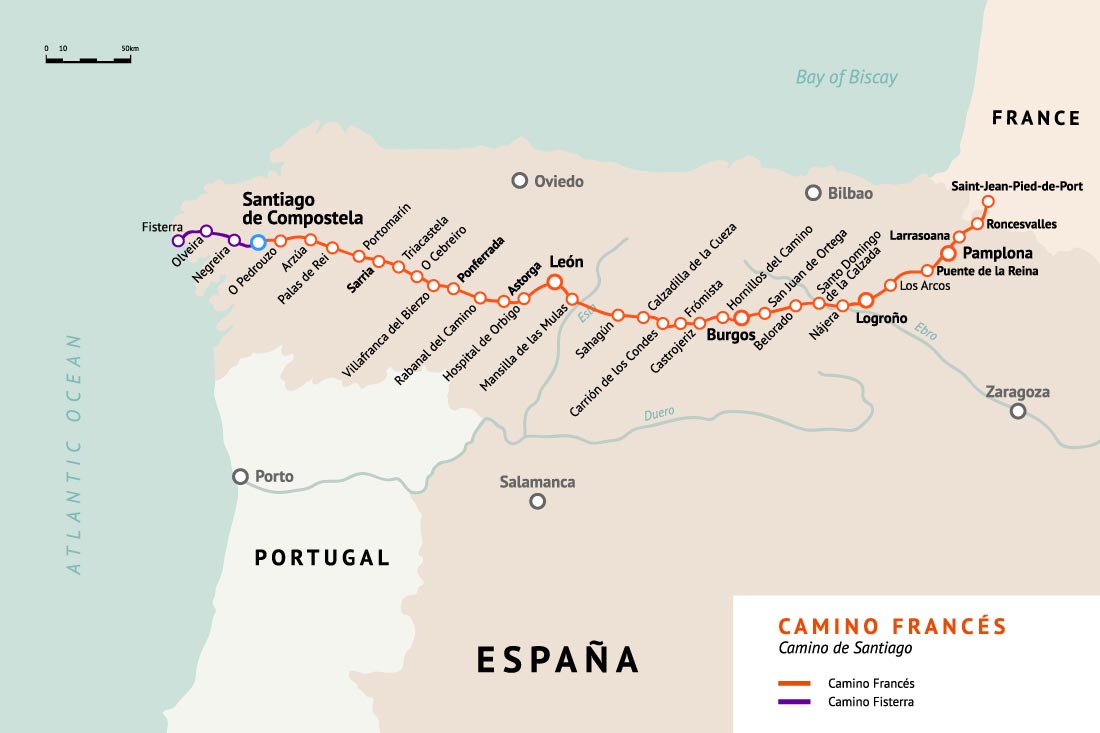
Jackie and I had hoped to walk in 2020 but COVID happened. Shortly after my retirement in 2022 Jackie and I simultaneously realized we could walk the Camino. We completed the 500 miles / 800km from SJPP to Santiago de Compostela along the Frances Camino on June 7, 2023. I posted a follow-up Lessons Learned on the Camino and our polarsteps photo journal.
History
The Camino de Santiago started out as a Christian pilgrimage, but as interest has exploded, devout Christians are small portion of the >400,000 people who travel along “The Way” each year. In May 2023 an average of 500 people were leaving SJPP each day, and even more people were doing the last section starting in Sarria. For people used to the “typical” wilderness thru hikes like Appalachian or Pacific Crest Trail it would be useful to read Ten Reasons not to Hike The Camino de Santiago and a counterpoint What you can expect from the Camino de Santiago. The Camino is much more social and a lot less wilderness.
For some background / history check out 2000 Years of the Pilgrimage which starts with the life of James and ends in the 21st century. In the 9th century pilgrims couldn’t hop on a plane to return home once they reached the “destination”, that was just the half way point for their journey. The goal of the pilgrimage was to visit Santiago de Compostela Cathedral which is reported to hold the remains of the Apostle James. We don’t know for certain it’s James, but it was someone very important in the Christian community from the 1st century. The space was treated as special (no other burials) through the 8th century when it was publicized as the burial spot of James. Over time several common routes to this spot developed and then were forgotten. In the 1950s there was a renewed interest in the pilgrim routes and a program to welcome pilgrims was developed. Through the 1980s there were very few pilgrims. In the early 1990s the president of Galicia started to promote the pilgrimage and arrange for the municipal alberques to be built. Next, numerous associations sprung up such as the American Pilgrims which has local chapters such as Northern California.
Physical Preparation
Walking ~15 miles / day for 30+ days is challenging for most people, even those who are young and fit. On our walk we encounter many people who were struggling with the constant walking. The majority of people didn’t have trouble with the aerobic demands of say going up the steeper hills, but rather the accumulated wear and tear on their lower bodies due to walking miles day after day. Nearly everyone had sore feet and muscles. The most common issue was blisters which will be addressed later. Some developed more serious conditions such as achilles tendonitis, plantar fasciitis, or shin splints. All of these come from people placing a significantly higher load on their feet and legs than normal.
The best way to prepare for the Camino is to slowly increase the amount of walking you do each week. Doing a long walk each weekend is not going to be sufficient. In the running community there is a rule of thumb: your weekly mileage should be 3 times the race distance you are training for. Long distance walking isn’t running a race, but I think it’s a good starting point. In the case of the Camino this would suggest that if you are planning to do 15 mile days, that you should walk >=45 miles in a week, with at least one day that is close to the average day you plan to walk on the Camino. I would recommend work up to doing 3 miles each morning and evening (listen to a podcast or audio book if you need to make the most of your time) 5 days, and a 15 mile walk once a week. You could also look for ways to turn your daily activities into walks. For example, I typically walk to get groceries. Since I have to carry the groceries home this means that the trips are more frequent. A nice side effects is our food is fresher.
When doing your training, it’s important to carry a backpack that has the same weight you would be carrying on the Camino and using the shoes you will wear on the Camino. The slope of the shoe from heel to toe (called the shoe’s drop) changes the demands on your muscles and especially your achilles tendon. Many people wear shoes with moderate to high heels in daily life and use shoes which are near zero drop on the Camino. This can lead to achilles tendinitis.
The book Fix Your Feet is filled with valuable information for people doing long walks.
Mental / Spiritual Preparation
Some people do the Camino as a tourist. That is collecting a set of experiences and crossing the activity off a “bucket list” while staying as comfortable as possible. My perspective is that walking the Camino, especially if you are doing the full Frances Camino, is too much of an investment to approach the journey merely as a tourist. We did the journey as pilgrims. Jackie and I walked with an intention to be open to all we would experience, and to be a blessing to all the people we encountered.
Pilgrimages provide an environment to step outside everyday life and encounter something greater. Pilgrimages typically involve facing challenges. Pilgrimages aren’t meant to be easy or “relaxing”. It is said the Frances way has three distinct sections. The body: which challenges you physically as you adapt to walking 15 miles a day or so. The mind: between Burgos through Astorga where the landscape can be a bit monotonous. The final section is the Soul where you’re finding your true heart.
I was considering doing a 30 day variant of Spiritual Exercises of St Ignatius. I started a thread asking if there was any material / recommendations combining the exercises and the Camino. Based on the feedback, I decided that the Camino de Santiago will be too social to be fully immersed in the Ignatian exercises unless I joined a group lead by an experienced director. Doing the spiritual exercises as a walking retreat might be best done on the quieter Camino Ignaciano some other time. Rather, this might be the opportunity to really listen to my fellow pilgrims.
The best mindset is to lay aside expectations and to embrace the moment by moment experiences. Allow yourself to slow down and notice what you are experiencing on the Camino.
Nancy Frey has documented how Smart phones and WiFi has altered the Camino experience on her site Walking to Presence. For many people this has resulted in a deeper connections with “home” during the Camino, and less of a connection with people on the Camino. I believe everyone should think carefully about how much they will make use of connectivity. Our experience was less is more. To focus on being present with the people and environment you are experiencing on the Camino, and not worry about “back home”.
We removed most apps (especially social media, and filtered email). We used a route guide, map, translation app, bible, audio recorder, and a daily devotional app. We also have WhatsApp installed, not to interact with people back home, but to manage reservations and coordinate get togethers with pilgrims we met. The one exception was we installed Polarsteps which we posted to, but never look at feedback. We decided to using polar steps for two reasons. Most important was to honor a request from Jackie’s father who wanted to follow along because he was unable to join us. Secondly, it forced us to daily record a bit about the day.
Timing and Route
The common view is that the best months are April, May, September, and October. You are missing the worst of the summer heat and the crowds due to school being out. You also miss the harsher weather / closed services during the winter. The temperatures in the fall and spring are cool which is perfect for hiking in, generally (7-18C, 45-65F) though it could be colder or warmer. It is likely there will be several days of rain in the spring. The fall has less risk of rain, but larger crowds. I would note that during holy years there are typically an extra 100k catholics walking the Camino. The next holy year is 2027.
Any of the guides listed below will provide all the information you will need to plan a journey along the Camino de Santiago. An easy starting point would be the online planning resources from the Village to Village guide.
All the guides break the journey into daily stages. Most complete the journey in ~33 stages. Many of the stages are identical across the guides with slight divergence and then resynchronizing in a few days. Jackie would like to do the Camino Frances again at a slower pace. The standard 30-33 stages provide enough time for the walking, house keeping, and experiencing community with fellow pilgrims, but not enough time to fully explore the history, culture, and architecture. The traditional first stage from SJPP is one of the longest and toughest. Discussion of how to handle it / where to stay.
Traditions & Important Sites
Remember loved ones lost with wooden cross along the way
Drink Rioja wine from fountain of Bodegas Irache, just outside Estella (early in the typical stage 6).
Leave a burden behind, symbolized by a rock from home (or maybe the laptop you are carrying) at Cruz de Ferro, the Iron Cross (stage 24)
Wash in the stream at Lavacolla, just outside Santiago. In ancient times there weren’t showers each night. The pilgrims would wash and change into their best clothing to enter the city.
Pilgrim’s Mass (offers in serveral locations)
Zero Days
Some people plan “zero days” to explore a city’s sights and sounds. Other times zero days are to recovery from an injury or illness. The best recommendation is to take a zero day when you body tell you to, and skip zero days you might have planned if your heart wants to continue to walk. Commonly recommended towns for zero days:
stage 3 – Pamplona (lively town, food). I think it’s a bit early, but helpful for people who aren’t experienced walkers who might need to swap some of their gear, get a massage, etc.
stage 7 – Logrono (good size town known for wine and hundreds of tapas places, especially along Laurel street)
stage 13 – Burgos (arch, museum, cathedral)
stage 20 – Leon (arch, food, I think the most beautiful cathedral in the world)
stage 22 – Astorga (arch)
stage 25 – Villafranca
The follows are some towns which the community has indicated are good places to consider if you want a quiet rest:
stage 5 – Estella
stage 10 – Santo Domingo or Grañón
stage 14 – Castrojeriz
stage 17 – Villalcázar de Sirga
stage 18 – Sahagun
stage 19 – Mansilla de las Mulan
stage 26 – O’Cebriero
Interesting Sites (History, etc)
The follows sites / towns might be worth exploring as you pass through:
stage 28 – Arthur Lowe’s art studio on main trail, 1 mile from where the detour to Samos splits off
stage 28 – Samos monastery (if you take the detour)
Festivals Along the Way
An incomplete list which of seasonable festivals. See moon guide for additional festival. Here is a sampling of festivals
Festa do Cocido in Lalin, February
Easter, Sunday, April
Festa do Maio – celebrations in Villafranca, Pontevedra etc, end of April, beginning of May
Ascension, May
Fiestas de San Bernabé in Logroño, June
Saint John and Midsummer celebrations take place in many other seaside towns and also in Santiago de Compostela, June
Sleeping & Housing
There is a huge range of housing. The cheapest is using a tent or staying in one of the free alberques in the dorm. Most alberques will be between €8-15 for a bed in the dorm. Private rooms run between €30-60. There are some very nice inns, hotels, and AirBnB that are €60-100 / night. Finally there a luxury, 5 star hotels such as the Parador properties which are in restored historical buildings and cost hundreds of € / night.
Nearly all the land along the routes are privately owned. Historically it’s been harder to find a camping spot than a bed in a alberque (hostel for pilgrims), hostel, or hotel. Most years I would recommend forgoing camping and leave the typical back country backpacking gear behind (tent, stove, sleeping pad, sleeping bag warm enough for outdoors, etc). The 2023 season seemed to be stressing the system due to a backlog of pilgrims whose trip was delayed by COVID, and a number of alberques that haven’t re-opened since the pandemic. I would still recommend using the alberques, just that you should make reservations.
Alberques (guide to alberques) are the cheapest, most available, and more common option. All alberques have dorm style housing. Many have communal dinners or a common kitchen. Linens and blankets are often not provided in the dorms… so unless you have have made reservations for every night and confirmed they will provide all you need, you should plan to bring a sleeping bag, or a sleep sack + quilt/blanket, a towel and at least a bit of soap. More on this in the gear section. The downside of the dorms is that you don’t have privacy, snoring and others moving around can interrupt sleep. Ear plugs and sleep masks are highly recommended. Many of the alberques have private rooms for extra money which often have ensuite bathrooms and provide linens and towels. Jackie and I think that a private room in an alberque is ideal, allowing a good night of sleep, intimate time as a couple, while experiencing community with other pilgrims.
There are also hotels, guest homes, pensions, and inns which provide housing. If you are traveling during peak season I would encourage pre-booking accommodations a few months before your trip. If you have a reservation and don’t need it, please cancel it.
Many people worry about bedbugs, especially in the alberques. We didn’t encounter any bedbugs nor did anyone we traveled with. From reports I have read online and from friends’ experiences in previous years bedbugs will be found occasionally but are uncommon. If you stay in a location that has bedbugs, there is nothing that can guarantee you won’t be infected. There is some evidence that treating your sleeping gear with Permethrin will provide some protection. If you end up picking up bedbugs, washing your body throughly and then washing all your clothing and gear in 140F water will kill them.
Packing & Gear
My original packing list had a base weight of 5.5lb and could fit into a 14l bag. At the end of the trip I updated my camino 2023 lighterpack list to include everything I carried on the heaviest day including several items I won’t take in the future. The picture below is nearly everything I carried or wore:
On the walk I picked up some skin lotion and a 15l folding messenger bag to used after this trip (we don’t have Decathlon in US). There are a few items I added at the last minute (packing for fears) that aren’t in the picture and generally weren’t used. When Jackie’s Achilles tendon started to hurt I carried a few of her items. This raised my “base” pack weight to 7lb. The heaviest total weight was 11 pounds when I was carrying extra water and a fair bit of leftover food / snacks.
Everyone I have talked with that wasn’t an experienced light-weight onebag traveler or ultralight backpacker said they brought too much stuff. They often either gave away the unnecessary items, shipped them home or to Santiago. Several people who have done multiple Caminos told us that any item not used by the time you got to Burgos isn’t needed, and you should be dropped. I encourage everyone to treat the Camino like a pilgrimage and leave behind excess baggage and live in the moment. I have some general notes about packing light aka onebag travel which might be helpful to someone packing for the Camino. There are people who go even lighter such as such as Tim Evans’s 7L fanny-packing list for Shawn’s 7-10l fannypack packing
Example Summer Packing List
It’s pretty warm in the summer and you don’t need to bring a lot.
Hiking clothing made from thin nylon, polyester or merino wool which can dry overnight. My recommendation would be:
nylon hiking pants that are quick dry like Outdoor Research Ferrosi, prAna Brion or a hiking dress
fast dry shirt that is high UPF like ArcTeryx Cormac, OR Astroman, Mountain Hardware Crater Lake, or if UPF 15-20 is enough for you, the very comfortable OR Echo
non cotton underwear. Light weight bra or swimsuit top.
insulation: an alpha direct hoody, 100wt fleece, or sweater made of wool, alpaca, or cashmere.
sun hat: something with wide brim or veil such as those made by sunday afternoon
small first aid kit focused on foot care: compeed bandages are great for protecting skin about to blister
toothbrush
water bottle such as reusing a smart water bottle
a 50F rated sleeping bag or sleep sack + a light blanket/quilt if staying in hostels / albergues
Modest size travel towel if staying in hostels, or maybe even if you are staying in full service hotel every night: see towel entry, hitchhiker’s guide to the galaxy.
When needed (which is less frequent than you might expect) you can wash you hiking clothing in a sink, shower, or machine if one is available. That’s all you need.
Hiking poles are not generally necessary, though if you are used to using them, bring them… just remember they have to be checked baggage when flying. If everything else you are bringing is carry-on, you can use a cardboard “poster tube” to ship your poles.
In the spring and fall you would want to add insulation, and extra pair of socks in case they don’t fully dry over night, and maybe rain pants or a rain skirt.
Pro Tip: Don’t bother with “dress up” clothing while walking the Camino. Restaurants are used to pilgrim attire: shorts, tee shirts, slides/sandals. If you need fancy clothing on a trip paired with your “Camino”, ship them to Santiago to be stored until you are done, no reason to carry them while you are walking. There are a number of services such as Casa Ivar which can help. Jackie and my first stop after the Camino was the UK. After after spending a week in Paris, before walking the Camino, we posted our extras including “dress up clothing” to a friend’s home in the UK.
Footwear
The single most important item you bring is footwear. I think minimalist shoes are the best way to go IF you have used them for at least six month. Otherwise I would generally recommend wearing trail runners or hiking oriented sandals. Sandals are often seen as people recover from bad blisters which makes me wonder if they won’t be the best “shoes” to start with. I have written up a brief comparison of boots vs trail runners. It’s important that you use whatever footwear you have selected (or identical models) for an extended time before the Camino to give your muscles a chance to adapt. For example, going from traditional shoes with a heel to zero drop trail running shoes is a good way to end up with achilles tendonitis. For people who are prone to getting blisters I would recommend sizing up your shoes by 1 size and wear 2 pairs of socks: a thin liner made of coolmax or nylon closest to your foot, and a thick wool sock worn “inside out” so the fuzzy part is against the shoe, and the smoother side is facing inward toward the liner and your foot. Another good option are Xoskin toe socks. I have zero blisters after walking thousands of miles in Xoskin toe socks. I had pre-blisters from other socks heal while wearing Xoskin socks while doing 15 mile days.
Backpack
The second most important item is your backpack. People who complete the Camino generally use outdoor oriented pack which are between 20-40L in volume. For people carrying less than 10 lbs, there are many good options. If you are carrying more than 10 lbs you will want a pack that has a hipbelt which is capable of transferring the majority of the weight to your hips rather than just stabilizing the pack. I have a post about selecting a good trekking pack.
Sleeping “Gear”
Most people walking the Camino will spend one or more nights in an albergue dormitories which are often mixed genders in the same room. You should have some clothing to sleep in. Tip: if you are in the bottom bunk near the wall, you can hang your towel to provide a bit more of privacy.
Albergues typically don’t provide linens. Many pilgrims bring a light weight sleeping bag (rated for 40-50F) which removes the need to worry about sheets and blankets. I prefer to use a silk or nylon sleep sack which is paired with a light weight quilt or blanket. When it’s warm you can use just the sleep sack. A good quality down backpacking quilts can cost $300, but if you only need enough insulation for sleeping inside (say rated for 55F), then there are a number of light weight down or synthetic outdoor blanket / quilts which are less than $100, such as hangtight shop blanket. Costco sometimes has a down throw blanket for around $25. A classic poncho liner, aka woobie is another option. Some folks find that just a sleep sack combined with their outwear can work. Clothing which are warm enough for “light work” in 40F (a typical spring morning) should be warm enough for sleeping indoors when the room is >=60F. I used a sleep sack and a piece of Polartec Alpha Direct 90gsm fabric which was used as a blanket at night, and as a scarf, shawl, vest, or poncho liner during the day. I wrote up a description of this in a post about my poncho system.
Keep it Light
For people who are used to luxury & comfort, don’t just prepare yourself to “rough it”, but embrace a simple and more communal experience. It is especially important to minimize what you bring because you will be carrying everything for many miles each day. If your bag feels heavy before you start walking, you are bring too much and it will get worse as the days progress.
Conventional wisdom is that people should carry a backpack that’s <25% of their body weight. This is reasonable for moderate distances but will be fatiguing on a longer hike. There were several experiments evaluating how pack weight impacted soldiers physical performance. A key finding was that on all day exercises, fit/trained soldiers had a measurable increase of fatigue and a drop in agility when they carries more than 10-12% of their lean body weight. This matches my personal experience: I feel no more tired at the end of a 20 miles carrying 17lb as compared to carrying no pack. My one caveat that when over 8 lbs I need to shift some weight to my hips or shoulder pain will be fatiguing through the day. My wife found her sweet spot is <7lb.
Some people ship their bag(s) town to town via a transfer service and carry a small daypack which holds only what they need for the day. This costs 4-6Eu for one time, and around 150Eu for an entire journey. I would recommend not planning to do this as a regular practice, though it can be useful if you are trying to recover from an injury or fatigue. If you going to use a transfer service I would recommend using a duffel which does not need to be expense. We saw a number of people using $4 Ikea frakta duffels. Realize that mistakes can be made, and you might find your transfer bag misplaced for a day or two. For people who are finding lodging as they go, using a transfer service can add stress and complications since you don’t know where to ship your bag on days you don’t have a reservation. Warning: Several traditional alberques have banned “suitcases” or transfer services from delivering because the alberques exist “to serve pilgrims, not tourists.”
It’s better to bring twice the money you think you need, and half the stuff. It fairly easy to pick up items that you forgot, lost, or are damaged along the way. Worse case is a 20 minute taxi ride to a larger town. Several of the town along the Camino have a Decathlon store, which is the Ikea of outdoor equipment and clothing. There are also a number of stores which cater to nearly all the needs of pilgrims (shoes, clothing, backpacks, toiletries, etc) such as Boutique du Pelerin in St Jean Pied de Port, Caminoteca in Pamplona, Pilgrim Oasis in Carrión de los Condes, etc. Most of the towns have a small store near or on the Camino route which sell comfortable shoes (almost all sell Hoka) and some other items that pilgrims might need.
Food and Water
Unlike backcountry backpacking, you rarely need to carry much food or water because you will be in the next town before you need more. Generally .5-1L of water will be enough if you periodically stop at a cafe / food trunk for a drink and make use of the fountains. You will want more water on the hottest days. Before walking, you might figure out how much water you need. I discuss this in my post about water treatment and containers. You might want to carry some food with you when entering a less populated area on Sunday because the groceries / cafes / restaurants might be closed or have hours which are incompatible with your schedule. I liked granola bars and Laughing Cow cheese which doesn’t have to be refrigerated. Of course, if all the food options are closed you can treat it as a day of fasting.
Jackie’s Pack
The following is a picture of the contents of Jackie’s backpack for the Camino. She used a 15 year old Camelbak hydration pack which was retired at the end of the Camino. Jackie runs colder than me so she brought more insulation that I did. While my strategy was to use my blanket for warmth during the day, hers was to use insulating clothing + a silk sack for sleep. This works well because night time temperatures inside the albergues required about the same amount of insulation as walking in the coldest mornings.
Outerwear
Clothing
Misc Other
Uniqlo Down Jacket Montbell Insulation Skirt Ikea Rain Poncho Montbell Umbrero Hat Macpac Nitro Alpha Direct Hoody Montbell Windbreaker Buff
Initial Items, Items Offloaded, “+” indicates items added. Buff wasn’t used. Waterproof socks used only a few times. Leg warmer not used after compression socks was purchased. Jackie didn’t bring first aid… she made use of the kit I brought.
Blisters
Jackie and I have been blister free, even for extended journeys like 500 miles of the Camino from SJPP… but we seemed to be exception. Many (most?) people get blisters on extended trips, especially people wearing hiking boats. Most people were able to manage their blisters and continue to walk. A significant number of people we met on journeys like the Camino needed to add a zero day and/or take a taxi or bus to shorten their daily walking to give their feet time to recover.
The first step is to try to prevent blisters. Blisters develop when your skin is exposed to friction, especially when wet or hot. Most important is to remove friction, specially lateral shear forces (good short video). This means that you shoes need to be roomy enough for your toes to splay without being so large that your feet slide around. If you shoes / boots are stiff, you will need something that provides a cushioning. Wearing two socks, a thick wool sock turned inside out, and a thin synthetic liner sock is one of the most effective solutions. More information about this on my recommended socks page. You also want to keep your feet dry when possible. This is typically best achieved by wearing fast drying, well ventilated shoes or sandals. Avoid waterproof shoes and boots. In rain they don’t really keep your feet dry due to feet sweating, and they hold moisture when it’s dry.
Second, as soon as something doesn’t feel right apply treatment, don’t wait for a blister to appear. Sometimes changing your laces or adjusting your socks is all that is needed. Most of the time adding something to protect you skin. My experience is that KT-tape and Compeed blister bandages are the most effective treatments. Duct tape works pretty well. Some people swear by “hiker’s wool” but I have no experience with it. I don’t find Moleskin very effective.
Third, if you develop blisters treat them. Start by draining them and then clean gently. Next you need to make sure they don’t get worse. One option is to leave a small thread in the blister to allow it to drain and then put a breathable protective bandage over them. The method I use is to squirt a bit of superglue (I bring some single use tubes) into the blister. This keeps the loose skin from tearing and makes a durable barrier which protects the tissue under the blister.
For more information about caring for your feet, read the book Fix Your Feet.
Guide Books and Apps
There are a variety of guidebooks and applications designed to help people successfully navigate the Camino de Santiago. All the guidebooks provide information about the route itself and places to stay. Some provide a day by day schedule. Others provide information which allows the pilgrim to decide were they want to stop.
A Pilgrim’s Guide to the Camino de Santiago by John Brierley is the classic english language guidebook (don’t buy it in kindle form, terrible formatting, no hotlinks!). It breaks the route into discrete stages. Many people follow his stages woodenly which typically means that the villages listed at the end of each stage will be more crowded. Brierley includes selection about ‘the mystic path” and “personal reflections” which can be enriching, but annoy speople wanting a purely practical guidebook for a long hike.
Moons Guide is the only guide which highlights food, and focused more on local culture, detailing local festivals and annual events but is somewhat dated. Several of the restaurants mentioned are now closed.
Wise Pilgrim is a very practical guide which is reported to be the best iOS/Android App. The app supports offline maps. The full content is available as a Kindle and Paperback book. Much of the content is also freely available of their website. Has booking.com links for any of the lodging that supports online reservations, and WhatsApp links for any lodging that can contacted that way which is great for non Spanish speakers. The paid version has the best offline map (which includes several of the alternative routes). Downside is that it sometimes crashes but always restarted.
TrekRight Camino Guide is a iOS Guidebook application. UI needs work but is one of the most complete online guides. Trail notes, offline maps, indications of service in town include grocery stores, some good details sbout each of the lodging locations. Missing booking links and WhatsApp contacts found in Wise Pilgram. Has a notes, flags, highlights flags.
Buen Camino De Santiago by Carlos Mencos is available for IOS, Android. What a bit awkward to set up, provides a nice view of your daily stages. Has incorporated a bunch of content from wikipedia and some video clips to provide background to the version towns along the Camino.
Camino Guides by Gerald Kelly is available as an iOS/Android app, Kindle, paperback, and a downloadable PDF. Gerald also makes a free version of the PDF available (which is missing maps and historical background).
FarOut (aka GutHook) is a hiking oriented mapping guide which focuses on the trail, water sources, etc rather than the towns. I don’t see the point with how well the trail is marked.
WhatsApp is used by many businesses along the Camino including a number of the taxi companies and alberquea.
Google Translate lets you communication with people you don’t share a common language with. Our experience was English and Spanish were the most useful / common languages used. We heard a significant amount of Portuguese, Korean, French and German. You can download language modules so the app can work offline.
The camera to help you remember people and places.
Resources
caminodesantiago.me is a very active online community run by Ivar Rekve, a resident of Santiago de Compostela.
santiago.forwalk.org is a very well done website. They have a number of “pre selected” routes / stages with information about what services are available with pictures and links to make reservations.
Route Planner which lets you choice start/end locations, and then select the villages you want to stop in (lists type of accommodations but no description of them). For these selections the website can generate a number of files including a path to be viewed through google earth, gps waypoints, and a schedule in a nice, spreadsheet readable table
gronze.com: in spanish, but google translate can make it quite useful
Metroblue: Best weather app I have found. The weather maps are really useful. iOS
Stories
I Will Push You – Wonderful movie about a great friendship. Patrick joins Justin to complete the walk. The journey would have been impossible for Justin to complete by himself due to a neuromuscular disease.
TrailJournals: Camino de Santiago is a site which originally was used by long distant hikers for the Appalachian and Pacific Crest Trail but now hosts journals for other trails including the Camino de Santiago. I particularly appreciate Slow Walkers (first) 2007 journal… he has more recent entries as well.
The Camino is steeped in history. Having a sense of the history and culture and enrich the journey. While walking the Camino you will pass some classic architecture. Some resources to appreciate this background:
The Pilgrimage Road to Santiago: The Complete Cultural Handbook by David M. Gitlitz won’t tell you anything about the modern cities, hostels, or amenities but will give you an in-depth look into the history of the path you are walking.
Iberia by James Michener isn’t about the Way, but provides a good amount of background about this region of Spain.
Be curious and ask questions of the people you meet. There are many amazing stories you will hear, and many reasons people are walking the Camino. Good questions: “Why are you walking the Camino?” “What have you learned during your walk?” “How has the Camino changed you?” “What are some of the hightlights of your walk so far?”
Make a list of people you meet and take pictures of help your memory. Maybe consider asking how you could pray for them and make prayer cards.
Get used to Spanish schedule. Breakfast is a slightly sweet pastry and a coffee, maybe a spanish tortilla. Lunch is generally 1:30-3:30. Dinner starts at 8 PM. Many stores are closed in the mid afternoon and on Sundays.
As you enter new cities look for a poster with a list of local taxi phone numbers and take a picture in case you are injured and need transportation. Often in the entry of hostels, sometimes there is a poster near the entry / exit to the town. When you take a new picture delete your old picture. For non Spanish speakers, try putting the number in to WhatsApp or iMessage and see if they are on one of those platforms. If so, you can send them messages which includes your location and your request that you translate into Spanish using a translation program.
If you are having trouble finding a place to stay on the Camino look a few km on either side, There are often hotels and guest homes that are pretty close, several will offer free pickup and return to the Camino so you don’t have extra walking.
Walking takes hours to go between towns, but a taxi and bus takes tens of minutes. It’s pretty quick and not that expensive to return to a town to retrieve something you left behind. Realize just because a town has buses doesn’t mean they have buses that go to where you want to go.
Once a week stay someplace with a washing machine. They are way more effective at cleaning clothing than hand washing.
If you are bring a cell phone, have WhatsApp loaded. It seemed to be the universally used communication tool along the Camino for many businesses and most of the pilgrims. Take a screen shot of your QR code (settings, click on the QR code icon next to your name). If you don’t have connectivity and want to exchange contact information with someone just have the scan or take a picture of your QR code which will save the hassle (and eliminate errors) of them getting your contact info.
Each morning I would stop at first church I came to that was open. I would go inside, if there was a nun present thank her and then sit down to reflect of what I had to be grateful for and then to pray for the coming day and the people I had met along the way. Doing the make the rest of the day better.
If you walk from SJPP, prepare for things to change in Sarria. There are many more people and many are more tourist than pilgrim. First, don’t judge them, everyone is walking a different road. It will be much harder for them to experience the Camino spirit, but try to share it with them. To avoid the massive crowds try leaving before 7am or after 9:30. Most of the tours / packaged trips have a breakfast which is between 7-9am.
If you want to get a Compostela, use the pre-register website a couple of days before you finish and get a barcode. You will likely be in and out in 5 minutes rather than waiting in line for hours.
For people biking the Camino… have a bike bell. Its sound is pleasant and universally understood. Saying “coming through” only works if people understand you language and is more jarring that a bell.
Re-Entry from a Pilgrimage
Many people talk about how jarring it is to return to “real life” after a pilgrimage like the Camino. After a month of a slow paced life characterized by simplicity, quiet, and community they found themselves facing a hustle / hurry culture that is filled with noise and often more oriented toward competition than community. It is easy to get overwhelmed and to return to old patterns and habits, leaving the Camino experience something remembered fondly, longed for, but divorced from daily life. As I have talked with people about their post Camino experiences there are several things which seem to have kept the Camino spirit alive for many. The following is a summary of the advice I have heard about how to live into the Camino experience once the walk is complete.
Set aside some quiet time (ideally a week or more) between the end of your Camino and starting back to “normal” life to have time to think, pray, journal, and reflect on your experiences. Identify what you learned, how your perspective has changed, how your values have shifted or strengthened. Ask yourself what is important in light of your Camino experience?
Consider your life before the Camino and ask the question “How did my pre-Camino life align with my post-Camino understanding?”. It is likely that you will find places the two don’t align. Realize that if you don’t make explicit changes, your post-Camino life will likely look exactly like your pre-Camino life.
Identify changes you would like to make as your return to “regular life”. Many try to change everything, fail, and quickly give up. Rather make a list of things you would like to change and then decide on one item you will start with. Break it up into manageable steps and find ways to turn it into a habit and then a lifestyle. The book Atomic Habits is a great resource for this sort of planning. Once something has gotten established, look at your list and make the next change.
The most common change I heard from people was making sure they left slack in their schedule so they weren’t constantly forced to react to life. There were moments to reflect and choose a response. Many found that adding a time each day to just be was key. For some this was time to sit, reflect, and maybe write a few sentences in a journal. For others it was a quiet walk in their neighborhood or a nearby park.
The second most common change I heard was people striving to build a genuine community. Often, they had been part of some sort of a community before the Camino, but the experience fell far short of their Camino experience. In some cases people have found that by intentionally investing and initiating in their community they were able form a genuine community. In other cases people realized that where they were putting their time wasn’t working and that they should try something different.
Set a date for your next Camino 🙂
All of these items suggest that what’s key is to identify what you loved about the Camino and then to identify little things which will remind you and keep your grounded, anchored to those things.
I am not in control. I am not in a hurry. I walk in faith and hope. I greet everyone with peace. I bring back only what God gives me.
Bugforce Scale as proposed by Paul Wagner is an attempt to describe how annoying mosquitoes are from a qualitative perspective. An example of one of my level 9 experiences was descending into the basin around Dick’s Lake is Desolation Wilderness. While walking down the trail I briefly stopped to get something out of my pack. In less than one minute I counting more than 100 mosquitos land on the parts of my body I could see. DEET didn’t prevent them from landing on me, but thankfully they couldn’t penetrate the Supplex clothing I was wearing or get my face because I was wearing a head net.
0 is Zero. Really. No mosquitoes or other biting bugs
I think I may have seen one. But maybe it was a gnat.
OK, I saw one, and heard one, but didn’t actually get bitten,
Yeah, there were some in a few spots. Only the timid put on organic bug juice.
Got a few bites, but I got more of them than they got of me.
Time for DEET at dawn and dusk. Hiking, we just slapped and sped up.
DEET while hiking. Headnets at dawn and dusk
Pick your camp spots carefully, up on the ridge in the wind. Bites between hat and sunglasses–how do they get in there?
Long sleeves and long pants, I don’t care how hot it is. Pray for wind.
Headnets while hiking, or you’ll breathe in at least one bug per mile. DEET dissolves sunglasses
Clouds of mosquitoes waiting on the trail and on the screen of the tent. Open warfare. DEET dissolves watchband, and it’s stainless steel.
No mosquitoes or if there are some, but not biting yet
Very light during the day, moderate at dawn and dusk
Moderate during the day, heavy at dawn and dusk
Heavy during the day, heavy at dawn and dusk
Unbearable all day, no breaks, cannot eat outside of tent. If you stop, hundreds will descend on you; when looking thru a camera viewfinder, you see more skeeters than lake. If you slapped your arm, you’d smear blood from all the dead gorged bodies
My Approach
I typically wear long pants and long sleeve shirts which are hard for bugs to bite through with Permethrin treatment to add to the effectiveness. I will use a head net when bug pressure is high. I use Picardin on exposed skin.
Picaridin finally entered the US market. Picaridin has a number of advantages over DEET: it doesn’t destroy plastics, it doesn’t smell bad, and doesn’t leave that icky feeling. From the studies I have read Picaridin is slightly less effective than similar concentrations of DEET. I have found that 8% Picaridin is effective against modest mosquito pressure for a few hours but not effective in heavy mosquito areas, and >20% worked well for medium to high mosquito pressure.
I have tried a number of the natural insect repellents. Lemon Eucalyptus seems to have been the most effective. In locations which have only minor mosquito problems they can be effective, but if you are somewhere with lots of mosquitoes (say in the Sierras when the snow is melting, Canada during the summer, etc), you will get eaten alive if you use “natural” repellents.
Permethrin infused clothing can provide reasonable protection when the bug pressure is moderate, but I found it to be inadequate when the mosquitoes are out in force. Several companies sell clothing with permethrin pre-applied. You can self-apply Permethrin (it’s sold many places including at REI) or ship clothing to Insect Shield for professional application.
Ticks
Start with prevention. Spray your cloths with Permethrin and use DEET based repellent if you are in a location which has a lot of ticks. You should remove ticks by gently pulling them off with a pair of tweezers or using one of the special tick removing devices which are designed to lift ticks off your skin (such as the Pro Tick Remedy). Using hot match, Vaseline, nail polish is extremely counter production. Not only do these techniques risk killing the tick and leaving part of the tick in the victim, but ticks will often expel their stomach contents when distressed, the very thing you want to avoid. There is a belief that Lyme disease isn’t transmitted for 24 hours, so make sure you do a tick check each night. If you have been bit by a deer tick, check with a doctor. There is now an anti-biotic treatment which is more than 80% effective. I collected some info about tick removal tools from backpacker.com forum. Of course, treating clothing with Permethrin helps keep ticks away.