Author: mark

  • Your Company Isn’t Your Family

    TL;DR – Read the title 🙂

    The HBR Your Company Is Not a Family written by Reid Hoffman, Ben Casnocha, and Chris Yeh  has better prose than what follows here.  If I had found it earlier I wouldn’t have bothered writing this post.

    In the last few months I have chatted with a number of young folks who just got laid off from their first job. When joining “their” company they were told “We are a family”. The company provided meals, social activities, and many other services. Then they received a text informing them they were no longer employed and all their access was revoke. They were shocked and dismayed. I wasn’t  surprised, nor were any of the people who had experienced a business boom / bust cycle.

    Second TL;DR

    • Companies are more like professional sports teams than a family. Companies look out for the good of the company. Employees are resources used to achieve objectives. If someone isn’t helping they are expendable.
    • No company offers long term security or lifetime employment. Select a job because it’s a good match now and has at least a year of “runway”.
    • Family (at least good ones) sticks by you through thick and thin. They always have you back. Everything is faced as a family. No one suffers alone. Cherish your family and give it first priority. Don’t sacrifice your family for work.

    Loyalty?

    There was a titanic shift in business that started in the 1970s. Shareholder / investor returns became a primary (sometimes the only) lens that companies were evaluated by. Loyalty to employees wasn’t important. Care for the customer was variable. Companies that were profitable but not delivering excellent returns on their stock would would often do layoffs, close divisions, reorganize to eliminate redundancies,  close sites, etc to improve their financial metrics. Loyalty to employees no longer mattered.

    People lost jobs not because they weren’t performing, but because the company wanted to cut costs. Being a “company man” with an implicit employment for life disappeared. Companies embraced the “all will” employment. It was during this era that the book “What Color is my Parachute” was released. Executives often got “golden parachutes” while the scores of people laid off were given nothing.

    To be fair, there were some notable exceptions. During a tough recession that hit high tech hard, HP leadership slashed their own comp, asked whoever could afford it, to take a voluntary furlough. Everyone else took a 10% salary cut with a 10% reduction of workdays referred to as “Nine-Day Fortnight”.  Quite different from HP’s announcement in 2022 that they would be laying off 6000 people when the previous quarter posted a 7% profit margin from a $14B revenue stream.

    Choosing a “Safe” Company?

    When I first entered the working world there was still the illusion that working for a “big company” was safer than working for a small company. Most of us had seem small companies close, but the big companies always seemed to have resources to weather unexpected financial storms.  was not interested in join start-up or small companies. I wanted a large stable company where I would have a reliable paycheck and could “pay my dues” and grow my career.  The cracks in this narrative started in the 1970s, and by the 1990s, you would need to be ignorant to believe working for a large company was safe.

    By the 1990s it was clear to me that I shouldn’t expect that “paying my dues” would result in any loyalty from my companies, nor that performing my duties well would guarantee continued employment. This led me to change how I evaluated work opportunities.  My evaluation became:

    1. Would my work promote human flourishing? Would my “customers” have better lives takes to my companies work. Was I going to be leaving our world in better shape than how I found it?
    2. Is this a position that I am uniquely qualified to take? Do I either have the skills and experience required to succeed or the time to develop that experience? Will my strengths be utilized?
    3. Will I be joining a good team. I want to be working with people who will help me grow and learn. I definitely want people who are smarter and better than I am so I can learn from others.
    4. Do I believe that companies finances has at least 1 year, ideally 2 years of runway. I can get up to speed and make a meaningful contribution in 1 year.  2 years is enough time to master a specific role and be ready for something new.
    5. Is my comp enough for me to maintain my current lifestyle.

    A few things that were not criteria

    1. Am I going to make a lot of money / is this going to be an IPO hit?  It’s silly for me to think I can pick a company that will have this sort of success. VCs have access to more information that I do as a prospective employee, and more leverage to make a company succeed and pick winners maybe 1 of out 10 times. It’s unlikely I can pick a winner
    2. Is this a promotion… better title, more salary?  Money isn’t everything. So long as they pay me enough to have the lifestyle I am currently living. Titles aren’t as important as the body of work produced and the relationships that get build when doing excellent work with colleagues.
    3. Is this a company that I can work for until I retire?  The world is changing so quickly… there is no guarantee that large companies that were in the fortune 100 will still be relevant, if even exist in 50 years.

    Prioritizing Family

    As noted in commands for life hospice nurses never hear people say “I wish I would have worked more”.  They hear people say “I wish I hadn’t worked so hard.” so they would have had more time with the people they love and care about.

    Make sure you are spending your time on things that will be valuable throughout your life.

    I will note that there are some seasons of life when work might take time away from family. For example, a critical crunch time where for a week or two you need to put in extra hours to hit a deadline that actually matters. This is not the same as an extended, chronic crunch which is properly called a death march that does no one any good.

    People who are starting a new venture will likely require  taking time and some focus away from family. What’s important is to determine the length of time this will be permitted. Come to an agreement with your family and/or partners about what this duration will be. Set a “checkpoint” date. At the time review how things are going. Do you need to make a change? 
  • HR Isn’t Your Friend

    A common misconception held by first time managers and many employees is that Human Resources, AKA HR, People Team, or whatever is the in-vogue term is these days, exists to support the employees.  Well informed optimists would say HR is called on to look after the interests of both the employees and the organization as a whole. Their responsibilities involve balancing the needs and concerns of these two key stakeholders. 

    In my career many of the individuals in the HR team strive to support employees, but in my experience the HR institution has little regard for employees beyond extracting maximum value. In many companies HR exists to protect the company by minimizing liability and get maximum useful output from the employees. Employee welfare matters only to the extend that it impacts productivities and the company retention targets.

    Making Best Use of HR

    While it’s true that HR teams aren’t on your side, there are numerous ways a good HR team can be helpful and you should take advantages of the services they provide.

    Benefits

    HR Teams typically function as the administrators for benefits programs. Good HR teams will be excellent advocates for employees programs since they know the offerings and helping employee take advantage of the programs improves employee satisfaction against resources already budgeted and will be wasted if not used.

    Policies

    HR teams insure company policies are well documented. Good HR teams strive to insure policies are enforced fairly across the organization, though often there are “golden” people, typically high ranking individuals who get special treatment. The best HR teams advocate for transparency which builds trust and makes it much more likely than policies will be applied in a fair manner .

    Often companies will have a “company manual” which is maintained by the HR team which will hold all the company policies. Whether your company has a manual or not, it’s often useful to ask someone in HR what formal policies exist.  For example, most companies have travel policies which specifies payments, maximum lodging cost (often by location),  modes of transportation the company will pay for, etc.

    Training

    Many companies offer in house training, and/or access to external training and educational resources. These opportunities are often managed by the HR team, though in larger companies departments might have additional resources. Take advantage of these opportunities.

    Recruiting

    The recruiting process is very labor intensive. Writing up positions to be posted. Processing resumes. Reaching out to people who aren’t applying but would be good fit. Screening candidates. Arranging interview schedules. Making sure the candidate feels like they are cared for, are well informed, and are getting feedback. Insuring feedback is processes is happening and a good decision is made. Kindly delivering the offer/no-offer message to the candidate. Educating a candidate what is included in an offer: both good and bad. There are meta processes like developing a good screening system, training people to be effective interviewers, etc.

    In my career I have had mixed experience with folks doing recruiting as part of an HR team. Some people have been superb. They often were involved in the initial “cultural” screening that examine work style / philosophy of the candidate and were able to help the candidate understand the important values of the team they we interviewing for. They made should there were no unnecessary surprises and everything was taken care of. Feedback was provided so I knew what was going well and not so well. If there were areas of concern or alignment which need more conversation. I have also experienced bad recruiters. In one case, they never got back to me after the interview and didn’t return my calls or email to follow-up. I later learned that the hiring manager thought I wasn’t interested in the position.

    Avoid HR For…

    Unlike a lawyer or CPA that you hire, HR personal are not obligated to confidentiality, fiduciary duty, or due care. Their first priority is protecting the company from lawsuits and other adverse situations. They are often required to report things that you would like to keep confidential.

    Conflicts… unless unmanageable

    People on the HR team can be effective mediators but they are no always permitted to do this. .Often company policies and politics can trump a mutually acceptable resolution. If there is a conflict between employees of a company, I would recommend not bring the conflict to HR unless you are prepared to see at least one individual lose their job. 

    How can this go wrong? One example is a young women who felt a coworkers was making inappropriate comments. She was encouraged to talk to HR rather directly address her peer with her concern. In less than a week her peer was terminated with no opportunity to correct the situation. The reporter was shocked and heartbroken with this outcome… the terminated team member was (and is still) a friend.  Before the termination was finalized the two employees talked and came to see  the issue was more a misunderstanding and some insensitivity on the part of the male coworker who would have been happy to change once he knew is relating style could give offense. Alas, once the process was started, the women was not permitted to stop the process.

    Performance Issues… unless termination is likely

    If you are struggling with your job performance, or if you are a manager who is working with an employee who is struggling with their performance I would recommend avoiding HR unless you believe the situation is likely going to end in a termination and want to insure all the rules / procedures are followed. While there are exceptions, HR teams are typically staffed by relatively young people who don’t have a lot of experience coaching people through difficulties and their first duty is to the company, not the employee who is struggling.

    The other thing to note is that sometimes HR doesn’t want someone to be terminated because of the risk of legal action. They rarely understand the wrong person can dramatically impact the entire teams performance. For example 1 problem person on a team of 8 doesn’t reduce the team’s output to 7.5 to 7, it can drop the team to a 5 or less.

  • Gear-a-holic-ism

    One of the dangers of any activity that involves “gear” is that people can get hyper focused on “gear” rather than the activity / goal. Ironically, there is a similar danger for people pursuing minimalism: a temptation to chase after the “perfect” rather than being content with a functional system already in use. I recommend focusing less on “perfect”, and rather focus on removing friction so you can devote more of your time and energy to the activities you love / find meaningful.

    Pretty much every hobby or activity can descend into gearaholism, where the focus switches from the activity to the acquisition, evaluating, reviewing, etc of the gear. You know you are on this path when you spend more time reading about gear, thinking about your next purchase, testing items, than using the gear to enjoy the activity. For backpackers I like to ask how much time are you spending researching your next destination as compared to thinking about the gear you are going to take.

    The following has been my journey with backpacking / outdoor gear as I shifted my focus to simplicity. I had similar journeys with photography, audio, and computing equipment. I somehow avoiding gearaholism with bicycling. Cyclists often talk about the correct number of bikes is either:

    • N + 1 for single folks: The optimal number of bikes is one more
    • N – 1 for married folks: the correct number of bikes is one less than will result in a separation from your partner.

    I managed to be content with a single bike, and didn’t bother upgrading until my bike became too difficult to maintain or I was no longer able to use it.

    Phase 0 (many years)

    I was the prototypical boy scout.  I wanted to “be prepared” for any situation, so I carried everything including the kitchen sink, whether or not it was likely to be needed.  If it was theoretically possible, one needed to be prepared for it. Everything was build to survive anything short of a nuclear blast. Heavy leather boots, 1000D Cordura Nylon, etc. A 4-season mountaineering tent was guaranteed to do well in wind, rain, and snow so it would be great in milder conditions. During this period of time I would spend some time trying to find the best option, but once it was purchased I was done. I would stop looking at alternatives and just use the item until it was worn out, broken, or stolen.

    Phase 1: Discovery (2 year)

    I found that I wasn’t really up to carrying a 60lb pack anymore, and came across people doing adventure racing, Mark Twight’s Extreme Alpinism, ultralight backpacking advocated by Ray Jardine. I benefitted greatly from correspondence with Glen Van Peski, Ryan Jordan and Don Ladigin, the backpackinglight yahoo mailing list, and later the folks at BPL. While I don’t go as light as some of them, I was strongly influenced by them. I suppose most people would consider me an ultralight backpacker. I agree with Andrew… ultralight people need to chill.

    I started by replacing my heaviest items with light or ultralight weight versions. I drop some items I always took but never used and asked the question “Do I actually need these things?” and “Can I improvise or use something I already have to cover this potential need?”

    Phase II: Incremental Improvement (3 years)

    I treated each trip as an experiment, often varying the items I brought and the approach I took. I was constantly pushing myself, and my gear to the edge, looking to see what the real (rather than imagined) limitation was.

    I took a notebook on each trip where I would log the conditions (logging thermometer / mini weather station was very helpful). I would make notes about what worked and what didn’t work. I found both the comfort and the safety ranges of my clothing, shelter, and sleep system. I figured out of various items could be combined to cover unusual circumstances.

    I would often bring something extra as a “safety” item as I was learning my limits, but commit to not pull it out unless it was actually a safety rather than a comfort issue. For example, I brought an extra warm puffy on several trips but didn’t pull it out when I was uncomfortable, but not yet unable to function / approaching hypothermia.

    After each trip I would review my experiences. My goal was to remove at least one item from future trips until there was nothing left to remove. If I was smart, I would have been content with the system I arrive at near the end of this phase.

    Phase III: Obsession (4 years)

    I was on a quest to find “perfect” gear and to get my pack weight as low as I could. I was a full on gear-a-holic. This resulted in purchased multiple items which provided the same function which were optimized for varying conditions. Multiple shelters, packs, bags, etc. Each trip had a different combination of gear. During this time I spent a lot of cash and engaged in a lot of “catch and release”, purchase gear (often used), use it on a few trips, sell it and try something else. I spent a year trying  super ultralight (SUL) approach, e.g. based weight <5lbs. I recorded my last super-ultralight gear list from 2007.

    Phase IV: Comfortably Dialed In (4 years)

    I decided to rein my spending, and to get more focused on using rather than buying gear. I started that transition by committing to a zero-cash spend in 2006. If I wanted something new, I had to sell items I already owned to cover the cost. My “budget” was whatever was in my PayPal account. I have a lot of gear that I had accumulated during my obsession phase. The items that were uber-lite and I didn’t enjoy using were sold off. Each trip I selected the optimal system from my “quiver”, often influenced by which items I loaned out to people on the trip I was leading.

    I decided lightest weight pack just wasn’t that important. There was no different in fatigue or enjoyment when carrying <20lb with a good pack with a weight transforming hip belt compared to <10lb, so why I was I using a sleeping pad which wasn’t comfortable, using a shelter that didn’t protect me from bugs, just to save weight, especially when I had to carry >10lbs worth of food and water.

    My base went when from <5lb to between 8-12lbs depending on if I had to bring a bear can, and if it was 3-season or winter trips.

    Phase V: Minimalist (10 years)

    I wanted to minimize my possessions so I could focus on things that really mattered to me. I wanted my activities to maximize enjoyment and meaning. This resulted in changing the trips I planned. For example, while I could push myself to do 30 (or in one case 50 miles) in a day, my sweet spot is more like 15-20 miles/day. While I could do solo winter trips, I didn’t enjoy them, nor hot desert trips.

    Eliminated the more extreme trips reduced the conditions I would face. This made it possible to build a “standard” packing list which would cover 95% of my trips with no variance other than the amount of food and water I started with. When I learned the next several days were free, I could pack and be out the door in around 15 minutes. It was OK to carry a bit of extra weight if that removed a decision and allowed me to sell of gear than was somewhat redundant. I downsided my gear, typically striving to have a single item for each function: 1 backpack, 1 quilt, etc. During this time my system didn’t change except when items wore out and needed to be replaced.

    Phase VI: Simplicity/Essentialism (current)

    Really focus on what I want to do… which is enjoy hiking and the outdoors. I was over constraining myself by insisting on a single item to meet ALL requirements. I decided I was too focused on limiting the total number of items, and that it was OK to have some specialized gear. For example, these days I have two shelters. A GG Whisper for my three season solo trips, and a X-Mid 2 Pro for when I can share a shelter with someone and for solo trips when I might need to face a serious storm.

  • It All Comes Down to Love – Jack Kornfield

    Snipped from The Tim Ferriss Show Transcripts: Jack Kornfield (#684). BoldItalic added by me for emphasis

    Jack Kornfield: In all these years, my understanding really is that it comes down to love. I’ve met [inaudible 01:05:26]. And lamas, and gurus, and lamas and everybody else in between in my industry. And some of them are fabulous. But there’s a really interesting thing that you can have these powerful experiences and still be a little bit of a jerk. Just getting real about it because — 

    Tim Ferriss: There’s a lot we have going around.

    Jack Kornfield: Our consciousness is like a mandala and we can awaken some dimensions of it. So you have an Olympic-level athlete who’s an emotional idiot. You have a professor of nuclear physics, most brilliant, and she can’t find her shoes or her body. We can develop ourselves in some areas, but it turns out unfortunately, that doesn’t always go over to another area. And so there’s a kind of halo effect where people think, “Oh, this person is a spiritual teacher and they’ve had these spiritual experiences. I’ll go ask them for marriage advice or advice for sexuality.” They don’t know shit about marriage.

    So this is our human nature. If we’re actually to become wise, we need to direct our attention to body, to emotions, to relationships, to thought. We actually need to become wise in those major dimensions of our life. And we can’t expect that of people just because they have a certain title or robe or anything else. But having said that, my measure now for myself: are you loving? Am I loving? Are they? And that love isn’t just like, oh, sweet Valentine love, but can you be in this world and can you love it with all its imperfections? And can you bring that spirit of care and love in the middle of what’s tragic and what’s beautiful? That’s a liberated heart.

    Tim Ferriss: So love, let’s underscore this. For people who are listening, this might sound like a really strange question who are thinking to themselves, “Well, I love my dog, I love cheesecake. Love my kids.” If they have kids, let’s say, but maybe they’re like, “I’m not sure if I would recognize or even know the feeling of what it is to love the world.” Maybe they feel like they might be color blind to the first-person experience of feeling that.

    Jack Kornfield: It’s a gorgeous question.

    Tim Ferriss: Is it just something they can intuit or could you expand on that?

    Jack Kornfield: It’s a gorgeous question. You remember Einstein said that, “The task for humanity is to widen our circle of compassion, or you could call it love to include all of humanity and all of nature in its beauty.” And so we start by loving that which is right around us. It’s natural, your dog, your children, the partner, the people you care about and maybe your neighbors. And now we’re talking about, “Well, what is wisdom and what is liberation?” And it’s that widening of the circle so that when you are moving through the world, it’s not just that person over there is an object, but they become more and more a part of your family. 

    There’s a beautiful monument to a mystical experience. Going back to your asking about that in Louisville, Kentucky on, I think it’s on Fourth Street, Fourth and Walnut. And the great Christian mystic Thomas Merton left his monastery and was walking down the street in the middle of Louisville and he said, “I’d come from the monastery. We were all trying to be holy and close to God and have all these spiritual experiences the way one does and pray and so forth. And I was walking down the street and all of a sudden it came to me. I looked in the eyes of everyone going by and I saw their secret beauty that was born in them that no one can take from them. That magnificence of spirit, soul, whatever you want to call it.” He said, “The only problem would be I wanted to fall down at their feet and worship each one that went by.” He said, “If we could see each other that way there’d be no more need for war and cruelty. The world would be a different place.So this monument, a public monument to a mystical experience, what it does is it says that this is possible, but more than that, there are beautiful trainings to do it.

    One of my favorite trainings is trainings in loving-kindness meditation. There’s bunches of it on my website in [inaudible 01:10:17]. And lots of other colleagues and teachers. And it turns out if you practice it like anything, it grows. You start with people close to you and then those in a little wider circle and gradually extend it. And for me, for example, I’m out on the street or I’m driving or something and I’m a bit of a speed freak. I can sit quiet in temptation, but my general M.O. is to get stuff done and move through the — just — anyway. And so if somebody’s driving slowly and meandering and not being a good driver in front of me and I get annoyed or even on the sidewalk, people are blocking it and not aware that I have something important I’m trying to get down, whatever, and I feel a little moment of irritation arise, which it will, I look and I see them, not as they are now, but as they were — as I imagine them at three or four years old, completely innocent child, they all were that no matter what things happened to them. And I go, “Oh, yeah, I see who’s in there. That’s like [inaudible 01:11:24]. I see that there’s that person doing the best they can and there’s that child that that’s in there.” 

    And instantly my heart changes and I go, “Oh, yeah, there’s a kind of — I wish them well, may they be safe and whatever dance they’re in, may they be protected.” And this quality of love, and kindness, and compassion, it’s grown because I practice it some, it’s where I want to live, but it’s more than that. I see it or sense it as the best expression of enlightenment. All those other things or experiences, they lead us back to love. And if they don’t, I’m not sure that they matter that much.

  • Packing for the Camino

    This post has been extracted from my camino page because the most common question we have gotten from friends was about what we carried. They already knew something about the Camino itself and most wanted to understand how we managed to “go so light” for a trip in May (temps were 37-72F). If you want to learn more about the Camino de Santiago or preparing for a pilgrimage see my full Camino page. I also posted a take-aways from the camino and a photo journal.

    [toc]

    Jackie and I really enjoy embracing radical simplicity when walking the Camino. It helped us experience life as a pilgrim. We felt free and liberated during the walk. We found joy in discovering how little we needed, that we didn’t have to make decisions about what clothing to wear or items to use, and the little daily rituals that we developed like washing our hiking clothing each day. Post Camino, I am still living out of onebag, though using more stuff than when walking the Camino.

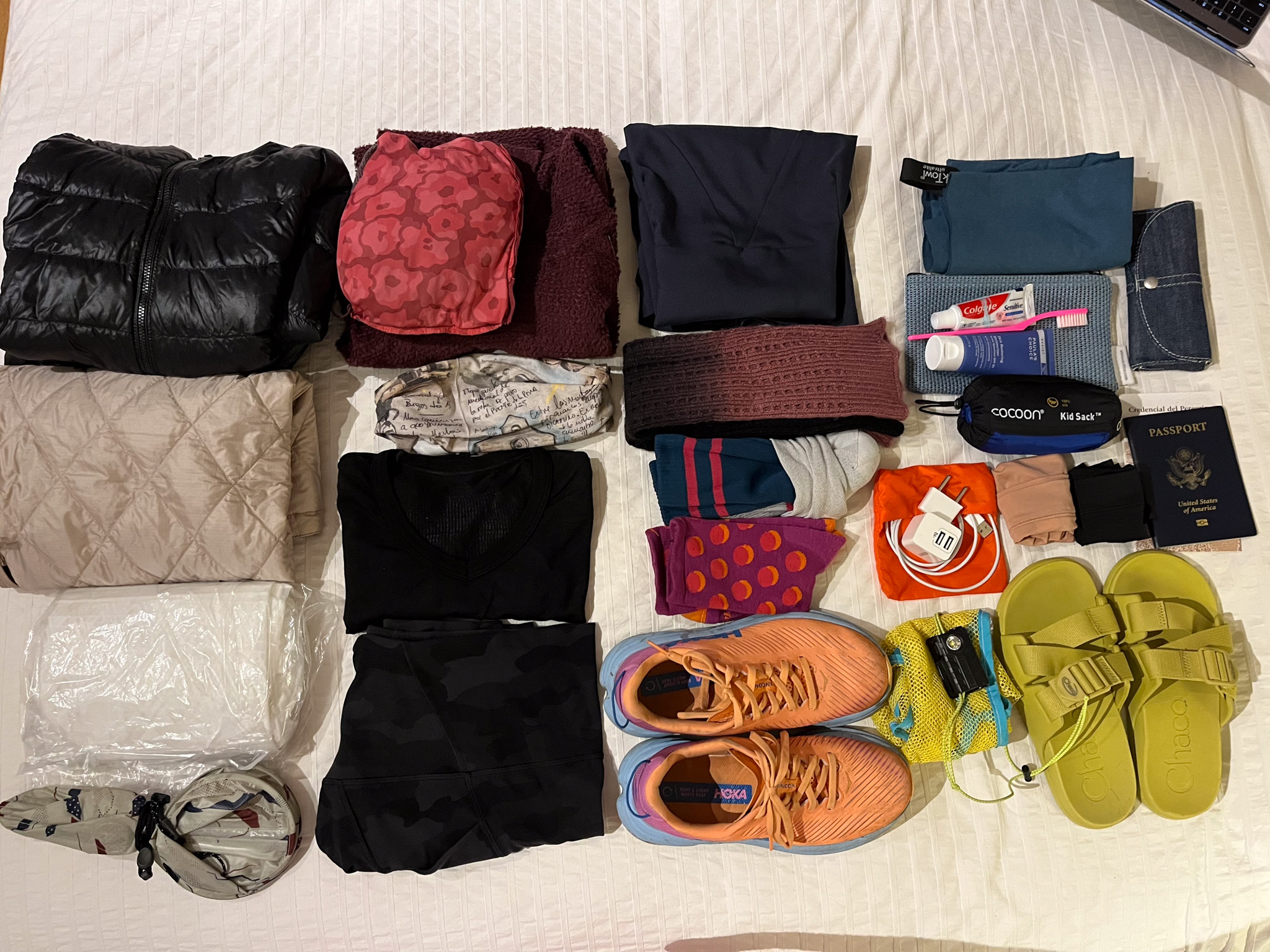
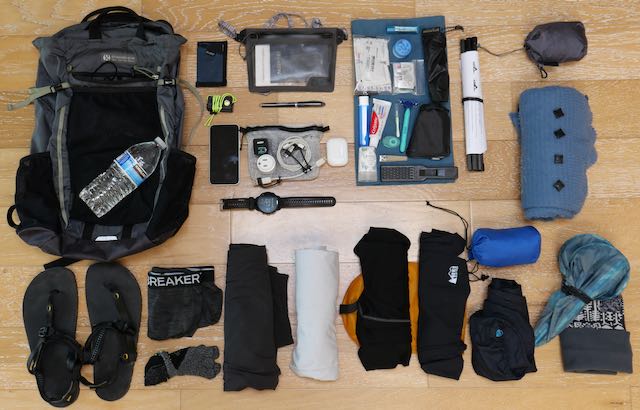
    My original packing list had a base weight of 5.5lb and could fit into a 14l bag. At the end of the trip I updated my camino 2023 lighterpack list to include everything I carried on the heaviest day including several items I won’t take in the future. The picture below is nearly everything I carried or wore:

    On the walk I picked up some skin lotion and a 15l folding messenger bag to used after this trip (we don’t have Decathlon in US). There are a few items I added at the last minute (packing for fears) that aren’t in the picture and generally weren’t used. When Jackie’s Achilles tendon started to hurt I carried a few of her items. This raised my “base” pack weight to 7lb. The heaviest total weight was 11 pounds when I was carrying extra water and a fair bit of leftover food / snacks.

    Everyone I have talked with that wasn’t an experienced light-weight onebag traveler or ultralight backpacker said they brought too much stuff. They often either gave away the unnecessary items, shipped them home or to Santiago. Several people who have done multiple Caminos told us that any item not used by the time you got to Burgos isn’t needed, and you should be dropped. I encourage everyone to treat the Camino like a pilgrimage and leave behind excess baggage and live in the moment. I have some general notes about packing light aka onebag travel which might be helpful to someone packing for the Camino. There are people who go even lighter such as such as Tim Evans’s 7L fanny-packing list for Shawn’s 7-10l fannypack packing

    Example Summer Packing List

    It’s pretty warm in the summer and you don’t need to bring a lot.

    • Hiking clothing made from thin nylon, polyester or merino wool which can dry overnight. My recommendation would be:
      • nylon hiking pants that are quick dry like Outdoor Research Ferrosi, prAna Brion or a hiking dress
      • fast dry shirt that is high UPF like ArcTeryx Cormac, OR Astroman, Mountain Hardware Crater Lake, or if UPF 15-20 is enough for you, the very comfortable OR Echo
      • non cotton underwear. Light weight bra or swimsuit top.
      • trail running shoes or hiking sandals that fit you well with a roomy toe box, I like Inov-8 Trailfly G 270 and Luna sandals
      • Non cotton socks, I like Xoskin toe socks (2 pairs)
    • Clothing to wear while your clothing are drying and to sleep in such as a pair of fast drying running shorts and light weight merino wool tee
    • rain gear: light weight poncho
    • insulation: an alpha direct hoody, 100wt fleece, or sweater made of wool, alpaca, or cashmere.
    • sun hat: something with wide brim or veil such as those made by sunday afternoon
    • small first aid kit focused on foot care: compeed bandages are great for protecting skin about to blister
    • toothbrush
    • water bottle such as reusing a smart water bottle
    • a 50F rated sleeping bag or sleep sack + a light blanket/quilt if staying in hostels / albergues
    • Modest size travel towel if staying in hostels, or maybe even if you are staying in full service hotel every night: see towel entry, hitchhiker’s guide to the galaxy.
    • phone, charger, and cable
    • light / comfortable pack to hold the above items

    When needed (which is less frequent than you might expect) you can wash you hiking clothing in a sink, shower, or machine if one is available. That’s all you need.

    Hiking poles are not generally necessary, though if you are used to using them, bring them… just remember they have to be checked baggage when flying. If everything else you are bringing is carry-on, you can use a cardboard “poster tube” to ship your poles.

    In the spring and fall you would want to add insulation, and extra pair of socks in case they don’t fully dry over night, and maybe rain pants or a rain skirt.

    Pro Tip: Don’t bother with “dress up” clothing while walking the Camino. Restaurants are used to pilgrim attire: shorts, tee shirts, slides/sandals. If you need fancy clothing on a trip paired with your “Camino”, ship them to Santiago to be stored until you are done, no reason to carry them while you are walking. There are a number of services such as Casa Ivar which can help. Jackie and my first stop after the Camino was the UK. After after spending a week in Paris, before walking the Camino, we posted our extras including “dress up clothing” to a friend’s home in the UK.

    Footwear

    The single most important item you bring is footwear. I think minimalist shoes are the best way to go IF you have used them for at least six month. Otherwise I would generally recommend wearing trail runners or hiking oriented sandals. Sandals are often seen as people recover from bad blisters which makes me wonder if they won’t be the best “shoes” to start with. I have written up a brief comparison of boots vs trail runners. It’s important that you use whatever footwear you have selected (or identical models) for an extended time before the Camino to give your muscles a chance to adapt. For example, going from traditional shoes with a heel to zero drop trail running shoes is a good way to end up with achilles tendonitis. For people who are prone to getting blisters I would recommend sizing up your shoes by 1 size and wear 2 pairs of socks: a thin liner made of coolmax or nylon closest to your foot, and a thick wool sock worn “inside out” so the fuzzy part is against the shoe, and the smoother side is facing inward toward the liner and your foot. Another good option are Xoskin toe socks. I have zero blisters after walking thousands of miles in Xoskin toe socks. I had pre-blisters from other socks heal while wearing Xoskin socks while doing 15 mile days.

    Backpack

    The second most important item is your backpack. People who complete the Camino generally use outdoor oriented pack which are between 20-40L in volume. For people carrying less than 10 lbs, there are many good options. If you are carrying more than 10 lbs you will want a pack that has a hipbelt which is capable of transferring the majority of the weight to your hips rather than just stabilizing the pack. I have a post about selecting a good trekking pack.

    Sleeping “Gear”

    Most people walking the Camino will spend one or more nights in an albergue dormitories which are often mixed genders in the same room. You should have some clothing to sleep in. Tip: if you are in the bottom bunk near the wall, you can hang your towel to provide a bit more of privacy.

    Albergues typically don’t provide linens. Many pilgrims bring a light weight sleeping bag (rated for 40-50F) which removes the need to worry about sheets and blankets. I prefer to use a silk or nylon sleep sack which is paired with a light weight quilt or blanket. When it’s warm you can use just the sleep sack. A good quality down backpacking quilts can cost $300, but if you only need enough insulation for sleeping inside (say rated for 55F), then there are a number of light weight down or synthetic outdoor blanket / quilts which are less than $100, such as hangtight shop blanket. Costco sometimes has a down throw blanket for around $25. A classic poncho liner, aka woobie is another option. Some folks find that just a sleep sack combined with their outwear can work. Clothing which are warm enough for “light work” in 40F (a typical spring morning) should be warm enough for sleeping indoors when the room is >=60F. I used a sleep sack and a piece of Polartec Alpha Direct 90gsm fabric which was used as a blanket at night, and as a scarf, shawl, vest, or poncho liner during the day. I wrote up a description of this in a post about my poncho system.

    Keep it Light

    For people who are used to luxury & comfort, don’t just prepare yourself to “rough it”, but embrace a simple and more communal experience. It is especially important to minimize what you bring because you will be carrying everything for many miles each day. If your bag feels heavy before you start walking, you are bring too much and it will get worse as the days progress.

    Conventional wisdom is that people should carry a backpack that’s <25% of their body weight. This is reasonable for moderate distances but will be fatiguing on a longer hike. There were several experiments evaluating how pack weight impacted soldiers physical performance. A key finding was that on all day exercises, fit/trained soldiers had a measurable increase of fatigue and a drop in agility when they carries more than 10-12% of their lean body weight. This matches my personal experience: I feel no more tired at the end of a 20 miles carrying 17lb as compared to carrying no pack. My one caveat that when over 8 lbs I need to shift some weight to my hips or shoulder pain will be fatiguing through the day. My wife found her sweet spot is <7lb.

    Some people ship their bag(s) town to town via a transfer service and carry a small daypack which holds only what they need for the day. This costs 4-6Eu for one time, and around 150Eu for an entire journey. I would recommend not planning to do this as a regular practice, though it can be useful if you are trying to recover from an injury or fatigue. If you going to use a transfer service I would recommend using a duffel which does not need to be expense. We saw a number of people using $4 Ikea frakta duffels. Realize that mistakes can be made, and you might find your transfer bag misplaced for a day or two. For people who are finding lodging as they go, using a transfer service can add stress and complications since you don’t know where to ship your bag on days you don’t have a reservation. Warning: Several traditional alberques have banned “suitcases” or transfer services from delivering because the alberques exist “to serve pilgrims, not tourists.”

    It’s better to bring twice the money you think you need, and half the stuff. It fairly easy to pick up items that you forgot, lost, or are damaged along the way. Worse case is a 20 minute taxi ride to a larger town. Several of the town along the Camino have a Decathlon store, which is the Ikea of outdoor equipment and clothing. There are also a number of stores which cater to nearly all the needs of pilgrims (shoes, clothing, backpacks, toiletries, etc) such as Boutique du Pelerin in St Jean Pied de Port, Caminoteca in Pamplona, Pilgrim Oasis in Carrión de los Condes, etc. Most of the towns have a small store near or on the Camino route which sell comfortable shoes (almost all sell Hoka) and some other items that pilgrims might need.

    Food and Water

    Unlike backcountry backpacking, you rarely need to carry much food or water because you will be in the next town before you need more. Generally .5-1L of water will be enough if you periodically stop at a cafe / food trunk for a drink and make use of the fountains. You will want more water on the hottest days. Before walking, you might figure out how much water you need. I discuss this in my post about water treatment and containers. You might want to carry some food with you when entering a less populated area on Sunday because the groceries / cafes / restaurants might be closed or have hours which are incompatible with your schedule. I liked granola bars and Laughing Cow cheese which doesn’t have to be refrigerated. Of course, if all the food options are closed you can treat it as a day of fasting.

    Jackie’s Pack

    The following is a picture of the contents of Jackie’s backpack for the Camino. She used a 15 year old Camelbak hydration pack which was retired at the end of the Camino. Jackie runs colder than me so she brought more insulation that I did. While my strategy was to use my blanket for warmth during the day, hers was to use insulating clothing + a silk sack for sleep. This works well because night time temperatures inside the albergues required about the same amount of insulation as walking in the coldest mornings.

    OuterwearClothingMisc Other
    Uniqlo Down Jacket
    Montbell Insulation Skirt
    Ikea Rain Poncho
    Montbell Umbrero Hat
    Macpac Nitro Alpha Direct Hoody
    Montbell Windbreaker
    Buff
    2 Yoga Pants
    Decathon Dress (Navy)
    +2nd Decathon Dress (Colorful)
    Underwear (not shown)
    Leg Warmers
    Waterproof Socks
    Wool Socks
    +Compression Socks
    Trail Runners
    Slides

    +Merrill Sandals
    Towel
    Toothbrush / Paste
    Moisturizing Sunscreen
    Glasses
    Sleep Sack
    Cell Phone, Charger , Cable
    Passport
    small fabric shopping bag
    Notebook, Pen
    Headlamp
    +Ankle Brace
    +Knee Brace
    +Tiger Balm & CBD Lotion
    Initial Items, Items Offloaded, “+” indicates items added. Buff wasn’t used. Waterproof socks used only a few times. Leg warmer not used after compression socks was purchased. Jackie didn’t bring first aid… she made use of the kit I brought.

    I am not in control. I am not in a hurry. I walk in faith and hope. I greet everyone with peace. I bring back only what God gives me. – Murray Bodo, The Pilgrim’s Credo

  • Parable of the Prodigal Son(s)

    The story of the prodigal son is well know, even among people who haven’t read the Bible. The parable is found in the 15th chapter in the book of Luke. The conventional telling of the parable is about a young man who leaves home and squanders his inheritance. When he hits rock bottom, he returns home hoping to be permitted to benefit from his father’s kindness. His father exceeds the son’s hopes, and throws lavish party to celebrate his son’s homecoming.

    Some churches use this parable to talk about how “sinful” people can repent and God will forgive and fully accept them. While it’s true that God will forgive people living a “sinful” life this is missing much of what this passage teaches. If this is how a church teaches this passage I am not be very interested in attending that church. I would expect the church to be overly “religious”, with a tendency to judge others as sinful and fail to recognize their own problems which include pride and self-righteousness.

    People who read the passage carefully will note that there are two sons, and recognize that the older, “good” son has his own issues. The older son is ungrateful and entitled. He is angry that his father has welcomed his younger brother home. He feels slighted and that his brother is getting things which should be the older brothers. The older brother is taking his relationship with his father for granted just like the younger son, just in a socially acceptable manner.

    Ken Bailey1 noted that this parable is more about the older son. The parable was being told to the Pharisees, a very devoted, religious group of people who were upset that Jesus was associated himself with “sinful” people. The parable illustrated God’s forgiveness and reconciliation with the younger, sinful son. Then the parable talks about the problem with the older son and ends with the question “Will you please come join the celebration for your younger brother.” We don’t know what the older brother choose. The parable is left hanging. Jesus was asking the Pharisees what they were going to do. Continue being judgement and self righteous… breaking their Father’s heart, or come and rejoice that others have returned to God.

    Ultimately though, this parable isn’t about the sons at all. The real message of this parable is about father’s heart, his scandalous love of his two disloyal sons.

    1. Much of Ken Baileys’s insights can be found in the book Finding the Lost: Culture Keys to Luke 15. There are several other books which have been inspired by Bailey’s keen insight including Henri Nouwen’s The Return of the Prodigal Son and Timothy Keller’s The Prodigal God. ↩︎

  • Lessons from the Camino

    The following is a list of the lessons I learned, beliefs that were strengthen, and/or topics which frequently came up in discussions with other while walking the Camino. Walking the Camino provided a wonderful opportunity to consider what makes a meaningful life. The book Walk in a Relaxed Manner by Joyce Rupp is far more in-depth and insightful than this post.

    [toc]

    TL;DR

    • The best part of this journey is experiencing the “Camino spirit” which is exhibited by most of the pilgrims and many of the residence along the way: the default response to others is kindness, curiosity, openness/vulnerability.
    • Simple acts of love and kindness can be life changing for both the “giver” and the “receiver”. If everyone’s response to others was kindness and compassion the world would be a completely different, better, place.
    • The Camino can be a transformative experience. People who benefit the most take time to reflect on their Camino journey, identify what they have learned, and then make changes in their life informed by what they have learned and regularly remind themselves what’s important.
    • The best physical preparation for the Camino is increasing the milage you walk each week in the six months before leaving. Doing once a week training hikes won’t adequately prep you for 30+ days of walking. The people who have the least physical struggles were walkers.

    Life Lessons

    • Love is the ultimate measure of a life.  Love spreads through connections and multiplies: the giver and receiver both grow love. This can result in exponential rather than merely linear impact.
    • The Camino Spirit is:
      • default is to be kind (loving) to everyone encountered
      • no judgement of others, instead curiosity when differences are encountered. Miroslav Volf would say everyone was an “us” not a “them”.
      • choosing to be vulnerable, sharing deeply and honesty which builds connection
    • Walking the Camino forces us to slow down and have space in our lives to notice what is going on in our and others lives. This is something that everyone wanted to bring back with them from the Camino. People who have done multiple Caminos reported that over time they returned to a more hurried pace. One of the reasons they returned to the Camino was to get a reset. Busyness and chasing after “success” will choke the Camino spirit out when you return home.
    • Life changing community can develop almost instantly when a super-majority has chosen to be in the Camino spirit. This is partially fueled by a self selection bias of who walks a Camino. Being on a shared journey helps brings people together.
    • Community is the key to a flourishing life and community is what many people discover on the Camino. Community requires:
      • Time / Availability / Slack. If you are always busy then you won’t have time for community. True community can only form when people are able to share their lives together. Life isn’t predicable. If your community activities are restricted to a tightly defined time-box you will miss out.
      • Care / Love / Acceptance. As mentioned above, love is so important. Healthy communities require the members to choose to love each other and the world around them.
      • Vulnerability. People need to drop their guards and lower their masks so people can truly seem them. Without vulnerability the bonds in the community will be weak.
      • Something bigger than the individuals of the group. What psychologists can transendence. Community that is only focused in itself will stagnate. It needs something bigger than itself.
    • What seems insignificant to you can be life changing for others. Don’t underestimate power of simple acts of loving your neighbor. Thank people when they have made a difference in your life. Often they have no idea they had any impact on you. Your thanks will be an encouragement.
    • The skill of listening well is hard to be developed, but is worth the effort. I often fail to listen because I am so busy formulating answers and fixes rather than listening to truly understand and be empathic.
    • Presence is maybe the greatest gift we can give to someone.  Really seeing people and being with them. Giving them our full attention, and not looking for something better in the moment.
    • Everyone is fearfully and wonderfully made. Cherish, honor, and respect others even if they are being an idiot in the moment.
    • Being a great companion requires dropping expectations and being delighted by another which results in an ease of interactions and great satisfaction.
    • Living out the Camino spirit has many similarity of what Christians would call kingdom living.
    • You can maintain a Camino spirit by cultivating gratitude, remember to put other people first, and leaving slack in your schedule so you can respond to unexpected needs.
    • Sometimes suffering isn’t about us, it’s to prepare us to help others. God loves all his children and will sometimes let one child suffer so all his children can thrive.
    • Don’t blame others. We are responsible for how we respond to all situations. If you give that away, you will always be dependent on other for a sense of happiness.
    • Contentment = CurrentReality – Expectations. We can be happy in very difficult circumstances if we don’t have any expectations, and miserable in situations that nearly everyone would be delighted by because our expectations are extremely high.
    • There is great joy and freedom when simplicity is embraced. Pack and live lightly.
    • Intentional minimalist / essentialism / simplicity focused on making time for what’s most important and getting rid of obligations and possessions that keep us busy and/or distracted.
    • Minimalist can lead to people being hyper focused on stuff, constantly trying to prune things down to a “perfect” set. Minimalism at it’s best understands that stuff is only useful when it enables spending time on meaningful activities and is best when stuff fades into the background.
    • Prayer is good, and has been at the heart of most of my most profound experiences. Yet I am not consistently praying.  This is stupid and needs to change.
    • We all hunger for transcendence because we know in our hearts that there is more than our eyes can see. Some people try to find this in nature and art but this isn’t sufficient.
    • If you don’t push a particular ideology and are genuinely curious, most people are happy to share their spiritual (or none spiritual) journey and you can hear some amazing stories. Ask questions, don’t give answers. Often these people will be interested in learning about your journey. Don’t preach at them, share what you have experience and let them decide what they think. Don’t expect or insist they agree with you. If you are interested… this is a description of my journey.
    • When people share something significant in common, like walking the Camino, other differences aren’t very important. We heard no one spewing nationalistic rhetoric. Rather than “my country is better than yours” I heard a lot more “oh, we do the same” or “We don’t do that, tell me more about…”. The only time I didn’t always see empathy / compassion is the pilgrim vs “tourist” divide in the last 100km.
    • If you want to go fast, travel by yourself. If you want to go far, travel with others. You don’t notice the miles if you are in a good conversation, and you are able to help and encourage each other when difficulties are encountered.
    • The symbolism of the Iron Cross is powerful… identify the weights you are carrying, and drop them at the cross.
    • For many people, the “Camino Spirit” persists for several months and then tends to fade. Key to keeping “in the Spirit” is to leave slack in your schedule to you can be attentive to others, and to remind yourself regularly to prioritizing contributing to your community.

    Practical Hints

    • I found two questions open up many great conversations. The first is “Why are you walking the Camino?” The second was “You don’t have to believe in it… but if someone was going to pray for you during this journey, what would you want them to pray for / about?”
    • Many people we met were carrying too much stuff and found their bag to be a burden. The people who seemed unburdened by their packs were carrying less than 15lbs. Here is a packing list for my next Camino which is less than 10lbs.
    • The right footwear makes a big difference when it comes to preventing blisters. Minimalist sandals like the Shammas Elite Maximus (Bedrock, Luna, Earthrunners, etc) are great provided you have trained your feet before embarking on a long walk. I had no blisters and no foot issues, even after 30 mile days. Ironically I have several people each day ask “Are you hiking in those sandals?” to which my answer was “Yup.. from SJPP. They are the only footwear I brought.”
    • Most people found private or 2 person rooms greatly enhanced sleep quality. Unless money is really tight, they are worth the cost. If not doing semi-private rooms be sure to have eye mask and ear plugs.
    • When you meet people that you “connect with” take their picture and exchange contacts on WhatsApp so you can stay in contact. There are a number of people I would have liked to stay in contact with from some of the first days, but we never saw each other again because we were walking at different rates. WhatsApp QR codes are the easiest way to exchange contact info. If you are using WiFi and don’t have cell coverage take a screen shot of your WhatsApp QR code for others to scan, and take a picture of their QR code for when you having Internet connectivity to connect.
    • Orginize items in your pack based on where you use them. Unpack and pack them the same way each day so you don’t forget anything. For example even if they are different, put things that going next to the bed in the same bag: charger for phone, eye mask, lotion you put on as you get out of bed.
    • The best physical preparation for the Camino is increasing the amount that you walk everyday. Weekly training hikes by themselves are not adequate to get your body ready for a month of continuous walking.
    • Bicyclists on mixed use trails should use a bell to warn hikers of their approach. It is universally recognized and doesn’t seem to startle people.
    • People who are walking as part of a tour can miss out on some of the Camino Spirit because they often travel in a bubble which keeps them from a broader interaction with other pilgrims. If you are in a tour group make a point to meet people outside the tour.
    • At the end of the day it’s hard to recognize people when hats are off, sunglasses put away, and people of freshly showered. If you are meeting someone for dinner and they haven’t arrived, double check to make sure they aren’t already there.
    • We could have sold 90+ Montbell Umbrello Hats. They are incredibly practical and made a lot of people smile. We often had people ask for selfies with us or to borrow the hat so they could have their picture taken wearing one.
    • Some more hints on my Camino page.

    Snippets of Stories

    One of the best parts of the Camino was hearing people vulnerably tell stories from their lives. I don’t feel free to share full stories without people’s permission… but some short fragments of stories I witnesses or heard to give a sense:

    • Retired minister who yearly does 750 tax returns free of charge for the poor in his community which is greatly appreciated by them and grew his empathy and understanding of what people were facing.
    • 72y old gentleman with a lot of grit who adjust his plans so as not to damage his body because he had nothing to prove.
    • A man with terminal cancer walking to Camino to prepare to be his very best self in his last year of life. When he walked the Camino in the past he found the power of kindness, the value of being present with others, and the clarity of a simple life make him better and more loving to all those he came in contact.
    • A couple that came together years ago when one of the parties came to realize the other wouldn’t hold them back but would always strive to lift them up. We could feel their gentleness just by sitting next to them in a restaurant. Though they faced some serious challenges they were joyous and thankful.
    • A couple who met on the Camino and found they enjoyed discovering the Way together. They were learning each others language and enjoying each others company. The had a joy and ease that was breathtaking because they have no expectations other than to be companions as they walked.
    • A vision impaired gentleman who noted that he has a super power… that people strived to be their very best when they saw his cane… being kind and generous to him with this could spill into the rest of their lives.
    • A women who help many of us see the “boring and ugly” Meseta with new eyes… such as how the wind move the grain like waves on the ocean.
    • A gentleman who lost his wife on the Camino 5 years ago who is finishing the walk they started, leaving little memorials each place that would have been special to his wife and sharing his experience of what makes a meaningful life.
    • Many stories of people who were burned out and recovered during their walk finding energy and joy during the Camino. One gentleman said “I was a broken man… on the Camino I was restored.”
    • People who had trouble “letting go” and so were carrying a laptop to keep tabs on things “back home”. It would have been appropriate to leave the laptop at the Iron Cross, but they took the more practical approach of shipping it to Santiago.

    Resources I Shared Frequently

    • Excellent Advice for Living – Kevin Kelly’s 450 tweet size bites of wisdom. This is an expansion of his 68 bits of advise.
    • The idea of training for the Centenarian decathlon. Ideally start in teens, as soon as possible, but it’s never too late, especially if you didn’t do a lot of exercise in your earlier life.
    • Design Your Life – Burnett & Evans. Run small experiments and design yourself into a good life rather than trying to figure everything out and then a grand plan to accomplish everything.
    • Life Worth Living – Volf, Croasmun, & McAnnally-Linz. This book provides a toolkit to explore and determine what is a meaningful life for you.
    • Harvard Study which reveals how good friendship and personal relationships are the most significant factor to health and happiness.
    • Interview with Tom Catena the only doctor serving 750,000 people in the Nuba Mountains in Sudan. Humility, simplicity, what’s important, and resiliency. Support the Sudan Relief Fund.
    • How to Build a Happy Life podcast by the Atlantic. First season was by Arthur Brooks. Other seasons followed with different hosts.
    • Books by Arthur Brooks, Richard Rohr, and Parker Palmer for their life affirming and gracious content.
    • The Good and Beautiful God – James Bryant Smith. Identifies many of the false narratives of what God is like that we believe, and encourages us to have a clearer, and more healthy understand of God’s nature and what He wants for us. Not discussed during our Camino but excellent is Practicing the Way – John Mark Comer which explores some practices which align us with Jesus’ way, a life guided and powered by love.
    • Kindness Diaries follows Leon as he travels around the globe, and then from Alaska to Argentina by relying on the kindness of strangers who freely provide him food, fuel, and a place to sleep.
    • My Unsung Hero from Hidden Brain. Encouraging stories of lives changing by simple acts of kindness
    • Lectio 365: A devotional application which provides 5-15 minutes of content each morning and evening.
    • Six Streams of Spirituality promoted by Renovare for a balanced faith and what living out those streams might look like.
    • How many people miss what the parable of the prodigal son is about, and the gracious insights of Ken Bailey.
    • My notes about the Camino
    • My Packing Light Page
    • My Healthy and Fit Page
    • My advise about money

    Re-Entry from a Pilgrimage

    Many people talk about how jarring it is to return to “real life” after a pilgrimage like the Camino. After a month of a slow paced life characterized by simplicity, quiet, and community they found themselves facing a hustle / hurry culture that is filled with noise and often more oriented toward competition than community. It is easy to get overwhelmed and to return to old patterns and habits, leaving the Camino experience something remembered fondly, longed for, but divorced from daily life. As I have talked with people about their post Camino experiences there are several things which seem to have kept the Camino spirit alive for many. The following is a summary of the advice I have heard about how to live into the Camino experience once the walk is complete.

    • Set aside some quiet time (ideally a week or more) between the end of your Camino and starting back to “normal” life to have time to think, pray, journal, and reflect on your experiences. Identify what you learned, how your perspective has changed, how your values have shifted or strengthened. Ask yourself what is important in light of your Camino experience?
    • Consider your life before the Camino and ask the question “How did my pre-Camino life align with my post-Camino understanding?”. It is likely that you will find places the two don’t align. Realize that if you don’t make explicit changes, your post-Camino life will likely look exactly like your pre-Camino life.
    • Identify changes you would like to make as your return to “regular life”. Many try to change everything, fail, and quickly give up. Rather make a list of things you would like to change and then decide on one item you will start with. Break it up into manageable steps and find ways to turn it into a habit and then a lifestyle. The book Atomic Habits is a great resource for this sort of planning. Once something has gotten established, look at your list and make the next change.
    • The most common change I heard from people was making sure they left slack in their schedule so they weren’t constantly forced to react to life. There were moments to reflect and choose a response. Many found that adding a time each day to just be was key. For some this was time to sit, reflect, and maybe write a few sentences in a journal. For others it was a quiet walk in their neighborhood or a nearby park.
    • The second most common change I heard was people striving to build a genuine community. Often, they had been part of some sort of a community before the Camino, but the experience fell far short of their Camino experience. In some cases people have found that by intentionally investing and initiating in their community they were able form a genuine community. In other cases people realized that where they were putting their time wasn’t working and that they should try something different.
    • Set a date for your next Camino 🙂

    All of these items suggest that what’s key is to identify what you loved about the Camino and then to identify little things which will remind you and keep your grounded, anchored to those things.

    My Next Steps

    • Finish nomad experiment and select the location for the next season of life.
    • Arrange my schedule so I have regular personal (1-to-1) time with people I care about and enough slack to respond when surprises come up.
    • Be more intentional to build community. Not wait for it to happen or be invited in to something that already exists but to initiate time with individuals and group events which will encourage bonding.
    • Improved my listening skills and practice the art of being present. Continue to deepen understanding of love.
    • Set aside time each day to pray.
    • Plan to do another Camino in 2026.

    I am not in control. I am not in a hurry. I walk in faith and hope. I greet everyone with peace. I bring back only what God gives me.

    Murray Bodo, The Pilgrim’s Credo
  • Vagabond Review

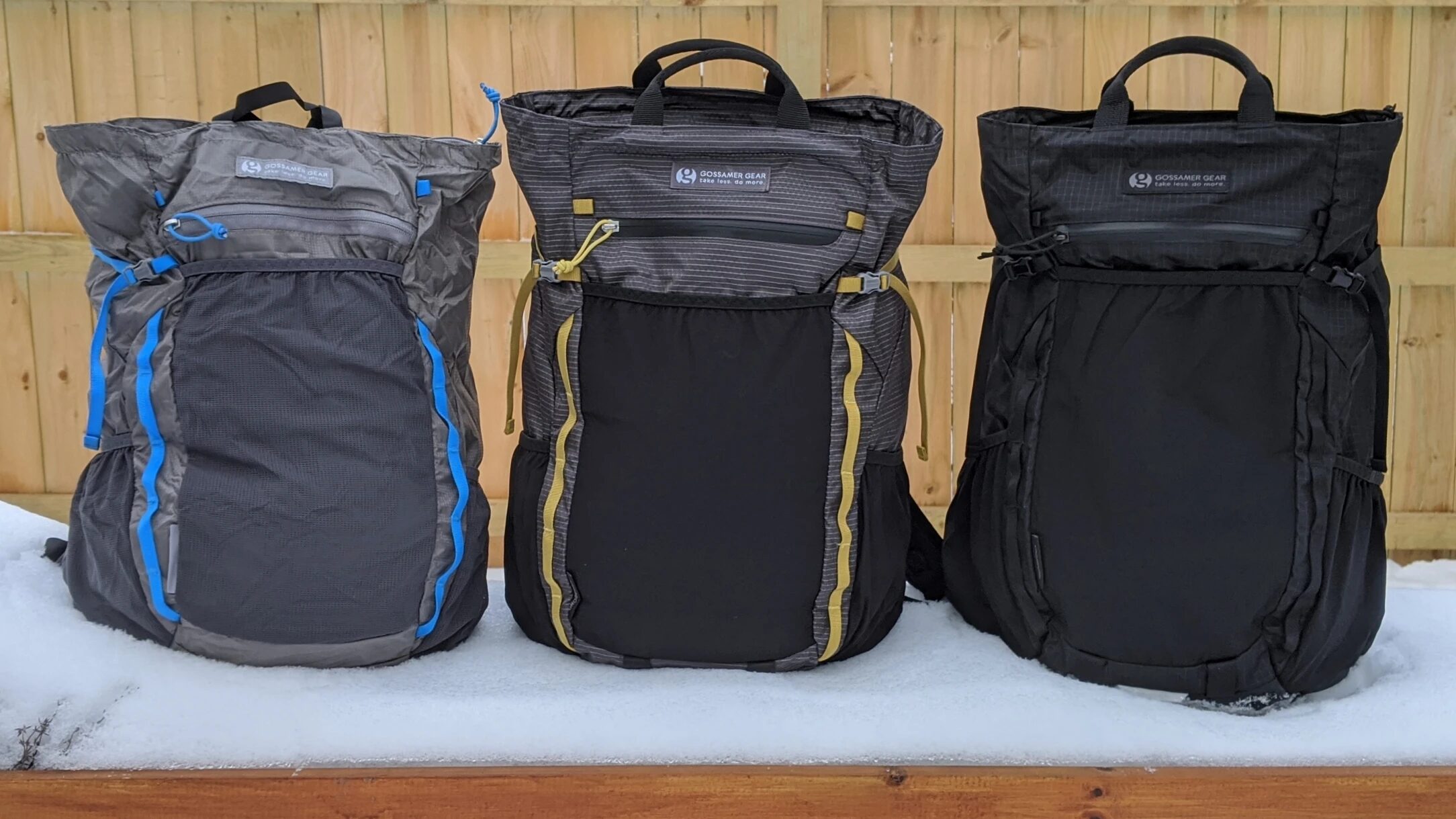
    I have carried the Gossamer Gear Vagabond Trail more than 2500 miles over last few years for EDC, done in a day outdoor activities, and onebag travel which included walking 500 miles of the Camino Santiago Frances route from SJPP. Between Jan 2023 and March 2025 I lived out of a Vagabond Trail as we explored locations that might be “home base” for the next season of life. I found the Vagabond provided nearly perfect functionality for me. I have a list of what was in my pack for much of 2024, and what I am generally carrying now.

    The Vagabond had three variants. The Packable and Trail models are now discontinued. The urban oriented Jet variant is still sold. I originally picked up the packable to supplement other bags. I found it the most comfortable carrying packable daypack I had ever used. I liked it so much I picked up the Trail version so my wife and I could both use a Vagabond pack. I started using the Vagabond Trail as my primary onebag in 2023. In May 2025 I switch to using the Jet which was gifted to me. The Jet is made from a slightly heavier black grid fabric which has a more tech / urban vibe and added a padded laptop slot. The external dimensions of the all the Vagabond models are the same, but there is a bit less volume inside the Jet due to heavier material, padded laptop sleeve and back panel which is a bit thicker.

    Description and Design

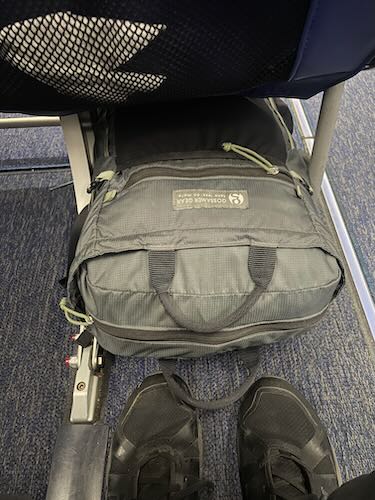
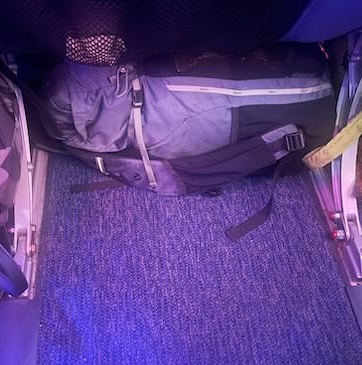
    The Vagabond is top loading using a zipper to close the main compartment. Weights are 10oz packable, 18oz trail, 24oz jet. The packs are listed as 23l with dimensions of 46x27x15cm (18/10.75/5.75inches). I believe the main compartment is 17l with the other 6l being the external mesh pockets. The Vagabond is a bit thinner than many daypack which keeps the load close to the back with a corresponding loss of volume.  Except when grocery shopping I think this is the right trade off.  I feel agile wearing the pack. I have never had a problem fitting pack under the seat in front of me on a plane except when a support beam bisected the under-the-seat space. When it’s slightly under-filled the Vagabond can compress into every airline “personal item sizer” I have encountered including EasyJet, Spirit, RyanAir, Vueling, and Wiz so long as the side pockets were not filled. There are some airlines that officially restrict personal item thickness to just 10cm like EVA which would make the Vagabond too thick unless under packed, but we were not sized by them and my bag fit under the seat. Pictures under the seat of a Southwest Boeing 737 on an aisle, and sideways in the middle seat.

    The pack has loops which enable attaching waist strap.  I found the Gossamer Gear Fast Belt provided good stability but wasn’t particularly helpful transferring load. The ULA Ratpack belt is able to transfer enough weight I could carry 13lb all day without pain (8lb is my limit without hip belt).

    The pack has a flat bottom, and can stand upright on its own.  This makes it very convenient to access when you place it on the ground while minimizing how dirty it will get. The Jet model has an extra durable, waterproof bottom.

    The pack has 5 mesh pockets: a stash pocket on the front of the pack, traditional side pockets, and on the shoulder straps. The pockets are made of a mesh material which is adequate but not optimal durability.  I have torn the mesh on the front pocket of my vagabond trail (it was repairable).  I believe the Jet mesh is more durable than what was used on the discontinued models. The front pocket is large, and works well for items such as a jacket, towel, or a small laptop that I stash when preparing to go through security checkpoints. The side pockets are pretty standard, with room for two 16oz water bottles or one larger bottle. I found items were retrievable while wearing the pack. I love the shoulder pockets and use them constantly. Items placed in these pockets are easily accessible, and when I set the pack down they aren’t in the dirt unlike pockets on hip belts.

    The pack has a floating laptop sleeve against the back. If the pack is reasonably full, the laptop won’t hit the ground if you are careless when setting the bag down. In the packable and travel models the sleeve is the same material as the pack body. In the Jet, the laptop pocket is padded with foam, and has a second slot for a tablet and a small zippered pocket for small items.

    The packable and trail has two solid pockets… one near the top of pack’s front and a second in exactly the same location on the inside of the pack. I use the outside pocket for small items I don’t need to access constantly and the inside pocket for items I can’t afford to lose such as my passport.  Being on the inside of the pack makes it a bit more resistant to pick pockets and any item that might fall out of the pocket would end up inside the pack rather than on the ground.  If the pockets are completely filled they might make it a bit difficult to insert and remove large items from the bottom of the pack, though this hasn’t been a problem for me. The Jet shifted the inside pocket to the padded laptop sleeve.

    Use

    I liked the idea of the tote handle but didn’t use them much. They are too short to hang the Vagabond over my shoulder.  When holding the pack by the one or both handles it was nearly impossible to unzip the top.  On the other hand, the side compression straps worked pretty well. I could access the main compartment without stop walking or putting the bag down. I would release one shoulder strap and swing the pack in front of me to grab one of the compression straps on the side of the pack.  This provide enough tension that I could then unzip the pack with my other hand,  retrieve whatever I needed. I would switch hands to close the the zipper. I found then the pack was only partially full, that items stays in the pack without needing to close the zipper.

    Sometimes it is difficult to access items at the bottom of a top loading pack. I didn’t find that this issue with the Vagabond. As mentioned earlier, the Vagabond is a bit thinner than many packs, so items tend to fill space front to back.  I load my larger / less frequently needed items near the bottom of the pack vertically next to each other. The combination of a stuff sack and varied materials made it easy for me to identify items by feel to pull them out.  These items provide a shelf for the rest of what I pack which get layered on top. The only issue I had was my laptop can sometimes get caught on the top zipper.

    I have read several people complain that the top collects things like leaves which can then end up in the bag when you unzip the top.  I didn’t experience this.

    Performance – Carry Comfort

    I have some shoulder issues which limits how much weight I can carry on my shoulders without pain. I found the wide and padded shoulder straps on the Vagabond Trail and Jet allows me to comfortably carry more weight on my shoulders than just about any pack I have tried.  I was able to get up to around 12lbs for a few hours, and to 8lb for all day use without any pain. I also carried 13lb all day when I using a ULA waist strap without pain.  The Vagabond was as comfortable as every shoulder only pack I have used up to 15lb which includes packs with harness style straps. 

    Something that surprised me was that it was more “comfortable” for me than a brand new GoRuck GR1 when carrying 30lbs of iron plates + 10lbs of rice. I don’t recommend doing this regularly… the frame sheet in the trail seemed to be slightly deformed. I should note that goruck lovers say you need to break in the shoulder straps before they are really comfortable. To keep the plates from shifting in the vagabond I had to fill the space using a rolled foam pad.

    Materials and Finish

    Finish is good, excellent when considering the price.

    The Packable and Trail are made from 70d Robic… light but durable enough for on trail or around town use. The Jet is made from 210D Robic which I think is the optimal weight/durability for long term use unless you really abuse your pack (I don’t).

    Today I favor Robic over waterproof fabrics because it’s reasonably durable and doesn’t seem to degrade over time like PU coated material or composite / laminated fabrics. I think a heavier Robic fabric impregnated with PC or silicon would be great. The laminated UltraX fabric and bonded ALUULA Graflyte looks promising… we will see how durable they are after a few years of real use.

    Improvements

    The following are improvements to the Vagabond Trail that I sent to a friend at Gossamer Gear. Several of the changes were made to the Jet even before I sent made my suggestions.

    • More durable / waterproof fabric for the pack’s bottom. Fixed in the Jet
    • A slightly stiffer separator between the laptop / hydration sleeve and the main compartment would make placing and removing the laptop easier when the pack is full. Fixed in the Jet.
    • Separate the outside and inside pockets to make it bulge less. Fixed in the Jet.
    • slight angle side pockets  to make access easier when pack in on the back.
    • The top zipper and the zipper for the front pocket unzip in same directions.
    • It would be nice if the top zipper could be locked closed. Either loops on the zippers or a way to secure the zippers to one side of the pack.
    • I never needed it, but a couple of lash points on the bottom of the pack would be nice to attach a sleep pad or yoga mat.
    • Pole loop on the front
    • Maybe a U shaped zipper on the top would provide better access for larger items. I now think this would be a bad idea.

    Related

  • Poncho + Insulating Liner System

    I have had a love hate relationship with ponchos. Theoretically they make great sense, but I have tried rain ponchos five times for six month or longer. After each poncho experiment I switched back to a rain jacket and a dedicated shelter. This post is about my current re-evaluation of ponchos as rain gear. For a two year period of time I used one of Brawney’s ponchos for both rain gear and as my shelter. I don’t think I will ever return to a poncho as both rain gear and shelter: there are just too many compromises required for little or no weight savings.

    Related… I have always thought the US Army Poncho + Liner was an extremely versatile system, but was heavy. I recently realized there are new materials such as Polartec Alpha Direct which could be used to make poncho liner than is significantly lighter while providing a useful amount of insulation. I tested this system at home and used it for walking the Camino Frances with good results.

    [toc]

    Why a Poncho?

    Drew Smith‘s  The Backpacking Poncho makes a good case for using ponchos.

    On the plus side a poncho can be an extremely light and compact item which can provide rain protection for the body, backpack, and can function as a shelter if it is large enough. A poncho made from good material can be a “buy it once for life” item, lasting decades without any maintenance. Another nice feature of a poncho is that it can be put on and then taken off without removing a backpack. You don’t even need to stop walking.

    Downsides of ponchos are they can flap in high wind, get snagged when climbing or going cross country, and don’t protect arms when using poles (which I am not), and doesn’t “fit in” (e.g. looks odd) in many urban settings.

    The biggest downside for me is that most ponchos are made from non-breathable materials which has no air permeability and zero vapor transmission so moisture often condensates in the chest area. I know people say that ponchos can provide good ventilation but this hasn’t prevent me from overheating and getting wet from condensation even when I hold the poncho up to maximize ventilation. I find ponchos too warm above 55F.

    When active in >55F conditions (dry or light rain) I am more comfortable wearing a Shakedry rain shell, or just getting wet provided I have a way to dry myself when either the temperature or my activity level drops.

    Alpha Direct for Modern Poncho Liner

    I realize the conditions I was like the face on the Camino: daytime lows around 40F and nighttime lows sleeping in alburgues around 60F required about the same insulation. This would be a perfect situation to use a poncho liner or wearable quilt for insulation during the day and to sleep at night. The other option would be to sleep in my warmest clothing at night. I discarded the idea of just using clothing because the pants I wear do not provide enough warmth to sleep in.

    I considered using ultralight synthetic quilt or a traditional poncho liner, but both options were heavier and more expensive than I desired. Then I thought about using Alpha Direct for the insulation. Unlike many synthetics or down, it doesn’t require a fabric to contain it which reduces weight and allows it to be useful in a wider range of temperatures depending on how much you prevented air circulation. Combining an alpha direct “blanket” with a light weight poncho and sleep sack could provide an extremely light (10.8oz) and versatile system:

    Originally I was going to purchase a larger piece of Alpha Direct so it could be the same dimensions as a poncho with a slit to pass my head though.  I ended up using a smaller, unfinished piece of alpha direct because I hadn’t settled on how to attach it to the poncho, and the fabric for a shaped liner would have doubled to cost. Rather, I decided to “make do” with a simple blanket.

    Experience Walking

    I ran some simple experiments around the SF Bay Area, slept in our unheated garage and backyard to validate the idea. The first true “field” use was for 31 days walking Camino Santiago – Frances in May 2003. Daytime temperatures were 38F-72F (not counting windchill), sitting outdoors in cafes (~45F-55F), and nighttime sleeping temperatures ranged from 55F-70F. We had several days of rain with the temperature during the rain varying between 45-65F. Right after this trip we were in Taiwan with torrential rains in 65-85F. Winds varied from completely calm to 35mph.

    My “base” clothing were Luna sandals, Xoskin toesocks, Patagonia Terrebonne jogging pants, a ArcTeryx Cormac Sun hoody, a PolarBuff, and a Montbell Umbrelo Hat.

    When highly active, just my base clothing kept me comfortable when it was >55F (factoring in wind chill), >60F when it was raining. I was wet (except for my head due to my hat), but my movement kept me warm enough, and when the rain stopped my clothing dried in around a hour.

    When it was cooler than that some combination of my rain poncho and Alpha Direct blanket gave me just the right amount of insulation. On the coldest mornings (38F air temp, wind, sun not out yet), the combination of my base clothing, my backpack, a Polar Buff, Alpha Direct wrapped over my shoulder and across my front torso, and the Gnu poncho on and snapped shut kept me quite comfortable even when I was just standing around. I particularly enjoyed my arms and hands being comfortably under the poncho without needing mittens.

    As it warmed up I would gather the Alpha Direct into a scarf configuration continuing to use the poncho to protect against the wind. Eventually I would remove the poncho and use the Alpha Direct as a shawl, over my shoulders or around my body as a vest which was kept together using magnets made to hold racing bibs on shirts. In modest wind conditions the alpha direct configured as a vest kept me comfortable down to around 40F.

    FIXME: Pictures of blanket going from Shawl to Vest using magnets, to Scarf.

    A real plus of this system is I could adjust it as I walked. I didn’t have to stop walking and never had to take my backpack off.

    One challenge was when the temperature was between 40-50F and the wind was going from 0 to 30mph and the sun was playing hide and seek with the clouds. With no wind and sun strong I wrapped the Alpha Direct blanket around my waist. When the wind was blowing and the sun was blocked by clouds using the Alpha Direct blanket when carefully doubled over my sides and chest was comfortable. The constant reconfiguration was bothersome. In these conditions I tried using the poncho rather than the Alpha Direct blanket. That mostly worked, but sometimes was too warm.

    After a couple of weeks I pulled out a Shakedry shell which I brought in case the poncho just didn’t work, and used it as a wind shirt. I continued to use the poncho on especially cold mornings, or when it rained. The next pilgrimage we take I will bring something like the Montbell Ex Wind Shell for those days that are very windy but moderate temperatures.

    Experience Sleeping

    Night time sleeping condition were primarily indoors with temperatures between 55-75F. When nights were cool, I slept in a pair of shorts and a tee shirt with the alpha direct as a blanket, inside a nylon sleep sack. This was warm enough to sleep well to around 55F. As it warmed up I shifted the alpha direct on top of the sleep sack resulted it less insulation allowing me to sleep in warmer condition. Above 72F I would just use just the sleep sack or no sack with the alpha direct blanket draped over my legs. The sleep sack was a perfect size for colder nights using my relatively small blanket, but I sometimes felt a bit constrained. In the future I think a larger blanket and a larger sleep sack would be more comfortable.

    The Gnu Cape

    Amazingly light and compact. Could put on / take off over my 23l pack without removing or unsnapping the cape. The cape claims to fit up to a 30l pack. They make a larger version reportedly good for larger packs. I found the shape worked well.

    Alpha Direct “Blanket”

    The piece of fabric I purchased was listed as 120gsm, model 4004 which doesn’t make sense. 4004 is 90gsm and 4008 is 120gsm. Given the weight & dimensions of my piece, I think I have 90gsm but I am not 100% sure. What I know is that it is an amazing material to use as a poncho liner. Absorbed very little water so would dry amazingly quickly. Didn’t pick up odor after a month of daily use. When air movement was blocked by sleep sack or poncho was quite warm. When doubled up it provided some warmth without wind blocking. (A single layer of 90gsm Alpha Direct seems to hold no warmth in strong winds)

    The piece of Alpha Direct I brought was a bit too short but worked well enough. In the future I will likely purchase a larger piece of Alpha Direct and actually make a poncho liner rather than just a rectangular piece of fabric. Having a small foot pocket would make it work better in sleeping mode.

    There was a thread on backpackinglight.com about making a summer sleeping system using alpha direct.

    Future Improvements

    Make a hoodless poncho which can easily ventilate around my neck. My Montbell Umbrero Rain Hat will keep by head dry and prevent rain from getting in through an open neck area.

    Other Options

    Ponchos

    • MLD Pro Poncho
    • Sgt Rock  hammock friendly poncho/tarp 
    • No experience, but the  Aricxi Poncho  from AliExpresss looks like a good deal. 
    • The cheapest are typically fragile “emergency” ponchos made from plastic weighing just a couple of ounces. These can be effective in moderate conditions, but they are very easy to tear.
    • The  DriDucks Poncho  is slightly more durable that plastics but is still fragile. It has the benefit of being somewhat breathable. 
    • Vinyl / PVC ponchos which can typically be found as hardware stores. These ponchos are inexpensive and typically weight 8-16oz. They are durable enough to wear, but I won’t recommend using them as a shelter.
    • SaphiRose ponchos with a zipper  have been positively reviewed in the BP gear forum.
    • SMD Gatewood Cape and Liteway Pyraomm which provides rain gear and highly protective shelter. I found them a bit too big to wear, and too small to be ideal shelter but many people love them.

    Liners and Wearable Quilts

  • Men Are Generally Happy People, Why?

    The following is one of the posts that makes the rounds a bit like a chain letter. No idea who the original author is and how it has changed from when it was first written. My wife received it from a friend as we were talking about several of these items which made me think to post it here. We both think it’s a fun read… whether your are a male or female. What’s described seems to be western, maybe US cultural norms. Friends from Hong Kong found several of the observations missed.

    What do you expect from such simple, mostly innocent creatures? 

    Your last name stays put. The garage is all yours. Wedding plans take care of themselves.  Chocolate is just another snack.  You can never be pregnant. You can wear a white T-shirt to a water park. You can wear NO shirt to a water park. Car mechanics tell you the truth. The world is your urinal. You never have to drive to another gas station restroom because this one is just too icky. You don’t have to stop and think of which way to turn a nut on a bolt.

    Wedding dress – $5,000. Tux rental – $100. New shoes don’t cut, blister, or mangle your feet. Your underwear is $8.95 for a three-pack. Two pairs of shoes are more than enough. You almost never have strap problems in public. You are unable to see wrinkles in your clothes. One wallet and one pair of shoes – one color for all seasons.   You can wear shorts no matter how your legs look. A five-day vacation requires only one suitcase.

    One mood all the time. Phone conversations are over in 30 seconds flat. You know stuff about tanks. You can open all your own jars.

    You get extra credit for the slightest act of thoughtfulness. If someone forgets to invite you, he or she can still be your friend.

    Everything on your face stays its original color. The same hairstyle lasts for years, maybe decades. You only have to shave your face and neck. Wrinkles add character. You can ‘do’ your nails with a pocket knife.  People never stare at your chest when you’re talking to them. You have freedom of choice concerning growing a mustache…

    You can play with toys all your life.

    You can do Christmas shopping for 25 relatives on December 24 in 25 minutes. No wonder men are happier!

    NICKNAME  ·        If Laura, Kate, and Sarah go out for lunch, they will call each other Laura, Kate and Sarah. ·    If Mike, Joe and John go out, they will affectionately refer to each other as Buz, Mullet, and Rooster.

    EATING OUT  ·     When the bill arrives, Mike, Joe and John will each throw in $20, even though it’s only for $32.50.  None of them will have anything smaller and none will actually admit they want change back. When the girls get their bill, outcome the pocket calculators.

    MONEY.     A man will pay $2 for a $1 item he needs. A woman will pay $1 for a $2 item that she doesn’t need but it’s on sale.

    BATHROOMS  ·     A man has six items in his bathroom: toothbrush and toothpaste, shaving cream, razor, a bar of soap, and a towel ·   The average number of items in the typical woman’s bathroom is 337. A man would not be able to identify more than 20 of these item

    ARGUMENTS  ·    A woman has the last word in any argument.  ·   Anything a man says after that is the beginning of a new argument.

    FUTURE  ·     A woman worries about the future until she gets a husband ·  / A man never worries about the future until he gets a wife.

    MARRIAGE  ·     A woman marries a man expecting he will change, but he doesn’t.·     A man marries a woman expecting that she won’t change, but she does.

    DRESSING UP  ·     A woman will dress up to go shopping, water the plants, empty the trash, answer the phone, read a book, and get the mail.·     A man will dress up for weddings and funerals.

    NATURAL  ·    Men wake up as good-looking as they went to bed  ·   Women somehow deteriorate during the night.

    LAST THOUGHT FOR THE DAY. A married man should forget all his mistakes.  There’s no use in two people remembering the same thing for the rest of his life! 

    So, send this to all our beautiful, sweet, loving, caring and sharing ladies who we cherish and adore and can’t do enough for and wish we could more, who we hope will continue to be our queens and who have a sense of humor …. and to other men who enjoy reading.