Author: mark

  • Gear 2024

    I have an updated list which captures what I am using now.

    I have found simplicity to be a useful lens which led me to simplify stuff in my life down to a set of items that enable a healthy, impactful life, while removing unnecessary friction and decisions. The following is a complete list of everything I own. My onebag packing list details what’s with me right now. Making this list was inspired by zenhabit’s one bag lifestyle and Tynan’s Gear posts. I have a list of items shared by our family. Please do not allow your possessions to become the basis of your self-worth, security or well being.

    Items in bold are exceptionally great. I happily use items marked with “*” but I would not automatically replace them. If I was a “true minimalist” I would get rid of them. The (year) is when the item became a standard part of my life, /year indicates when I re-purchased.

    On My Person
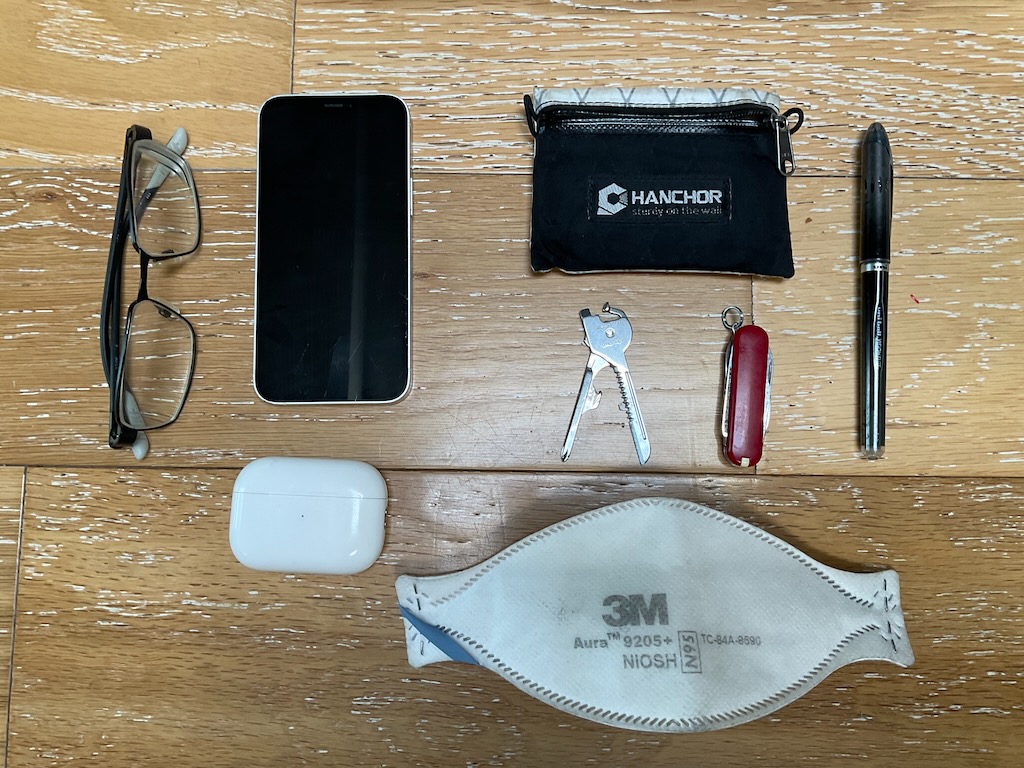
    Flexon Frames (1995/2020) with high index progressive lens with Transitions XtrActive Polarized (2023) lens. Eyeglasses are an incredible blessing. I used to break frames within a year until I tried Flexon frames in 1995. They last an average of 8 years with lens being changed each year due to prescription changes. The XtrActive lens go from almost clear and unpolarized to 90% light blockage which is polarized!

    Apple iPhone 12 Mini (2020) on T-Mobile (2022). I don’t use a phone case. The iPhone mini was the smallest usable full feature phone until it was discontinued. Ease of sharing (AirDrop, iCloud/Photo, iMessage) with family and friends bias me toward Apple. T-Mobile has great international roaming, haven’t needed to pick up a local SIM anywhere though coverage is often not as good as the best local carriers. T-mobile has mediocre coverage in USA compared to Verizon. If/when I spend most of my time in the USA I will switch back to Verizon even though their plans are more expensive… or maybe not depending if data via StarLink becomes a reality. I wish someone made a phone the external size of the original iPhone and a battery that lasts more than a day. There is some hope that Unihertz or some other company will make a small Android phone I will like. Android’s has superior speech recognition, notifications, and an open platform. For people not using T-Mobile,  Airalo makes it easy to acquire an eSIM for wireless data while traveling internationally.

    Apple AirPod Pros (2021/2023) are nicely integrated with the Apple eco-system and just work. Bluetooth connects reasonably quickly, is reliable, and switches between my phone and laptop mostly automatically. Noise reduction is “ok”, and the “ambient mode” provides adequate situational awareness. Can adjust volume from AirPods. The case is part of the “Find My” eco-system. Downside is battery isn’t swappable when it wears out. I have written about other headphones. Replaced a pair that was lost.

    Hanchor Mica (2023) a tiny wallet / coin purse which holds my IDs, 1 credit cards, 1 debit card, a few bills, coins when needed. Using a Chase Sapphire Reserve card for this season of life. Annual fee is ridiculous, but benefits have more than paid for the fee last year. Really appreciate that the points can be transferred to the frequent flying programs we use, and the access to airport lounges was a lifesaver. For a bit I carried a Chipolo Card Spot (2023) which is part of Apple’s “Find My” network, but decided it wasn’t needed. Switched from my old wallet because I often needed to carry coins for small vendors in some countries.

    Victorinox Swiss Army Rambler (1999/2015) is the smallest, usable tool I have found with a blade, phillips head & flat screwdriver, scissors, bottle opener, and nail file. I am on my 3rd Rambler after losing a couple to TSA in the early 2000s. I have some notes about other knives.

    Swiss+Tech Utili-Key (2002/2023) Replaces my Rambler when flying and none of my companions is using a check-through bag where I can stash my Rambler. The Utili-Key has made it through TSA checkpoints over 140 times without being confiscated, but isn’t as usable as a Rambler pocket knife. On third Utili-Key due to misplacing them.

    Uniball Vision Elite .5mm Pen (2015/2023) Writing feel approaching Pilot V5 and doesn’t leak after plane flights!

    N95/KT94 Masks (2020/2023) I like the BOTN KT94 and the classic 3M N95. For other good options see Masknerd reviews. N95 properly worn provides significant more protection than cloth or the basic surgical masks. I was recently introduced to the totobobo mask which looks promising. While not as effective as a professionally fit N95, it was close, and was better than an N95 used by an untrained individual.

    Garmin 955 Watch – not shown (2022) accurately tracks my activities and measures my fitness level. Has decent integration with smartphones and notifies me when I have left my phone behind. I find the data I get from Garmin to be higher quality than most other wrist worn sensors I have tried, being close to medical grade when paired with external sensors. Better battery life than iWatch and physical buttons which work with sweaty fingers. The display on the 965 is a significant improvement but I am happy enough with my 955 not to upgrade. There are other good sport watches.

    Bags
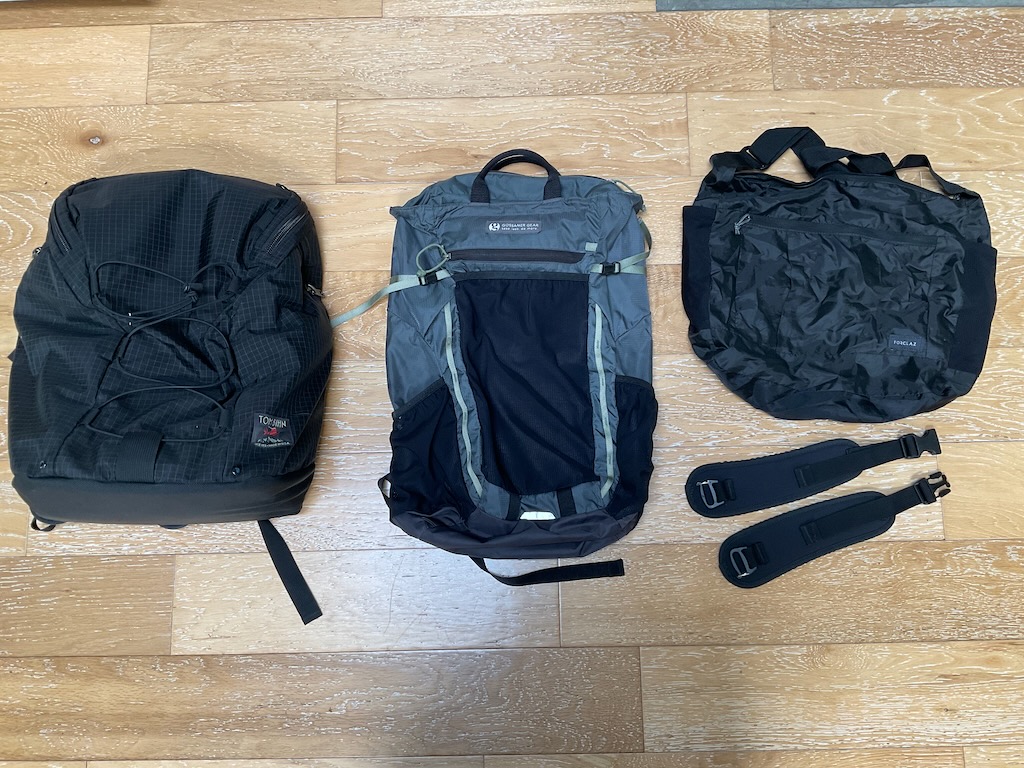
    Tom Bihn Smart Alec (2022) durable bucket style day pack. Stands up by itself and is easily accessible through the top zippered opening without spilling. In this season of life this pack has two functions. When we are using planes as our transportation it is filled with the items I am not using, and is stored in the trunk of our car. When at home or at destination we drove to, it functions as my office storage. It is also the perfect size to hold two folding chairs and food for a picnic and works well as a grocery bag.

    Gossamer Gear Vagabondmy review (2022) a 23L day pack which is light weight, comfortable to carry, works well for EDC, and is large enough to hold everything I take when traveling. I am using the discontinued Trail model. The current Jet model has some nice upgrades. The 46x27x15cm (18/10.75/5.75inches) filled with my normal gear is small enough to squish into every “personal item” sizer I have encountered and under the seat in front of me on every jet I have flown in. While access is not as easy as a clamshell style bag, I have no problem retrieving items by feel because my clothing and organizing sacks have different textures. Stands up on its bottom making access on the go easy. I have a list of other traveling packs.

    Tom Bihn 1” padded waist strap (2021) allows a moderate amount of weight transfer for me when attached to my TB or Gossamer Gear daypack. The Gossamer Gear fast belt has pockets but don’t transfer load for me.

    Decathalon Packable 15L Courier Bag (2023) Used around town and sometimes to hold items I will use on a flight if I put my pack in the overhead compartment. Unstructured, so care is needed when loading it up. A very inexpensive clone of the discontinued Patagonia Packable Courier Bag which I used for 10 years.

    Daily Life
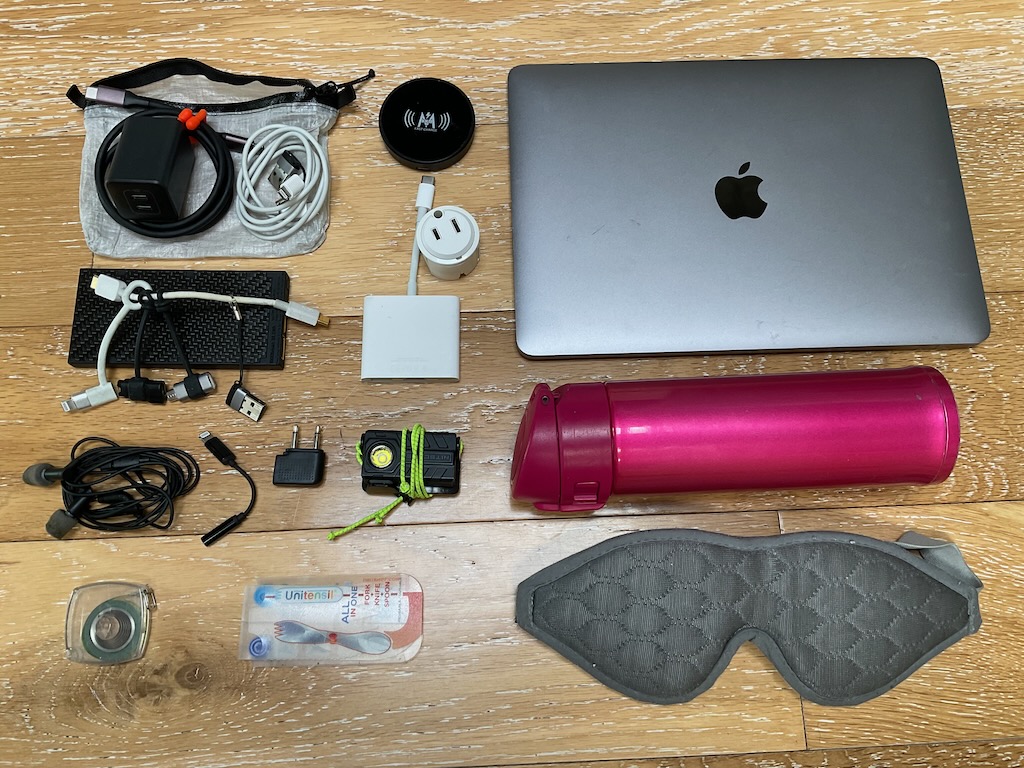
    “Tech Kit” items are stored in a small litesmith zipza pouch (2023) which is the perfect size, mostly waterproof, light, and a different texture than anything else in my bag so easy to find by touch.

    • Anker 523 (2023) Dual USB-C, 47w. Single port 45w, using both ports 27w top, 20w bottom. Can charge my MacBook at near maximum speed when it’s the only device plugged in. Over night can charge fully depleted iPhone, Nitecore 10k, and MacBook with power flowing through the 10k. It’s fairly compact making it less likely to slip out of loose outlets. I recommend the Nomad Slim 65w, Anker 735 and I am amused by the SharkGeek charger for people who need 65w.
    • Nitecore 10000 Gen2 (2023) power bank with USB-A&C out. Lightest and most compact 10k battery I have found. Comfortable in my pocket while charging my phone, Enough power to very slowly charge my MacBook or mostly power the MacBook while charging my iPhone. Supports pass through charging so I can charge this battery while my MacBook is plugged into the charger. Spreadsheet of many power bank options.
    • Cables: Apple 4ft USB-C to Lightning, 4ft video rated UCB-C and 6″ USB-C cable
    • Adaptor tips from USB-C to (A, micro, Lighting, Garmin), and 2 USB-C to A converter.
    • Apple USB-C to AV-multiport dongle for those times I need to display my laptop on an external screen. Might drop.
    • MagSafe Charger (2021) is bit heavy, but useful when lighting port in aging iPhone becomes unreliable or when I want to charge phone while using the lightning port for headphones.
    • Mogics Adapter MA1 (2023) is the smallest, lighter “universal” power adaptor I have found. For type E remember to unscrew and extended the type C prongs. I wonder about its durability but it’s been ok so far. In some UK outlets had a bit of a trouble making good contact, sparking until I got it set.

    Etymotic HF3 (2013/2023). Great sound isolation, Apple friendly volume stop/start button, and mic. Provides me with around 40db of noise reduction which is better than any consumer grade active noise cancelling headphones I have tried. Also gives better audio quality on phone calls than BlueTooth earbuds. I have a lightning and airplane double jack adaptors. I thought the double jacks would be phased out, but in 2023 I flew on several newish 777 which still had these plugs?! The foam eartips eventually stop sealing, but can be replaced.

    Nicore NU20 headlamp (2016) Just 29 grams when the headband is replaced with shock cords. Adequate regulation on medium and low settings. When closed the power button to covered preventing accidentally turning it on. Use when I need hands free light: repairs, backpacking, running in the dark, and it has been used when I forgot to recharge my bike light. Lit our kitchen during a power outage by bouncing light off ceiling. Can be powered from a remote USB power bank making it useful in extreme cold or when needing exceptionally long runtimes. The NU20 classic is a nice upgrade. There are many other good flashlights.

    6 Foot Tape Measure (2023) I often need to measure things. Replaced a retractable fabric tape measure that broke.

    Fold-it-flat Unitensil Spoon/Fork (2015) I have gone years without needing to carry my own utensils in urban environments, but there are exceptions to this. Last year there were numerous times that having a spoon/fork would have useful. I added this back in at the end of the summer and have used it several times.

    MacBook 12″ from 2017 (2023) This is the last ultra portable made by Apple. It’s 2lb, decent keyboard, and enables me to complete daily tasks with a minimum amount of friction. Apps can be slow to start but deliver acceptable performance thanks to 16gb of RAM. Tablets are great for media consumption, but even with a keyboard had too much friction when I switch between windows/apps while integrating information. Chromebook aren’t lighter and are missing some Apps I want. Tiny PCs like the GPD Pocket 3 have keyboard and screens which are too small for me to be productive. There are some amazingly light x86 laptops such as the 1.4lb Fujitsu Lifebook UH-X, the Asus Expertbook B9 and the Lenovo ThinkPad X1 Nano which would give me a much more performant laptop, but several of my apps aren’t available under Linux (Lightroom Classic & Bear), and I don’t like Windows due to the fragility / pain of patching and upgrading the OS. Maybe in the future running Linux with macOS in a VM is worth a try. My 14″ MBP (2022) has been left running in a safe location and us accessed remotely via Tailscale and I can spin up AWS instances when I need more computing power.

    Zojirushi Double Walled Mug 16oz (2013/2017) can easily be used one handed, locks, pours at the perfect speed, the mouth is wide enough for ice cubes, and insulates better than every other mug I have tested. When air temp is ~80F and the mug is exposed to the sun, 6 small ice cubes in cool water have just finished melting in around 3 hours – water temp is 35F. In 68F conditions ice lasts most of the day. In many countries you you can fill mug with ice (no water) and get through airport security. Once through, add water and you can have icy cold water for your flight. I have a Deep Cherry color mug which is easy to spot. When I want to go extra light weight, I swapped it with a SmartWater bottle I reuse.

    Sleep Mask (2022) helps me get longer / better sleep because it stops external light from disturbing me. This mask was a free gift which replaced a mask that got lost. For a number of years I used Bucky brand, but they wore out in less than two years.

    Bathroom
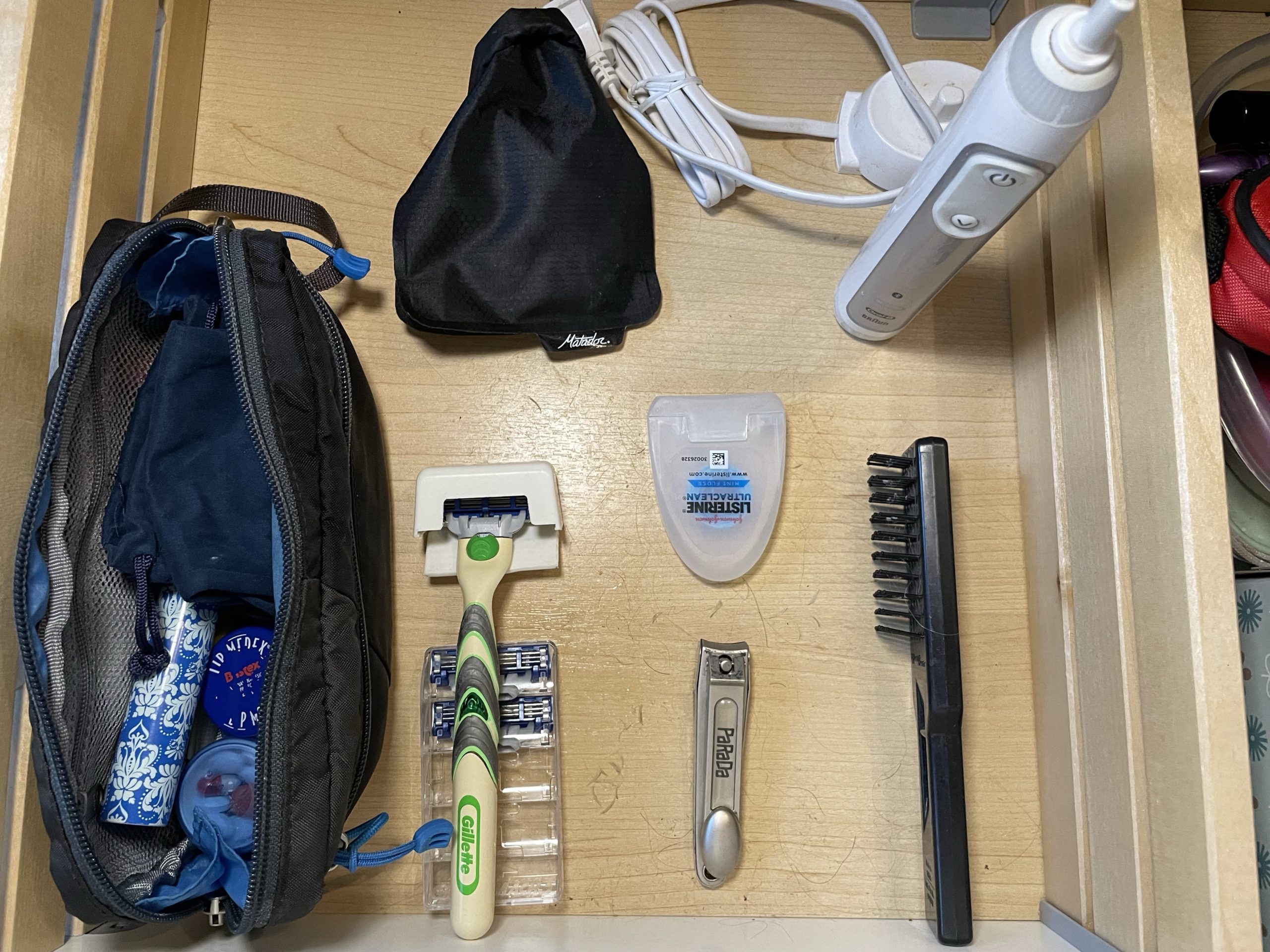
    REI Micro Shower Bag (2017) is the perfect size for my toiletry kit and make it easy for me to find everything quickly. Inside pocket holds a few doses of nyquil and benadryl. Main area has: lip balm, toothpaste, a micro fiber cleaning / storage bag for my glasses, a small HumanGear GoTubb to store aleve, and the bathroom items listed below. Outside pocket holds first aid kit which includes band-aids, single use benzoin tincture, compeed blister pads, antiseptic wipes, antibiotic cream, superglue, a couple of safety pins. This bag is discontinued… the GOX Organizer looks to be similar.

    Matador Flatpack Soap Case (2020) to carry a 100senses body bar (2019/2023) which takes care of all my cleaning needs without drying out my sensitive skin or making my hair feel like straw. One bar lasts around six months. There are better shaving creams and detergents to wash clothing, but it’s been good enough and simplifies life for me. The Flatpak lets the soap dry out better than a ziplock bag, but it’s far from magical. Downside is that it doesn’t work very well as a case while showering.

    Gillette Power Mach-3 Razor (1999) and blades (1999/2021) Using as a manual handle since vibration stopped working and they stopped making the “power” version of the handle. Use around 11 blades / year. Costco often sells large packs of the blades

    PaRaDa Nail clipper (2014) are large and heavy but effective and the trimmings catcher is brilliant. I have been saying for years that I will replace it with something lighter and more compact but I haven’t done it yet.

    Retractable Bristle Hairbrush (1994) Compact and more effective than a comb for me.

    Reach (rebranded Listerine Woven / Ultraclean) Floss (1996/2022) is the most effective dental floss I have used. Gentle to the gums while still getting plague and food wedged between teeth out. I believe it has been discontinued but still possible to find stock. My dentist has recommended coco floss as a good replacement though it’s more than twice as expensive.

    Oral-B/Braun 6000 Electric toothbrush (2016) and USB powered charger. A recent meta analysis concluded that the rotational approach of Oral-B is likely superior to approach of Sonicare, but both are significantly more effective than manual brushing and the electric toothbrushes like the Quip and my old Violife which relies on a brushing motion.

    Crystal Deodorant – not shown (2023) Simple Potassium Alum crystals. Years ago I ran an experiment and discovered if I showered regularly, no one could tell that I didn’t use deoderant. I suppose I have lower BO than some people. After >10 years I gave this deodorant a try after reading about them on /r/onebag. I notice that my shirts go a day or more longer before they pick up body odor. Carrying a 1.5 oz stick which shows little wear after a year. It’s best to apply right after a shower since it needs to be wet and works best on clean skin. It’s not an anti-perspirant nor doesn’t cover up existing odor. Rather it produces it environment that is hostile to the odor creating bacteria.

    PackTowel Ultralight Body Size (discontinued) – not shown (2009) Dries in less than 3 hours after I dry myself when hanging indoors, faster in sun, is compact, weights just 3oz. Large enough that I can wrap it around my waist like a small sarong. I found the face size sufficient for me to dry my body, but I am willing to carry a larger towel for the added versatility and ease of use. There are other travel towels.

    I acquire sunscreen wherever I am. I try to select SPF >=50, considered very low risk for health, and reef safe when near the ocean. The sun screens in EU are way better than in the US because the FDA hasn’t approve some of the newer options. Such a shame since they are reportedly are safe, feel better on the skin, and often don’t leave you looking like a ghost. If the trip is short and I don’t have any sun screen from the EU left I will bring a Neutrogena Mineral stick. Around town where I don’t need to worry about form factor or TSA I will see what the top rated sun screen that is liked by both consumerlab and ewg.

    Core Clothing

    I have notes about selecting clothing for an active life which goes in detail  about how I select clothing for a wide range of activities and conditions. My core clothing comes on every trip I take and is used for my daily life at home. Some people achieve simplicity by having many pairs of the same clothing item which the rotate through. My approach is have fewer items and run small loads of wash when they get dirty. I keep a log tracking each item’s longevity. Number of days of repeated wear was determined by asking others who would be honest with me if the clothing still looked good / had no odor after airing out overnight. The following items I have with me always and would have provided effective clothing which would have been acceptable in every circumstance I faced in the last five years.
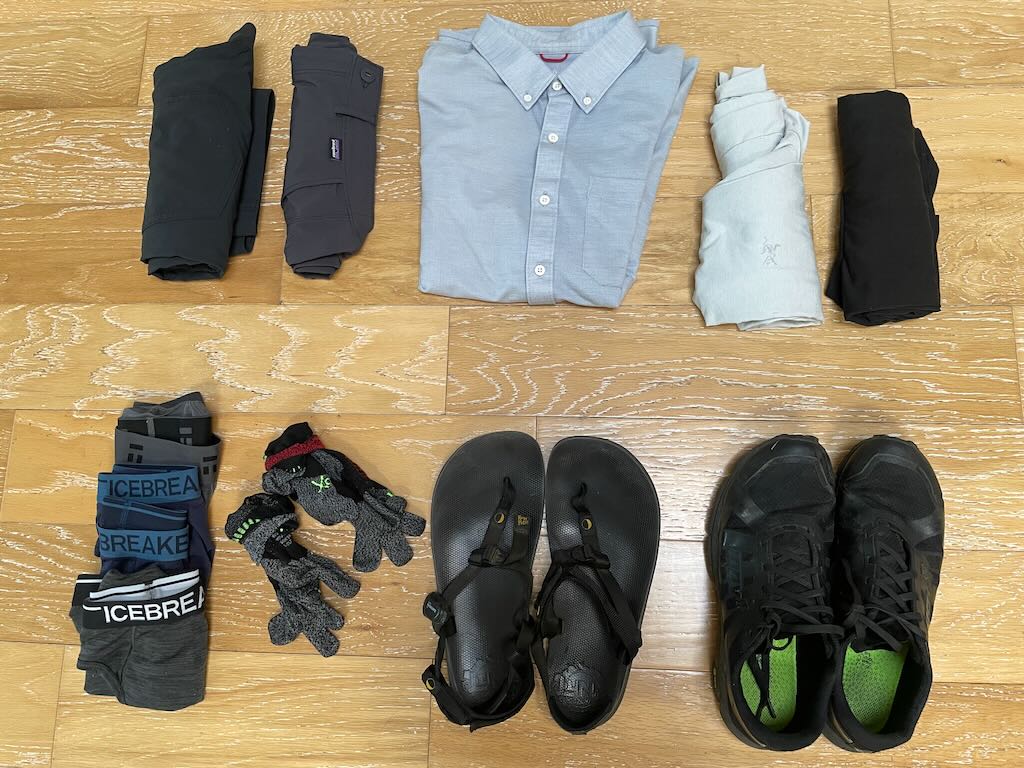
    Western Rise Slim Evolution V1 Pants (2020/2022) Slightly stretchy nylon pants that are a cross between jeans and chinos which can dry overnight when hanging in the bathroom. The most comfortable pants I have found in hot weather that have a “business casual” look. I found their fit to be “snug” fitting rather than the nearly tailored fit of the Outlier Slim Dungarees. After around 300 days of wear they are a stretched and the color fades slight but otherwise are still in good functional shape. My second pair had a seam separated after only 200 wears, now on pair 3. Sizing is not consistent, customer service is poor. Version 2 of the Slim Evolution has an overly tight, but “fits” thanks to a greater stretch. Classic hiking pants like prAna Brion are cheaper, have a more consistent quality, and are more rugged, but not as comfortable in heat and aren’t as refined looking. UPDATED April 2023: Outdoor Research Ferrosi Transit pants have replaced my Evolution pants because they look as good once the logo is remove, have better mobility, dry more quickly, and are much more comfortable in hot weather. Other suggestions for good pants.

    Patagonia Hydropeak Hybrid Walk Shorts (2023) dry in a couple of hours while hanging, faster when wearing. The are very comfortable, give me good freedom of movement. Not excessively “technical” looking. They can function as a swim suit, but if I am going to be on a beach for multiple weeks I will retrieve my Bluesmith board shorts described in the “beach section” below.

    Western Rise Unlimited Button Down (2022) Blue Merino / Polyester blend button down shirt. My wife tells me it also looks like it was just ironed as it comes out of the my pack. Reported to be UPF 40. Fairly air permeable, resists odor, comfortable in a wide range of conditions. Dries quickly enough to hand wash at night and be ready to be worn the next morning. Can wear 4 days without any odor. It’s a great shirt for “urban” use. UPDATED April 2023: now in storage, and pulled the OR Astroman Button Up from “Extra” to my standard core. Astroman dries faster, more comfortable it hot weather, and my wife prefers how it looks.

    Arcteryx Cormac Hoodie (2023) A casual UPF 50 shirt. Slightly calendared which I find reasonably comfortable when I am hot and sweaty. When using a crystal deodorant resists odor for 3+ days of normal activities, 2 day of vigorous activity. Provides full sun protection. Resists stains pretty well so spills generally clean with a quick rinse, but after 130 days of continuous use (mostly hand washing) there were stains which won’t come out even after being machine washed a few times on heavy duty. Thankfully light stains on the white heather aren’t as noticeable as pure white shirts. I found this shirt dries in less than 3 hours after being squeezed, rolled in a towel and hung in a cool indoor room with modest ventilation. When hung in bright sunlight on a warm day dries in less than 1 hour. Also dries in less than 1.5 hours when I am wearing it in moderate temperatures and humidity. This is my default shirt for “sporty” / “athletic” activities and what I wear most of the summer. The Outdoor Research Echo is a good alternative for many: lighter, cooler feeling, with a slimmer fit, and good anti odor. Unfortunately for me, the Echo’s UPF is 15-20 has resulted in me getting sunburn when I spend all day outdoors in locations which have >10 UV Index. I have notes about other base layers.

    Icebreaker Anatomica Tee-shirt (2014/2021) merino wool with a bit of nylon for durability and a bit of lycra for a body hugging fit. This tee-shirt fits me perfectly, is super comfortable, doesn’t smell after many days of wear, dries fairly quickly, and my wife likes how the shirt looks on me. UPF between 15-30? I get around 500 days of wear before an Anatomica Tee looks tired, and 600 days before the first small holes appear. I think Icebreaker makes the best merino tees, but there are a number of other good options from Smartwool, Outlier, Wool&Prince, and several other companies. While I love merino wool, there are advantages to synthetic technical-tees: absorb less water, dry more quickly, and are more cost effective because they tend to be cheaper and longer lasting.

    Icebreaker Anatomica Briefs – 4 pairs (2014/2021) the most comfortable underwear I have worn. They dry quickly and resist odor. I get around 600 days of wear before the waist band deforms and small holes appear. Only downside is that they bunch up a bit in hot weather when carrying a backpack. Tommy John’s Air Briefs (2022) are really wedgy-proof and dry very quickly except for the waist band. In the past I found the synthetic briefs from Ex Offico were pretty good but their quality has dropped. I tried Saxx a number of years ago, and didn’t think they were worth their high price. I have heard Uniqo Airism, 32 degree mesh, and Duluth Trading Buck Naked briefs are great, but no personal experience. When going light I bring two pairs: one to wear, one to wash/dry.

    Xoskin Toe Socks – 2 pairs (2022/2023) prevents blisters forming between my toes when walking or running for extended distances. I have worn one pair 30 days in a row doing 15-37 miles of hiking each day without blisters and had pre blisters that were forming before I started using the socks heal. They weren’t stinky after six days of continuous use (and not washing) while backpacking in sandals, though they are more prone to pick up odor after several hundred miles of use. They are significantly more durable than my previous merino toe socks. After ~500-700 miles get my first hole when a sandal strap was rubbing or my toenail sliced through. I nursed by first pair to 1400 miles. I expect to retire them every 1,200 miles or so.

    Luna Venado Sandals (2012/2022) I love the feel of running almost barefoot and the tiny space they take when packed. I can walk 15-37 miles / day for a month on hard surfaces and my feet are still feel good. They mold to your feet over time. Even after 1500 miles they have a bit of cushion though I have worn the sole through in at least one spot. I generally replace them every 1200 miles or so. I have used them in the back country but traction is poor. These have been my “shoes” in town unless social convention would have me wear closed toed shoes. On my third pair.

    Inov-8 Trailfly G 270 (2022/2024) Used to be called the TerraUltra G 270. Zero drop trail running shoe that is a good amount of cushion and a 12mm stack. Great fit for me: enough room for my toes to splay while gripping my heel perfectly. Used for backpacking or trail running when the terrain is too challenging for my Luna sandals or when I need to wear closed toe shoes. They have been acceptable footwear in snobbish establishments and no one has ever commented about them. I wear in transit and pack my sandals. The graphene infused soles are more durable than typical trail runners. At 1500 miles though the uppers still look good and there is still a bit of tread on the highest wear areas of the sole. The V2 of this shoe reinforcements is a shiny grey rather than black :(. I have hear it claimed that Nike Pegasus Trail 4 might be even longer lasting though I am skeptical.

    Extra Clothing

    There are some clothing that I take / use based on what the next leg of my journey will require. When not in use, they are stored in the trunk of our car’s trunk.
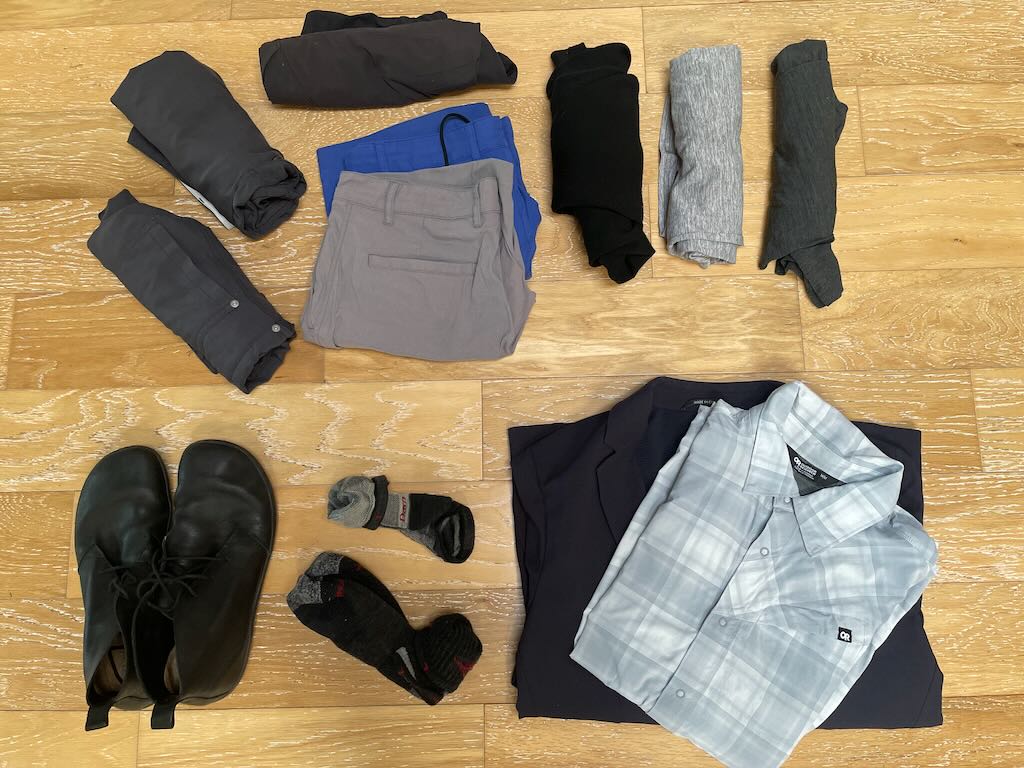
    Outlier Slim Dungarees – 2 pairs (2014/2019) High-tech nylon pants in the style of jeans. Gives me an almost tailored fit, looks great, good mobility and durability. Thanks to the NanoSphere treatment very stain and water resistant. They are perfect when it’s <75F and I am inactive, <55F when active. When highly active and >70F the seam that runs along the inner thighs chafes. In hot weather prefer OR Ferrosi Transit pants. Over time the pants stretch out a bit especially around the knees which make them a bit less slim fitting. I get more than 550 days of use before there is any signs of wear: light pilling at the top of the pocket I use the most. I have yet to completely wear out a pair though I have retired a few pairs after a pen leak created a large stain and after I lost weight and needed to switch to a smaller waist. When paired with nice shirt, and blazer have been accepted in situations which called for semi-formal dress. The hiking pants I wore in the past couldn’t do that. I have repeatedly had women say “Where did you get those pants? They look great. I want to buy a pair for my husband.” SD seem pricey but it depends what you compare them to. When considering the cost / day of wear ($0.07/day)… they are 5x the cost of mass market nylon pants which don’t fit me that well, 2x the cost of higher quality nylon pants from companies like Prana and Patagonia, and about the same cost per day as Levi 501 jeans if you retired them when the knees are blown out. Maybe an indulgence, but I don’t think them as a luxury item when I see $1390 nylon shorts from Prada. Current pairs I am wearing were acquired in 2017.

    Patagonia Terrebonne Joggers (2023) Very light weight polyester pants which provide a good range of motion, are very light, pack up small, UPF 40. Dry in less than 2 hours when hung indoors, less than 1 hour when wearing after being completely soaked in a rain storm. Very breathable and comfort in hot weather. These are the only pants I worn when walking the 800km Camino Frances in 2023. found them good for outdoor activities in cooler weather and for sleeping / lounging. Downside are that the pockets are a bit shallow so items fall out when sitting down. Will likely move to my grab and go backpacking kit because the OR Ferrosi Transit pants dry almost as quickly, are only a bit heavier, and are more versatile.

    Outlier New Way Shorts 2 pairs – (2014/2017) are nice looking shorts which fit me perfectly, are durable, and resist stains. The first place place for wear to show up is the mesh to drain the pockets develop holes. These shorts feel like they were tailored for me. I can’t put into words how “right” they feel each time I put a pair on. The fabric is thick enough to prevent items in my pocket from really standing out. They are pricy but I hadn’t found any shorts that I liked as much. They can function as a swim suit but aren’t ideal for that use because they take 2x times to dry as some of my board shorts and my wife observed “they don’t look like a proper swim suit.” Still wearing the first pair I purchased.

    Minus33 Mid-weight Merino Mock Turtleneck (2023) Purchased for cooler days when I want something bit more casual than button down shirt but a dressier than a hoody. Warm enough that I don’t need a sweater when it’s cool, but not overly warm when sitting around indoors. Have been able to wear for more than a week with no noticeable odor retention.

    Patagonia Cool Daily Hoodie (2022) Comfortable hoodie, resists odor for 4 days when somewhat active, provides moderate sun protection which I believe is good enough when I am indoors much of the day or in locations with moderate UV index. Patagonia removed any UPF claims because between their initial testing and production the UPF performance dropped / was inconsistent (from >50 to 17-45, average 34). Use when my Cormac hoody is dirty.

    Second Icebreaker Anatomica Tee-shirt in grey which enables me to do wash just once / week.

    Darn Tough Socks – 2 pair (2013/2019) are unsurprisingly durable since they come with a lifetime warranty. Icebreaker and the Smartwool PhD line are good alternatives. Worn out and replaced 2 pair of the no show light socks after >4000 miles of use for each pair. None of my light crew have been worn through yet.

    Vivobarefoot Gobi II (2017/2022) are comfort, zero-drop, minimalist ankle boots which look good with casual clothing or dressed up in a suit. I have used them around town, hiking in the backcountry and even run in them. Sending my original pair to be resoled after walking more than 1500 miles. With an occasional brush and polishing the uppers still look good after repeatedly soaked in rain storms, covered in mud, etc. Unlike shoes with breathable nylon uppers, keeps sand and dust away from my feet and socks. They are generally not needed given current dressing standards, I can typically get away with trail runners.

    OR Astroman Button-Up (2023) UPF 50, light weight long sleeve button-up shirt. It’s reasonably comfortable in warm weather and it’s been reported that mosquitos don’t bite through it. When under a blazer can pass for a dress shirt, but no some much stand alone due the slash pocket and that the collar is a bit floppy. Being used as an experiment this year. If performs well, it will likely become part of my core clothing, swapping places with my Wester Rise Unlimited shirt.

    Bluffworks Hopsack Blazer (2022) Blazer which doesn’t wrinkle, can be washed in a machine, and is light enough to wear in hot weather. Took on several trip but used very rarely and was never required (even venue I wore it I saw people without a suit or blazer who were accepted). Current dress standards make it mostly unnecessary. From what I have observed, suits are only required by lawyers, bankers and business exec in more formally dressing companies, and more formal wedding. Oh, and whoever the wife says “I would really like you to wear your suit”. I have noticed “the cool kids” are using canvas work jackets rather than blazers when getting “dressed up”. I believe the time has come to view suits / blazers as optional. If the Bluffworks Telex model existed, I would have purchased it rather than the Hopsack. I have been tempted by ArcTeryx’a now discontinued Veilance Windshirt Blazer… but it was way too expensive.

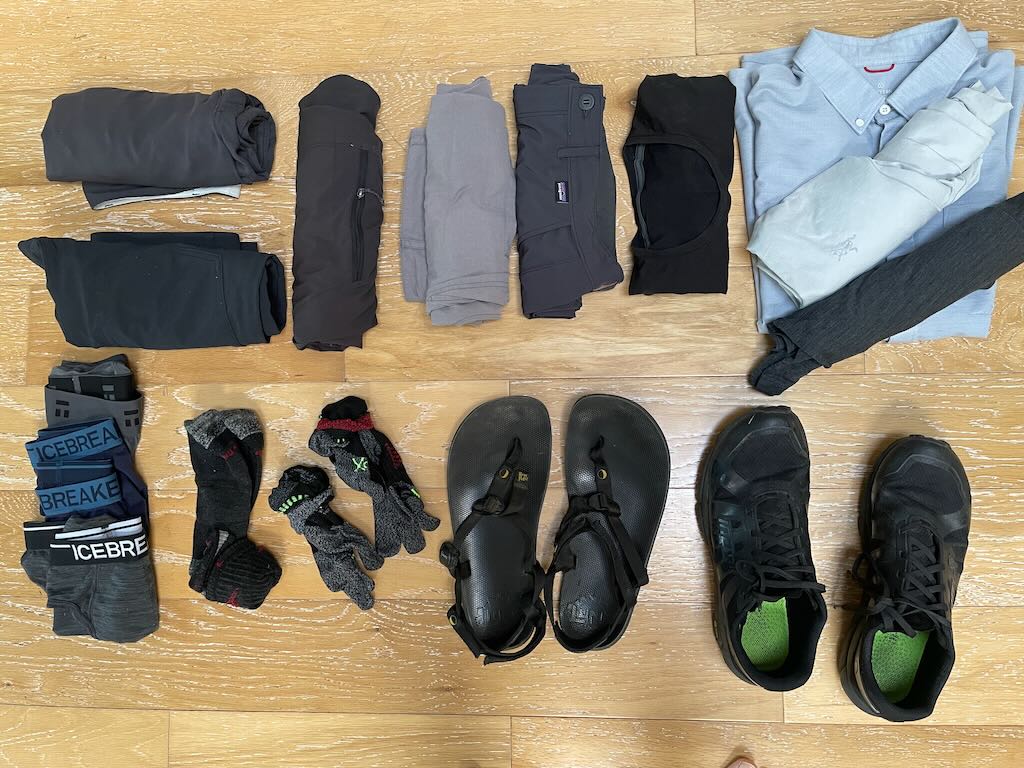
    The Following is a picture of my core clothing plus the “extras” I most often use when I am going to be in the same location for an extended period of time and am optimizing for easiest life without minimizing space. The extras added to core: Outlier SD pants, Terrebonne Joggers, Outlier New Way Shorts, second Icebreaker tee, and 2 pairs of wool socks.
    Outerwear

    The following clothing allows me to be comfortable at all actively levels when the temperature is 0F or warmer, and colder if I am engaged in high aerobic activities like running or cross country skiing.
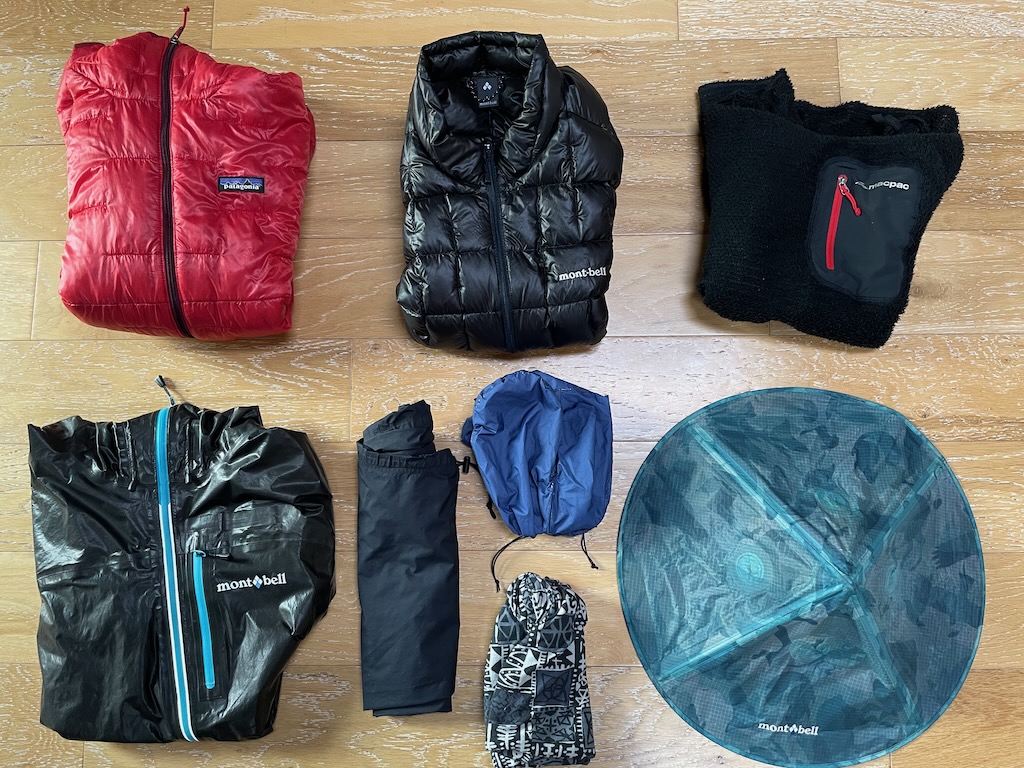
    Patagonia Micro Puff Hoody (2020) Keeps me comfortable ~25F lower than I would be without the jacket. Provides just the right insulation for me for winter nights in the SF Bay Area and shoulder season backpacking in the sierras. Combined with down vest or Nitro Hoody it’s just right for winter trips in the sierras. Reasonably light and compressible. Long enough to cover my blazer. Only take when I expect temperatures to regularly be below freezing.

    Montbell Plasma 1000 Down Vest* (2021) Incredibly light weight vest which provides moderate insulation for my core. I have the Japanese version which has pockets. With a long sleeve shirt and shell I am comfortable down to around 40F. When combined with a tee-shirt, Macpac Nitro, and a shell allows me to be comfortable while walking down to 25F. Combined with Nitro and Micro Puff keeps me warm enough in any winter conditions I am likely to encounter in the next few years. More acceptable looking over button down shirt / under blazer than my hoodie. Less than perfect for me: cut is a bit too boxy the neck doesn’t seal well.

    Macpac Nitro Pullover (2021) Made from Polartec Alpha Direct (90gsm). Highly breathable and dries super fast. Very light insulate without a shell, surprisingly warm under a shell. Great when active in cold conditions. I can feel air flow at walking speed in still air. Worn whenever my shirt isn’t warm enough. I am comfortable sitting in 68F wearing the Nitro and a tee-shirt, but when I pull up the hood and layer on a shell I am comfortable down to 40F doing light work (walking 2mph), and in colder conditions when highly active. There are lots of good options for an insulation layer.

    Montbell DryPeak Jacket (2022) made from Shakedry. I can actually wear it and not be soaked by sweat when active! I have done zone 2 runs for 2 hours in 48F rain with just 1 gram of water accumulating in my running shirt. Waterproof and doesn’t wet out. Works well as a wind shell. Alas Shakedry is somewhat fragile and is being discontinued… hope something equally performant comes out soon. In the mean time I have picked up several Shakedry jackets for my “stash”. Other options are discussed in my post about rain gear.

    Zpacks Vertice Rain Pants (2018) are simple, light, breathable, waterproof rain pants. Have used them occasionally in cool rain when commuting by bike, hiking, or backpacking. After a few years of light use I am getting some minor leaking in the seat, and the bottom cuffs are fraying / delaminating. I forgo using them when I spend all my time in urban locations. When they fully wear worn out will go with rain pants made from a more durable material, GoreTex Pro or Columbia Outdry Extreme Mesh.

    PolarBuff* (2003) Generally I use the hoods on my garments, but sometimes I want extra insulation for my neck or head. Don’t use it that often, but small and light enough it doesn’t make sense to retire it.

    Enlightened Gear Visp Rain Mittens (2022) Super minimalist protection from hands. Keeps my hand comfortable from freezing to around 50F when engaged in modest activity up to zone 2 workout.

    Manzella Power Stretch Touch Tip Gloves – not shown (2023) Light weight gloves that I can mix/match with shell mittens. Hands have been ok Visp mittens down to 20F.

    Montbell Umbrero Rain Hat from Japan, also avail from US Site for more $$ (2021/2023) is a 1.8oz folding hat which fully shades my face, ears, and neck. It’s fully waterproof but still provides the best ventilation of any hat I have used. It deforms but usable in <25mph winds. Montbell originally said provide protection from sun, but when I reached out to ask what’s its UPF was informed the indication of UV protection was a bug in their website. I addressed the lack of UV protection by coating the inside with a paint which fully blocks UV. I think it’s silly looking, and periodically have people point and laugh… but I have also received compliments and have had people chase me down to ask where they could purchase one for themselves. When walking the Camino we had around 90 people ask us where they could get their own. There are lots of other good hat options. UPDATE Sept 2024… after three years of daily use the wire in the brim broke… hat still functions but is a bit more floppy. I just replaced it with an Umbrero I purchased on our last trip to Japan which I had cache for when my current hat wore out.

    Sports / Exercise

    Garmin HRM-Pro (2021) get higher accuracy during interval training than built in optical sensor on smart watches and works when swimming. Can record data without the watch being connected, but I don’t generally use that feature. Also provides running power which has been somewhat useful. Supports ANT+ and Bluetooth.

    Foam Visor (2023) Keeps sun, rain, and sweat out of my eyes when running or hiking and doesn’t absorb water when worn in the rain. Typically combined with a hood which protects neck and ears.

    Xoskin Compression Shorts (2023) Started using when my Tri-Shorts began to chafe on long runs in hot weather. Wore a hole in the first pair when I used them bicycling without shorts over them. The have eliminated chafing on long, hot runs, and of course work fine in less demanding circumstances.


    Used When I Drive To the City of Residence


    Household Items

    The following are used whenever they can be easily transported to where we are staying for >2 weeks. If we are flying to a destination, they are stored in our car. We also have a cooler and some kitchen tools and stables we have put aside for when we travel by car.

    Withering Body WiFi Scale (2014) makes it easy to track weight which is well integrated to Garmin, Fitbit, MyFitnessPal, LoseIt, and numerous other health tracking eco-systems. Body composition numbers not accurate. Having trouble getting it to switch WiFi networks.

    ChiliPad (2019) which cools or warms water which flows through a mattress topper. I need to be significantly colder than Jackie to sleep soundly. When under our bed the heat exchanger not able to hit the cooling target when the unit was under the bed, but it has been fine when sitting out. We tried an eightsleep system which much quieter but not worth the added cost to us. I didn’t find the automatic temperature adjustment of the eight sleep particularly helpful and the sleep tracking wasn’t significantly better than my Garmin watch.

    Pulse Flex Wireless Speaker (2017 & 2022) allows us to have synchronized whole house music and plays nicely with other BlueSound products and can be combined into a reasonable quality stereo system. We have the original Flex speaker and the updated Flex 2i. It also supports inputs via USB, Bluetooth, AUX, a number of streaming services like Spotify, and many free sites via URIs. Has a iOS and Android remote control app which works but has a somewhat awkward UI. Controls on the top let you select one of 5 user-defined “channels” without using the remote. I have the optional battery pack so it can be used outdoors. Sound quality is significantly less than KEF LS50 but better than most portable speakers, the speakers on our phones and the built-in speakers on TVs. When using them away from home primarily play lossless music which is stored on a thumb drive plugged into the back of the speaker. For most people I would recommend Sonos: for its lower price point, better streaming options, and slightly more processed sound quality which everyone but audio purists like me prefer. Even cheaper are products from Audio Pro.

    MacBook Pro 14-inch (2006/2022) Holds the family’s archives: pictures, videos, ripped CDs, digitized books, and documents. There are better performing laptops for the money, but the touch pad is more usable than most laptops and OS X provides high quality commercial applications and full UNIX tooling. I have made it through many OS upgrades without problems and have never had to wipe the disk and reinstall the operating system. I select a configuration with enough storage for 2x my current usage (4tb at the time of purchase) and the maximum memory available which has allowed me to use the same MacBook Pro for ~5 years before I feel the need to upgrade.

    Lives in Car

    I leave some items in car trunk in case we encounter unexpected conditions. I rarely use these items personally, but have often loaned them out to friends who weren’t prepared for the weather we encountered.

    Gossamer Gear Vagabond Packable (2021) 23L pack which is comfortable to carry and easily packs away in my larger bag. Used for done in a day outdoor activities, as a EDC / grocery shopping bag, and has been used as my primary luggage on trips on several trips. This is by far the most comfortable carrying packable day pack I have ever used. Most packable daypacks feel like a sack with straps designed to fit a non human.

    Tilley LTM6 Hat* (2014) durable hat that provides good sun protection. I prefer the LTM8 which has more ventilation. Replaced a 20 year old canvas Tilley that was lost on a river trip.

    ArcTeryx Squamish Wind Shell* (2012) is a 5oz windshirt with an air permeability of ~30 CFM. When combined with a heavy base or light middle layer provide comfort over a huge range of conditions. Comfortable against the skin. Best replacement would likely by the Mountain Hardware Kor.

    Icebreaker Quattro Hoody* (2012) is a medium weight merino wool sweatshirt. After several years of near constant use starting to pill and is a bit stained, so has been “retired” to the car.

    Backpacking Gear

    I have a 3-season packing list which makes use of a number of the items on this list and has several items which are specific for backpacking. I have not taken pictures of any of these items. The “winter gear” is not used “at home” because the Bay Area never gets cold enough to need these items, but they are pulled out when traveling to winter destinations. These are stored in a old Coke crate in the garage.

    Hanchor Tufa (2023) 40L pack which weights 26oz and carries up to 22lb with great comfort, usable up to around 27lb. I found it more comfortable than the HMG SW2400. When the rolltop is fully cinched down qualified as carry on for most airlines. When lightly packed has passed for a personal size item, can scrunch into many personal bag sizers. Beautifully made. Most of the body is 100D PC so highly water resistant without the risk of delimitation.

    Osprey Ultralight Drysack (2021) Used as a liner to protect against rain, can be used to wash clothing on trips if I am sharing a bathroom and can’t soak my clothing in the sink, and as a giant “clothing packing cube”. Sometimes used to separate dirty from clean clothing.

    Gossamer Gear Whisper (2023) Ultralight shelter for one person which weights 9oz. Uses two hiking poles to stay up, and 7 stakes. Has bug netting around the perimeter, and you provide your own floor (I typically use polycro). Provide bug and rain protection for typical 3 seasons use, 2.5 above treeline? Lots of room with easy access and exit.

    Durston X-Pro 2 (2022) Ultralight shelter for two people that weights 20oz. Good performance for 3 seasons. Used it in moderate snow without problems. Easy to set up provided there is a flat space. Footprint in a bit larger than some 2-person shelters. Large vestibules. Very easy to use.

    NunatukUSA Ghost Quilt (2003). 16oz, comfortable to 30F, have comfortably pushed it down to 15F when wearing my clothing and jacket. This is the second version of one of the first backpacking quilts commercially made. A bit narrower than several of the more modern quilts with a tiny footbox which I like because it makes it easy to ventilate my feet when I get too hot.

    Therm-a-Rest NeoAir XTherm Air Mattress (2012). 15oz, R5, comfortable for me to below 10F. This is my second after the first failed to stay inflated and was replaced by Therm-a-Rest. Acceptably comfortable, but a bit noisy when I move. The Nemo and Sea2Summit insulated air pads are likely more comfortable, but I already own this. For a bit was being used by my daughter after I purchased a NeoAir UberLite. The UberLite top seam started leaking after less than a month of use. Back to my old XTherm.

    Trail Designs ULC Caldera, Gramcracker esbits Stove, MLD 850ml Pot. (2009). 4.5oz cooking set which fits inside the pot. Easy, efficient, compact. Couldn’t ask for something better, except the Tri-Ti version which can burn wood as well as esbits and alcohol.

    HydraPak 28mm Water Filter (2023). 2oz, can push more than 1l / minute through it with modest pressure. So little pressure is required that I can actually use it inline between a water bladder and a hydration tube. Attaches to SmartWater and Platypus water containers. Huge improvement over my old filter whose flow requires much more force as it has been clogging. Just remember to give it a good soak if fully dried out before the next trip, otherwise you will have very slow flow for around 30 minutes during the first use.

    Garmin InReach (2020). 3.5oz. Satellite communication device. Can send an SOS and do short 2-way text messages. Take on solo trips when in locations without a lot of human traffic so my family doesn’t worry about me. I have found it works with tree cover and in most canyons, but in these conditions will often take 30-45 minutes to get a message out or receive messages. There were time it did not work in a slot canyon. Much faster when it have a broad view of the sky. Can be using with a smartphone, or the numeric pad on the device.

    Montbell EX Wind Shell (2023) Weights just 56grams and easily fits in my pants pocket. Provides decent wind protection while still being fairly breathable. Normally I use a Shakedry jacket as a wind shell, but carry when I am using a poncho.

    Trailbum Gnu Rain Cape (2023) Ultralight 3.5oz rain protection. Nice because it protects me and my pack. I wrote up a description of using this poncho combined with a piece of polartec alpha direct as a poncho liner.

    Patagonia Cap 3 Tights (2007): added to my legs when facing continuously below freezing conditions.

    Outdoor Research Meteor Mitts* (2004): which have a removable 300wt fleece inner mitt which folds back to let you use your fingers and a durable, waterproof shell. Can use the shells without liner when it’s warmer. The magnets on the inner mitt detract from overall comfort. Many people replace the liners. Dries faster than all-in-one handwear.

    Traction Devices* (2020): Gives trail runners and other shoes grip on snow and ice. Picked up when we were facing icy trails in Grand Canyon without footwear with sufficient traction. Don’t remember the brand and it’s not stamped into the chains. When doing a lot of winter trips I would use screw shoes.

    OR Gaiters: (<1988) for keeping snow out of shoes/boots and the lower legs most dry.

    Hostel sleep system: 48″ x 62″ piece of Polartec Alpha Direct 4004, 120gsm (2022) compressible warm blanket which is a $20 piece of bulk fabric, MLD Bag Liner (2023) 3oz 10D nylon sleep sack, in a Sea2Summit 2.5L Ultra-Sil Stuff Sack (2022). For stays in basic hostels and alberques that don’t provide bedding of any sort. Comfortable for sleeping down to 55F. The sack is snug but not too tight, keeping the blanket well positioned when cold. As it warms move blanket to outside of the sack or remove completely. Blanket can be warm like a shawl during particularly cold days. I will likely get a bigger piece of alpha direct, add a head slit so it can be worn as a poncho and get a larger sleep sack if I am regularly staying in the dorm style hostels.


    Stored during our travel (2022-????)


    Bicycling Gear & Clothing
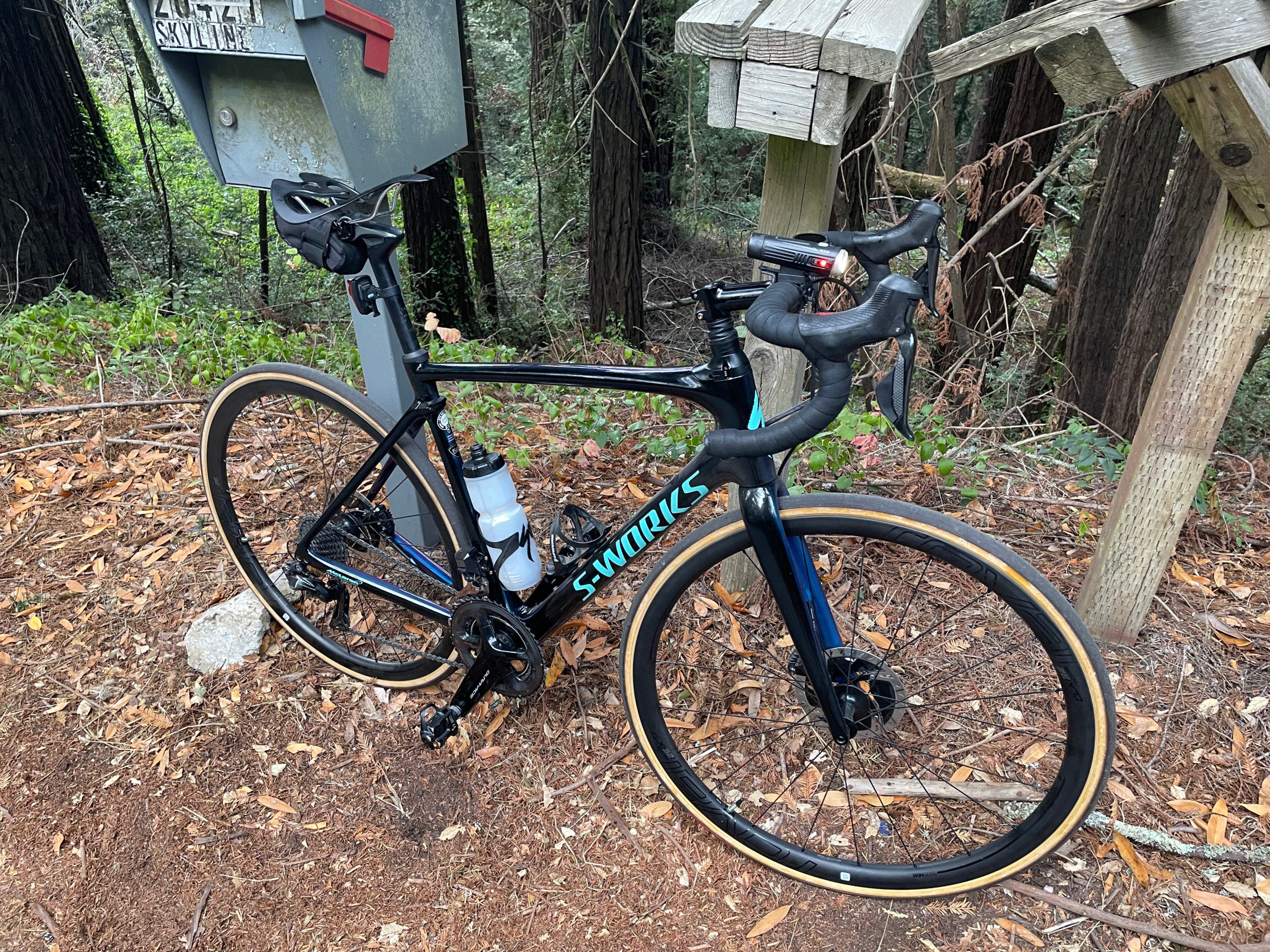
    Specialized S-works 2019 Roubaix (2021) an endurance bike that smooths out the road making it easy to be confident on less than ideal road surfaces with a responsiveness that approaches the Cervelo R-series. A huge improvement from the 2013 version of the Roubaix. Fitted with an Infinity Seat (weird looking but the most comfortable seat I have used), 2 water bottle cages, and a small seat bag which holds a pump, tubolito, bike tool, and 2 tire levers. I have a charger for DI2 which is powered via a micro USB cable gets used every month or so. Otherwise it sits in the garage.

    Cervelo R3* (2013/2015). Replaced with identical bike when my first was stolen. Comfortable enough for an endurance ride, responsive like a race bike, great for climbing. Wore out drive train which has now been mostly replaced… still looking for Rotor chain rings. Now primarily lives on a Kickr for indoor “rides” and is my “spare bike” and if my Roubaix is out of action or an out of town friend wants to go for a ride.

    Felix BC21R Bike Headlamp and Cygolite Hotshot Pro 150 (2019) The BC21R uses a removable 18650 rechargeable battery. I don’t love the Felix but it’s getting the job done and the swappable battery is very handy.

    Power Tap P1 Pedals (2015) because I like objective measures. No longer made. The Garmin Vector pedals use standard Keto cleats, and are lighter.

    Bicycling Shoes (2013) with cleats for PowerTap peddles. No idea the brand.. they were the cheapest shoes I found at a local bike shop. They are near the end of their life, but I haven’t found a shoe that is as well ventilated so I continue to squeeze a few more miles out of them by regluing the seams.

    De Soto Mobius Tri Shorts (2018/2021) Can be used forcycling, running, and swimming. They used to be comfortable for all the activities I engage in when the temperature is above freezing. For many year reduced issues with chafing, dries fairly quickly, and are reasonably comfortable when wet. They have side pockets large enough to hold some nutrition and my phone so I don’t need to use a special cycling jersey. I get around 1000 hours of use from each pair before the elastic no longer provides any compression. Never had a pair develop holes. For many years I loved using these because I never need to think about what to wear for vigorous physical activities…. I just grab a pair of tri-shorts. Recently I have been chafing on my male parts when running in hot conditions so now not used for running.

    Xenith Delta Shirt (2021/2022) is the most comfortable shirt I have worn when sweating heavily. The shirt maintains air permeability and doesn’t stick when wet. The shirt dries at the perfect rate: faster than wool or cotton, but slower than classic “fast dry” shirts, and feels cool against the skin. I have also found that is it the most odor resistant synthetic shirt I have tried, though not as good as wool. Only UPF 30. Use a ArcTeryx Cormac on longer rides.

    Black Diamond Alpine Start (2021) is a 6oz hoodless ultralight soft-shell which is very air permeable (30-60 CFM depend on who did the measurement… feels like 45cfm to me) and extremely water resistant thanks to the Schoeller NanoSphere treatment. Very comfortable in high wind <60F doing normal activities, bicycling at tempo pace (~220watts / ~18mph) when it’s <55F or doing a zone 2 HR runs when it’s <50F. In a light rain find it easier to manage moisture than a Shakedry shell because the higher air permeability helps me dump heat (reducing the amount I sweat) while resisting the rain. Normally I like a hood, but the lack of a hood is useful when cycling and running with a hat. Windshirts are great!

    Pearl Izumi P.R.O. Barrier WxB Cycling Gloves (2021) Keep hands comfortable on rides when it is cool and maybe wet. Cheap thanks to a clearance sale at sierra.com. Likely better gloves but they are getting the job done.

    Giro Air Attack Shield Helmet (2013/2016) provides protection, good ventilation while having a streamlined aerodynamic profile. Has snap on optical shield. On my second Air Attack helmet due to a crash which broke the helmet but protected my head. If you ride a bicycle, wear a helmet!! I have been able to walk away from at least two accidents thanks to the protection of a helmet. Helmets don’t lead to more injuries due to a false sense of security. These days there are helmets which are more aerodynamic than mine, and also cheaper while providing equivalent protection.

    Wahoo Fitness Kickr (2013) is a trainer for when it’s not convenient to hit the road. Integrated power meter and variable resistance which can be controlled via ANT+ or BlueTooth. Very useful if doing structured training based on power.

    o2Trainer – not shown (2022) Working on improving my breathing. Not used enough to have an opinion.

    “Variety” Clothing

    While I normally like to wear my “uniform”, but I sometimes want to wear something a bit different. I know my wife likes variety in my clothing. I sometimes call the following my “Jackie clothing”. These clothing can be rolled over their hangers and be stored in a $4 Ikea Frakta Duffel (2022) along with my beach items and extra clothing items.
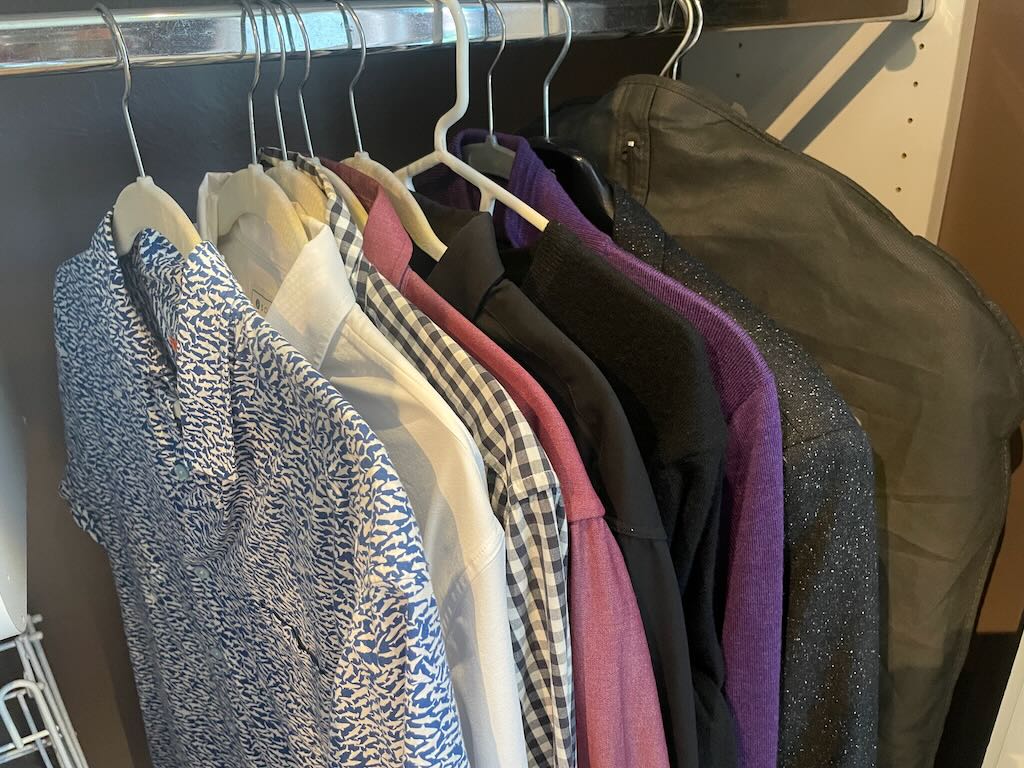
    Toni Richards Hawaiian Shirt (2019) Everyone needs at least one shirt for “Hawaiian shirt day” though some might argue that white and blue with sharks rather than flowers isn’t very Hawaiian. I find the cotton lawn fabric used by Toni Richards to be one of the most comfortable materials when it’s hot and humid. Alas, UPF is quite low.

    White Cotton Button-up Shirt* (2012) Was my default when I want to wear something more formal than a tee-shirt. Appropriate in almost any setting. Shirts which have more sun protection and dry more quickly have replaced it.

    Muji Black/Grey/White Checked Button Up Shirt* (2013) for something that is casual but a bit more dressed up than my tee-shirt or hoody. Gift from Jackie.

    Outlier AMB Merino Wool Button Up Shirt (2019) Very comfortable. It doesn’t wrinkle and if I don’t spill food on it can be worn many days without washing. Good air permeability, surprisingly comfortable in warmer conditions.

    Wool and Prince 210wt Burgundy Oxford Shirt* (2020) Slim fit, classic oxford cloth look while being 100% wool. Christmas present.

    Banana Republic Purple Merino Wool Sweater (2013) for cool days or when some color is called for. Purple is the color of royalty… so it can function as a Christmas or Easter sweater. Gift from Jackie.

    Grey Cashmere V-neck Sweater* (2019) for fall and winter evenings when I need more warmth than just a shirt and my hoody is too casual. Love cashmere but durability is low, it pills very quickly.

    Boss Blazer* (2014) for dressy events in the fall and winter that don’t require a formal suit. Have found that it doesn’t wrinkle when packed carefully in my backpack while traveling between locations. Christmas present.

    Boss Wool Suit (2012) slim/european cut in super 140 wool. Fits me perfectly though not bespoken. First suit that I wear rather than the suit wearing me. Light enough that it’s usable in the summer. I use it for weddings, funerals, and special nights out on the town. I won’t naturally choose to wear a suit, but sometimes it’s appropriate.

    Alpaca Blend Socks* – not shown (2021) are soft, warm, and cushioning with non slip “dots” on the bottom.

    Softstar Zen Moccasin (2021) Comfortable slippers for cold days.

    Luna Oso Flaco Sandals (2022) I can walk 25 miles / day for a week on hard surfaces and my feet are still feel good. Has decent ground feel and pack very compactly. Good traction on trails. The wings are must more convenient that the “traditional” lacing. They irritate the side of my foot when I run without socks (fine for walking). When they are wet my feet slide a bit which makes me consider trying 5fingers again for back country trekking and trail running. Bedrock Sandals are very similar.

    Keen Clearwater CNX* (2014/2018) are the lightest sandals Keen makes. The toe cap has been effective at protecting my toes. When worn with gray socks they can “pass” for shoes most of the time. Keens ground feel is a bit “dead”.

    “Extra” clothing stashed for when my existing clothing wears out. Most of the extra clothing was purchased on sale, lightly used, or I had been wearing and decided to drop the number of items I have in a weekly rotation. I currently have 1 pairs of outlier slim dungarees (2019), 2 outlier new way shorts (2014-8), 2 western rise evolution pants (2022), 3 icebreaker tee shirts (2018-2021), 1 arcteryx cormac shirts (2023), 3 pairs of briefs (2019-2021), 6 pairs of darn tough socks (2015-2019), 2 pairs xoskin socks (2022), GoreWear R7 trail running jacket (2020/2022), 1 Montebell Peak Dry Jacket (2023), Macpac Nitro hoodie (2022), 2 delta tee-shirts (2022). These items will be pulled out when my current clothing wears out. It’s useful to have have an unused items purchased at the same time as one which is in “heavy rotation” to see how much wear and tear accumulates over time.

    Beach / Water Clothing and Gear

    When we spend extended time near a tropical beach these get pulled out.
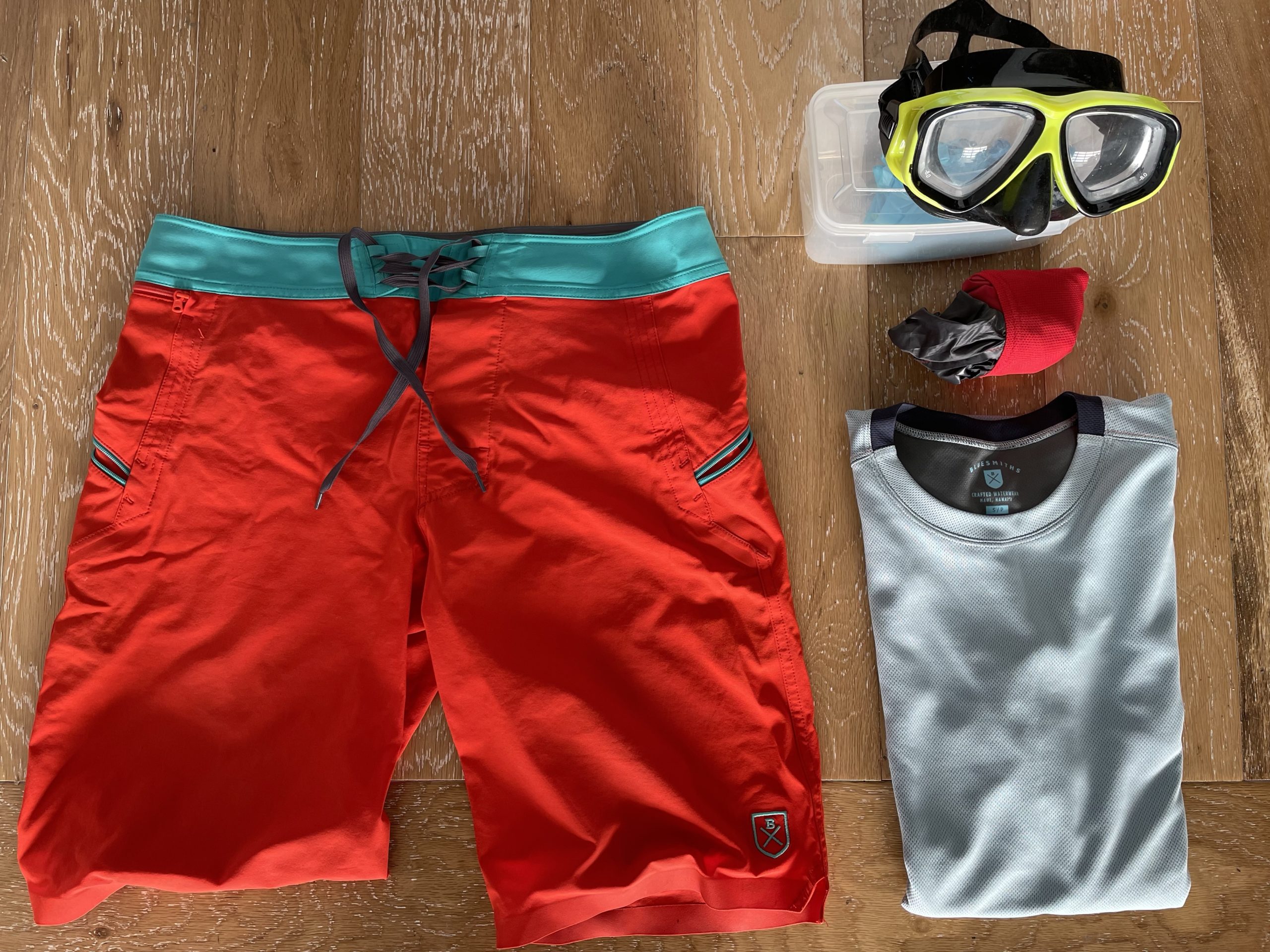
    Bluesmith Spartan Board Shorts* (2016) For days that I am living in swimming suit, going in an out of the water. These shorts dry very quickly. Could use my other shorts if I was trying to minimize more.

    Patagonia R0 Longsleeve Shirt* (2022) UPF 50 shirt for water activities. Tight fitting, dries quickly. Jackie approved. Picture has my retired Bluesmith shirt rather than white R0.

    Matador Pocket Blanket* (2019) to sit on when at the beach.

    Matador Droplet Wet Bag* (2019) which holds items on the way to the beach, and wet items on the way home.

    Yeesam Prescription Snorkeling Mask (2019) which lets me actually see underwater life when snorkeling rather than just blurs and flashes of color!

    Akona 2mm Neoprene Socks – not shown (2019) Prevent my toes from getting ripped up when using flippers. Sometimes used with sandals if I am constantly going in and out of water or with my cycling shoes if doing an extended ride is cold rain.

    TYR Corrective Optical Performance Goggles not shown (2012) so that I can actually see when I am swimming in pools.

    Sentimental Items

    There are a several items I have kept as a specific way to honor people I love or past experiences.
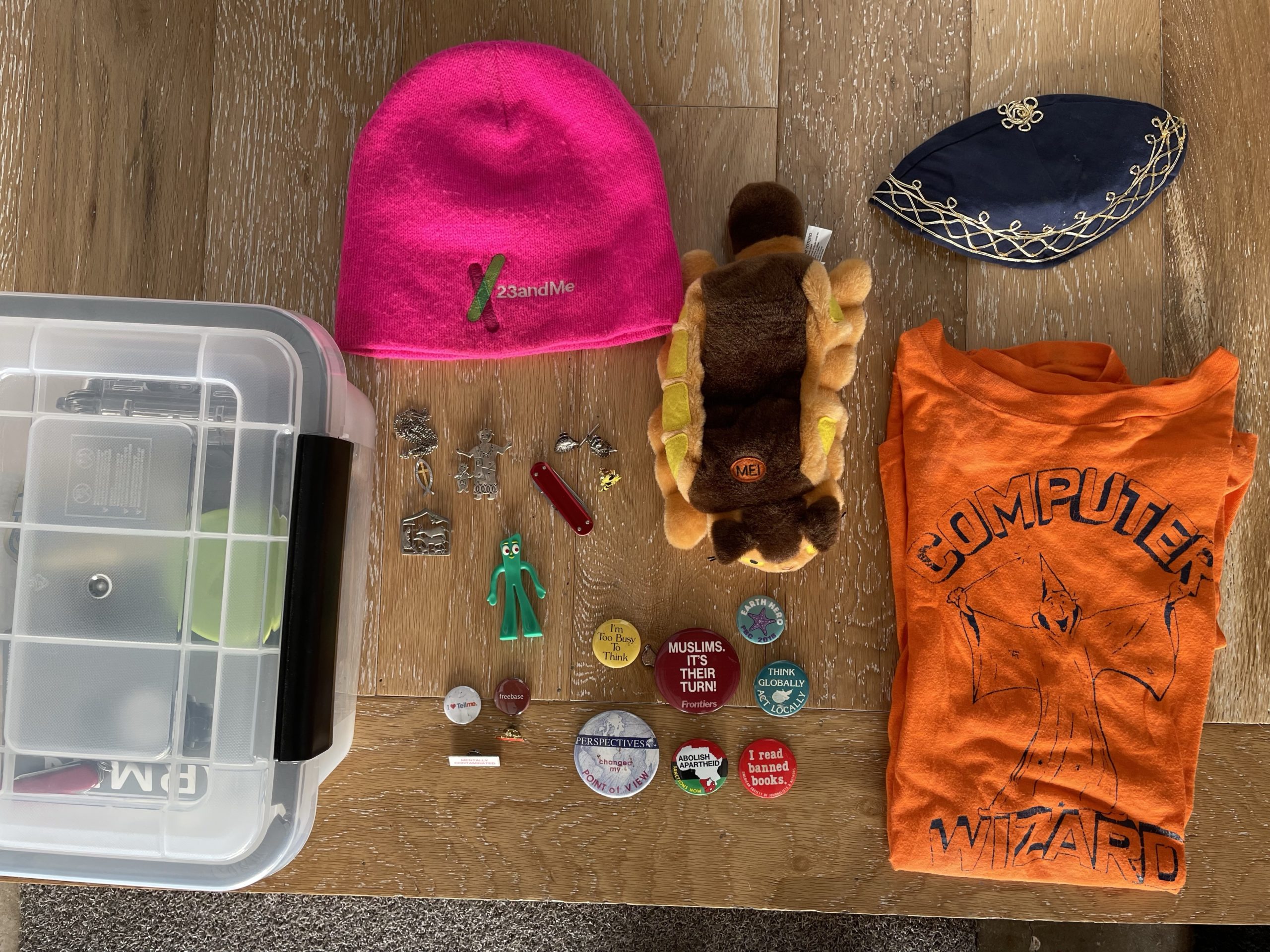
    Box which I store these things, my spare glasses, some old documents, etc.

    Various buttons collected over the years related to projects or movements that were important to me.

    Libby’s pins (<2000) of a nativity scene, a mother and child. Originally worn by Libby on special occasions, they became daily decorations on the hats she wore during chemotherapy. They remind me of Libby’s courage and the two things most important to Libby, family and Jesus.

    Gumby (2011) which was given as a reminder that when life is difficult, we need to be flexible.

    Dad’s (<1980) tie tacks and Alox Swiss Army Knife which remind me of his love of the outdoors and his care for his students.

    Knit Cap with 23andme logo (2016)

    CatBus Plushy (2018) given to me by Jackie. It reminds me of the gentle film My Neighbor Totoro. I wanted a real CatBus, but no one can find one for me 🙂

    Computer Wizard’s Tee Shirt (1977) from high school group club… still fits. Not shown: 23andme Tee-Shirt (2016) Hashicorp Cycling Jersey (2021)

    Grandpa’s Yamaka (<1980)

    Stored – Possibly Retire

    Tom Bihn Passport Pouch (2022) Small pouch which is large enough to hold my passport, phone and everything that might be in my pockets when passing through security checkpoints. In high crime cities I wear it under my shirt. Haven’t needed it.

    Entchin Fanny Pack (2020) Inexpensive fanny pack which is a good size for half day activities. Can hold a headlamp, mini first-aid/emergency kit, water bottle, a protein bar, and small volume jacket. Use rather than daypack so my back is ventilated. The bucket has broken three times and is being held together by tape. Looked at a bunch of much more expensive fanny packs, but not work as well. Closest was the REI Trail 5 but when I put my water bottle in a holster it gets in the way of my arms as they swing.

    Gossamer Gear Gorilla (2012) An older version of the Gorilla which I used when doing multi-night backcountry trips or urban travel when I am carrying more weight / volume than appropriate for the Vagabond. Its weights just 28oz, comfortable carries up to 25lbs for tens of miles in a day, has survived thousands of miles, and works as a carry-on bag. My size L is actually 23″ long, but has been able to fit in airline sizers and overhead luggage bottom in first if not overpacked and placed at an angle. Sidenote: The first generations of the Gorilla carried pretty well, the current generation connects the frame directly into the hip belt which has been stiffened compared to the first generation improving it’s carry characteristics. Likely being replaced by Hanchor Tufa which is more carry-on friendly and as comfortable to carry up to 22lb which is the most I typically have.

    Carots Shoes* (2017) are formal looking zero drop shoes. These are the only minimalist shoes I have found that looks like traditional dress shoes (heels and and tapered toe). They are sufficiently comfortable for an evening, but I won’t want to walk or stand for an extended period of time. My Gobi II are formal enough for any events I am likely to attend in the future.

    REI Swiftline Running Shorts Shorts* (2022) are very light shorts which dry quickly and pack down into a tiny space. Useful for running, working out in the gym, and as sleep wear. They can be used for swimming in a pinch. Over the years I have purchased these sorts of minimalist shorts, used them a bit, ultimately sold them because they weren’t being used, only to re-acquire a pair. I now know to store these away until the next time I think they would be a good idea.

    Patagonia Capilene Thermal Weight Hoody (2009) for cool/cold weather outdoor activities. Without wind protection the grid weave lets air flow through speeding the release of heat. With a shell it provides some insulation. Comfort down to 30F when running without a shell, below that with a shell. When walking around town keeps me comfortable down to 45F when combined with a wind shirt with hoods up. I am reasonably comfortable engage in high energy activities when it’s 65F by fully opening the zipper and pushing the sleeves up to my elbows. Dries amazingly quickly and feels more comfortable than any other shirt I have used when it’s wet in cool conditions. Mine was actually called Capilene 4 because it pre-dates the renaming to “thermal weight”. Likely retire because light base + macpac alpha direct hoody is more versatile and has better performance.

    Castelli Light Arm Sleeves* (2021) and Leg Sleeves* (2022) UPF 50 sun protection I combined with short sleeve shirt and shorts to avoid hassle of sunscreen. When in direct sunlight, limbs actually feel a bit cooler than when uncovered. Often using the Arcteryx Cormac hoody so don’t need arm sleeves.

    CoolNet UV Buff* (2022) Protects my neck and ears from sun and also functions as a headband to keep sweat out of my eyes. A set of magnets made to “pin” race bib to a shirt keeps the buff from riding up and exposing my neck. Often using the Arcteryx Cormac hoody so don’t need any more.

    Ultrafino Santa Fe Hat* – not shown (2021) is “Panama” straw hat. Alas, this hat’s weave is so tight that the ventilation is minimal, and the brim isn’t large enough to consistently shade my face and neck. The function of this hat isn’t as high as I expected, but I have held on to it because it’s a great looking hat that I will sometimes wear to a party when the UV index isn’t too high (like early evening).

    Rudy Project Ketyum Frames with Transitions DriveWear manufactured by Sports Optical* (2021) provides excellent protection for my eyes while cycling and any other daytime activity. Ketyum is one of the few wrap around frames that can handle a prescription as strong as mine. The lens are thick but not too heavy. Transition lens work well during daylight but are a bit too strong at dusk.

    HiFiMan RE800 Silver IEM (2022) Light weight, good quality sound which doesn’t completely cut me off from my environment. Used when I want to listen to music without disturbing family. Great deal at $90. Not really using it much.

    Radsome EarStudio ES100 (2018) bluetooth/DAC/headphone amplifier allows me to use wired headphones with devices missing a headphone jack. Can also function as a USB DAC. The ES100 is tiny, with decent sound quality (though Chord Mojo is better) and can even drive Sennheiser HD800 to reasonable sound levels. Not in situations that require a BlueTooth receiver or improved sound quality over the earphone jack.

    AWS AC-650 Digital Pocket Scale (2012) a small scale which makes it easy to weight food on the go.

    Kindle Oasis (2019) Lets me carry the majority of my library and every book can be displayed with large print for my aging eyes. Love being able to quickly search for notes / highlighted passages. I miss physical books and I know knowledge retention is better when reading paper books, but the convenience of the ebooks outweighs this for me. The Oasis ergonomics allows reading with a single hand and I like the warm backlight in the evening. I have been tempted by e-paper Android tablet such as those made by Boox which are a more versatile devices. If I lost the Oasis I would likely use my phone and laptop to access my Kindle “library”.

    Apple iPad Air 4 + Smart Keyboard Folio + Magic Keyboard for iPad (2021) Purchased as a second monitor (via Sidecar) for MacBook for when I am working away from home. I have found the iPad also works well for consuming media. The Folio keyboard is compact making it compact for onebag travel, but the keyboard feel is mediocre and not stable enough to use on the lap. I tried to do most of my “personal” computing on the iPad with a Magic Keyboard to see if a iPad could replace a laptop: it was a failure. There is too much friction integrating information from several windows and often the app experience on the iPad fell short when compared to the experience on a real laptop or Chromebook. This is my third iPad since they were first introduced. While each was useful for a particular task, I have yet to find it a compelling device for general use. A portable UCB-C powered screen is more effective for me as a second screen. I have mostly abandoned using the iPad. Jackie tried and gave up on “live on it”. Lives in garage for when exercising using Kickr and is taken to meetings when I want to take notes and a laptop would be too intrusive.

    Retired

    Montbell Wickron Dry Touch Short Sleeve Shirt (2021) for when I need to be more dressed when it’s is hot. The seersucker fabric is more comfortable than many other materials when it’s hot and humid. It resists accumulating odor better than many synthetics shirts I have used. A gift from my wife. Alas, UPF 20 which isn’t enough protection for my skin.

    Solbari Weekend Shirt (2022) White button up which is UPF50+, resistants odor for a few of days when moderately active, dries quickly, and under a sport jacket can be mistaken for a more formal dress shirt. In cooler weather blocks a bit of wind, surprisingly comfortable in hot weather. Downside is that it seems to be a dirt magnet and has collected stains and has started to slightly grey after just 34 days wearing it while hand washing every other day or so, and machine washing weekly. Still gray after several runs through washing machine using a non-chlorine bleach suggested by Solbari customer care.

    Peach Button Up Shirt (2014) for a change from a white shirt when we are going out for the evening. Birthday present. No really used.

    Tadeevo Derby (2023) Just 13oz, flexible, zero drop shoes. Purchased to be a dress shoe that packs smaller than my Gobi. Ok, but the Gobi’s are better looking and more comfortable on my feet. What looked like a dark shadow around the toe on the website is a different material than the leather uppers which gives the shoe a casual look. The run a bit large, make sure you read their fitting instructions.

    Nike Dri-Fit Visor (2012) keep sweat and sun out of my eyes while maximizing air circulation for my head. Mostly used when I am running. Combined with a hoody for sun protection. Stains from years of use couldn’t be removed. Switched a foam visor which is more compact, can be used in the rain without absorbing water, and it’s stained.

    Mountain Hardware Grub Gloves (2015/2020) medium weight PowerStretch gloves with a quilted mitten cover which folds away into the back of the glove making it comfortable to wear in a wide variety of conditions. My second pair worn out and won’t be replaced because it has been discontinued 🙁

    Flowfold Minimalist Wallet (2012) which was a perfect minimalist wallet for me, except doesn’t hold coins which has been needed in the last couple of years.

    NiteIze RunOff Waterproof Pocket (2023) is extremely useful when spending time on a beach when there was no one to watch my stuff while swimming. Large enough to hold my wallet, cellphone, keys, and passport, but not so larger than it interfered with swimming. I tucked it under my suit’s waistband on my back. When transiting International flights I would use it as a tiny sling across my chest to hold travel documents, my wallet, and phone. I have used it under clothing as a security wallet when in high crime areas. After around 200 zip/unzip cycles the it stopped sealing and was retired. A Loksac elements proof bag is smaller, cheaper, can operate phone but less durable and has no “strap” option.

    Matador Freerain24 (2017/2020) The waterproof zipper on a 1.0 model wore out after 2 years of daily running commute with my laptop and other supplies and so was replaced with the second version. Keeps contents dry in the worst rain. Weights only 5.5oz, and stuffs into a fist size package. Carries reasonably well but not as well as packable Vagabond. Shape tapers which is good for running but makes it a bit challenging to load properly for more “urban” uses. Given to a friend who needed a water resistant daypack.

    Gossamer Gear Loris (2023) 25l daypack. Top loading with a covering flap and a zipper to make it easier to reach into the pack that was gifted to me. Has a dual purpose foam back panel / sitpad. Internal unpadded sleeve is large enough to hold a MacBook Pro 14″ and is suspended around 1″ from the bottle of the pack. I found the wide but thin shoulder straps quite comfortable which has pockets on them for small items that are regularly needed. I found the Vagabond much more convenient to access. One surprise was that I found this pack as comfortable as a GoRuck GR1 when carrying 40-50lb with the caveat that the GR1 shoulder straps were not “broken in”. Gifted to one our of children who needed a new daypack.

    Linen Towel (2020) Lighter weight, dries faster, and less likely to get smelly than a traditional cotton terrycloth towel, but isn’t as soft. Lost 🙁

    Violife slim sonic toothbrush (1999). Had trouble finding replacement heads and wanted a more powerful motor for better cleaning. For now, use a small manual toothbrush or short trips and carry the family Oral-B toothbrush on longer trips.

    Panasonic LX100 II Camera (2023) Purchased to get back the control which I couldn’t find with photo apps on my phone and I don’t have to fight with my phone’s “unlock” to take a picture, and to have an effective fill flash. Has a one generation back micro 4/3s sensor which works better in low light than 1″ sensors like the Sony RX100 or the even smaller sensors in phones. Reasonably compact weighting in at around 400grams. Viewfinder so it can be easily used in bright light. A decent quality small zoom lens. Analog controls which remind me of classic rangefinders. Used primarily for street and portrait photography, particularly in challenging light conditions often using a fill flash which cell phones still haven’t mastered. Notes about cameras / photography. In the past year didn’t significantly improve images I captured, so not worth the weight. If I want significantly better image quality I will need to go with a larger camera. I am tempted by an image quality of my friends Leica M10, but reluctant to spend that kind of money or carry a camera of that weight on a daily basis. Maybe I will trying a Fuji X100V if they become available.

    Do not lay up for yourselves treasures on earth, where moth and rust destroy and where thieves break in and steal, but lay up for yourselves treasures in heaven, where neither moth nor rust destroys and where thieves do not break in and steal. For where your treasure is, there your heart will be also

    Matthew 6:19-21
  • Eat the Frog

    Many people make New Year’s resolutions. Within a few weeks the good intent disappears in the face of the realities of daily life. For millennia our wise elders have told us that forming habits is the most effective way to bring about change.  the Bible, Aristotle, the Stoics, Augustine,  Thomas Aquinas and Ben Franklin. In the last century there have been numerous authors who have written about habits. A few are listed at the end of this post.

    A simple and very power habit is called Eat the Frog.  Some say the term was coined by Mark Twain, though there is no evidence of this.

    At the end of each day you decide what is the most important thing to accomplish the following day.  The task should be completable in less than 90 minutes… the amount of time most of us can keep focused.

    If the most important thing will take more than 90 minutes, identify the next step which can be accomplished in less than 90 minutes. For example, maybe the most important thing is to resolve some sort of financial issue. Experience suggests that this could take many hours. The next step might be to talk to a representative on the phone. The night before I would record the phone number and what hours the agency will receive calls so I can immediate take action the next morning.

    In the morning I start with some physical exercise which helps me wake up and then immediately do my Eat the Frog task. I do this before reading email or looking at any media. That way I don’t get distracted or let something else squeeze out what I determined to be most important.

    It also gets the day off to a great start. I know that the most important thing has been accomplished. Everything else is “gravy”.

    If you struggle with keeping consistent there are a couple of hacks that can really help.

    • Do this with someone else. Either another individual or with a group of people. Knowing someone else is doing this will increase motivation.
    • Harness loss aversion. Using a commitment contract which requires you to pay money to something you dislike if you fail to reach your goal.  Online tools like Beeminder and Stickk can help with this.

    Up-level the Nightly Plan

    Once you have the habit of deciding each evening what’s the most important thing to do the following day, you can chain several other practices to this. My cluster of activities has been influenced by Greg Mckeown’s 1-2-3 method

    • I looking at the calendar to see what activities are scheduled so I am not surprised for miss appointments.
    • I look at the predicted weather, and factor that how I plan for the following day. For example, if it is suppose to rain, maybe switch from using my bike to other transportation, taking an umbrella, and packing a lunch so I don’t have to go out for food.
    • I look at the due dates of any projects / tasks I am working on to be sure I know what will become urgent soon.
    • Decide what the most important thing is
    • Reflect on the day I just finished and record
      • Did I get done what I planned? If not, why?
      • What I accomplished that wasn’t planned
      • Anything I learned today
      • Something that I am grateful for today

    Additional Materials

    We are what we repeatedly do. Excellence, then, is not an act, but a habit

    Aristotle
  • Optimal Group Sizes

    The optimal size of a group is first determined by the function of the group. A group will need the requisite skills, abilities, experience, and manpower to accomplish its goal. In addition to function, there are cognitive and social underpinnings which influence the optimal size of a group. Studies suggest optimal group size tends to cluster around 5, 15, 50 and 150.

    Dunbar’s Number

    Robin Dunbar, an anthropologist and psychologist, proposed that 150 is maximum size of a group that can maintain stable social relationships, where each member knows every other member and how they relate to each other. For a group of this size to remain cohesive, as much as 42% of the group’s time would need to be devoted to maintaining relationships which is can only happen when the group is in close proximity and with strong survival pressures. See the Dunbar’s Number wikipedia article which provides additional background information and optimal social networks (the paper) which provides insight from modeling. 

    Dunbar also identified a sequence of sizes for cognitively efficient social groups: 5, 15, 50, 150, and 500. Each of these sizes represents different layers of social relationships, varying in the strength of these relationships.

    Other Theories

    The largest group size that can maintain effective coherence, deep trust and highly efficient communication is generally considered to be relatively small, typically under 10, though the exact number can vary depending on the context and the nature of the group’s interactions.  It has been suggested that online groups might be able to function effectively at higher numbers of participants. There are a variety of theories and research topics in psychology, sociology, and organizational studies that can help identify factors which determine the optimal size of a group:

    1. Small Group Theory / Dynamics (3-20 members): Research in small group dynamics typically finds that groups of around 3 to 8 members are most effective for tasks requiring close collaboration and communication. In such small groups, members can form strong interpersonal relationships and maintain a high level of mutual understanding.  When the goal is to foster deep connections and effective communication in a community setting the community can grow to around 20 people with smaller groups within the larger community can ensure everyone feels heard and supported.
    2. Communication Network Theory: As group size increases, the complexity of communication channels also increases exponentially, making efficient communication more challenging. Smaller groups allow for more direct and clear communication.
    3. Collective Intelligence Theory: This theory would support a group size that balances diversity of thought with the ability to make collective decisions effectively, which could align with a smaller to medium-sized group.
    4. Steiner’s Model of Group Effectiveness: This model would favor a group size that maximizes productivity (in terms of community support and cohesion) while minimizing losses due to potential group conflicts or inefficiencies.
    5. Social Loafing Theory & Ringelmann Effect: These theories suggest that in smaller groups, members are more likely to contribute actively and take responsibility, which is vital in a community.

    Teams at Work

    When it comes to teams taking on a technical task, Amazon has popularized the idea  of the Two-Pizza Teams, that is effective meetings and teams are small enough that 2 pizzas can feed the gathering.

    Highly functional start-ups can easily grow to 50-150 people and keep good alignment of collaboration across the company. After this alignment tends to pull apart as subgroups interests come into conflict. As a group grows it’s impossible for everyone to recognize, much less “know” each other. Individuals gravitate to only knowing members of their team.

    The most effective strategy when a company is more than 150 people is to identify people who can be interfaces for the other teams. The works best if you have a personal relationship with one or two people in each of the teams who you can build trust with, and who can represent this team to you. This often works best if the person is not the manager or director of that team. Having relationships with people in other teams naturally occurs when people join an organization which was smaller than 50 people, when the company was small enough to know everyone. As the company grows larger, these early team members typically know at least one person in every major group. People who join companies when they are larger, this has to be an intentional activity. Smart companies provide opportunities for people to interact with members of other teams personally, in a context free of work pressures.

    Often a mission is too large to be taken on by a small team. A common solution to this is build a hierarchy of teams with middle managers with one or more directors or executives that leads the group. When (not if) projects fall behind expectations there is a temptation to add additional people. This always ends badly. See the classic book The Mythical Man Model for a description of this.

    The most extreme example I saw of how a large team can be hampered by size was a skunkworks project of around 8 researchers at Xerox PARC that built a product based on a series of tools that were in common use at PARC. At the same time a “clean sheet” product team was assembled to create a very similar product. The product team grew to 250 people and failed to deliver a useful product after two years of work. Eventually that team grew to 750, then downsizes and refocused. After five years they finally produced a product that was mostly competitive with the product the researchers had been selling to customers for the previous five years.

    Often the best solution for taking on larger missions is to have a network of autonomous teams which collaborate. This approach was eloquently discussed in Team of Teams by General Stanley McChrystal.

    Group Sizes at Church

    I have been part of church groups which ranged from a couple of people, to several thousand. It seems to me that

    Discipleship: Discipleship is often portrayed as a one-to-one meeting of a “master” and a “student”, where the master is passing on their experience. While this can work, I have observed that this sort of intentional life transfer works best in the context of a small group where people have both the opportunity to learn, and to share, help, serve, teach each other.

    Life/Community Groups: Truly sharing life with others takes time. People need to be able to share what’s happening with them on at least a weekly basis. This level of sharing can’t happen in the group is more than 15 people or so. More than that, and people don’t have enough opportunities to share.

    Medium Size Groups: Over the last two millennium, churches typically were 50-150 people. This is large enough for the full diversity of gifting to be present while;e small enough that everyone can recognize each other. In meetings of this size there aren’t opportunities for everyone to share with the entire group each week, but it’s small enough that people will have repeated contact with each other to the point they will have some understand of others needs and ways they they could be of service.

    Large Size Groups: In the USA there has been a trend toward mega-churches which are able to efficiently make use of resources. For example excellent teaching, run programs which require a lot of people, build spaces to serve the community, etc. People who only attend these large groups will not find the sort of community that church was designed by God to provide. Many of these churches encourage people to join life groups… but I think this is sub-optimal. First, people might not be ready to join a community group. Second, community groups are too small a context for people to learn about and use their gifting. Medium size groups which are more open are very helpful.

    Other Groups

    Over the years Jackie and I have experimented with the optimal size of a dinner group which has the goal of people getting to know each other and share life. We found that 6 seemed to be optimal in providing diversity while providing opportunities for each person to contributed. Conversations naturally flow with effective turn taking. When the group grows to 8-12 we have seen that a skilled facilitator are able maintain a good environment, but without a facilitator the quieter people often don’t have an opportunity to contribute, and side conversations will start.

    Further Investigate?

    The following are papers and books which examine issues related to how the size of groups impacts the groups function.

    1. What is the Ideal Team Size to Maximize Productivity
    2. how to assemble a team with dunbar’s numbers
    3. dunbar’s number in social architecture
    4. Effective teams for the military is a life or death matter. The core of the military are fire-team and squad. A discussion of how function has impacted the size of a squad.
    5. The Magical Number Seven, Plus or Minus Two: Some Limits on Our Capacity for Processing Information by George A. Miller: While not about group size per se, this seminal paper on cognitive processing limits indirectly informs theories about optimal group sizes, especially in contexts requiring intensive communication and coordination.
    6. Group size and the trust, cohesion, and commitment of group members Shane Drew Soboroff. Dissertations that examines how group size affects trust, cohesion, and commitment in group members.
    7. Why individuals in larger teams perform worse by Jennifer Mueller: examines who as group size increases, individual’s perception of support shrinks.
    8. Communication and Group Decision Making Randy Hirokawa & Marshall Poole. This book provides insights into how group size affects communication and decision-making processes within small groups.
    9. Research of George Homans. Best know for his paper “The Human Group“. This is a foundational text in understanding group dynamics.
    10. Group Dynamics by Donelson R. Forsyth: This comprehensive textbook. Several sections, such as group coherences, collective behavior, and communication talk about how size has an impact.
    11. The Five Dysfunctions of a Team by Patrick Lencioni: Addresses team dynamics, indirectly touching upon group size issues.
    12. Designing Team-Based Organizations by Susan Albers Mohrman, et al.: Discusses organizational design and team size in the context of knowledge work.
    13. Group Creativity: Innovation Through Collaboration by Paul B. Paulus and Bernard A. Nijstad: Explores how group size affects creativity and innovation.
    14. A Meta-Analysis of Group Size Effects in Electronic Brainstorming: More Heads are Better than One – Alan R. Dennis & Michael L. Williams
    15. The Difference: How the Power of Diversity Creates Better Groups, Firms, Schools, and Societies by Scott E. Page: Addresses how diversity in groups, influenced by size, affects performance.
    16. The Wisdom of Crowds by James Surowiecki: This book discusses how large groups can be remarkably intelligent and are often smarter than the smartest people in them
    17. Team of Teams by General Stanley McChrystal: Examines of in the face of a chaotic world, small teams which are given significant autonomy with the ability to partner with other teams are significantly more effective that large, top down organizations.
  • Recommended Churches

    The following is my highly opinionated list of churches that I would recommend (or than are on my list to check out at some point). I have a separate post above how to find the right church for you.

    Silicon Valley

    • Abundant Life Christian Fellowship~ In the 1990s was an amazing dynamic, multi-cultural church that was located in East Palo Alto bring together people from many cultures, backgrounds, and economic situations. They were rocked by several scandals (resulting in leaders departing). They engaged a number of experienced pastors to get their footing back but have not returned to their “glory days”.
    • Menlo – Multi-site mega presbyterian. Lots of resources and programs which can be helpful such as Divorce recovery. They tend to use staff rather than empowering members which can hurt community. Side by Side on the Menlo Campus is a good multi-generational group which encourages everyone to use their gifting.
    • New Beginnings Community Church – A dynamic, multi-cultural church. Seems to have taken the mantle that Abundant Life used to carry.
    • New Community Church – Menlo’s first experiment with multi-campus was called Cafe. Originally formed to provide space in the main sanctuary, it became a place that people attended who had trouble connecting at the main Menlo service.  Cafe was closed, but many of the people who made it a welcoming community are now at NCC, including the original pastor for Cafe.
    • Peninsula Bible ChurchPBC Cupertino – Classic Bible churches. Expository teaching, small group inductive bible studies.  Has a very good recovery ministry and a good young adults fellowship.
    • Peninsula Covenant – A modern parish church. Takes serving Redwood City seriously.  Deep commitment to serve and be involved in the locale.
    • Spark – Spark is a safe place for people who feel the need to deconstruct their faith. The church was formed by some gifted people who were burned out in local mega churches are were looking to build a safe place for them and others to recover. Encourages people to ask hard questions and is comfortable with no easy answers. Deep appreciation of the Old Testament and has a great relationship with a local Jewish congregation. One down side is that due to people recovering from past wounds people aren’t always good at engaging with new people. You will need to work to get connected.

    Churches I have had a bit of interaction with that seemed good: Vive Mountain View, West Hills Community Church, Westgate Church, Bridges Church, Los Gatos Christian Church, Calvary Church

    San Francisco

    • Reality SF – Popular with genX,Y,Z. Excellent teaching, good community life.
    • cornerstone sf – multi-generational, multi-ethic missional church.
    • Epic SF – Have heard it’s a good church but no personal experience.
    • Experience Church – Have friend who highly recommends it
    • We Are Church – Micro church movement started by Francis Chan focused on under served neighborhoods.

    Parachurch in Bay Area

    • Western Seminary – has an extension programs in this area.
    • Wellspring – offers retreats and seminars on topics related to spiritual formation.
    • Bible Study Fellowship – Often in-depth studies of the Bible. Hosted by several local churches.
    • Mercy Center – Spiritual formation from a catholic perspective. You don’t need to be catholic. They have trained many of the Protestant spiritual directors in the Bay Area.
    • Transform the Bay – Connects areas leaders to see the bay areas transformed by Jesus.
    • Volunteer Info Center – has links to most of the organizations which operate in the bay area.

    Portland, OR

    • Bridgetown: Contemplative meets the charismatic streams with strong community groups. An amazing church for many who are looking for a framework for a life following Jesus. Downside is that if you don’t fit into their framework you are going to feel like you are on the outside. You are “welcomed”, but not really enfolded into the community.
    • The Well Church: Strong Missions program. Very welcoming.
    • Imago Dei Community: Deeply integrate social justice with faith
    • Cedarmill Bible Church: Classic Bible church.
    • Sonrise: Baptist church which has a long history of sacrificial giving and supporting church planting.

    Taipei, TW

    English speaking congregations.

    Other Locations

    Church I have spent time with or churches strongly recommended by good friends who I trust

    • Dwell Community Church Columbus, OH. The church that I came to faith at. Very strong teaching the scripture, deep community, and encourages all to grow and serve. Downside is some parts of the church can be overly controlling.
    • Vineyard Columbus Columbus, OH. The largest Vineyard church? Strong biblical teaching combined with leaving room for the Spirit to work and lead. Dwell and Vineyard Columbus have common roots / influences, but Vineyard leaves more room for the Spirit to work.
    • From people at Bridgetown
      • Oregon – Saint’s Hill (Newberg), Riverbend (Bend), 26 West (Hillsboro)
      • Washington – Van City (Vancouver), Rivers Edge (Spokane)
      • CaliforniaReality San Francisco, Park Hill Church (San Diego), Garden Church (Long Beach), Vintage Church LA, Genesis (Costa Mesa)
      • MassachusettsThe Table (Boston)
      • North CarolinaEmmaus (Raleigh)
      • New York – Oaks Church Brooklyn, Church of the City (Manhattan), New Life Fellowship (Queens)
      • U.K.KXC (Kings Cross Church, London)
      • Australia – Red Church Melbourne
    • Santa Rosa Christian Church Santa Rosa, CA. Classic Bible church which seems to have avoided falling into a judgement / overly religious.
    • Northshore Church Kirkland, OR. Big church that is welcoming with solid preaching.
    • The Austin Stone Community Church Austin, TX. Very strong community groups and support of missions.
    • Upperroom Church Dallas, TX
    • Journey Church  in Bend. Focused on gracious engagement and leading with love while holding to a conservative biblical theology.
    • Redeemer in NYC: Started by Tim Keller. Excellent teaching, strong engagement with culture.
  • How to Find the “Right” Church for You

    There are numerous reasons why you might be looking for a church. You could be being a journey to explore the Christian faith. You might have recently moved, or maybe you are dissatisfied with the church you previously attended. Whatever the reason you are looking for a church, I would encourage to devote yourself to the search and then commit to the best church you find. God’s wants you to be involved in a local church: to build a community of love where you can be cared for, and where you can be serving others.

    Finding a new church can be very challenging. There are no perfect church so there will always be trade-offs. If you feel completely lost and don’t have anyone to help you, drop me mail and I will reach out to my personal network to try and help.

    In older times people didn’t choose a church. Geography determined what church you attended. The parish church was responsible for the spiritual needs of an area. The good thing about this was that you saw the people from your church everyday and could do “Life together”. The bad thing  was when you didn’t get along / agree with the church you didn’t have an alternative. The lack of choice could be good because growth often comes through conflict.

    Today, most people have the freedom to choose what church they will attend. It’s easy to approach selecting a church like a consumer, with a list of attributes that are desires such as worship style, a particular set of doctrines, a particular governance, and/or a specific program.

    I would encourage people to think  like an investor. Look for the place that God is calling you to serve. I Cor 12 and 14 talk about how we each have something to offer. Our lives, the church, and the world we live in is poorer when everyone doesn’t share what God has given them.

    Discovering Churches

    The first step in to find your church is to discover what are possible churches. In many locations there are more churches to consider than you would have time to explore. This means you need to find a way to narrow down the choices. In my experience, typical review sites like yelp, google, etc are not useful at all. There are several approaches that will improve the odds that you will find a church that is good for you.

    Personal Referals

    I have found a good starting point is asking people you know in the area for a recommendation. The person you ask should either know you well, or know the sort of church which has been a positive influence in your life. 

    If I don’t know someone in the area I am looking for a church, I will ask my trusted friends if there is anyone they know in the location I am looking in who could suggest a good church.

    My list of recommended churches.

    Known Associates, Denominations, Programs

    Typically churches which are part of an associate or denomination have agreed to a common set of doctrines and practices. If you have appreciated a church that is part of one of these orginizations,  you odds go up in finding a like minding program.

    • Denominations which have strong cultures will produce churches that share many characteristics.
    • Church networks like the salt company
    • Church associations which churches join will typically indicates some of the core values of the church.
    • National or International programs which churches might host / sponsor / participate in that indicate something about a churches values.
    • Parachurch organizations such as IVCF often produce a curated list of churches that they recommend to their members.

    Identify What’s Right for Your Now

    There are plenty of good reasons to change the church we attend. It could be that we have moved or have constrains which make our old church unworkable. It could be tha as you have grown and changes the church isn’t able to support you, or that your  unique gifting might be most benefital to a different church. 

    Take some time to consider what you are looking for in a church. Don’t default to whatever is familur or comfortable. The “right” church for each of us will likely change as we growth and experiece different seasons of life. For example, some churches have an immersive community which is great for a college student or young adult, but is unsustainable for working parents of small children.

    Churches, like people typically have strengths and weaknesses. If your strength and weaknesses are the same as the church you previously attended,  it might be benefical to be at a church were your strengths help fill their weak spots, and where their strengths can help you strengthen where you are weak.

    One word of caution. You might be attending a church that you are disatisfied with. It may be that God is calling you somewhere new… but please don’t take changing churches lightly. Be sure you aren’t running away from something God wants you to work through. If you are changing churches every year or so, the problem is likely you, not the church.

    Preview Churches

    Odds are there are several churches which pop up as “possible” churches for you to attend. One approach is to just start attending, and see where that takes you. This is perfectly reasonable approach. There is a lot you can learm when you attend a church that you can’t pick up on from written material or online resources.

    Churches “About Us”

    Most churches will have an “About Us” section on their webpage. This will include information about their leadership, beliefs, and whatever else the church wants people to know. Churches should be reasonably trasparent about money, so I would like to see something about what they are doing with the money they collect such as a summary of their budget.

    For me, this information will typically not draw me to a church, but might throw a “red flag”, issues that are concerning which I would want to investigate in person.

    Church Sermons

    Most churches put their sermons online. Sidenote: some of my favorite sermons / podcasts. I find listening to how the church teaches the parable of prodigal gives me more insight into a church than reading it’s statement of faith or “principles”. Here is my rating system:

    1. Only talks about the prodigal son that leaves home for a sinful life who then returns home to his father. They are likely “religious” and judgmental. Completely uninterested in visiting.
    2. Talks about the prodigal sons, pointing out that the older son has as many issues as the younger son. They have likely been exposed to Tim Keller or Henri Nouwen writings. This sermon doesn’t draw me nor repel me.
    3. Talks about how the older son is the primary focus… the parable is asking “Will you celebrate/repent?”. Likely read Ken Bailey’s writings. Suggests that they are aware that church people tend toward being overly religious. Hopefully a place that not just teaches, but practices grace.
    4. The focus is on the Father’s heart. The party is for the Father, not the sons. Ah, they really understand!

    Evaluating A Church

    This is a huge topic which I will have to write up later.  The things that are most important to me are captured in my post about church essentials.   To summarize:

    • God is the head, not human leaders
    • Everyone is important and has a role
    • Love, not religious judgement

    Take Your Time

    I generally recommend not to choose the first church you visit without visiting a few churches. I would encourage spending a few weeks at several different churches. Take to members. Attend a “welcome” or “orientation” meeting. If there isn’t one, request a meeting with someone from the church leadership who will spend time sharing their vision for the church and whom you could discuss the best way to get involved.

    There are times when it’s clear to be a church is good, but not what is right for me in this season of life.  In those cases I will note things that are great about them and then indicate I am looking for something a bit different. I will share what I am looking for. Mature leaders will respect your candor (and hopefully your encouraging words) and be able to suggest a church that could be a good match.

  • Gaza

    Hamas, Palestinians, Israel, and the “West”

    Updated Feb 20, 2025

    The  satiric post Israeli, Palestinian officials commit to ensuring kids grow up hating one another underscores the current war between Hamas and Israel will have no winners, just losers. More civilians will be killed. Two populations with be polarized even more. The next generation of Palestinians are prepped to hate and Israelis are prepped to respond aggressively. Hamas “wins” even if it is destroyed because peace is now less likely.

    I recently heard an interview with Trey Yingst about covering all sides of the story which provides the background for his book Black Saturday which details the unfolding of Oct 7 attack told from the perspective of people experiencing the day. I haven’t read the book, the interview suggests the book would be excellent for people coming from any perspective.

    Some Background

    The Athens of Asia: A History of Gaza is a short article which traces changes in Gaza since the first century. Picking up toward the end of the story… from the 16th century through the early 20th century, this area was ruled by the Ottoman Empire which was a Sunni Muslim monarchy. The population was predominantly Muslim, but unlike many of our current Islamic regimes, freedom of worship was permitted and there was generally peace between Jews, Christians and Muslims and between people who were part of different cultural / people groups. As the empire disintegrated in the 19th century one of the consequences was this starting to break down, resulting in genocides committed against minority groups (like the Armenians) in other regions of the empire.

    During most of the Ottoman Empire people had their cultural identity AND they thought of themselves as part of the empire. People didn’t have a “national” identity.  No one thought of themselves as a “Palestinian”. Rather, people identified themselves by their tribe (such as Bedouin), their religious sect (Sunni Muslim), and/or ethic group (Arab).

    WWI was the end of the Ottoman Empire. The European powers divided up the remains of the Ottoman Empire to suit their needs and desires. Countries were created where none existed such as Iraq, Syria, Jordan, and Palestine.

    Before these arbitrary lines were drawn, there were numerous people groups who lived in these areas. Many of these people groups were semi nomadic. Many groups found their population bisected  by they newly created national borders. For example, the Kurdish people were split between Turkey, Iraq, and several other regions, unwelcome in all the countries.

    To make matters worse, national status was offered to multiple groups whose “homes” overlapped, insuring future conflicts.

    Between 1910-1948 there there was significant changes in the population in Palestine.  Most people are aware that Jews from Europe came to the area but many people are unaware that a significant number of the Arabs came into this area from neighboring countries in search of a better life, and than many Jews came from neighboring countries when they were ejected from Arab countries after the formation of Israel.

    There is an article which details some of the objective numbers with a Jewish interpretation see myths and facts about the british mandate period. [FIXME: Include good source with factional numbers with Palastinian interpretation or find something trying to be even handed]

    Two days after the UN finalized the Partition plan which called for the creation of a Jewish and Palestine state a war broke out. Militant Palestines were joined by Egypt, Jordan, Syria, Lebanon, and Iraq in attacking the newly created state of Israel. Israel fought for is very existence. The attack on Israel failed. Rather than destroying the new nation, the borders of Israel grew. During the war homes were destroy, and more than 700,000 Palestinians were displaced. What was to be a Palestinian state was divided between Egypt, Jordan, Syria, and Israel.

    There are two different narratives about the displaced Palestinians. The Palestinian narrative is that Zionist Jews purposely drove them off their land, e.g. ethnic cleansing, and that the Jews tried to destroy their culture. This is referred to as the Nakba. The Jews narrative is different. They note that they were attacked, and targeted for destruction. It was a war and they were fighting for their lives. They did not purposefully engage in ethnic cleansing… that much of the movement was the natural outcome of a war, people fleeing the violence. Israeli also claim that many people left their homes because they did not want to be part of a Jewish state. To support this Israelis will point to the fact that there are Arab Israelis who stayed and have full citizenship.

    Did ethnic cleansing happen? My belief is that it did, but it wasn’t an official government policy. Without something like a truth and reconciliation process we will not know the details. Too much time has passed. The key actors in this conflict have died. Documents have been lost or destroyed. This is a topic which could be debated endlessly and likely will.

    When the war ended, none of the Arab nations, nor the Palestinians who were displaced were willing to acknowledge that Israel was a legitimate nations as mandated by the UN. This is the seeds for the conflict today.

    Hamas

    The Hamas attack on Israel Oct 7, 2023 was an evil act. This was a terrorist attack. No actions justify the killing and kidnapping of civilians. This is a direct violation of the Geneva Convention, e.g. this can’t even be excused by saying “it’s a war”.

    Hamas is an extremist organization that believes killing civilians is a legitimate  “tool of change”.  It’s one thing to fight against a power you view as oppressive, it’s quite another to purposely target children and other civilians and to purposely disrupt attempts to find a peaceful solutions. They could take lessons from Gandhi, Martin Luther King or Nelson Mandela who accomplished much more than Hamas has or likely will ever accomplish. I call Hamas’ approach evil. It will bring more death and suffering, not liberation and certainly not the Palestinians thriving.

    Hamas was founded on the idea that Israel as a nation must be ended and the Jews be removed or killed. Hamas was formed when members of the Muslim Brotherhood decided that the PLO was compromising too much by recognizing Israel. The original Hamas Charter released in 1988 called for the obliteration of Israel through violent jihad. There was an updated 2017 charter which soften the wording, but didn’t change the substance of their objectives.  Hamas’ tools of charge include suicide bombers, rockets attacks, murder, rape and kidnapping. 

    I have heard people say that Hamas isn’t a terrorist organization. They are the elected representatives of the people of Gaza and are trying to improve the conditions of the people in Gaza.  All I can say is that while they were claiming to improve the conditions of the Palestinians in Gaza, they were  actively planning the Oct 7 attack and were using the aid they were receiving to spend everything else on making war on Israel. This is not the actions of an organization that wants any sort of peace or is trying to care for it’s people. Alas, Israeli official grossly misread Hamas’ capabilities and intent.

    I would encourage everyone to listen to the interview  between Ezra Klein and Tareq Baconi.  Ezra is an award winning journalist and liberal Jew who has advocated for peace. Tareq is a sympathetic expert on Hamas.

    Tareq did his best to advocate for Hamas, stated that Israel did not negotiate in good faith.  He has some good points. In particular the continued building and support of the settlements. Tareq noted that core to Hamas’ demand is the repatriation of the Palestinians who were displaced in 1948 which they accuse Israel of not taking seriously. It is clear that Hamas idea of repatriation would never be accepted by Israel, because Hamas idea of return requires the destruction of Israel. He acknowledged Hamas purposely sabotaged peace talk by sending suicide bombers into public spaces and agitating for armed uprisings. This was done so Hamas could shift the starting point of the negotiations which stopped the negotiations rather than shifted them.

    Hamas’ “minimum requirement” for peace would result in the elimination of Israel. Hamas and Israel cannot negotiating anything significant until something changes. If/when Israel was ready to have an authentic negotiation today the biggest issue is there is there is no one on the Palestinian side they could engage with. I pray that a new leadership would emerge that could represent all Palestinians and would put their people before their own agenda.

    Palestinians

    I feel compassion for the peace loving Palestinians who live in all the occupied lands, especially in Gaza. They, or their ancestors were displaced from their homes by a war. They have few opportunities for work, infrastructure we all take for granted in the developed world is non-existent or failing apart, and that was before the war destroyed what was working. They have suffered injustice and one indignity after another. They have been a tool wielded by their neighbors to attack Israel rather than a people to be helped. Their leaders have been corrupt and power hungry, exploited them, hoarding resources and brutally suppress anyone who opposes them. They are subject to inter-faction violence within the Palestine community. They get caught in the cross fire between the violent elements of their society and the Israeli Defense Force and have their freedoms restricted. I haven’t fact checked all the claims in Paul Biggar’s post I Can’t Sleep, but I believe it captures many of the ways Israel has treated Gaza as a hostile neighbor. Trauma and violence are a way of life.

    A slice of life about Palestinian climbers in the West Bank illustrates a bit of what it’s like to live in an occupied territory and the impact Jewish settlements have on the people living nearby. It should how daily life is effected, even when there are no active conflicts. There are many more stories that I could share.

    I have numerous friends who have visited either Gaza or the West Bank in the last thirty years. All of them talk about the poverty they saw in contrast to the flourishing they saw in Israel. Many indicated that the occupied territories were worse than their experiences doing relief projects in parts of Africa and South America.

    A friend shared that a number of years ago he attended a summit to build bridges between businessmen in Gaza and Israel. Everyone who attended the meeting was a young, successful, professional. Nicely groomed, multi-lingual, educated, desiring dialog and solutions. He noticed something else. All the Israelis (both Jewish and Arab) had 4G smart phones. Nearly everyone from Gaza had 2G feature phones. This sort of difference is taken for granted.

    I used to believe that the majority of people in Gaza wanted peace, to be able to live a “normal” life, and were unhappy with Hamas. People in my social network from the occupied territories hate Hamas. News reports I hear in the US media like CNN’s  voice of the people in Gaza  suggest that the majority of the people in Gaza wanted Hamas to be replaced. I thought that there are many people in the occupied territories that would accept a two state solution provided they could have their own land, rule themselves, have dignified work, and raise their families.  Maybe I was wrong.

    Survey data from pcpsr shows 52% approval of Hamas in Gaza, and a 85% approval rating of Hamas in the West Bank. Results from the Arab World for Research and Development (AWRAD) which was removed from their website showed a 75% approval rating of Hamas, 85% support Islamic Jiahad, and 74% of the respondence favored a “river to the sea” solution which was defined as a single state which was Palestinian, with only 17% opting for a two state solution. In other words, the majority of the people responding to the survey want Israel to cease to exist. Maybe people were afraid to voice their viewpoints. I hope this is the case, but I fear I am wrong.  This viewpoint has been rooted in history.

    A peace accord was signed in 1949 between Israel and Egypt after Israel successfully defended itself from attacks which came from militant Palestinians and military units sent from five Arab nations. Rather than conceding defeat and beginning a new life the Palestinians were encouraged by their “allies” to think of themselves as temporary refugees. They were encouraged to hold on until the next war would remove Israel and give them back their land. These nations provided little support other than providing weapons and training so they could attack Israel once again.  Obviously this hasn’t worked out so well. These Palastianians have been waiting to get their land back for more than 70 years.

    Since then Gaza has been administered by both Egypt and Israel. Before Israel unilaterally withdrew from Gaza, Israel attempted to turn Gaza back to Egypt. Egypt didn’t want the trouble. During the current war Israel has request Egypt to permit civilians to flee the conflict into Egyptian lands. Egypt is not interested.

    It has been said without vision the people perish. Palestinians need a vision, a real hope.  Not the hope that if they wait (be it a few more years, or maybe another 70 years) Israel will be defeated and they will take back their land. Rather a hope that they can have a meaningful life where they can work, eat, love in peace.

    I would encourage people to give to organizations that help Palestinians and have a record of not being diverted to Hamas projects. Two organizations that come to my mind and MSF/Doctors Without Borders and Save the Children. I am sure there are others, but make sure they actually help.

    Return the Land?

    There can be no peace give the current positions of Israel and Hamas.  Israel will insist that it continues to exist as a nation, where there is at least one country that Jews can be secure. Hamas will insist that that everything from the Jordan River to the Mediterranean Sea be ruled by Islamists, which means Israel no longer exists as a nation. These are completely incompatible.

    In fact, most Palastinians seem to favor a one state solution. One example of this is Lex Fridman’s interview with Mohammed el Kurd who describes past and current injustices, especially around homes being confiscated. He’s only solution is a one state with all the land being returned.

    One of the key desires of the Palestinians is that they can be repatriated, by which many seem to want to get their land back. The right to return to ones country is called out in the UN’s universal human rights (article 13) but does not say they are able to re-acquiring their specific land. It has been noted by Human Rights Watch Israel Campaign that it is not feasible for Palestinians to return to their original homes, they propose they should be provided land in the general proximity OR if they settle in other locations that they should be welcomed as full citizens which has not been universally offered by the neighboring Arab countries.

    I understand wanting their original land and homes back. This would have been a reasonable position when the first treaties were signed, but after 70 years there is no practical way to implement this. Too much time has gone by for people to return to their, or in most cases their ancestors homes. What used to be a one bedroom cottage has been torn down and replaced by a multi-story apartment or a business complex. Villages have become cities. The people living on these formerly Palestinian lands are likely several generations removed. It’s not any more fair to take their homes, than for the home and land to have been taken from the Palestinians.

    Realistically the Palestinians need to accept that in the case of wars or major partitioning such as between India and Pakistan there will be people who are displaced. While it’s unjust, there isn’t a practical solution to return the specific land when significant time has passed. A portion of the Palestinian people tried to destroy Israel and failed. They lost the war and many suffered the consequences. As a result a large number of Palestinian people found themselves displaced, their land and homes now occupied by Israel. Is that right? No. Is it just? No. This is why war is never a good thing.

    I am unaware of any time in the last 100 years where land or property was returned to a population that was displaced in a war between a people’s allies and the nation holding the property. The closest analogy from a Palestinian mind is that the Israelis were a colonial power which took their land like the white colonialist took land from the native people of South Africa. Once apartheid was ended there were attempts to engage in land reform. This has proved to be very difficult and the results fall short of what Palestinians seem to desire. How to fix it? That’s is very difficult. Through history the most common resolution is that the people who lost move on and make a new life. In other cases grudges are held until the victors can be attack. The world is filled with examples of how this cycle can last centuries and brings nothing but destruction, with the pen-ultimate example being WWII.

    Personally I see the resolution with Germany as a glimmer of hope. Germany was treated badly at the end of WWI. They wanted everything back that was taken from them. They fought to retake it and lost. Along the way they did horrible things. When they were defeated a second time rather than vowing to keep their fight alive the vast majority of the people repented, changed their mind and were ashamed of many things they did in the name of nationalism. Thankfully, rather than oppressing the Germans, the victors of the war responded compassionately, most exemplified by the Marshall plan which help rebuild Germany, and turned it into what is arguably the strongest nation in Europe. It’s worth nothing that after the war Germany was split into two pieces. Germany didn’t become whole by war, but by economic and political realities.

    I would also note that many of the ancestors of the people in Israel lost their possessions, homes, businesses, and in some cases loved ones who were murdered before coming to Israel. If land is going to be returned to the Palestinians in what is now Israel, will what was taken in Iran, Syria, Lebanon, Germany, France, Poland, etc be returned to the Jewish decedents that are now in Israel?  I think not. Here is Bill Maher’s reality check on the conflict in Palestine

    Israel and the Jews

    There is no secret cabal of powerful Jews manipulating our world. Rather, Jews as a people have faced systematic discrimination. The most extreme version of this was under the Nazis during WWII. 6 million Jews, nearly 66% of the Jewish population of Europe was murdered in just five years!! While this is horrible, it’s just the tip of the iceberg. For generations there has been a pattern. A group of Jews is welcomes to a town or country. They start with little. In a couple of generations they have established their lives. They build homes, start businesses, and establish good lives. And then people in power become jealous of what the Jews have built or feel “threatened” by this small minority. These leaders demonize the Jews, which ultimate leads to the Jews’ property being confiscated and the Jews either kicked out of the area or killed. Nowhere has been safe for more than a few generations.

    There are Jews with influence and power. I have heard people noted that Jews with a lot of money are using that money to black ball people who speak out against Israel. There are some well documented examples of this such as a $100M grant tentatively withdrawn from Penn State. Likewise I have heard that some high-tech Israeli companies are making some business deals contingent on the participants stances on issues related to Israel. This is not a sign of a conspiracy or that Jews have enormous power. If you examine business associated with numerous countries including France, the USA, Russia, China, Saudi Arabia, etc you will see the same thing. Somehow, when it’s Jews using their wealth to influence it’s somehow much worse than when any other group does this.

    After the Holocaust, I understand the Jews’ desire for a country of their own. A place they could build homes, live their lives, and not have someone take it all away from them. It makes sense for that home to be Israel which was their ancestral lands, and has had a portion of the Jewish people in residence for thousands of years.

    I appreciate the British government and the UN helped create a modern Jewish state. Yet I regret how it played out. Before the decree forming Israel, Jews had been purchasing land and moving into the area that is now Israel. When it was happening as a grassroots movement few objected, though there was opposition (which included killing the Jews that had moved in) in some locations like Gaza. Many people were delighted to sell their land and to use their profits to enhance their lives in the land they retained or move to a location they preferred. Often the land the Jews purchased was considered sub-standard. 

    The serious conflicts started when the British declared that two states was to be formed. Something that many people fail to note is that this contested land was just 30% of the land the British control. What is now Jordan was designated to be for Palestinians only. Jews were forbidden to move into that area. Much of the land assigned to Israel was majority Jewish (by land purchased) or was land that no one wanted at the time. Many of these lands are desired now because decades of investment by Israelis have resulted in what was poor land is now rich farmland.

    Once Israel became a nation, many more Jews came from neighboring countries. Why? Because they were kicked out of the Arab nations they lived in, or feared for their lives. Much like the Palestinians, they often lost their homes, possessions and livelihoods.

    Israel is often accused of being expansionist. People should pay attention to how / when those expansions happened. Just two days after Israel was formed, 5 neighbors (Egypt, Jordan, Syria, Lebanon, and Iraq) attack the new nation attempting to prevent a Jewish state from coming into existence. Israel found back and when the war ended they take taken more land. A sad truism is to the victor goes the spoils. The actions taken to prevent Israel from coming into existence resulted in it growing. Since then Israel has been repeatedly attacked. In each case Israel defended itself, and when the war ended they had expanded. See a short article by the BBC for a bit more information. Israel has attempted to return the acquired land for a guaranteed peace, but their neighbors were unwilling to offer peace in exchange for the land. In fact, when a peace deal was signed with Egypt, Egypt refused take Gaza back. One snarky observation I can’t help but make… attacking Israel seems to be counter productive. They grow the most when defending themselves.

    I don’t think the majority of the Israelis are expansionist but there is a vocal minority who are. Some would say that the expansionists are in the extreme right wing parties. While it’s true that the right wing tends to be the expansionist, it’s also clear the more liberal governments were at best passive, and at worse quietly colluded with the settlers to take land that was rightfully the Palestinians. In 2005 the last of the settlements were removed from Gaza, but many still exist in the West Bank. I know people who have been part of some of these settlements. They are lovely people just trying to build a life. They aren’t trying to hurt others, but I think building the settlements was wrong and that the settlements shouldn’t have been permitted. Ultimately I would hope that these settlement would either be opened (be a join venture with Palestinians) which a blessing to their neighborsmbe turned over to Palestinians, or remove so they are no longer symbols of injustice and oppression.

    Last week I was chatting with a supporter of Israel who noted that years ago sections of Gaza were beautiful. Filled with greenhouses and other signs of life. They noted it looks like a wasteland even before this wars bombs and missile attacks. They blame the Palestinians, but fail to see Israel’s part in this. For example, when Israel pulled people back from the settlements, they didn’t identify a moderate group of Palestinians who would been good stewards of what had been built and would keep things blooming. Rather, they destroyed all the infrastructure that had been built rather than letting Palestinians from getting it. Israelis have pushed against me saying “even if there were moderates who would have taken care of what we left, Hamas would have rolled in, taken over, and used whatever resources were there to attack us.”

    There is no question that Israel has deal harshly with the people in the occupied territories. Palestinians have had their human rights violated. Israel has been an oppressor. A small sampling of complaints raised by Amnesty International, Human Rights Watch, and the Norwegian Refugee Council regarding Israel’s treatment of the people in the occupied territories.

    Furthermore, it’s clear that Israel is using its superior military power against Hamas and other groups that attack it. Israel’s attempts to end attacks on their people have resulting in significantly larger civilian loss of life among the Palestinians compared to the loses suffered by Israeli civilians. UN OCHAOPT shows a roughly a 10 to 1 ratio of Palestine civilians killed for each Israeli civilian and an order of magnitude more injured by the end of 2023… in 2024 the ratio is far higher. The current response to the the Hamas attack on Oct 7 looks to be even more intense. Many characterize Israel’s response as being at best an overreaction and at worst ethnic cleansing or genocide, the actions of a bully and of an oppressor. In 2023 I would have resisted the terms ethnic cleansing or genocide, but Israel continuing to press and attacking areas they had declared “safe zones” makes me think these are appropriate terms which saddens and appalls me.

    I am honestly of two minds. On one hand, Israel was attacked. They are defending themselves and striking back at an opponent that routinely uses terror and kills innocent people. The organization they are fighting against stated goal is the destruction of Israel. The IDF is a modern armies fighting a guerrilla force that is embedded inside a civilian population in an urban environment. These type of conflicts are always ugly. An example of this was the battle for Mosul between the Islamic State and the US + Iraqi and Kurdish forces. Mosul covered around half the area of Gaza with a similar population. The primary battle lasted 9 months. The death told in Mosul is unknown with number estimates ranging from 11,000 and 40,000, the majority being civilian casualty. Hamas reports to have 40,000 fighters which is at least 4x the number of Isis fighters in Mosul. In both Mosul and Gaza the attempt to use “precise strikes” proved to be anything but precise. This was due to the mobility of guerrilla force and how well dug in they were compared to the surrounding civilians. There are numerous studies examining the battle for Mosul and the lessons learn. I will leave this as an exercise for the reader. It’s worth noting that urban warfare when one force is trying to displace another force which is surrounded by civilians always results in destruction of the city and a significant number of civilian deaths, no matter which force the civilians are aligned with. Sidenote: an PhilG’s drawing parallels between the battle to retake Manila during WWII and Gaza. Bottom line, in these sort of battles, civilians suffer tremendously. If a force such as Hamas is to be removed, there will be a high cost. Is the cost worth the objective? I personally don’t believe it is. There was a paper by RAND about the trouble with a ceasefire which I found thought provoking.

    Some people have suggested that Hamas is over reporting the death toll of the civilians and under reporting their loses. The counter narrative is that that five major humanitarian organizations are also characterizing this as one of the most destructive siege they have witnesses and that in a study published in The Lancet that Hamas has not previously inflated the morality numbers. I personally believe the reports coming out of Gaza. This war has been brutal to the Palastinian civilians.

    On the one hand, I see the history of the Jews. They have been the oppressed for centuries. One would think that given this history they would tread lightly, be unusually compassionate because they understand what it means to have their land taken away, to be oppressed. My Christian ethics talk about turning the other cheek, and going the extra mile. Doing this isn’t to be “fair” or “just”, but it is loving. This is a long game. Throughout history we have seen with perseverance, this sort of non-violent response will be successful, but it comes at a high cost. I want to say to my Israeli friends be more compassionate, even to the people who want to you dead. It’s easy for me to say that, sitting safely in the USA. It would be much harder to say this when being attacked and talking to someone who just lost their child or parent. When I see Israel act in what I concern an oppressive way I can’t help think about how common it is for a abused and traumatized individual to become an abuser later in their lives because that is what the world taught them to do.

    An example of how Israel could have gone the extra mile was how to approach the hospitals in Gaza. The strategy seems to be isolating the hospitals with a priority to eliminated Hamas command centers and to show the world how Hamas was evilly using the hospitals as a staging ground. I wonder if a better strategy would have been to support the hospitals. To swiftly move in with doctors and medics from IDF who would bring with them much needed supplies.  This would have risks. Undoubtedly the initial reactions would be negative and some Israelis might lose their lives… but it would be a great opportunity to change the narrative and ultimately defuse some of the hostility and win support. The current actions might temporarily hurt Hamas, but it will likely recruit even more people to Hamas or similar organizations.

    I believe the current war is Israel’s attempting to remove the ability to make war from Gaza. The attack on Oct 7 was a shock and made many Israelis feel unsafe. The Israeli leadership isn’t worried what the Palestinian people think of them or what the rest of the world feels. They expect to be hated. They know that many schools (some funded by the UNRWA) teach the students to hate Israel and the Jews. They don’t care. What they care about are attacks from Gaza that hurt Israelis. Take out the leadership of Hamas, take out the infrastructure, and all you have to worry about will be knife, or maybe gun wielding individuals.  That’s manageable.  Israel isn’t intent on destroying the Palestinians… they just want to make sure they can’t attack.

    Given the long history of antisemitism, being a tiny country in a sea of relatively hostile Arab nations (only 6 out of 22 recognize Israel as a nation), that of the countries than attack Israel only Egypt and Jordan recognize it, and that the people in Gaza would eliminate Israel if it was possible, they see little option but to respond. They feel like they are fighting for their existence, and Hamas is only the tip of the spear. I can’t say that they are wrong to feel that. I can only plead for them to raise above this. I know it’s a big ask.

    Responses in the West

    Before getting into the responses in the “West” I think we need to acknowledge that Western Europe generally, England particularly, and the United States has played a significant role in creating the conditions which have lead to this conflict. Everyone has blood on their hands. There are no easy solutions.  People who have a nuanced view of the occupied regions are not supporting of Hamas. A prominent national periodical critiquing Obama, saying he failed to criticize Hamas. Personally, I think his statement was appropriate.

    I have been amazed at how ignorant many folks are about this conflict. I participated in a salon which invited people from all perspectives to come together for a respectful and meaningful conversation. The Jews who attended were well informed, unsurprisingly somewhat biased (but reasonable), and had strong opinions. Most of the other people were fairly liberal / “progressive”. They wanted to condemn the 10/7 attack and also wanted to condemn Israel military response… but the dialogue didn’t produce a particularly meaningful conversation because the majority of people lacked so much context that they were not even able to ask useful questions.  I wrote this post to force me to go a bit deeper and to hopefully help others who are looking to grow their understanding.

    The protests on college campuses has demonstrated to me that we have failed to educate our youth. I can understand, and respect people who are protesting how Israel is conducting the war in Gaza. I hope these people are consistent,  and also protested the US activities in Iraq and Afghanistan which had a simular flavor. What about advocating that the homes and business that were taken from the Japanese in California and other US states during WWII be returned to them? If not, these protests looks suspiciously antisemitic.

    What troubles me are the people who were supporting Hamas, and stating that Hamas was justified in their attack, often blaming Israel for the entire conflict.  Even more shocking was the protestors chanting “from the river to the sea”, which in the context of Hamas, is a call for the destruction of Israel and a removal of Jews from not just Gaza and the West Bank, but all of Israel. I have heard people say “oh, those students don’t know what those word mean.” That might be truth, but it seems from the Harris poll mentioned below that many seem to believe that Israel has no right to exist which is at the heart of the river to the sea.

    Apparently this viewpoint isn’t just an elite university things. The  results from a recent Harris poll found that among the 18-24y demographic in the USA

    • 60%  think that Hamas killing of 1200 Israeli civilians and the kidnapping of another 250 civilians can be justified by the grievances of Palestinians!
    • 67% believe that “Jews are a class of oppressors or hold to an ideology of oppression” and should be treated as oppressors. Not clear to me whether this is just about their conduct with the Palestinians (which I could accept) or a general belief (which would be very troubling)
    • 69% believe that Israel has not right to exist

    I am amazed by these numbers. Has our youth not learned of the systematic persecution of the Jews for centuries? Do they fail to recognize that Hamas is an extremist organization that cares nothing about progressive, liberal values… certainly not free speech these students so love? Never mind… knowing history isn’t the answer. I know of 20-something Jews in the USA who are aware of how the Jews have been persecuted over the centuries AND who fully support Hamas! They have experienced some antisemitism but aren’t worried about that, they still feel safe living in the USA.

    My theory is these students are so used to associating those with less power (the underdog) as “good” and the people with dominate power as “evil” that they have stopped paying attention to what the underdogs are actually doing.  A WSJ opinion piece suggests something similar saying these protests are driven by an ideology of intersectionality. Hamas is the underdog. Hamas was also the aggressor, purposely killing civilians, raping women, kidnapping children and the elderly. Hamas use innocence people as human shields. No matter what motivated Hamas, we must call these evil acts, and must stand again the celebration of these acts!

    I have been troubled by the inadequate responses of the university administrators. The hearing (c-span video) with the presidents of MIT, Harvard, and Penn demonstrated they are not prepared to lead their organizations in the midst of a crisis. I have had people observe that these presidents were being bullied. Well, anyone who had watched C-SPAN over the last 43 years would have expected the questioning they got. Their fumbling answers, and failures to get to better questions demonstrated their lack of preparation, if not deeper problems. Based on the Harris polls I mention earlier, it seems like they have been pandering to their students and have failed to get them to engage in deep thinking. Thankfully there are schools like Dartmouth has been able to promote meaningful dialog.

    For people in the West who support Hamas, be aware that if they ever succeed in destroying Israel, you and your freedom will be next. Hamas won’t rest until every nation is an Islamic state. Their idea of an Islamic state is not like those in history that allow all faiths (or no faith) to flourish, but a state intolerant like Iran or ISIS.

    Solutions

    I don’t have a magic solution and only a thimble worth of hope. I appreciated the discussion in calmly considered: the israeli palestinian conflict which suggested that this conflict won’t get resolved until we stop looking backward and look forward and how nationalism is a poison to civil society. The Economist offered some ideas of how to move forward.

    It’s presumptuous in the extreme for me to suggest could identify a solution, living half a world away, in relative security and privilege, but I feel I need to do what I can to bring an end to this tragic cycle of violence. Hamas, nor any other group that advocate the use of unconstrained violence will never bring about lasting peace nor justice. I see two paths.

    Two State

    The first step is to understand there is fault on all sides of this conflict and work to bridge the gap such as the what’s being promoted by groups like Sharakango. I think the principles of Non Violent Communication would be key. A bit ago I wrote a post about find common ground that mentioned

    At the start of the COVID pandemic there was an encouraging story ‘Everybody’s Getting Along Here’: How ‘Hotel Corona’ United Israelis And Palestinians.  People who would normally separate themselves from each other found themselves confined together. At the very  beginning, people separated from each other along traditional dividing lines. Then a few people decided to cross the normal dividing lines, and soon, nearly everyone was coming together.

    The second step requires a demonstration that the parties are serious about bring an end to the conflict. Israel needs to either open up or remove the settlements from the West Bank and put measures into place that enables Palestinians to stay in east Jerusalem. Israel needs to explicitly acknowledge that many Palestinians were driven from their lands, and whether this was by design and a side-effect of the war that they are entitled to restitution. The Palestinian’s need to acknowledge that Israel is a legitimate nation and agree to stop attacking it.

    The third step is create the Palestinian state that was suppose to come into existence when Israel was formed but never developed. Whether this is a separate nation or autonomy zones as part of Israel or one of the neighboring countries I would leave up to the Palestinians to determine democratically. The Palestinians would be free to stay in Gaza / West Bank or emigrate to nearby nations that were part of the war which resulted in them being displaced. Those nations should be obligated to take the Palastinians in since they started that war that resulted in this displacement. A path should be constructed such that once relationships are normalized and trust has been built, that Palestinians would be free to emigrated to Israel if they desired.

    The fourth step is that the Palestinians in the West Bank and Gaza need to transition from refugees to a people who have autonomy and opportunities. I think the most important change would be the creation of jobs doing useful work. The Marshall plan after WWII would be a great model for this. I believe Israel, Arab nations that have previous attacked Israel, the USA, and West Europe should fund the plan. The Marshall plan was highly effective but did have a pre-condition. Germany repented of its war. It would make no sense to fund such a plan if the Palestinians intend to attack Israel or reject Israel’s right to exist.

    Some of my acquaintances have suggested that the biggest problem right now is the UNRWA (2022 reports) because their services remove incentives for the Palestinians living in the occupied regions to change their immediate situation. Rather, it encourages them to be “taken care of” until Israel is finally eliminated and they can take their land back.

    I am not so cynical, but I will share what I witnesses with humanitarian projects in Africa. Several organizations went into areas that had terrible problems. The initial solution was to offer a wide variety of relief programs. After many years things didn’t improve. As these organizations examined the dynamics they concluded that unemployment was at the root of nearly all the problems. The organizations scaled back or eliminated most of their programs and put nearly all their energy into job creation. Within five years most of the social issues went from significant to minor. Quality of life improved significantly. We were made to work, and feel like we are doing something that matters. When people have no work, and don’t have some way to contribute to general flourishing, they will turn their energy toward things which harm society. As the saying goes the devil finds uses for idle hands.

    Resettlement

    I hate suggesting the following. I write this down because while it seems wrong, I wonder if it might be the only “solutions” as discussed in a post about the Israel-Hamas war by an acquaintance of mine Frank Revelo. It got me thinking that no matter “what’s right” or “fair”, Israel has the power to hold on to the land and will do so. When two peoples wants the same thing and are unwilling to share, someone has to move on. The reality is that if someone moves on, it will be the Palestinians because they can’t win in a power against power contest.

    This would require the Palestinians to leave the land they feel is theirs. Many would not move voluntarily, and would need to be forced to move. This is the very definition of ethnic cleansing and seems completely wrong to me. Alas, sometimes we have to choose between the best of multiple bad options.

    Rather than continuing a fight that can’t be won, or pouring in resources that never bring peace, all parties would invest in finding a place (or places) where the Palestinians can resettle and be a constructive part of that nation. It would make sense for this to be a country with a similar culture and religious background. So far, there aren’t nations that have truly welcomed Palestinians as full citizens. I would hope that with enough resources offered for all parties, one of these nations would be willing to welcome the Palestinians.

    First of all, then, I urge that supplications, prayers, intercessions, and thanksgivings be made for all people, for kings and all who are in high positions, that we may lead a peaceful and quiet life, godly and dignified in every way. 

    I Tim 2:1-2 (ESV)
  • Finding Common Ground

    What allows people to let go of revenge and drop their contempt for others long enough to actually listen to the other? How do you get people out of their rut?

    My observation is that this happens when people start to see others as individuals, rather than part of some other group. Rather than reacting to a caricature, people are able to see a complex human being who isn’t so different from them. This allows people to find common ground.  A few examples of this come to mind.

    At the start of the COVID virus pandemic there was an encouraging story ‘Everybody’s Getting Along Here’: How ‘Hotel Corona’ United Israelis And Palestinians.  People who would normally separate themselves from each other found themselves confined together. At the very  beginning, people separated from each other along traditional dividing lines. Then a few people decided to cross the normal dividing lines, and soon, nearly everyone was coming together. What touched me the most was that the hotel management had installed a temporary wall so the ultra Orthodox Jews could celebrate Passover according to their traditions. When the Seder started the Orthodox Jews realized it felt wrong to have a wall between them and everyone else. They recruit some help to remove the wall and joined with the rest of the people in the hotel, which included several Palastinian who were Muslim.

    When walking the Camino we saw how the pilgrims on the journey found connection with each other in their shared experience. National rivalries, differences in religion or social economic differences were forgotten. Everyone tried to care for their fellow pilgrims. It felt like we were a family.

    There was a wonderful Danish commercial:  All That We Share .  They initially had people group themselves the the typical social-economic / ethnic buckets. They then had people flow into new groups. At first it was fun or easy dividers:

    • Who was a class clown
    • Who was a step-parent
    • Who loves to dance
    • Who has seen an UFO

    Then tougher things like

    • Who was bullied
    • Who was a bully
    • Who feels lonely

    By the end, people’s simple identity had been shredded and their view was expanded. People discovered they were more like others than then realized. They felt more of a connection to people than they had 30 minutes earlier when most of the people were “the other”.

    Finally I am reminded of a study looking at the “righteous gentiles”. These are people who put their lives at risk to hide and protect Jews from the Nazis.  Christians were no more (or less) likely to be a righteous gentle, nor were “liberal” social advocates. The best predictor was a personal relationship with the Jewish person that was protected.

    What’s the solution?

    It likely won’t be some grand, national action. It won’t be some moralist / religious movement. It will be individuals interacting on a personal basis with people who they would normally distance themselves from (the other).

    One approach which I think will help are groups like Braver Angels and Oak Guild which are trying to get a constructive dialog going. Another example is the faculty at Dartmouth University response to the attack by Hamas and Israel’s response. Unlike several of the Ivy schools, the administration and facility were able to promote meaningful dialog which was able to simultaneously offer a full throated condemn of the Hamas attack AND to discuss what has led to such a polarized moment. A simple tool that might be helpful is depolarizinggpt.org which will show a left, right and depolarized result.

    A second is to strive for a both-and rather than either-or. Take supporting kids in the inner-city. Both the left and the right are concerned for them. The left narrative is that systematic discrimination, inadequate resources, etc is at fault. The right will typically cite the breakdown of the family. Both sides wants the kids to thrive. So why not attack the issue from both sides. Get more resources into the schools, do things that support the kids, provide opportunities, AND find ways to strengthen family, encourage character development, etc. These efforts don’t have to be in conflict.

    At the end of the day, it’s finding values that everyone can support, and for people to leave their old grudges behind, looking for solutions that will work. That is my prayer.

    Bless your enemies; no cursing under your breath. Laugh with your happy friends when they’re happy; share tears when they’re down. Get along with each other; don’t be stuck-up. Make friends with nobodies; don’t be the great somebody. Don’t hit back; discover beauty in everyone. If you’ve got it in you, get along with everybody. Don’t insist on getting even; that’s not for you to do. “I’ll do the judging,” says God. “I’ll take care of it.”

    Romans 12:14-19 (MSG)

  • Bema Seat Judgement

    The Bible talks about a judgement that people who know Jesus will undergo (Romans 14:10, 2 Corinthians 5:10, etc). This is often called the Bema seat judgement.

    I didn’t look forward to this judgement.  It sounds like a…. Judgement.  My expectation is that this would be a lot like the performance reviews have I received at work. Commended for the things I already knew I had done well, critiqued for failures I was very aware of and regret. There would be a few minor surprises, likely critiques, but maybe wins.

    I was never able to fully reconcile my experience with performance reviews and what the Bible describes as an era where no more tears would be shed (Rev 7:17, 21:4). Then I saw a one man show that changed my perspective and makes me look forward to this coming “judgement”.

    Imagine a huge stadium that has all of the people who follow Jesus assembled. In the middle of the stadium is Jesus on His throne.  He calls the first person down. They come down, a bit nervous of what is going to be revealed.

    Jesus asks:

    Do you know what you did?

    The person called down gulps and answers:

    I am not sure?

    Jesus then explains how the person blessed and impacted others.  As Jesus described what was accomplished, the crowd cheers, but even better the people whose lives were touched stand up in the stadium and shout

    That was me!!  Thank you so much!

    Often the person had no idea that what seemed like little acts on their part were life giving to others . Once Jesus finished telling the person all that was accomplished through them he calls up someone, likely someone the first person touched, and the process continues.

    The first individual gets to see not only how their life touch people in ways they didn’t realized, but that there were even more people touched through downstream.

    I look forward to learning how simple acts of love had ripple effects through many people’s lives.

    For we must all appear before the judgment seat of Christ, so that each one may receive what is due for what he has done in the body, whether good or evil.

    2 Corinthians 5:10 (ESV)
  • Grief

    This has been a grief filled week. My sister’s husband Don passed away on Monday. It that wasn’t enough, most of my close friends have had some new grief in the last few weeks. Finally there is the horrible devastation from the Israel / Hamas war and the “civil” war in Sudan. This morning Hidden Brain’s Podcast came to the top of my queue with its timely content: Healing 2.0: Life After Loss which got me reflecting on what I know about grief.

    Not a Linear Progression

    My first observation is that everyone is different, and no one goes through the so-called “stages of grief” in a linear fashion. I think the stages of grief are more “modes of responding”. We have a tendency to jump between all of the reactions. Often little things will result in very strong responses. This is normal. The grief process is messy and chaotic.

    The other thing is that it’s good to pull back from the grief when it’s too much. This isn’t denial or avoidance. We don’t have to be pressing into grief all the time. It’s healthy to oscillate between grief and simply living.

    The period of grieving is highly variable. Some people process deep grief in months… these people are outliers. There are others who never recover, such as people who suffer from PTSD… each time their memories are triggered it’s like a fresh trauma. Most people get through the worst of their grief in a couple of years, though the grief might flare up at the oddest times when something triggers a memory, a regret, etc.

    Most People Don’t Help

    Most people are not very good at helping you grieve. They are uncomfortable and want to do or say something to make their discomfort, and maybe yours, go away. This is a period that is uncomfortable and no words are going to change that.

    Some people will want to identity with you, and will bring up how they “understand” your grief because of X, where X is something that will seem to be on a completely different scale like they broke up with their boyfriend of six months as compared to the lost of a spouse of 30 years.

    All I can say is that it will get better in time, and that there will be people who will be a surprise blessing.

    In one of my lowest moments a gentleman I barely knew came up to me, put his arm over my shoulder, looked me in the eye, and said “It’s hard”.  When he saw that I got it, he smiled at me and walked away.  I knew he understood my pain, that I wasn’t alone, and that somehow it would get better. I think that brief interaction carried me for more than a month. Trust that when you most need it, God will bring people by who will speak to your heart and be a source of encouragement.

    My recommendation to people who are grieving is figure out who are the people and activities that are the most comforting and helpful, and make sure that’s what you concentrate on. Maybe it’s your closest friends and favorite activities, but don’t be surprised if it’s people you just met or a new activity. I have met a number of people who were never runners, cyclists, or hikers, but found that they ran, pedaled, or walked their way out of their grief. I started several new friendships with people who were able to support me in the midst of my grief.

    If you know someone who is grieving, don’t try to fix them. Be willing to sit in that difficult place with them, and talk about whatever they want to talk about. Often what people need to hear is what that gentleman told me. “It’s hard”, with an indication that you really see their pain and won’t run because of it. Sometimes no words are best.

    What Ifs?

    When faced with deep grief it’s common to play the “what if” game. This is an endless rabbit hole which will bring nothing but pain. I was willing to permit myself one or two what if? in a sitting, but then I would remind myself that it’s not going to be helpful and find something else to think about.

    For example, After I lost Libby to cancer I found myself wondering if we should have chosen more extreme measures, been more aggressive to find experimental treatments, etc. There were people who indicated we should have fought harder, who had hopes that Libby could have been miraculously cured if only…, that we shouldn’t have given up and switch to hospice care when we did.  I had some comfort that Libby and I had talked extensively, she had written a living will, and most importantly that Libby knew she was  going to see the Lord, something she deeply desired to do. Our hope is in eternity, not now.

    Good Memories

    Remembering and looking at the richness of life together can be very healing in time. I found writing down memories particularly helpful. The day I lost my dad I wrote a tribute to him. Likewise, when one of my mentors, Doug Goins passed. I couldn’t do that with Libby because the emotions were too strong. Several months later I was able to write  27 years of blessings. I also found looking through my pictures and orginizing them, especially make some “Best Of…” albums was really helpful.

    Self Care

    During a time of severe grief it’s really important to time take care of yourself. Get sleep, if you are having trouble sleeping be willing to take meds for a bit. Take care of your body and find time to feed your soul. Listen to music… it helps most of us move into places, to face emotions that we might have trouble accessing otherwise. Get outside. Walk in a forest. Get some exercise.

    Caring for Someone Grieving

    If someone you care about is deep in grief find little ways to help them. Often to drop off a meal, or if they would prefer, take them out or have them come to your place for the meal. Don’t say “If you need something, ask and I will be happy to help”. Most people don’t have the energy to self advocate. Rather I recommend observing what they are doing and then make a specific offer of help.  If you can’t come up with something ask what’s really hard for them, what’s a struggle, or overwhelming them right now. Based on that answer ask if they would permit you to take a very specific action you have determined would lighten the load on them.

    Whatever you do, don’t ghost your friends because you are uncomfortable. If the person is a close friend consider calling them on some sort of regular interval… somewhere between daily and weekly so your friend will know they haven’t been forgotten. This is especially important after a few month when most everyone else goes back to normal, and some people might be pressing the grieving person to “get on with life”

    Talk about the person (or whatever is at the root of the grief). Avoiding is not a help.

    I also want to say something to all the women out there whose friend has their her husband. Support your friend. Include her as an honorary member of your family. She is not going to steal your husband. I have heard far too many stories of women who were struggling with the lost of the husband to have most of their friends distancing from them. Don’t do it.

    Embrace Life

    The USA we have a narrative of the transformational trauma. What doesn’t kill you will make you stronger. I think this puts a huge pressure on people in the midst of deep grief which isn’t helpful. There are people who go through a massive transformation, but they are the exception. Most people struggle through the trauma to emerge much like they were with one exception. Nearly everyone who has gone through major trauma have more compassion and empathy for others.

    There are times that your physiological reactions with knock you back and your emotions will run wild. There is nothing you can do to stop these emotions. What you can do is choose your response. We can observe and slowly direct our thoughts. What helped me the most was to choose life. To look for beauty, to find things that I could be grateful for, to look at things that gave me hope, to watch for people being kind to each other.

    Loneliness

    If you are anything like me, once the crush of functioning and a sense of numbness fades, you will face a crushing loneliness, just a huge sense of emptiness is likely going to one of those hard things you will face. Nothing will make it go away, but in time, it will heal. I found loneliness can transform into solitude.

    If you have someone who is grieving the lost of someone, make it a point to check in on them. Not so much in the first couple of weeks, but after that when everyone else is going on with their lives. Encourage the grieving person to have good outlets. Maybe they have enough friends (and it will take several) who understand enough to be good companions. Maybe encourage them to check out GriefShare or other support organization.

    Other Material

    Resources

    There are organizations that exist to support people who are going through seasons of grief. Virtually everyone I know who has facing significant grief have indicate that spending time with others who have (or are currently) struggling through grief has been very helpful. People who actually understand. Many religious organizations sponsor group but don’t require people to share their faith nor do they proselytize.

    • Kara in Palo Alto, CA is a comprehensive center that provides individual counseling as well as facilitated support and counseling groups. They have a great program for kids.
    • GriefShare online and locations around the US. Typically meets monthly.
    • Stephen Ministry is a program that trains people to walk along side people who are facing hard things. Not to solve problems, but to be present, to act as a sounding boarding, ask good questions, and connect people to good resources. Their “locator” isn’t on the website anymore. Google “Stephen Ministry” your city to get a list of churches which provide this service.

    Blessed be the God and Father of our Lord Jesus Christ, the Father of mercies and God of all comfort, who comforts us in all our affliction, so that we may be able to comfort those who are in any affliction, with the comfort with which we ourselves are comforted by God.

    II Cor 1:3-4 ESV
  • Unity, Freedom, Charity

    In Essentials Unity, In Non-Essentials Liberty, In All Things Charity.

    Rupertus Meldenius

    Over the last 40 years I have often heard this quote. There is some confusion who actually penned this quote. I believe I found an answer in the article In Essentials Unity, In Non-Essentials Liberty, In All Things Charity.   According to the article, this phrase with used in a pamphlet written by Rupertus Meldenius in the early 17th century.

    The phrase is lofty, but the circumstances which led to it were grim.  The 30 year war was ranging. It terms of total deaths, it falls behind the world wars, but it terms of percent of total population, it was arguable the worse war in Europe ever. More than 500k people died directly in combat. Some estimates are 12 million people lost their lives as a result of war due to famine and disease. The heart breaking thing is that this wars was largely driven by leaders who were fighting over how areas were divide up between different Christian beliefs / alliances. 

    Rupertus was calling on Christians to lay down their arms and stop killing each other, especially when the conflict was something that wasn’t even an essential truth. In the “modern” church  we don’t have people killing each other with weapons, but we often try to kill each other with our words.

    Unity

    It’s important for a church to take the Bible seriously and to adhere to essential orthodoxy which was captured more than 1500 years ago in the Apostles and the Nicene creeds. Rejection of these doctrines would be a rejection of Jesus. I think it’s appropriate to say that denying these core beliefs could be called heresy from a biblical Christianity perspective.

    Many, many churches, denominations, and ministries embraces these essential truths. Whenever we find that we share these core truths, we should look for ways to work together and promote those things which are most important. We should not let other, less important issues distract us. We should focus on what we have in common and support each other, not attack or tear down.

    I couldn’t in good conscience join a church which didn’t embrace the essentials of a theologically orthodox faith. I care too much about Jesus. It would be like spending time with people who are always badmouthing my wife or children. I would rather spend my time somewhere else. That said, if there were issues I wanted to invest my time into, and a church or individual didn’t share a orthodox view, but wanted to make progress on the same issues, I would be happy to be a coworkers with them in our common ground, so long as this didn’t directly undermine my orthodox beliefs.

    I would also note that orthodoxy must flow into our practices.  A good indications that a church practices the essentials of the orthodox faith is when people who aren’t valued by our culture, people who are poor, addicted, immigrants, orphans, widows, etc feel comfortable attending the church.  After all, these were the people who were comfortable around Jesus. Warning signs of a church that has forgotten what it means to live out the gospel would focus on things you need to do, and or external compliance with an set of rules without hearing about the peace, comfort, and rest that God provides. As the Bible stays, we love because God first loved us. Churches that don’t live out the gospel will be self-righteous, judgmental, lack humility and compassion for those who are struggling.

    Freedom

    Every church typically will have a lot on “non-essential” beliefs.  People should feel free to have opinions on these non essentials, even select a church based on them. Examples of non-essentials:

    • Type of Worship
    • Gender roles within the home and church
    • Nature and Practice of Spiritual Gifts
    • Nature of End Times

    While it’s reasonable to focus you time with people who share your views on non-essentials, it’s wrong to use those differences as a weapon or a way to divide “us” from “them”.  We should be happy to interact with people who different from us on the non essentials.

    There is a risk of missing out when we gather around non-essentials. First, our cherished position is likely not 100% correct. If we only associate with like minded people we will never learn what we have missed. Secondly, I have found that when I interact with people who are different from me it provides opportunities for all of us to grow and mature, even when our positions don’t change.

    This was first modeled for me by Doug Goins.  In later years, Danny Hall, another pastor from PBC was a great example of granting this sort of freedom to others.  We were talking after he gave a presentation about the work of the Bay Area Anti-Trafficking Coalition.  He said to me

    When I just graduated from Bible college there were many things I was prepared to died for. These days, the list is quite short.

    He went on to explain that it was crazy to not collaborate on important issues if there was agreement on what was essential for that endeavor.

    If something isn’t essential, why not grant others the freedom to pursue those things. Does it hurt you in any way? 

    Charity

    It’s always appropriate to be charitable to others. To care for them. To treat them with respect. This respect should be extended to all people, and even more so to those who we share the essentials of faith. There have been a host of articles such as The Evangelical Church Is Breaking Apart, How Politics Poisoned the Evangelical Church, and My Father, My Faith, and Donald Trump which tell the story of how Christian are letting political ideologies tear them apart. I find the lack of charity in the Christian community heartbreaking. I see it all the time in blogs, articles, and book reviews. People are regularly demonized.

    In the last year I have heard the following men (and many others) be called “dangerous”, “apostate”, and several other names which are ridiculous. All of them hold tightly to the essentials of the Christian faith:

    • Billy Graham
    • John Stott
    • Rick Waren
    • Richard Foster
    • Dallas Willard
    • Tim Keller

    We could all learn from the apostle Paul:

    Some indeed preach Christ from envy and rivalry, but others from good will. The latter do it out of love, knowing that I am put here for the defense of the gospel. The former proclaim Christ out of selfish ambition, not sincerely but thinking to afflict me in my imprisonment. What then? Only that in every way, whether in pretense or in truth, Christ is proclaimed, and in that I rejoice.

    Philippians 1:15-18 (ESV)

    Biblical Call for Unity

    Here are some passages worth meditating on and a brief commentary provided by chat-gpt?!

    • John 13:34-35: This passage indicates that the world can judge whether we are following Jesus based on our love (e.g. unity) for other followers.
    • Ephesians 4:1-6: This passage urges believers to “maintain the unity of the Spirit in the bond of peace.” It emphasizes that there is one body, one Spirit, one hope, one Lord, one faith, one baptism, and one God, highlighting the commonalities that bind Christians together.
    • 1 Corinthians 1:10: Paul appeals to the Corinthians “by the name of our Lord Jesus Christ, that all of you agree, and that there be no divisions among you, but that you be united in the same mind and the same judgment.” This passage stresses the importance of agreement and unity in thought and belief.
    • Romans 14:1-19: In this chapter, Paul addresses the issue of differing opinions on non-essential matters. He encourages believers to accept those who are weak in faith without quarreling over disputable matters and to make every effort to do what leads to peace and mutual edification.
    • Galatians 3:28: This verse declares, “There is neither Jew nor Greek, there is neither slave nor free, there is no male and female, for you are all one in Christ Jesus.” It underscores the idea that in Christ, traditional divisions and differences are overcome.
    • John 17:20-23: In Jesus’ prayer, He prays not only for His immediate disciples but for all who will believe in Him through their message. He prays that they may all be one, just as He and the Father are one, so that the world may believe that the Father sent Him.
    • Philippians 2:1-4: This passage encourages believers to be of the same mind, having the same love, being in full accord and of one mind. It advises looking not only to personal interests but also to the interests of others.
    • Colossians 3:13-14: Here, believers are instructed to bear with each other and forgive one another if any has a grievance against someone. Love is emphasized as the perfect bond of unity.

    These passages collectively emphasize the importance of unity in the Christian community, advocating for harmony, mutual respect, and love despite differences in opinions, backgrounds, or practices.

    Chat-GPT

    For another time…

    The article Of Mountains and Molehills discuss how to handle disagreements over doctrinal issues. While I appreciate several of the observations, I am troubled that the author is descriptive about “tier 2” issues – what separates churches, rather than prescriptive, e.g. what Jesus or the early church would have encouraged. A book which I haven’t read on a this topic is When Doctrine Divides People.

    There are a number of things that are closely related to this topic, but I would never post anything if I followed those threads.  For another time:

    • Majority in the Majors: Being guided by what God emphasizes rather than issues which only have a few verses in the Bible.
    • Humility: The taproot of a good life
    • Culture Containment and Nationalism: Mistaking our culture for God’s
    • Embraces a Pluralist World: Until Jesus returns we will be living in a pluralistic society, trying to change that through power will result in a mess and dishonor God.