Author: mark

  • Flashlights & Headlamp

    Updated November 2024

    Flashlights and headlamps let you continue your activities once it is too dark to see. The ability to expend the hours that we can do things is invaluable. Today, virtually all flashlights and headlamps use LEDs to produce light. I strongly encourage people to retired any lights which aren’t using LEDs. LEDs are more durable, have a longer lifetime, and are more energy efficient than other options.

    [toc]

    My Choice

    I use the Nitecore NU20 classic for most of my lighting needs. Until recently I used the original NU20 which weighted 1oz with the headband replaced by shock cords. Light output 1lumens/100hours, 40/7h, 220/60min which falls off, turbo boost 360/few minutes. It can charge and run at the same time so you can use it as a remote battery headlamp with a USB power pack when you want longer runtimes or in extreme cold. Holding the button will indicate >50%, between 10-50%, or less than 10% battery level. Output is well for regulated for low and medium output levels, the high not so much. The downsides are that the throw isn’t really up to challenging cross country way finding and you can’t quick change the battery. If I am going to do a lot of way finding while backpacking, I sometimes switch back to my ZebraLight H51 that has a better beam. When I need a lot of light or all night runtimes I use a ZebraLight H600 headlamp (notes on ultralight headband). My family regularly uses a Black Diamond Apollo lantern both around the house and when camping.

    Issues to Consider

    There are a wide variety of headlamp and flashlights. They come at all sorts of different price points, features, and characteristics. Below are some of the issues I consider when selecting a light.

    Brightness/Throw

    The need for light varies based on how light sensitive a person’s eyes are (often older folk need more light) and the task at hand.  Given time, many people’s eyes can adjust to available light. If you are patient, you might find that the moon and stars provide enough light for a number of activity.

    Petzl has been developing lights which adapt their intensity based on the conditions. While I think this is an interesting idea, everyone I know with one of these headlamps has told me that it’s still a work and progress and more gimmick than function.

    I look for lights which have multiple output levels. My experience is that:

    • 1 lumen is enough light for simple tasks
    • 10 lumens close proximity tasks that require seeing details or color.
    • 30 lumens following established trails
    • 100 lumens with focused beam for easy cross country travel
    • 200 lumens for moderate speed urban cycling, technical navigation requiring short distance visualization of terrain
    • 500 lumens for cycling at speed, cross country navigation requiring long range visualization

    For up close activities, an even floody light is desirable. When moving fast (running, biking, skiing), or trying to see things in the distance, a narrower, focused beam is helpful. The distance that a light is effective is called the “throw”. Often lights will provide a compromise by having a focused center (call the hotspot), with a broader area of light at a lower intensity called the spill. When needing to see far distances (like wayfinding) you want the beam to be focused with little spill due to inverse intensity law: I = 1 / d^2. The spill from nearby features will drown out the the distance.

    Regulation

    I strongly recommend using flashlights and headlamps which have full regulation, sometimes called boast regulation. Full regulation uses circutry to keep a steady amount of power flowing through the LED. As a result, the brightness of the light stays nearly flat until the battery is nearly out of power. An unregulated light just lets the current flow which means the light is quite bright with fresh batteries, but falls off quickly.

    The best way to understand the performance of a light is through a runtime graph.  In the graph below you can see the performance of four different flashlights.  the Fenix has full regulation and keeps nearly 100% of it’s initial output for most of the flashlight’s runtime.  The Sapphire light has no regulation. It’s very bright for the first few minutes and then it’s brightness falls off fairly quickly. The EOS flashlight uses simple resistance regulation which limit the amount of current that is permitted to flow. This prolonging the “high” runtime by limiting the maximum brightness with new batteries.
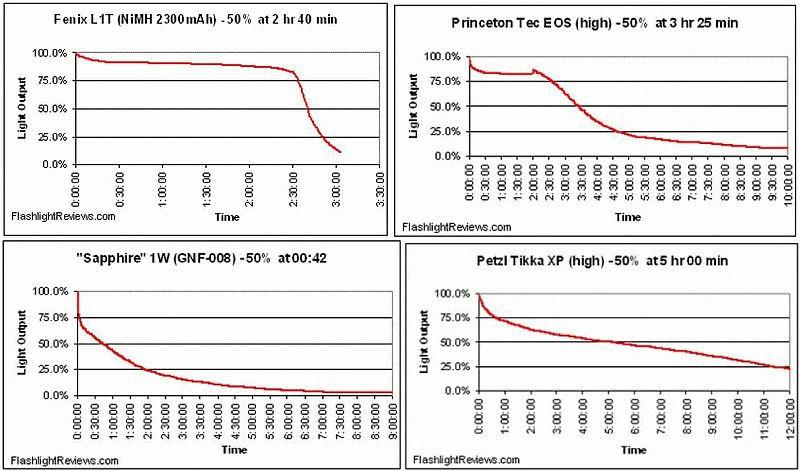
    candlepower forums,com

    You should know that unregulated lights tend to report how long light is generated rather than light which is at a particular intensity. So in the case of a flashlight like the Sapphire, the runtime might be reported as 9 hours, even though it’s at 50% after just 30 minutes, and a quarter after 2 hours. This issue is explore more in the article why headlamp claims are deceptive. You can use ceilingbounce to do your own tests. BackpackingLight is working on LightBench which is a quantitative method for rating flashlights which uses the area under the curve to characterize the light produced.

    Battery Type & Sizes

    Historically I have selected lights it to use AA because this is what most of my other devices use, they are easy to find in stores, and have a reasonable size/power density trade-off. When I have need a light which is exceptionally bright or has a long run time I will consider 18650, 22700, or internal rechargeable batteries because USB is becoming a ubiquitous power source.

    During summer months I recommend using eneloop (or other low discharge NiMH formulation) batteries which outperform classic alkaline batteries and are more eco-friendly. I recommend avoiding the “Pro” version of the envelop, they tend to die much more quickly than the “normal” version.

    In cold conditions NiHM batteries function better than alkaline, but I would recommend using Lithium batteries because they even less affected by cold, hold more power, and, are 30-40% lighter. You should be aware that lithium batteries can burn out un-regulated LEDs. Verify that your light is rated to be used with lithium batteries.

    I would recommend getting a conditioning charger because you can reduce a battery’s capacity and lifecycle using a poor charger. I would recommend the Xtar VC4SL, Nitecore I4, Vapcell S4, or the pricy Epoch X4. The cheapest, more versatile, and compact options is a “universal magnetic” charger. These chargers plug into a USB outlet with two leads that terminate in magnetic heads. Most support multiple battery chemistries, automatically detect polarity. Only downside is that they are fairly slow charging. The first was made by oLight, which not longer makes them, but there are several clones still in the market. These chargers typically cost less than $15. There are a number of batteries that have integrated charging circuits powered by a built-in USB ports such as the Fenix ARB-L14-1600U. Alas, even though this AA Li-Ion battery limits output to 1.5V, it doesn’t work in most Zebralight brand lights. 

    Other Issues to Consider

    Beside what’s listed above things I look for:

    • reasonable user interface (can be used with gloves and doesn’t have many blinking modes you have to cycle through)
    • weight (lighter generally better)
    • waterproof
    • battery life indicator
    • good price / value
    • for headlamps comfort to wear and stay on the head when active
    • additional features such as being an USB power bank.

    I don’t have a recent of experience with headlamps which are extremely bright (>600 lumens) or are dependent on remote battery packs. Remote battery pack are very important when in extremely cold environments because the battery pack can stay under your coat to keep the batteries warm so their performance doesn’t fall due to the cold environment.

    Headlamps

    I recommend getting a headlamp because the hands free operation is extremely useful and you can always use it like a hand light.  Why would you use a headlamp in your hand?  Having a light source coming from the same location as your eyes creates hard shadows which can make it harder to see things. When night hiking having the light coming from down around your waist makes it much easier to see the terrain. Secondly, when in groups, there is a tendency to turn toward people who are talking which minimally exposes them to the spill of the headlamp if the headlamp is properly adjusted down, or worst case, you hit your friend with full force light. When in a group, a useful trick is to wear the headlamp loosely around your neck with the beam angled down toward your hands.

    Headlamps with swappable batteries I would recommend:

    • Zebralight make numerous excellent headlamps. These are my top recommendation if their price isn’t too high. I suggest the standard (non floody) reflectors for all-around use, powered by whatever batteries has the size / runtime profile you desire. Zebralight maintains a google sheet with the specs of all their lights. I have used a ZebraLight H51 from 2010-2019 for most of my portable lighting needs. The current version of this light is the H53. The H51, an AA eneloop battery, and original headband weight 3.5oz. It has 6 regulation output levels which include lumens/runtime : 0.2/19 days, 8/39h, 30/10h, 200/55min. I have the standard (non floody) reflector: the beam has a hot spot with enough throw for wayfinding and enough spill to be useful for close up tasks. The headband is comfortable, removable, with a glow in the dark holder which makes it easy to find at night. The only thing this light is missing is a battery life indicator which exists in the later version. When stored, I unscrew the tail-cap 1/3 a twist to prevent accidentally it turning on. The Hx2 models had one advantage over the newer ones, they can use 14500 batteries.
    • Thrunite TH20, $30 is one of the best values. Durable case, good quality regulation, nice user interface which ramps up intensity rather than going in 2 or 3 big steps. Can use any formulation of AA battery including Lithiums. Beam patterns is fairly floody.
    • Mankerlight E03H, $35 can be thought of as a budget version of the Zebralight H53.
    • Fenix HM50R. $60 which have a good beam, regulation, swappable battery and weights 2.8oz. Downside is lowest setting is 30 lumens which is overkill for simple tasks.

    If none of the above headlamps appeals to you, I would recommend looking at headlamps made by Fenix and Nitecore since they have good regulatory circuity and durable cases at reasonable prices.

    Many of the better known manufacturers include Petzl, Black Diamond, and Princeton Tec tend to lag when it comes to embracing the more efficient LEDs, regulation and durability. I know people who really like the Petzl e-lite but I don’t recommend it. More details below in the section “Button Lights”

    While I generally prefer replaceable batteries when away from civilization, I have come to appreciate several lights which integrate rechargeable batteries into their headlamps.

    • NU20 classic is an upgrade of the original NU20/NU25, and I think better for many people than the current version of the NU25. NU20 classic model is USB-C, has a red and CRI lamp, with a more efficient and better thrown main LED, and improved battery life indicator. A useful review.
    • Petzl Bindi: is the mainstream version of the NU20. I think the NU20 is superior and cheaper, but you can likely buy a Bindi in a local store.
    • BD LT 1100 no personal experience, but is reported to be good for off trail navigation with a super bright burst model which is helpful when trying to see distant indicators.
    • The Nitecore CU10 was an interesting design which clips to a backpack strap and is powered by an external USB power source. It was discontinued shortly after release 🙁

    Traditional (Hand-held) Flashlights

    There are numerous good options today. I would suggest you start by decided what battery size you want to use. Three factors typically effect battery selection: what batteries are being used by other devices, size/weight, and run time. I generally think flashlights which are powered by AA batteries are in the “sweet spot”, through I will consider 18650 when I want longer runtime / brightness, or AAA when small size matters.

    There are a number of companies which make excellent flashlights. Generally I tend toward the flashlights made by Fenix because I have found them to be well made at a competitive price. There are a number of other companies that make excellent flashlights including NitecoreolightStreamlight, SureFire,  Thrunite, and Zebralight. My short list recommended flashlights based on value and performance:

    • Thrunite Ti3, $16, uses a single AAA battery.  Good regulation with three lighting levels 0.04 lm(115h), 12 lm(6.3h), 120lm(0.5h). I think this is the best flashlight you can stash in your pocket, purse, backpack for emergency lighting. The olight i3s eos is very similar, with the maximum output being 80 lm(50 minutes).
    • Fenix E12, $30, uses a single AA battery. Good regulation with three light levels: 5 lm, 30 lm, 200lm. I think this is good all around flashlights in a compact form.
    • Zebralight SC600w, $100, using a single 18650 battery. Has 12 light levels which include 0.1 Lm (4 months), 150 Lm (12 hours), 1700 Lm (20m). Great if you need a very bright light in a modest size package.
    • Wurkkos HD15, $35 is a decent 18650 powered flashlight which can double as a USB power bank. Note: many devices work with the power bank feature, but iPhones didn’t.

    Button Lights

    Small lights that are powered by coin/watch batteries and typically have a single LED. These lights are very small and light. People often attach them to keychains, zipper pulls, or drop them in their pockets or purses for when there might be an unexpected need for lighting.

    Button lights typically have only a few hours of useful light for close proximity tasks or maybe a hour illuminating an easy to follow path. Most button flashlight permit momentary on/off operation by squeezing the case, and most provide a way to “lock” the light on. Many of the locking mechanisms can accidentally get locked on when carried in a pocket using up the batteries. I think the  Doug Ritter Photon made by Photonlight is the best button light made. It’s user interface is very good (easy to vary intensity and to select push-to-light mode, and the various strobes stay out of the way unless you need them). The primary down side is that the light falls off pretty quickly as indicated by the Photon Freedom’s runtime graph.

    Some ultralight backpackers seem to like the Petzl e-Lite, which is a headlamp powered by two coin batteries. Like the Photon Freedom, the light intensity falls off very quickly. I think a AAA powered flashlight with good regulation or the modern keychain lights are nearly as small, significantly more useful.

    Keychain Lights

    I don’t have a lot of experience with the modern keychain lights. These are high performance replacements of the button lights. Rather than running on a coin battery the have internal batteries which are recharged via a USB port. The typically offer a range of intensities, often including super bright (>400 lumens) for brief periods of time. In the ultralight backpacking community the RovyVon Aurora A8 is popular. Moon and low well regulated. A somewhat narrow beam which is useful for navigation, though medium and high fall off pretty quickly. Useful for around camp, easy trail hiking and very brief wayfinding. The Nitecore Tiki and Tip keychain flashlights seem to be popular in the flashlight geek community.

    Bicycle Lights

    Bicycle headlights are sometime mounted on the handlebars and sometimes mounted on the helmet. I prefer the handlebars because I see shadows being cast by obstacles that I might otherwise miss if the light was coming from the same angle as my eyes. The one advantage of a helmet-lamp is that it can shine in any direction you turn your head, not just in the direction your bicycle is going.

    I believe that headlights under 200 lumens primary use is for other people to see you. I can get by on suburban streets with a 300 lumens light, but I often experienced near misses. At the speeds I ride (>15mph), I want a light with an output of least 500 lumens, with 800-1000 being a sweet spot. I certainly appreciate brighter lights, but it’s not worth the reduction in runtime or increase in size/weight. There are a number of companies that make excellent bicycles lights. I have been very happy with the lights made by Cygolite and Light and Motion. There are a number of other good manufacturers. The website bikelightdatabase.com has pretty good coverage of all the options.

    Two Fish makes several different size LockBlocks which make it easy to attach a flashlight to the handlebars of a bicycle. I have had good luck using a Zebralight SC600 and my daughter used a LockBlock with AA powered Fenix flashlight.

    The Cygolite Expilion 850 is the bike headlight I used for several years. It’s bright enough that I have time to maneuver around obstacles in my path, it’s reasonably compact and the batteries are swappable for longer rides, though you have to buy them from Cygolite due to a special case. This light was recently stolen which is why I replaced it

    Fenix BC21R has a good range of intensities with reasonable run times, powered by a removable 18500 battery so it’s easy to carry extra power when you need longer runtime than a single battery can provide and you can charge the battery outside the light enclosure. The enclosure will also charge the battery when powered via a micro-USB port inconveniently located on the underside of the light. You likely will need unclip the light from your bike when charging unlike some lights which place the charging port on the rear of the light which is easily accessed while sitting on the mounting. I found the “dual lens” a great theory, but found the more even light distribution from other lights such as the Cygolite 850 to be more useful.

    I think it’s very important to use tail lights during the day and at night time. They make bicycles significantly more visible. There are a lot of good tail lights. I don’t have a strong preference between them. I purchased the original Cygolite HotShot several years ago, and have been very pleased with it. Recently my Hotshot was stolen. I ordered a replacement from Amazon which was defective. The forth HotSpot I received finally worked… the rest were returned because they were DOA.

    Lanterns

    I don’t have recommendations  if you want a lot of light (>800 lumens). It used to be that the best option for this sort of light was fuel powered lanterns which ran on iso butane canisters on propane. These days I am sure there are good alternatives which use LED that are significantly more durable, and likely have a better light produced / weight ratio.

    If you want less than 700 lumens, there are a number of excellent LED lanterns. These lanterns are not just more durable with a better amount of light / weight compared to their fossil fuel siblings, but if you have a solar panel, you can “fuel up” during the day. My favorite options are the tiny Nitecore LA10 and the fairly compact Black Diamond Apollo which can put our 230 lumens and is powered by an internal rechargeable battery and can switch to three AA batteries if you need additional power. If you need more light, the UST 30 day lantern puts out 700 lumens, and is powered by three D batteries.

    In the old days, candle lanterns, or small oil lamps were the lightest way to provide long lasting light. There were not bright, but you could get something like 12 hours out of a 2oz candle. The candle holder would be another 4-6oz. The old candle lantern has the one advantage of providing a bit of warmth which is nice on a cold night.

    Other Information

    BPL did a State of the Market Backcountry Lighting (2025) which includes a description of their LightBench testing.

    Candle Power Forums (CPF), is one of oldest online communities devoted to flashlights and Budgetlight Forum is quite active. They have great reviews which typically include runtime graphs and beam shots. FlashlightWiki has links and information for people who are obsessed by all things flashlight like. A nice review of some ultralight lights.

    There used to be a large number of websites which specialize in high quality flashlights, headlights, and batteries. These days it seems like there are only two that are left: brightguy and battery junction.

    An interest podcast about how the cost of lighting dropped through history. Until 300 years ago, a day of labor would pay for around 10 minutes of artificial light. The development of kerosene in the 1800s raised this to 5 hours. Today, a day of labor pays for more than 20,000 hours of artificial light!!

    Low Cost

    For basic task lighting, the photon II knock-offs can be found for between $1-$3 many places.

  • Knives and Other Sharps

    Many activities benefits from having some sort of sharp object to cut things. Examples of this include food preparation, opening packaging, trimming material to cover a blister,  preparing kindling, or hacking branches to build an emergency shelter.

    My Choice

    My every day carry (EDC) knife is a Victorinox Rambler Pocket Knife which is the smallest tool I have found which has all the features I desire: a phillips head & flat screwdriver, scissors, and a sharp blade. I also get a bottle opener and nail file which are periodically useful. When flying I switch to a Swiss+Tech Utili-Key which is not as usable as the Rambler, but for years has made it through TSA checkpoints without being confiscated. When backpacking with others I bring a Benchmade Mini Bugout folding lock blade for food prep. I am no longer fishing or hunting so I don’t need to worry about prepping game/fish. When I expect to do wood craft, building fires for larger groups, or in remote back country when a knife might be required for survival I bring a Fallkniven F1. Our family go/car camping bag has a little Vicky for food prep and an original Leatherman because it has a wide array of tools which are sometimes useful: most often the pliers. In the kitchen we most often use an inexpensive Victorinox paring knife and a New West Knifeworks Santoku.

    Pocket Knife

    A “pocket” knife is one of the most used tools while camping and backpacking, but there are many different styles selected by people. Ultra-light backpackers often make do with a tiny Swiss pocket knife like the Victorinox Classic which have a small blade, scissors, a nail file, tweezers, and a toothpick. These tiny knives are more than adequate for basic “housekeeping” tasks.

    I think the best balance of features and size is the classic Camillus boy scout pocket knife and it’s cousin, the medium size Swiss knife from Victorinox which contain a can opener, bottle opener/screw driver, 1-2 blades, and maybe a few other options such as: an awe, corkscrew, and/or phillips head screwdriver.

    Alas, the tendency of bloated “more is better” led to the creation of large Swiss “pocket” knives with their 10s of tools in a package that really doesn’t fit comfortably in a pocket anymore. In general I don’t like these knives since they are expensive, bulky, and I expect I will use less than 50% of the tools. There are also the super light (and not that durable) derma safe utility razor and backknife.

    Folding Lock Blades

    Folding lock blades are often a good compromise. By locking the blade they are safer to use than typical pocket knives and are more compact than fixed blade knives. The most common locking mechanism is a liner lock. It’s cheap, but not super reliable. In recent years there are a number of locking mechanisms which are significantly stronger and easier to use such as my favorite, the the AXIS lock originally developed by Benchmade and now being used by others since the patent expired in 2016.

    I think that Benchmade is one of the best manufacturers of folding knives. If I had to purchase a general use lock blade now, my first choice would be the Benchmade Bugout. It’s not cheap, but it very well designed, made from excellent materials, with great attention to detail, and substantial enough to depend on in emergency situations. The Asher Nomad3 is reported to be a good quality copy for less money. The first lockblade I owned was an Buck 110 Hunter and later used a Ritter RSK Mk1 Knife for many years. The Chris Reeve Sebenza might be the ultimate folder, but I could never bring myself to pay so much for a pocket knife. My knife loving friends also recommend Spyderco and the higher end knives from Kershaw, SOG and Boker. Decent lock blades at a more reasonable price point are made by Buck, CRKT, Gerber, Kizer, and Kabar / Dozier. Ganzo sells a number of Benchmade clones which are 5-10x cheaper (average price $20) but but are lower quality. I have also heard the KingMax folder is an ok knife and only $12. Opinel makes a number of folding knives which have good quality carbon steel blades, adequate wooden handles, and cost around $10 making them a great value. Just be careful to dry them well or the blade will rust and the handle will swell. I generally prefer the simplicity of a single blade locking knife, but there are some multi-blade pocket knives that lock such as the Victorinox Hunter.

    For people doing a lot of cooking on the go might want to check out A.G. Russell Folding Cook Knife, the pricy Spyderco SpydieChef, or one of the ncampgear folding food prep knives. MagnaCut and LC200N are ideal for food prep because I hold a good edge and resist corrosion, but are more expensive than most other options.

    Fixed Blade

    Finally there are some people who really like fixed blade knives because of their ability to stand up to serious abuse (chopping, digging, etc). You should stick with knives with a full tang for maximum durability. Keep in mind that you don’t need a huge / heavy blade, 3-4″ is actually plenty for tasks as described in the book Bushcraft, and a short article in field&stream about The Wilderness Blade. My favorite fixed blade knife for the back country is the Fallkniven F1. This is a high quality knife that is durable and functional.

    There are a number of other high quality, reasonably light weight fix blades which are up to taking serious abuse. I don’t use them, but I have friends who like fix blades from ESEE, SOG, Survive Knives GSO 4.5, and the Benchmade 162. The classic Kabar and USAF Survival Knife are also popular, but heavier than I would want to carry.  Others have noted the the quality of the Kabar and the USAF Survival knife is much lower than the beloved knives from 1970s and before. The Chris Reeve One Piece knives like the Aviator have been very well regarded, but are now discontinued so will likely be even more expensive as they become collectors items. These knives are very well crafted, but I found that I didn’t like the round textured  metal handles. I much prefer the feel of the Fallkniven knives.  If you are around salt water a lot you might look at the Gerber Silver Trident or the titanium knives made by Mission.

    The most affordable, but decent quality fixed blades I have seen are from the Swedish maker Mora though they typically don’t have a full tang such as the Mora Companion or Bahco 2444.

    There are also a number of minimalist fixed blades which aren’t up to heavy abuse, but are reasonably priced and provide a better blade than they typical pocket knife such as the Ka-Bar BK14 Eskabar,  Ka-Bar Becker Remora, the Buck Hartsook, AG Russell Hunter Scalpel, or even an inexpensive kitchen paring knife such as the Little Vicky.

    Most sheaths provided with knives are pretty heavy. Ultimate Edge Bladesaver can be the basis of an effective and light weight sheath or you can get a nicer but more expensive custom sheath from Cleveland Kydex.

    At the minimalist extreme is the CardShark and the pricy Lynx cardblade. These knives are so light that they are easy to be damaged. While I might uses these around town, I would want something more substantial in the back country where a knife might make be critical to surviving something unexpected.

    Multi-Tools

    Growing in popularity are the multi-tools first introduced by Leatherman. These are typically fold-able piers or scissors with a number of blades hidden away in the two handles. If you expect to be repairing machinery, these are a great option since it is like having a small toolbox in small package. Of course having a single package can be an issue since you can’t hold a bolt with the pliers and use a screw driver at the same time. The Leatherman Squirt seems to be one of the more popular multi-tools among backpackers.

    Scissors

    Some people have found that all their cutting jobs are easily handled with just a small pair of scissors. Super ultralight folks tear apart the Victorinox Classic, use the scissors from the Victorinox Swiss Army Swiss Card, or use the small blunt-end kid scissors.

    Additional Information

    There are a large variety of knives in the marketplace today. Options includes basic type (pocket, fixed blade, etc), type of ground used on the blade, blade material, blade shape and craftsmanship. Doug Ritter’s Sharp Stuff page has a good discussion of knife choices with an eye on survival. You can checkout Knife ForumsBlade Forums and EDC Forum’s knives topic  to see what knife enthusiasts have to say.

    Musing about Knives

    There was a discussion on BPL about “Why bring a knife?” A couple of things I thought were noteworthy. First, that a “serious knife” was rarely needed when people are backpacking, but people typically found uses for their knives… e.g. having a knife produced reasons to use it. The second was whether high end knives where “worth it”. For some people high end knives are worth the money. Others will see them as a wasteful extravagance in the same way that some people love their Toyota Corolla while others love their Porsche. Reasons for high end knives:

    1. ease of use single handed. Knives like the Benchmade Bugout can easily opened using one hand and safely closed (love the AXIS lock).
    2. durability in the face of mistreatment / neglect. Counter-point: you could replace cheaper knives multiple times before a high end knife makes financial sense
    3. performance / characteristics such as it’s ability to hold a good edge in the face of challenging situations
    4. enjoyment of good craftsmanship. several people noted the simple act of opening and closing the knife could be joyful.

    Low Cost

    The very cheapest option is the $2.50 derma safe utility razor. You can get a YAODHAOD Ceramic Pocket knives for $8. They are sharp but ceramic blades are much easier to destroy than steel. The small Victorinox Classic can often be found for $10 and are often given away with someone’s logo on the side. If you want a larger pocket knife, it is possible to find the classic Victorinox Recruit for around $15. If you want a locking blade folder, then you should be able to pick up a Opinel folding knife for less than $15.

  • Water Treatment & Containers

    Next to staying warm, the most important survival and comfort factor is drinking an adequate amount of safe water. This often means you need to carry water and be prepared to treat water. Not all locations have a continuous supply of safe water. Failure to treat the water can result in severe illnesses which would minimally make your trip less enjoyable, and in the worse case be life threatening. Death is likely after three days without water.

    My Choice

    Every water treatment option has compromises in terms of speed, simplicity, reliability, and ease of you. Periodically I change my system because my weighting of the tradeoff changes. In the back country I typically carry a SmartWater bottle for drinking, and use a Platypus to hold dirty water which I filter through a HydraPak 28mm Filter Kit. I have a few doses of Aqua Mira or Micropur tablets as a back-up and to purify my collection water container. On group trips I use the HydraPak in-line filter between a 3L Big Zipper SL and a Platypus Water Tank as a gravity filter.

    Pro tip: many of the modern filters need the fibers to be wet to function. A day before your trip make sure they flow. If not, they will typically be good after soaking in water for an hour.

    In urban areas I tend to carry a Zojirushi Double Walled Mug because it can easily be used one handed, locks so it doesn’t open accidentally, pours at the perfect speed, the mouth is wide enough for ice cubes, and liquids stay fairly warm or cold for 24 hours.

    How Much Water?

    Knowing how much water you need is important so you have enough but don’t carry several extra pounds of unneeded water. There has been a lot of mis-information about how much water people need. Overhydration in endurance sports can result in hyponatremia. The best rules of thumb are to drink when you feel thirsty and to pay attention to when you pee. If you are peeing every hour you are drinking too much. If you can’t remember the last time you had peed, or when color of your pee is dark, you aren’t drinking enough. Also keep in mind that if you are sweating a lot you will be losing electrolytes. If you loose too many electrolytes will you start to cramp. If you are expecting high heat / activity levels bring an electrolyte supplement. I like lemon flavored powders that I can add to my water that have little or no sugar.

    I developed a sense of my water needs by repeatedly running an experiment. I would weighing myself naked, get dressed. engaged in activities at different MET intensities and temperatures (no peeing during the experiment and any consumption was measured, and accounted) for 1-4 hours, removing clothing, drying with a towel, and then weighing myself measure weight loss due to sweating / perspiration / breathing. I lost 1L every three hours when it’s 30-60F and I am moderately active (MET 3-6), around 1L for every 1.5-2 hours 60-80F, and 1L every hour when it’s more than 80F.  When >9 METs water lost was 3x my normal rate. When I gave chat-gpt the prompt “what’s the rate of water loss in humans at different MET and temperatures? How does variance of humidity effect this?” I got results compatible with my self experimentation and some added nuance.

    Water Treatment

    Water can be contaminated by biological, chemical, and radioactive components. Some would add micro plastics to this list. In most of the US and the EU the municipal water is “safe” from all contaminates, e.g. you can drink from the “tap”. There is a risk of chemical (lead) contamination in older buildings if their plumbing used lead. The only treatments which effectively remove lead are charcoal filters or reverse osmosis. The safety of water varies in other countries, often better in cities than rural locations. Chemical contamination is more likely downstream from large scale agriculture and mining which is beyond the scope of this post. In these locations it’s best to use water which is bottled / “imported” from outside the area. The rest of this post focuses on biological contaminates because that is what is the most common issue in the back country.

    In the back country of the US (streams, lakes, rivers) the the most common issues are typically larger organisms: bacteria, cysts, etc. If the water is particularly cloudy, chemical and UV treatments are are less effective with these, especially cysts and bio-films. Outside the US, you might also need to deal with even smaller organisms like viruses. A basic filter is not effective, you need a “purifier” filter. The good news is that chemical and UV are highly effective against these smaller organisms, so often people will filter and then use chemical or UV to be completely sure the water is safe. The best place to take water is from the top 1/2 inch of a lake. Constant exposure to UV light from the sun tends to purify the top layer of a fixed body of water.

    Chemical Treatments

    Chemical treatments are small, light weight, and don’t clog. First, let me suggest that you should skip to common chemical treatments of iodine and bleach. Both chemical are more effective than nothing… but both chemicals are less effective than Chlorine Dioxide water purification. I like Chlorine Dioxide because it is effective and has less of a “taste” than most other chemical water treatment. Just after treatment, the water can taste a bit like pool water just after treatment and becomes less pronounced if given a bit of time to “breath”. In clear water it’s fully effective in 30 minutes, in cloudy water everything but cysts are killed in 15 minutes, with the cysts taking up to 4 hours to neutralize. I often used Kaytadyn Micropur tablets because they are so simple. I have also used  Aqua Mira treatment drops. There are a few other chlorine dioxide based treatments tablets made by Aqua Mira, and the MSR MIOX system. The tablets from Aqua Mira and Kaytadyn have three times the chemical load of the suggested dose using Aqua Mira drops making them more effective but also having a stronger taste.

    Squeeze / “In Line” filters

    Squeeze filters have become quite popular since they filter as fast and pumps with less work. The downside is that you need a large contain to hold “dirty” water. Many companies set filters which attach to soft bladders that you squeeze to push the water through the filter.  HydraPak, Katadyn  BeFree, and Sawyers Squeeze are what I have had some experience with, but there are a number of other options these days. I have also heard some gook things about the Platypus Quick Filter. There was a post on reddit of someone who has been testing 5 different filters. Water can be moved through these filters in a variety of other ways beyond squeezing:

    • Gravity filters: originally either DIY used by backpackers or very heavy systems designed for base camps.  A number of companies now sell purpose designed gravity filters that are appropriate for backpacking including the Platypus Gravity Works,  MSR Autoflow and Katadyn Basecamp.  I like the feeder for the Platypus, but I think the clean reserve is less than ideal. The Platypus Water Tank is much better because it can sit on the ground with the opening toward the top.
    • In-line hydration: You typically had to create suction with your mouth to pull the water through. This is fine around town at lower elevations. If you are slightly out of breath after a long climb, and you are at 14k ft, having to apply sufficient suction can be very difficult. The exception to this was the The Geigerrig hydration system let you use a small hand pump to pressurize watch so it would flow through am filter and literally squirt when the activating a “bite value” allowing the filter to be “in-line” of a hydration system.
    • Straws: Sometimes built into hardside water bottles or look like large straws you stick into a water source such as those made by LifeStraw.

    Pump Filters

    Pump based water filters used to be the go-to water filter system used by backpackers. They are very well suited to situations when water hard to access, like in very shallow pools. They are effective, long lasting, and some have charcoal elements which will remove some chemicals and improve water taste. Filters tend not to catastrophically fail, but as the age they can filter 4x slower than a new filter. If you use a filter when the nights get below freezing, make sure to either fully drain your water filter, or keep it warm so it doesn’t freeze. Filters are particularly useful if you are in locations which are hot and have few sources of water. You can “camel up”, drink as much water as you can at the source so you don’t have to carry it.

    UV / Solar

    Recently, a number of products have come to market that use UV light to purify water. The most popular is the SteriPEN which is now owned by Katadyn.  The nice thing about the using UV light is it will purify reasonable clear water in something like 60 seconds. Just scoop up the water and turn on the UV source. When the water is cool and good tasting, this can be quite the treat. The downside of the UV systems are that they don’t work well with cloudy water, and the systems is prone to fail, particularly in colder conditions. It you decide to use a UV system, bring a a backup system. Most UV systems needs a wide mouth container so the typical Playtpus bladders don’t work with it.

    Solar water disinfection (SoDis) is a highly effective way to treat water in sunny locations if you aren’t on the go. Simply fill up a plastic 2 litter or smaller bottle with water, and put it in the sun. In full sunlight it will be safe to drink in 6 hours.

    Boiling Water

    Three minutes of boiling water is also highly effective went dealing with biological containments. The downside is that you might need to carry extra fuel, and in hot weather, you don’t get safe, cold water to drink.

    No Treatment?

    There is significant evidence that poor personal hygiene (e.g. not washing hands during food prep) is the most significant source of contamination in the back country, so some people don’t purify their water sources. I think this is an unnecessary risk and don’t recommend this approach. One of the early scholarly look at this was performed in 1984 about  Giardia Lamblia and Giardiasis in Sierra Nevada and a more recent study from UC Davis from 2003 seems to indicate that the water in most of the high sierras is still pretty clean.  You can read their technical article An Analysis of Wilderness Water in Kings Canyon, Sequoia, and Yosemite National Parks for Coliform and Pathologic Bacteria. Related articles include Cyst acquisition rate for Giardia lamblia in backcountry travelers to Desolation Wildereness and Evidence based Medicine in the Wilderness: The Safety of backcountry Water.

    Water Containers

    When engaged in activities away from home or the office it is good to have water readily available.

    Nalgene & Plastic Water Bottles

    Nalgene water bottles have been one of the most iconic and commonly used water bottles. This is understandable because they are nearly indestructible, don’t give beverages a “taste” like aluminum can,  and have a wide mouth which makes them easy to fill. Boiling water doesn’t melt them which make them particularly useful in the winter as hot water bottles.

    Also popular are sports bottles that are flexible enough to squeeze with sealing squirt tops which was originally popularized by cyclists. There are several companies which make insulated bottles, but I haven’t found any which can keep my drink cold or hot for more than an hour.

    Empty bottled-water containers are a cheap and lighter alternative to the classic Nalgene water bottle and are surprisingly durable. They are also a good size to hang on your shoulder strap (adventurer racer style) which gives easily access and can provide a bit of weight to counter balance your pack

    In recent years people have become concerned about polycarbonate based plastic which might pose a threat to pregnant women and young children. Nalgene now makes a number of bottles which don’t leach chemicals into water.

    Metal Containers

    Metal canteens were a commonly used water container for outdoor pursuits before plastic water bottle became available. In recent years they have been making a come-back as people are concerned about plastic leaching harmful chemicals into their drinks, a desire for containers which are ultra durable, and with the advent of the double walled vacuum container the ability to insulate.

    For modest amounts of water I think metal containers can work well, but when the amount of water exceeds 1L I believe it’s best to use lighter weight water containers.

    Some of the more popular metal water bottles include those made by  Hydro FlaskKlean Kanteen, Yeti. I am very fond of the double walled insulated water bottles made by Zojirushi. Snowpeak makes some beautiful titanium water bottles.  There was a thread on reddit with a discussion about good titanium water bottles.

    Water Bladders

    Platypus was one of the first companies to make flexible bladders designed to carry water and other beverages. The original models could be folded up into a small space when empty and were hand held with a small opening for filling and drinking.  The narrow mouth could be a problem since it was challenging to clean, dry, and in some situations fill. Since those early days a number of other companies now make flexible water containers including Vapur, Hydrapak, and MSR.

    There have been a number of innovations, largely related to the openings. Several companies have paired the soft side bladders with larger opening to make then easier to fill and clean. There is also significant cross over between  water bladders and hydration systems discussed below.

    Hydrations Systems

    Camlbak might have been the first company to make a hydration system. They combined a flexible water bladder which could be kept inside a backpack with a plastic tube and “bite” valve that allows the user to drink without using their hands.

    Several other companies including Platypus now make hydration systems. For several years I used the Platypus 3L Big Zip SL. It is light, durable, and collapsible, and competively priced.  Today, I use a pressurized system made by Geigerrig.

    Other Information

    BPL’s ultralight water treatment options,  and their older Water Quality Technologies and Trends. The most complete review I have seen, but no longer published was the US Army’s Commercially Available Water Treatment (via archive.org)  That site does have a number of resources about safe water.

    Low Cost

    If you aren’t moving much and it’s sunny, you can put the pop bottle filled with water in the sun.  The sun’s UV will kill off biological threats within 6 hours. Otherwise, Aqua Mira or boiling will be the cheapest in the short term.

  • Hats

    Hats seem to be one of the more personal pieces of gear. People seem to care about the style of their hat than many other clothing items. There are a huge number of options with a wide variety of styles, colors, materials, etc.

    Hats are highly effective at fine tuning thermal comfort because they are easy to put on and take off (provided you aren’t wearing a helmet) which lets you control the venting of a significant amount of heat. Hats have a good warmth / weight ratio so don’t try to save weight by skimping on your headwear. I would also strongly recommend that at least one of your jackets have a hood.

    In hot weather a hat can help you stay cool and protects against sun damage with could be sunburn in the short term, and cancer in the longer term. I strongly encourage people to always wear a sun hat which fully shades head, ears, face, and neck and use sun protective lotion.

    My Choices

    I generally use a Montbell Umbrero Rain Hat (more $$ Via US Site) a 1.8oz folding hat which fully shades my face, ears, and neck. It’s fully waterproof but still provides the best ventilation of any hat I have used. It deforms but usable in 25mph winds. I coated the inside with a paint which fully blocks UV. I think it’s silly looking, and periodically have people (mostly men) point and laugh… and I have also received compliments (mostly from women) and periodically have both genders ask where they could purchase on for themselves. I have a Ultrafino Santa Fe Hat which is attractive looking but the brim isn’t wide enough to give me full sun protection. I sometimes use a PolarBuff: in moderate conditions I double the fleece section over my ears with just the light polyester fabric over the top of my head to avoid overheating. When the temperature is down around freezing I reconfigure the buff so the fleece covers all of my head. When it gets really cold the buff becomes a neck gaiter / face mask inside my hood.   In the past I used Tilley LTM6 Hat, OR SunRunner, or a hat from Sunday Afternoons.

    Ball Caps

    Many people use baseball caps to keep their hair out of the way, things out of their hair, and shading for their eyes.  I don’t wear baseball caps because they don’t provide adequate sun protection for the side of my face and neck.

    There are several companies that add a veil to a baseball cap to protect ears and neck from the sun.  These hats provide very effective sun protections. The downside is that when using the veil, the wind is blocked which allows heat to build up more than if there was completely free air flow. I think the OR SunRunner Cap is one of the best options with a removal veil that is very packable. Sometimes rather than a baseball cap shape, hats have a higher crown like the hats made famous by the french foreign legion.

    Sun Hats

    I have found the “coolest” wearing hats are classic loose weave Panama straw hat, which actual come from Ecuador. These hats provide sun protection while permitting better air flow than nylon or cotton weave hats. The down side is that they are more expensive, less durable, and can be a challenge to pack. There are some which will roll, but if you do that too often the hat will start to wear out. These hats degrade quickly if repeatedly worn in the rain. Note: many straw hats have a weave which is so tight that they don’t permit much airflow.

    I have found the hats from Sunday Afternoons, especially the Adventure and Sports models with a veil in the back permits a reasonable amount of air flow while providing some of the best sun protections I have found. One downside is that the larger models have too much surface area without enough structure to work well in wind. The other problem is that I think they are one of the more silly looking hats on the market.

    There are a host of more conventional brimmed hats on the market. I tend toward hats which have reasonable stiff brims such as the famous Tilley LTM6 Hat, the Shelta Hats Firebird v2 and Sunday Afternoon Charter hats. Dorman-Pacific  makes a number of nice hats from a very light weight supplex weave which breaths somewhat while providing good sun protection. I like hats that have foam brim with a plastic or wire stiffener running around the outside of the brim to keep it from flapping in the wind. Wallaroo makes some nice straw hats. ThePopHat is a packable 6″ brim sunhat.

    The Kavu Chillba is a modern interpretation of the asian conical hat which can provide excellent protection from rain and sun while permitting good ventilation. The Montbell Umbrelo is a packable rain hat in a similar style and they also have a foldable sun hat, but the sun model airflow isn’t as good as the rain variant.

    Another option is rather than using a hat, using a light weight hoody, combines with a long visor to shade eyes and face. The challenge is to find a hoody whose material provides good sun protection, air permeability, and is adequately durable. The best I have found is the Arcteryx Cormac Hoody and the MH Crater Lake.

    In hot weather a cotton bandana, or better yet, a “tie” filled with poly-crystals such as those made Kooltie can help keep you cool.

    Modest Conditions

    In moderate weather having a hat which is wind resistant can be a big aid to regulate your body temperature. In cool or cold weather, hats made from waterproof breathable material can be quite useful. Outdoor Research is well known for making brimmed hats from WP/B materials. These sorts of hats can keep your head dry when you are not wearing a hood which allows more ventilation then wearing a hood which is nice in warmer conditions. There are a number of companies that make baseball style hats out of WP/B materials. Some people use these sorts of hats without a hood, or sometimes as a way to compensate for a hood which lacks an effective brim. Keep in mind that not all WP/B materials are equally breathable. If possible, get a hat made from eVENT. The classic OR Seattle Sombrero is one of the most beloved rain hats. I used one for many years.

    Cold

    In cold weather you will want a hat which keeps you warm. Winter hats can be caps (typically wool, fleece, or soft shell) though there is the blackrockgear downfill beanie, hunter style (typically shelled fleece), or balaclavas (normal fleece, windstopping  fleece, high loft).  I typically find a balaclava overkill until it is below 20F and windy at which point it is indispensable. The Mountain Hardware Flex balaclava is my favorite. Don’t underestimate how much a neck gaiter (or scarf) can help you stay warm. Also don’t forget the the snow is very reflective and can easily damage your skin. You won’t even notice because it’s cold. Alway wear sun lotion when out in the snow, and consider using a balaclava not just for warmth, but sun protection.

    Details and Further Information

    There is a wide range of numbers given for how much heat is lost through the head. My investigate of various scholarly articles brought be to the conclusion that somewhere around 10% of body heat exits through the head & neck given uniform insulation on the body.  This changes significantly when you are shivering / approaching hypothermia where you lose around 45% of your heat through your head.

    Low Cost

    Get a free hat. Lots of companies give hats away with their logo on them for proportional purposes.

  • Handwear

    Like hats, hardware seem to be one of the more “personal” pieces of gear. Unlike “hats”, fit and function rather than style seems to drive most people’s decision making.  The fit of handwear is much more important  than say, a jacket.  Less than 1 cm of extra length in the fingers can be the difference between a glove that is highly functional and a glove that gets in the way and makes it difficult to to make the grabs necessary.

    There is often a trade-off between “feel” and “protection”. Typically the more protective handwear is, the less “feel” they provide. My experience is the same as Andy Kirkpatrick’s:  there is no perfect glove.

    My Choices

    I found that changing how I holding my hands affects my hand comfort:  in the cold my hands are in loosely held fists while in the warmest conditions I keep my fingers spread open. Furthermore pulling my hands inside my sleeves or putting them in my pockets can allow them to warm up if feeling chilled. Even better is having hands under a poncho where they are dry and warm thanks to body heat. Of course there are activities like cycling, climbing and skiing where this isn’t an option. I haven’t found handware that I really love. Right now I am using a combination of gloves made from PowerStretch fleece and some EE Visp Rain mittens. Separately they keep my hands comfortable when active for to around 45F. Together they are ok to around freezing. In colder conditions I typically use a pair of OR Meteor Mitts

    Factors to Consider

    Feel / DexterityThe best “feel” are fingerless gloves which can keep the core of your hand warm while giving full dexterity to fingers. There are fingerless gloves with a mitten flap that can be overlaid when you don’t need to be using your fingers, traditional gloves, lobster claw gloves, and mittens.
    GripThe  materials used on the palm and the fingers will effect what sort of grip you can have and how durable the handwear will be. The most grippy materials tend to be specially designed synthetic materials. Leather is reasonably grippy and long lasting.  Plain fabric is often slippery and not very durable.
    WaterHardware can range from “sponge like”, to water resistant, to pull on waterproof. Related to this is how quickly the handwear will dry. Handwear which doesn’t have absorbent padding will dry more quickly. Handwear which separates insulation from the protective outer shell also has an advantage when it comes to drying out your hands.
    InsulationPrimaloft and down are commonly used in warmest handwear because it is warm for it’s weight, while still providing good feel because the insulation will compress when pressed. The compressibility gives good feel, but it means that the compressed area isn’t as protected from the cold. So if you are going to be holding onto things for an extended period of time (say climbing with ice tools),  then you want the insulation to be something that won’t compress like fleece or thermolite. Some handwear uses hybrid insulation… fleece on the palm and fingers, and primaloft across the back of the hand.

    Handwear Options

    There is a large number of companies that make high quality mittens and gloves. In the past I have found that I like hardwear made by Outdoor Research, Mountain Hardware, and Black Diamond. Your experiences might be differ. Since models change quite often and I am not regularly trying new gloves I am generally going to skip listing specific gloves or mitts. The exception to this are items which are somewhat uncommon,

    Base/Liner

    Base/liner gloves made from a wicking material like PowerDry,  wool or my favorite PowerStretch.  These are very thin gloves which can boast the insulation of other gloves, or be worn stand-alone in moderate weather. They provide little or not protection from wind or water.  I have found in all but the most extreme conditions that liners can keep my hands warm enough down to around 20F. I have found that I can wear them up to around 50F. 

    Unlined Shells

    Year ago Outdoor Research (OR) introduced an ultralight rain mitten which worked well stand alone in warmer weather and could be combined with a base or unshelled insulated glove or mitt when the temperature dropped. OR stopped making it, but there is lighter and more breathable mitts such as the MLD eVENT rain mittens and the ZPacks Vertice rain mitts. I found these lighter mitt are fine for light use, but I wouldn’t want to use them for rough activities or in abrasive conditions. BPL did an extensive guide to of rain mitts.

    OR does make heavier duty unlined waterproof shell mitts such as the revel shell mitt. and shuksan mitts. I haven’t been really happy with most of the other mitts in this catagory. Many are too stiff for my taste (typically because of the tape used to seal their seams). Also, they tend to be smooth on the inside so an liner inside them slips around providing a less than ideal interface. There are a small number of modular gloves/mitts which come with an unlined shell, though most have a lined shell combined with an inner insulated glove.

    Lined Shells, Softshells, Work Gloves

    Lined shell gloves which have a water resistant shell and a light liner. These gloves often use what is waterproof breathable materials in the shell, but don’t seal the seams. As a result they are moderately protective in wet conditions, but after some time, moisture will start seeping in. These gloves tend to be very good feel and dexterity. The MH Plasmic and the REI Minimalist are examples of this type of glove. I really like these gloves for done in a day activities when the temperature is above 10F and where my hands aren’t buried in snow (e.g. skiing, snow shoes, etc) when NOT building snow caves

    A number of companies are making light gloves made from soft shell materials like PowerShield.  These are fairly protective from the elements, durable with abrasive conditions, while still providing very good feel.

    For me, work gloves are either unlined or lightly lined with an emphasis of dexterity and durability.

    Insulated with Shell

    The most common “ski” gloves are typically made with a waterproof breathable shell and use either fleece or primaloft for insulation.  Alas, most aren’t fully sealed, so after a full day in the snow they will be wet on the inside and are hard to dry out. Typically modular systems are a better option, though most modular systems don’t have as much dexterity as a glove that is fully integrated. Neoprene gloves such as those made by glacier glove provide very effective protection when dealing with very wet and cold conditions.

    Modular Gloves/Mitts

    Modular Gloves / Mittens are problems which typically combine a durable, waterproof mitten with an inner insulating glove. OR is the best known maker of modular handwear. Typically these will have extra long gauntlets for maximum protection & good sealing, extra durable shells made from waterproof breathable materials which are fully sealed, very grippy palms, and removable insulation. 

    If I am doing “snow work”, I bring a modular mitt, with a durable shell and a removable inner glove or mitt which is either 100% fleece, or has a fleece palm, with primaloft insulation on the back of the hand. While far from perfect, I most often bring a pair of OR Meteor Mitts. 

    High Loft Mittens

    When spending extended time in the back country I have found high loft over mittens with a breathable shell very useful. They have a lot of warmth for very little weight and pack down. They aren’t useful when you are doing things because when you use your hands you compress the insulation. The shells should be highly breathable so if they get wet you can dry them inside your sleeping system. A good example of this is the Enlightened Equipment Torrid Mitts

    Vapor Barrier Mittens

    In theory, vapor barrier mitts allows the construction of mitts which have a very high warmth / weight for use in cold conditions. rbh designs makes a variety of nice mitts. I have found that the rbh mitt weight half as much as a conventional mitts providing equal warmth.

    Other Options

    Komperdell seamless gloves seem like they might be quite an innovation, but I haven’t tried them. 

    The bluebolt gear yeti-mitts look interesting

    Atlas Showa Gloves are beloved by several of my friends who need durable, insulating gloves.

  • Rain Gear

    TL;DR

    As of April 2024 the best rain gear in terms of performance have their membranes on the outside. They don’t wet out, and dry amazingly quickly, and have ok to superior breathability.

    • If you aren’t climbing, doing bushwacking, or facing serious abrasive conditions, can find one (or several if you can afford them) pick up a shell made from Gore Shakedry before they disappear from the market. It really is waterproof and breathable and does ok under a light pack which doesn’t have heavily abrasive fabric.
    • If you are going to face moderately abrasive conditions pick up a Columbia Outdry Extreme Mesh which is more durable that Shakedry with so/so breathability.
    • If you are on a budget pick up some of Frogg Togg UL rain gear (aka DriDucks) for something like $20, and bring duct tape to repair the holes you will put into them because the fabric isn’t durable. I have talked with numerous folks whose tape patched DriDucks were still usable after a full Appalachian Trail thru-hike.

    Other reasonable options

    • If you want a traditional WP/B shell and are prepared to regularly refresh the DWR, choice one of the following (increase in price and durability): Marmot Precip-Eco (maybe), Montbell Versalight, Montbell Storm Cruiser, ArcTeryx Beta LT.
    • Go with a rain suit or poncho made from non breathable fabric which has options to ventilated. They can be cheaper than the above options, will last long, and don’t wet out. For example: antigravitygear, light heart gear, leve outdoors, timmermade.
    • Use an umbrella plus maybe rain pants / rain skirt provided wind isn’t high and you don’t need to use one of your hands (or attach your umbrella to your pack).

    Don’t try to use a wind jacket like the Patagonia Houdini as a rain jacket. A real rain storm will soak through in minutes. There are some soft shells that can handle on and off drizzle, and will let you stay warm enough (but not dry) if you are working hard in real rain. Unless you are experienced, this is not a substitute for rain gear.

    [toc]

    Context

    The purpose of rain gear is to protect you from “wet” environmental conditions.  Finding the right shell is quite challenging because staying dry and comfortable requires managing external moisture from rain, sleet, and snow as well as managing internally generated moisture from perspiration and sweat. There is no perfect / magic material that does all this in all conditions. As a result, learning good techniques to manage moisture in sustained rain is as important as selecting the right rain gear. In many cases you won’t be completely dry, but you will be warm enough which is what’s most important.

    Most rain gear is not only waterproof, but is also windproof and boasts the insulation of the garments under the shell. In warmer weather this is a serious problem because the wearer will overheat, sweat, and then find themselves almost as damp as if they were walking around in the rain without protection. Air permeability is typically a good predictor of a shell’s comfort.

    I something hear people rave about the breathability of a garment that both laboratory tests and my personal experience suggestion are at best mediocre like the original Marmot Precip. I think this is often because the person raving about breathability has not used the garment doing heavy work in challenging conditions and/or are comparing the garment to a non-breathability alternative.

    My Choice

    I use a shakedry shell (favorite is a discontinued Sitka shell) most of the time.  I can do zone 2 run (8 MET) for multiple hours in a steady rain with an air temperature of <50F. At the end of these sorts of runs I feel slightly damp around my neck. After a 10 minute cool down I am not feeling particularly damp. On one of these runs I weighed my shirt before and after and recorded just 1 gram of weight gain. I am comfortable in this shell when it <70F standing around, <60F bicycling zone 2, <55F light hiking, <50F zone 2 jog / general backpacking, and <40F when running hard, zone 4 cycling, or doing a hard push up a big hill while backpacking. Even when I exceed these ranges, the dampness tends to clear in less than 20-30 minutes once my activity level drops within these ranges. Above these temperatures I typically go without a shell using clothing that is comfortable when wet such a base made from Polartec Delta, Polartec PowerGrid, or absorbs little water / dries quickly. Shakedry isn’t for everyone: it’s pricy, $300 retail, though I found mine on close out for less than $100 and not that durable. Shakedry jackets are not recommended backpacking (except the GoreWear H5). My current Shakedry jacket has been used under a 8-22lb packs for ~500 hours with no issues, with an additional 500 hours without a pack running, hiking, and cycling. There are a couple of invisible “gashes” on the upper arm where I scraped a granite wall… no water leakage and the surface doesn’t look damaged, but when I hold that section of the jacket up to a lamp, I can see a line of light through the material.

    I currently don’t have a system I would recommend when expecting highly abrasive conditions like climbing or bushwacking. The best system I have used was an EPIC shell combined with a power grid fleece which keeps me warm though damp. I retired my EPIC shell after 15 years of use because it was just too baggy after I lost weight.

    I typically just let my legs get wet. When the temperature is below 50 F, or when facing very strong winds (>25mph) I sometimes use a pair of Zpacks Vertice Rain Pants which aren’t remarkable in any way and already leak a bit with just moderate use. I will eventually replaced the with pants made from a more durable material.

    Ponchos make a lot of sense theoretically, but I keep drifting back to rain jackets. In 2023 I used a poncho system when walking the Camino and on several other trips. I really want to like ponchos, but most of the time I prefer a rain jacket and pants.

    Forms of Rain Protection

    There are a variety of options to

    Rain Jackets/Pants

    Most common approach and what I normally recommend. Typically made from some sort of waterproof material, though there is a growing number of people who use materials that are not fully waterproof in a system to keep the wearer’s micro climate comfortable even if they aren’t 100% dry.  Most of this post will be about jackets.

    Something + Chaps/Skirts

    Rather than pants, some people use rain skirts or chaps which are typically easier to put on / take off than rain pants at the cost of area covered. These are typically made from non breathable, waterproof materials.

    Rain Jacket/Pack Cover

    The Packa pas elements of a pack cover and a rain jacket with sleeves, a front zipper, and pit-zips for ventilation. While it looks a bit like a poncho, I found it significantly more protective in heavy wind and rain. The pit zips provides much better control of side ventilation while the arms were were significantly better protection, especially when using trekking poles. The Decathlon Quechua 900 Poncho is a very similar design.

    Poncho

    Ponchos have good ventilation and can are be very light weight. Many people like that a poncho can be put on without removing a backpack, there by performing triple duty: rain gear, pack cover and later shelter.  Elsewhere I have written a bit about using a poncho as a shelter. Disadvantages of using a poncho are that many people find them ineffective in high winds, awkward when bushwhacking and impossible to use when climbing. My personal experience is that my chest get soaked in sweat from condensation (except with DriDucks). I have tried ponchos five times for 6 month or longer. After each poncho experiment I switched back to a rain jacket. Drew Smith makes the case to use a Poncho when Backpacking. My last experiment using a poncho (and AD as a “liner”).

    The lightest ponchos are made from sil-nylon, sil-poly, or DCF. Several people on BPL seem to like SaphiRose ponchos with a zipper. No experience, but the Aricxi Poncho from AliExpresss looks like a good deal. The Trailbum Gnu Cape is less than 4oz made from sil-poly. The cheapest are typically fragile “emergency” ponchos made from plastic weighing just a couple of ounces. These can be effective in moderate conditions, but they are very easy to tear. The DriDucks Poncho is slightly more durable that plastics but is still fragile. It has the benefit of being somewhat breathable. Finally, there are vinyl / PVC ponchos which can typically be found as hardware stores.  These ponchos are inexpensive and typically weight 8-16oz. They are durable enough to wear, but I won’t recommend using them as a shelter.

    Umbrella

    Some people like to use wind/water resistant jackets + umbrellas.  Certainly very good ventilation.  Winds or going off trail can pose significant challenges to the use of umbrellas. Some people have found ways to mount an umbrella on their packs so their hands are free. GoLite Chrome Dome umbrellas popularized using an umbrella for both rain and sun protection while backpacking. Several backpacking companies such as Six Moon Design and Gossamer Gear sell “Chrome Dome” type umbrellas today. If you use an umbrella, make sure it is sufficiently durable. Some of the best are made euroSchirm which is marketed under the brands such as Birdiepal and Swing Trek LiteFlex. I found the Montbell Trekking Umbrella has a decent balance between small/light and adequate canopy size to protect my upper body. Over the years I have tried to use an umbrella but it never stuck. It seems much of the time I encounter rain I am also experiencing strong winds which make managing the umbrella and maintaining coverage difficult.

    Rain Shell Materials

    There is a wide variety of materials used in rain shells. In a perfect world there would be materials which would prevent rain from entering but let you vent perspiration. This is the dream offered by waterproof / breathable (WP/B) materials. Alas, I have yet to see a WP/B material live up to their hype. The very best WP/B materials found in shipping products (eVENT DVL and Gore Shakedry) will be overwhelmed by extended aerobic activities but is up to lower activity levels. Many WP/B will be overwhelmed if you do much more than stand around. This is why many WP/B jackets have side or pit-zips which enable the wearer to vent heat and internal moisture when activity levels will overwhelm the materials ability to move the moisture. A survey of the breathability of 27 garments was recently published by Stephen Seeber found shells made from Shakedry to be the best (beating the MTVR of some wind shirts) and that the runners-up included the Marmot Precip Eco?!, OR Motive, MH Quasar Lite, and the ArcTeryx Beta AR which is the most durable jacket of the bunch. A new material I haven’t see any independent, in-depth reviews is Nike’s new aeogami.

    Waterproof breathable jackets are breathable only so long as their DWR continues to function. Most forms of DWR “wet out” after a few hours in continuous rain, and many of the cheaper DWR breathable jackets wet out in less than an hour in continuous rain. The only WPB that doesn’t wet out is Shakedry, Driducks, and Columbia’s Outdry Extreme mesh.

    Basic use will degrade the DWR over time. Rough conditions such as bushwacking can significantly speed up this process. This is why you rarely see WP/B being used by people who work in very harsh conditions like the Alaskan bush, Australian outback, fishing trawlers, etc. You will typically find them using very durable non breathable waterproof materials, or they use something that keeps warm and mostly dry such as the modern military layering system using EPIC fabrics. There are some reports that the Columbia’s Outdry Extreme mesh might but up to the rigors of the Alaskan bush and be fairly breathable.

    Common materials used in shells today ordered roughly by their breathability.

    • Softshells: See my soft-shell post for more information about this approach.  The use of soft shells was initially prompted by experienced climbers in the UK when facing cold, wet conditions while engaging in heavy work. These sorts of shells only make sense if you are wearing them continuously and working hard. If they are something you will be putting on only if it starts to rain, then you should go with a traditional rain shell which will be lighter weight and more waterproof. The classic British rain gear is Paramo.
    • Finetrack Photon looks promising. Better MVTR than Shakedry in the lab (but will wet out).
    • Gore Shakedry such as used in the Gore Gear R7 Shakedry Hooded Rain Jacket, ArcTeryx Norvan SL and Montbell Dry Peak. The Norvan SL (and later the Gore Gear R7) were the first rain shells I have found that are almost as breathable as an unlined windshell. Unfortunately the material is not rated for abrasive activities, so it’s not recommended for backpacking, climbing, going off trail, etc. I have used it for on-trail backpacking trips, hiking, trail running and cycling. After a two years of continuous use I have a number of pinpoint holes in the shoulders but so far I haven’t experienced any leaking. While I can overwhelm it’s ability to move moisture, it’s ability to clear out the moisture once my activity level drops has really impressed me. The Norvan SL had a design flaw which results in leakage through the zipper which the Gore Gear R7 doesn’t have. The Gore H5 Jacket uses a more durable form of Shakedry and Gore states it would be durable enough for light backpacking, but “H” jackets made from shakedry are not consistently in production. If you want one of these Shakedry jackets purchase it as soon as you see it, because Gore will drop it from the line up in 2023 🙁
    • Polartec NeoShell?: Polartec claim’s it’s around twice a breathable as eVENT. I have no experience with it. The people I know who have used it say when it’s dry outside it works well, but in a rain rainstorm it becomes much less breathable and wets out quickly. I would recommend skipping this material. Decode ring for NeoShell variants.
    • eVENT:  used to be my favorite WP/B material, especially eVENT DVL until I used Shakedry. I used a Westcomb Focus LT Jacket for several years. I found that eVENT to be more comfortable than Gore-Tex PacLite, Propore, or any other PU shell I tried, but it wasn’t the miracle I had hoped. In particular, I found that when engaged in heavy work, I still need pit zips (which it doesn’t have) to avoid internal condensation. That said, I found that when my activity level dropped that the moisture was able to dissipate. I found I was equally comfortable in a jacket made from eVENT DVL without pit zips as I was wearing lesser breathable jackets that did have pit-zips. eVENT has not been innovating and is falling behind Gore. We can hope they will recover now that they have been spun back out of GE.
    • Microporous polypropylene WPB nonwoven fabric (Propore):  Strickly speaking Propore is a specific formulation… but I going to use it as a generic term in this paragraph to save space. Propore is the cheapest water proof breathable material available today. In it’s lightest form it is also very breathable and doesn’t wet out. I have been more comfortable wearing a light Propore jacket in warm weather than a 40 denier eVENT shell and have experience wet clothing dry while being worn under a Propore Jacket. The first rain suit I discovered using the material was the Rain Shield O2, which I believe uses the lightest weight Propore manufactured. You can get a complete Dri Ducks Ultralite (jacket and pants, 11oz) for less than $20!  There are also the slightly heavier, more durable, less breathable, more expensive Frogg Toggs.  The down sides of  Propore garments? First, the fabric is very flimsy. They are not appropriate for abrasive conditions: climbing and off-trail travel through shrub country is right out, though they have been fine cross country in relatively open conditions. Some people wear wind shells over their Propore rain gear to protect against rips. My Rainshield O2 jacket had several locations it had worn through after just 100 hours of use. With the aid of  duct tape patches I was able to keep the garment alive for a couple calendar years. An odd place I see the fabric wear out is around the wrists. Another issue with Propore rain gear is that the cut tends to be awful: the DriDucks tend to be huge, with the Rainshield O2 cut too tight with uncomfortable seams.
    • Zpacks Vertice and EE Visp are reported by some to be as breathable as anything on the market. Some of the numbers look better than eVENT but I found eVENT DVL seemed more breathable in the field and was more durable. That said, the Visp has an option of pit zips. Downside with both is the DWR isn’t the most durable, expect to need to refresh often.
    • Gore-Tex Pro/PacLite/Standard: For the last twenty years, Gore-Tex Waterproof/Breathable (WPB) rain gear has been successfully marketed as the gold standard for outdoor activities in the USA.  In theory Gore-Tex keeps the rain off you, but “breaths” so your perspiration escapes.  Alas, if you are engaged in aerobic actives, you will find that Gore-Tex does not breath enough and you will likely get soaked in sweat.  Gore Pro is the most durable version of Gore-Tex and surprisingly more breathable than PacLite. On the other hand PacLite is often bonded to lighter materials, so it can seem more comfortable and PacLites seem to buffer moisture well, so if you engage in brief aerobic activities, you are likely not to notice you have briefly overwhelmed PacLite’s ability to move moisture.  I can’t imagine purchasing a Gore-Tex Classic jacket these days since there are a number of PU based jackets which are as breathable and less expensive.
    • Outdry Extreme mesh is reported almost twice as breathable as the version I tried several years ago so might be approaching Gore-Tex Pro. Doesn’t require DWR, won’t wet out.
    • North Face’s new FutureLight… no personal experience, but others with lab equipment found it not as breathable as eVENT, but provided solid performance.
    • Pertex Shield: one name, several fabrics, highly variable in terms of breathability and waterproofness. Not sure how to rate them.
    • Columbia Outdry Extreme is immune to wet out which makes it better than the typical WPB material. While the numbers look good, I didn’t find it as breathable / comfortable an the materials listed above. After using it for a season I switched back to materials above.
    • Air Permeable PU: Some versions of Toray’s Entrant and related materials like Montbell BreezeTec has some air permeability and are able to directly vent water vapor rather that requiring the vapor to condense and then be transported out. While not as breathable as eVENT, these materials are noticeably better than the earlier PU garments. Not only are they more breathable, but they tend to feel less clammy if you happen to have the material directly against your skin. Reports about the MemBrain Strata claim breathability similar to Montbell’s BreezeTech while being lighter and more durable, but I haven’t seen detail analysis which bears this claim out.
    • PU Coated Jackets: Most WP/B jackets that aren’t branded as GoreTex or eVENT are PU.  The biggest issue with PU jackets is that water vapor has to condense before being transported across the material. This limits the speed the moisture can be move, makes the jacket feel a bit clammy, and when facing severe cold the water can end up such inside as frost because it freezes more quickly than it can be transported. Marmot PreClip which historically has been one of the better values when you factor price (<$100), design (includes features such as as pit zips and  a good hood), quality (like fully taped seams), and reasonably light weight (~12 oz). The downside of the less expensive Marmot jackets is that the DWR is so/so… after a number of hours in hard rain they tend to wet out. Most PU coated jackets are not as breathable as Gore-Tex and can be easily overwhelmed by aerobic actives.
    • Non-Breathable Waterproof (NBWP) Jackets: Can be quite inexpensive, durable, and very light. Just make sure it has a high enough hydrostatic head to keep water out. Some variants of sil-nylon and sil-poly won’t keep water out in a heavy storm or when the water is being pressured by shoulder straps. I have experienced sil-nylon tarps “misting” in a storm (and simulation sending water from a hose) and have read reports of people having water penetrating so sil-nylon rain suits. Besides having a sufficiently high hydrostatic head, you also need to deal with condensation, especially if you are engaged in aerobic activities can soak you in sweat. Heavy duty NBWP Jackets are sold to boaters. Light weight are typically produced by cottage gear manufacturers since it’s a nitch market (Gore Tex Marketting machine has convinced everyone that waterproof breathable is a requirement).

    More Info / Details

    The Rain Jacket Guide at backpackers.com is a good overview of rain gear.  There was a wonderful thread on BPL which which Bill Budney nicely summarized, resulting in a crowdsourced state of the market report on raingear.

    I strongly agree with the BPL article Why You Should Spend a Few Ounces of Pack Weight on Rainwear Ventilation Features. In the last several years I have used rain shells which didn’t have pit-zips or venting pockets. This was not because I was trying to save weight, but that fabrics I wanted to use (Shakedry for example) was not available with better venting options from the manufacturers. I found that some fabrics performance in jacket which lacked venting options were superior to lesser fabrics which could vent. I only recently realized I could have the best of both worlds (best fabric + venting) by adding pit-zips to an existing jacket.

    There is an interesting podcast on BPL about measuring waterproof breathable fabrics. Roger Caffin from down under has written a nice but now somewhat dated Rainwear FAQ. There is a nice article by Richard Nisley called  A New Paradigm for Understanding WPB Fabrics with a corresponding thread which discussed the article. Patagonia wrote a nice article entitled What is Percent of Naked? which describes a way to characterize shells which captures both wind permeability and water vapor transmission. A study found that air permeability was a better predictor of comfort than vapor transmission rates. Andrew Skurka wrote an article Breathability: It’s Mechanism and Limitations. There is a nice article by Patagonia about the History of their Raingear.

    An interesting reddit post on a methodology for selecting rain protection.

    Some material which is dated but still interesting includes articles from BPL about Waterproof Breathable Fabric Technologies , ORWM 2011 new WPB fabric technologies, and High Exertion Moisture Accumulation. I found the Breathability Graphs and Temperature Dependent Water Vapor Diffusion from the Soldier Systems Center to be interesting.

    Low Cost

    The cheapest rain gear for short periods of rain are those cheap ($1) and light weight (2 ounces)  plastic emergency ponchos or a plastic garbage bag with a hole cut in the bottom.  You can also find more durable ponchos made from thin PVC for around $3 (weights around 8oz) at hardware or outdoor stores.  The cheapest water proof breathable option I know of are Dri Ducks which are less $30 for jacket and pants (sometimes $20 from Amazon)

  • Pants

    Often people will have a single layer of clothing for their legs. Generally legs need less protection from weather than the torso for several reasons. Moisture management is typically less challenging and in most activities, your legs  generate more heat than your arms because you are using your legs to propel yourself. Legs also tend to be more sheltered from rain than your upper torso except when climbing.  All these factors means that the comfort range of pants will tend to be wider than clothing for your torso. The most significant challenge presented by legs is that they tend to get abraded more than your torso, so pants generally need to be more durable for an equivalent lifetime.

    My Choices

    I use the same clothing for around the town, at work, while traveling, and for outdoor activities like backpacking, camping, and hiking. My requirements for pants are they are made from a quick dry material than is reasonably durable, no giant cargo style pockets, no obviously reinforced bum/knees, no zip-off legs, good cut, and has pockets that are deep enough that things don’t fall out when I sit down in a chair that slopes back. Extra credit if the material looks like classic chino twill on the outside, lightly textured inside for comfort, doesn’t have “discreet” pockets on the thigh, no prominent logos, and doesn’t have a built in belt.

    I really like Outlier Slim Dungarees. They fit me perfectly, the fabric is excellent. I have had women in the fashion industry come up to ask me “Where did you get those pants. They are great. I want to buy some for my husband.” The only downside is that when it’s above 75F and I am physically active they tend to chafe my inner thighs.

    In warmer weather I switch to OR Ferrosi Transit Pants which don’t look tailored and aren’t as durable, but aren’t excessively baggy, and perform very well with great mobility. Both are styled like jeans, but made from a breathable, stretchy, and fast drying synthetic technical material. They can be used the the back country as well as in a business meeting with a blazer.

    When shorts are appropriate I wear Outlier New Way Shorts which fit me perfectly, or Patagonia Hydropeak Hybrid Walk Shorts which dry more quickly. When engaged in high energy activities I often use a pair of Tri-Shorts. They dry quickly, are comfortable when wet, don’t normally chafing, and work for swimming, biking, running, or hiking. When doing long, hot hikes/runs I use a pair of Xoskin Compression shorts which have always prevented chafing.

    “Hiking” / “Travel” Pants

    Outlier, BluffworksMakers and Riders, and Wool and Prince makes expensive, but nice pants designed for an active (primarily urban) lifestyle. When Western Rise first started making pants I recommended them, but over the last few years they have had inconsistent quality, fit, and generally poor customer service. I no longer feel comfortable recommending them.

    The best value tends to by whatever nylon hiking pants are sold at Costco. There are a number of moderate cost pants made by more mainstream companies that market to “active / outdoor lifestyle”. Most of these pants are made from supplex or other light but durable nylon fabric. Examples of companies that sell these sort of pants are: Columbia, Eddie Bauer, Kuhl, Mountain Hardware, Patagonia, prAna, REI, Royal Robbins and TNF. Ex Officio used to make clothing made from lighter fabrics which were nice in the summer. Alas, they stopped making these after they were acquired. Lululemon ABC pants are popular with some, though they don’t feel right to me.

    Nylon pants have a number of variances. You will likely be able to fine a pair of pants which will check all your boxes. Example of features / variances:

    • stretch: no, 2way, 4way
    • cut: slim, standard, baggy
    • pocket configuration
    • zip off legs?
    • integrated mesh briefs
    • built in belts

    I would suggest going with whatever pants fit well and have a design you like.  PackHacker did a decent list of Best Travel Pants for Men. While I don’t agree with their rankings, OutdoorGearLab.com Best Hiking Pants tends to list many of the decent pants made by mainstream companies.  It seems most hiking / travel pants end up with a thigh pocket which I dislike. There was a good thread on BPL in 2023 about durable trail pants.

    Some people like convertible pants since they can worn as pants when it is cool and then convert to shorts when it warms up.  I wore a pair of Ex Officio convertible pants at least twice a week between 1992 and 2006, plus many successive days on every backpacking trip I took between 1996-2004. They were still in good shape (ignoring a few pine sap stains) when they were retired, I just stopped using zip-offs. Part of the reason was my wife really disliked them, but I also found the zippers could chafe on extended trips.

    I would recommend checking out the follow pants. Most have slightly textured fabric which is better looking than the classic smooth / swishy nylon hiking pants and I also find more comfortable against the skin

    Pants I regularly see others recommend but I don’t have personal experience

    Softshells

    Soft shells have been gaining popularity since they are comfortable over a wide range of conditions and tend to be made from durable materials.  I have a general post about softshells. A quick caveat, I have yet to find softshell pants that I am happy to wear in hot weather, unless OR Ferrosi are considered soft shells.

    There are a number of quality travel friendly softshell pantsMaker and Rider also makes some nice soft shell pants as well as some very nice 4 season pants made from wool. I am not fond of the Huckberry Proof Nomad pants. The fabric is too stretchy without any texture. In recent years the gap between soft shells and “nylon hiking/travel pants” has really shrunk. I am not sure how useful this distinction is these days.

     If you don’t mind more “outdoors” styling, there are a number of excellent softshell pants made specifically for climbing, skiing, etc. Many of these are make from Schoeller Dryskin. For many years I used a pair of Marmot ATV made from a heavy version of Dryskin for cool to cold outdoor activities. The ATV pants were comfortable when I was active down to 15 F (skiing, snowshoeing, hiking, moderate duration ski lift rides) and still acceptably comfortable when it was 45 F and I was engaged in demanding activities.  They were even comfortable when I was inactive in 70 F (eating lunch inside a lodge). If I expect conditions to be below 20F, I add a mid-weight base or a wind shell.

    Rain Pants

    I have a general post about rain gear.  As for rain pants, there are a variety of theories.  Some people believe that legs work hard enough that rain shell for legs is typically not needed.  In warmer conditions this works well for me, but when the temperature dips below around 45F I found that I don’t like soggy pants on my legs and started to carry rain pants. I am using a Zpacks Vertice Rain Pants which have been ok. My experience is that my legs produce less moisture than my torso, so I don’t have to be as picky when it comes to breathability for rain pants.  Pretty much anything that is sufficiently durable would work for me.

    Shorts

    When I am engaged in high intensity physical activities, I can shorts down to 40F. “Around town”, I typically switch to using shorts when the daytime stays over 70F. When active, I find motion keeps my legs warm enough when it’s 30F or warmer, though I often switch to pants when I need to protection from strong winds, bug bites or abrasions from vegetation / rocks. If it rains, I often just let my my legs get wet because the heat my legs generate keeps me warm enough to be comfortable.

    Kilts / Skirts

    I know a number of men and women who like using kilts, skirts, or even full dresses when traveling, hiking, and backpacking. Mountain Hardware makes a Kilt designed for outdoor use which seems to be a cult favorite.  I intended to experiment with hiking in a kilt, but could never bring myself to use one in real life. I guess I was afraid the fashion police would get me.

    One think I did use for awhile was a rain kilt. I found these pretty effective, but ultimately switch back to rain pants because I found them more versatile.

    Insulation

    Many people require little insulation for their legs to feel comfortable while being active, but it’s also important to remember that your body is a system. Your upper thighs come just after your core torso and head/neck areas in the amount of heat you can lose. So even though you legs tend not to be as affect by cold, insulating your upper legs can be a big help if you are trying to stay warm. Several companies including Mountain Hardware and Montbell make insulated skirts / kilts.

    There are several ways to keep legs warm. For most people a base layer plus a shell work well or one of the warmer softshell pants. There are a number of companies which make down or high loft synthetic pants. As mentioned above, there are companies that make insulated skirts.

    Managing Chafing

    Chafing = Wetness + friction. Something to keep in mind is that you want to minimize chafing. One of the most effective solutions to minimize friction against the skin is to wear tight fitting boxer-briefs, biking shorts, or tights which are made from nylon or polyester with lycra. A number of people I know really like Under Armor compression shorts. Some people apply products like Glide as a preventative measure. I found that Glide did significantly reduce chafing, but I thought it was a bother to use, especially on trips which are more than a day or two. Wearing light, open, well breathing pants/shorts helps minimize accumulated moisture.

    There are some new products which are base layers with stretch sections designs to compress and support your muscles to enhance performance such as those made by CW-X.  I have no experience with theses, but they have gotten some good reviews.

    Low Cost

    Nylon hiking pants, warm-up pant, or running shorts from Costco are typically the best value. You can also look at Target, Walmart.

  • Insulation Layer

    [toc]

    The purpose of the insulation layer is to keep you warm. (I have brief notes about layering clothing). There are a number of factors which affect how much insulation a person will need to be comfortable for a given set of conditions.  The most significant is the level of activity, or what researchers call Metabolic Equivalent (ResearchGate PDF / PA Compendium). Below is a table from Hal Weiss’s Secrets of Warmth which summarized the results of  US Army study to determined recommended insulation (expressing in terms of inches of loft) for various effective temp (which include wind chill):

    Effective TempSleepingLight WorkHeavy Work
     +40F1.5″0.8″0.2″
    +20F2.0″1.0″0.27″
    0F2.5″1.3″0.35″
    -20F3.0″1.6″0.40″
    -40F3.5″1.9″0.48″

    As the table indicates, the amount of insulation you need is inversely proportional to your activity level. One of the most common mistakes is using too much insulation during heavy work that results in sweat and then feeling chilled. In cooler conditions, if you are sweating, you are wearing too much clothing. I think it’s good to feel cool (even slightly chilled) while active. So long as you have adequate food are rested, your activity will warm you up. When engaged in high energy activities I will wear clothing that I initially feel cold. After around 10 minutes I am cool but ok. Around an hour into the activity I am comfortable to a bit warm at which point I ventilate a bit. I add insulation when my activity level drops. Doing this avoids sweating. Sweat makes it much harder to keep warm long term. It is often useful to have multiple insulation layers which can be varied to match conditions and activity levels.

    Inches of loft is a decent approximation of warmth, but there are other factors that govern how warm a garment feels. For example, there have been a number of tests which indicate that down garments that are overfilled provide more insulation that standard fill and that often synthetics lose more loft than insulating ability as they age. There are also other elements that can be incorporated that boost warmth without changing the garment thickness such as vapor barriers and reflective barriers like Columbia’s Omni-Heat.

    My Choice

    I live in the San Francisco Bay Area which has particularly mild weather. I have found that a hoody made from 90gsm Polartec Alpha Direct (Macpac Nitro Hoody) is the perfect insulation for our conditions. It offers very little insulation when uncovered (especially when the wind is blowing or even air movement from walking) but can be surprisingly warm when worn with a wind blocking shell, making it an excellent active insulation for stop and start activities when combined with a shell. Merino tee + Nitro Hoody + Shell, hoods on, keeps me warm to around 40F when static, in colder conditions when I am active, and comfortable in warmer weather by venting the shell. I believe it’s around .8iclo. I have a Montbell Plasma 1000 Vest (Cumulus Minilite much better value) which extends my comfort range to cover all the conditions I regularly encounter. I also have a Patagonia Micro Puff Hoody (iclo ~1.3, 2x a basic fleece, about the same as MH Ghostwhisper, around 2/3 Montbell Plasma Alpine Parka) which extends my comfort by roughly 25F. I layer it over it my hoody in colder conditions such as winters in the Sierras or when I am dressed up in the city and need something that easily goes over a suit. I used to do a lot more winter trips which used a similar but warmer system. The biggest difference was bringing a down parka rather than the the MicroPuff.

    Down

    Down is still the premier insulation material. Down offers more warmth / weight than nearly any other material. It’s also amazingly compressible for easy packing. When properly cared for, down can last decades.  Down is more expensive up-front, but cost competitive over the long run. The biggest issue with down is that moisture significantly impacts insulation performance.

    The introduction of hydrophobic treatments such as DriDownDownTekNikwax Hydrophobic Down in theory addresses the problem of moisture. These treatments are amazing in the lab, but there isn’t consensus as to whether these treatments are superior to high quality down in the field. For example, an experiment done by BackpackingLight.com folks found that even when you soak a well designed ultra-light down garments with highly breathable shells such as the Western Mountaineering Flash Vest, that in less than an hour the Flash vest will have more loft than any synthetic vest which weights the same as the Flash when dry. Of course, that hour would be miserable and you would need to be a condition to generate enough heat to avoid hypothermia. 

    Besides external moisture, one needs to manage internal generated moisture: sweat and perspiration. As a result, down is typically not ideal when engaged in high energy activities because moisture tends to accumulate in the down, and the shell which contains the down tends to have low air permeability. This suggestions that down is best suited to  static “activities”, such as sitting or standing.

    I think concerns about moisture are typically over-blown. It’s only an issue if you are caught in a rain storm without real rain gear, if you are doing heavy work which has you sweating for an extended period of time (hours), or are in sub-zero F conditions for many days where your perspiration can freeze on it’s way through your insulation. In the last 30 years I haven’t had my down clothing significantly impacted by moisture. Of course, I have spent most of that time the the relatively dry “Western United States” and the few trips where there was a high risk of moisture (like climbing in bad weather) I did opted for a synthetic belay jacket.

    Montbell has been my recommended supplier of down garments due to their wide range of features and fill amounts at competitive prices. The Montbell Inner Down Jacket (now called the Superior Down)  followed by the Ex Light and Plasma ignited the market for ultralight down garments. I have recently been impressed by products come from Cumulus Equipment though don’t own any personally. If you want something perfect for you, check out Goosefeet Gear and Timmermade that will make a customize a garment to your exact specifications using excellent quality materials. I often recommend the Mountain Hardware Ghost Whisper as an easy to find light down jacket. For people on a tight budget I recommend Uniqlo, Costco, or Decathlon ultralight down garments.

    For a good list check out ultralight dandy’s down jacket guide. I do wish he would use real measurements of iclo rather than estimating “warmth” from his equation, but it’s still quite useful and arguably the best data that can be easily found. The lists maintained by Adventure Alan, greenbelly, and switchback travel seem pretty good summaries of decent options.

    Synthetic High Loft Insulation

    In most cases I would recommend using down insulation over synthetic high loft garments. High loft synthetic insulation used to have two advantages over down which are largely gone: the cost gap has been shrunk due to improve market efficiencies for down and water resistance is less of a worry thanks to hydrophilic treatments for down. There are two applications that synthetic high loft insulation I believe still has a place. The first is when you are regularly transitioning between high and low activity levels in wet conditions. The second is when engaged in aerobic activities (aka heavy work) in conditions which are too cold for a base layer with a shell. BackpackingLight wrote a good but now somewhat dated Market Summary of Synthetic Insulated Jackets (2018). The other reason some people will choice synthetic insulation is because they are vegans or are concerned that the ducks or geese are not treated humanely. There are a few companies that use down which is harvested from nests or other means which avoid plucking the animals. Many companies are using down from animals that were killed for their meat… the down would have been wasted if not collected. Today, I think the Patagonia Micro Puff Hoody and the EE Torrid are two of the best options.

    The Belay Garments for Activity Transitions

    Andy Kilpatrick’s The Belay Jacket is a nice explanation of an idea popularized by Mark Twight.  Simply put, you have a warm garment than is layered over all the clothing you are wearing while active to warm up during periods of lower activity level or when you have become too cold to function effectively. By putting the garment on over the rest of your clothing means you don’t lose heat by removing your shell to add additional insulation. You also create an environment which can allow the inner garments to dry out from your body heat.

    These sorts of garments are typically made from materials like Primaloft, Climashield Apex, or Polarguard. See comments on various insulation material. Belay clothing are coming on and off in the middle of an activity, so it likely to be exposed to more moisture than down can handle which is why high loft synthetics are ideal.

    Fleece

    Fleece (typically 100, 200 or 300 weight) have been the most commonly used insulation layer for the last forty years.  Reasons to use fleece include: price, durability, breathability, and low water absorption/retention. Finally, compressed fleece retains it’s warmth which is very useful in pants that you might use to sit on a cold surface or gloves when holding ice tools.  100wt and 200wt fleece were designed to be used as active insulation.

    Polartec Thermal Pro High Loft (which first appeared in the Patagonia R2/R3) is the nicest fleece material in terms of comfort and warmth / weight. I found that Thermal Pro which was the same weight as a traditionl 200wt fleece, was warmer than a traditional 300wt fleece.  There was a nice discussion about fleece as a staple for backpacking. I am fond of combining a light fleece with a high loft vest.

    WindPro is one of the few forms of fleece  that is somewhat wind resistant while still being adequately breathable.  I generally do not recommend using WindStopper and Windbloc fleece because they don’t breath well and aren’t as warm for weight as other fleece when using a shell.

    “Active” Insulation

    In the last decade a number of garments have been released which make use of high loft synthetic insulation which have been designed for high energy activities. These garments are typically worn rather than fleece providing similar warmth and breathability at a lower weight, better mobility, and is more compressible.

    Polartec Alpha Direct combined with a separate highly breathable shell is excellent active insulation layer (IMHO the best). I have been using a Macpac Nitro Hoody since 2021. It’s lighter and warmer than Patagonia Thermal Weight Capiline which uses Polartec PowerGrid as well as 100wt fleece like that Patagonia R1. A downside compared to these is AD is more fragile… best as a middle layer. On the plus, it dries super fast because the fabric doesn’t absorb much water and the open weave lets water drain out easily. The other advantage as a mid-layer is its high air permeability which is its secret for being useful over a wide range of conditions. When uncovered or heavily ventilated it provides almost no insulation, but when fully covered with a shell it is surprisingly warm. I can feel air flow at walking speeds in still air. I am comfortable sitting in 68F wearing the Nitro and a tee-shirt, but when I pull the hood up and layer on a shell I am warm enough down to 40F when static, colder when active.  I expect when combined with an EPIC shell it would provide excellent cold weather rain protection when active in highly abrasive conditions that would kill the typical WP/B shell. There are a number of pullover/hoodies made by cottage gear companies such as superiorfleece, senchi designs, farpointe, timmermade (garage grown gear stocks AD from a number of vendors). There are a few jackets with zippers, typically using heavier versions of Alpha Direct including the Rab’s Alpha Flash, OMM Core, and the Ursus-UL Jacket. I have seen a 90gsm full zip from Ursus at no-W, but don’t see it on Ursus’ website. For more info about AD, listen to a podcast discussing Alpha Direct history and use. A materials not quite a performance at Alpha Direct, but more durable and often cheaper is Teijin Octa (called AirMesh when used by Mountain Hardware). See JCH’s brief write-up comparing AD and Octa.

    There are a number of other active insulation layers which sandwich a high loft synthetic like Apex between a light shell such as Pertex Quantum Air. Jackets that have had good reviews include the ArcTeryx Proton, Montbell Thermawrap, and Patagonia’s Nano-Lite Air.

    Other Insulation Options

    Several companies have tried making products which would let you vary insulation by changing the amount of air in a garment. None of these products have lasted more than a year or two. This include Gore’s Airvantage the Aerovest designed for emergency insulation, and a jacket made by Klymit which uses compressed Argon rather than human blown air. I would be highly skeptical of any products like this. 

    Another emerging solution is micro heaters (or coolers) being developed by companies like Aspen Systems primarily for military applications. I think there is a lot of development left before these sorts of systems would be good for light weight, or even “normal” applications.

    There are materials like aerogel (first created in 1931) which often incredible insulation for a given weight at stratospheric pricing. I have seen several clothing items made using aerogel, but so far, none have had staying power in the marketplace.  Time will tell if this can be made sufficiently durable and affordable while delivering performance benefits in the real world. My experience with a sleeping pad and boot inserts which made use of aerogel were disappointing. I found these items offered no advantages over more conventional materials at a higher price. The latest attempt is to use aerogel formed to mimics polar bear fur. Time will tell if this formulation can make it out of the lab into products that actually work.

    Several companies are reportedly making “graphene” jackets with claims of amazing performance. I know graphene has some amazing properties, but I am skeptical. The only independent review I found for an earlier Graphene jacket had a disappointing user reviews. The Graphene-X Aerograph Puffer sounds interesting, but it’s very heavy.

    There is a material which reportedly heats up 50F after 10 minutes in the sun.

    Additional Factors

    It’s also worth noting that different parts of the body might need different levels of insulation. For example, when I am doing just moderate activity my legs are comfortable with 1/2 the insulations I need for my torso. Several manufacturers are starting to use body mapping to create garments which vary insulation and breathability.

    People’s base metabolism level varies which is often reflected in people talking about running “hot” (me) or “cold” (my wife). The amount of insulate listed above should be considered “average”. You might find that you need more or less. For example, I found that I need and 1/2 the listed insulation doing “heavy work”, 2/3 the insulation listed for “light work”, and I need the listed amount for sleeping. If you haven’t had adequate food and water, you are short on sleep, or if you are physically exhausted, you will need additional insulation because your metabolic systems will not work efficiently. Activity levels can shift your metabolic rate, even after the activity has ended. For example, I have found that after backpacking for 15 miles with a lot of elevation changes that I need less insulation in camp that evening, even though I am no longer hiking.

    For an insulation layer above to freezing I encourage people to consider a vest rather than jacket. Vests  tends to provide more warmth / weight, leaves your arms unencumbered for better mobility, and make it a bit easier to vent heat when you are too warm.

    Strategies for Clothing and Sleeping when Backpacking

    As the table at the top of this post indicates, it’s important to consider both activity level and target temperature when selecting clothing. There are three common approaches used by people when engaged in multi-day activities such as backpacking:

    1. Go as light on clothing as possible. Typically this means bring a clothing system that is slightly warmer than what’s needed for heavy work. This is an approach often embraced by dedicated thru-hikers. It’s an effective strategy when hiking all day with minimal stops and where you can keep moving. When stops are short and the metabolism is still running hot little insulation is needed. Eat dinner early before it has cooled too much, and then hike at a moderate pace (avoid sweating) until bedtime. Stop and immediate get into the sleep systems. The sleep system (bag or quilt) will be warmer / weight than clothing at any given temperature. The early morning cold is overcome by immediately hiking (hopefully up hill… think about this when selecting a stopping location) and eating breakfast later. The sleeping system can be worn like a cape if warmth is needed during the day. This is my approach on solo trips or when I am with other ultralight folks that embrace hiker’s midnight. This approach didn’t work for me when I was doing technical climbing, going cross country, or other activities which required me to slow down/stopping longer than the warmth from earlier activity would keep me comfortable.
    2. Bring clothing that are warm enough to be comfortable doing light work in the coldest expected conditions and sitting (static) when you plan to be awake and out of your sleep system. Bring a sleeping bag/quilt that is warm enough to be comfortable for the expected night time conditions. This allows someone to do camp chores at their leisure, be comfortable most nights using just their sleeping bag, and allows their clothing to supplement their sleeping bag if the night turns out to be surprisingly cold. When low temps are near or below freezing, insulation is at least two pieces (typically a light fleece and a puffy) so the insulation isn’t too much during the day when active. This is my approach when I am with groups that will be sitting around late into the night talking and/or are very slow to get going in the morning.
    3. Have your clothing provide the majority (if not all) of the warmth, even when sleeping. The theory goes that insulation in the form of clothing is more versatile than just a sleeping bag or quilt because you can make use of it anytime. Often an elephant foot sleeping bag is used. In very cold conditions where activity level is low this can work. Generally though I don’t recommend it.  A sleeping bag / quilt will provide more warmer / weight than clothing, and clothing that is warm enough to keep you comfortable when sleeping will be way too warm when you are active. I have experimented with this approach but not done it on any serious trip.

    Technical Details

    For even more information, check out articles by Stephen Seeber and Richard Nisley’s posts such as best clothing combinations for backpacking. Note that the colder it gets, the more you want different insulation for when you are active, when you are at rest, and when you sleep. I find that Richard’s graph roughly matches my subjective experience, though I need less insulation when active (roughly 1/2 when highly active). Richard also has a very useful New Paradigm for understanding garment warmth and his even more detailed Revised Paradigm which will provides a sense of the relative insulating ability of garments. The open textbook Body Physics provides the mathematical models for how our bodies and the environment interact. For more information about how to measure the performance of materials see Thermal Performance Measurements of Synthetic Insulations by Stephen Seeber and for additional values see high loft materials CO values and engineeringtoolbox clo clothing page. The paper Application of Nanofiber Technology to Nonwoven Thermal Insulation has some interesting observations for people interested in various properties of a number of insulation materials. There are also some great articles about clothing systems which are at the bottom of my clothing page.

    Low Cost

    You most likely already have a fleece.  If not, it is possible to buy a fleece at discount stores for around $20 which will be adequate for cool-moderate temperatures. You might also look at using the US Army’s M-65 Field clothing liners which can often be purchased for less than $20. For colder weather add a good wool sweater under your fleece, or get a slightly oversized fleece which will over your first fleece.  Costco sometimes carries low cost down or synthetic garments, and there are a number of reasonably inexpensive jackets from Decathlon. Uniqlo down garments are fairly inexpensive and sometimes go on sale.  L.L. Bean, Eddie Bauer, and Lands End sometimes have specials which make their puffy jackets and vests very reasonably priced.

  • Softshells

    Everyone has their own definition of “softshell” which makes the marketplace quite confusing. My definition of soft shell is any single layer garment which is designed be worn in a wide range of conditions putting an emphasis on breathability over absolute protection from external conditions.  I consider unlined windshirts a part of a softshell system. Contrary to what some manufacturers would like you to believe, soft shells have been around a long time, predating hard shells by several millennium since full waterproof didn’t exist until the 1800s. These days there are a number of man made wonder materials that are attempting to beat what has been found in nature (e.g. animal skins). I would suggestion that people who are just working out their clothing systems skip softshells until they are fully comfortable with a more traditional layering system.

    Andy Kirkpatrick (aka psychovertical) identified four types of soft shells in the post real soft-shell story:

    • Pile/Pertex
    • Stretch Woven
    • Encapsulated
    • Laminated Stretch

    My experience suggests stretch woven and pile/pertex style soft shells are significantly more performant than laminated stretch materials such as PowerShield and Encapsulated such as EPIC. That said, I would recommend EPIC in the face of multi day rain in high abrasion conditions due to it’s durability and low water absorption / fast drying nature.

    Rational

    The primary advantage of soft shells is that they offer adequate protection while doing away with the typical layer on/off dance when people are varying their activity levels. Additionally, many softshells offer better mobility than a classic hard shell and will be less noisy because the shell isn’t encumbered by a stiff membrane.  Classic hard shells are very effective at keeping wind and water outside the shell. Unfortunately, no hard shell is sufficiently breathable avoid significant internal condensation during aerobic activities. Since many outing don’t face serious deluges,  the classic hardshell has the wrong balance of breathability and protection.  If you are facing wind and a light drizzle or snow, why not take a garment that will keep you comfortable while avoiding the pain of taking off and putting back on your shell.

    Soft shells work by using a durable water resistant fabric that shed precipitation and wind while still being highly breathable. Light rain, slush and snow rolls right off the shell.  In an extended shower or when in constant contact with snow, moisture will soak through the outer surface, but the combination of your body heat and the wicking action of the soft shell will provide a comfortable micro climate next to your skin.

    This approach was first popularized by British climbers who regularly face notoriously wet conditions in cooler temperatures. For this system to work well you need to be engaged in sufficiently aerobic activity to be generating heat, and the conditions need to be cool enough that the soft shell doesn’t cause you to overheat. I think the best soft shell materials has some air permeability which helps keep the wearer from overheating, and allows the modest air flow to move water vapor away from your body.

    Slightly related. Patagonia used an interesting percent naked system for rating clothing.

    If you aren’t working hard or need to keep clothing under your shell dry you should use real rain gear.

    My Choice

    I no longer own a classic soft shell, I use two items to make a soft shell system. In cooler weather I use either a BD Alpine Start Jacket or another unlined windshirt combined with either a Patagonia Capilene Thermal Weight base or a Macpac Nitro Hoody made from Polartec Alpha Direct which functions much like a classic pile/pertex soft-shell but is a bit lighter. I use stretch-woven pants made by Outlier or OR. In the past I have used a number of other soft shell garments.

    Pile/Pertex

    Pile/Pertex soft shell first appeared in the 1980s, and are still one of the best options because they provide good performance at a reasonable price. The Buffalo Systems Mountain Shirt was the first modern soft shell, and it reminds largely unchanged from its original form. The Yamatomichi Alpha Anorak seems like the best modern version of this jacket. For more information I would suggest taking a look at Andy Kirkpatrick the best soft shell in the world. I was first introduced the the idea of using a soft shell by Michael’s Ultralight Clothing (RIP) page available via to the Internet Archive.

    My favorite pile/pertex type soft shell was the Rab Vapour-Rise line which upgraded the shell from Pertex 6  to Pertex Equilibrium or Air. I have found the “light” version of the Vapour-Rise breaths well, had just right amount of warmth for when I was active, and kept me comfortable (a bit damp, but warm enough) in all day drizzle, short lived rain storms, and in wet snowfall.  For done in a day activities in cooler conditions I haven’t found anything better for high energy activities, whether it’s dry or wet. On multi-day trips with continuous rain I am not so happy, prefering a shell made from EPIC which can dry completely over night.

    When it’s a bit warmer, the classic Marmot DriClime Windshirt was very effective having switched from pile to a lighter bipolar wicking fabric and using a shell which is more breathable but less protective than Pertex 6. The Mountain Hardware Kor Warm Shell looks promising.

    Finally, there is Paramo. I find Paramo garments too warm unless the the temperature is hovering around freezing, and I think they are also rather heavy in terms of weight, but there are many from the UK swear by these garments. There is also Cioch Direct which custom makes jackets using Nikwax Analogy.

    Stretch Woven

    Stretch Woven soft shells are great when you need an a garment that can stand up to a lot of abuse without binding. They are more air permiable than pile/pertex making them ideal when you want protection with minimal insulation. Softshell materials work best in cool or cold conditions when highly active. They work well in moderate to  warm conditions provided the wearer isn’t too active. Schoeller fabrics such as Dryskin, especially with the Nanosphere treatment,  is one of the nicest materials for this sort of application. The downside of most stretch-woven materials is that they can absorb moisture in an extended rain, and can be a bit heavier than a traditional three-layer system which doesn’t need to stand up against serious abrasion.

    Encapsulated and Membrane

    I think membrane soft shells make little sense. They are typically quieter than a full on WP/B shell, but are no more breathable, and don’t provide the same level of protection from external moisture. Encapsulated shells (such as those made from EPIC) aren’t as breathable as the Pile/Pertex or Stretch Woven soft shells, but they have one big advantage. They absorb almost no moisture.

    For almost 15 years I found a heavy base (Thermal Weight / R.5) or a light fleece (R1, MB Chameece)  + a Patagonia Essenshell Pullover (unlined EPIC) was my go-to system when I needed durability and I expected to face snow/rain on extended trips. I wasn’t necessarily “dry” but always was warm enough when I was active and found it dry and ready to go each morning. I retired the Essenshell when weight lose made it too baggy and am still trying to figure out the best replacement. The BD Alpine Start is amazing, but the current generation DWR (Schoeller NanoSpheres) wears out when facing abrasive conditions.

    Nylon “Hiking” Clothing

    While many people might not think of the classic nylon hiking pants and shirts as a soft shell I think it’s making similar trade-offs, it’s just not quite as performant as the hi-tech stretch woven materials. In particular they aren’t as water resistant as top fabrics from Schoeller. They are more air permeable then a hard shell and more resistant to water than a classic base layer while protection the skin from abrasions, biting bugs, sun burn, and scratches from vegetation.

    Shell Materials

    Here is a list of “soft shell” materials I have encountered with a brief summary of my experiences using them. Temp range is my comfort range when engaged in aerobic activities going from lightest to heaviest. Often these materials will be paired with some sort of liner

    • Light weight Schoeller fabrics used the Black Diamond Alpine Start and the Outdoor Research Ferrosi. Especially nice with the Nanosphere treatment. There are several materials no longer made such as Inertia used by Cloudveil, Extra Light Pertex Equilibrium used in the BPL Thorofare clothing.
    • Supplex Nylon/Taslan (and other light, nylon materials) using in “hiking” pants and shirts. Best with a bit of elastic added improve mobility.  Even with DWR they tend to get soaked pretty quickly, but when lightly calendared on the inside are acceptably comfortable when wet in moderate conditions provided activity level is high enough to stay warm. They dry quite quickly.
    • Schoeller Dynamic is decent in cool weather when facing abrasive conditions but for general use, I find that the optimal comfort range is smaller than other soft shells. It is a bit more wind resistant that Dryskin, but doesn’t wick as well and is less insulating. Dynamic started leaking in less than 10 minutes during a hard rain storm. I overheat in conditions that would be OK in an unlined wind shirt, and find myself feeling chilled at approx the same time as a wind shirt. On the other hand, Dynamic is significant more durable in abrasive conditions that many materials.   Useful for Spring skiing over light insulation or heavy base, and moderate weather climbing. The ArcTeryx’s Alpha Comp was a brilliant combination of Dynamic in the body with a Gore-Tex yoke.
    • Pertex Equilibrium is fairly wind resistant (CFM 10), decent water resistance, a bit of stretch.  Not a durable as Dynamic but better at shedding rain. The surface will pill when in area of high wear. Appropriate for spring and fall conditions, high output aerobic activity in the winter. Used in the light version of Vapour Rise, The Westcomb Crest, and a short lived shell from REI.
    • Nextec EPIC is a good  wind shell in cold to cool weather.  Layered over a wicking base layer (with light insulation in colder situations) is where EPIC shines.  EPIC doesn’t absorb much water, even if it gets soaked, so it dries more quickly than most soft shells. You can restore the DWR by washing it and running it through the dryer. I found that it resists light sprinkle for several hours, leaks after around an hour in a moderate rain storm, and really lets the water in after 15 minutes in a real storm.  Seems that there are several weights of EPIC which variety is wind and water resistance. Good as wind shirt over a light base layer when the temp is <45 F. Patagonia Essenshell, Dimension Shell, part of the US military clothing system.
    • Schoeller Dryskin is ideal for pants when it was between 0-30F over a medium base layer so long as I wasn’t facing really serious winds, or 20-45F as a stand-alone garment, and usable up to around 60F. I also used a Dryskin jacket for several years. I remember it being useful over a large range of temperatures when I was active. I think Dryskin garments might have had the widest comfort range of any soft shell I have used.  I have been dry after being out for multiple hours in a light rain storm. Wicks and breaths really well. ~30CFM? One down side is that it will absorb water over time. Great for for spring and fall, high output winter activities.
    • Sporthill SP3 and Swix seemed like it would be similar to heavier weights of Dryskin at a lower price.
    • Paramo makes a number of materials which have a range of warmth and protectiveness.  I have little experience with them, but they have a cult like following in Europe which touts it’s great breathability. Noted outdoorsman  Chris Townsend  indicated that he uses Paramo for continuous rainy cool conditions which is what I have heard is Paramo’s sweet spot.
  • Windshirts

    Windshirts, sometimes called windbreakers or wind-shells are one of the most versatile pieces of clothing you can use. A simple, unlined windshirt can ounce per ounce provide more warmth than many other clothing items because it helps prevent convection cooling which increases significantly as the wind speed increases. In many cases a windshirt over an appropriate weight base layer is all you need to keep comfortable when active. Windshirts can protect you from biting insects. Wind shirts slow evaporation a bit (they are not perfectly breathable) which moderates flash-off cooling. Finally, a good wind shirt can keep you comfortable (but not necessarily dry) in a light drizzle when a full rain shell would be too much.  Ideally you want some air permeability to maximize breathability while still providing protection from convection cooling.

    My Choice

    I mostly use my shakedry rain shell for wind protection. I have found shakedry fabric is approaching the breathability of a windshirt, though it’s not as air permeability as I would like when I am highly active. When starting out from home, I often use a Black Diamond Alpine Start which is a ultra-light softshell that’s fairly air permeable (listed as CFM 40, but feels more like 60) when biking and running in Bay Area winters. It is more durable than most wind shells, the Schoeller NanoSphere treatment lets it shake off light rain (and dry very quickly). I have a 2012 ArcTeryx Squamish windshirt which has an air permeability around 30 CFM. It’s more durable than many of the lighter wind shells, and it’s slight textual feels better against the skin than many other options. It lives in our car to be pulled out when the weather changes unexpectedly (or friends failed to prepare for the weather). Note: my understanding is the current Squamish isn’t as air permeable. Finally I have a Montbell Ex Light windshirt which weights less than 2.5oz and packs into a space smaller than a cliff bar. Not as comfortable against the skin as the other options. I put it in my pocket when doing day hikes when I am not carrying a bag, and bring it I am using a poncho for backpacking or trekking. If I was purchasing a windshirt today it would be a Mountain Hardware Kor Airshell. Looks decent, comfortable against skin, reasonably light / packable, has hand pockets, and around 30 CFM.

    Classic Windshirts

    Classic windshirts are ultra-light, ultra-breathable unlined nylon or polyester jackets which block the wind while being highly breathable. I am particularly fond of windshirts with hoods and full zippers such as the MH Kor, REI Flash Jacket, ArcTeryx Squamish, and Montbell Tachyon. I have heard good things about the EE Copperfield but not personal experience. I used to like the Patagonia Houdini, but in recent years it seems like the cut isn’t great, they aren’t breathable enough, the the fabric is kind of noisy. It seems many of the manufacturers change the materials in these wind shirts almost every year… I have a hard time following them.

    Stretch woven softshells can be a good alternative to wind shirts. They tend to be more air permeable and more durable than a classic wind shirt. This makes them great for high energy activities and/or when engaged in activities that are hard on clothing like climbing.

    Some people use rain gear for wind protection. In warmer weather, most rain gear is not sufficiently breathable and tends to retain too much heat. They block the wind too well, the wearer will often overheat and get wet from sweat. A counter point is that if you either manage you activity level and/or are in cool weather rain shells can work.

    There was a nice discussion about breathability, CFM and wind shirts windproofness, breathability, and air permeability , how breathable a wind shirt is, visual paradigm for wind shirts, comparison of montbell tachyon and patagonia houdini air on a BPL forum. When backpacking a CFM between 30-40 is considered optimal. There is a thread on reddit about finding 40CFM windshirts. Note: I find that a traditional supplex hiking shirt feels like it has a bit less air permeability than a 40cfm shell, and more wind blocking that the Dooy which is reported to be around 60cfm which I find too much for many use cases. When running or engaged in other high aerobic activities, 70-90 CFM is typically optimal. Most people can’t perceive wind if a material is CFM of <=5. A discussion about older (2012-2014) Squamish wind shirts. There is a nice article about High Exertion Moisture Accumulation in Rain and Wind Shells. There is a thread on BPL about

    Low Cost:  The cheapest solution is a cheap nylon windbreaker found at Target, Walmart, Dooy on Amazon (though it’s air permeability seems very high – more like a everyday shirt), and it seems to only be UPF 15-25)), the women’s windshirt on ebay, etc.  Discussions on BPL about Fauxdini. Personally, I don’t get the dooy/fauxdini love. They seem to have about the same air permeability as a supplex hiking shirt (e.g. too much when I really want protection from the wind). There are a number of articles with lab test by Stephen Seeber, properties that effect air permability, and an articles which compares field and lab results.

    You’ll wear it when the rain comes down,
    You’ll wear it when the wind blows ’round.
    You’ll wear it when the temps are low,
    You’ll wear it when it starts to snow.
    You’ll wear it while the flies do swarm,
    You’ll wear it when the sun is warm.
    So skeeters, wind, rain, snow, or sun,
    A wind shirt is for everyone.

    Ode to a Wind Shirt from Clothing and Sleep Systems for Mountain Hiking