Today I was deeply sadden by the news that Doug Goins had succumbed to his three year struggle with cancer. Like many people, and especially Candy, I will miss him, and look forward to seeing him in the next life. As I pedaled my way into work today I couldn’t stop crying and thinking about the powerful influence Doug and Candy had on my life. In the midst of the sadness, there was also a joy and thankfulness for Doug’s amazing life. Here are a number of things that came to my mind.
Help Adapting to the Bay Area
After living in Palo Alto for a few months I found myself feeling frustrated. Doug said “You are suffering culture shock”. I said “that can’t be true, I love it here” Doug then helped me see how there were things in the Bay Area culture that didn’t fit with my values and previous experience. He encouraged me to adjust my expectations, but also to hold onto things that were valuable, even if they didn’t “fit in” with Bay Area culture.
For example, I was used to spontaneously getting together with people in Columbus. In the Bay Area it seemed like no one was prepared to do something spontaneously. I would suggest getting together with someone, and they would pull out their Day Planner and say “I have 1.5 hours free three Thursdays from now at 7:30pm. Should I pencil you in?” Doug’s response was different. Like others he was often busy, but he said “I would love to join you but I already have something scheduled tonight, but please keep inviting me to do things spontaneously, and please continue to invite others to do things spontaneously because this is something our community needs.” Doug provided a great example of caring for others and making space for them. Though he was unable to respond to spontaneous invitations, Doug was wonderfully hospitable and made a point to welcome me, and many other people into his life. I took Doug’s encouragement to heart in three ways. The first was I continued to invite people to do things spontaneously. Second, I purposely left a couple of nights unscheduled each week, so there would be room to be available to others when unexpected things came up, to have margin. Third, I tried to invite at least one person to come over for dinner each week.
A Model of Trusting People and God
Doug and Candy opened their home for a young couples bible study. My late wife Libby and I had been married for ten years, but we were about the same age as everyone in the group, so we decided to give the group a try. After the study ended we were talking with Doug and Candy in their kitchen. At the end of the evening Doug said to me. “If you are interested, I lead a Sunday school in the west wing of the church. If you would like to take a turn teaching that group, or here in the couples group, I would be happy to give you a slot”.
In the church I grew up in this would never happen. You had to prove yourself. When one of the church’s elders switched to our house church, he didn’t start teaching until people in our house church got to know him. How could Doug offer to let me teach having just met me? Doug had seen me interact with people during the couples group and had reason to believe I had a decent grasp of the Bible. Odds are that I would do an adequate job… but more than this, He trusted his God. Doug knew that even if I was a crackpot, that God was bigger than me. If I taught something crazy God would use it for good. He trusted that people would know I was wrong, corrections would be made, and everyone would grow.
Doug’s trust in the Lord enabled him to extend amazing trust to others. To give broken people extraordinary opportunities to try things, to take risks. Sometimes these things went better than planned. Sometimes they “failed” spectacularly… but people always learned, grew, and God was magnified.
An Authentic Life
As I got to know people in the young couples group I noticed that there were couples that I was drawn toward, and others than I never got close to. Some couples looked “great” on the outside. I came to notice that they seemed to have a protective bubble around themselves which kept everything safe. Then there were the people who seemed most influenced by Doug and Candy. The best word I could use for them was “authentic.” Their lives were messy, but they lived with wholeness, honesty and courage that was so attractive. Doug and Candy modeled this authenticity and encouraged others to join them. We watched as a number of couples started to drop their defenses and started to honestly engage with each other, maybe for the first time. I saw numbers lives and marriages transformed. The example made me feel welcome and encouraged us to “keep it real”.
A Model of Godly Parenting
I grew up in a non-Christian home, as did many of my friends. Many people I saw who grew up in “Christian homes” seemed worse off. They struggled with legalistic and were often extremely hypocritical. I honestly wondered if it might be better to grow up in a non-Christian home.
Doug and Candy changed my perspective. I saw what a difference parents could make in the lives of their children. I saw how a mature faith could be a blessing to children rather than a lodestone. Candy and Doug models how to love children. Their example gave me the courage to start a family. Their example and words of wisdom made me a better parent.
True Ecumenism
Before getting to know Doug I could be pretty narrow minded when it came to interpreting the Bible and thinking about how a Christian life should be lived. I was happy to tell others how things should be, done, or understood. Doug by example and teaching helps me learn some humility. He helped me see that there are different, but equally valid ways to look at many topics. There are absolute truths, but the number of these is much smaller than the number of things I was prepared to take a stand on. Doug taught me to understand what was essential, and what was just my opinion. Doug taught me how to extent respect to people who looked at the world a bit differently than I did, and to learn from them. Over the years Doug’s humility and gentile spirit inspired me to find common ground with others, to learn from great authors like Henri Nouwen, and to be able to see the faith journeys of others who were seeking the same Lord I was.
You then, my child, be strengthened by the grace that is in Christ Jesus, and what you have heard from me in the presence of many witnesses entrust to faithful men, who will be able to teach others also. Share in suffering as a good soldier of Christ Jesus. No soldier gets entangled in civilian pursuits, since his aim is to please the one who enlisted him. An athlete is not crowned unless he competes according to the rules. It is the hard-working farmer who ought to have the first share of the crops. Think over what I say, for the Lord will give you understanding in everything.
Remember Jesus Christ, risen from the dead, the offspring of David, as preached in my gospel, for which I am suffering, bound with chains as a criminal. But the word of God is not bound! Therefore I endure everything for the sake of the elect, that they also may obtain the salvation that is in Christ Jesus with eternal glory. The saying is trustworthy, for: If we have died with him, we will also live with him;
if we endure, we will also reign with him; if we deny him, he also will deny us; if we are faithless, he remains faithful— for he cannot deny himself.
We live an an era which encourage us to consume ever more products, always looking for what would be better than what we have. I strive to be content with adequate shelter, clothing, and food and grateful for the material possessions which grace my life. One of the ways I fight against the drum beat of rampant consumerism is by going on a shopping diet. The idea of a shopping diet has been around for awhile. Two example of this were NYT articles Shoppers on a ‘Diet’ Tame the Urge to Buy and My Year of No Shopping.
A shopping diet is when you choose to stop purchasing anything that isn’t essential for a period of time. Think of this as intermittent fasting applied to purchasing. Most people seem to diet for between 3 months to a year. My definition of essential is food, household consumables like cleaning supplies, toilet paper, razor blades, and items that regularly wear out like tires for my bike and running shoes. I do permit myself to purchase gifts for others, items that are to be given away such school supplies for under-resourced students, and household goods my wife asks me to pick-up for one of her projects (typically something for the garden).
In the middle of 2016 started my first diet. I didn’t purchase anything for myself for 12 month except to replace (1:1) items that wore out or broke. I did buy food, pay for activities, and I let myself purchase kindle books on my wishlist whose price had dropped to below $2.
I was amazed at how much of an impact the shopping diet had on my time and focus. I started to experience that “owning less is good, wanting less is better”. I was able to resist many impulses to buy things just by reminded myself I was on a shopping diet. If the temptation was particularly strong I would place the item on a wishlist. When I ended my first shopping diet after a year I reviewed the items on my wishlist (there were over 100 items). What I found (and continue to find as a have done additional diets):
70-80% of the items were no longer desired. If I would have given into my impulse the item would likely have been used briefly and then put on a shelf. I move the items from my wishlist to a “Rejected” list. Interestingly, there are several items that re-appear on my wishlist over the years only to be rejected and second or third time after a “cooling off” period.
10-20% of the items I didn’t have an immediate need for, but are still desired. Those get moved to my public “Stuff” or “Home” wishlists that my family uses when they want to purchase a present I would appreciate.
5-10% of the items on my wishlist that I would immediately use and I purchase during my shopping diet break.
After a year I ended my diet. I thought it had provided a good reset to my consuming behavior, but I found shopping started to take more of my time and energy after several months, so toward the end of 2017 I restart my shopping diet as a lifestyle. I am on the shopping diet for six months, take a short break, and then restart the diet. During the break I review the previous six months to see if there are any lessons I need to learn. Initially I permitted myself to purchase “whatever made sense” during my break which resulting in me picking up things I really didn’t need. These days (still doing this practice at the end of 2024) I only permit myself to purchase items that were on my wishlist before I took the break. If there is something that catches my attention during the break it goes onto the wishlist to be considered during my next break.
This post was written at the end of my second shopping diet. The lessons I have learned:
“technology news” and “social media” is increasingly covert advertising
many of my impulses to purchase items are short lived
my shopping and purchasing desires are often driven by ego rather than need
I over optimize for the “perfect”
After several years I wrote up an additional shopping diet retro 2020 because after several years of being fairly compliant with my shopping diet I repeated violated my diet in a six month period of time. I learned when stressed I can fall for the allure of retail therapy and the “therapy” wasn’t very helpful. Note to self: when I find myself doing a lot of product research and shopping, I need to ask the questions “What is stressing me? What feels out of control? How am I having trouble trusting God?”
Tech News and Social Media is Advertising
It seems that many of the news outlets, blogs, twitter feeds etc which used to feature information seem to be filled with “reviews” and “news” which promotes consumer products. For example, in a recent week almost 1/3 of the articles in lifehacker were about products which are now on sale. Maybe it’s always been that way and I am just noticing this trend but I think this is a trend of advertising appearing as content. For example, why is there articles about the 2018 Miata getting a boast in horsepower in a blog about computer technology?! I am sure several of the articles I see now see are paid “product placement”. Even if I didn’t ultimately purchase one of these items, it ended up taking time as I researched the deal and spent time wondering if this was something I might need. Now I just ignore any “deals” I see. In the next few months I am going to see if I can modify my news sources and filtering rules to be more about important ideas and technologies, and less about new consumer products that someone thinks I should buy.
Desire is Often Short Lived
I have found a shopping diet very liberating. It seems I am often exposed to “great deals”, “must have products”, etc which would often have me considering purchasing an item which I had no idea I needed or desired minutes before I saw the advertisement or read the “news” story. During the shopping diet I was committed to not purchasing things, so it was much easier to ignore these bids for my attention, especially sales that ran for a limited time.
Sometimes I wasn’t able to just dismiss the appeal of an item. Rather than break my diet, or spend lots of time researching it, I would drop the item into a wishlist and then put it out of my mind. This week I finished my diet and looked at the wishlist accumulated over the last six months. I immediately was able to dismiss nearly 70% the items on the list. A “cooling off” period from my initial purchase impulse allowed me to I realized that I had no need or lasting desire. Around 10% of the items I decided to purchase because they were still desirable and I would immediately put them to use. The last 20% were still desirable, but I wouldn’t immediately use. I left them on the list for future consideration.
Shopping can be Drive by Ego
One item on the wishlist I dismissed was the very pricy shure kse1500 electrostatic headphone system. Finding this on my wishlist surprised me. A few years ago I decided that a pair of Sennheiser H800 headphones driven by a Chord Mojo DAC was my “end-game” headphone system. [Since then I downsides to some much less expensive IEM] Great headphones are a waste because I would rather use speakers so Jackie and I can enjoy the music together. Why was I tempted to purchase some pricy headphones that I wouldn’t use that much?
The first reason I considered purchased these headphone was driven by my curiosity. I was interested to see if these headphones were as wonderful as reviews suggested, and how my perceptions compared to the people who wrote such positive reviews. Second, I was experiencing a bit of FOMA… what if these reviews were correct? Maybe I was missing out of some amazing sounding headphones which could bring me musical bliss. Third, these appealed to an imagined future life which allowed me to have superior sound quality while having great freedom of movement. Unfortunately, while all three of these reasons made purchasing these headphone attractive, that was an even stronger reason these headphones had ended up on my shopping list. I wanted to be an expert consumer.
I realize I take a fair bit of my identity from having good taste and from having a comprehensive knowledge of a product space. I felt compelled to find “the very best” items. Ugh. This is about ego and identity. That I know what is world class.
When I think about the legacy I want to leave, it’s not that I am an expert consumer, it’s that I have made this world a better place and had a positive impact on people I encounter. Being an expert consumer is not something that significantly advances either of these things. I don’t want to spend my time refining my ability to be a good consumer. I don’t want to invest countless hours creating and then maintaining web pages about products that people consume. Going forward I want to minimize or eliminate time writing product reviews or maintaining product lists. I want to spend my time investing in people.
I Over Optimize for the “Perfect”
I am rarely content if something is just “getting the job done”. I generally want to use things which are “perfect”. While I keep the total number of object I own down, it doesn’t guarantee that I am not being driven by materialistic hunger or that my mind is focus on better things. I can obsess over whether I have selected exactly the right item. If I am not 100% happy with something I am willing to continue to search for the perfect item. Sometimes this means that I continue to purchase a type of product even after I have one that is getting the job done. If I find something that is better, I eBay or gift my existing items to someone who could make good use of it and purchase the improved item.
An example of this behavior is I have a backpack which I have been using since 2009. It works fine (Gossamer Gear Gorilla). There are a few things that could be improved. In the following 10 years I have likely tried 5-6 packs to see if I could find one that I like better. So far, nothing has been sufficiently better that it made sense to change to a new pack. This is exacerbated if I have some big adventure planned. My first instinct is to ask “How should I optimize my gear?” I am striving to be content if my gear will “get the job done”. I am seeing progress… I don’t immediately go out and purchase new gear for a new adventure, but it’s still a strong inclination.
A Less Radical Approach?
Rather than an extended diet, you could do a short term shopping pause. In the minimalist community it common to hear people talk about the “one item in, one item out.” Another variance of this for people who have a gear heavy hobby is that changing gear has to be financially neutral. This is often implemented by having all hobby related purchases (and profits from ebay) going through a paypal account. These practices do stop the ever growing pile of stuff, and lead to more mindful consumption. I would suggest that we don’t want to be more mindful consumers… we want to be creators and producers. A shopping diet is a complete reframing rather than a way to limit excesses.
As for the rich in this present age, charge them not to be haughty, nor to set their hopes on the uncertainty of riches, but on God, who richly provides us with everything to enjoy. They are to do good, to be rich in good works, to be generous and ready to share, thus storing up treasure for themselves as a good foundation for the future, so that they may take hold of that which is truly life.
Hmm… what to say about Columbus? It’s flat. The cost of living is reasonable. It’s isn’t as backward as it used to be. It’s the world’s largest cow town and a good place to live but a so/so place to visit. I lived in Columbus for thirty years and have visited at least yearly since 1992. What I miss the most about Columbus are my friends and family who still live there.
Drive down to the Hocking Hills (Old Man’s Cave) in the fall to see the foliage turn colors.
Walk around German Village and the Short North for food and small galleries
Go to church. Seriously. There are two remarkable Biblically based churches in Columbus. Both have extensive home fellowship, superior teaching, great educational programs, opportunities to service in a variety of capacities, and excellent children programs. Xenos Christian Fellowship and Vineyard Church of Columbus
Food
Not a food Mecca. In the 1980s there were only a four of restaurants I considered good, but over the years restaurants have gotten better. Some places I like
Ice Cream: Jeni’s Splendid Ice Cream, Columbus, OH. The best ice cream I have had. Interesting flavors. They have has some issues with their production. Grater’s Ice Cream, what happens when a chocolate maker and ice cream maker join forces. Other ice cream worth a try: Handels, Johnson’s Real Ice Cream, Whit’s Frozen Custard. Knights Ice Cream used to be good… haven’t been there in years so no idea how they are now. OSU Dairy Program used to do good ice cream but that was closed 🙁
The Refectory: The best French restaurant in Columbus… but it doesn’t compare to great restaurants in Paris, NYC, SF Bay areas, DC, etc. Has a pretty good wine list. Sometimes great service, but sometimes they are to pretentious.
Lindey’s: Well executed traditional American cuisine.
Handke’s: Suppose to be excellent. Haven’t had a chance to eat there yet.
Sidecar: Tapas in what feels like a small, neighbor place on the edge of downtown.
Bexley’s Monk: Constantly well executed Eclectic/American cuisine.
Cameron Mitchell’s empire. Ok food. Honestly, I don’t think their food is better that the high end chains like Cheesecake factory but locals seem to hold them in high regard.
Mozart’s: nice European bakery but have heard they have gone downhill a bit.
My Big Fat Greek Cuisine: The best Greek restaurant in columbus which is saying something given that many of the restaurants are owned by greek families.
Schmidt’s Sausage Haus: German sausage. The spicy Bahamas Mamas are a local speciality.
Over the last several years I have tried to answer the question “What is a Healthy Lifestyle?”. The following is a summary of what I have learned (with some minor updates in 2024). My conclusions seem to overlap a fair bit with what is advocated by Stanford Lifestyle Medicine, Dr Peter Attia and the insights from Blue Zones. Caveat: blue zones might be due to errors in records rather than actual longevity… a good article from Attia about What We Can Learn From the Blue Zones.
I believe the current medical model (what Attia refers to as Medicine 2.0) is broken with it’s focused on managing symptoms rather than addressing root causes and putting too little emphasis on prevention. I have come to believe that the majority of chronic conditions people struggle with including a number of mental issues are caused by either unhealthy mitochondria, unhealthy gut microbiome, and/or chronic inflammation. Proper sleep, diet, and exercise is the best “medicine” for these issue. Two doctors who have been been quite outspoken on this topic are Chris Palmer and Casey Means.
TL;DR
Develop strong social connections
Sleep: get at least 6 hours, or maybe 7.5 hours since that is what experts say.
Eat natural / whole / “real” foods: Avoid big surpluses of energy and minimize sugar
Move! Be Active – Walk at least 7k steps. Don’t sit for hours in a row.
Exercise: Low and high intensity which includes resistance training, stability, and range of motion
Be Mindful: Live in the moment, manage stress, cultivate a attitude of gratitude
Push beyond your comfort zones, including periodically engage in fasting or fast mimicing diet
By applying these principles I am in better condition in my 60s than I was for most of my adult life. I dropped 50 lbs in a couple of years while increasing my muscle mass. My body fat dropping from >32% (obese) to 15% (fit) measured by DEXA… though in the last few years gone up a bit. Working on that now :). I went from not being able to run 1 miles without pausing to completing the big sur marathon, did all five passes on the deathride, and completed backpacking trips covering more than 90 miles in 2 days with >25k ft elevation change. I was unable to do a pull up and now can do a number of pull ups with a 25lb backpack and can squat twice my bodyweight.
Left (30 years old) / Right (57 years old)
I can’t stress enough that you are never too old to “train”. There are numerous studies about how people who are in their 60, 70, and 80s were able to significantly improve their physical condition and quality of life by adding some well designed exercises.
Have Strong Social Connections
The Harvard / MassGeneral Adult Development Study started in 1939 has studying the the lives of two cohorts and now their children found that the strongest predictors of a healthy (and happy) life was an individual’s quality of social relationships. Researcher Susan Pinker found that the secret to living longer may be your social life due to the correlation between social connections and people who are 100+ years old / live in the “Blue Zones”. Strong social connections have as much impact on all cause mortality as smoking!
For me social connections come from four sources: family, church community, work, and long term friends… many of whom I met in school. A key to keeping connections is taking initiative! Inviting people over for dinner or for a hike. Calling people up on the phone just to connect. Don’t wait for someone to contact you. Find ways to serve your community which involves person to person interactions.
Eat Healthy Foods
Michael Pollan, who wrote a number of excellent books on food distilled his nutritional insights into three simple rules: “Eat food. Not too much. Mostly plants.” By “food” Pollan means real food—vegetables, fruits, nuts, whole grains, and meat and fish—rather than what he calls “edible food-like substances” found in the processed-food aisles of the grocery store. Lifehacker’s the only three things everybody agrees on aligns with Pollan, highlight two specifics to avoid and doubles down on more vegtables. What’s the optimal mix of meta-nutrients? Whatever works for you. A combined Stanford and NIH study found that when it come to weight lose, that neither low fat or low carb was superior. My read of all Cochrane’s findings about diets and time restricted feeding (intermittent fasting) is that none are significantly better than another in terms of health outcomes. What’s important is not to eat too much. The biggest issue for most people is compliance. Use whatever approach works for you and realize it likely won’t work for others. My rules:
Eat as many non-starchy vegetables as you can, especially those that have deep colors. The caloric density of these vegetables is small enough that you will not eat too much. The vegetables are packed with health promoting micro nutrients and nutritional building blocks. This will also get your fiber consumption up to an healthy level. Fiber is critical to your micro-biome health. These days I strive for 50% (by weight) of my food to be these sort of vegetables.
Avoid highly processed food including white flour based bread & pasta, processed meat, food filled with ingredients you can’t pronounce. Eliminate all “foods” which are high in trans-fats. There is significant evidence that trans-fats have a negative impacts to health.
Minimize the sugar in your diet, and eliminate any products that have added sugar. There has been significant evidence since the 1960s that sugar is directly linked to a number of health issues including heart disease. There is a very strong connection between fructose and metabolic disease. Fruit with the skin is ok in moderation because it has many good micro nutrients. I believe berries and pomegranates are some of the healthiest fruits. Avoid fruit juices.
Minimize the calories you drink. In particular alcohol, sodas, and fruit juices which pack a lot of calories and spike blood glucose levels.
Eat enough protein to maintain your muscles. A good rule of thumb for adults is .7 grams/1lb of your lean body weight will allow you to maintain your muscles as you age. For more info, see my Protein post.
If you eat meat, focus on cold water fish and pasture raised / grass fed animals
If the vegetables and protein don’t give you enough calories: focus on whole foods which contain resistant starch, beans, lentils, and/or nuts. Be aware that nuts are very calorie dense. Learn what food will make you feel more satiatied.
Make sure you get at least 3g of omega-3, keep omega-3 to omega-6 ratio between 1:1 and 1:2, and 10g of essential fatty acids each day.
Eliminate alcohol, or if you do want to occasionally drink, do it in the company of others. All evidence is that alcohol is toxic to the body. An occasional glass of wine which enhances an evening with friend and/or loved ones is a reasonable tradeoff.
Consider taking a few supplements to insure your are getting all the mineral and vitamins you need. Our food and water has less of these important building blocks than they used to.
A great resource for thinking about healthy eating is Reframe Health Lab’s Healthy Eating page which contains links to a short screencast and several resources available on the Internet. It’s worth noting shifting to a mostly plant based diet (eat your vegetables!) is not only good for your health, but for the planet as well because of the inefficiencies of animals converting feed into tissue we eat. For example, cows require at least 8x the amount of feed as we get by consuming them.
I have tried a variety of diets: south beach, the zone, ketogenic, basic 30, vegan, with and without intermittent fasting. Most diets I was on for at least 3 months, some for more than 6 months. I didn’t find any diet significantly better regarding weight management or optimizing bio-markers after 3 months. I did find a ketogenic diet was slightly more effective at reducing visceral fat. This is evidence that a vegetarian (or pescetarian) which is primarily unprocessed vegetables can reverse heart disease, diabetes, cellular aging, and might be protective of Alzheimers. Keto diet can been effective at managing epilepsy and diabetes.
My “diet” when I am trying to lose weight is never to run a deficit which is more than 21-31cal/1lb of body fat which is what a typical person’s metabolism can extract in a normal day according to one analysis, maybe as high is 31cals. I strive to get enough protein for building muscles which is around 113 grams / day and at least half my food by weight are vegetables. Normally this means calories are fairly evenly split between carbs, fats, and protein.
While I believe nutrition and food quality is important. I am skeptical of the value of supplements. Repeatedly I have seen attempts to “distill” important elements from food fail to deliver on their promises. A recent study found Vitamin, Mineral, and Multivitamin Supplementation failed to show significant impact Preventing Cardiovascular Disease and Cancer. That said, a number of nutritionists I talk with tell me that a multi-vitamin is likely useful. No matter how expensive the vitamins you are taking cost, almost all the core ingredients are coming from a few factories in India and China. I have been told Centrum is reasonably priced with decent quality control. The supplements I take are fish oil for omega-3, 5g of creatine monohydrate, a multi-vitamin, and an some sort of electrolyte drink like LMNT which prevents leg cramps I used to get at night.
Sleep >6 Hours
There is ever increasing evidence that sleep is absolutely critical to a mentally and physically healthy life. Sleep scientists believe healthy adults need between 7-9 hours of quality sleep each night and children require even more sleep. Kevin Kelly wisely said “If you can’t tell what you desperately need it’s probably sleep.” While we don’t yet fully understand all of the ways sleep impacts our health, there are a number of important processes that are primarily activate while you sleep, particularly during the deep, delta wave stage such as:
Release of human growth hormone which is critical to fighting the effects of aging and repairing damage
The glymphatic system clears toxins and “trash” from the brain which might contribute to Alzheimer’s and other neurological disorders.
I experienced the importance of sleep first hand when after a nine month period of sleeping <4 hours/night my body rebelled. For a week I was so exhausted I couldn’t get out of bed for more than an hour. After I partially recovered my boss recommended The Promise of Sleepwritten by a pioneer in sleep researcher. I learned my lesson, but the damage was done. It took me more than 10 years to be back to “normal”. BTW: Matt Walker seems to have picked up the mantle of the leading sleep advocate.
I am now very careful to get enough sleep. When I cut my sleep short I am very aware of it the following day. The days following a night that I didn’t get enough sleep my resting heart rate rises by around 10 bpm one my heart rate variability falls around 10 points for several days and I have a tendency to gain weight. There are numerous things which help me sleep well:
Go to bed at a consistent time
Get up at a consistent time which provides enough rest. I am not shocked awake by an alarm, I naturally wake up.
Use a chilipad (eight sleep is a more advanced product) keeps me at the right temperature for good sleep. People need to lower their body temperature 2-3 degrees F to fall asleep.
Use a mask over eyes to keep the “room” dark while sleeping
Take a calming walk in evening avoid things that will aggravate me
Limit bright light (especially computer screen) 1-2 hours before bed.
Associate bedroom with rest… e.g. don’t do work in the bedroom, no TV
Avoid caffeine after lunch
Avoid eating food, especially junk food, within a several of hours of bed.
Take a warm shower.
When (not if) I wake up in the middle of the night, not to stress about it.
Some folks with chronic pain report that PEMF mats help them sleep and recover.
A further note about what to do when you wait up in the middle of the night. First, don’t pick up your phone and start doom scrolling. You won’t get back to sleep. Second, don’t get anxious, lying in bed hoping to fall back asleep. Find something to calm your body and mind. Things which seem to help people:
Engage in calming meditation / breathing / relaxing practices
Listen to some calming music / audio book / podcast
“Mentally” take a “walk”, imagine walking a route that you have strong memories of. For me, it’s a walk from my mother-in-laws home in Taipei to Daan Park or through Portland’s Japanese garden.
Get up, go to another room, and doing something calming like read a book or do yoga until you are sleepy.
Avoid frequently changing time zone or having a life which doesn’t align so you are most active when the sun is out. There are numerous studies which have found being out of sync with the sun throws off your circadian rhythms which has a negative impact to physical and mental health. For NASA lovers, check out a summary of their research applied to designing sleep spaces.
Finally, don’t trust wearable’s analysis of your sleep. I have tried several. Even the Muse device mischaracterized my sleep. Better to pay attention to how rested you feel. Wearables are useful to notice long term trends (like RHR) but shouldn’t be used to determine what you are going to do on a specific day (e.g. recovery scores).
Stay Active… Move!
Our bodies are made to move and our brains are made to direct that movement. Through most of history this was a given. Life was filled with physical activity. This is only true today for “blue collar” and agriculture jobs. I find it fascinating that the jobs that are often considered least desirable might be the best for our health and wellness.
For those of us with “office jobs”, e.g. we sit on our butts most of the day, one of the most natural and health promoting activities is walking. Walk at least 30 minutes each day, getting a total of >=7,500 steps. There is a huge advantage of getting to just 5-7K rather than they typical sedentary 3K. It is also highly recommended to walk right after you eat because it can help with glycemic control. There is evidence that significant benefits drop off at around 12k steps and don’t have any impact to mortality after 17k. My personal experience is when I am walking 15K steps / day everything seems to be a bit better. Besides the physical benefits, walking engages our brain, strengthen our creativity, improves cognitive function, and ability to focus. It’s best if you walk outdoors to get the benefits of movement and the exposure to nature.
Minimum effective dose from mortality data suggests 150 minutes / week (vigorous exercise counts double). Maximum returns seems to be around 600 minutes / week (study).
Exercise
In 2024 I have become convinced that developing and maintaining stability and range of motion is absolutely key to long term healthspan. It is well documented that for people over 65, falls resulting in injury have a devastating impact to both lifespan and Healthspan. A lack of stabilty leads to injury. See the book Built to Move for many practical ways to improve your stability. If you aren’t experienced at strength training, or you regularly get injured, you likely lack stability and are moving wrong. Find a good coach who can help you develop stability and move correctly. I have read that DNS and “real” pilates are very effective. In the next year I plan to learn more about this.
V02Max is likely the best overall measurement of overall fitness. There is no shortcut to increase it. Increased VO2Max is highly correlated with a longer Healthspan and lifespan. The most cite protocol for increasing VO2Max is a doing 4 4-minute sprint at whatever level you can maintain with a 3-4 minute recovery between. There is evidence that the minimum effective does are 2 20-second maximum effort sprints with a 4 minute recovery. For more information, see my V02Max page.
I strive to engage in exercise that encourages high V02Max, high metabolic function, and preserving my strength. Numerous professional trainers and researchers (for example 80/20 endurance training) recommend that exercise is best performed at two level. The majority of your exercise should be performed in zone 2 (description of zone 2) where you can fully rely on energy from your mitochondrial and you are using type I (slow twitch) muscles. Exercising at this level improves your ability to burn fat, clear lactate, and improves mitochondrial function. This has been used in some cases to address type II diabetes. The recommendation is 3-4 times a week, for between 60-90 minutes for each session. It’s worth noting that people whose day to day life involves significant movement: manual work in the yard, cleaning houses, doing construction, etc likely get plenty of zone 2 activity. There is an excellent article by Iñigo San Millán about training in zone 2 as well as a a very informative podcast (best in video form to see graphs). It is worth noting that not everyone can put this much time into zone 2 training. If your time is tight, you might want to give up the zone 2 training and focus on improving VO2Max as discussed in the podcast with Ben Greenfield & Ulrich Dempfle.
On top of the “base” zone 2 work, It is recommended that people engage in 2 sessions / week of between 30-60 minutes train sessions targetting zone 5, e.g heavy work. This is often done via high intensity internal training. The minimum effective dose seems to be 2 20 second all out sprints with a 3-4 minutes rest in between. Vigorous exercise has many positive impacts. It helps control stress hormones, strengthens the circulatory systems and metabolic systems. Experts have a a wide variety of protocols / specifics for this sort of exercise, but what’s most important is consistency. Pick activities that you will stick with.
Your strength will degrade as your age so you should make sure you are working on building / maintaining your strength. Peter Attia encourages people to think about Healthspan rather than lifespan and training for the centenarian olympics which is not a sporting event, but being able to engage in activities such as catch a great-grand child that wants to leaping into your arms and places a suitcase in the overhead storage area on a plane. For a bit of inspiration watch this heart warming video.
Some people are really into stretching. I haven’t found a lot of value in stretching as a specific activity. What I have found is that it’s important that the body is warmed up before do something really strenuous. This could be stretching, mobility focused exercise, or just taking it easy for the first 10 minutes.
The last thing to keep in mind is that we often componsate for weakness or pain by changing the way we move. If you are having issues with chromic injury, work with someone who can help you analyze the way you move / perform tasks.
My personal routine is running and/or biking everyday. 6-7 days a we I do “zone 2” for 60-90 minutes (running or biking). 2 days / week I do HIIT sessions of ~60 minutes biking or using a rowing machine (warm-up, 4 4×4 (4 minutes zone 5, 4 minutes active recovery), 10 minutes threshold pace, cool down. I found this produced significantly better adaption for me than similar duration static workout at threshold pace or a more compressed time doing tabata intervals. Five days a week I do the The Simple Six for basic strength. I generally get in 12k steps each day not counting my runs. Whenever possible I turn meetings into walking meetings, and time with friends and family are often walking in our neighborhood or on hikes. Whenever possible I walk or biking rather than using a car (grocery shopping, commuting to work, etc).
Practice Mindfulness and Attend to Mindset
Thanks to Paul Roy to mentioning that something should be added…
Mindfulness has been a practice in every major culture and religion for millennia. I am drawn to the Christian mindfulness practices which is closely related to the practice of Christian meditation. In more recent times there has been a growing enthusiasm in secular society for mindfulness fueled by a body of scientific evidence that intentional mindfulness re-wires our brains for the good, producing improved physical and mental health. Mindfulness is incorporated in a number of therapeutic programs. There is stunning imagery from fMRI scans while people practice these disciplines showing changes in the areas of the brain that are activated. Mindfulness can improve empathy and gratitude which in turn leads to more joy in everyday life which has a significant protective effect on health. Gratitude and joy, unlike happiness, are not dependent on external circumstances, but rather are an internal response which we can choose.
It’s also important to point out that our mindset can directly impact our physical health via the placebo effect discussion in an episode of the hidden brain.
Jackie and I take a several hour hike in a forest at least once a week, typically Saturday morning. Several times a week we try to take a walk around sunset to enjoy the changing sky. We regularly will take longer duration trips to destinations known for their natural beauty.
Push Beyond Comfort Zone
Chronic stress is unhealthy, but an appropriate amount of acute stress encourages adaption. Humans are the most adaptable species on the planet. Our adaptability comes from our bodies natural ability to physiologically adapt to highly varied conditions as well as our ability to transform the environment we live in. Civilization has favored adapting our environment to provide a “comfortable” experience rather than encouraging people to exercise their physiological adaption “muscles”. I believe we need to periodically move outside our comfort zones so our body doesn’t “get lazy” and adapts to changes. Example of the adaptability we should cultivate:
High Intensity Interval Training (HIIT) produces better performance improvements than more static training in short periods of time.
Short duration exposure to heat (sauna) and cold (ice baths)
Periodically engage in either a fast or fast mimicking diet. I personally believe for people with a health metabolism, a 5 day fast quarterly is good. People fighting against metabolic disease might benefit for doing this on a monthly basic. Do some research, and then talk with your doctor.
This post provides a foundation to live a healthy life, but it’s not what life should be focus on. These items (other that social connection) merely enable to you engage in a meaningful life, they will not provide meaning.
Or do you not know that your body is a temple of the Holy Spirit within you, whom you have from God? You are not your own, for you were bought with a price. So glorify God in your body.
I have an updated list which captures what I am using now.
Minimalism led me to simplify my stuff, keeping just the items that are regularly used and give me joy. I considered taking the 100 Items Challenge, but decided I would be too focused on curating stuff rather living a meaningful life. I am following an organic process… holding on to things that are adding value to my life and remove those that are a distraction. Here is a list of all my possessions excluding our family’s furniture and kitchen. Items in bold are exceptionally great… I regularly finding myself telling people about them. I am happily use items marked with “*”, but they won’t be replaced if lost. Making this list was originally inspired by one bag lifestyle and Tynan’s Gear posts. I hope this list might encourage others to surround themselves with items that truly bring them joy and remove items that are a burden… and not to encourage people to just consume more. My traveling list is a subset of the items in this post.
Everyday Carry Items
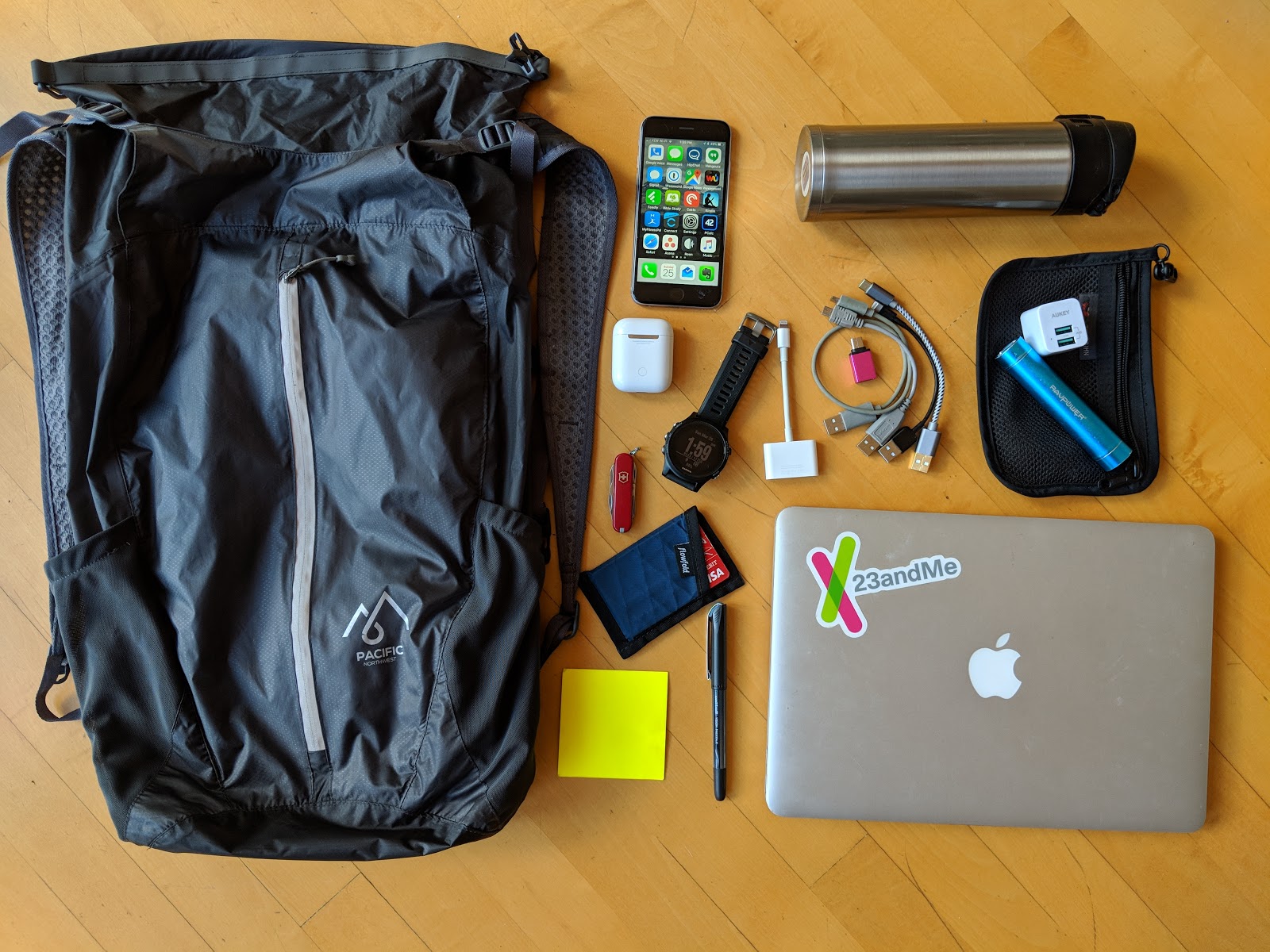
Flexon eyeglass frames with high index progressive lens. Seeing clearly is such a blessing. I break most frames within a year of getting them. Flexon last me several years. My current pair was purchased in 2010, though the lens have been replaced a few times when my prescription was updated.
Garmin 935 Watch: is a do everything watch which is light enough that I don’t mind wearing it everyday. It has decent integration with my phone and provides every fitness and activity tracking feature I want. I appreciate the alert on the watch when it loses bluetooth connection with it’s paired phone that reduces the likelihood of leaving the phone behind. There are a number of other sport watches I would recommend if you wanted to spend less money.
Victorinox Rambler Pocket Knife is the smallest, most usable tool I have found with a phillips head & flat screwdriver, scissors, knife, bottle opener, and nail file. Even though the blade is tiny, TSA will confiscate this knife. When flying I switch to a Swiss+Tech Utili-Key which is not as usable as the Rambler, but for years has made it through TSA checkpoints without being confiscated. I have notes on other knife options.
Apple iPhone 6 on Verizon. At some point I will switch to a new iPhone for a significantly improved camera. Apple’s iOS usability used to be superior to Android, but Android has mostly caught up except for management of audio I noted with the Pixel 2 below. I continue to use an iPhone because the rest of my family is in the Apple eco-system (iMessage, Photo sharing, iTunes, etc) and I like it’s more security oriented stance. I continue to use Verizon because I find their coverage best in the places I spend my time. Verizon is “overpriced”, but I value working coverage over saving money.
Apple AirPods have decent sound quality while letting in ambiance noise providing situational awareness, stays in place during the most vigorous exercise, no wires to get tangled, has good user interface with Apple products (would be perfect if I could change volume) and ok with others, acceptable sound quality, the ear buds run 5 hour, fully recharges in 20 minutes, with a carry case which can recharge them 4-5 times. With Apple products they just work! They aren’t rated for water resistance, but after more than a year of using them while sweating heavily, rides and runs in the rain they continue to function flawlessly.
Zojirushi Double Walled Mug (1 + 1*) can easily be used one handed, locks so it doesn’t open accidentally, pours at the perfect speed, the mouth is wide enough for ice cubes, and best of all does a better job insulating than any other double walled mug I have used. Liquids stay fairly warm or cold for up to 24 hours. I have a silver colored mug. I often misplaced it at work. When it was misplaced for more than a week, I purchased a replacement thinking it was lost for good. Realizing findability was important, I purchased a Deep Cherry color mug which is much easier to spot across the room. After several weeks I found my original Silver mug. Now I have the Red mug which lives at work, and the silver which I use when not at work. Zojirushi makes a number of other excellent styles of mug and Snowpeak makes a beautiful Titanium double walled mug.
Tech “Survival Kit” which is stored in a small mesh pouch. RAVpower Portable Charger/Flashlight is small enough to fit in my pocket while proving power to recharge my phone. Aukey Ultra Compact USB Charger is one of the smallest chargers with two slots and up to 2.4A amps. 6” USB Lightning, USB micro, USB mini, and USB-C cables with some adaptor tips which let me connect pretty much any two USB devices. A Lightning to HDMI converter. A USB thumb drive because sometimes I need to transfer / store files.
Macbook 13″ Pro Laptop. I have tried using tablets but still find myself prefering a real laptop. I would love to find a lighter and more compact laptop, but I like 13” screens, and am still pretty much committed to OSX because it has the applications I use and the good integration with iOS devices.
Matador Freerain24 is a nicely designed daypack which: carries well even when running, weights only 5.5oz, easily folds into it’s own pocket, and keeps contents dry even in the worst rain. I actually own a PNW Sea to Sky Waterproof Backpack which is a ripoff of the Freerain24.
Home Electronics
Roon software isn’t really an item, but it effected many of my decisions related to audio playback. Roon integrates my iTunes library which is made up of CDs ripped using ALAC codex with the TIDAL streaming service to provide loseless audio to multiple speakers around the house. Roon would be perfect if the remote clients supported off-line caching of music so playlists and favorite music was accessible when out of the house, and was a bit less buggy (it sometimes stops playing which requires me to restart the app on my Macintosh). I carry music on my phone by exporting play lists from Roon to TIDAL, and then use the Tidal client on my iPhone to do offline playback. If I didn’t care so much about sound quality I would be using Spotify which would make everything simpler.
KEF LS50 wireless monitor speakers with a built in DAC and amplifier designed for the speakers. Good quality sound that fills a room, excellent for near field use in a nicely designed, compact package. Can take TOSlink, USB, Bluetooth, analog, and several IP based streaming protocols inputs over ethernet or WiFi. Roon can stream directly to it over the network, but it’s not Roon-Ready so can’t be synchronized with other Roon-Ready systems. The iOS remote application is poor. I drive the LS50 via USB on a computer running Roon which remove the need for the KEF remote and the speakers can be synchronized with other Roon Ready end-points giving me whole house music. I still prefer the sound quality of electrostatic speakers with audiophile grade full electronics, but I am happy that I downsized my stereo so I could focus on other things.
Pulse Flex Wireless Speaker allows me to have syncronized whole house music since it’s Roon Ready. It also supports inputs via USB, Bluetooth, AUX, a number of streaming services like Spotify, and many free sites via URIs. Has a decent iOS and Android remote control app. Controls on the top let you select one of 5 user-defined “channels” without using the remote. I have the optional battery pack so it can be used in our backyard. It can be used away from it’s home, but you have to reconfigure it’s WiFi settlings which is a pain. Sound quality is significantly less than KEF LS50. For people who aren’t using Roon, I would recommend Sonos: for it’s lower price point, better streaming options, and slightly more processed sound quality which everyone but audio purists like me typically prefer.
Anker 60W PowerPort+ 5 with 1 USB-C and 4 traditional USB ports has enough ports to charge every device I use on a daily basis including my 13” MacBook Pro. When MacBook isn’t being charged can rapidly charge all my devices.
La Crosse Battery Charger which does a great job charging any combination of 1-4 AA or AAA batteries for Eneloop Pro Batteries are the best rechargeable batteries I have found. Near maximum capacity for the form factor while retaining most of their charge for months.
Olight I3S EOS Flashlight is slightly larger than the single AAA battery which powers it. Selectable output of 8,50,80 lumens permits the user to make a trade-off of runtime vs brightness. The combination of the flash on my Phone and the RAVpower Portable Charger/Flashlight should have rendered this flashlight unnecessary, but when I take walks around the neighborhood at night I find myself reaching for this tiny light. I have notes about other flashlight and headlamps.
Brother MFC-J880W Multifunction Printer, Scanner, Fax, Copier has been a reliable device for me unlike several other multi-function devices which failed within a year. WiFi enabled, supports AirPrint, Google Print, and several other standards.
Google WiFi Mesh network access points easily install and just work when you have an area than a single WiFi router isn’t sufficient. There may be faster / more featureful options out there, but the Google devices work flawlessly and are visually appealing.
Kindle PaperWhite* lets me carry the majority of my library with me and every book can be displayed with large print for my aging eyes. Love being able to quickly search for notes / hi-lighted passages. I miss physical books and knowledge retention with paper books is still better than when using an e-reader, but the connivence of the Kindle outweighs this for me. I often use the Kindle reader on my phone, but the larger display surface of the Paperwhite, much longer battery life, and usability in sunlight means the PaperWhite goes on most trips I take.
LG OLED55B6P SmartTV* purchased for the family movie night and other group activities that use a screen. I would be content using the screen on my laptop or even iPhone for the occational video streaming I watch. That said, the picture quality is amazing and the webOS based controls work well.
Westone 5ES custom In-ear-monitors (IEM) with excellent sound quality and comfortable enough to wear on 14 hour flights. They reduce noise by 35db which makes travel much less fatiguing for me while being much smaller and having better sound quality than active noise canceling headphones. Stored in a medium size HumanGear GoTubb with adapters.
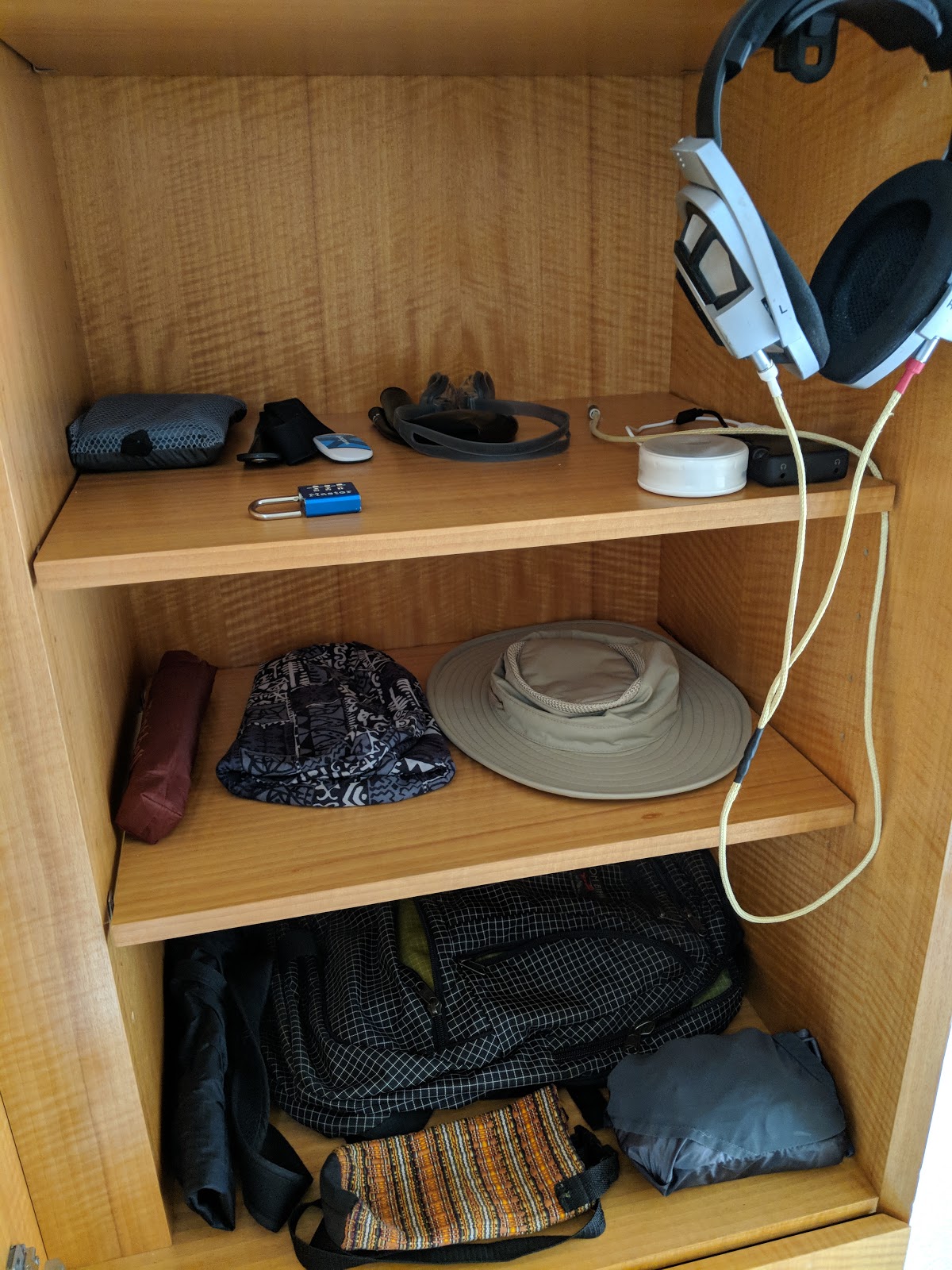
Sennheiser HD800 Headphones* for when I want very high quality sound and don’t want to bother others too much (sound does leak). These are the second best sounding pair of headphones I have ever used, at 1/3 the cost of the best (Stax SR-009). I have a headphones post with additional information.
Chord Mojo DAC* offers a nice design, good quality sound, good price / performance ratio, portability, has enough power to happily drive Sennheiser HD 800, and has an internal battery which enables it be driven via USB from phones and portable DAPs. I have written about other DACs.
Travel and Activities
Tom Bihn Synapse-25 Backpack is my travel luggage. Wonderfully designed with just the right amount of organizational features. Large enough for nearly every trip I have taken, while small enough that it fits under every seat I have used and has never been viewed as “luggage” by transportation operators. The laptop cache works brillantly. Have notes about other travel packs.
Patagonia Ultralight Courier Bag* is perfect size for day use and compact enough that I can pack it away in my backpack when moving between towns. Easy access without taking it off, in hot weather maximized ventilation, and can be used at the same time that I am carrying a backpack.
Water Bottle Sling Nancy brought back from South America. Great for days I just need water and nothing else. Sometimes borrow my wife’s Chico Water Bottle Sling because it can hold my water bottle + my umbrella or windbreaker.
Montbell Trekking Umbrella has the best balance I have found between small/light and canopy size. It has survived fairly strong wind/rain storms. In warm to hot weather much more comfortable than wearing a rain jacket.
PackTowel Ultralight (Bodysize/XL) dries amazingly quickly, is compact, and is very effective. The XL is large enough that I can wrap it around my waist like a small sarong. For awhile I used a medium/face size which packs in a tiny space. I found the face size sufficient for me to dry myself after a swim or shower, but I am willing to carry a larger towel for the added versatility and ease of use.
TYR Corrective Optical Performance Goggles so that I can actually see when I am swimming. I keep the goggles with a generic swimming cap because some pools require them, and small combination lock.
Stryd Footpad captures workout intensive better than using pace or heart rate. The Garmin Running Dynamics Pod might be a cheaper way to get the same sort of data. The RunScribe Plus now syncs to Garmin and other eco-systems and might provide more actionable insights about running form that other running power meters.
Wahoo Tickr X Heart Rate Strap because optical heart rate monitors aren’t sufficiently accurate for HRV measurements and aren’t responsive enough to track interval training. I mostly use it as a basic HRM, but if you use the Wahoo fitness app there are a number of other metrics that it can record. There are plenty of good HRM including Garmin’s Tri HRM which can be worn swimming and the Viiiva HRM which can be used to bridge other sensors between BlueTooth and ANT+. These days I mostly use Power rather than heart rate to track intensity, and the optical HRM on my Garmin 935 is almost good enough to replace the strap.
Clothing
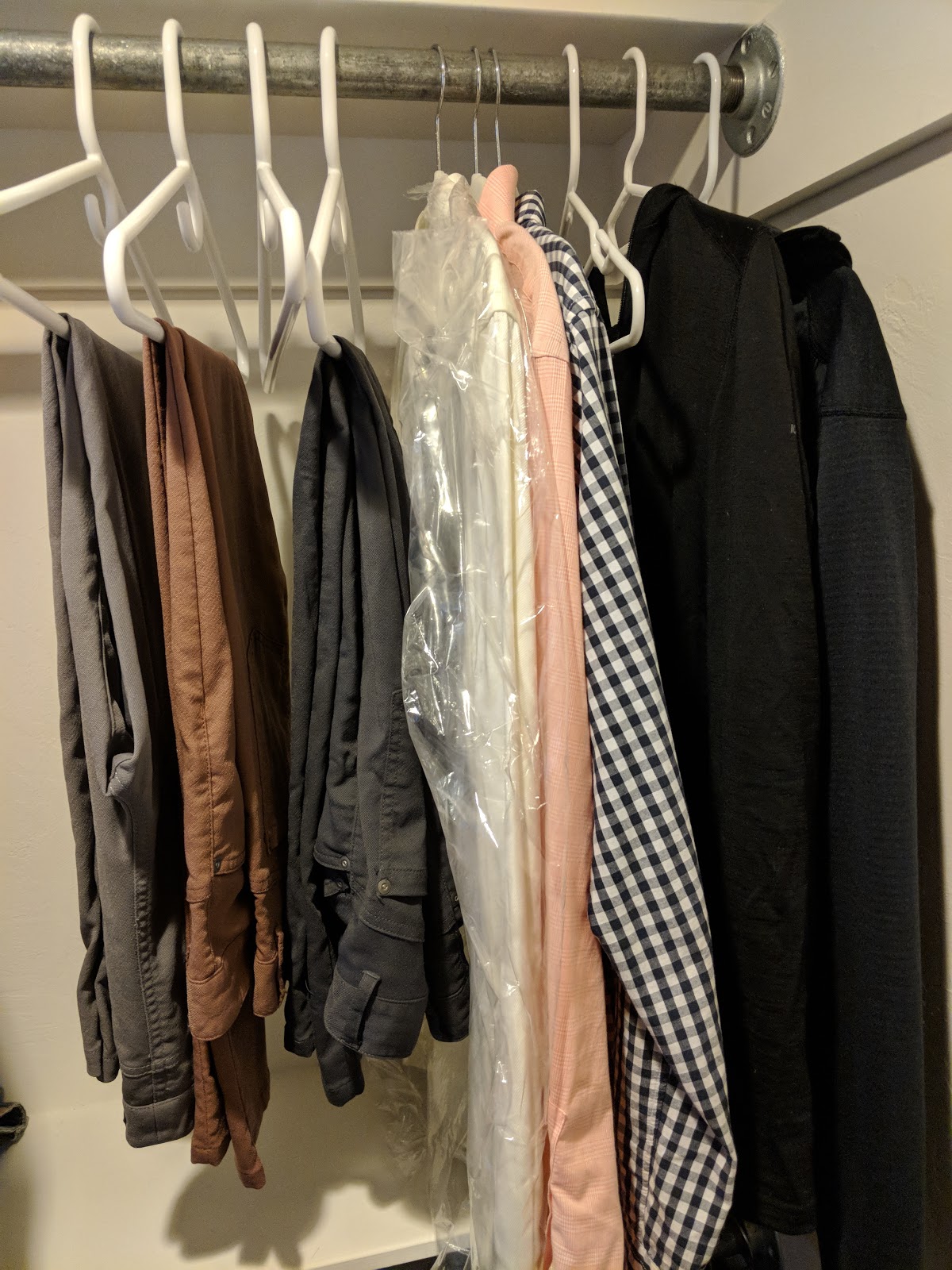
Pictured Above
I have notes about selecting clothing for an active life which goes in detail about how to select clothing for a wide range of activities and conditions.
PolarBuff is a versatile item which can be used as a neck cozy, balaclava, beanie, hair band, and in a number of other configurations. I typically use it as a beanie.
Tilley LTM6 Hat provides good sun protection while offering decent ventilation. I think it’s one of the more stylish hats which provides good sun protection. My wife says I am wrong… that my SunRunner is better looking, but is willing to put up with me wearing this hat when the sun is big. I have a list of other hats that you might prefer.
REI eVENT Rain Hat (not shown): a discontinued ball cap made from waterproof/breathable eVENT. Used when hiking or running when I know it’s going to be raining.
OR SunRunner Cap* (not shown) ball cap with a removal veil that is very packable. Downside is that it looks a bit silly when used with the veil and air flow when using the veil is less than when I wear the Tilley. I use this hat when I want some shade for my eye but don’t need a full brim, when I need a hat that’s more compact than a Tilley, or when I forgot to grab the Tiley hat (the SunRunner lives in the trunk of my wife’s car).
Mountain Hardware Grub Gloves (not shown) medium weight PowerStretch gloves with a quilted mitten cover which folds away into the back of the glove making it comfortable to wear in a wide variety of conditions.
Outlier Slim Dungarees (5) softshell pants in the style of jeans. Wonderful fit, looks good, excellent mobility. Thanks to the NanoSphere treatment very stain and water resistant. They are perfect except when it’s >80F and I am active. They seem pricy, but the per day cost of wearing is about the same as denim jeans. Maker & Rider makes a nice alternative.
BPL Thorofare Trekking Pants (not shown and no longer made which is a shame) are ultralight, ultra-compact pants which are surprisingly weather resistant, quick drying, and feel comfortable against the skin. They aren’t used in day-to-day life. I used them for cool weather backpacking and on trips where the weather is perfect for shorts (e.g. too hot for the Outliers) and I will need to wear long pants to be culturally appropriate. When the Thorofare pants wear out I will replace them something like Royal Robin Global Traveler, Patagonia Quandary, or ArcTeryx Rampart pants.
White Dress Shirt purchased to be worn with suit or blazer when more formal clothing is required.
Peach Button Down Shirt* for when my wife wants me to wear something at is a bit different than normal (for me).
Black Checked Button Down Shirt* for when my wife wants me to wear something nicer than a tee-shirt but less than a suit, white shirt, and tie.
Wool and Prince Blue Oxford Shirt* (not shown) is a blue dress shirt my wife loves. Crisp look and a slim fit while still having all the advantages of 100% wool.
Outlier Air Forged Oxford Shirt* Fits me well, made from durable nylon weave so it dries quickly and doesn’t wrinkle when traveling while looking nicer than many “travel” shirts.
Icebreaker Wool Hoodie: (4) Oasis 200wt merio wool hoodie with 1/4 length zipper. Worn when it gets too cool to wear just a tee-shirt. Icebreaker seems to have discontinued this model.
Patagonia Capilene Thermal Weight Hoody for cool/cold weather outdoor activities. Without wind protection the grid weave lets air flow through letting heat vent out. With a shell it insulates well. Comfort down to 30F when running without a shell, below that with a shell. When walking keeps me comfortable down to 40F when combined with a wind shirt. I am reasonably comfortable engage in high energy activities when it’s 65F by fully opening the zipper and pushing the sleeves up to my elbows. Dries amazingly quickly and feels more comfortable than any other shirt I have used when it’s wet.
Montbell Tachyon Windshirt (not shown) a 1.8 ounce wind shirt that can be compressed into something slightly larger than a cliff bar. Windshirts, especially when combined with a air permeable middle layer provide comfort over a huge range of conditions. I could use my Norvan SL as a wind jacket, but given the durability/expense of the Norvan it makes sense to use a cheaper jacket when I don’t need rain protection plus the Tachyon is lighter, more breathable and packs more compactly.
ArcTeryx Norvan SL Rain Jacket is one of the lightest, most breathable rain jacket currently available. I can actually wear it comfortably jogging in cool, rainy weather. Other options are discussed in my post about rain gear.
Zpacks Vertice Rain Pants are simple, light, breathable, waterproof rain pants. Used when commuting by bike, hiking, or backpacking in the rain.
North Face TKA80 (not shown): Fleece which is lighter weight and less bulky than most. I love the convenience of a full zipper. Unfortunately this has been discontinued. Montbell’s Chameece Inner Jacket would be a good alternative. My wool sweater can be worn in a wider number of situations, but isn’t as convenient or durable.
Mid-Weight Merino Wool Sweater is a bit less convenient to take off/put on compared to a full zipper fleece, but provides similar insulation and is much more appropriate to wear to a business event or when going to a nice restaurant.
Uniqlo Ultralight Down Vest is decent quality, low price, with just the right amount of insulation for me. Combined with my sweater and a shell keeps me warm enough in the coldest weather I normally encounter.
Patagonia Down Shirt with 23andMe logo. Even though it’s bit more insulating that I need around town, I want to show my company spirit and my wife thinks it looks better than the combination of the above items. The Patagonia Micro Puff Hoody using PlumaFill insulation would be better for back country use thanks to it’s superior water resistance. The Montbell inner down jacket continues to be the price performance champ, and Uniqlo’s down jacket is a good alternative for someone on a tight budget.
Boss Blazer Jacket. Used when going out and it’s appropriate to be wearing something more dressy than a hoodie, but a full suit is too formal. I often wear the blazer over my tee-shirt rather than taking a more traditional “outdoor” jacket.
Boss Wool Suit slim/european cut in suit cover bag. Fits me perfectly though not bespoken. First suit that I wear rather than the suit wearing me. Light enough that it’s usable in the summer. I use it anytime I need to be very dressed up: weddings, funerals, special nights out on the town. Have two ties… one that is “serious” and one that is “fun”
Outlier New Way Shorts (4) are nice looking shorts which fit me perfectly, don’t have cargo pockets, are durable and dry reasonably quickly. I am sure there are less expensive shorts that I would like, but I don’t need more shorts so haven’t bother to look.
Zootsports Performance Tri Shorts works well cycling, running and swimming. They are comfortable for all the activities I engage in, in a wide range of conditions. They have reduces issues with chaffing, dry fairly quickly, and are reasonably comfortable when wet. They have side pockets large enough to hold some nutrition and my phone so I don’t need to use a special cycling jersey. I never need to think about what shorts to wear when I am going to engage in vigorous physical activities…. I just grab my pair of zoot.
Icebreaker Anatomica Tee-shirt (5) merino wool with just a bit of lycra for a body hugging fit. This tee-shirt fits me perfectly, looks good, is super comfortable, doesn’t smell after several days of wear on the road, and dries fairly quickly. There are two downside. First, they are pricy especially in view that they wear out more quickly that a cheap cotton tee. Second, they don’t work as well as synthetics when engaged in high energy activities where you are sweating a lot. There are a number of other good merino wool shirts from Smartwool, Outlier, and Wool&Price.
Icebreaker Long Sleeve Oasis Crew (not shown) orange & grey color which was a Christmas gift from my wife to add some color to my wardrobe.
Columbia Omni-Freeze Zero Shirt: Picture shows a blue shirt which has been discontinued, but there are other models which use Omni-Freeze fabric that helps cool when working out in moderate to hot conditions. Pretty much any “runner” weight shirt would work well.
Icebreaker Anatomica Briefs (7) the most comfortable underwear I have worn. Downsides are that they start getting holes after a year and they are expensive. Some people prefer boxer style but I see no reason to have extra fabric on my thighs. Good alternatives are the synthetic travel oriented briefs from Ex Offico and the comfortable but expensive underwear from Saxx.
Darn Tough Socks (8) are unsurprisingly durable since they come with a lifetime warranty. I found they fit and perform very well and come in a wide variety of thicknesses, lengths, and colors. I like the endurance light socks. Icebreaker and the Smartwool PhD line are good alternatives.
Injinji Ultralight Toe Socks (2) for long distance runs / hikes. Generally I prefer wool, but I found light weight wool toe socks get holes very quickly.
Rocky Gore-Tex Socks are the best way I have found to keep my feet reasonably clean, dry and warm in messy back country conditions. Often worn with Keen sandals to maximum breathability and speed drying once they are out of the water.
Keen Clearwater CNX are the lightest sandals Keen makes. I liked the minimalist sandals made by luna and Xero Shoes but the toe protection of the Keens makes them a clear winner for me. If worn with gray socks they can pass for shoes. Comfortable in a wide range of conditions. I can run in them when I don’t have my Alta running shoes with me.
Alta Running Shoes are the best running shoes (trail and road) that I have used. Wearing these shoes with toe-socks has allow me to do marathon length runs and 20+ mile days backpacking with no blisters or foot pain. Just one week after purchasing my first pair of One V2.5 I completed the Big Sur Marathon without issue. I like the models with minimal cushion. I currently use One V3 for road running and the Superior V3 for trails.
Vivobarefoot Gobi II are extremely light weight, zero-drop, minimalist ankle boots which can be worn with casual clothing and my wife tells me they are acceptable to wear with a suit. Love them because they are light weight and comfortable. Two downside are that they take longer to put on and take off than low rise shoes and my feet can feel tired if I have been walking 14+ miles each day, for several days.
Carots Shoes* are formal looking zero drop shoes. These are the only minimalist shoes I have found that looks like traditional dress shoes (heels and and tapered toe) that are sufficiently comfortable for day long wear. These were purchased before I discovered that the Gobi II were acceptable footwear with my suit.
Skinners* (Not Shown) Socks with durable flexible coating on bottom so they can be used like shoes. Small and compact. Use as slippers, when I biking somewhere and then want to walk around without cleats, or when I am in the mood for barefoot running.
Topo Running Shoes* (Not Shown) are zero drop minimalist running shoes. My model is a bit lighter than their current zero drop road running shoe. These shoes live at work for the days I ride my bike and don’t want to clomp around with cleats all day.
Bathroom
Withering Body WiFi Scale (Not shown) makes it easy to track weight which is well integrated to Garmin, Fitbit, MyFitnessPal, LoseIt, and numerous other health tracking eco-systems.
Oral-B/Braun 4000 Electric toothbrush (Not shown). Oral-B and Sonicare both make excellent toothbrushes which are significantly more effective than using a manual toothbrush.
REI Micro Shower Bag is the perfect size for my toiletry kit while providing just enough organizational features to make it easy for me to find everything quickly. Holds a number of the items listed above in the “bathroom” section.
Gillette Mach-3 Razor + Pacific Natural Shaving Oil. I am sure there are better razors and many people would suggest that shaving oil is a prep step which should be followed by shaving cream… but I have found this combination effective, reasonable cost effective, and compact when traveling.
Listerine Floss (use to be Reach) is the most effective dental floss I have used. Gentle to the gums while still getting plague and food wedged between teeth out.
Small first aid kit which includes waterproof Band-Aids, antiseptic wipes, anti biotic cream, superglue, a couple of safety pins. Small size HumanGear GoTubb to store aleve and a few nyquil caplets.
Ziplock bag with two weeks work of supplies: dropper bottles filled with Dr Bronner Soap, Shaving Oil, shampoo, skin lotion, and a few single use woolite packets
Cervelo R3: pricy but amazing road bicycle. Comfortable enough for an endurance ride, but responsive like a race bike. Fitted with an Infinity Seat, and a small seat bag which holds a pump, inter-tube, bike tool, and 2 tire levers. Moots makes some great Titanium bikes but you have to special order them.
Power Tap P1 Pedals because I like objective measures about how my physically conditioning is changing. The Garmin Vector 2 pedals integrate better into the Garmin eco-system, use standard Keto cleats, and are lighter / more streamlined at about the same price point.
Cygolight Expilion Bike Headlamp are bright enough to illuminate when I am riding fast and has a swappable rechargeable battery. Have a Cygolight HotShot rechargeable taillight.
Giro Air Attack Shield Helmet provides protection, good ventilation while having a very streamlined aerodynamic profile. Has snap on optical shield which is great because with my eye prescription, it’s hard to find sports oriented sunglasses. If you ride a bicycle, wear a helmet!! I am alive today because I was wearing a helmet when I was in an accident. Giro has newer models which have better ventilation and aerodynamic profile and also cheaper models that will protect your head.
Bicycling Shoes with Cleat for PowerTap peddles.
Wahoo Fitness Kickr* is a great trainer for when you can’t get outside. Integrated power meter and variable resistance which can be controls via ANT+ or BlueTooth. Wahoo build the Kickr with an open API so there are numerous companies which have applications which can control the Kickr.
Backpacking
I have a separate 3-season packing list which makes use of a number of the items on this list and has several items which are specific for backpacking.
Sentimental
There are a few items I have kept as a specific way to honor people I have lost.
Libby’s pins of a nativity scene and of a mother and child. Originally worn by Libby on special occasions they became daily decorations for the hats she wore during chemotherapy. They remind me of Libby’s courage and the two things most important to Libby, family and Jesus.
Carl’s Rolex Oyster Watch to remember his craftsmanship, love of teaching, and ironically his frugality. Jules’ sculptures of musicians made from nails because he passed on a love for music and art.
WWII Era Wool Blanket (not shown) Originally owned by Carl or maybe even my grandfather. It has been on countless fishing and camping trips and to virtually every picnic and outdoor concert I have ever attended. Everything I see the blanket I think of my dad and many wonderful moments.
Recently Retired
Google Pixel 2 on Google Fi has great integration with Google Apps, a best of class phone camera, and I find Google Assistant much more useful that Siri. In the locations I frequent in the USA, Google Fi has coverage that is competitive with Verizon and better than any of the lower cost carriers, while still being one of the cheapest plans. The plan really shines when traveling internationally, providing good coverage which is hassle free at very reasonable prices. I hoped the Pixel 2 on Fi would become my primary phone, but I found it’s management of audio (switching between built in speaker/mic, bluetooth ear buds, car bluetooth, and a USB DAC) to be buggy / inconvenient compared to the iPhone. In situations where the iPhone would automatically switch just as I would desire, Android would stay stuck on a particular audio output channel. I would have to go into the control panel and manually disconnect and maybe unpair/pair a device to get the phone to select the correct audio out I wanted to use. For me, this was a deal breaker. My son is now enjoying this phone.
Timbuk2 Classic Messenger Bag (Small, Coated Nylon) is just the right size for my day to day needs with just the right amount of organizational pockets. I prefer courier style bags over backpacks because they are easier to access on the go and leave my back with more ventilation. This has been the bag that has carried my daily items to work 2001-2018. I appreciate that it is waterproof, and the fabric is heavy enough to retain it’s shape, but light enough not to be a burden. Retired because I am running rather than biking to work, and the bag is looking scruffy.
Pilot Precise V5 Extra Fine Pens are the nicest flowing pens I have ever used but often leak after air flights due to pressure changes.
Arc’Teryx Atom LT Jacket is a lightly insulated jacket with side panels which are very breathable. A useful mid-layer insulation layer which looks good around town, and performs well in the back country. Was retired when I started to use my 23andme down sweater.
Salewa Ramble GTX Shoes are attractive leather shoes which are breathable, waterproof and provide all day comfort. Generally I prefer more minimalist shoes, but wife really likes the way these shoes look, and apparently a lot of other people do too because I regularly get asked where to buy a pair. Replace by Gobi II which are more comfortable.
Vibram Five fingers shoes for running about backpacking. Loved the lightness, ground feel, and lack of blisters, but I kept stubbed my toes when on trails. Retired when I found Alta shoes which give me the blister free experience I first had with the five fingers while providing more protections to my toes.
Francis Schaeffer observed that we live in a world that worships “personal peace and affluence”. Our culture tells us that we should put comfort above all else which leads to a self centered life. Advertisers buy our attention to convince us more stuff will make our lives better. They tell us we should “keep up with the Jones” if not the rich and famous. This encourages us to be dissatisfied with what we have rather than to be grateful. This sort of outlook leads to a consuming hunger that never satisfies our hearts. Additionally, once we have upgraded one item, many are affected by the diderot effect driving an upgrade of everything we own.
Minimalism has been a useful tool for me. I like Joshua Becker’s definition of minimalism found on his blog becoming minimalist “The intentional promotion of the things we most value and the removal of anything that distracts us from it”. Minimalism in its best form is about making space for what’s most important. Marie Kondo realized that spending time with her kids was more important than being perfectly tidy. Brian Gardner points out that minimalism isn’t about stuff, but redefining our relationship with “stuff” is often the starting point for people on a path toward minimalism. The book The Longing for Less points out that minimalism can lead to a dark pattern of favoring style over substance.
I would recommend Josh Becker’s book Minimalist Home: Room by Room for people are trying to minimize stuff in their home.
My Path
I was first introduced to the idea of minimalism by watching my dad’s example. It wasn’t called minimalism… we called it simplicity. If something was working, no reason to upgrade it. No reason to buy something to impress others… function ruled. My dad’s greatest pleasure might have been simply being outside, experiencing nature. I learned to love simplicity and nature. I dreamed of building a small sustainable cabin like Henry David Thoreau described in Walden. I didn’t want to be weighed down by lots of stuff, with the possible exception of books and music.
In college I became a Christian and joined a church community that leaned toward a communal lifestyle dedicated to service. I was introduced to the Christian discipline of simplicity by Richard Foster’s writings, was challenged by a talk by Ralph Winter about a wartime mentality and Ron Sider’s book Rich Christians in an Age of Hunger. I tried to resist the “gospel” of personal peace and affluence. I desired a life which was light on stuff and heavy on meaning and purpose.
I found that getting married and then having a child made it harder to maintain a minimalist lifestyle. It’s not that minimalism is incompatible with being a good spouse or parent, but when more people are involved, it gets more complicated. It’s often easier to just add an activity or item than to figure out what would be most valuable to the family as a whole while not overly restricting any individual. In the quest to provide the “best life” for my family, more got added than was necessary. We resisted giving fully into the consumer oriented culture: we drove a modest car, purchased a house that was affordable on one income, kept commute short, was generous to charities, and tried to put time into activities that mattered. Still, life grew ever more full with things and activities that didn’t matter to me. What’s sad is some of the things and activities didn’t really matter to the rest of the family either… I just thought they did.
In 2011 life was uprooted when I lost my wife Libby to cancer. I found myself in a new chapter of life. I wanted a simpler life full of meaning. I was concerned that I would pass on my dreams because I was afraid to give up my high-tech salary and the comforts it purchased. I decided that I needed to learn to live with less stuff and less money so that I would be free to pursue whatever God had for me. Six years later I share my life with my new wife Jackie as we seek to live meaningful lives. My gear and family gear pages list what we are currently using.
Simplify Clothing by Adopting a Uniform
Many of the articles I read about minimalism suggested the first place to start downsizing is clothing. It’s one of the easiest areas for people to take a more minimalist lifestyle, and it’s something that you experience every day. People often start this process by removing clothing they no longer wear. Project 333 is one way to explore this. As people gain experience they often build a capture wardrobe (for some ideas women check out build your first capsule, capsule that lasts, men rank & style, how to make a capsule) which select a small number of clothing items that can be mixed and match, often with some accessories which can change the “look” of the outfit.
My approach was a bit more radical. None of my clothing fit well because I had just lost more than 30 lbs. I decided to purchase all new clothing and then give away all my old clothing except for my sandals and running shoes. I had read about wearing a uniform in Insanely successful men wear the same thing every day and the women’s version why i wear the same thing to work everyday. I was intrigued by some of the traveling minimalists whose clothing fit in a small daypack. I purchased only what I needed and would be happy to wear every day. It was summer and I had nothing that required me to dress up. I purchased 3 pairs of shorts, 3 black wool tee-shirts, underwear and a windbreaker. I picked the number 3 because this would be enough for me to go at least a week between wash days. In the fall I added a few pairs of long pants, a wool hoody, and some winter outerwear. As Christmas approached I purchased a suit, a tailored button up shirt, and a pair of nice shoes for a friend’s upcoming wedding and so I had appropriate clothing to attend an unforeseen event that required more formal clothing, like a funeral :(.
I love my “uniform” for several reasons. The first reason was unexpected. Every time I put my clothing on I feel grateful. My clothing are comfortable and feel like “me”, not a costume I am wearing to please others. I found my heart content. Second, I enjoyed the simplicity of life and that I was eliminating unnecessary decisions. Every morning I will take whatever is on the top of the stack of nearly identical items and get dressed which requires no thought or planning. Finally, I found I spent a lot less time “shopping” and am able to resist “deals” which used to lure me to buy things that I really didn’t need or enjoy wearing. I can now immediately tune out advertisements because my uniform is all I need. I only purchase clothing when something is wearing out, and then it’s a simple replacement… I purchase the identical item.
Update: Between 2021-2025 I lived a mostly nomadic life. I decided to reduce the clothing I used to something that fit into what budget airlines classify as a personal size bag to keep travel expenses low, give me great freedom while in transit, and as an experiment to see was the least amount of stuff that would allow me to live the lifestyle I wanted. I used a 23 L Gossamer Gear Vagabond (my packing list). This required changing some of my clothing to items that worked over a wider range of conditions and would reliably dry in less than six hours in non optimal conditions. This meant I swapped several items in my “uniform” to items that were usable in a wider range of conditions. Alas, these replacement items are not as optimal for specific conditions (e.g. jack of all trades master of none). Now that we are living in our home again, I have retrieved the clothing that was my original uniform from storage, and added them back to my daily rotation.
My nomadic experiment taught me that it is possible to fit clothing which covers conditions that ranged between 20F-100F in a personal size bag, but this required me to be more focused on “stuff” which sometimes took energy away from the rest of life. Going forward I plan to:
Use an ultra minimized uniform when engaged in purposeful journeys which involve a lot of walking, such as when we did the Camino. This simplicity was joyous.
When traveling in a single “climate”, use my normal uniform which lets me go 7 days between washing and fits into a personal size bag.
If I am going to be in widely different climates on a single journey use a carry-on size bag, and use my “normal” uniform in each of those climates. The extra airfare and weight to carry is worth the simplicity / quality of experience in day to day life.
Declutter Home
Once I had cleaned out my clothing closet I decided to declutter the rest of the house. I started with some basic principles from the book Organizing from the Inside Out which stressed everything should have a place near whether it was used, ideas from web page Declutter Every Room in Your House and a few few practices from Marie Kondo’s bookSpark Joy. I decided that the best thing for me would be to work on one room at a time, get the room completely finished and then move onto the next room. There are several decluttering strategies which have helped others.
I started with the kitchen. The drawers were filled with countless utensils, many of which I didn’t use and often were on top of the utensils I was looking for. I pulled everything out of the drawers. In the process I found that we accumulated several of the same utensils because we “replaced” an item we had “lost”. Once the drawers were emptied I selected only the items I was sure I would use at least weekly. I thought about how I worked in the kitchen and stored the utensils near where they were used. Everything else went into several boxes placed in the garage. I found that a bit of creativity often allowed me to avoid the hassle of going into the garage to retrieve the rarely used utensil. Over the next six months I retreived just few items from the garage. After six months I gave all of the unused utensils away. I found the streamlined kitchen made cooking more enjoyable. When I needed something, I would pull the drawer open and immediately see what I needed. I also found that a well organized drawer was attractive to my eye compared to a drawer crowded and filled to the brim with items.
Once the kitchen was completed I worked through the house using a method similar to Declutter Every Room in Your House. After the “first pass” I just continued to remove things that weren’t added value to life using principles very similar to Colleen Madsen’s Ten Principles to Help Anyone Clear Clutter. There are plenty of other articles, blogs and books about minimalism that have been helpful as I trying to simplifying “stuff” in the house, but most don’t add substantially to Colleen’s simple post. After a while I found material on minimalism to be a bit repetitive, though each person has a different backstory to tell which can be inspiring.
When Jackie and I got married we combined out households. Thankfully, we were quite compatible and found that we both wanted a fairly simple and uncluttered home. The number of “family” items grew slightly compared to what each of us would have had in a house by ourselves, but way short of doubling. For example, the core of our kitchen is pretty much the same as what one of us would have owned (Jackie’s plates, my mugs, a mix of our glasses). There was some growth where one of us used something regularly that the other didn’t such as Jackie’s wok, and my baking pan and blender. Our extras were used to equip other households.
We saw a great benefit from our minimizing when we moved out of the house I had lived in for 26 years. We managed to pack the house on Friday in 10 hours and were fully moved into our new home by the end of the weekend: all our stuff was put away, all the moving boxes were folded flat, and pictures had been hung on the walls.
Challenges to Minimizing Stuff
I used to struggle giving things away because I might need them some day. I have come to believe someday is often so far away it never arrives. Meanwhile, the items sits around, taking up space and not being used. Something that has really helped me let go of currently unused objects is that I can imagine the object I am no longer using crying to fulfill it’s purpose. It’s saying “I want someone to love me”, much like the toys in the movie Toy Story just want a child to play with them. If I am not loving the object by using it, I am happy to sent it to a home that will love and care for it. As I have practiced downsizing, it has become easier as my confidence has grown. There are only three times that I gave something away, only to discover I really wanted it back. In each case, I was able to re-aquiring the item without difficulty or a high cost.
Sometimes I know it will be difficult to re-aquire an item because it’s one-of-a-kind, handmade, or no longer manufactured. In these cases I will set these items aside in a “holding” box. If I don’t think about these items in a year, I give them away on the theory I won’t miss them in the future because I will have forgotten I ever had them.
The harder I worked to acquire an object the less likely I felt comfortable giving it away or selling it. I would focused on the labor I had invested. I have come to appreciate that rather than thinking about what it cost to acquire an object, I should think about the cost of replacing it in the future. These days using services like Amazon, eBay, etc can significantly reduces the work to find the right object, and ever increasing efficiencies in industry often reduces the cost of items over time. When factoring in the cost of storage, it is often cheaper to sell or give away an item, even if you will need to repurchase it several years later.
Another challenge are items that have sentiment value. I came to realize that pictures are almost as good (sometimes better) to promote good memories that the item would trigger, while requiring no physical space, and are easily accessible anywhere at anytime. So I tag these special photos so I can easily immerse myself in memories. There are some sentimental items I have held on to which I specifically choose to keep as a way to honor someone who was very special to me.
The final challenge was the sunk cost. I had spent money on the item. In most cases I would get significantly less money when I sell it than when I purchased it. I comforted myself by thinking about the value I got from the item when I used it compared to the amount of value I would get in the future with minimal use. I think about the joy others would get from using it.
I found that the hassle of selling, especially the emotional roller-coaster of trying to get a “fair” price was a high emotional cost which delayed my selling items. Ultimately I developed a simple system. I would look to see what my item sold for on eBay. If it was less than $40 I would give it away. I don’t like Goodwill. I look to get the item to people who will actually use them. Clothing goes to homeless shelters or taken to events (like activity meet-ups) where people use the items I am getting rid of. Items over $100 I try to sell of craigslist to avoid the hassle of shipping. If no one was interested in the item I sell them on eBay.
My Biggest Challenge: Books
The most difficult thing for me to downsize was my book collection. To me, books are sacred. I grew up in a family that cherished books and learning. I like to think of myself as educated and an intellectual… having lots of books is part of that self identity. When I started to downsize my book collection I had eleven, or was it fourteen, full size (36″ x 72″) bookcases completely full, often with books double deep. I couldn’t bring myself to part with my old friends in one go, it took several years.
I started by looking at large reference books since these had the lowest emotional attachment and took a disproportionate amount of space. Those no longer used, or that could be replaced by resources freely available on the Internet were given away. I replaced any reference materials I used regularly with electronic versions. Even though this cost money, it saved space and made the materials more useful to me.
Next, I went through my books and asked the question “Is this a book I am likely to re-read or recommend to someone in the next few years?” If the answer was no, I gave it away. I was down to less than five bookcases.
The first difficulty were books I hadn’t read. Often there is a reason I haven’t read the book after purchasing it. Maybe I started the book but just couldn’t get “into” it. Maybe my interests changed or I had purchased the book because someday I knew I would be interested in the topic. It seemed wrong to give away something I hadn’t used, but I realized I didn’t have enough time to read all the books I am interested in. Keeping these unread books just made me feel guilty. Any books that I didn’t have hopes to read in the next year I gave away.
I changed tacts to identifying books I really wanted to keep. I asked the question “Which of these books changed my life or I think it’s so great that it might change someone else life?” Those got put into a special bookcase, set off to be scanned, or in some cases purchased for my Kindle and given away.
For all the remaining books I asked “Can I get this book again?” I looked up each book on Amazon. If it was still in print I put it on an Amazon wishlist and I gave the book away confident I could get it back if I needed to. What’s left? Less than one bookcase of largely out of print books. Every quarter or so I looks through the remaining books and ask the question “Do I think I am going to ever read this book or loan it to someone?” Each time I do this there are several books my answer is”no”, and they get donated to friends of the library. If you are struggling with downsizing books you might appreciate the post 6 Mindset Hack to Declutter Books.
2022 update: Of the thousands of books I have given away, there are less than than a dozen that I have re-purchased, and only one book that was a bit of work to get. I am generally glad that I pruned my books, but there have been some costs. I find it harder to find information that I had learned in the past. The physical books, arranged by topic make it easier to retrieve memories. Being surrounded by books, especially the unread books, often inspired me in a way that ebooks don’t. Nassim Taleb has inspired several articles about the value of the anti-library (unread books), and having more books than you will ever have time to read because it keeps us aware of all that we don’t know. The Japanese call this tsundoku.
The Process Continued
I considered doing the 100 Items Challenge, but decided my attention would be on how to curate possessions rather than on living. Rather that shooting for a particular number, I just asking the question “Does this item enrich my life on a regular basis?”. If the answer was yes, I would keep it. Otherwise it went into a box that would ultimately be given away or sold. I repeat this pruning exercise at the end of each year. I posted a Great Stuff for Me which records where this process has taken me. Along the way there were a couple areas that took some focused attention.
Electronics
I had to work at simplifying electronics… I am a technologist and a geek. I consolidated all the data I needed onto my laptop (backed up into the cloud) which removed the need to have a file server in the house. I stopped running a computing infrastructure appropriate for a medium size business by switching to use Google Apps and a few other cloud services. In the process I got rid of several servers, a lot of upkeep, and a number of older computers I was holding on to “just in case”. Three large moving boxes filled with cables was reduced to three quart size ziplock bags. I realized I really didn’t use the home phone and answering machine so they were dropped and I just used my cell phone. Rather than multiple portable audio devices I decided I would use my phone or if I didn’t have my phone, forgo music. Rather than having multiple stereo systems with a complex (and somewhat fragile) streaming infrastructure I switched to a single system based around my computer and audiophile grade powered speakers.
Cameras
Camera equipment was another area that took a fair amount of work. I had a high end pocketable camera that I had with me always (a Sony RX100) because you never knew when you might need to take a picture. I had a camera that was particularly good for in low light conditions without a flash that was perfect for candid shots at events. Finally I had a couple of camera bodies, and numerous interchangeable lens. I had several tripods, flashes, and camera bags. One camera bag could hold nearly all my equipment. Another was good for outdoor events, and I had my original Domke F-5XB which I used whenever I wanted to minimize the amount of camera gear I carried. Every time I was going somewhere I would have to figure out what camera gear to take, and then what bag to use.
My downsizing came in three stages. The first was reducing my gear down to the pocketable camera which I always carried, one camera with a couple of lens, and some accessories which would fit into the Domke bag. If an event was “photographic” in nature I would grab the camera bag, otherwise I would use the pocket camera. After awhile I noted that I wasn’t grabbing the camera bag very often. I just didn’t want to carry it around. I was mostly happy to make do with the pictures from my pocket camera. A couple of years later I realized that I wasn’t happy with my pocket camera. My camera didn’t focus as fast as my phone (the newest version of the RX100 is much better), it didn’t geotag pictures, and was too big to be in my pocket all the time. I also noted that while the RX100’s image quality was better than my phone camera, I found the Pixel 2 and the iPhone X to be “good enough” in most situations. I sold my RX100.
Now I am using the camera on the iPhone and am generally happy. I can always rent equipment for a specific event, like when we went whale watching or for a trip to Hawaii. Most of the time I would rather focus on the event than hassle with the camera. Besides, there is almost always someone else with a good camera who is happy to share the images they captured when were were together. The best of both worlds.
Update 2025: Every few years I have purchased and then sold a compact cameras that I hoped would produce better image quality with better UI than my phone. This has included a Sony RX100VI, a Panasonic LX100II, and a Panasonic GX9 + pancake lens. I am back to using an iPhone for pictures. Based on past experience, I don’t think I will be content with a compact camera. If I was really going to devote myself to photography, it would something with a larger sensor (Fuji, Sony interchangeable lens, Leica)… but I know I am not willing to carry it with me at this time.
Shopping Diet
In the middle of 2016 I went on a “shopping diet”. I decided that I wouldn’t purchase anything new for myself in the next year except to replace (1:1) items that wore out or broke. Of course I would buy food, pay for activities, and I let myself purchase kindle books that whose price had dropped more than 80% since I put it on my wishlist. I also permitted myself to purchase gifts and items needed by other family members. I was amazed at how much of an impact the shopping diet had on my time and focus. I never realized how much the constant bombardment of “deals” I see in social media drove my consumption. Even if I didn’t ultimately purchase the item it ended up taking time as I researched the deal and spent time wondering if this was something I might need. Now I just ignore any “deals” I see. I started to experience that “it’s better to want less than to have less.” After a year I ended my diet for a few months, but found shopping started to take more of my time and energy, so toward the end of 2017 I decided to make this a lifestyle. At the end of the fall and spring I review my list of item to potentially purchases, buying just those that were still compelling and be glad that I avoided more than 70% of my purchase impulses.
In 2021 My wife and I were talking about retirement. We decided to rent our house and try living in different cities. This meant a bit of streamlining of the house so others could live in it, and getting the items we used daily down to something that would fit in our Mini Cooper, if not luggage when we flew to our destination. As of 2023… my core items fit in a 23l daypack. I have a 26l bag which holds items I use through the year but aren’t currently needed. I have a 75l Ikea duffel bag which is storing clothing I am not going to use in the next 2 years, and 75l box which is holding all my outdoor gear except for my bicycles.
We periodically stay in our home for month at a time. This allows us to access our storage, give the yard some extra care, and enjoy the home we love. When it’s time to continue our journey it takes a couple of hours to “depersoanalize” our house (pack luggage, move extra clothing into storage, box up our irreplaceable items). Our cleaning service does the final prep and we are off for several more months.
I am not a sound engineer or music producer. I do consider myself am an audiophile because I really care about the sound qualty of the music I listen to. Unlike some audiophiles, the audio equipment is only a means to an end and not part of my audio hobby. As a result, I tend to hunt for audio equipped that delivers the sound quality I desire, and then don’t think about audio equipment for years. Eventually an external event triggers a re-evaluation my equipment such as a move into a new space, a fundamental shift in technology, or equipment dying. For me this meant I spent time evaluating equipment in 1978 (first real system), 1993 (move, switch to CD), 2006 (computer audio and kids), 2012 (lost wife), 2017 (remarried and moved). I am willing to spend hours evaluating equipment blind A-B testing, etc to find equipment which made a significant improvement in sound at what I considered a reasonable price.
Reasonable Investment?
In this age of lossy streaming audio, smartphones, earbuds and bluetooth speakers spending thousands of dollars on audio equipment would not be considered “reasonable” by many. On the other hand, I invested around $6000 + $6000 worth of music in an audio system I used for 19 years which gave me significant joy. That works out to around $1.72 / day, and less than $0.40 / hour. That is less than many people spend each day on coffee. I think it’s been a good investment.
I often tell people that they should only spend money if they hear a difference. I am sure there are experts who can tell the difference between excellent speakers which cost $10K and the ultra high-end $100K speakers, but if you don’t heard a significant different compared to a $300 speaker, there is no reason to spend the extra money.
Audio products suffer from diminishing returns. Improving sound quality of higher end products requires significantly more money. For me, “reasonable” has been components which I though delivered an excellent return on investment (e.g. before the quality to price graph is growing exponential). I generally end up with components which are classified by Stereophile as class B (or restricted class A) whose price was at the lower end of what was typically classified class-C. For most components careful selection keeps the cost under $1k, though speakers are likely to be in the $2-4k range.
I can hear the difference between good quality lossy (AAC 320kbps, VBR LAME) and CD quality lossless.
I have not been able to hear a difference between 44/16 encoding and 96/24, SACD, Pogo, and other high resolution encodings, nor analog (eg vinyl).
My media is mostly CD ripped into Apple Loseless, or loseless streams
I do use Spotify when building/listening to playlists with/for friends and family because that is the eco system they live and that Bluesound supports.
Equipment
KEF LS50 wireless speakers primarily driven by Bluesound Node via USB cable
Bluesound Node streaming device. Playing lossless RIPPed CD from an SD card, driven via AirPlay via Apple Music (Lossless), or via built in streaming service end-point (Paradise Radio, Spotify, etc). Used to use Roon, but bugs led me to give up on it and using the native BlueOS system.
Bluesound Flex 2 Wireless Speakers + Battery Pack which provides ambient / a part of a whole house music and can be used in the backyard. When traveling 2 are configured as a pair to provide stereo sound.
Apple AirPods Pros driven by an iPhone for around town when convenience trumps sound quality
History
Starting Out (1978)
I started on my audiophile journey in the late 1970s. I wanted a good sounding stereo but I didn’t have a lot of money. There was no way I could afford a system like my dad’s: Thorens turntable with a Dynavector Rudy cartridge, a Apt Holman preamp, driving a Mcintosh amplifier into Dahlquist DQ10 speakers which later got upgraded to Conrad-Johnson preamp& driving Sonus Faber speakers.
I realized that a using headphones rather than speakers would be significantly less expensive. A friend’s Advent receiver driving Stax earspeakers seems equal in sound quality to my dad’s system at a much lower price point. Alas, this was still too expensive.
My starting system was Technics turntable, Orofon cartidge, NAD 3020 integrated amplifier driving a first generation AKG 240 headphone. Later I added a pair of Boston Acoustic speakers, a Marantz PMD 221 portable cassette deck and a portable CD player and finally got a pair of Stax.
Upgrade After Move (1993)
In 1992 I moved to the San Francisco bay area. I had a bit more money, and the cones on the BA speakers needed to be replaced. After much consideration I settled on a pair of Martin-Logan Aeius hybrid electro-static speakers which lead to a Classe 70 power amplifiers paired with a Classe 4 pre-amp. During the move I decided to switch exclusively to using CDs. My cassette deck and turntable were dropped and my CD player was upgraded to a Marantz 63SE CD player. I finally picked up a pair of Stax Lambda Signatures and a amplifier for them.
Computer Audio & Second System (2006)
I purchased an iPod to replace my portable CD player. I was enjoying play lists and not having to swap CDs. It was sometimes plugged into my stereo, I used a pair of Etymotic EP4 on the train, and a Stax SR-001 in the office. I decided it was time to fully embrace computer based audio. I picked up a Squeezebox and starting RIPPING my CDs to FLAC which I later converted to Apple Lossless. Later I added a Lavry DA10 DAC.
I was motivated to build a second audio systems so when the kids were listening to music in the family room, the adults could enjoy our music in the living room, The family room system was also integrated with a TV and a Mac Mini. During this time I tried a wide variety of component including some DIY designs. I was pretty active on gear trader and was able to borrow friend’s gear for extended trials. Eventually we settled on a Bryston BP-60 integrated amplifier, NHT speakers, a DVD/CD player, and a DAC driven by a Macintosh Mini.
Death and Solitude (2011)
In 2011 my wife died, and the same day my Classe 70 started to malfunction. In a time of sorrow, music was critical to me. In the past I had liked Chord’s power amplifier. I stumbled on a good deal on a used amplifier, so I replaced the failing Classe without a lot of testing.
Over the following months I found that I was listening to music late at night. I didn’t want to bother the kid so I was using headphones. Alas, I had sold my Stax years earlier and I didn’t like using my in-the-ear monitoring for extended periods of time. I stopped by an audio store planning to purchase a pair of Stax, only to walk out with a pair of Sennheiser HD800 which sounded better to my ears than the mid-range Stax.
Over the next couple of years I tried a variety of headphone, headphone amplifiers, and DACs which I was able to borrow from friends, purchase, or trade. Most of the equipment I had for more than a few months is listed on my head-fi profile.
Ultimately I found three headphone systems I considered keeping. I couldn’t justify the cost of the Stax SR-009 + BH amplifier. I found that while different, I liked the Stax SR-007mk1 driven by a KGSSHV amplifier and a Sennheiser HD800 driven by a Headamp GS-X mk2 equality. I decided to keep the Sennheiser HD800 system and sold the Stax for two reasons. First, I could get more money for the Stax. Second, I could drive the Sennheiser HD800 using portable electronic while the Stax required me to be tethered to a wall outlet and large amplifier (e.g. more versatile).
Marriage and Simplicity (2017)
In 2015 I remarried and started using speakers for most of my listening so my wife and I could share the listening experience. I wasn’t using my headphones that much. I decided that sound quality from the Chord Mojo feeding the HD800 was sufficiently good on the rare occasions I used headphones, so I sold the rest of my headphone gear, a head-fi heresy no doubt. Later I sold the Mojo and HD800 because they weren’t getting used.
After a move, the Aerius no longer really fit in our living room. After a fair bit of soul searching I decided that I was willing to compromise a bit of sound quality for marriage harmony. I also was actively looking to simplify life.
The KEF LS50 wireless was exactly what I was looking for. The size and look appealed to my wife. The sound quality for general use was good, and excellent if I used them in a near field configuration. Since the speakers had a built in amplifier and DAC which was designed to pair with the speakers we didn’t need a lot of equipment in the living room, just a device to stream lossless audio (originally directly connected via USB to a Macintosh, later connected to a Bluesound Node). My trusty Aerius and assorted other gear was sold to a co-worker who appreciated it’s sound quality.
Hall of Fame
The following are products which I thought delivered particularly good performance given their cost at the time the product was released (great ROI). Some of them I owned, some I merely listen to in friend’s homes.
Quad ESL-57 Electrostatic Loudspeaker
Magnepan (pretty much any model) Speakers
Rogers LS-3/5a speakers
Etymotic ER-4 In the Ear Monitors
Martin Logan Aerius
KEF LS50 wireless Speakers
Advent 300 Receiver
NAD 3020 Integrated Amplifier
GAS Ampzilla II
Forte 4 Amplifier
Rotel RB-980 amplifier
Dynaco ST-70 Amplifier
Headphone amplifiers designed by Ken Gilmore
Dual 501 Turntable
Marantz CD63 Mk II CD Player
Audioquest Dragonfly DAC
Chord Mojo DAC
Products which I found class leading (though they weren’t cheap)
Amplifiers designed by Nelson Pass
Apogee Stage Speakers
Aerial 10T Speakers
Stax SR-009 Ear speakers
Classics Desired by Me and My Friends But We Never Purchased
I define sports watches and wrist worn instruments which collect and display information that grants insight about health, fitness, and/or physical activities. My experience is that in most cases Garmin make the category leading watches. There are also “smart watches” which can be used as sport watches, but they focused on integration with smart phones, and are typically sub-standard for serious use with sports.
I would recommend checking out Ray Maker’s Buyer’s Guide if you are looking to purchase a sports watch. Ray publishes amazingly in-depth reviews. I have found Ray’s reviews are spot on for all the gear I have used and he has experience with many more products that me and tracks the industry much more closely that I do. The Quantified Scientist Youtube channel does reviews from a health accuracy perspective,
I have been impressed with the accuracy of Garmin metrics. I have compared it’s numbers (like calories burned) to the same data collected while I was at a performance measurement lab… the results were within 2% which is much better than the 20% or worse I saw from other systems.
I generally don’t recommend Fitbit unless people want basic activity tracking and have friends already in the Fitbit eco-systems. I started with Fitbit, but found them inaccurate except for basic step counting. Polar was a leader years ago, but gave up their lead. Suunto tends to lag Garmin in overall features, but can be good for endurance sports / activities. Apple iWatch is more featureful, but the battery life is too short for my taste, lack buttons which are important when your fingers are sweaty and you don’t want yo be distracted having to look at the screen. I don’t find it’s sports metrics are as good as Garmin… thought they have the potential to be as good or better.
As mentioned in my Gear post, I love my Garmin 955: a do everything watch which is light enough to wear everyday. It has decent integration with phones and provides every fitness and activity tracking feature you could want including SpO2. Fenix is a more expensive, metal case (more durable but all heavier) variant, which might have additional features such as downloadable maps.
Garmin 255 Watch: Superior to to the older 935 in every way: more advanced features, cheaper, lighter. It has most of the features of the 955. Ironically has a better feature set than some of the current Fenix models.
Garmin Vivoactive3 are cheaper, smaller, and I think more attractive. I would recommend this watch to anyone who doesn’t want to track multi stage events such as triathlons, are willing do without some of the more advanced fitness metrics, and don’t need route following navigation. You can download IQ apps that supports navigation, but it’s not integrated into the core of the watch. The Vivoactive4 and Venu are a step up, but I don’t think worth the extra cost.
Apple iWatch is now the most popular smart watch. It has great integration between the iPhone and the the iWatch, but the combination of it’s poor battery life (2 days best case, much less running GPS), touchscreen interface that doesn’t respond to sweaty fingers, and the so/so accuracy recording high excursion exercise stopped me from using an iWatch 1 I won in a raffle. Later models have better accuracy, and the Ultra model has a larger battery and added a button but still no support for power meters. For many people the iWatch is a great option.
Garmin Instinct is a watch designed for people who are more interested in trips into the back country than doing a triathlon. It looks like a Casio G-Watch. Has most of map/routing features of the Fenix 5 but lacks many of the more advanced sports metrics and no smart phone integration.
Suunto Ambit3 Peak was released in 2014 but is still champ when it comes to battery life with 1 min sampling of GPS: 200 hours run time, and almost a month run time with GPS turned off. Nice long-term review for hikers.
COROS Pace 2 is a lowest cost triathlon watch. Lots of good features in the watch itself including running power, but the app and external integrations are still weak.
Amazfit Bip (and other models) amazing prices. Decent phone integration / notifications, warns you when you loose connection with your phone (why doesn’t the iWatch do this yet?!!), always on display, great battery life: 4 days if using all the feature and some runs using GPS to >30 days if you don’t use GPS and display updates 1/minute. Big downside is the heart rate sensor is extremely poor, often off by +/-25% making it completely useless. There are some open source downloads which provide additional features.
ArcTeryx Norvan SL Rain Jacket is one of the lightest, most breathable rain jacket currently available. I originally purchased the jacket in 2016. I have made some updates my original post based on longer term use. The Norvan SL works brilliantly when biking or hiking when it’s cool (say 55F). When running I can go for 15 minutes before I notice any moisture accumulation. As a reference, this is about the same amount of time before I start sweating when it’s slightly warmer without any shell and the same amount of time as when I am wearing a ArcTeryx Squamish Windshirt. More impressive is that when I stop jogging the moisture / humidity seems to clear out after 10-15 minutes.
The Jacket has been tailored to be close fitting, over a base layer. There is not a lot of room for insulation unless you size up. This makes sense since it was designed for trail running.
I used mine for four year biking, running, hiking, and on-trail backpacking with an ultralight pack. That includes around 200 hours under an backpack with 18-28lbs, and many more with a light daypack or no pack. I had no issues with durability, but people who aren’t extremely careful might have issues.
The one defect of this jacket is the zipper which is water resistant, not waterproof. My first jacket’s zipper leaked very badly. ArcTeryx offered me an exchange or an upgrade to the Norvan Shell which is more expensive. I took the exchange and found the zipper on the replacement jacket was better, but still leaked in heavy rains. In both cases you could easily see light between the zipper teeth.
In late 2018 a new version of the jacket was released with a better zipper and an internal storm flap. ArcTeryx kindly swapped my jacket for a second time. I have found the new zipper is much better, but still not truly waterproof. It has been fine when facing multiple days of stop and start rain, but I found in a continuous rain storm that after 2 hours enough water came in that my Patagonia Thermal weight base under the zipper had accumulated enough water I could start to feel it. The wet strip was 1/4 of my chest wide centered roughly over my sternum continuing down to my waist. It was sufficiently wet that it took almost 2 hours to fully dry once I was in a dry place without the jacket on. This water was from the zipper, not accumulated perspiration. The first time I experienced this it was cool and I was moving at a casual walking pace of level ground.
I love the lightness and breathability of this jacket. This was the first jacket I could be highly active in and not feel like I am swimming in my own sweat. Unfortunately several hours of a hard rain soaks me due to the leaking zipper as much as if I was wearing a non-breathable shell. For people doing shorter runs, the Norvan SL is an excellent, but expensive jacket.
I called ArcTeryx again to discuss the zipper. They told me that the zipper was water resistance, but not waterproof. They wouldn’t take it back as a defect. In 2020 I sold the Norvan SL on ebay and replaced it with a GoreWear H7 Trail Running Jacket. While I don’t like the cut or obnoxious Gore logos, the H7 is as breathable as the Norvan SL and the zipper is truly waterproof so I can stay dry while being reasonably active in multi-hour rain storms.
I have a post about rain gear with other thoughts. If the Norvan SL doesn’t sound right for you, I would recommend looking at:
GoreWear H5 which is made with ShakeDry, but on a slightly heavier fabric so they should be OK for on trail backpacking.
GoreWear H7 Trail Running Jacket which as light, not tailored fit but the zipper is waterproof.
Zpacks Vertice have good specs, and I have been happy with the Vertice rain pants. My subjective experience it’s about the same as eVENT, and not up to the Norvan SL and is still subject to wet out.
Columbia Outdry Extreme Featherweight Shell is less breathable than the Westcomb Focus LT but resists wet out like the Norvan SL, is more durable than the Norvan SL, and can sometimes be found on sale for around $120.
O2 Rain Jacket is one of the cheapest rain jackets around, doesn’t wet out, and is surprisingly breathable. Years ago I had my first experience of clothing drying under a zipped up rain jacket. This is form people who don’t care about fit, looks or durability (but it is easy to repair with duct tape).
I think most people are best served packing light, and using a carry-on size “travel pack” which is a cross between a backpack and soft-side luggage. Most travel packs are designed for urban use with an emphasis on ease of use, convenient access when at your lodging, fitting efficiently into carry on luggage compartments, and clean lines which are visually attractive in urban environments. They are designed to get you through an airport, to ground transportation, and then a short distant to your lodging. I have found most travel packs holding more than 10lb are not comfortable on multi-hour walks.
If you are planning to be walking long distances with your pack, you would be better served by using a trekking pack, or wilderness backpack if you able to keep your load weight & volume done. If you have no plans to use your back as a carry-on, a classic daypack which isn’t too deep can function beautifully as a “travel” pack.
It’s likely that you won’t find “the perfect pack“ and need to make some compromises. Every week someone will post on /r/onebag looking for what I call the unicorn bag. A pack which is comfort to carry for multiple hours when fully loaded, large enough to carry all gear for an extended trip in the back country, compact enough for every day carry (EDC) in urban setting, and sleek enough for business meetings. The ULA Dragonfly is the closest in my mind for people with small volume gear. People will sometimes call out features like load lifters, load transferring suspension, a ventilated back, and fits under the seat (can slip in as a personal item), while asking for low weight and not look too outdoorsy. I think it’s impossible for any bag to fit all those criteria.
Make sure the travel pack you are considering is still under the limit for carry-ons! Feature and size creep has resulting in many travel packs which are heavy and are too big to be used for carry-on. At the same time the airlines have been reducing the size/weight limits of carry on bags.
Below are a list of travel packs which I think are worth a closer look. This list is in roughly in my preferred order when considering function and price. Note: this list is dated. I have been pretty happy with my current bag so I haven’t been looking seriously / trying bags since Jan 2023. I will occasionally make a change if I stubble across something that seems noteworthy.
My Choice
I typically use a 23L Gossamer Gear Vagabond Jet. When I need to carry a larger or heavier load than is comfortable in the Vagabond I typically use Zpacks Arc Hauler 50l pack. Finally I own a ULA DragonFly 30l which I sometimes use. It’s not as comfortable to carry as my other packs, but the size, organizational features, ease of packing, and styling are perfect for urban trips where I needed to bring dressy clothing (suit, leather shoes, etc) to “upscale” destinations.
Don’t Over Pack
A generalization of Parkinson’s law is that the demand on a resource expands to match the supply of the resource if the price is zero. When it comes to luggage it means that you will have a tendency to fill your bag. I mention this because when people start onebagging they often look for a bag that is a “max size” carry-on. This will often lead them to over pack.
Even experienced travelers are susceptible to over packing. Over the last fifty years I have taken trips to the same destination which were of identical duration with the same expected conditions. I generally used whatever was my “standard” bag of the time which has ranged ~15L-46L. Each trip generally filled the bag with things that I asserted were “needed”. What was the difference? Some of it was experience and more compressible items, but mostly it was the smaller bags forced the question “Is this necessary?” The smaller the bag, the more frequently my answer was “no”.
If you are new to onebagging, I often recommend getting a bag that’s a bit smaller than you think you “need”, because you will discover there are several items which aren’t actually needed. I can’t remember ever regretted carrying a smaller bag, never felt like I didn’t bring something that would have enhanced the trip. If anything, the trip was more enjoyable. When I carried the larger bags I sometimes did regret bring as much as I did because items ended up not being used and on long walks the bag felt like a burden.
There are exceptions to this recommendation. The first are people who are big. For example the clothing of someone who is 7ft tall with size 47 feet will have troubles fitting into a bag that works well for my 5ft wife. The second exception are people who are engaged in special activity which required a lot of gear, or gear which can’t be carry-on and they aren’t going to rent at their destination. Special note to photographers. Do you actually need 2 bodies, 6 lens, numerous filters, 6 batteries, and a pocket camera? If you are doing a wedding the answer could be yes, but often a single body and 1 or 2 lens might actually unlock your creativity and improve your eye. Finally, there are people who are going to be in a location for an extended period and the supplies and items they need for day to day life can’t be acquired locally and won’t fit in a bag which is carry on approved. In some cases the supplies won’t fit into a single check-through bag.
Many airlines used to define carry-on bags as being 45 linear inches which enabled people to bring bags / objects longer than 22″ such as a garment bag or back country backpack. These items often had to go into the overhead bin sidewise which means someone else might not have room for their bag. These days the largest permitted carry on is typically 22x14x9in (55x35x23cm) which perfectly fits most overhead storage areas. It’s possible to overstuff soft side bags to the point that they will not fit, even it the bag is theoretically the “permitted” dimensions. There is a summary of common carry one restrictions, and an exhaustive periodical table of carry on size limitation. When it doubt, check with your carrier. The packhacker site list which airline a bag is guaranteed to qualify as a carry on.
Organizational Features
Travel packs vary in the amount of “organizational features” they have. One approach is to divide the bag into sections which are often directly accessible from the outside of the bag. In theory is it’s quick and easy to retrieve a particular item without disturbed most of the pack’s contents. If the way you separate your items matches the size of these compartments this works very well.
The other extreme is that the bag is just one large space. This has the advantage of being very flexible. The downside is that finding things in the one large section can be challenging. People typically manage this by using packing cubes or stuff sacks to collect smaller items together. When using stuff sacks or packing cubes, I recommend filling them with items you use at the same time / location. For example, if you use a charger next to the bed, group it with other items you use in the bed like sleeping mask rather that with electronic items you use on the go.
In between are bags that have external access to compartments, but the divider is light and flexible materials that allows the main compartment to “take back” space not used by the small compartments.
I personally tend toward a large primary compartment, a small internal pocket for documents I don’t want to lose, a modest external pocket on the top of the bag for items I want to reach on the go, and at least one external water bottle pocket. That said, in the past I have used a duffel with shoulder strap that had no pocket and also used (and loved) a Tom Bihn Synapsis 25 that had numerous compartments.
Personal Size
Bags which are 16 x 12 x 6 inches (40 x 30 x 15 cm) are considered personal size items on virtually all airlines, including the budget carriers which tend to be extra strict. Many carriers now have have lower cost tickets if you don’t bring a carry-on bag.
Gossamer Gear Vagabond Jet: minimalist 23L pack with a few organizational features, light weight, durable, and carries very well. Flat waterproof bottom lets you put it down on the ground and easily access the main compartment. It’s 18″ tall which is permitted by some airlines but considered too tall on a number of budget carriers. If not overpacked, has been able to squeeze into the personal item sizers box.
Osprey Daylite 26+6: When in compressed configuration meets most airlines “personal size item”, when expanded it qualifies as carry-on on nearly all airlines. Some nice organizational features, an external water bottle pocket, and finally includes a basic laptop sleeve. Has grab handles and a trolley pass through. Often disappears from the market for a few months during its periodic (yearly?) update. The shoulder straps are adequately comfortable.
Tom Bihn Synapse-19 is a beautifully designed pack with many organizational features made from excellent materials and great craftsmanship, and a price to match.
Cabin Zero Military 28L (durable) Classic Tech 28 (lighter few more features) are moderately priced bags designed to maximize carrying capacity while qualifying as a personal item on budget airlines. They don’t have the level of features and finish of some of the above bags, and isn’t particularly comfortable to carry, but they are a good value.
Decathon Quechua Arrpenaz 30L is a $30 day pack which is a bit taller that most personal sizers. If you don’t overpack, it can easily fit into a sizer and under the seat in front of you.
Rangeland New Business Trip Backpack: $45, qualifies as a personal item with most airlines. No personal experience but several people recommended it.
Decathlon / Quechua 23l NH Escape 500 rolltop: budget bag which qualifies as a personal item.
Small Carry On
In my experience, many people will be well served by a bag that is 25-30l with dimensions of 7.8×12.5×20″ or less which will be accepted as a personal size item on more generous airlines, and which virtually every airline permits as carry-on. This size bag often fits under the seat in front of you, though with the smaller seats and intruding infrastructure they sometimes need to go into the overhead storage.
ULA Dragonfly: For minimalist packers who are dialed in. Small bag, beautifully made, great material, good shoulder straps, clean design.
Patagonia Mini MLC 30: A well designed duffel with comfortable backpack shoulder straps and just the right amount of organizational features. Laptop and “office items” near the back, small organizational out the front of the bag, with a fairly large main compartment. Side water bottle stretch pocket. Grab handles including one that can go over trolley handle.
Gossamer Gear Aero Jet: Haven’t seen or used. Looks promising and I have had found most GG packs are very comfortable to carry when appropriately packed.
Full Size with Load Bearing Hip Belt
Many people want a maximum size bag. This is often driven by a sense of scarcity: they are being constrained, so they want to take as much as they can get. In most cases, a completely filled, max size carry-on bag will be too heavy to be comfortably carried on the shoulders for and extended period of time. Having a good suspension and load transferring hip belt can make carrying a heavy bag almost comfortable.
ULA Camino: A full feature back country backpack which has been designed to be travel friendly. If you are going back and forth between city and back country with a heavy load and need a carry-on sized bag which can expand when on the trail to hold multiple days of food, this is your pack. If I was to buy a larger bag, this is what I would most likely purchase.
Osprey Farpoint 40: Less functional volume than some of the maxi-volume carry-on size bags which is offset by a real frame that is comfortable for me up to around 22lb, a large pocket on the opening panel, an externally accessible padded slot for laptop, a number of built in straps to keep everything in place. Downside is no side pockets. If the load is less than 10lbs, I would prefer several of the following packs over the Farpoint, but if the load is a bit heavy, the carry comfort of the Farpoint trumps most of the other packs in this list. I would say that the Farpoint (or women’s Fairview) is the “safest” / most likely to be an effective travel pack the most people, especially for someone who is just starting onebag travel. The daypack can attach to the back or hang on the front from the shoulder straps.
Six Moon Designs All Day Pack: Haven’t see it in person but seems promising. 50oz weight, 35 or 45L, SMD “Flight” suspension, suitcase style opening.
Decathlon Forclaz Travel 500 Organizer 40l: No personal experience (other that looking at it in the store) but reported to be quite good, less than $100. Max size carry-on with good organizational features.
Hanchor Breccia Travel Backpack: The suspension is a combination of a folded foam pad (like the Tufa) plus two aluminum stays. 22in tall so long as you don’t fill the brain. It is both top loading and panel access and some organizational features. Max size carry on. A bit more 3lb.
REI 40L Trail and Rucksack 40 are pack which seem well liked by the onebag community and supposedly can transfer significant weight to the hips, is easy to purchase, and reasonably priced. It can stretch to be used in the back country if you are carrying an ultralight load. I have only tried them in the store. I didn’t find them comfortable with >10lb and had trouble getting it into a comfortable position. The zipper configuration that allows it to be partially opened for top loading or fully opened seems nice, but I found the zipper often caught in the transition area.
Tortugaback Packs is a small company that makes packs specifically designed for the light weight traveler. Suitcase like zipper opening, side access laptop sleeve, zip away straps, and other features make this a well designed travel pack. Waist belt actually transfers weight. Heavy.
Matador GlobeRider45: No personal experience. Looks like a very nicely design max size carryon travel pack which should have good load transfer to the hip belt though read several reviews that didn’t find it’s carry comfort particularly good. The one downsize is the pack by itself is more than 4lb.
The Rest
The following. Are bags that I have used, seen, or that people I trust have recommended and are worth considering:
Bags from Tom Bihn: All the bags made by Tom Bihn are amazingly well thought out, have great organizational features, and are top quality. Choose the bag that fits your packing need and style, but be prepared to pay for the quality. The downside of Tom Bihn bags is that they don’t have the class leading weight to carry volume nor are they the most comfortable when carrying significant weight for longer durations. If you are carrying a heavy weight, you will likely prefer one of the other travel packs listed that have load transferring hip straps. I wonder how TB fares with Tom and his lead designer retiring and the company purchased by a capital management firm.
ULA 36l Dragonfly. is a larger version of the Dragonfly. Tall enough that the optional hip belt can be load bearing for people with average torso lengths while qualifying as carry-on on all airlines.
Rick Stevens Back Door Bag: A great value. Typically less than $80. Light weight. All the features that are critical. Not as refined as many of the bags on this list, but also significantly cheaper than most.
Cabin Zero Classic Plus: 36l $70, or 42l, $100. Decent quality, basic features, but good price.
Cotopaxi Allpa 35l was a Indiegogo funded project but now easily purchased at stores like REI. Well designed bag that unzips suitcase/clamshell style with zippered mesh compartments. Has a fair number of organizational features and externally accessible laptop compartment. Hip belt does an ok job of transferring weight. Wish it had an external pocket to carrying water. This bag calls attention to itself with the bright, multi-color fabrics pieces. I have noticed a lot of shorter women rave about the packs fit and carry comfort.
Peak Designs Travel Backpack 45L is a kickstarter project from a company that has delivered numerous successful projects designed for photographers. This bag would be ideal for photographers, and would be a good bag for just about anyone. The back has good access and organizational features, and opens likes a suitcase. The hip belt actually takes some weight off the shoulder making it comfortable carrying moderate loads. It can be slimmed down to 35L by closing two side zippers and snaps (which have a tendency to pop open when pressured). It’s very durable. Heavier that I would like.
Opsrey Porter 46: A durable bag which will protect the contents better than many other bags because there is closed cell foam sewn into the sides which also gives some structure without adding much weight. The “strait-jacket” compression system is very effective but the straps need to be released when you want access to the main body of the pack. There’s a fairly large top pocket which I put everything I might want quick access to while on the move. The lid to the main compartment has an external accessible zippered pocket, and a mesh pocket on the inside. One side of the bag has an internal mesh pocket which runs the length of the bag. This is one of the more comfortable carrying bags I have found though the hip strap is more stability than weight transfer. This pack unfortunately doesn’t have an external water bottle and is a light on organizational features. This was my primary bag for ten years. There is also a 30L version of this pack. Note: Osprey periodically makes minor updates to this bag, at which point you can often find “last year’s model” on sale for less than $100 which is a very good value.
Patagonia MLC: Nothing special but nothing particularly wrong either. Decent travel bag with backpack style straps that hide away. I haven’t see the most recent update so might be better than the first version I tried.
zPacks Bagger: expensive, light, minimalist pack (doesn’t have a laptop/hydration sleeve). Avail in 25 & 40l. No personal experience other that briefly putting it on my back and walking for a couple of minutes.
Patagonia Cragsmith 45l: The foam sewn into the fabric give it a stiffness which provide structure and padding while adding modest weight. Stands up on the bottom with a zip top which provides good access. When laid of it’s front the entire back unzips providing full access to the contents while keep the harness out of the dirt. When empty the foam keeps structure. This bag “natural” size is 23″ x 14″ x 8″ but it will squish into many carry-on sizers provided you don’t overpack. The side pockets are quite tight, your average water bottle will only fit by pressing in against the contents of the pack. The carry comfort is surprisingly good up to around 20lb. They also make a 32l version that has a webbing belt.
MEI: One of (if not the first) travel pack makers. Very durable, carries well. Hard to find in local stores… when doing mail order you might need to wait for your bag to be built.
Marmot Long Haul, Northface Basecamp Duffel (Small), etc: Very durable and highly water resistant. A good option if you expect your bags to be outdoors a lot and you aren’t looking for organizing features (Marmot has a few features, TNF none). I didn’t find either as comfortable to carry as the Osprey Porter, but would choice it if I expected my bag to spend a lot of time exposed to the elements. Duffles are really nice if you are doing a lot of loading / unloading. Many other outdoor companies make similar duffels with straps which are roughly equivalent: Patagonia, REI, etc. Consider how easily the straps come on and off, and what against your back.
Granite Gear Cross Trek2: Moderately priced 36l bag. No personal experience with it, but generally have had good experiences with Granite Gear Packs.
Minaal Carry-on is a pricey bag that was a successful kickstarter project. The bag zips open like a classic suitcase for easy access, has an external water bottle pocket, removable straps, and a well designed padded pocket for a laptop. Clear design, but the webbing waist strap is only for stabilization, not load transfer.
Nomatic Travel Bag is a kickstarter project bag designed for travel. Well designed with a lot of organizing features. Clamshell opening, shoe compartment, side storage pockets, internal waterproof water bottle pocket. I don’t have personal experience using this bag but it seems well regarded.
Goruck GRx: I don’t really understand the love as a travel bag, especially given it’s high price. Yes, it’s seriously durable, but short of doing military deployments I don’t believe most people need a pack which is that rugged, and you pay for the weight. The other issue is that I didn’t find the shoulder straps that comfortable when carrying significant weight. I will say that no pack I have tried keeps rucking plates in place as well and Goruck packs. A GoRuck lover told me that they need to break in and I didn’t use it long enough to experience it. I have never heard about a backpack that needs to be broken in before and was unwilling to risk $400 on a pack that was initially uncomfortable, in the hopes than after several weeks of use (which would prevent me from returning it) might still be uncomfortable.
There are a number of other packs which I don’t have much experience with that seem beloved by their fans including AER, Bellroy, Evergoods, and Topo.
bags are being used by the /r/onebag community. Very surprised that the Daylight 26+6 isn’t on the list (should near the top on rankings), and somewhat surprised by the stack ranking, but all the packs I expected to see (other than the 26+6) were on this list.
packhacker site has lots of reviews and list which airline a bag is guaranteed to qualify as a carry on. I don’t necessarily agree with how they rank bags but they have an extensive list of bags and details about them.