In the book A Praying Life, Paul Miller asserts that we shouldn’t focus on prayer (the method) but rather God (the object). Miller has a very high view of prayer. He expect prayer to accomplish things. Not because we are somehow manipulating God, but because God cares and prayer is a key way that we communicate with Him. Prayers answered tomorrow? Maybe, or maybe in 20 years, or maybe 2000 years. And your prayers might be answered in a way that you wouldn’t have predicted and might not like, but God will do what’s best. Miller highlights how critical our heart is in prayer, and that prayer will change our hearts. I first read this book in 2011 and I found it disturbing in the best sort of way. This book changed my approach to prayer. I periodically reread it to continue to be reminded of how essential prayer is to life. This post started out as an email with a friend which mixed talking about prayer cards with some situations we both were facing. It took me awhile to turn it into a more generic post.
Besides challenging my view of prayer, I have adopted several of Miller’s practices. One of those practices was switching from a “prayer list” to “prayer cards” which he discusses in chapter 29 entitled “Keeping Track of the Story”.
Miller provided several example prayer cards with the follow general description of what he puts on his cards:
The card functions like a prayer snapshot of a person’s life, so I use short phrases to describe what I want.
When praying, I usually don’t linger over a card for more than a few seconds. I just pick out one or two key areas and pray for them.
I put the Word to work by writing a Scripture verse on the card that expresses my desire for that particular person or situation.
The card doesn’t change much. Maybe once a year I will add another line. These are just the ongoing areas in a person’s life that I am praying for.
I usually don’t write down answers. They are obvious to me since I see the card almost every day.
I will sometimes date a prayer request by putting the month/year, as in 8/07.
One of the things I love about this approach is that by praying the Scripture on the behalf of someone, I can be sure that I am praying for something that is within God’s will. I am in essence, agreeing with what God has already told me would be best. I am just asking for me to see His’ will be done. I find this very encouraging. Wycliffe Bible Translators has a nice articles about How to Pray Scripture Back to God.
In addition to cards for individuals, Miller encourages people to have cards which are more topical. He provides an outline of a sample deck of prayer cards that allows him to pray through his entire life. Some cards he prays through every day; others he rotate through, using one or two cards a day. How many cards to use for a particular area depends on the shape of your life. It is completely up to you. Here is an example of the cards Miller thought you might want to have:
4–10 family cards (one for each person)
1–3 people-in-suffering cards
1 friends card
1 non-Christian card
1 church’s leadership card
1 small-group card
1 missionary, ministries card
1–3 world- or cultural-issues cards
3 work cards
1 co-workers card
3–5 repentance cards (things I need to repent of)
3–5 hope or big-dream cards
I have adopted an electronic version of Miller’s cards which I store in Bear. There are many electronic note taking applications would work just as well. Some might use Evernote, Google Keep, Apple Notes, Microsoft’s OneNote, Anytype or specially designed apps like Inner Room. Contents are often sensitive and need to be protected. Given the sensitivity of some of my prayers, I would only use applications that protects the notes from others reading them. Note keeping apps that can keep the notes encrypted include Bear, Obsidian, Anytype, Joplin, Snote, Standard Notes, turtlapp or Apple Notes.
I have found my electronic “cards” have several advantages over a typical 3×5 card.
It is possible to attach a photo with can bring the person, situation, or group to mind quickly. Many electronic note taking applications have a “card” view which lets you see several cards at once, with the attached photo and the first few words visible. I find the picture often allows me remember my prayer without even looking at the full card. What’s more, the picture often makes me feel a bit more connected.
Since the card is electronic, it can be a bit more dynamic. I feel free to update the card.
I am able to keep track of history on the card. The most current scripture and issues are listed at the top of the card. Older issues are lower on the card. This is a great reminder of how God has been working in the past, which reminds us of His faithfulness.
I always have the cards with me because I always have my phone with me.
There is no danger of losing my cards since they are backed up
A little tip if you use Bear, or other electronic note system that supports tags. Create a Prayer “Tag” to keep all your cards together. Rather than using a single card for your small group, have a card for each person (or maybe each family), and then use tags to make it easy to pull up a set of cards related to a specific context such as small group, work, missions, online community, etc. For example I have tags Prayer, Prayer/Church Prayer/Neighborhood, Prayer/Family, Prayer/SmallGroup1, etc.
Below is an example prayer card with details changed to protect the person’s identity
John Doe
I Cor 15:58 Therefore, my beloved brothers, be steadfast, immovable, always abounding in the work of the Lord, knowing that in the Lord your labor is not in vain.
Sacrificially love even when it seems no hope
Continuing reconciliation with family
Children thrive in the midst of the chaos
Answered
Repentance for adultery and betrayal of wife and others effected
First of all, then, I urge that supplications, prayers, intercessions, and thanksgivings be made for all people, for kings and all who are in high positions, that we may lead a peaceful and quiet life, godly and dignified in every way. This is good, and it is pleasing in the sight of God our Savior, who desires all people to be saved and to come to the knowledge of the truth. For there is one God, and there is one mediator between God and men, the man Christ Jesus, who gave himself as a ransom for all, which is the testimony given at the proper time.
I was born during the transition from modernist era to postmodernism. Like a modernist I believe there is truth in the world which is discoverable and that there are absolutes. Yet, the uncertainty of our postmodern age requires me to acknowledge that knowing what is an absolute rather than situational “truth” can be difficult, if not impossible to determine. I have tried to live an examined life and regularly revisit what I belief in the light of evidence. The last forty years has greatly reduced the number of things I am certain of. I like to say I have many strong beliefs, most of which are loosely held.
Truth is worth pursuing though it can be threatening and uncomfortable. Truth can demonstrate we are wrong or show we are failing. Ignorance doesn’t make us less wrong, nor does it save us pain in the long run. It is far better to know for certain what is true, even when unpleasant, because that gives us an opportunity to go in the right direction. Proverbs 27:6 says “Faithful are the wounds of a friend, but deceitful are the kisses of an enemy.”
[toc]
True Truth
While it is not a popular viewpoint today, I believe in absolute truth, what Francis Schaefer called “true truth”. There is only one reality, one true morality, things are either truth or false. If two people hold conflicting views, they aren’t both right, though both could be wrong. The challenge is discovering what is true. This takes work and humility. Even if someone works to discover what is true, it doesn’t mean they will succeed.
Some things might be so beyond our ability to understand that we will never really know the truth, we will see only a small portion of the truth and come to an incorrect conclusion. This dilemma is captured in the classic parable describing three blind men who encounter an elephant. Each man touches a different section of the elephant (leg, trunk, side of the body) and comes to a different and wrong conclusion about what the whole elephant looks like. This parable is a call for humility, and also for dialog. If each of the blind share their experiences with others, together they might have a more accurate sense of what the elephant is. We should seek to grow our understanding by listening to other faith / traditions and ask ourselves if they have insights into areas that we have a blindspot.
Sometimes I hear people use this parable to suggest that all faiths or religions lead to the same place and are equally valid. While this seems like a position of humility, it’s actually the height of arrogance, because the person is assuming they can see the whole and the communities of faith and religion are the blind who can only see a small part of the truth, not realizing they are no different from each other.
Just as the sighted man is the only person who can tell the story of the elephant, God is the only one who can fully tell the story of our world. That’s not to say that we can’t use our senses and mind figure things out, but what we discover will be an incomplete and often misleading.
This brings up an even more unpopular belief. The Bible is true and trustworthy. I reference some of the evidence for this in my post about faith. The ultimate author of the Bible is God who knows more than us. It’s very common for us to favor our experience and beliefs over the Bible, yet God know more than us and loves us more than we love ourselves. When our experience and beliefs disagree with the Bible it’s appropriate to ask if we were misreading the Bible or if we are misinterpreting our experiences or failing to see long term results.
The Bible is God’s self revelation and is able to give us insight into things that are either so important to Him that He wants to be sure we know them, or things we wouldn’t be able to discover if we reasoned just from our own experience. The Bible is like a letter from a dear friend. It can inform us, but we have to read the letter in the context or our relationship, based on what we know of our friend. The Bible is wholly true, but it is not a comprehensive textbook or an encyclopedia. For example, I like to say that Genesis is about home, not the house. The stories of a house would talk about how the walls are constructed, list materials and a floor plan. When people talk about their home, there may be some allusions to it’s construction, but the focus is typically on how it was a space that felt safe, a place you long for.
Love Truth
I find myself emotionally affected when people purposely attack truth by direct denials, though distortion, or suppression. I am encouraged when I see truth “win out”, especially truth spoken to power. I have come to realize that I view “truth” as being personal, not just objective facts. I believe Parker Palmer has wonderful captured this perspective in the book The Courage to Teach. Rather than seeing truth as a fixed object to be discovered and controlled by a detached observer, Palmer envisions truth as something that emerges within a dynamic relationship—between the knower, the subject, and the surrounding community. In his view, truth is not simply found but is experienced through dialogue, presence, and mutual engagement. Knowing becomes a spiritual and ethical practice, not merely an intellectual one. The subject of study is not a passive object to be dissected but an active participant in a conversation, something that “speaks” when approached with humility and care. Everyone can have something to contribute, not just an isolated expert or the “scientist as high priest” who bestows knowledge to the masses.
Palmer offers a “community of truth” as a rich metaphor—one in which all participants stand in a living triangle of relationships: knower, subject, and community. Each is essential, and none dominates. In this space, learning is not a matter of accumulating facts but of entering a shared search for meaning. It is a space marked by curiosity, openness, and transformation, where knowledge grows not from authority but from attentiveness and presence. This model invites both teachers and learners into a more humane and holistic vision of education, where the pursuit of truth becomes not a solitary endeavor, but a shared journey.
How to Seek Truth
I believe that the Bible is fully true, but just because it’s true doesn’t means that it’s easy for us to understand. The Berean Christian set a good example for all of us:
Now these were more noble-minded than those in Thessalonica, for they received the word with great eagerness, examining the Scriptures daily to see whether these things were so. Therefore many of them believed, along with a number of prominent Greek women and men.
Acts 17:11-12
The Berean Christians were devoted to studying the Bible together because they believed it to be truth from God’s lips. While the Bereans had a belief, a faith, the Bible was God’s true, this wasn’t a blind faith. The things they learned were put to the test and examined to see that it was true. This is different from classic utilitarianism which believes something is true because it works. Rather, things work because they are true. So what did the Bereans do? They did their best to read and understand the Bible. They would then put their understanding into practice and then see if it “worked”, the way a scientist tests a hypothesis. The Bereans not only gained knowledge by faith, but put that knowledge to work which made the truth personal, experiential, the sort of truth that transformed their lives for the better. This sounds like an exciting and wonderful community to have been part of.
The Bible authors make it clear than we should have a strong foundation, an examined faith. Paul wrote that we should be the most pitied of men if our faith isn’t based on truth (I Cor 15). Peter calls all of us to have a ready defense, that is to be able to explain what we believe and why (I Peter 3:15). When I first created my website I posted a description of my faith. Decades later I find that I am every more sure of my core beliefs, but I have become much less certain about many of the beliefs which aren’t at the core of my faith. The next sections explain why that is.
Truth… not lies, half truths or secrets
Truth is the only thing worth standing on. Lies, falsehoods, secrets, excuses, might seem expedient, but they are like quicksand. They will drown your life if you walk in them. Lies can only hurt people and will rot away your heart and conscience. Secrets limit your ability to share fully with others and damages your inner life until exposed by the healing light of truth and honesty. In recent times stories about superheroes often demonstrate how deadly lies and secrets can be. Secrets and lies used to “protect” a loved one end up hurting more than the truth would have.
Ultimately, lies and falsehoods will be revealed and brought to light because the Lord knows all. So live your life as if everything you do and say will be broadcast for everyone to see and hear. Live in the light. In the end you will give an account to the Lord, and you won’t be able to fool him. Indeed, many secrets and cover-ups are exposed in this life. Don’t compromise the truth today because in the face of eternity it is foolish.
Consistency Between Truths and Life
If it is foolish not to live based on the truth, why do people live any other way? Sometimes being committed to the truth seems too hard or too polarizing. It seems like it would be easier to stick with “truth” that doesn’t offend others, that everyone is comfortable with, that seems to remove unwanted conflict. Sometimes we do this by ignoring something that is true. Sometimes we do this by telling lies, often small one, that we don’t think will hurt anyone.
Of course, sometimes we aren’t being purposefully dishonest, we are honestly wrong. We have thought about an issue, maybe studied the particulars and have come to the wrong conclusion. The solution for this is to be willing to honestly look at the facts and be willing to change our position if we find we are wrong. We must not let our pride stop us from admitting when we are wrong. Another common issue is when someone hasn’t thought through a issue, they merely follow “traditions.” This as an unexamined life. The solution is to examine life. Look for facts and data which actually speak into whatever you care about. It is amazing that people who are willing to spend hours researching a purchase or a sports team spend very little time examining their assumptions about life.
Often times people’s day to day conduct seems to contradict their stated views. This is especially common among religious communities. While some of these people are blatant hypocrites, their actions showing their true hearts, often times people like this do “intellectually” believe their high sounding words even though it doesn’t come out in day to day life. Why is that… are they completely irrational? Typically no. What’s going on is that over time their experience has led them to use ineffective method to get some result. This has resulted in deeply held misbelief that contradicts what some philosophical position they express.
It is very easy for us to lie to ourselves, to choose to believe something that we should know is not true. The prophet Jeremiah observed “The heart is more deceitful than all else and is desperately sick; who can understand it?” Jeremiah goes on to observe that only God can cut through the deceit, and know what is true. Thankfully, God’s Spirit has given us a new heart and is happy to help us understand what is going on if we are willing to ask him.
Limits of Examination: Some Mysteries Can’t Be Uncovered
When the Bereans’ experiences differed from their understanding of the Bible they didn’t throw out the Bible, nor did they ignore their experiences. Rather, they used the apparent conflict to examine their understanding of the Bible as well as examining how they were evaluating their experiences. Sometimes this sort of careful examination would allow them to resolve the issue. Sometimes, they would find themselves facing a paradox or a mystery, something that seemed beyond their ability to know. While difficult, these sort of issues did not result in the Berean’s giving up on thinking or trying to understand.
Os Guiness’ excellent book In Two Minds (an abridged and slightly updated version was called Doubt and then released as God in the Dark) examines healthy and unhealthy ways to examine faith and resolve doubts. Guinness point out that rationality is not in conflict with mystery. Mystery is when we encounter things that are beyond human reason, but it is not against reason. It is a mystery to man and not to God. In these places the challenge for us is to suspend judgment and not press human reason to answer questions when it has insufficient information, but to trust God because He has shown Himself trustworthy in the areas we can understand. Guinness observed that rationalist (rather than rational examination of faith) result in one of two errors. Either “knowledge without experience” or “experience without knowledge”. Genuine understanding generates genuine faith, and genuine faith in turn generates genuine experience. without genuine faith, experience can be easily counterfeited by emotionalism. Without genuine understanding, what passes for faith can be a counterfeit confidence of purely human origins
Limits of Knowing: Uncomfortable Truths and Paradoxes
There are a number of things that make me uncomfortable as I read the Scripture. For example, I am uncomfortable with God apparently ordering genocide. My modern sensibility says this is wrong, always. Yet it seems like God told Israel to do just this. It doesn’t seem like most of these genocides occurred. One way to resolve this dilemma is to figure out a way that God wasn’t actually telling the Israelites to do what it seems like He was. There may, or may not be merit in a number of these arguments. I am not a Hebrew scholar, nor have I attempted to study this issue in great detail, so I am not comfortable judging these explanations.
But I think there is an uncomfortable explanation. What is recorded is exactly what it appears to be. That God did order genocide, and the only reason it didn’t happen was Israel was disobedient. Can I explain why God would order something that seems to me so wrong? No. Do I think innocent young children should be killed? No. And yet, who am I to stand up and judge God. Do I know more than Him? Am I more good? Do I truly understand what love is, and the consequences of every act and action? What if a child that God ordered to be killed would have driven a society to depths worse than Hitler, and that killing him would have prevent a greater evil? When God does something or says something that doesn’t make sense to us, we need to remember that we have a limited understanding. Rather than passing judgment, maybe we need to take a step back and let God be God. To let these apparent differences between what we think we understand, and what we see in the Scripture bring us to God in prayer and stretch our hearts. Asking in humility for understanding, but knowing that in this life, there are many things we will not understand. I think the Steve Curtis Chapman song “Questions” does a nice job capturing this stance.
Progressive Revelation
Progressive revelation is when truth is revealed in an incremental way. Rather than getting everything at once, things are learned in steps. Sometimes the steps are too large for anyone to make. In these cases, sometimes God, or our chemistry teacher will tell us something that moves us along the path of understanding but isn’t the full truth. Rather, it’s something that has been simplified for us. Once we master the truth in simplified form we can take the next step. I saw a great example of things with a women who was doing Igantian exercises with me.
Early on in the Ignatian exercises, a dear lady shared something that “God had showed her”. I wanted to jump up and say “No, that’s not possible. Here are five Bible passages that clearly show what you said is wrong.” During these exercises we don’t engage in “cross talk” (e.g. don’t comment on other people’s experiences) but rather stand in witness to what God is doing. Several months later, at the end of the exercises, this women’s life had changed for the better more than any of us. Her sharing at the beginning was what she was able to understand where she was at then. The following months God continued to moved her, showing her more and more truth, growing her understanding. I would bet at the end of the exercises, she would disagree with her earlier statement, yet it was a stage she had to pass through to her greater understanding.
The Two Books
the Bible is filled with passages which talk about examining our world can help us understand what is true. Not just facts about the material world we live in, but also more ethereal truths like the nature of God. Theologians called this general revelation. It’s often said the Bible is one book, and the world we live in is the second book. Both books should be read and understood. If they conflict, we should reread both and figure out what we have mis-understood. Maybe it’s a paradox, but it is just as likely we are reading into one of the books rather than letting it speak for itself.
Unconscious Bias
Daniel Kahneman’s book Thinking Fast and Slow explores how we use two systems when thinking. The “fast” system is much easier for us to use and is faster… but it is driven by broad generalization. As a result, it’s very easy for us to jump to wrong conclusions and to be influenced by others without even knowing it. There is a nice interview with Dan Ariel about Irrationality, Bad Decisions, and the Truth About Lies. At some later time I will do a stand alone post on what I have learned from Kahneman and other researchers working in this area.
Application
Take time and examine what you believe. If something isn’t working take the time to reflect on your life and your beliefs. Be prepared to admit you are wrong and consider a different perspective.
Have the humility to admit you could be wrong. Always consider if your beliefs are falsifiable. Live an experimental life, testing what you think is true.
Be willing to speak the truth, even if it is unpopular, or you will be persecuted for speaking the truth. If you aren’t willing to pay the cost for saying something that needs to be said, who will?
Don’t pretend you have everything together. People often do this because they think people will respect them more. This is not effective because people can sense you are living a lie. Be honest and vulnerable. An authentic life is very attractive.
Never assume you know everything and disregard other people’s perspectives. Take the time to really listen to other people… not just prepare your response. See my post about the 5 minute rule.
Don’t make people second-guess you. Make sure people know where you stand, what are your concerns, etc. We are called to speak truth in love as if seasoned with grace. This means temper what you say based on what the person needs to hear. Don’t use the truth as a weapon.
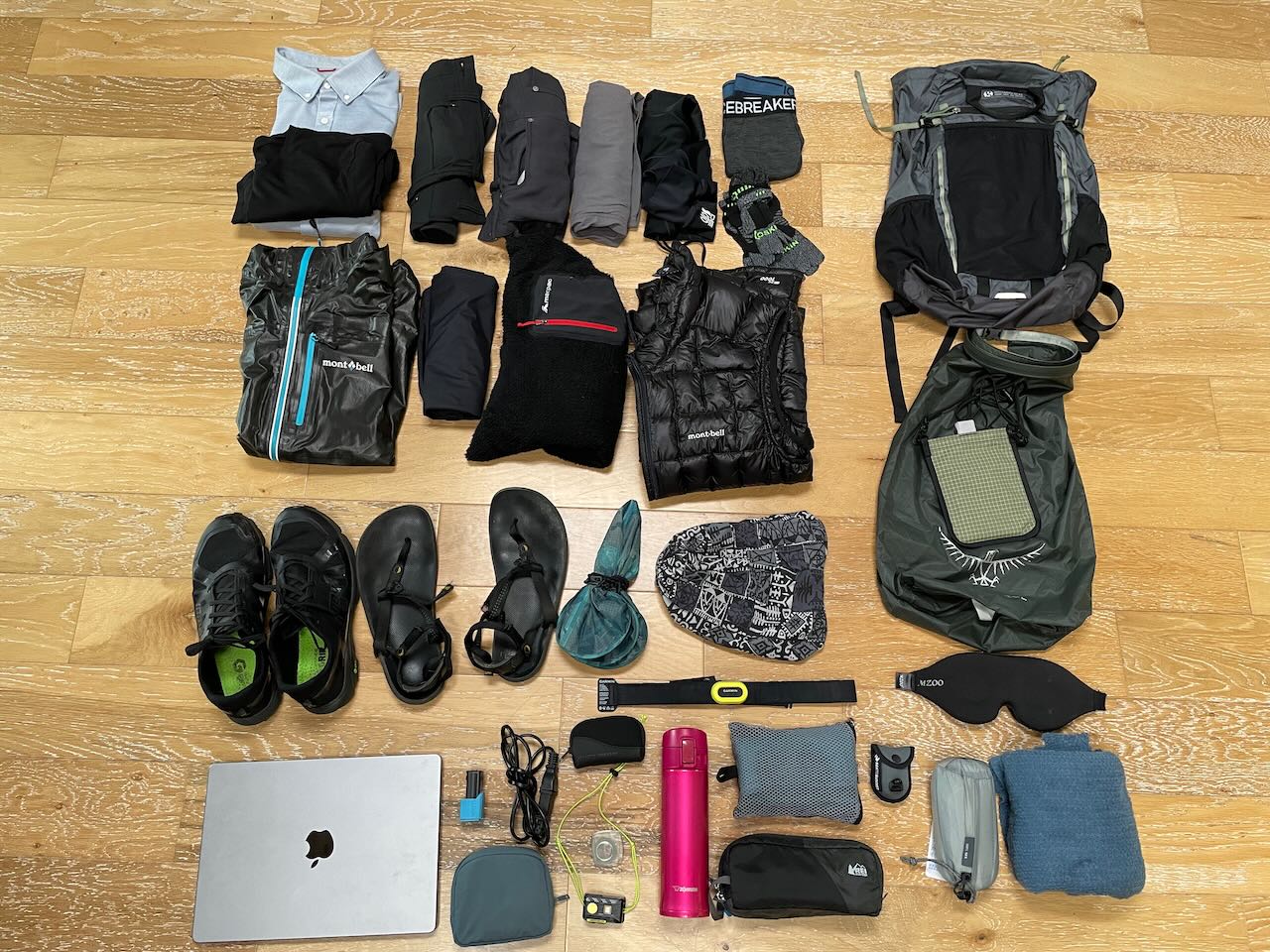
My packing list for trips than range from a few days to several months. Items “*” are optional. This list was extracted from my Packing & Traveling Light post. For a more complete description of these items see my gear for life. Packing list from 2023 Camino.
Luggage
gossamer gear vagabond
osprey 20l drybag*
Pockets/Wear
hanchor wallet w/ cards, cash
iphone 12 mini t-mobile for international roaming
victorinox rambler / swiss-tech util-key if flying
uniball vision elite .5mm pen – doesn’t leak!
garmin 955 gps watch
n95 masks
tickets* – if not on my phone
passport* – if needed
Daily Life
zojirushi travel mug
apple airpod pro
edc electronics pouch: 3 usb-c cables, anker 523 usb charger, nitecore 10k battery, usb adaptors
nitecore nu20 headlamp with strap replaced with shock cords
6ft tape measure
sleep mask
Core Clothing (Wear or Carry)
luna sandals – preferred when sandals acceptable
inov-8 ultrafly270
xoskin anklet toe socks (2)
tommy john travel briefs (1), icebreaker anatomica briefs (1)
2 outdoor research ferrosi transit pants
patagonia hydropeak shorts
icebreaker anatomica merino tee-shirt
arcteryx cormac hoodie
outlier amb merino wool button up shirt
macpac alpha direct hoody – if temps <55F
montbell dry peak shakedry shell
montbell umbrero hat – for sun & rain
zpacks rain pants* – extended time outdoors in cool & wet
Toiletries/Health
rei micro toiletry bag
toothbrush
reach floss
razor
folding brush
nail clipper
mini first aid kit with superglue
toothpaste (dawn mist .6oz perfect size for shorter trips)
100sense body bar in matador flatpak soap bag
extra n95 masks
High Intensity Exercise?
heart rate strap
xoskin compression shorts
visor
Beach? – Items to be added if a lot of time will be spent at beach
board shorts
rashguard long sleeve shirt (UPF 50 when wet)
matador pocket blanket
snorkling?
neoprene socks* – avoid heel blisters
vision correcting swim mask*
Blazer Required? (these days black trailrunners, slacks, and button shirt get men into most places, so only needed for special occasions)
vivobarefoot gobi II ankle boots
bluffworks hopsack sport jacket
Cold? – Items to be added if spending extended time outdoors temps below freezing
montbell plasma 1000 down vest
polar buff
fleece gloves and/or rain mittens*
swap cormac hoody for minus33 turtleneck*
darn tough light cushion crew socks* (2)
patagonia micro puff hoody jacket*
Extras
macbook 12”*
macbook pro 14”* – when traveling by car
etymotic hf3* – extended flight noise reduction
platypus water bottle* – if longer hikes without water
water purifier* – if hiking where water is available but of questionable drinkability
immersion water heater* – if staying place without microwave, coffee maker, or stove
folding foon*
ultralight body size packtowel*
mld sleep sack + alpha direct 120gsm “blanket”* – staying in minimalist hostels
If a trip includes camping as well as travel in cities, I switch from the Vagabond to a Hanchor Tufa pack + Vagabond packable for EDC. The Tufa is good in the back country and passable for travel. I merge my backpacking list with the items listed above which can been seen in my lighterpack template. When flying I check my trekking pole, stakes, and knife through using a cardboard poster tube and acquire fuel and food at my destination.
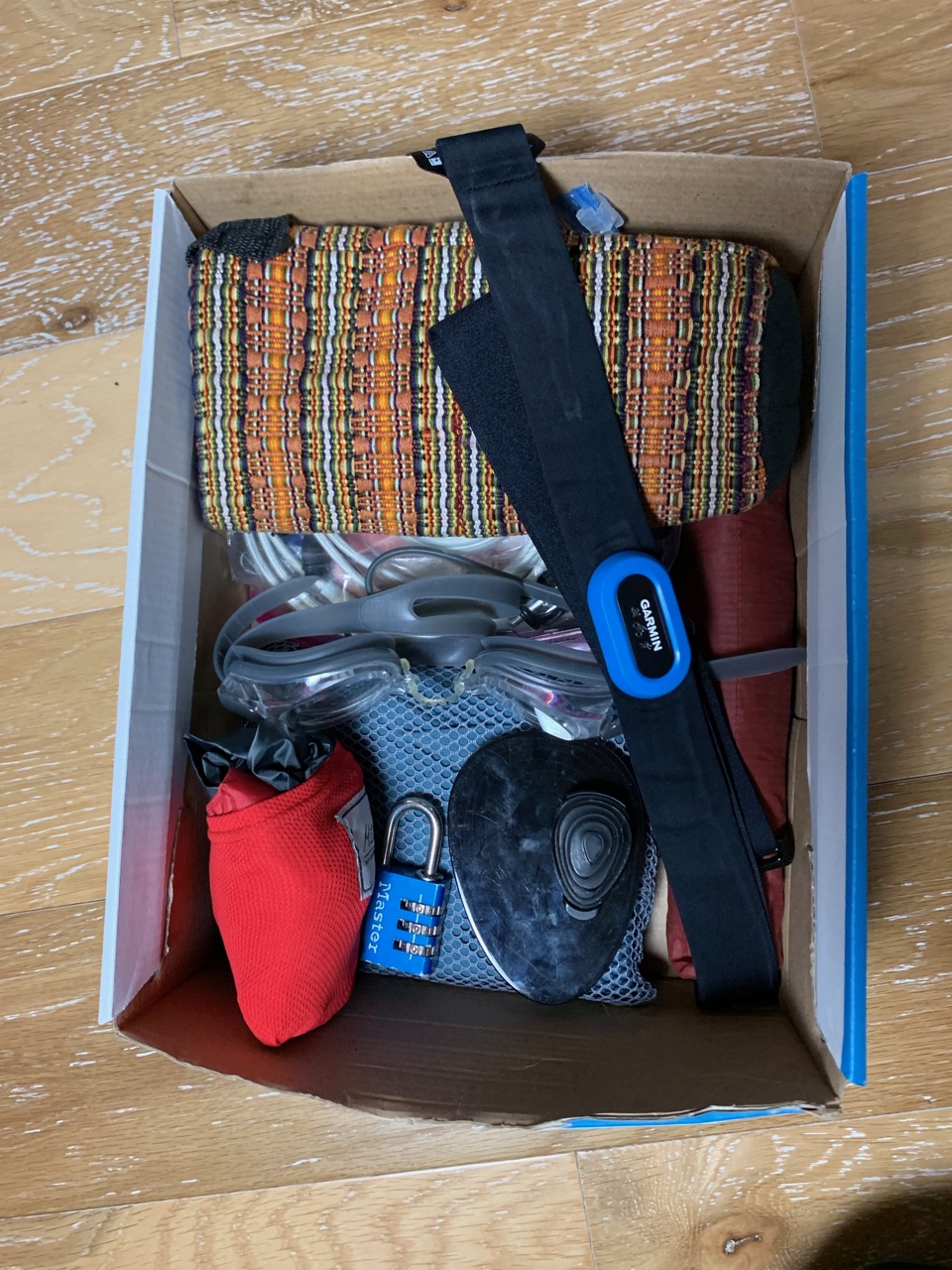
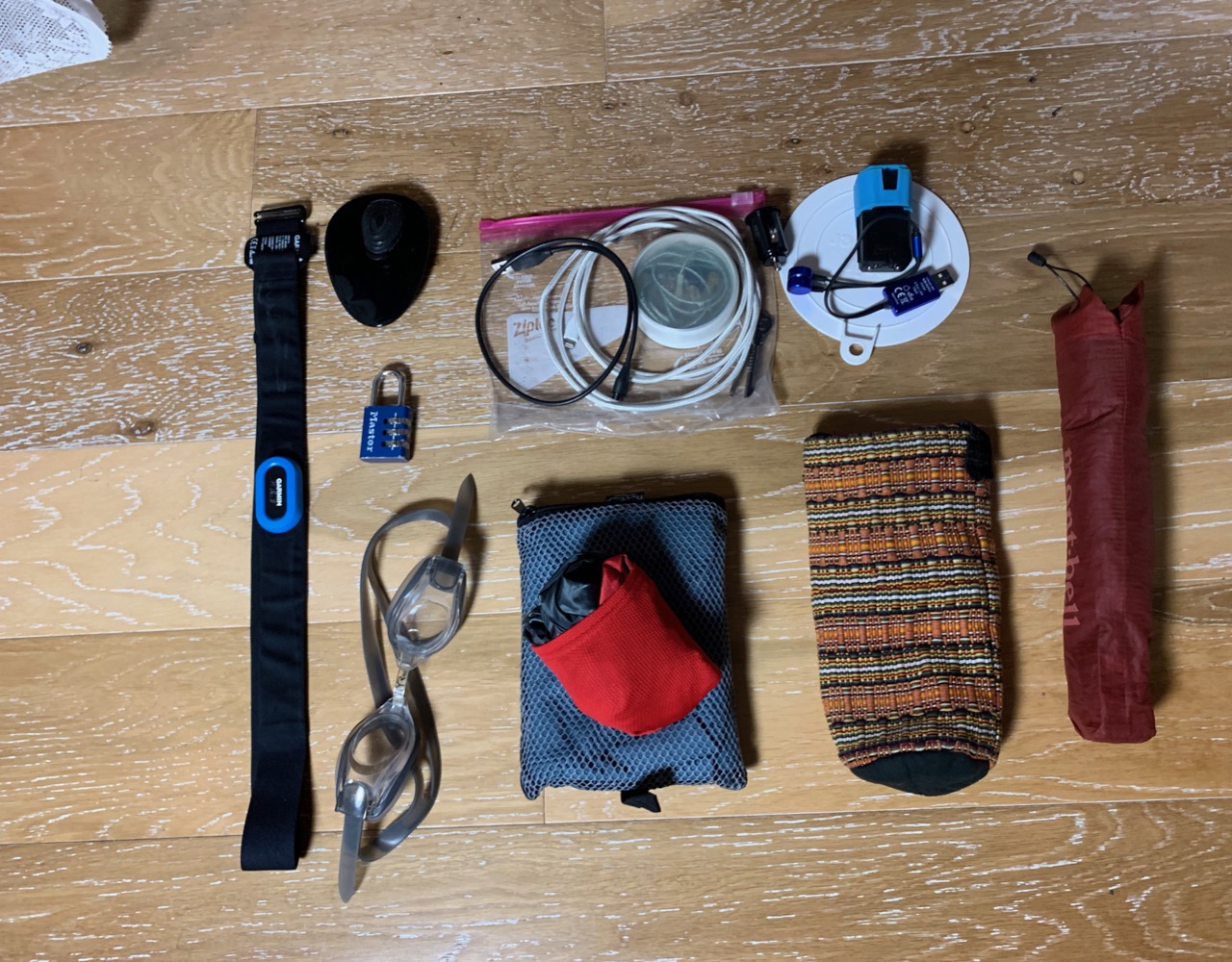
Recent load including worn and carried clothing for a four month international trip that ranged from 25-80F with frequent rain, some nights in a budget hostel requiring bring a sleep system, and regularly exercising. Note: there was still room in the pack for some gifts I brought / took back home. Miss from picture that I was carrying most of the time include a an oral-b 6000 toothbrush and charger which my wife also used.
I used pretty much the same gear in 2019 as previous years and will continue to use the same items with minor changes in 2020. My current list is now available. Several years ago minimalism led me to simplify my stuff, keeping just the items that are regularly used and give me joy. My traveling list is a subset of the items in this post.
Items in bold are exceptionally great… I regularly finding myself telling people about them. I am happily use items marked with “*”, but they won’t be replaced if lost.
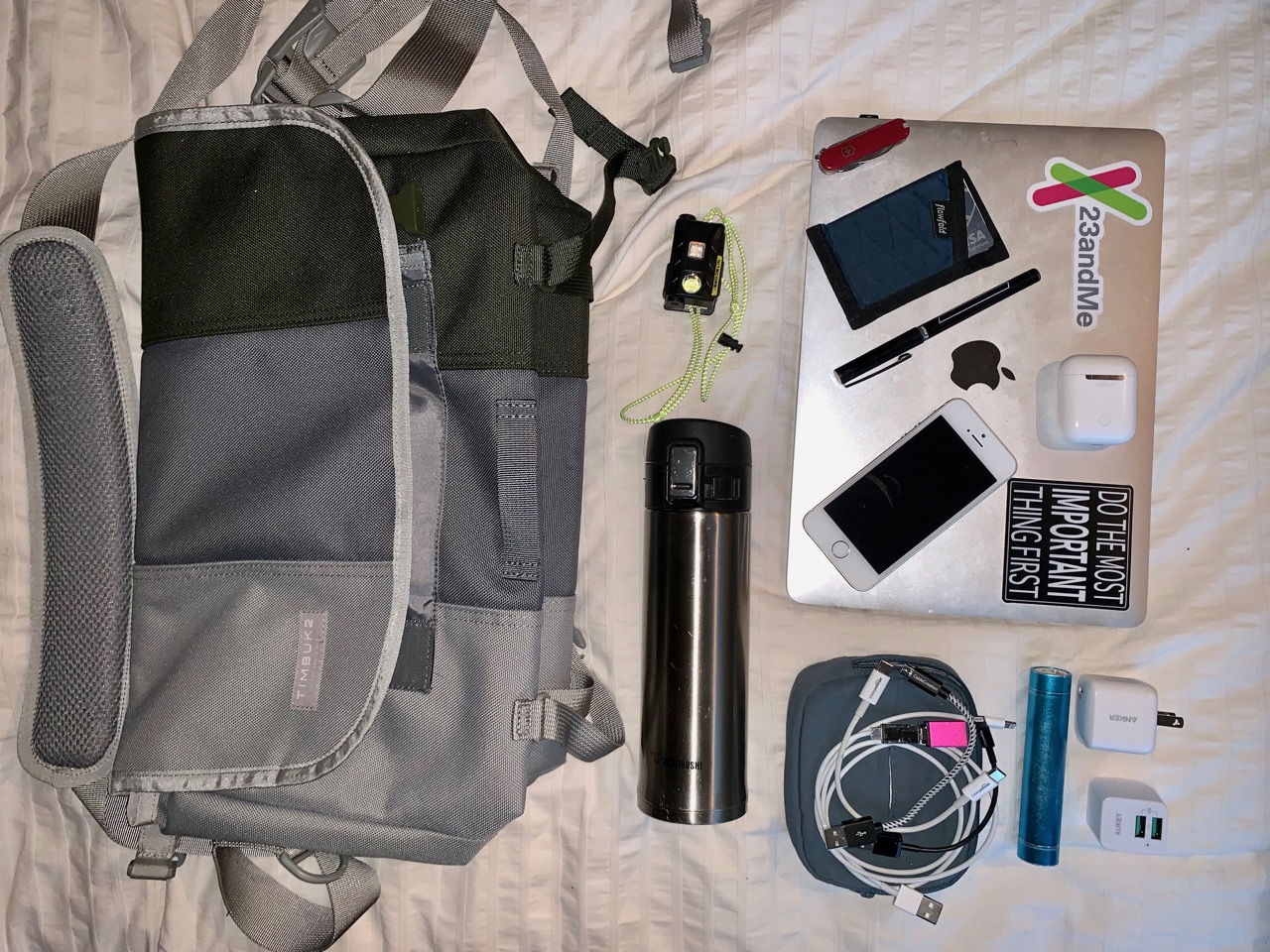
Everyday Carry Items
Flexon (not shown) eyeglass frames with Zeiss high index progressive lens (not shown). Eyeglasses which let me see clearly are an incredible blessing. I used to break frames within a year of getting them. Flexon last me several years. My current pair was purchased in 2018. My previous pair was worn daily 2010-2018 and is now my backup pair.
Garmin 935 Watch (not shown) is a do everything fitness watch which is light enough that I don’t mind wearing it everyday. It has adequate integration with my phone and provides every fitness and activity tracking feature I want with better accuracy than most other smart watches. I appreciate the alert on the watch when it loses bluetooth connection with it’s paired phone that reduces the likelihood of leaving the phone behind. The charging cables for Garmin have a tendency to not stay connected, the NexGadget Garmin Charging Puck seems to work better than most. There are a number of other sport watches I would recommend.
Timbuk2 Classic Messenger (Small) is just the right size for my day to day needs with just the right amount of organizational pockets. I used an almost identical bag from 2001-2018. It was still functional but looked pretty tired when retired. After a couple of years trying daypacks I am back to this bag. I prefer courier style bags over backpacks because they are easier to access on the go and leave my back with more ventilation. I appreciate the water resistant fabric and that the fabric is heavy enough to retain it’s shape, but light enough not to be a burden.
Nicore NU25 rechargeable headlamp* Very light-weight when the headband is replaced with cords. Good regulation, bright enough for trail running, a decent electronic lock so it doesn’t turn on accidently. I have a post about other good flashlights. Use it for when I am running in the dark and it has been a backup for when I forgot to recharge my bike light. This was a spurge purchase… my faithful ZebraLight H51 was fine, just a bit heavy / bulky.
Pilot Precise V5 Extra Fine Pens with it’s smooth rolling extra fine lines and Post-It Notes for jotted down ideas until I can get them into an electronic system. Alas, the V5 leaks after pressure changes in commercial airlines. When traveling I switch to a Uniball Roller which doesn’t come in black nor as smooth rolling as the Pilot but doesn’t leak.
Victorinox Rambler Pocket Knife is the smallest, most usable tool I have found with a phillips head & flat screwdriver, scissors, knife, bottle opener, and nail file. When flying I switch to a Swiss+Tech Utili-Key which is not as usable as the Rambler, but for years has made it through TSA checkpoints without being confiscated. I have notes on other knife options.
Apple iPhone SE on Verizon. Last year I was using a Xs, but was just too big to hold comfortably. I “upgraded” to a SE. While the screen and especially the camera on the SE isn’t up to the Xs standards, there are several advantages besides size: battery life, a headphone jack, and the touch unlock works better than the face unlock.
Apple AirPodshave decent sound quality while letting in ambiance noise providing situational awareness, stays in place during exercise, no wires to get tangled, has good user interface. They aren’t rated for water resistance, but after more than three years of using them while sweating heavily, rides and runs in the rain they continue to function. Originally the ear buds ran 5 hour, fully recharges in 20 minutes, with a carry case which can recharge them 4-5 times. After three years of daily use, the right bud lasted last than an hour until I paid $98 for Battery Service (which is really a replacement).
Macbook 13″ Pro Laptop. I have tried using tablets but still find myself prefering a real laptop. I would love to find a lighter and more compact laptop, but I like 13” screens, and am still pretty much committed to OSX because it has the applications I use and the good integration with iOS devices.
Tech “Survival Kit” which is stored in a small pouch from muji. RAVpower Portable Charger/Flashlight is small enough to fit in my pocket while proving power to recharge my phone. Aukey Ultra Compact USB Charger is one of the smallest chargers with two slots and up to 2.4A amps. Anker 30w GaN USB-C charger which isn’t fast but sufficiently powerful to recharge my laptop while I sleep and power it while I work. 6” USB Lightning, USB micro, and USB-C cables with some adaptor tips which let me connect pretty much any two USB devices.
Zojirushi Double Walled Mug (1 + 1*) can easily be used one handed, locks so it doesn’t open accidentally, pours at the perfect speed, the mouth is wide enough for ice cubes, and best of all does a better job insulating than any other double walled mug. I have a Deep Cherry color mug which I picked up after misplacing my silver mug at work. The striking color make it easy to spot when I forget it in a conference room. My silver mug which I eventually found I use everywhere else. When flying you can fill the Zojirushi with ice (no water) and get through TSA security. Once through, add water and you can have icy cold water for your flight. Zojirushi makes a number of other excellent styles of mug and Snowpeak makes a beautiful Titanium double walled mug.
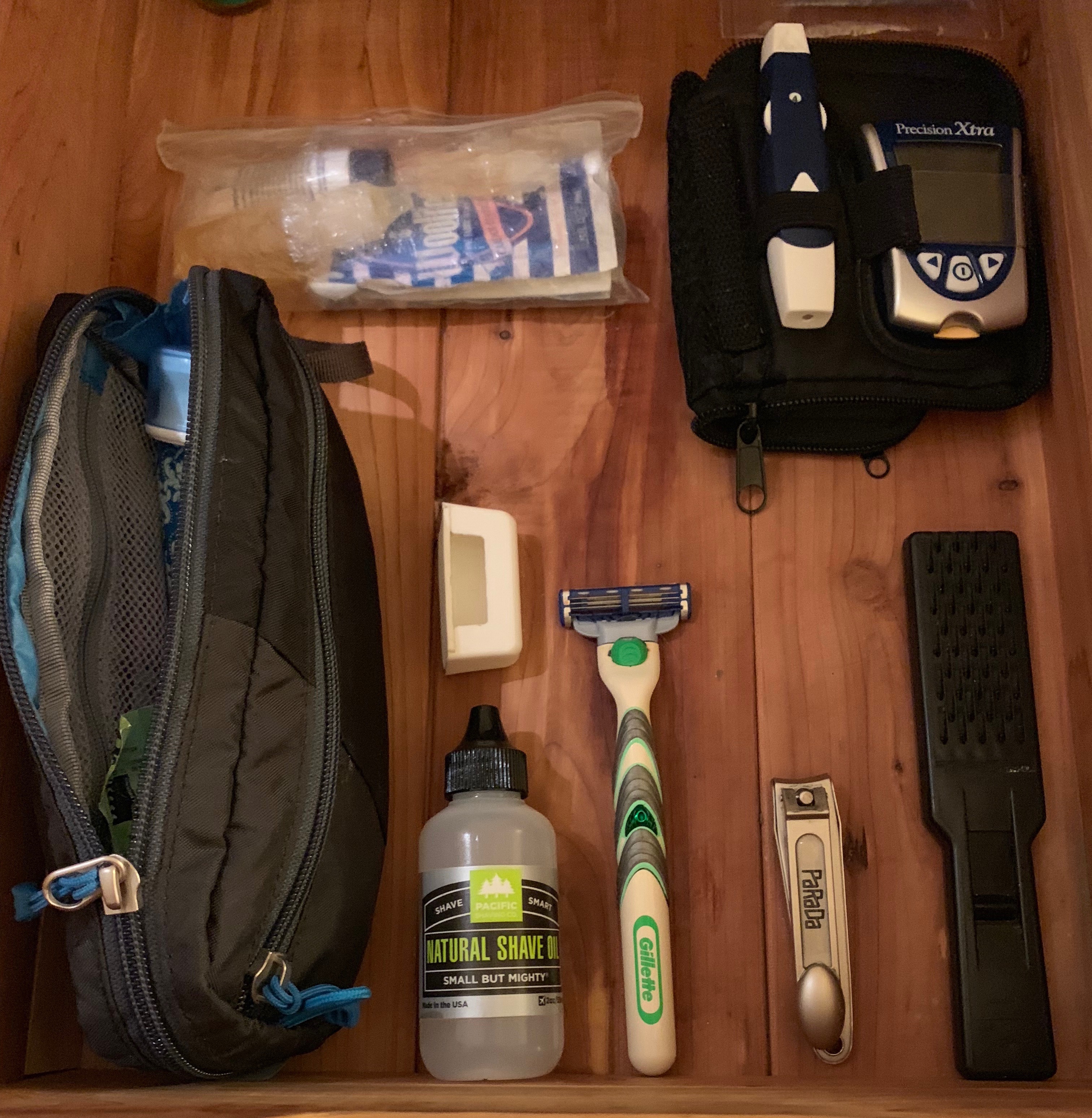
REI Micro Shower Bag is the perfect size for my toiletry kit while providing just enough organizational features to make it easy for me to find everything quickly. Holds all bathroom items when traveling. Inside has first aid kit which includes waterproof Band-Aids, antiseptic wipes, anti biotic cream, superglue, a couple of safety pins. Small size HumanGear GoTubb to store aleve and a few nyquil caplets and a Violife Slim Sonic toothbrush.
Ziplock bag with two weeks work of supplies: dropper bottles filled with Dr Bronner Soap, Shaving Oil, shampoo, skin lotion, and a few single use woolite packets
Listerine Floss (not shown) is the most effective dental floss I have used. Gentle to the gums while still getting plague and food wedged between teeth out.
Gillette Mach-3 Razor + Pacific Natural Shaving Oil. I am sure there are better razors and many people would suggest that shaving oil is a prep step which should be followed by shaving cream… but I have found this combination effective, reasonable cost effective, and compact when traveling.
Withering Body WiFi Scale (Not shown) makes it easy to track weight which is well integrated to Garmin, Fitbit, MyFitnessPal, LoseIt, and numerous other health tracking eco-systems.
Oral-B/Braun 6000 Electric toothbrush (Not shown). Oral-B and Sonicare both make excellent toothbrushes which are significantly more effective than using a manual toothbrush. Replaced a model 4000 whose batteries were dying.
Bucky 40 winks Sleep Mask (not shown) which lets me get an extra hour of sleep in the morning because the sun coming up doesn’t immediately wake me.
Sports & Travel
Tom Bihn Synapse-25 Backpack (shown below) is my luggage when traveling. Wonderfully designed with just the right amount of organizational features. Large enough for nearly every trip I have taken, while small enough that it fits under every seat I have used and has never been viewed as “luggage” by transportation operators. The laptop cache works brillantly. Have notes about other travel packs.
Patagonia Ultralight 15L Courier Bag (not shown) is perfect size for day use and compact enough that I can pack it away in my backpack when moving between towns. Easy access without taking it off, in hot weather maximized ventilation, and can be used at the same time that I am carrying a backpack.
Matador Freerain24 2.0* (not shown) replaced v1 which wore out after 2 years of nearly everyday use. Weights only 5.5oz, carries well. easily folds into it’s own pocket, and keeps contents dry even in the worst rain. Used for done in a day activities and for when I run rather than bike to work.
Garmin Swim Heart Rate Monitor strap because optical heart rate monitors aren’t sufficiently accurate for HRV measurements and aren’t responsive enough to track interval training. Switched from Wahoo Fitness TickrX because it became inaccurate for me after a hour of heavy sweating and I can use it swimming. Most people would find the Tickr adequate, and there are plenty of other good HRM including Viiiva which can be used to bridge other sensors between BlueTooth and ANT+.
Stryd Footpad* captures run’s intensity better than using pace or heart rate. The Garmin Running Dynamics Pod might be a cheaper way to get the same sort of data. The RunScribe Plus now syncs to Garmin and other eco-systems and might provide more actionable insights about running form that other running power meters.
PackTowel Ultralight (Bodysize/XL) dries amazingly quickly, is compact, and is very effective. The XL is large enough that I can wrap it around my waist like a small sarong. For awhile I used a medium/face size which packs in a tiny space. I found the face size sufficient for me to dry myself after a swim or shower, but I am willing to carry a larger towel for the added versatility and ease of use.
Westone 5ES custom In-ear-monitors (IEM) with excellent sound quality and comfortable enough to wear on 14 hour flights. They reduce noise by 35db which makes travel much less fatiguing while being much smaller and having better sound quality than active noise canceling headphones. Stored in a medium size HumanGear GoTubb with adapters.
Extra Charging Cables, sink stopper, Micro International power adapter. If I was doing more international travel, I would drop my power adapter and swap my every day USB power supplies for the Card Travel Adapter which looks really nice and was recommended by Tynan in 2020.
Olight Universal Magnetic Battery Charger powered by USB, and can be used with pretty much any size battery, and charges both 1.5V NiHM, 3.6 & 3.7V LI batteries for trips when I need to recharge batteries.
Water Bottle Sling Nancy brought back from South America. Great for days I just need water and nothing else. Sometimes borrow Jackie’s (my wife) Chico Water Bottle Sling because it can hold water bottle + umbrella or windbreaker.
Montbell Trekking Umbrella has the best balance I have found between small/light and canopy size. It has survived 40mph wind/rain storms but eventually one of the ribs has broken. In warm to hot weather much more comfortable than wearing a rain jacket but doesn’t adequately protect my legs in a hard rain.
I have notes about selecting clothing for an active life which goes in detail about how to select clothing for a wide range of activities and conditions.
Tilley LTM6 Hat provides good sun protection while offering decent ventilation. I think it’s one of the more stylish hats which provides good sun protection. Jackie says I am wrong… that the OR SunRunner I used before was better looking. I have a list of other hats that you might prefer.
REI eVENT Rain Hat: a discontinued ball cap made from waterproof / breathable eVENT. Used when hiking or running when I know it’s going to be raining.
Visor: keep sweat and sun out of my eyes while maximizing cool my head on runs.
Mountain Hardware Grub Gloves (not shown) medium weight PowerStretch gloves with a quilted mitten cover which folds away into the back of the glove making it comfortable to wear in a wide variety of conditions.
Columbia/Montrail Titan Trailrunning Shirt: Omni-Freeze fabric that helps cool when working out in moderate to hot conditions. Super light weight and breathable. Anti-stink is reasonable.
Icebreaker Anatomica Tee-shirt (4) merino wool with just a bit of lycra for a body hugging fit. This tee-shirt fits me perfectly, looks good, is super comfortable, doesn’t smell after several days of wear on the road, and dries fairly quickly. There are two downside. First, they are pricy. Second, they don’t work as well as synthetics when engaged in high energy activities where you are sweating a lot. There are a number of other good merino wool shirts from Smartwool, Outlier, and Wool&Price.
White Rashguard Long Sleeve Shirt to protect my skin from sunburn when swimming and snorkelling.
Outlier New Way Shorts (4) are nice looking shorts which fit me perfectly, don’t have cargo pockets, are durable and dry reasonably quickly. They are pricy but I haven’t found any shorts I like as much.
De Soto Mobius Tri Shorts (not shown) works well cycling, running, and swimming. They are comfortable for all the activities I engage in, in a wide range of conditions. They have reduced issues with chaffing, dry fairly quickly, and are reasonably comfortable when wet. They have side pockets large enough to hold some nutrition and my phone so I don’t need to use a special cycling jersey. I never need to think about what shorts to wear for vigorous physical activities…. I just grab my pair of Tri Shorts. Replaces a pair of Zoot Tri Shorts which wore out.
Icebreaker Anatomica Briefs (7) the most comfortable underwear I have worn. Earlier version developed holes after around 100 days of wear… the newest pair which has a bit of nylon with the wool has so far made it 150 days of use without holes. Some people prefer boxer style but I see no reason to have extra fabric on my thighs. Good alternatives are the synthetic travel oriented briefs from Ex Offico and the comfortable but expensive underwear from Saxx.
Darn Tough Socks (8) are unsurprisingly durable since they come with a lifetime warranty. I found they fit and perform very well and come in a wide variety of thicknesses, lengths, and colors. I like the endurance light socks. Icebreaker and the Smartwool PhD line are good alternatives.
Injinji Ultralight Toe Socks (2) for long distance runs / hikes. Generally I prefer wool, but I found wool toe socks get holes very quickly so I use the CoolMax, original weight version.
Rocky Gore-Tex Socks are the best way I have found to keep my feet reasonably clean, dry and warm in messy back country conditions. Often worn with Keen sandals to maximum breathability and speed drying once they are out of the water.
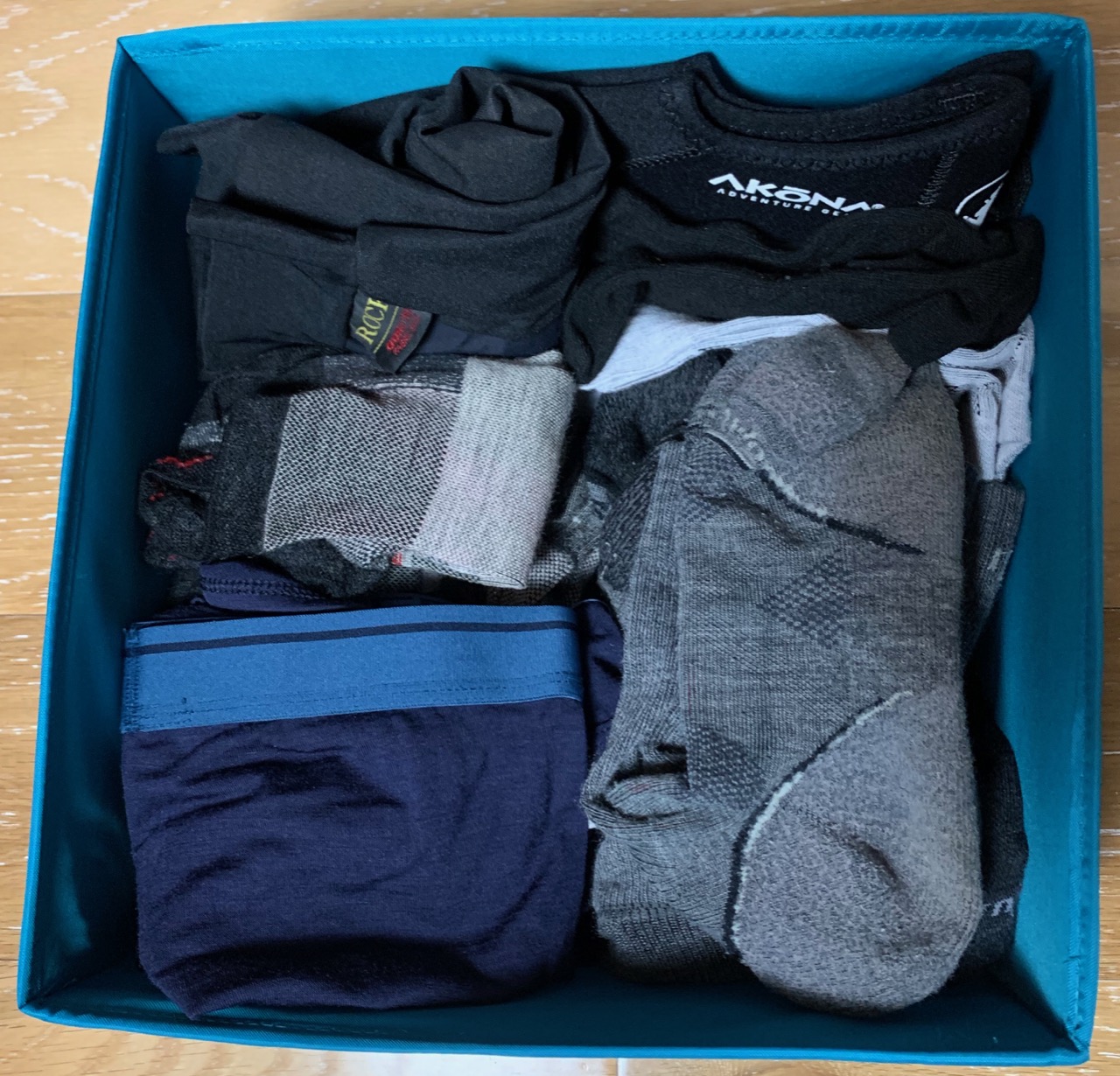
Akona 2mm Neoprene Socks which protect my feet when using flippers or with Keens if I am on a trip which is constantly going in and out of water.
Alta Running Supreme 3* trail running shoe which are light weight with a fairly grippy sole for mixed trail conditions. Generally I use my Vapor Glove unless I am expecting to need more than normal traction. Alas, Alta is following New Balance playbook… changing shoes so quickly that you had better buy 10 of whatever shoe you like, because they might spoil what you like in the next generation :(.
Merrill Vapor Glove 4: are the most minimalist running shoes I have found that fits me, “like a glove”. Sole works on road and on many trails. For people who need some cushion check out Alta Running, Topo, or if you need extreme cushioning Hoka OneOne.
Keen Clearwater CNX are the lightest sandals Keen makes. I liked the minimalist sandals made by luna and Xero Shoes but the toe protection of the Keens makes them a clear winner for me. If worn with gray socks they can “pass” for shoes. Comfortable in a wide range of conditions.
Vivobarefoot Gobi II are comfort, light weight, zero-drop, minimalist ankle boots which can be worn with casual clothing and Jackie tells me they are acceptable to wear with a sport jacket, but not a full suit).
Carots Shoes are formal looking zero drop shoes. These are the only minimalist shoes I have found that looks like traditional dress shoes (heels and and tapered toe) that are sufficiently comfortable for day long wear.
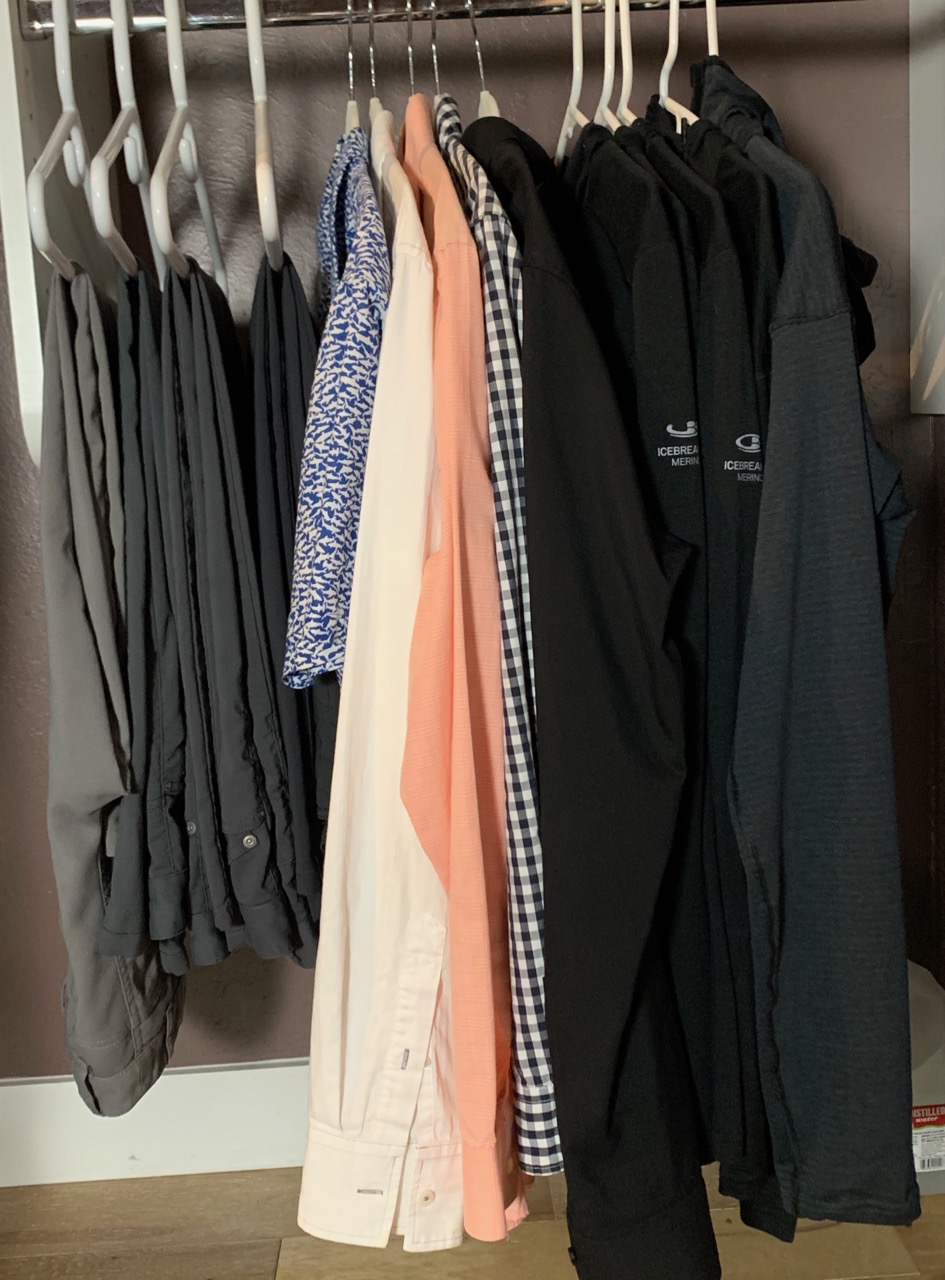
Outlier Slim Dungarees (4) Soft shell pants in the style of jeans. Wonderful fit, looks good, excellent mobility. Thanks to the NanoSphere treatment very stain and water resistant. They are perfect except when it’s >80F and I am active. They seem pricy, but the per day cost of wearing is about the same as denim jeans. Maker&Rider and Wool&Prince makes a nice alternative.
Toni Richards Hawaiian Shirt because everyone needs at least one shirt for “Hawaiian shirt day”. I find the cotton lawn fabric used by Toni Richards is more comfortable than other materials when it’s hot and humid.
White Dress Shirt for when I need to be dressed up.
Peach Button Up Shirt* for when Jackie wants me to wear something at is a bit different than normal.
Black/Grey/White Checked Button Up Shirt* for when Jackie wants me to wear something different.
Outlier AMB Merino Wool Button Up Shirt for when I want something a bit more dressy than a tee-shirt or hoodie but don’t need to wear a suit.
Icebreaker Wool Hoodie: (4) Oasis 200wt merio wool hoodie with 1/4 length zipper. Worn when it gets too cool to wear just a tee-shirt. Icebreaker has discontinued this model. Also have 3 in storage which will come out when these wear out.
Patagonia Capilene Thermal Weight Hoody for cool/cold weather outdoor activities. Without wind protection the grid weave lets air flow through letting heat vent out. With a shell it insulates well. Comfort down to 30F when running without a shell, below that with a shell. When walking around town keeps me comfortable down to 40F when combined with a wind shirt. I am reasonably comfortable engage in high energy activities when it’s 65F by fully opening the zipper and pushing the sleeves up to my elbows. Dries amazingly quickly and feels more comfortable than any other shirt I have used when it’s wet.
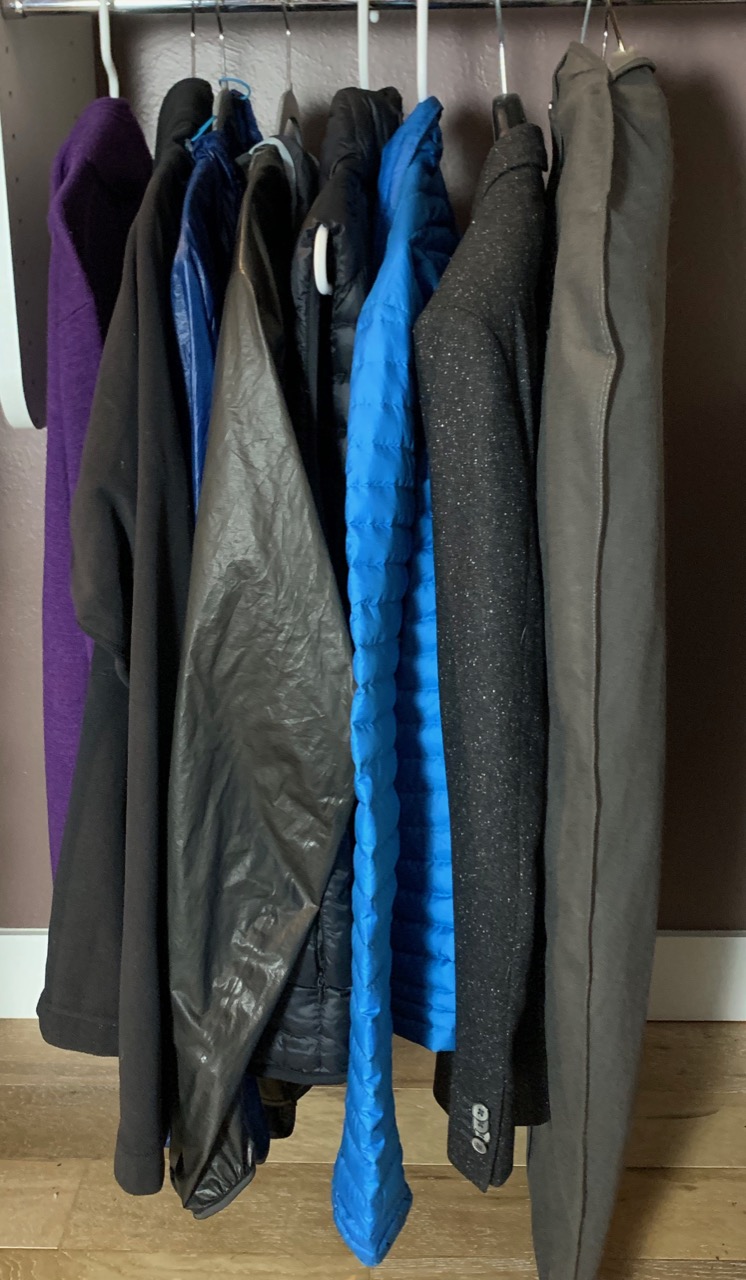
Mid-Weight, Purple Merino Wool Sweater* for cool days or when I want to wear something that isn’t black.
Montbell Chameece Inner Jacket is a very light weight fleece. About the same warmth as my sweaters but much more convenient to put on and take off.
Montbell Tachyon Windshirt a 1.8 ounce wind shirt that can be compressed into something slightly larger than a cliff bar. Windshirts, especially when combined with a air permeable middle layer provide comfort over a huge range of conditions. Maybe should list in my “Everyday Carry” section since I alway have it with me.
ArcTeryx Norvan SL (2019 model). Ultralight and ultra-breathable rain jacket designed for trail running. The most breathable jacket I have used. Previous model had a problem with the zipper leaking. ArcTeryx upgraded me to the current model free of change. Other options are discussed in my post about rain gear.
Zpacks Vertice Rain Pants (not shown) are simple, light, breathable, waterproof rain pants. Used when commuting by bike, hiking, or backpacking in the rain.
Uniqlo Ultralight Down Vest is decent quality, low price, with just the right amount of insulation for me. Combined with my sweater and a shell keeps me warm enough in the coldest weather I encounter in the SF Bay area.
Patagonia Down Shirt* with 23andMe logo. A jacket which provides adequate insulation for around the town use in the SF Bay Area. Allows me to show my company spirit and Jackie thinks it looks better than the combination of the above items. The Patagonia Micro Puff Hoody using PlumaFill insulation would be better for back country use thanks to it’s superior water resistance. The Montbell inner down jacket continues to be the price performance champ, and Uniqlo’s down jacket is a good alternative for someone on a tight budget. The ArcTeryx Photon LT looks like a great alternative for cool weather, active insulation.
Boss Blazer Jacket used when going out and it’s appropriate to be wearing something more dressy than a hoodie, but a full suit is too formal. On cool evenings I sometimes wear the blazer over my shirt rather than taking a more traditional “outdoor” jacket.
Boss Wool Suit slim/european cut. Fits me perfectly though not bespoken. First suit that I wear rather than the suit wearing me. Light enough that it’s usable in the summer. I use it anytime I need to be dressed up: weddings, funerals, special nights out on the town. Have two ties… one that is “serious” and one that is “fun”
Backpacking / Winter Clothing
I have a 3-season packing list which makes use of a number of the items on this list and has several items which are specific for backpacking. In addition to the items on my backpacking list, I have several items which come out when I am heading to the mountains and expect snow.
Patagonia Cap 3 Tights: which go under normal pants and/or rain pants when facing below freezing conditions.
GoLite Snow Cap: polarguard insulated bomber style hat which can be layered over other hats. Fairly windproof, warm, and light weight.
Outdoor Research Meteor Mitts: which have a removable 300wt fleece inner mitt which folds back to let you use your fingers and a durable, waterproof shell.
Gaiters: for keeping snow out of shoes/boots and the lower legs dry.
Bicycling Stuff
Cervelo R3: pricy but amazing road bicycle. Comfortable enough for an endurance ride, but responsive like a race bike. Fitted with an Infinity Seat, and a small seat bag which holds a pump, inter-tube, bike tool, and 2 tire levers. Moots makes some great Titanium bikes but you have to special order them.
Giro Air Attack Shield Helmet provides protection, good ventilation while having a very streamlined aerodynamic profile. Has snap on optical shield which is great because with my eye prescription, it’s hard to find sports oriented sunglasses. If you ride a bicycle, wear a helmet!! I am alive today because I was wearing a helmet when I was in an accident. Giro has newer models which have better ventilation and aerodynamic profile and also cheaper models that will protect your head just as well for less money.
Felix BC21R Bike Headlamp which was purchase when my Expilion 850 was stolen. The BC21R uses a removable 18650 rechargeable battery. I think I slightly preferred the quality of light from the Expilion, but the BC21R works well enough to stick with it, and I do appreciate that the battery can be charged outside light housing.
Power Tap P1 Pedals because I like objective measures about how my physically condition is changing. The Garmin Vector 2 pedals integrate better into the Garmin eco-system, use standard Keto cleats, and are lighter / more streamlined at about the same price point.
Bicycling Shoes with Cleat for PowerTap peddles.
Wahoo Fitness Kickr* is a trainer for when I don’t want to hit the road. Integrated power meter and variable resistance which can be controls via ANT+ or BlueTooth. Wahoo built the Kickr with an open API so there are numerous companies which have applications which can control the Kickr.
Electronics
Several items that used to be on my list has been moved to our family list.
Nekteck 4-port 72W USB C Charger with 1 USB-C and 3 traditional USB ports which allows me to charge every device I use on a daily basis from a single power brick, including the 13” MacBook Pro from work. When the MacBook Pro isn’t being charged can rapidly charge all my devices.
Kindle Oasis lets me carry the majority of my library with me and every book can be displayed with large print for my aging eyes. Love being able to quickly search for notes / hi-lighted passages. I miss physical books and knowledge retention with paper books is still better than when using an e-reader, but the connivence of the Kindle outweighs this for me. Replaced a PaperWhite because the Oasis ergonomics allows reading with a single hand.
RAVpower 6700Mah USB Charger for when I need to power devices for a couple of days or for long flights without USB power in the seat.
Radsome EarStudio ES100 bluetooth/DAC/headphone amplifier allows me to use Westone IEM (or other wired headphones) with devices missing a headphone jack. The ES100 is tiny, with good sound quality (though Chord Mojo is noticeably better) and can even drive Sennheiser HD800 to reasonable sound levels.
Sennheiser HD800 Headphones* for when I want very high quality sound and don’t want to bother others too much (sound does leak). These are the second best sounding pair of headphones I have ever used, at 1/3 the cost of the best (Stax SR-009). I have a headphones post with additional information.
Chord Mojo DAC* offers a nice design, good quality sound, good price / performance ratio, portability, has enough power to happily drive Sennheiser HD 800, and has an internal battery which enables it be driven via USB from phones and portable DAPs. I have written about other DACs.
Sentimental
There are a several items I have kept as a specific way to honor people I love.
Libby’s pins of a nativity scene and of a mother and child. Originally worn by Libby on special occasions they became daily decorations for the hats she wore during chemotherapy. They remind me of Libby’s courage and the two things most important to Libby, family and Jesus.
Carl’s Rolex Oyster Watch to remember his craftsmanship, love of teaching, and ironically his frugality.
Jules’ sculptures of musicians made from nails because he passed on a love for music and art.
Wool Blanket (not shown) Originally owned by Carl or maybe even my grandfather. It has been on countless fishing and camping trips and to virtually every picnic and outdoor concert I have ever attended. Everytime I see the blanket I think of my dad and many wonderful moments.
CatBus Plushy (not shown) given to me my Jackie because it reminds me of the gentle film My Neighbor Totoro which has delighted my family. I wanted a real CatBus, but no one can find one for me 🙂
Potentially Retired
The following items weren’t used in the second half of 2019. I have put them aside, to see if they get pulled back out.
Wool and Prince Blue Oxford Shirt Slim fit, crisp look while still having all the advantages of 100% wool. I haven’t really needed a light blue color shirt (e.g. I do casual or dressy, never business casual).
Outlier Air Forged Oxford Shirt Fits me well, made from durable nylon weave so it dries quickly and doesn’t wrinkle when traveling while looking nicer than many “travel” shirts. Hasn’t been used because I live in wool tees or hoody when traveling.
Grey Cashmere V-neck Sweater* for fall and winter evenings that when I should wear something a bit more dressed up than my wool hoody and/or want more insulation.
Smartwool Full Zipper Wool Fleece* with 23andMe logo. Team swag. Very nice, but I prefer the mobility of my 23andme Down Sweater which is approx the same warmth
Westcomb Focus LT Shell made with 2.5 layer eVENT DVT. The most breathable shell I had focus which was durable enough for backpacking. Been using on and off since 2012. Largely been replaced by Norvan SL which is more breathable but fragile.
Items that I removed from my personal gear list because we have them for the general family. This list is incomplete. I plan to make a complete list this year, but haven’t gotten around to it. Maybe I will make the complete list in 2021.
Electronics
Google WiFi Mesh network access points easily install and just work when you have an area than a single WiFi router isn’t sufficient. There may be faster / more featureful options out there, but the Google devices work flawlessly and are visually appealing.
LG OLED55B6P SmartTV for family / friends movie night and other group activities that use a screen. I would be content using the screen on my laptop or even iPhone for the occational video streaming I watch. That said, the picture quality is amazing and the webOS based controls work well.
Apple Mac mini. The Mini is compact, low noise, with a good collection of ports, has enough CPU, memory, and disk for my needs, and plays well in the Apple eco-system which I am committed to until my next refresh in a few years. It is overpriced compared to non-Apple hardware.
KEF LS50 wireless monitor speakers with a built in DAC and amplifier designed for the speakers. Good quality sound that fills a room, excellent for near field use in a nicely designed, compact package. Can take TOSlink, USB, Bluetooth, analog, and several IP based streaming protocols inputs over ethernet or WiFi. Roon can stream directly to it over the network, but it’s not Roon-Ready so can’t be synchronized with other Roon-Ready systems. The iOS remote application is poor. I drive the LS50 via USB on a Mac Mini running Roon which remove the need for the KEF remote and the speakers can be synchronized with other Roon Ready end-points giving me whole house music. I still prefer the sound quality of electrostatic speakers with audiophile grade full electronics, but I am happy that I downsized my stereo so I could focus on other things.
Roon software isn’t really an item, but it effected many of my decisions related to audio playback. Roon integrates my iTunes library which is made up of CDs ripped using ALAC codex with the TIDAL streaming service to provide loseless audio to multiple speakers around the house. Roon would be perfect if the remote clients supported off-line caching of music so playlists and favorite music was accessible when out of the house. I carry music on my phone by exporting play lists from Roon to TIDAL, and then use the Tidal client on my iPhone to do offline playback. If I didn’t care so much about sound quality the family would use Sonos speakers combined with Spotify for whole house music.
Pulse Flex Wireless Speaker allows me to have syncronized whole house music since it’s Roon Ready. It also supports inputs via USB, Bluetooth, AUX, a number of streaming services like Spotify, and many free sites via URIs. Has a decent iOS and Android remote control app. Controls on the top let you select one of 5 user-defined “channels” without using the remote. I have the optional battery pack so it can be used in our backyard. It can be used away from it’s home, but you have to reconfigure it’s WiFi settlings which is a pain. Sound quality is significantly less than KEF LS50. For people who aren’t using Roon, I would recommend Sonos: for it’s lower price point, better streaming options, and slightly more processed sound quality which everyone but audio purists like me typically prefer.
JBL Pulse Bluetooth Speaker for when my family wants music for a group away from home, and wants things to just work without hassle.
Brother MFC-J880W Multifunction Printer, Scanner, Fax, Copier has been a reliable device for me unlike several other multi-function devices which failed within a year. WiFi enabled, supports AirPrint, Google Print, and several other standards.
La Crosse Battery Charger which does a great job charging any combination of 1-4 AA or AAA batteries. Eneloop Pro Batteries are the best rechargeable batteries I have found. Near maximum capacity for the form factor while retaining most of their charge for months.
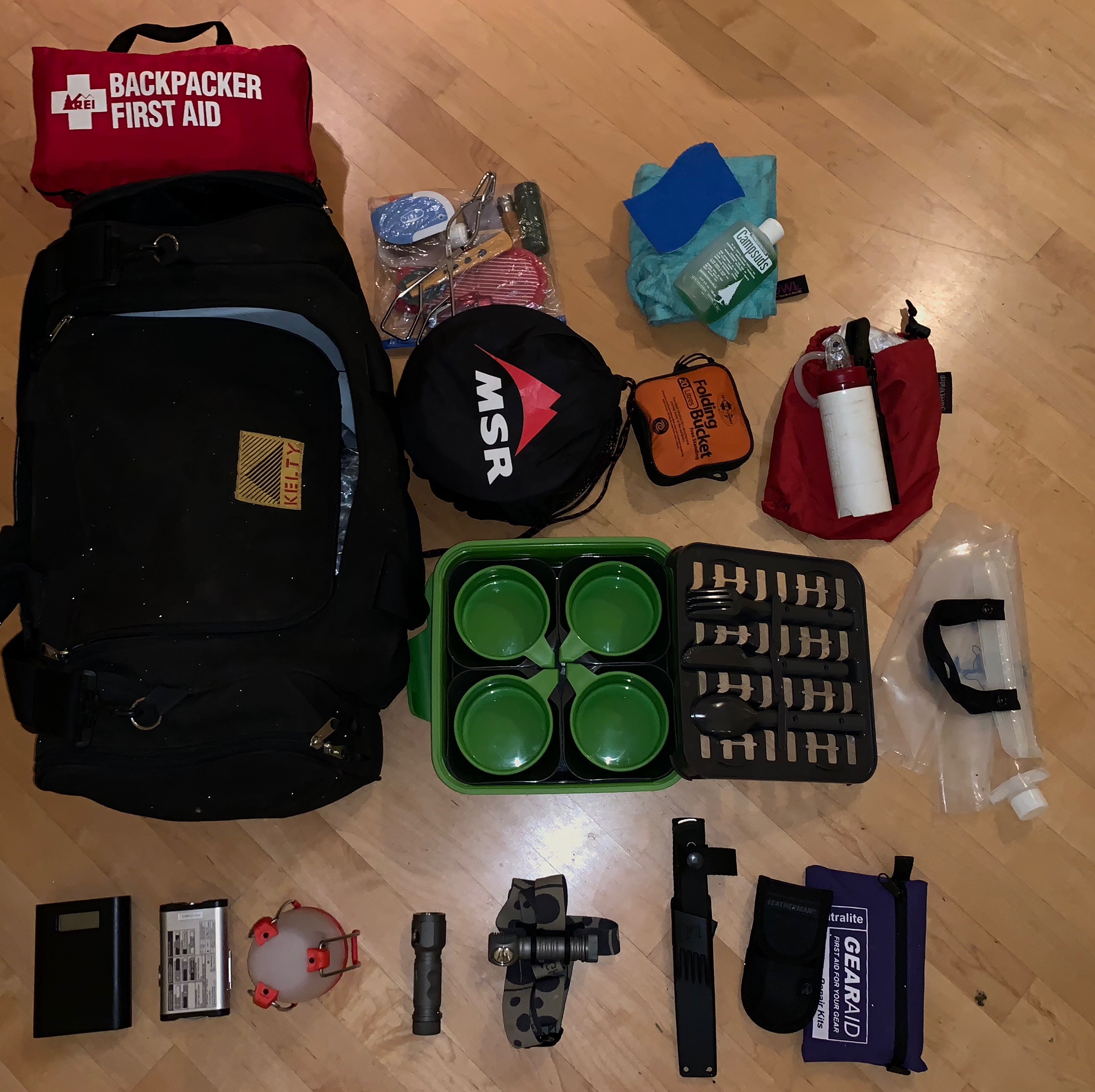
Duffel Bag with three compartments which I use for first aid supplies, my “outdoor kitchen” + water treatment/holding, and finally lighting / repairs. Items held in the duffel listed below:
Misc utensils for kitchen: matches/lighter, mixing spoon, strainer, can opener, pot holder, etc
Packtowel, Scrubbing spong, Campsuds
MSR Duralite Cookset. Inside also my cookset for group backpacking trips: 1.3L Evernew Ti Pop, Snowpeak GigiPower Stove, Fuel Canister, Silicon Bowl/Cup, and MSR folding Foon.
Foldable Water Bucket, Water Filter, Playtus Water Containers
REI Dinnerware Set for 4 including wash basin, drying rack, and cutting board
Plastic Dish tub (not shown)
Trashbags, Foil (not shown)
18650 Batteries in Charger which doubles as USB power supply. AA Batteries in a Charger which doubles as a USB power supply
Zebralight SC600 Flashlight, and H600 Headlamp which use 18650 batteries. There are several other flashlights and headlights I recommend.
Black Diamond Apollo Lantern which is a perfect size and amount of light for car camping or emergency lighting in a house in the case of a power outage. Built in rechargeable battery with the ability to use three AA batteries if the internal battery has been fully discharged and you need light.
Fallkniven F1 fixed blade knife and a Leatherman. There are numerous other good knives I would recommend.
Gear “Repair Kit” with zippers, glue, grommets, rope, safety pins, etc.
Insulated Wine Tote (not shown) which is a good size for a bottle of wine, some snacks, and a couple of glasses for two person picnics in the park.
KitchenAid Immersion Blender for many mixing, blending, and whisking tasks. There are better models on the market, but this one is good enough for my needs.
Last night I had a spirited discussion with some friends about US politics. One of our friends was expressing a concern that historically the US has been too “nice”, hopeful, helpful. We have created a culture people want to enjoy, but now we will be taken advantage of and ultimately destroyed. We need to be tougher and not be pushed around. I am not sure I would characterize the US as being “too nice”, but I contest that being collaborative is a liability.
My counter argument is that people are made to collaborate, and maximum value comes when people work together rather than engaging in a winner take all competition. It’s possible for a nation to be collaborative but still thrive even when facing bad actors.
Brief Update (2021): I recently finished Adam Grant’s book Give and Take which I think is excellent. He argues that often we are not in a zero sum game. and that cooperation can often “increase the size of the pie”. He has a nice section where he describes how effective givers can minimize the impact of people who attempt to take advantages of their cooperative nature.
The theoretical underpinnings of this viewpoint comes from game theory which is extensively discussed in the book The Evolution of Cooperation by Robert Axelrod. For people who aren’t into books, Leon Seltzer’s article The prisoner’s dilemma and the “virtues” of tit for tat provides a good summary. My super short summary: in a world ruled by selfishness with no central authority or rule, enlightened self interest can lead to effective cooperation in any situation where the participants believe that they will need to interact with each other in the future. In situations where there will be multiple interactions Tit for Tat ends up having the best long term payout. The algorithm is simple. Start by cooperating, and then mirror back the behavior of your competitor. That means “discipline” bad actors, but also “forgive” them if they are willing to cooperating. [A slight variation has a small random probability of cooperating even if the competitor has defected which can break retaliation cycles which out performance pure tit for tat.] Axelrod found that when facing numerous other algorithms, some of which were designed to take advantage of “cooperative” partners, that tit for tat consistent had the best over all returns when playing in multiple round competitions.
I believe that silicon valley culture is a great example of how this works. In the mid of the 20th century, there were several places that arguably were better positioned than silicon valley to dominate the technology landscape. For example, the Boston area had more capital and a larger educated workforce. Unfortunately for Boston, they also had non-compete employment contracts and people and institutions which were not inclined to collaborate with competitors.
The former dean of Stanford’s School of Engineering Fred Terman was instrumental in shaping the Bay areas technology landscape to be an open system which welcomes people in, encourages collaboration, and allows many people to succeed base on their merits. Terman later tried to help the research triangle in North Carolina and the area around Austin, TX replicate the successes in Silicon Valley. These effects fell far short of the results in the Silicon Valley. I believe this was primarily due to less willingness to collaborate. A secondary issue was that people were more oriented toward large organizations and struggled to take risks (e.g. less entrepreneurial). Other factors that might have contributed was less access to venture capital and a lower density of talent. I actually think access to capital wasn’t significant, because in the early data of Silicon Valley capital was not established… the east coast had much more.
A great example of this culture can be seen in the early days of semi-conductors. Competitors gathered weekly at the Wagon Wheel to swap stories and brag about their successes. Sharing took away some competitive advantage, but everyone benefited because really hard problems only had to be solved once, and everyone could move on to the next challenge. One of the best stories from those days was went Intel was having a serious issue. They were betting the company on a new chip. The chip looked good in prototype form but when they went to mass production the yield rate was extremely low. They spent several months trying to figure out what was going wrong. They couldn’t figure it out. In desperation they shared their difficulties with others at the Wagon Wheel. Engineers from Fairchild, arguably Intel’s biggest competitor of the day offered to help if Intel would provide the beer. The engineer sat down discuss the issue. In the end the engineer’s from Fairchild laughed and then said “Find out who on the line is using hairspray, and get them to stop”. Intel did as requests and their yield rates became viable. It turns out Fairchild’s engineers had chased almost an identical problem for a year before they finally narrowed it down when their yields became acceptable when one of their workers was away from the line for several days. The hair coverings both teams were using weren’t fine enough to contain the micro particles from the hairspray escaping.
It’s worth noting that the Silicon Valley has become a magnet for ambitious, highly skilled individuals. As a result there is a higher density of people who can be the core of a successful start-up than anywhere else in the world. These days it’s not that Silicon Valley grows the people who make amazing start-ups, but rather it has an environment that makes it easier than most places to build a start-up, with a huge number of people who have moved into the area to build the next great startup.
There is a nice evolution of trust simulation if you want to experiment with different strategies.
Eyeglasses in USA typically expensive due to monopoly. There are mail-order options for around $30 unless you have a complex prescription
I find Titanium frames, especially make by Flexon extremely durable
I am so grateful that I live in an era that can correct many issues related to poor vision!! It’s easy to take glasses for granted, but for thousands of years, people born with poor eyesight had to find ways to muddle through life, never seeing things clearly.
I have worn eyeglasses since I was three years old. I am told the first night I had my glasses I was amazed to discover stars in the night sky. I still love to gaze at stars. In high school I was struggling in several classes until we realized that my prescription needed to be updated. Once I had new glasses, and could see the board more clearly and my grades improved. More recently I started to have increased number of migraines and was having trouble driving at night. I discovered that my glasses had become progressively more clouded. I now have new lens and these issues have improved.
In several countries, it’s possible to purchase eyeglasses for less than US$10, but if you go to a typical optometry clinic in the USA you will likely be quote several hundred dollars for something basic, and more than a thousand if you do high quality frames and want high quality lens which are complex (e.g. progressives). VSP insurance can drop this cost significant, but is still quite expensive.
The reason for these high prices? The company Luxottica has a virtual monopoly on eyeglass frames with more than 80% of the world wide market sold under a wide range of brand names.
There are several companies in the US that have tried to make glasses more affordable. The price leader is Zenni Optical whose cheapest frames are US$6 and a full package with basic lens can be less than US$30. A company that has gotten a lot of press is Warby Parker that focuses on stylish / hip glasses at a reasonable price with a good try at home program and return policy. Originally an Internet only company, they now have showrooms in multiple locations.
I still typically use a local optometry clinic. Alpine Optical fit my wife well when other opticians failed. Mountain View Optometry has good customer service and carries frames made by Flexon which are not available through low cost outlets. Flexon makes the only frames that I haven’t broken in a year of wearing. My previous pair of frames were worn daily for 9 years. This year they were retired to be my backups, and I have a new pair of Flexon frames which my wife tells me are much better looking.
There are a number of companies that made frames for specialized activities and sports which provide more protection. For people with moderate prescriptions, there are lots of choices. I have heard good things about Roave. Unfortunately I have a very strong prescription. For prescriptions that are stronger than -6, check out Sports Optical. They were able to make a strong prescription with progressive lens that dropped into Rudy Project Ketyum frames.
Every few years I try Photo-gray and Transitions lens which automatically darken in sunlight. I was disappointed with their performance until I tried Transitions XtrActive Polarized which goes from almost clear and unpolarized to 90% light blocking that is polarized. The only downside is that when in a car they don’t transition much due to UV blockage in the windshield.
I hope that in the future there will be even more effective ways to help vision. There is some promising work with partial cellular reprogramming was able to reverse cellular aging and address age- and injury-induced blindness in mice.
For a year I tried using the service blinkist which provides summary’s of popular non fiction books, with a focus on business and self improvement literature. I thought it would be an effective way to screen books to decide what books I would want to read in full. After a year I decided it wasn’t useful for me.
There are a number of books that I read the blinkist summary and the full text. I found the blinkist summaries moderately helpful. I often found they emphasizing points I didn’t think were particularly important and failed to highlight what I thought were the most important points. I was surprised by this until I thought about my experience with a number of books.
There are several books I have read multiple times. Each time I read these books I had a different experience. Things I once thought were a focus of a chapter now seem more like footnotes, and there are passsage I have no memory of from this first time I read the book, I seem to have completely missed the point the first time through which later seeem to be a major focus of the he book.
This is a reminder that our perspective is shaped by our current life situation and has a huge impact on what we perceive, which in turn effects what we learn. It’s not surprising that the summary of a book written by someone with a wildly different life experience will call out very different and highlights.
Wine is the first order of business. There are more than 400 wineries in the Napa valley, and more than 600 if you include Sonoma county. I have visited only a small number of these wineries.
Many wineries now charge between $25-50 for a tasting flight. Some offer tours, meals, or other attractions on site. Most wineries have club membership with requires receiving shipments every 2-3 months. Members of the wine club typically get access to special events and free tastings.
There are a small number of wineries that offer free tastings or will wave the tasting fee if you purchase 1-2 bottles of wine:
Buehler Vineyards, St Helena hills, Free but tastings requires reservations
Heitz Cellar, St Helena, Fee waved if 2 bottles purchased
Vincent Arroyo, Calistoga, Free tour and tasting for groups less than 4. Reservations required.
The Wine thief in Napa down the street from the Oxbow Market, is a wine shop that does tastings from a number of the smaller, independent operations. Well worth a stop.
Some of my favorites wineries
Hess Collection (Napa, decent wine, small interesting modern art museum)
Cuvaison (my favorite wine)
Sterling Vineyards (Catistoga, tram to great view – wine not so good),
Hall (Saint Helena, some art, very good Cabs)
Castellodi Amorosa (13th century Tuscan Castle, some tasty Italian style wines. La Fantasia is perfect drink for turkey sandwiches the day after thanksgiving, or casual outdoor parties).
Clos Pegase (Catistoga, some interesting art).
Frogs Leap (Rutherford, well done wines, good environmental stewardship)
Korbel Champagne (Russian River, nice flower garden)
Buena Vista (Sonoma Valley, nice picnic area)
Toulouse (Anderson Valley, Pinot Noir excellent, Gewurtraminer is nice)
Fogline (Santa Rosa, My favorite Zinfandel)
Food
There are a large number of excellent restaurants. Many of these restaurants participate in “Restaurant Week” at the end of January where meals are provided at a discount rate. The Oxbow market is a high end food court, mike the ferry building in SF, North Market in Columbus, etc. Several interesting restaurants and food stores but nothing amazing.
Activities
Check of napa valley events for seasonal events and activities. There are a number of popular activities in the area: bicycling, hot air balloon rides, mud baths in Catistoga, etc.
Yosemite is arguably one of the most beautiful places on earth. I have been then tens of times, and never tire of visiting the park. While the Valley floor can be crowded, it’s still worth visiting. For a first time visitor to Yosemite I would recommend staying in the valley if possible. Lodging options range from camping, to tent cabins in Curry Village, to a couple of very nice National Park Lodges. I would recommend spending at least four days in Yosemite. If you like backpacking, I have a collection of links about Yosemite on my Camping / backpacking Destinations page. Yosemite Valley is around 4 hour drive for the Bay Area. A possible schedule might looks something like:
Day 1: Circle the Valley – would recommend a combination of using the free shuttle and walking… or consider using a bicycle you have brought or rent by Curry Village. It is possible to drive around the Valley, but this is discouraged by park officials.
Day 2: Drive toward Wawona. Make sure to stop at the look out just before the tunnel. Continue on to Mariposa Grove and see the huge redwood. There are a number of nice day hikes around the south west corner of the park. Stop at Glacier Point to see the sun go down and hear one of the ranger talks.
Day 3: Take a hike. People who want to push themselves hike Half Dome.. but there are lots of other wonderful hikes.
Day 4: Head up to Tuolumne Meadows. See the high alpine landscape. Take a hike.
If you have the time, cross Tioga pass and head down to check out Mono lake and the area around Devil’s Postpile. On the way to Devil’s Postpile you will past through the nice community of Mammoth Lakes. The food at the Convict Lake Lodge is quite tasty.